EXERCISE 15.9 (15–20 minutes)
May 2 Cash ……………………………………………………….. 192,000
Share Capital—Ordinary
(12,000 X £10) …………………………..…….. 120,000
Share Premium—Ordinary
(12,000 X £6) …………………………………… 72,000
EXERCISE 15.10 (20–25 minutes)
(a) (1) The par value is HK$2.50. This amount is obtained from either of
the following: 2020—HK$545 ÷ 218 or 2019—HK$540 ÷ 216.
(2) The cost of treasury shares was higher in 2020. The cost at
(b) Equity (in millions of HK$)
Share capital—ordinary, HK$2.50 par value, 500,000,000
EXERCISE 15.11 (15–20 minutes)
Item
Assets
Liabilities
Equity
Share
Premium
Retained
Earnings
Net
Income
1.
I
NE
I
NE
I
I
2.
NE
NE
NE
NE
NE
NE
3.
NE
I
D
NE
D
NE
4.
NE
NE
NE
NE
NE
NE
5.
NE
D
NE
D
6.
NE
NE
NE
NE
7.
NE
I
D
NE
D
8.
NE
NE
NE
NE
D
NE
EXERCISE 15.12 (10–15 minutes)
(a)
6/1
Retained Earnings …………………………..
6,000,000
Dividends Payable …………………………..
6,000,000
6/14
No entry on date of record.
6/30
Dividends Payable …………………………..
6,000,000
Cash ……………………………………………………….
6,000,000
EXERCISE 15.13 (10–15 minutes)
(a) No entry—simply a memorandum note indicating the number of shares
has increased to 10 million and par value has been reduced from
₺10 to ₺5 per share.
EXERCISE 15.13 (Continued)
(c) Share dividends and splits serve the same function with regard to the
EXERCISE 15.14 (10–12 minutes)
(a)
Retained Earnings (10,000 X €10) …………………………..
100,000
Ordinary Share Dividend Distributable …………………
100,000
Ordinary Share Dividend Distributable …………………….
Share Capital—Ordinary …………………………..
100,000
(b)
Retained Earnings (200,000 X €10) …………………………..
Ordinary Share Dividend Distributable …………………
Ordinary Share Dividend Distributable …………………….
Share Capital—Ordinary …………………………..
EXERCISE 15.15 (10–15 minutes)
(a)
Retained Earnings ………………………………………………….
30,000
Ordinary Share Dividend Distributable …………….
30,000
(60,000 shares X 5% X R$10 = R$30,000)
Share Capital—Ordinary…………………………..
30,000
EXERCISE 15.15 (Continued)
(c)
January 5, 2020
Debt Investments (R$125,000 – R$90,000) ………………..
35,000
Unrealized Holding Gain or
Loss—Income ……………………………………………..
Retained Earnings …………………………..……………………..
Property Dividends Payable …………………………..
Property Dividends Payable…………………………..
Debt Investments ……………………………………………
EXERCISE 15.16 (5–10 minutes)
Total income since incorporation ………………………..
W287,000
Less: Total cash dividends paid …………………………
W60,000
Total value of share dividends …………………..
Current balance of retained earnings …………………..
EXERCISE 15.17 (20–25 minutes)
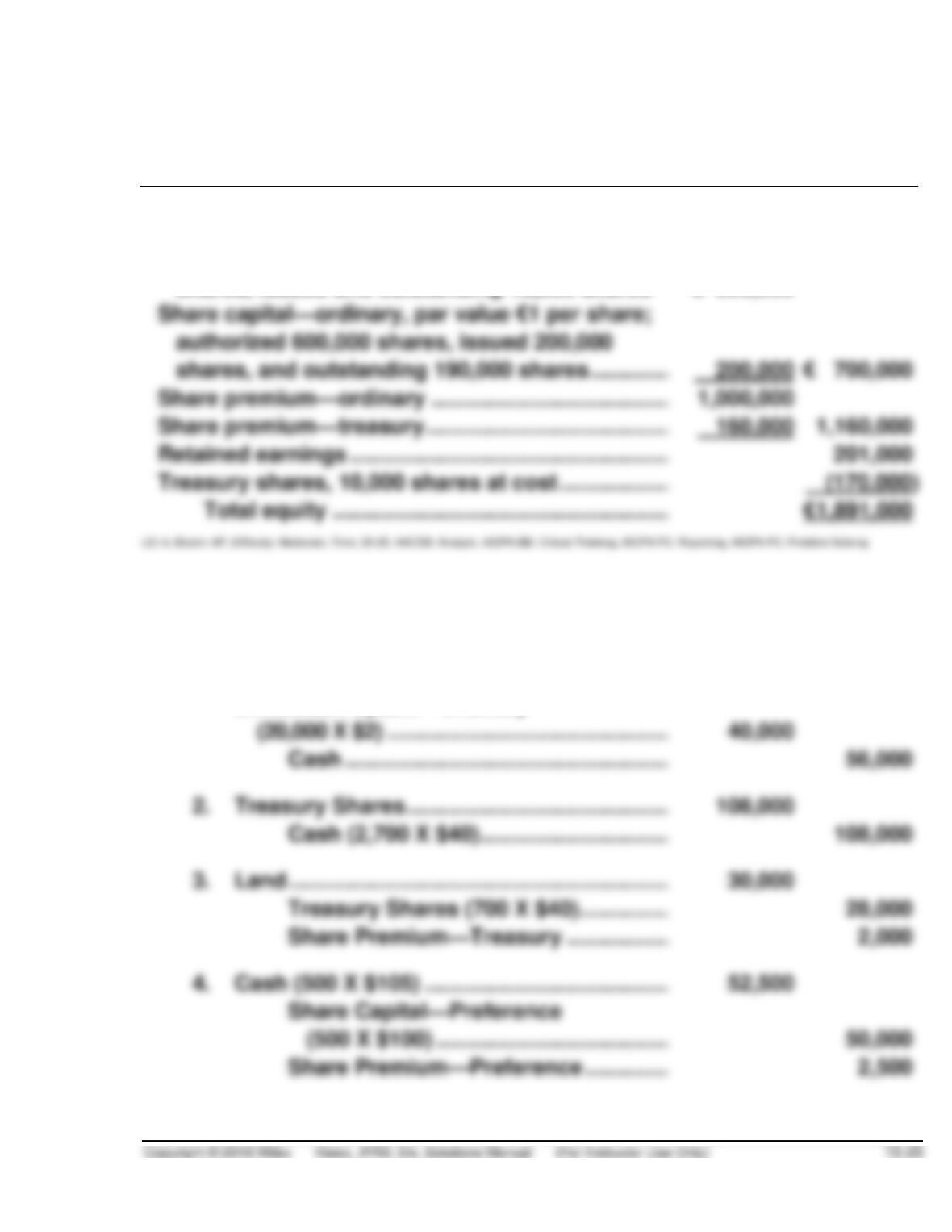
TELLER SE
Partial Statement of Financial Position
December 31, 2019
Equity
Share capital—preference, €4 cumulative,
par value €50 per share; authorized 60,000
shares, issued and outstanding 10,000 shares
€ 500,000
Share capital—ordinary, par value €1 per share;
authorized 600,000 shares, issued 200,000
Share premium—ordinary ……………………………………
Share premium—treasury …………………………………….
Retained earnings ……………………………………………….
Treasury shares, 10,000 shares at cost …………………
EXERCISE 15.18 (30–35 minutes)
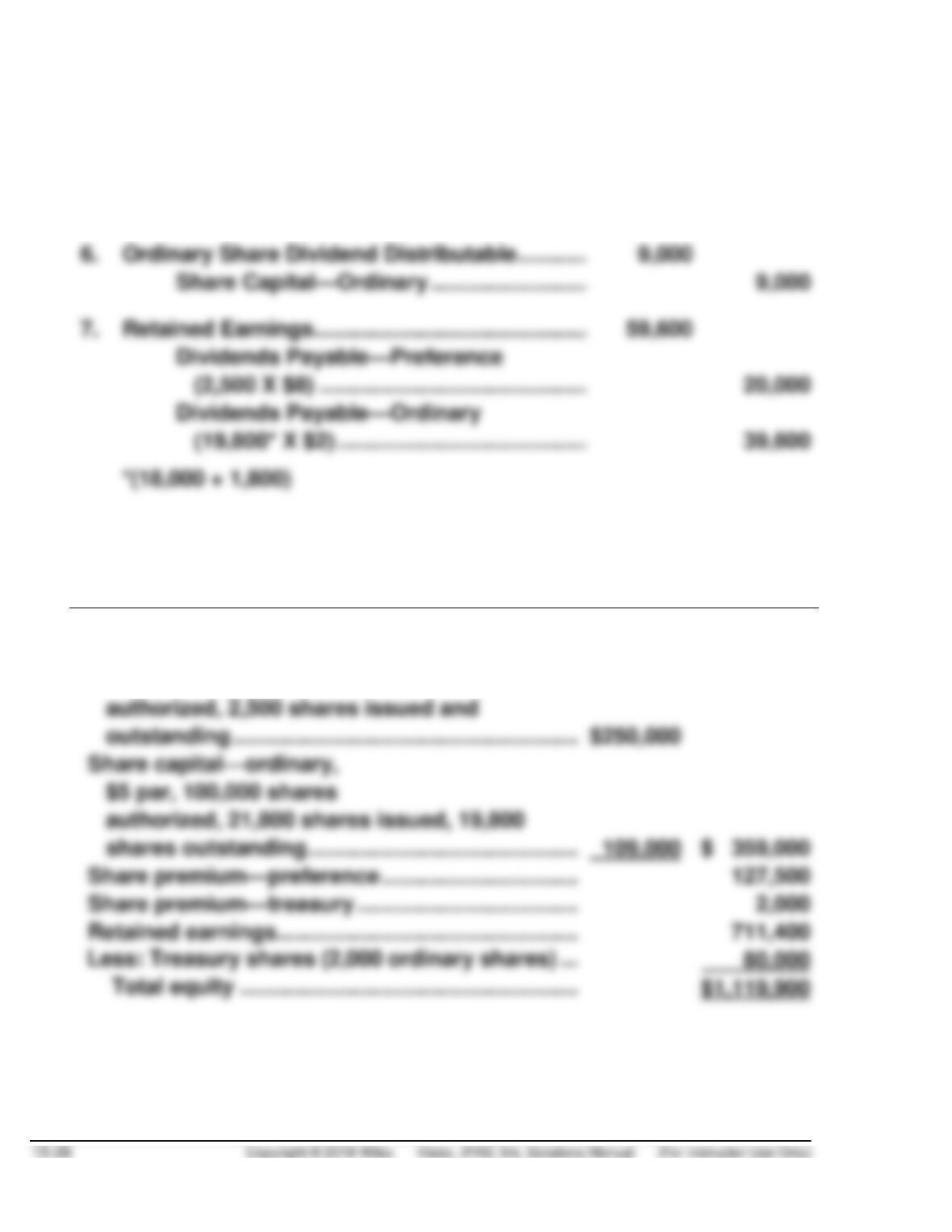
(a)
1.
Dividends Payable—Preference
(2,000 X $8) ……………………………………………………….
16,000
(20,000 X $2) ……………………………………………………….
40,000
30,000
52,500
Share Capital—Preference
Dividends Payable—Ordinary
EXERCISE 15.18 (Continued)
5.
Retained Earnings (1,800* X $5) …………………………..
9,000
Ordinary Share Dividend Distributable
(1,800 X $5) ………………………………………………….
9,000
*(20,000 – 2,700 + 700 = 18,000; 18,000 X 10%)
Ordinary Share Dividend Distributable……………………..
Share Capital—Ordinary …………………………..
9,000
Retained Earnings …………………………………………………..
Dividends Payable—Preference
(2,500 X $8) ………………………………………………….
Dividends Payable—Ordinary
(19,800* X $2) ……………………………………………….
*(18,000 + 1,800)
(b)
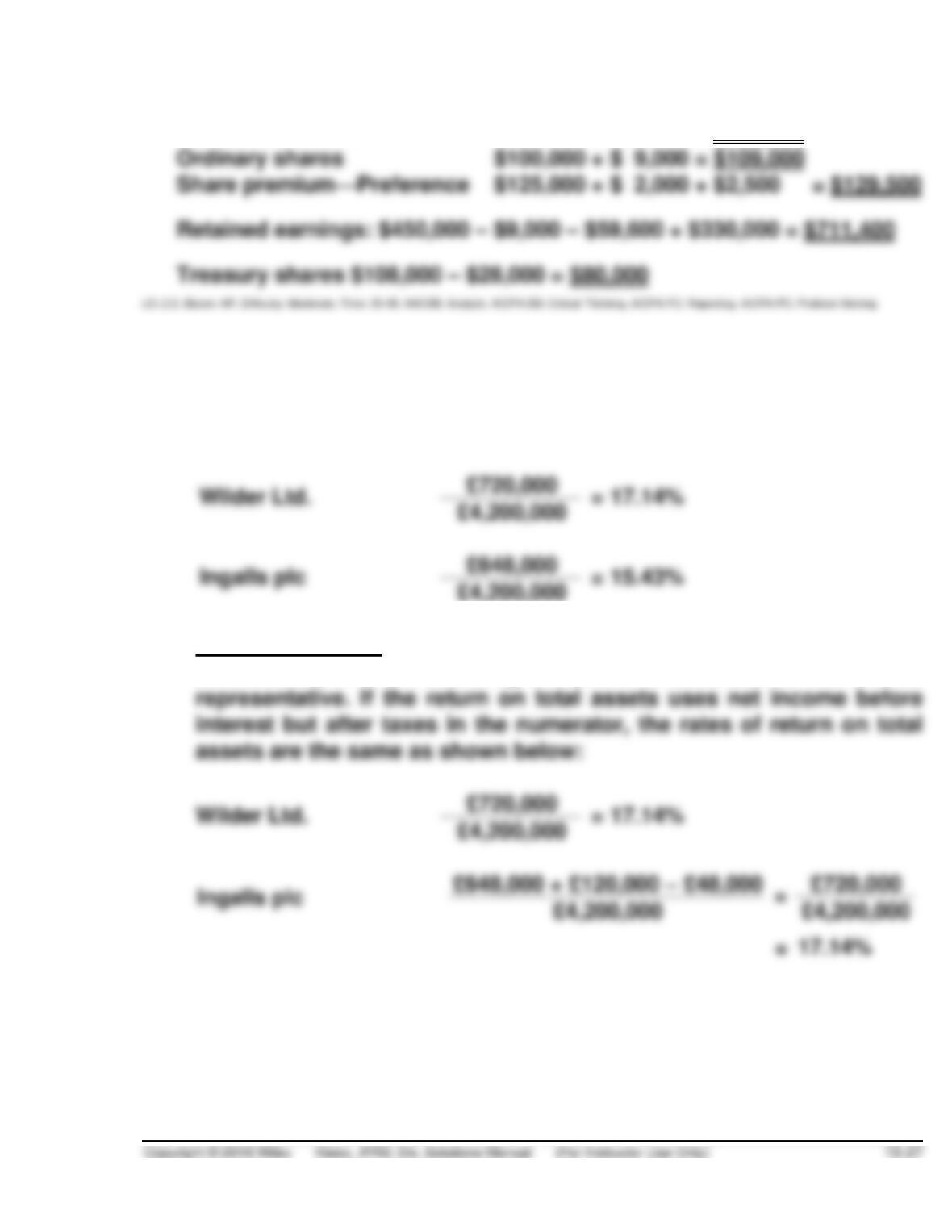
ELIZABETH COMPANY
Partial Statement of Financial Position
December 31, 2020
Equity
Share capital—preference,
8%, $100 par, 10,000 shares
authorized, 2,500 shares issued and
outstanding ………………………………………………….
$5 par, 100,000 shares
authorized, 21,800 shares issued, 19,800
shares outstanding ……………………………………….
Share premium—preference …………………………..
Share premium—treasury ………………………………..
Retained earnings ……………………………………………
EXERCISE 15.18 (Continued)
Computations:
Preference shares $200,000 + $50,000 = $250,000
EXERCISE 15.19 (20–25 minutes)
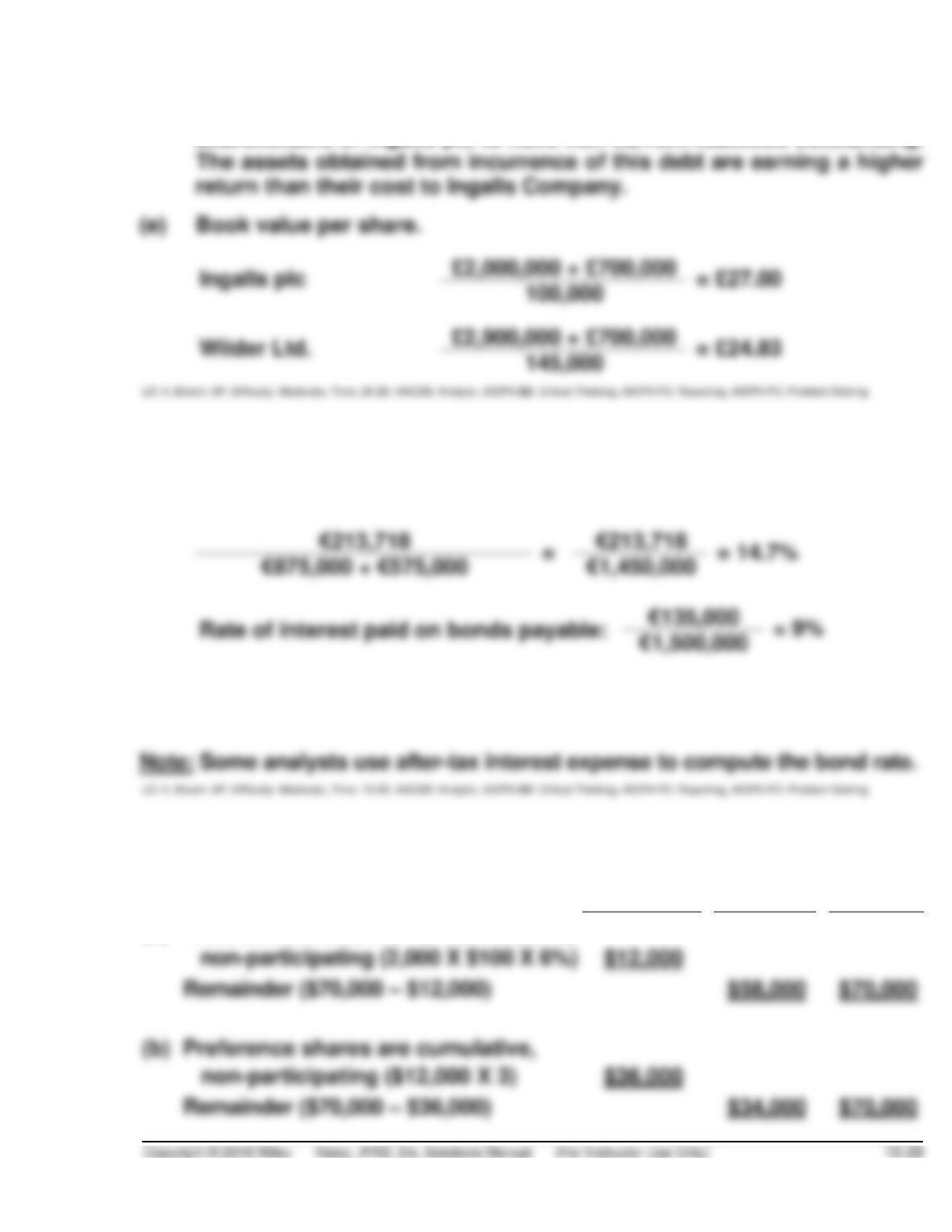
(a) Wilder Ltd. is the more profitable in terms of return on total assets.
This may be shown as follows:
Note to Instructor: These returns are based on net income related to
total assets, where the ending amount of total assets is considered
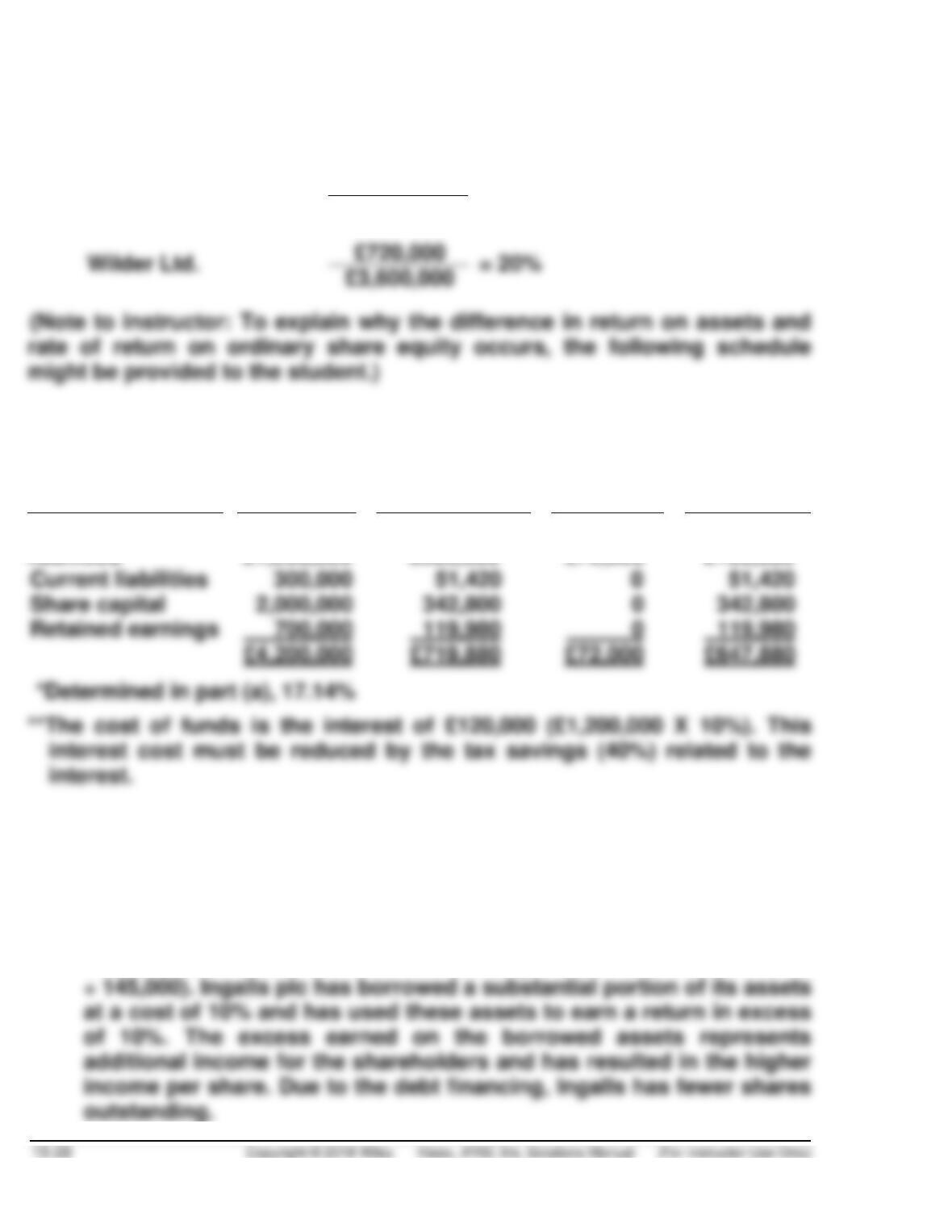
EXERCISE 15.19 (Continued)
(b) Ingalls plc is the more profitable in terms of return on ordinary share
equity. This may be shown as follows:
Ingalls plc
£648,000
= 24%
£2,700,000
£720,000
Ingalls plc
Funds Supplied
Funds
Supplied
Rate of Return
on Funds at
17.14%*
Cost of
Funds
Accruing to
Ordinary
Shares
Non-current
liabilities
£1,200,000
£205,680
£72,000*
£133,680
The schedule indicates that the income earned on the total assets
(before interest cost) was £719,880. The interest cost (net of tax) of
this income was £72,000, which indicates a net return to the ordinary
share equity of £647,880.
(c) The Ingalls plc earned a net income per share of £6.48 (£648,000 ÷
100,000) while Wilder Ltd. had an income per share of £4.97 (£720,000
EXERCISE 15.19 (Continued)
(d) Yes, from the point of view of net income it is advantageous for the
shareholders of Ingalls plc to have non-current liabilities outstanding.
EXERCISE 15.20 (15-20 minutes)
(a) Rate of return on ordinary share equity:
(b) DeVries Plastics is trading on the equity successfully, since its return
on ordinary share equity is greater than interest paid on bonds.
*EXERCISE 15.21 (10–15 minutes)
Preference
Ordinary
Total
(a)
Preference shares are non-cumulative,
(b)
Preference shares are cumulative,
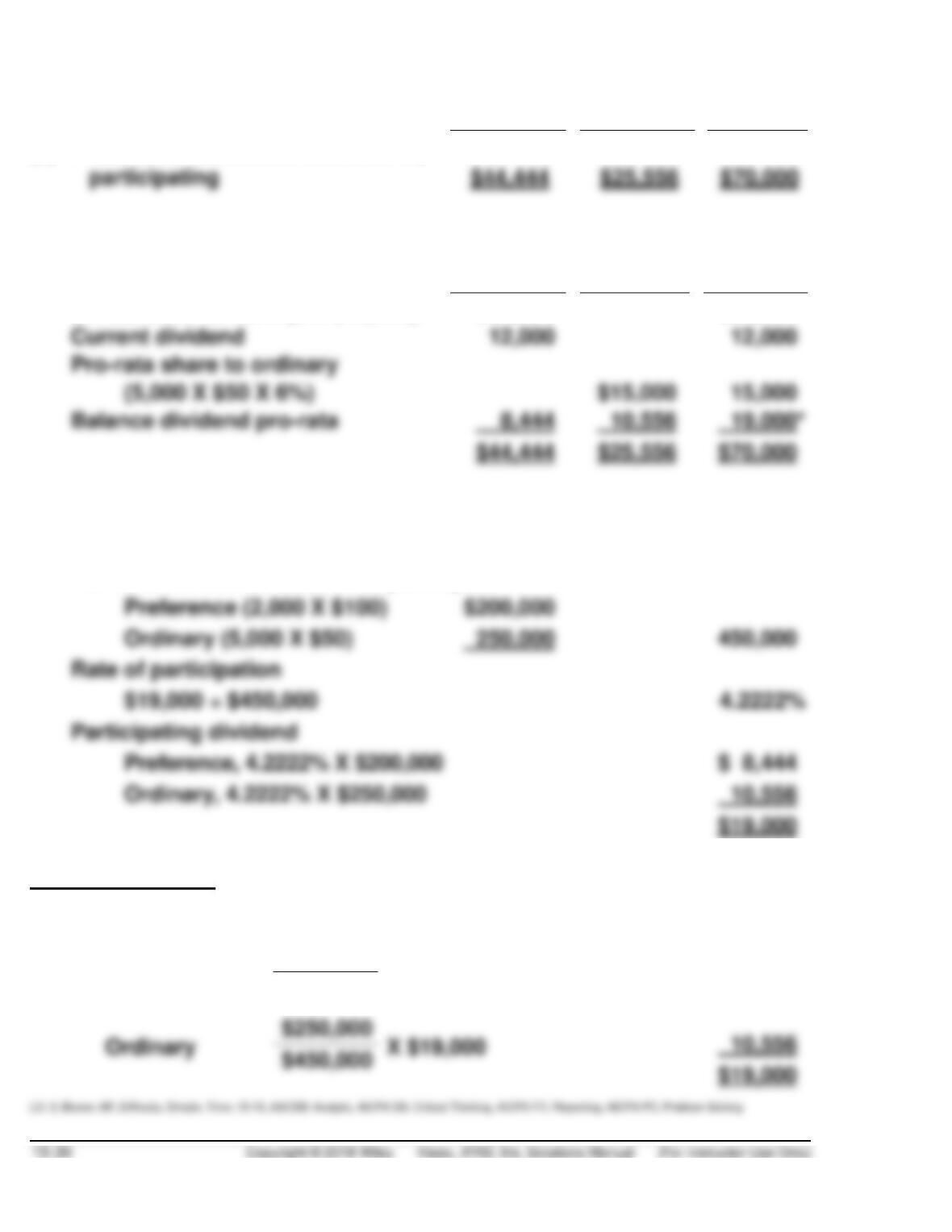
*EXERCISE 15.21 (Continued)
Preference
Ordinary
Total
(c)
Preference shares are cumulative,
participating
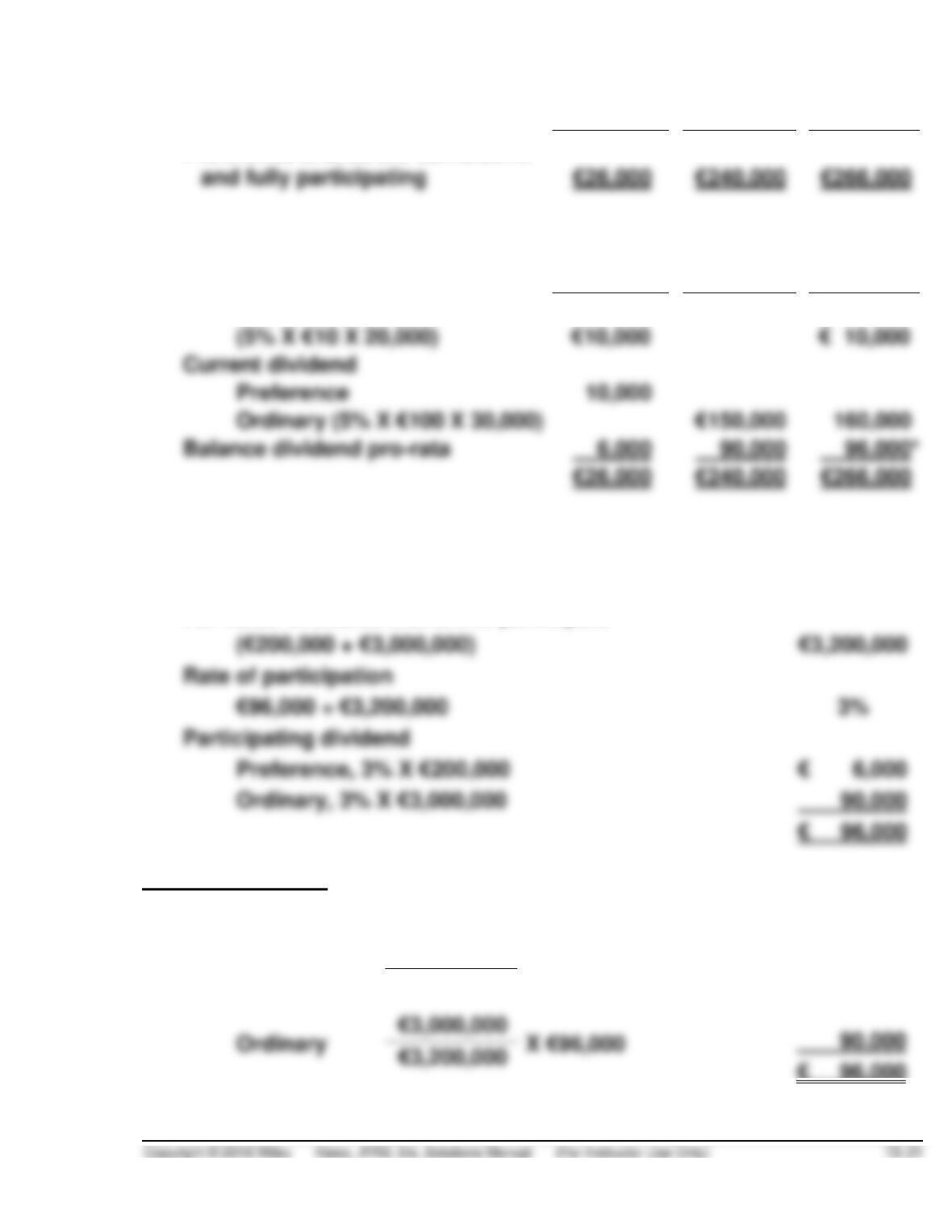
The computation for these amounts is as follows:
Preference
Ordinary
Total
Dividends in arrears (2 X $12,000)
$24,000
$24,000
Current dividend
Pro-rata share to ordinary
(5,000 X $50 X 6%)
Balance dividend pro-rata
*Additional amount available for participation
($70,000 – $24,000 – $12,000 – $15,000)
19,000
Par value of shares that are to participate
Preference (2,000 X $100)
Ordinary (5,000 X $50)
Rate of participation
$19,000 ÷ $450,000
Participating dividend
Preference, 4.2222% X $200,000
Ordinary, 4.2222% X $250,000
Note to instructor: Another way to compute the participating amount is as
follows:
Preference
$200,000
X $19,000
$ 8,444
$450,000
$250,000
*EXERCISE 15.22 (15–20 minutes)
(a)
Preference
Ordinary
Total
Preference shares are cumulative
and fully participating
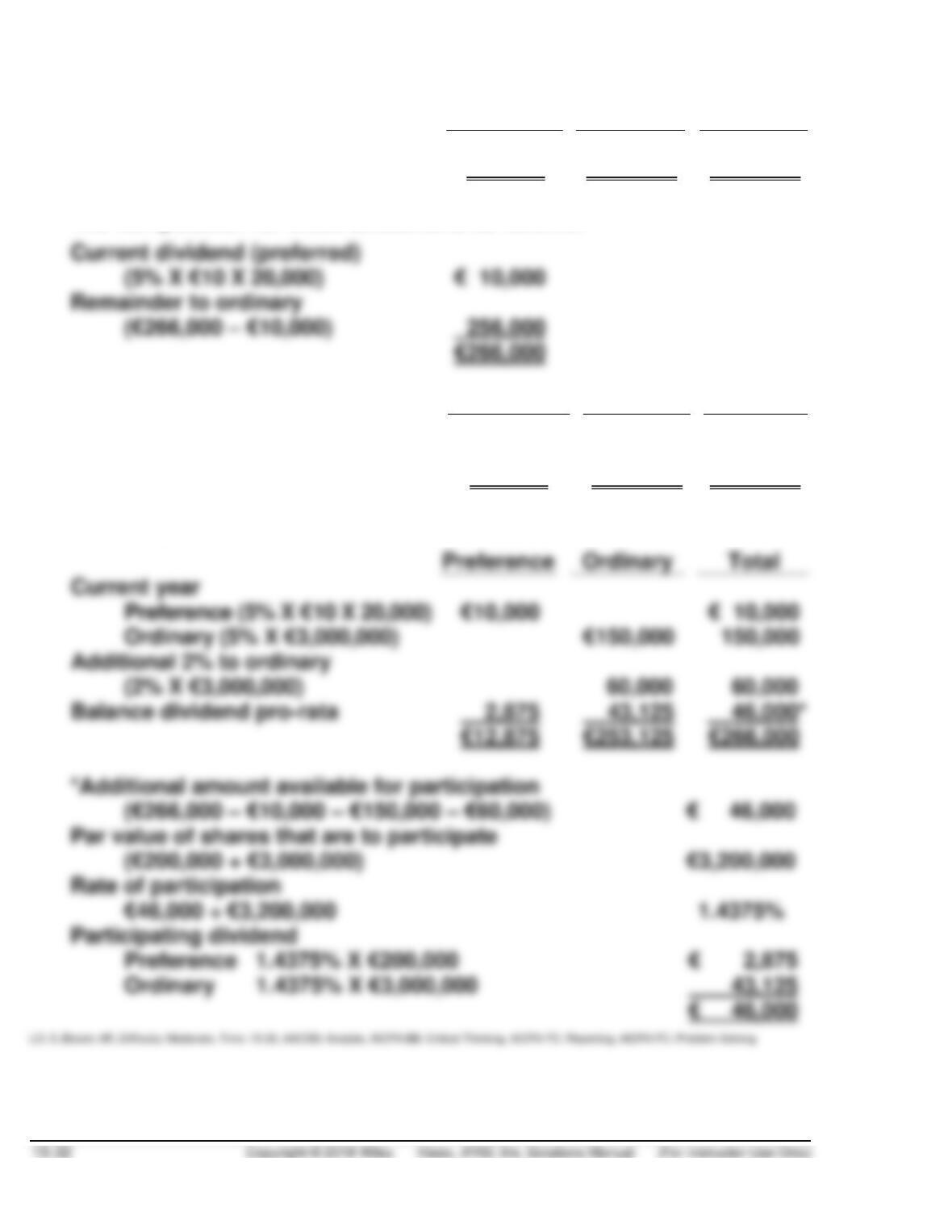
The computation for these amounts is as follows:
Preference
Ordinary
Total
(5% X €10 X 20,000)
Current dividend
Preference
Ordinary (5% X €100 X 30,000)
Balance dividend pro-rata
96,000*
Dividends in arrears
*Additional amount available for participation
(€266,000 – €10,000 – €160,000)
€ 96,000
Par value of shares that are to participate
(€200,000 + €3,000,000)
Rate of participation
Participating dividend
Preference, 3% X €200,000
€ 6,000
Ordinary, 3% X €3,000,000
Note to instructor: Another way to compute the participating amount is as
follows:
Preference
€200,000
X €96,000
€ 6,000
€3,200,000
€ 96,000
*EXERCISE 15.22 (Continued)
(b)
Preference
Ordinary
Total
Preference shares are non-cumulative
and non-participating
€10,000
€256,000
€266,000
The computation for these amounts is as follows:
Current dividend (preferred)
(5% X €10 X 20,000)
Remainder to ordinary
(€266,000 – €10,000)
(c)
Preference
Ordinary
Total
Preference shares are non-cumulative
and participating in distributions
in excess of 7%
€12,875
€253,125
€266,000
The computation for these amounts is as follows:
Preference
Current year
Preference (5% X €10 X 20,000)
€10,000
Ordinary (5% X €3,000,000)
Additional 2% to ordinary
Balance dividend pro-rata
*Additional amount available for participation
(€266,000 – €10,000 – €150,000 – €60,000)
Par value of shares that are to participate
(€200,000 + €3,000,000)
Rate of participation
Participating dividend
Preference 1.4375% X €200,000
Ordinary 1.4375% X €3,000,000
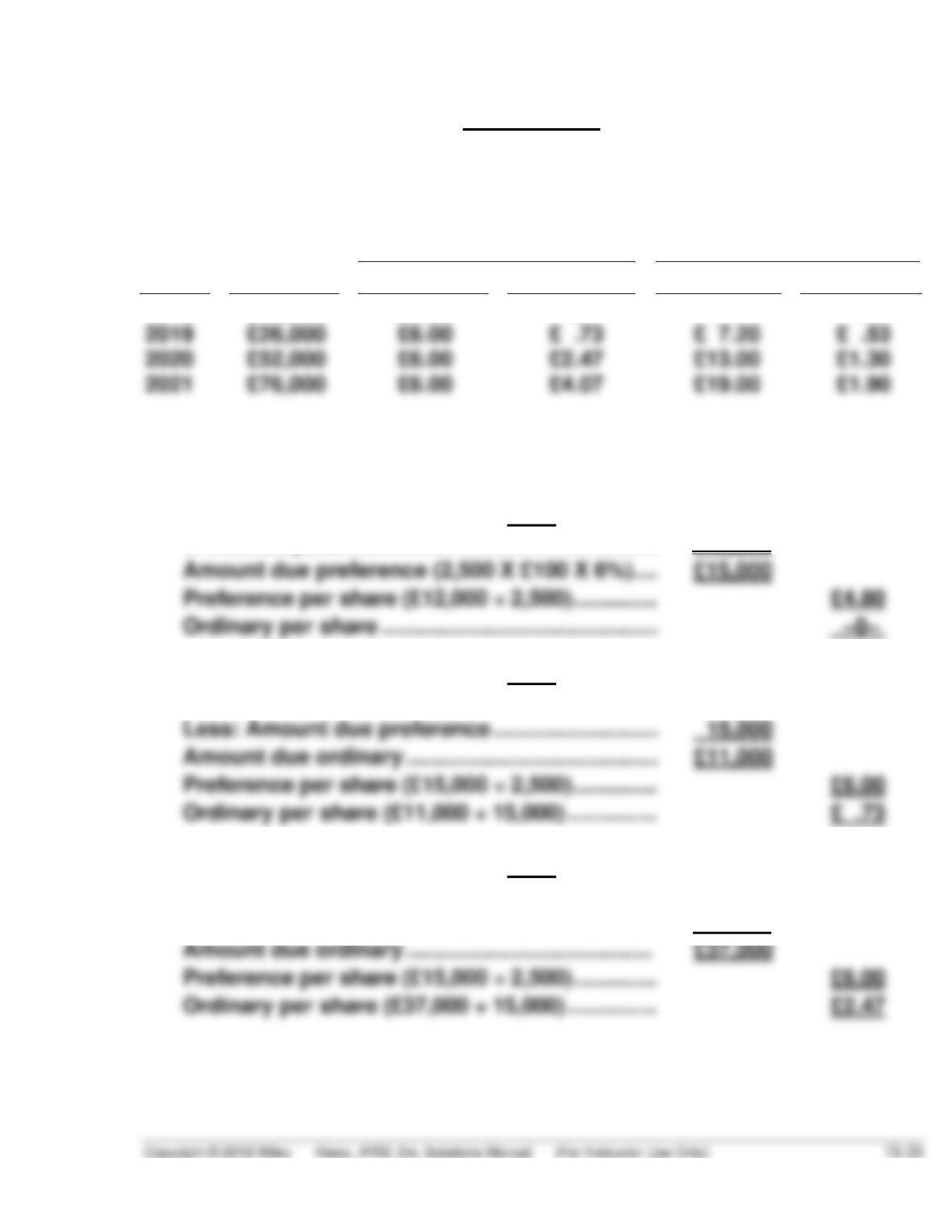
*EXERCISE 15.23 (15–20 minutes)
Assumptions
(a)
(b)
Preference,
non-cumulative, and
non-participating
Preference,
cumulative, and fully
participating
Year
Paid-out
Preference
Ordinary
Preference
Ordinary
2018
£12,000
£4.80
–0–
£ 4.80
–0–
2020
£52,000
£6.00
The computations for part (a) are as follows:
2018
Dividends paid …………………………………………….
£12,000
Amount due preference (2,500 X £100 X 6%) ….
£15,000
Preference per share (£12,000 ÷ 2,500) …………..
Ordinary per share ………………………………………
2019
Dividends paid …………………………………………….
£26,000
Less: Amount due preference ………………………
15,000
Amount due ordinary …………………………………..
£11,000
Preference per share (£15,000 ÷ 2,500) …………..
Ordinary per share (£11,000 ÷ 15,000) ……………
2020
Dividends paid ……………………………………………
£52,000
Less: Amount due preference ……………………..
15,000
Amount due ordinary ………………………………….
£37,000
Preference per share (£15,000 ÷ 2,500) …………..
Ordinary per share (£37,000 ÷ 15,000) ……………
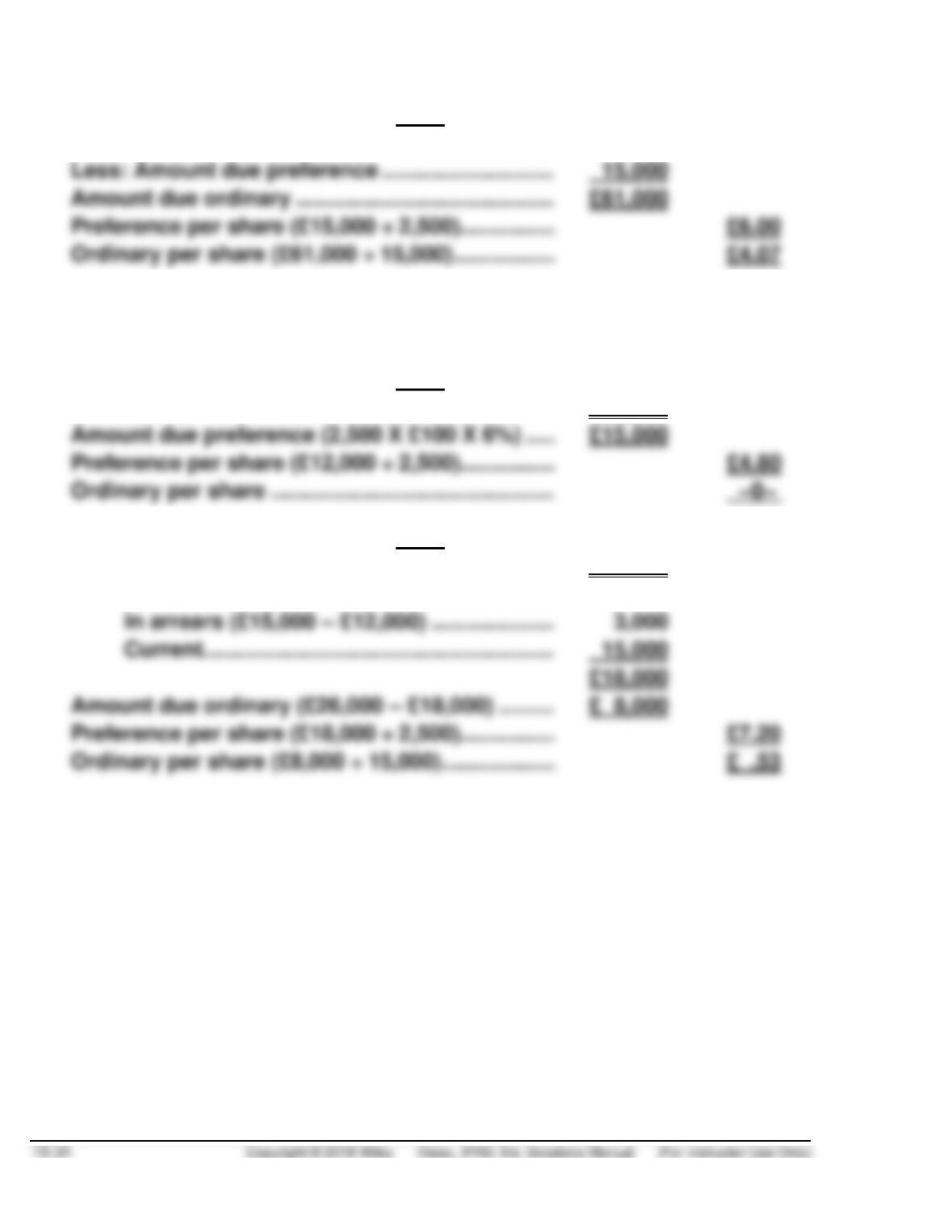
*EXERCISE 15.23 (Continued)
2021
Dividends paid ……………………………………………..
£76,000
Less: Amount due preference ……………………….
Amount due ordinary ……………………………………
£61,000
Preference per share (£15,000 ÷ 2,500)…………….
Ordinary per share (£61,000 ÷ 15,000) ……………..
The computations for part (b) are as follows:
2018
Dividends paid ……………………………………………..
£12,000
Amount due preference (2,500 X £100 X 6%) …..
£15,000
Preference per share (£12,000 ÷ 2,500)…………….
Ordinary per share ……………………………………….
2019
Dividends paid ……………………………………………..
£26,000
Less: Amount due preference
In arrears (£15,000 – £12,000) ………………..
3,000
Current…………………………………………………
£18,000
Amount due ordinary (£26,000 – £18,000) ………
£ 8,000
Preference per share (£18,000 ÷ 2,500)…………….
Ordinary per share (£8,000 ÷ 15,000) ……………….
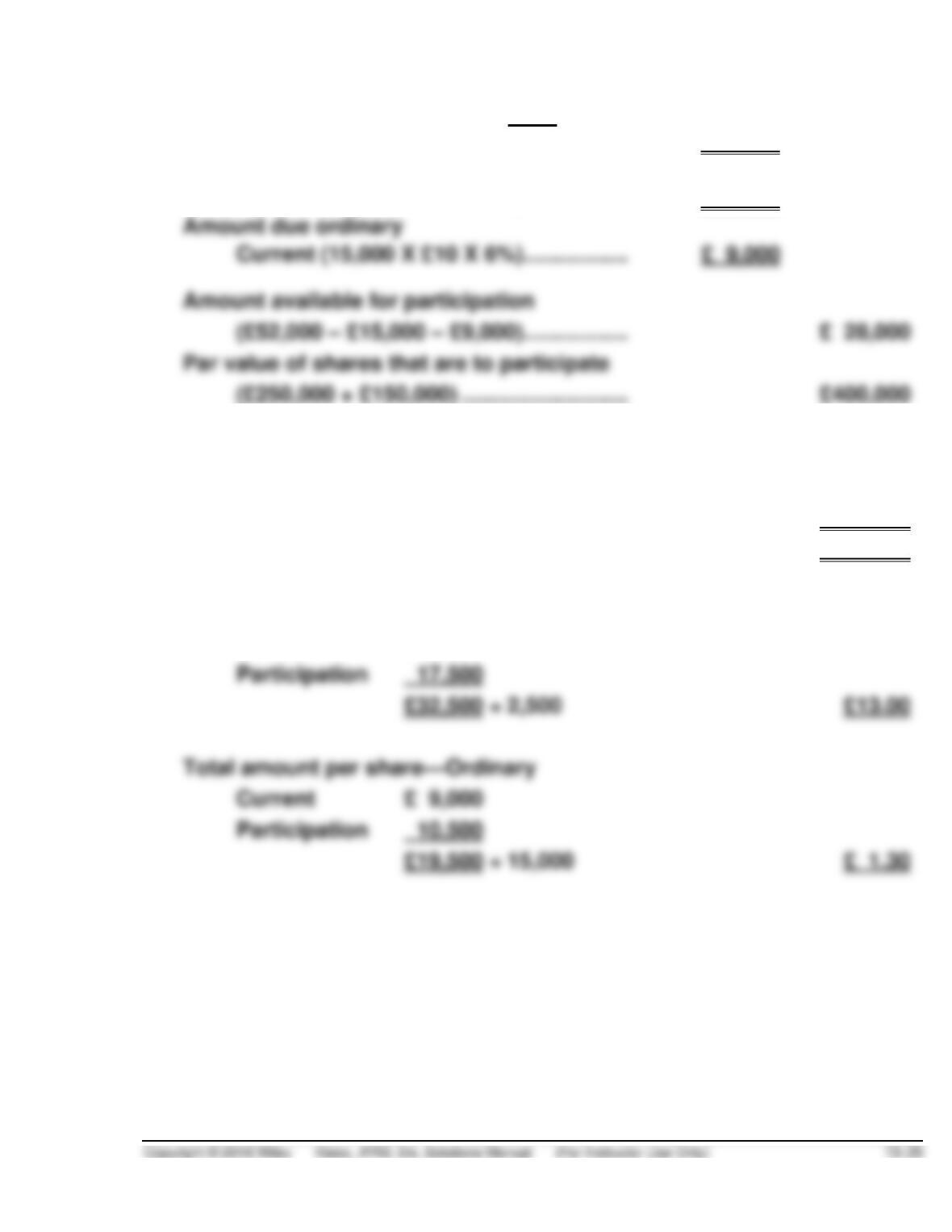
*EXERCISE 15.23 (Continued)
2020
Dividends paid ………………………………………..
£52,000
Amount due preference
Current (2,500 X £100 X 6%)……………..
£15,000
Amount due ordinary
Current (15,000 X £10 X 6%)……………..
£ 9,000
Amount available for participation
(£52,000 – £15,000 – £9,000)……………..
Par value of shares that are to participate
(£250,000 + £150,000) ………………………
Rate of participation
£28,000 ÷ £400,000 …………………………..
7%
Participating dividend
Preference (7% X £250,000) ……………..
£ 17,500
Ordinary (7% X £150,000) …………………
£ 10,500
Total amount per share—Preference
Current £15,000
Participation 17,500
£32,500 ÷ 2,500
Total amount per share—Ordinary
Current £ 9,000
Participation 10,500
£19,500 ÷ 15,000
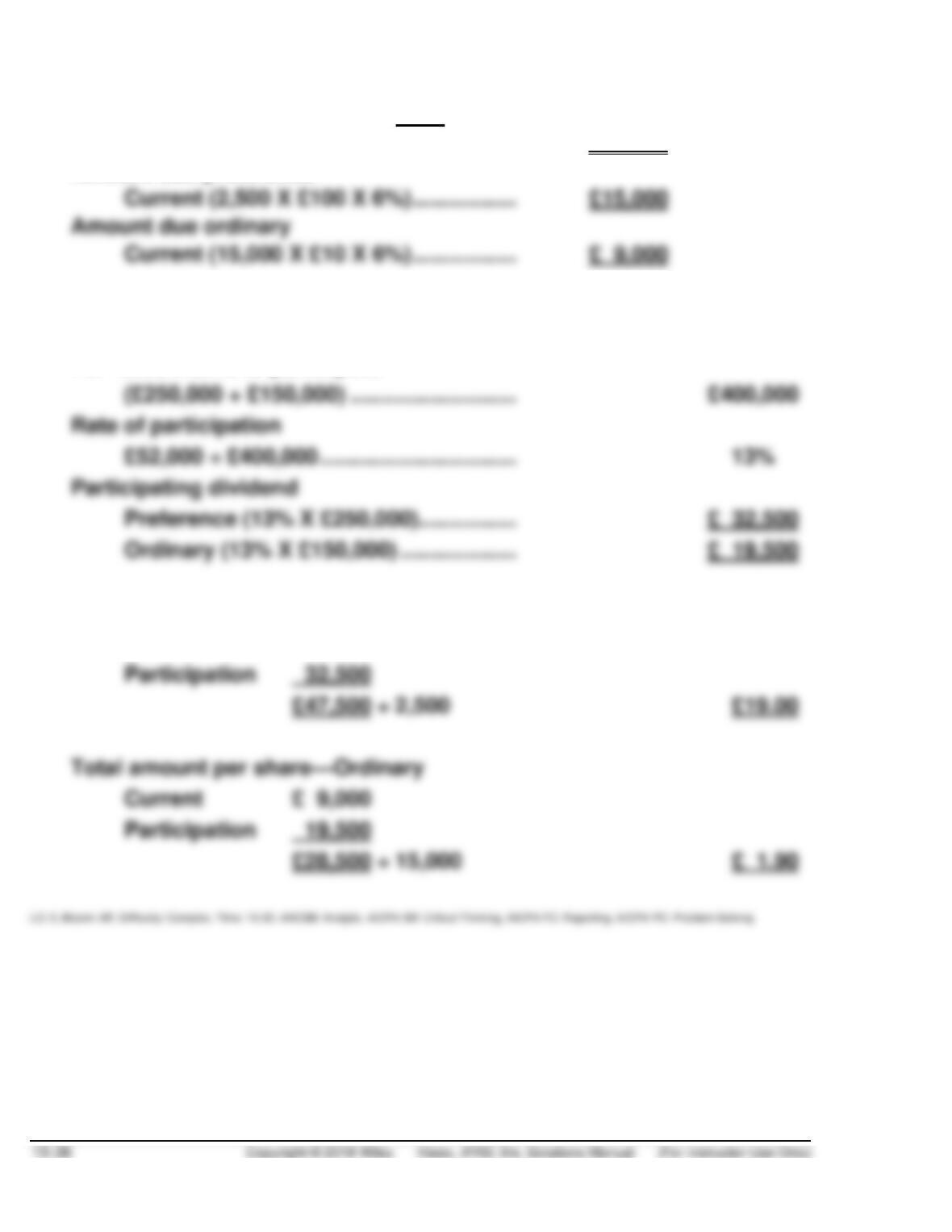
*EXERCISE 15.23 (Continued)
2021
Dividends paid ………………………………………..
£76,000
Amount due preference
Current (2,500 X £100 X 6%) ……………..
£15,000
Amount due ordinary
Current (15,000 X £10 X 6%) ……………..
Amount available for participation
(£76,000 – £15,000 – £9,000) ……………..
£ 52,000
Par value that is to participate
(£250,000 + £150,000) ………………………
£400,000
Rate of participation
£52,000 ÷ £400,000 …………………………..
Participating dividend
Preference (13% X £250,000)…………….
£ 32,500
Ordinary (13% X £150,000) ……………….
Total amount per share—Preference
Current £15,000
Participation 32,500
£47,500 ÷ 2,500
Total amount per share—Ordinary
Current £ 9,000
Participation 19,500
£28,500 ÷ 15,000
*EXERCISE 15.24 (10–20 minutes)
(a)
Preference
Ordinary
Equity
Preference shares …………………………………
$500,000
Ordinary shares …………………………………….
$ 750,000
Retained earnings
Dividends in arrears (3 years at 6%) ……….
Remainder to ordinary* ………………………….
310,000
Shares outstanding …………………………………….
*Balance in retained earnings
($700,000 – $40,000 – $260,000) ………………..
(b)
Ordinary
Preference
Equity
Preference share …………………………………..
$ 500,000
Liquidating premium …………………………..
30,000
Ordinary shares …………………………………………
$ 750,000
Retained earnings
Dividends in arrears (3 years at 6%) ………..
Remainder to ordinary* ……………………………….
280,000
Shares outstanding …………………………………….
*Balance in retained earnings
($700,000 – $40,000 – $260,000) …………………
Less: Liquidating premium to preference …….
Dividends to preference ……………………
Available to ordinary …………………………………..
TIME AND PURPOSE OF PROBLEMS
Problem 15.1 (Time 50–60 minutes)
Purpose—to provide the student with an understanding of the necessary entries to properly account for
Problem 15.2 (Time 25–35 minutes)
Purpose—to provide the student with an opportunity to record the acquisition of treasury shares and its
sale at three different prices. In addition, an equity section of the statement of financial position must be
prepared.
Problem 15.3 (Time 25–30 minutes)
Purpose—to provide the student with an opportunity to record seven different transactions involving
Problem 15.4 (Time 20–30 minutes)
Purpose—to provide the student with an understanding of the necessary entries to properly account for
Problem 15.5 (Time 30–40 minutes)
Purpose—to provide the student with an understanding of the proper entries to reflect the reacquisition,
Problem 15.6 (Time 30–40 minutes)
Purpose—to provide the student with an understanding of the necessary entries to properly account for
Problem 15.7 (Time 15–20 minutes)
Purpose—to provide the student with an understanding of the proper accounting for the declaration and
Problem 15.8 (Time 20–25 minutes)
Purpose—to provide the student with an understanding of the accounting effects related to share
Problem 15.9 (Time 20–25 minutes)
Purpose—to provide the student with an understanding of the effect which a series of transactions
Time and Purpose of Problems (Continued)
Problem 15.10 (Time 35–45 minutes)
Problem 15.11 (Time 25–35 minutes)
Purpose—to provide the student with an understanding of the proper accounting for the declaration and
Problem 15.12 (Time 35–45 minutes)
Purpose—to provide the student a comprehensive problem involving all facets of the equity section.
SOLUTIONS TO PROBLEMS
PROBLEM 15.1
(a)
January 11
Cash (20,000 X $16) …………………………………………. 320,000
Share Capital—Ordinary (20,000 X $10) ……… 200,000
Share Premium—Ordinary …………………………. 120,000
February 1
July 29
Treasury Shares (1,800 X $17) ………………………….. 30,600
Cash …………………………..……………………………. 30,600