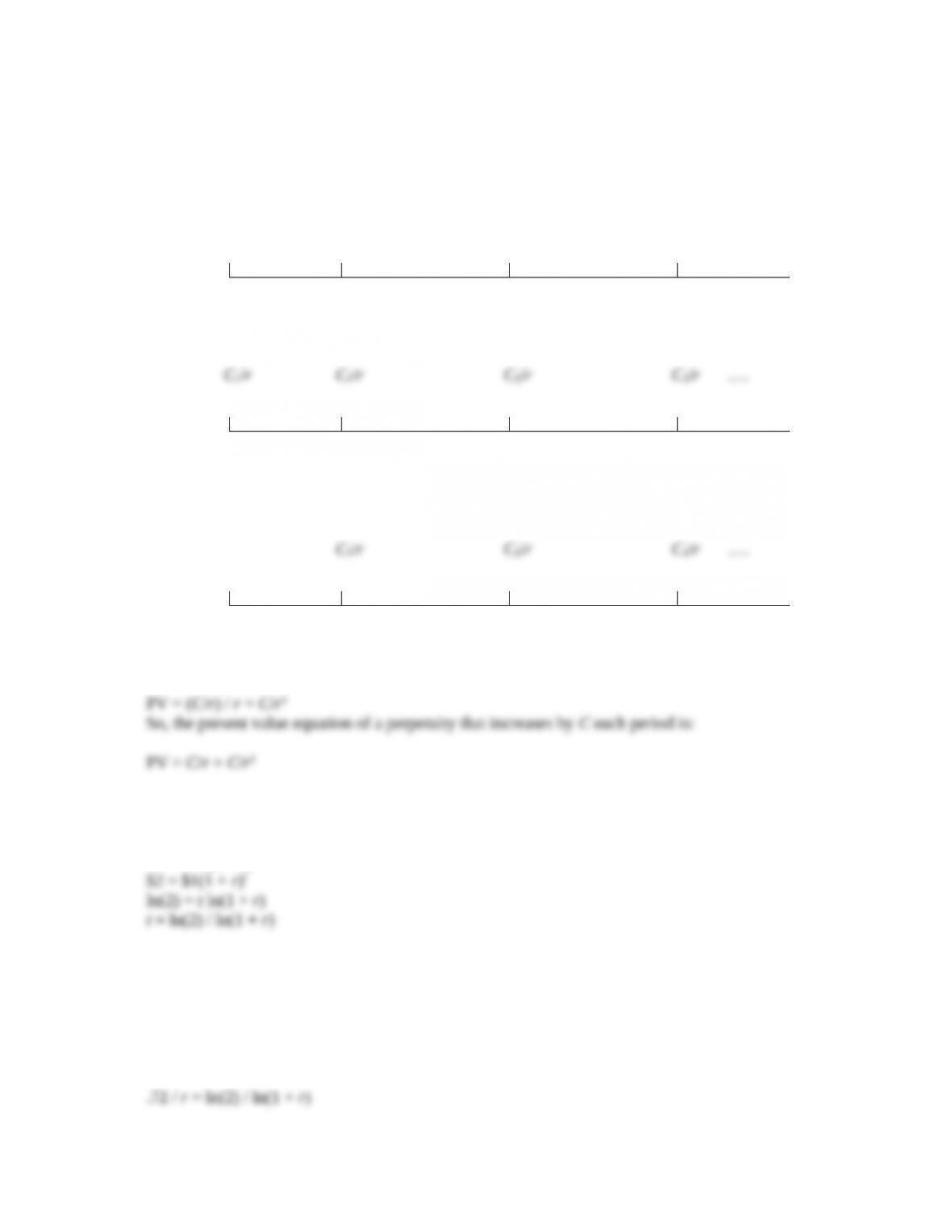
73. To answer this, we can diagram the perpetuity cash flows, which are: (Note, the subscripts are only
to differentiate when the cash flows begin. The cash flows are all the same amount.)
…..
C3
C2C2
C1C1C1
Thus, each of the increased cash flows is a perpetuity in itself. So, we can write the cash flows
stream as:
So, we can write the cash flows as the present value of a perpetuity with a perpetuity payment of:
The present value of this perpetuity is:
74. Since it is only an approximation, we know the Rule of 72 is exact for only one interest rate. Using
the basic future value equation for an amount that doubles in value and solving for t, we find:
FV = PV(1 + r)t
We also know the Rule of 72 approximation is:
t = 72 / r
We can set these two equations equal to each other and solve for r. We also need to remember that
the exact future value equation uses decimals, so the equation becomes:
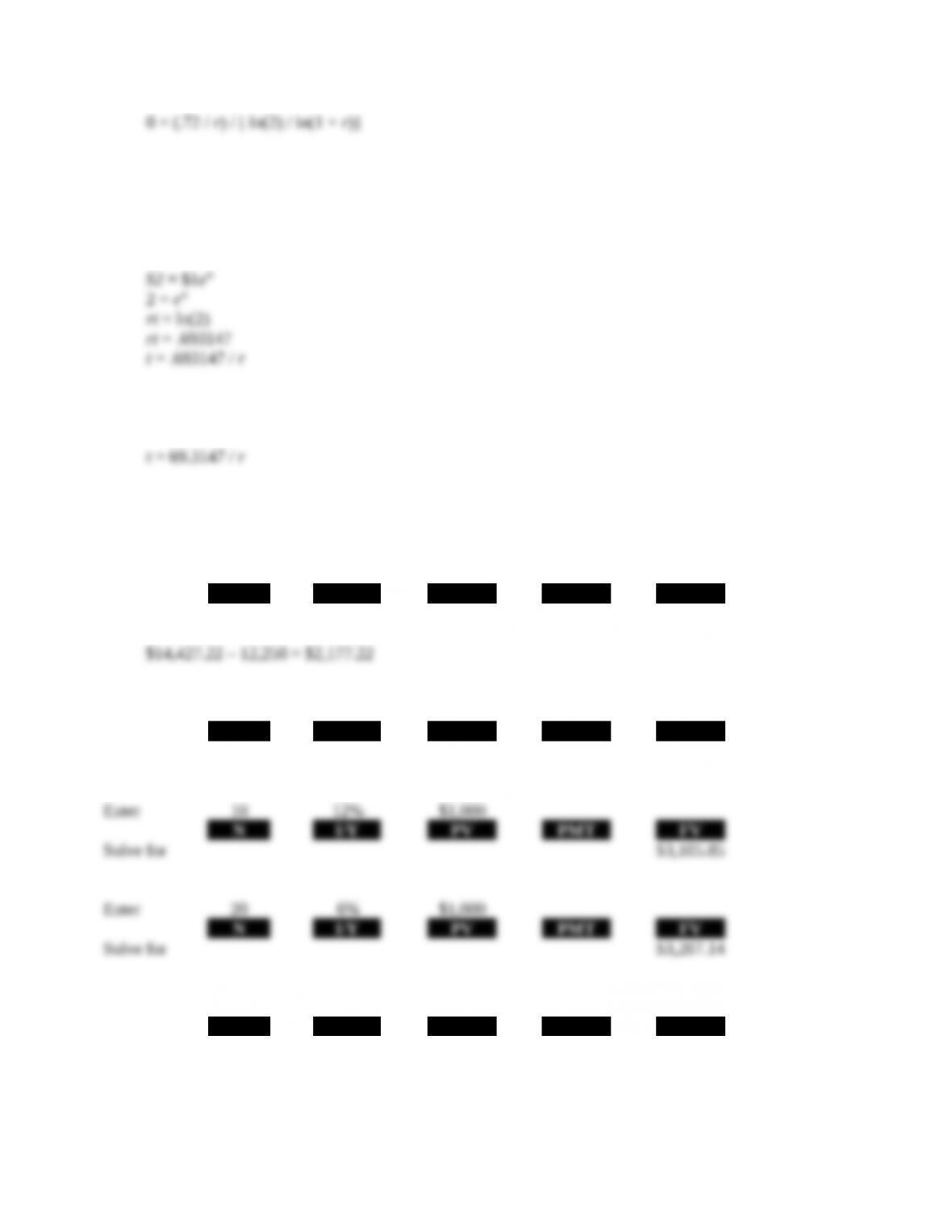
It is not possible to solve this equation directly for r, but using Solver, we find the interest rate for
which the Rule of 72 is exact is 7.846894 percent.
75. We are only concerned with the time it takes money to double, so the dollar amounts are irrelevant.
So, we can write the future value of a lump sum with continuously compounded interest as:
Since we are using percentage interest rates while the equation uses decimal form, to make the
equation correct with percentages, we can multiply by 100:
Calculator Solutions
1.
Enter 10 7.5% $7,000
N I/Y PV PMT FV
Solve for $14,427.22
2.
Enter 10 6% $1,000
N I/Y PV PMT FV
Solve for $1,790.85
3.
Enter 8 7% $13,827
N I/Y PV PMT FV
Solve for $8,047.44
Enter 13 15% $43,852
N I/Y PV PMT FV
4.
Enter 4 $242 $345
N I/Y PV PMT FV
Solve for 9.27%
Enter 8 $410 $927
N I/Y PV PMT FV
5.
Enter 7% $625 $1,284
N I/Y PV PMT FV
Solve for 10.64
N I/Y PV PMT FV
Solve for 25.01
6.
Enter 6.5% $1 $2
N I/Y PV PMT FV
Solve for 11.01
7.
Enter 20 6.4% $550,000,000
N I/Y PV PMT FV
8.
Enter 3 $1,680,000 $1,100,000
N I/Y PV PMT FV
11.
CFo $0 CFo $0 CFo $0
C01 $675 C01 $675 C01 $675
F01 1F01 1F01 1
12.
Enter 9 5% $3,900
N I/Y PV PMT FV
Solve for $27,720.50
Enter 5 5% $6,100
N I/Y PV PMT FV
Solve for $26,409.81
13.
Enter 15 8% $5,650
N I/Y PV PMT FV
Solve for $48,361.05
15.
Enter 6.7% 4
NOM EFF C/Y
Solve for 6.87%
16.
Enter 8.9% 2
NOM EFF C/Y
Solve for 8.71%
17.
Enter 10.3% 12
NOM EFF C/Y
Solve for 10.80%
18. 2nd BGN 2nd SET
Enter 12 $108 $10
N I/Y PV PMT FV
19.
Enter 1.1% $18,450 $500
N I/Y PV PMT FV
20.
Enter 1,733.33% 52
NOM EFF C/Y
21.
Enter 6 7.5% $1,000
N I/Y PV PMT FV
Solve for $1,543.30
23. Stock account:
Enter 360 11% / 12 $750
N I/Y PV PMT FV
Solve for $2,103,389.80
Bond account:
24.
Enter 12 / 3 $1 $4
N I/Y PV PMT FV
25.
Enter 6 $75,000 $125,000
N I/Y PV PMT FV
28.
Enter 23 8% $5,500
N I/Y PV PMT FV
29.
Enter 15 13% $900
N I/Y PV PMT FV
30.
Enter 360 5.2%/12 .80($650,000)
N I/Y PV PMT FV
Solve for $2,855.38
31.
Enter 6 2.40% / 12 $10,800
N I/Y PV PMT FV
35.
Enter 15 10% $4,300
N I/Y PV PMT FV
Solve for $32,706.14
36.
Enter 10% / 12 $240 $35,000
N I/Y PV PMT FV
37.
Enter 60 $96,000 $1,950
N I/Y PV PMT FV
38.
Enter 360 4.5% / 12 $950
N I/Y PV PMT FV
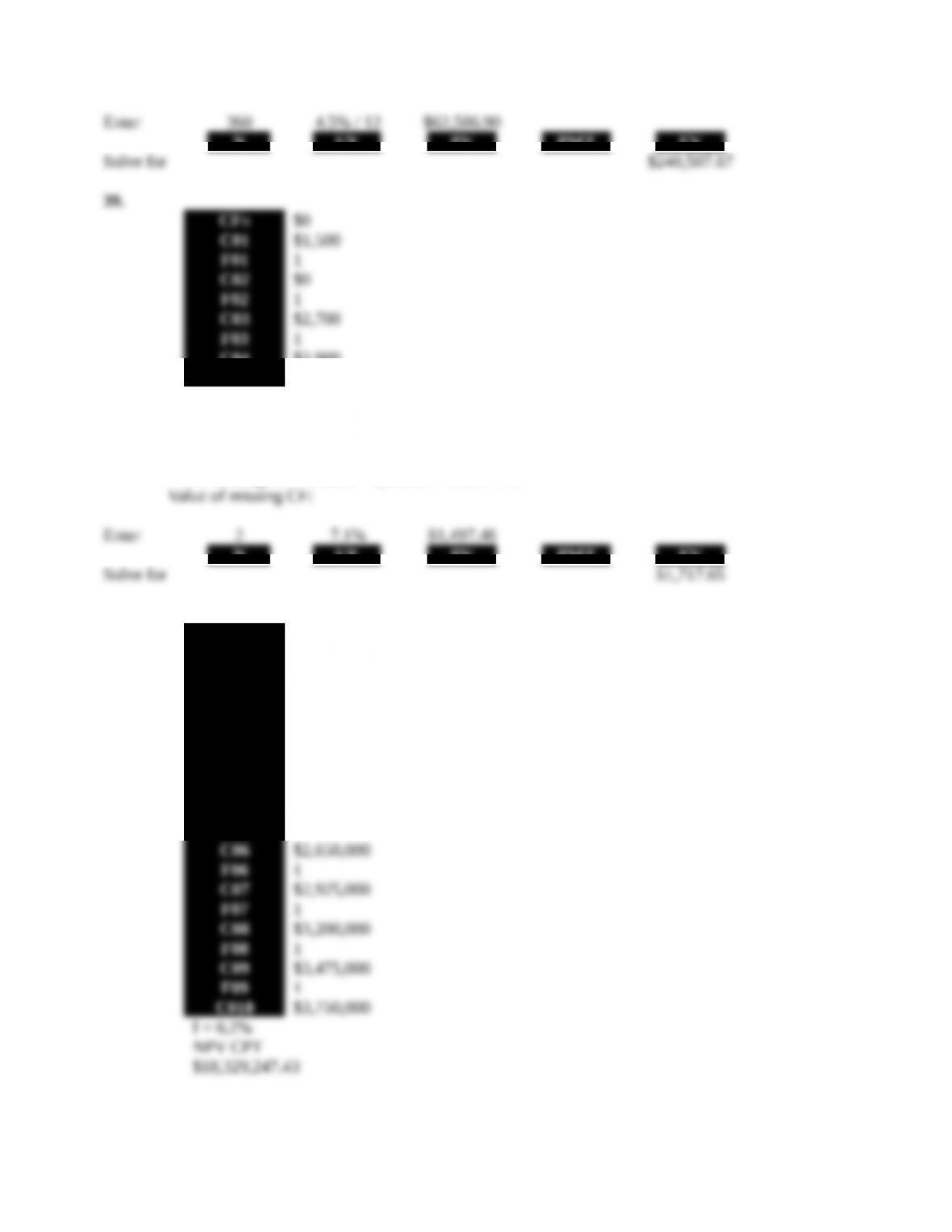
N I/Y PV PMT FV
C04 $2,900
F04 1
I = 7.1%
NPV CPT
$5,802.54
PV of missing CF = $7,300 – 5,802.54 = $1,497.46
N I/Y PV PMT FV
40.
CFo$1,000,000
C01 $1,275,000
F01 1
C02 $1,550,000
F02 1
C03 $1,825,000
F03 1
C04 $2,100,000
F04 1
C05 $2,375,000
F05 1
41.
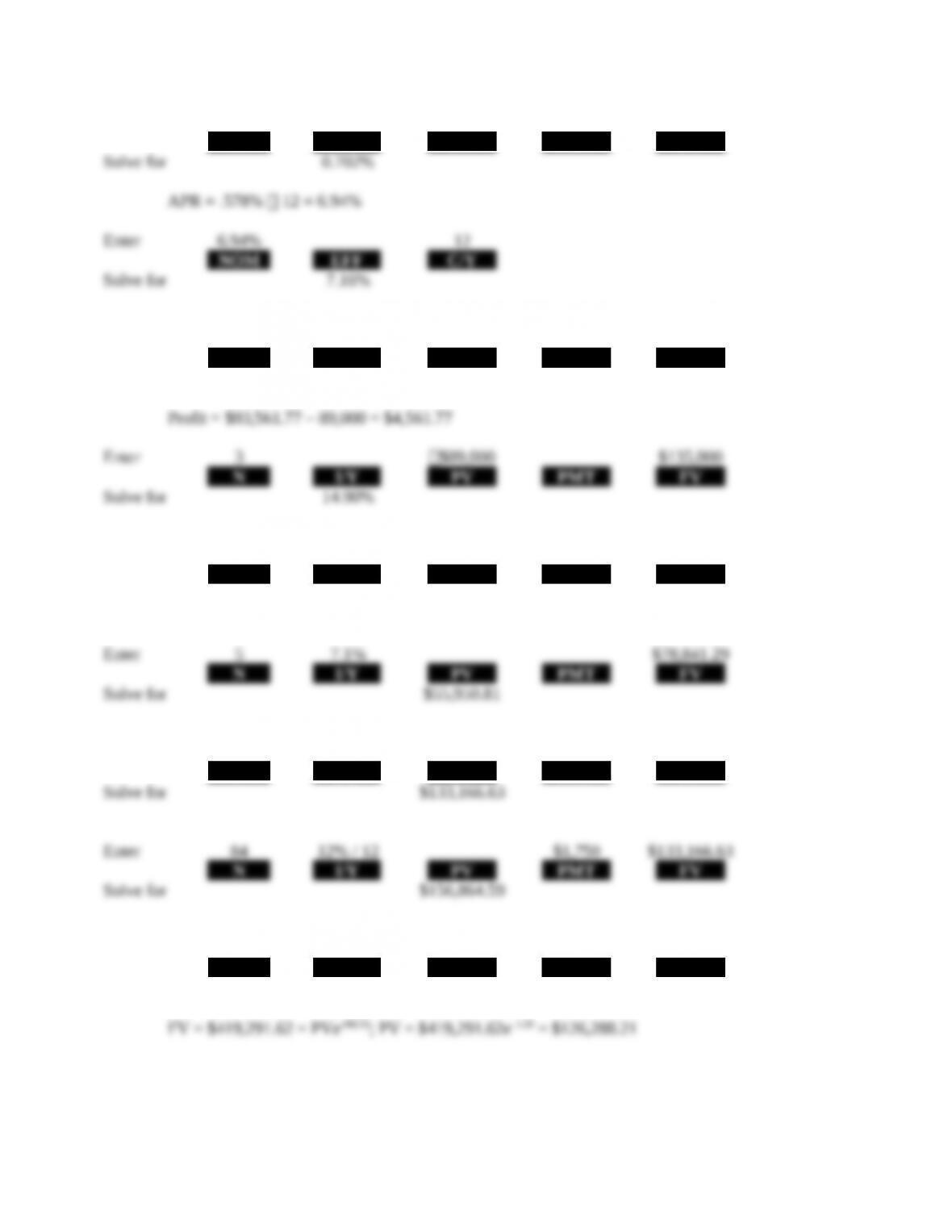
Enter 360 .80($5,200,000) $27,500
N I/Y PV PMT FV
42.
Enter 3 13% $135,000
N I/Y PV PMT FV
Solve for $93,561.77
43.
Enter 20 7.1% $7,500
N I/Y PV PMT FV
Solve for $78,841.29
44.
Enter 96 6% / 12 $1,750
N I/Y PV PMT FV
45.
Enter 15 × 12 7.2%/12 $1,300
N I/Y PV PMT FV
Solve for $419,291.62