Chapter 15
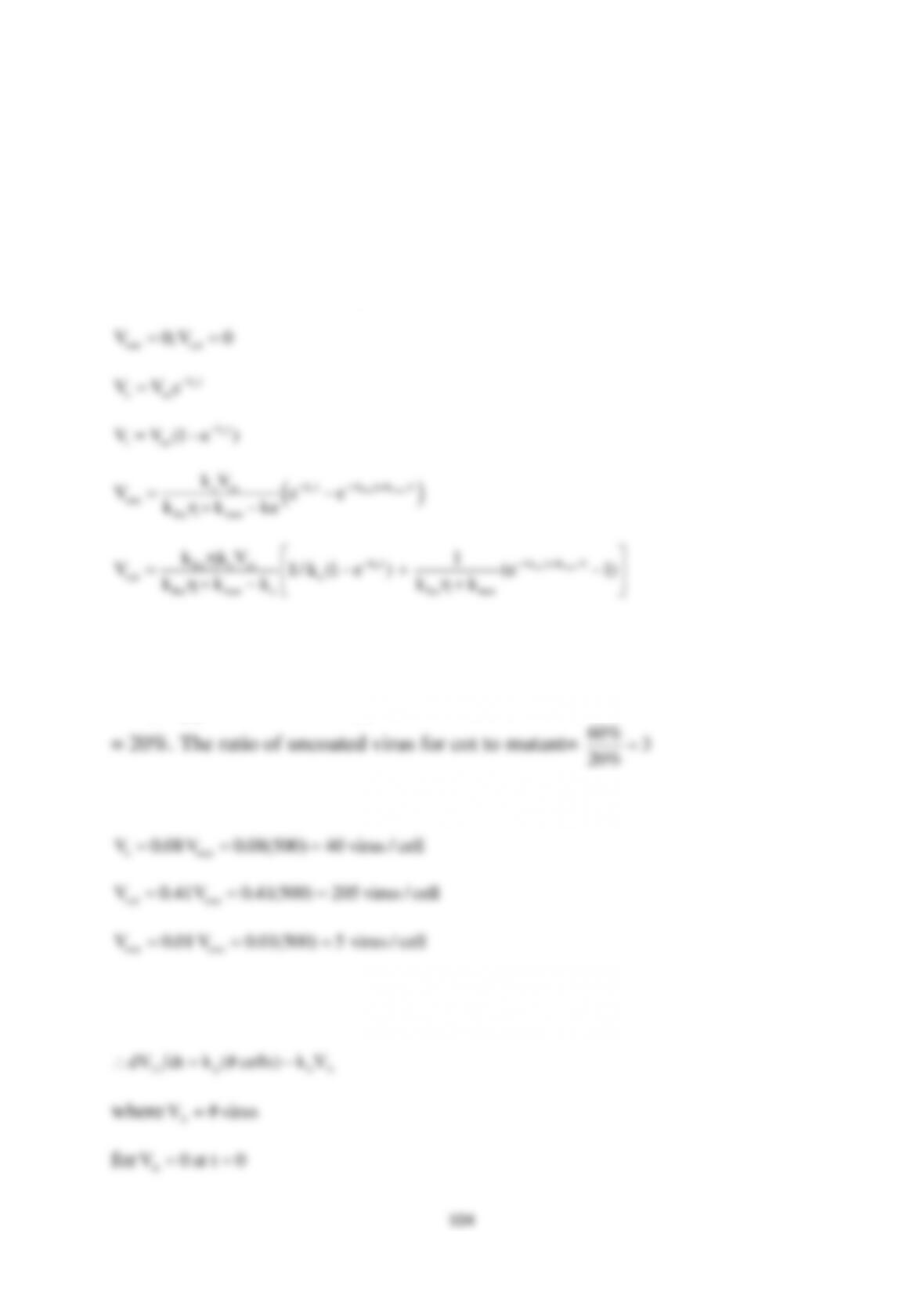
Problem 15.1. This derivation is very similar to the one in the text with “free”
virus. The only eqn that changes is (15.4) which for pre bound virus is
s e s
dV / dt k V=−
For initial conditions
s so
VV=
;
i
V 0;=
ene cyt
V 0;V 0==
e
kt
s so
V V e−
=
e
kt
i so
V V (1 e )
−
=−
( )
e fus tran
k t (k k )t
e so
ene
fus tran
kV
V e e
k k ke
− − +
=−
+ −
e fus tran
k t (k k )t
fus e so
cyt e
fus tran e fus tran
k k V 1
V 1/ k (1 e ) (e 1)
k k k k k
− − +
= − + −
+ − +
Problem 15.2. See Dee, Hammer &Shuler Biotech Bioeng 46 485– 496 (1995)
The equations from 15.1 are used and the values given in the problem statement
are “plugged in” – for wild type % uncoated at 20 min = 60% and for the mutant
60% 3
20% =
Problem 15.3. We use eq 15.9, 15.11, and 15.12 – The answers are:
s exo
V 0.08V 0.08(500) 40 virus / cell= = =
cyt exo
V 0.41V 0.41(500) 205 virus / cell= = =
exe exo
V 0.01V 0.01(500) 5 virus / cell= = =
Problem 15.4. The number of active virus will be a function of rate of production
and rate of decay:
A p d A
dV dt k (# cells) k V = −
where
A
V #virus=
for
A
V 0 at t 0==
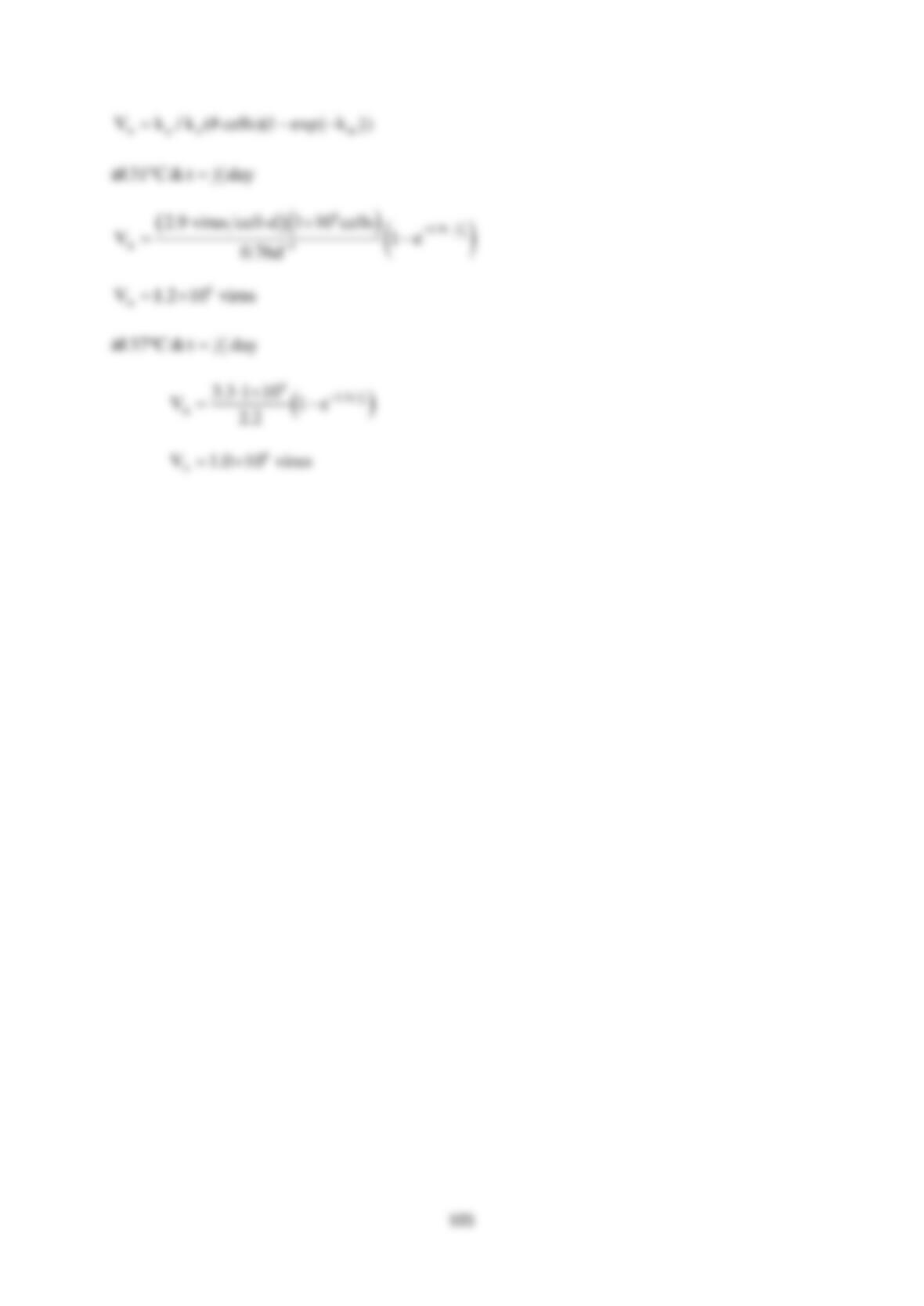
A p d dt
V k / k (# cells)(1 exp{ k })= − −
at
12
31 C&t day=
( )
( )
()
61
0.76 2
A1
2.9 virus cell-d 1 10 cells
V 1 e
0.76d
−
−
=−
6
A
V 1.2 10 virus=
at
12
37 C&t day=
( )
12
62.2k
A
3.3 1 10
V 1 e
2.2
−
=−
6
A
V 1.0 10 virus=
If you want concentration divide by 2 ml. In this case slight improvement in active
virus # by using lower temperature.