Chapter 11
Problem 11.l. a. For simplicity, neglect cell size distribution and cake resistance
considerations. Assume the following relationship applies to tubular centrifuge:
( )
( )
( )
( )
2
2
Recovery % at Condition 1 Rotational speedat Condition 1
Recovery % at Condition 2 Rotational speedat Condition 2
=
Condition 1 given: 60% recovery at 4000 rpm. Recovery at Condition 2 is 95%.
To find rotational speed required for Condition 2, use above eqn:
60/90 = (4000)2 / (Rotational speed @ Condition 2)2
Rotational speed = 5033 rpm for 95% recovery.
b. Again, neglect cell size distribution and cake resistance considerations. Assume that the
following relationship applies to tubular centrifuge:
( )
( )
Recovery % at Condition 1 Flowrateat Condition 2
Recovery % at Condition 2 Flowrateat Condition 1
=
Condition 1 given: 60% recovery for 12 liters/minflowrate.
Flow rate at 95% recovery = (60/90) × 12 liters/min = 7.6 liters/min.
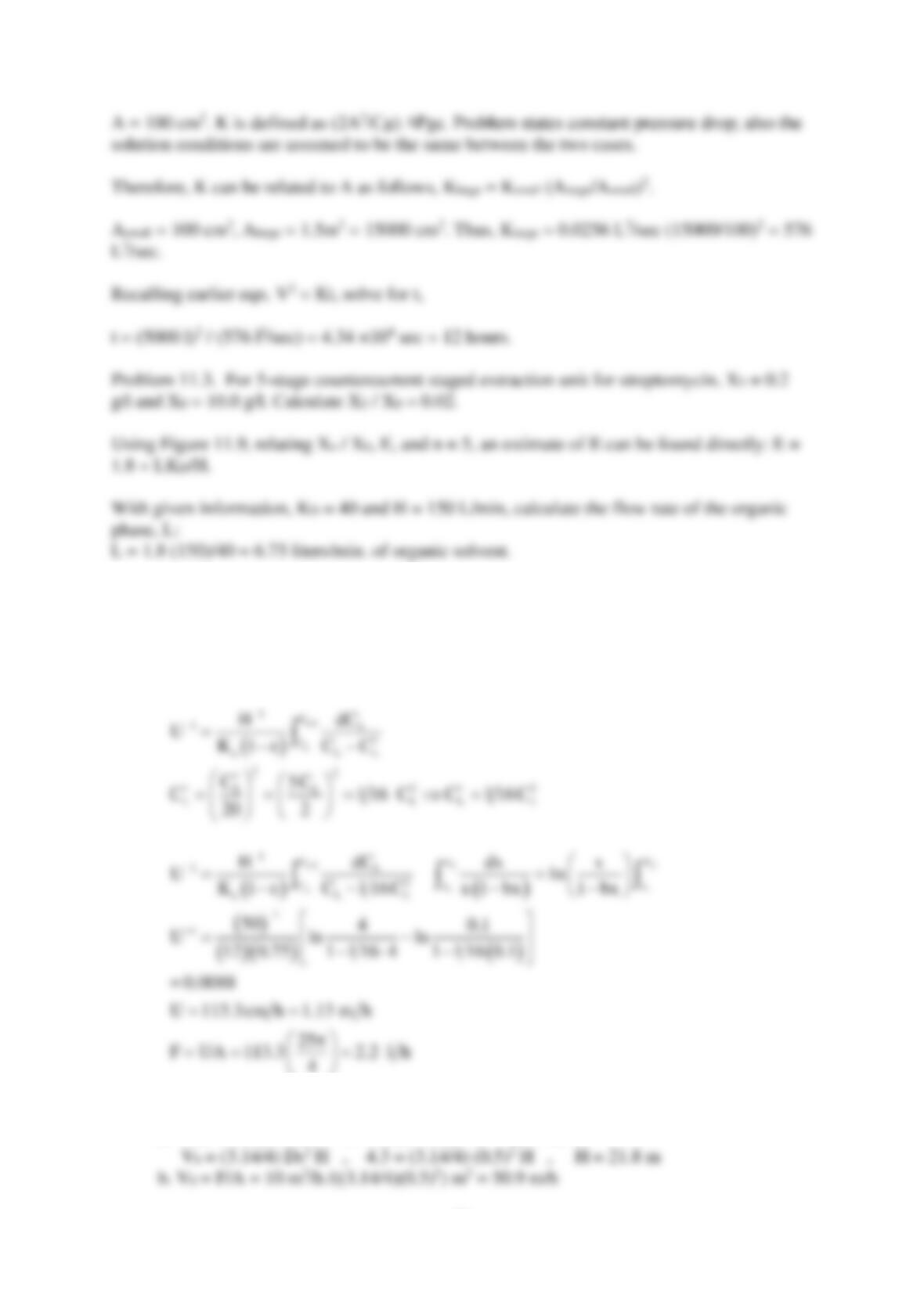
Problem 11.2. For each of the data points given, calculate t/V. Plot t/V vs. V, as shown
below. Use best fit linear regression to determine the slope of the line. In this case:
slope = 39.13 sec/L2
86
Problem 11.4. Rearrange eqn. 11.70
Equil:
( )
1/2
SL
C 20 C
=
Operating: CS = 5 CL
( )
L0
L
1C
1L
C
a L L
dC
H
UK 1 C C
−
−
=− −
22
22
SL
L L L L
C5C
C 1 16 C C 1 16C
20 2
= = = =
( ) ( )
( )
( )( ) ( )
L0 2 2
L 1 1
1CX
1L2
Cx
a L L
1
1
dC
H dx x
U 1n
K 1 C 1 16C x 1 bx 1 bx
50 4 0.1
U ln ln
12 0.75 1 1 16 4 1 1 16 0.1
0.0088
U 113.3cm h 1.13 m h
25
F UA 113.3 2.2 l h
4
−
−
−
−
==
− − − −
=−
− −
=
==
= = =
Problem 11.5.
a. VAC = Vb (1–
) , 3 = Vb (1 – 0.3) , Vb = 4.3 m3
Problem 11.6.
Problem 11.7.
Problem 11.8. fA = k1 CA/(k2 + CA).
( )
2
‘3
B 1 2 2 B
f k ‘k ‘ k ‘ C 0.204 cm mg
= + =
a.
( )
‘
ii
X V A mf = +
( )
fA A
‘
fB B
R / mf 0.117
= + =
Problem 11.9. The fundamental eqn for gel chromotography is
Ve = Vo + Ko Vi
Problem 11.10
3
C2
CV 15kg / m V
A 50 m
( )( )
( ) ( )
( )
V 30 3
00
3 4 1
C
22
3
1
m C m
1 1 1
mm
dV dt K 50 L min
V dV K dt 50L min 30min 1.5m
r 30 50 1.5m 1 m 0.9m
P.A 0.01N m 50m
dV dt 0.05m min
r r M r 0.9 m 0.18kg m min
r 0.9 m 55.6m r 54.7m
−
−
− − −
= =
= = = =
= =
= =
+ +
+ = =
b.) Now
33
5m
dV dt 0.0833m min
60min
==
( )
( )( )
30.01 A
0.0833m min 55.6 0.18
=
A = 83.4 m2
Problem 11.11.
a) Let exit of column 1 be C1 and column 2 be C2; counter current operation; do protein
balance over first column.
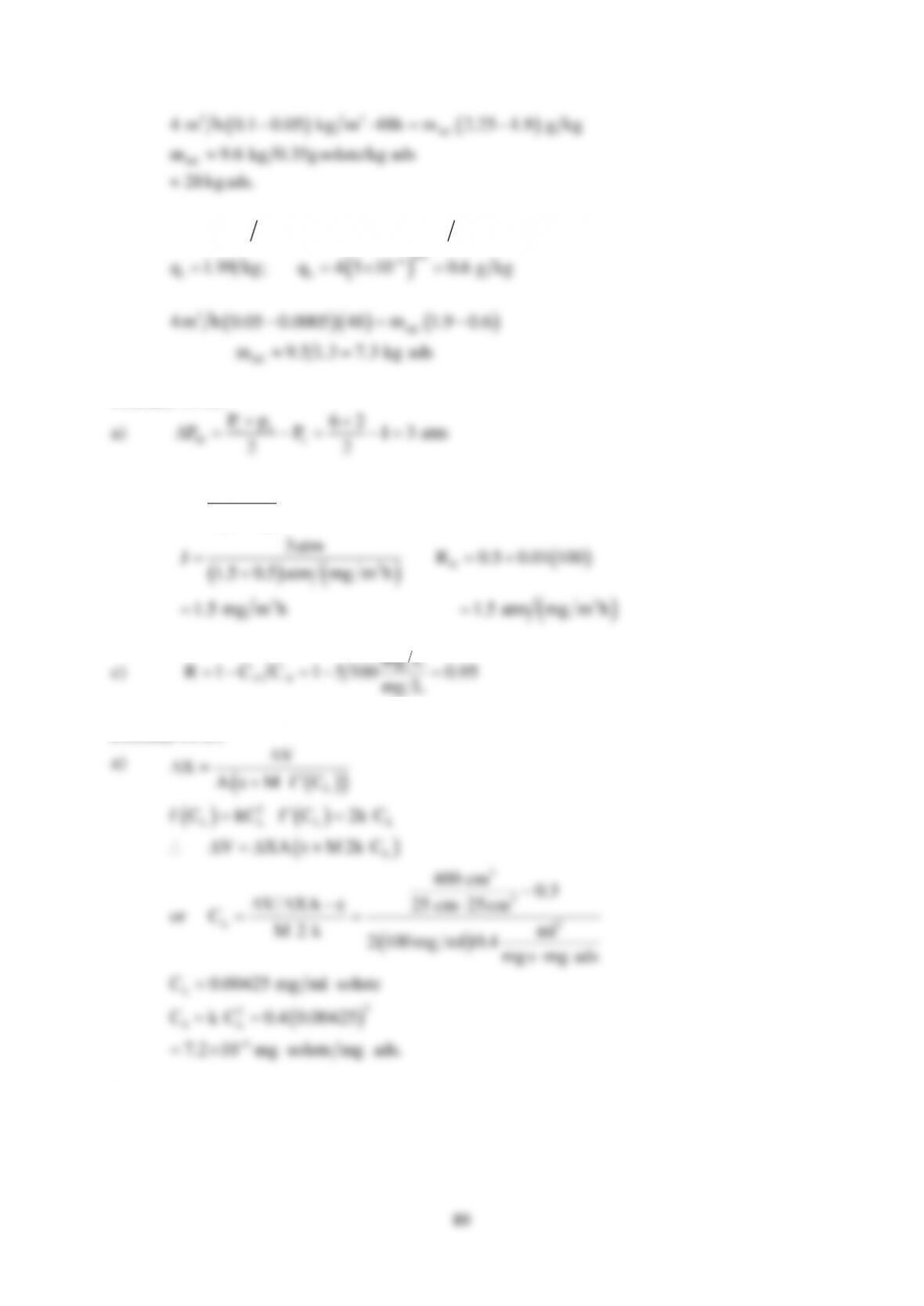
( ) ( )
33
AC
AC
4 m h 0.1 0.05 kg m 48h m 2.25 1.9 g kg
m 9.6 kg 0.35gsolate/kg ads
28kgads.
− = −
b.)
( )
3 4 3
12
1/4
4
12
C 0.05 kg m C 5 10 kg m
q 1.99 kg; q 4 5 10 0.6 g kg
−
−
= =
= = =
AC
m 9.5 1.3 7.3 kg ads
=
Problem 11.12.
io
Mf
Pp 62
22
++
b.)
( )
( )
( )
( )
( )
MG
GM
G
2
22
P
J R 0.5 0.01 C
RR
3atm
J R 0.5 0.01 100
1.5 0.5 atm mg m h
1.5 mg m h 1.5 atm mg m h
= = +
+
= = +
+
==
PB
mg L
mg L
Problem 11.13.
V
b)
90
( )
f
L
f
0.3
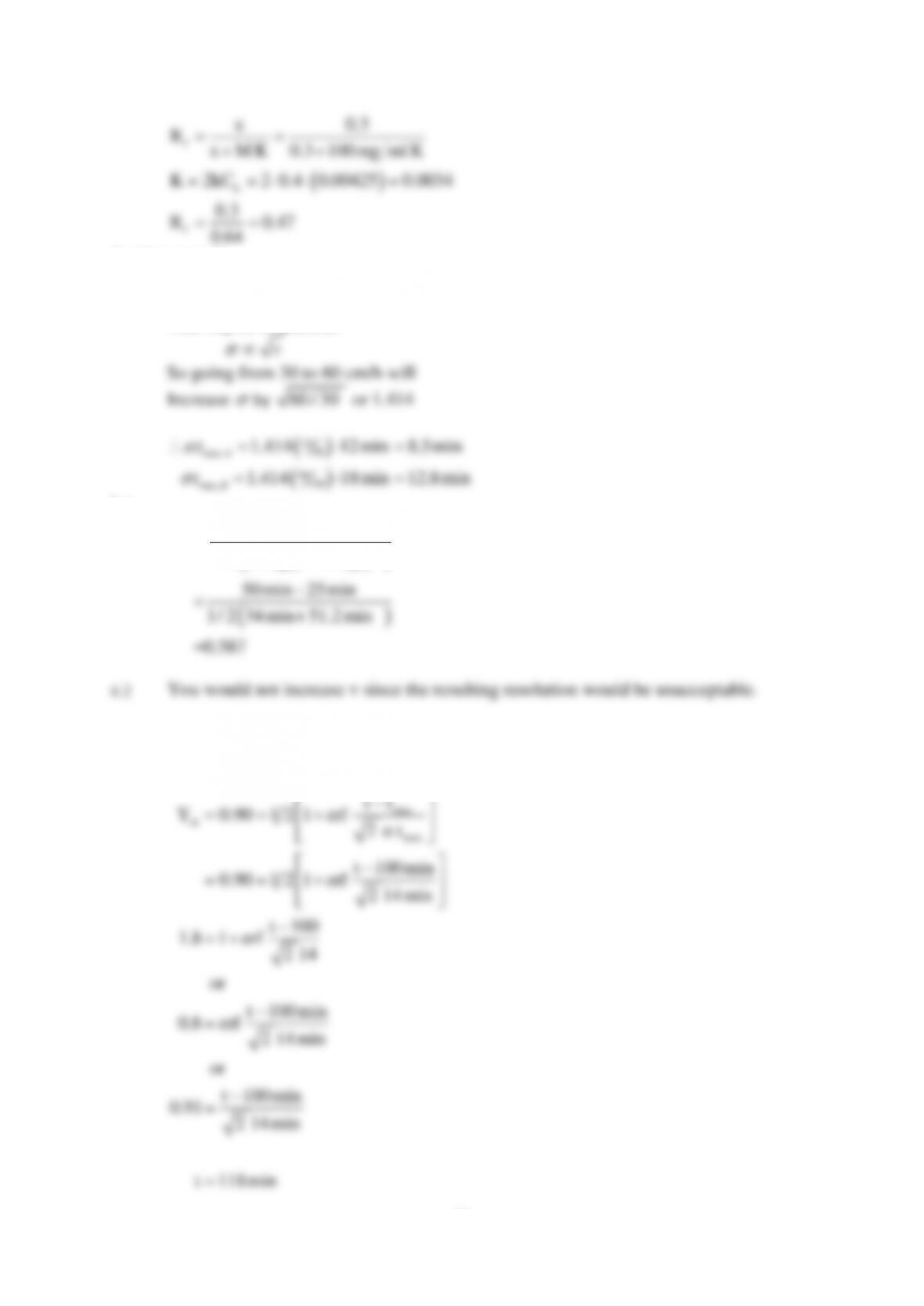
RMK 0.3 100mg mlK
K 2kC 2 0.4 0.00425 0.0034
0.3
R 0.47
0.64
==
+ +
= = =
==
Problem 11.14.
a.) At 60 cm/h peak elution times will be half of tmax at 30cm/h.
with Taylor dispersion:
( )
50100
max,
1.414 18min 12.8min
B
t
= =
b.)
)
(
ma
max max
x max
:
1/ 2 4 4
50min 25min
jj
j
Stt
tt
R
−
−
+
=
Problem 11.15.
a.) tmax = 100 min; σtmax = 14 min
max
t
max
tt
Y 0.90 1 2 1 erf 2t
t 100min
0.90 1 2 1 erf 2 14min
−
= = +
−
= = +
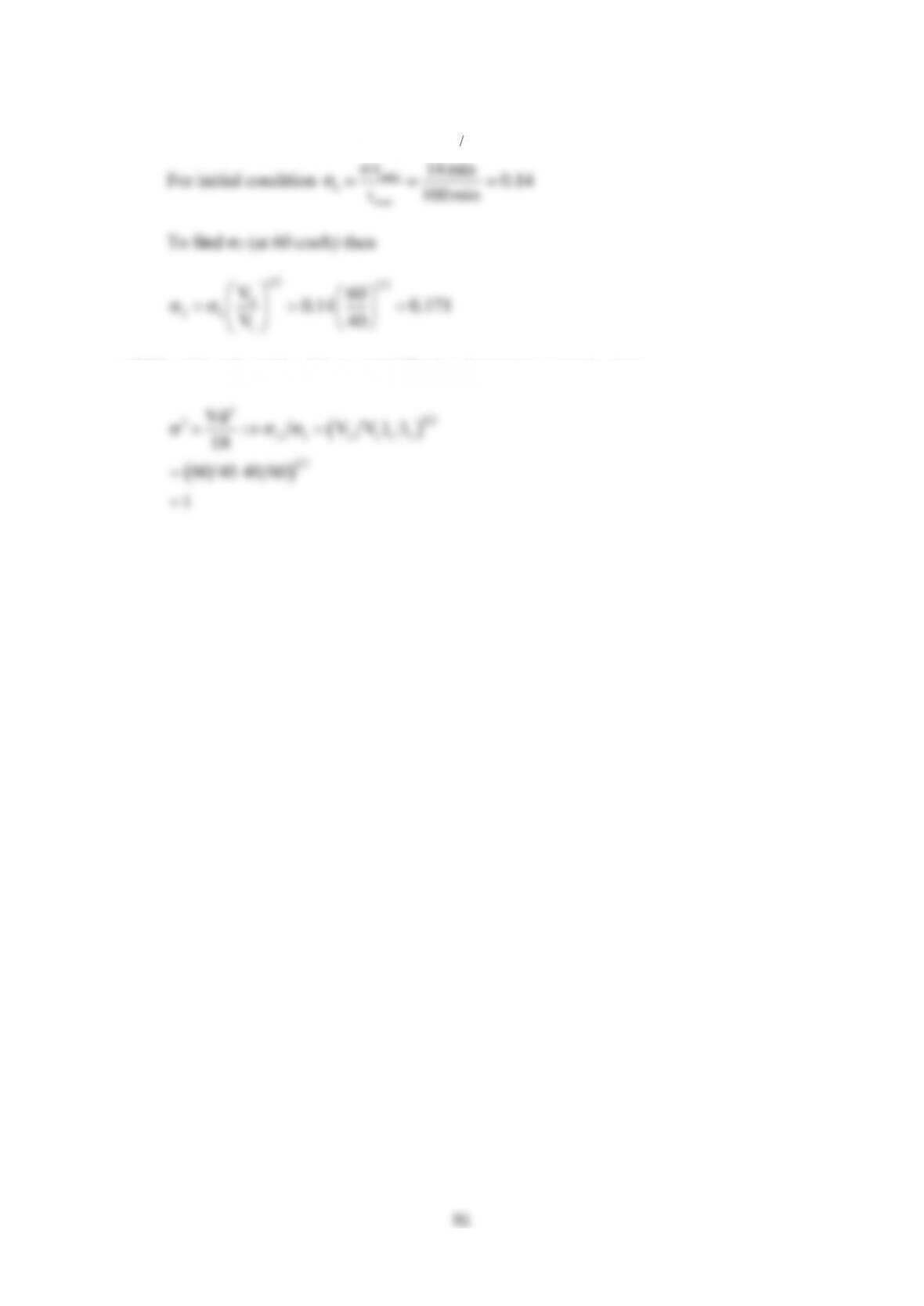
b.) If control by Taylor dispersion, then
12
V
max
t14min 0.14
c.) If V = 60 cm/h and l = 60 cm and if Taylor dispersion controls, then
1
=
Consequently expect same peak shape