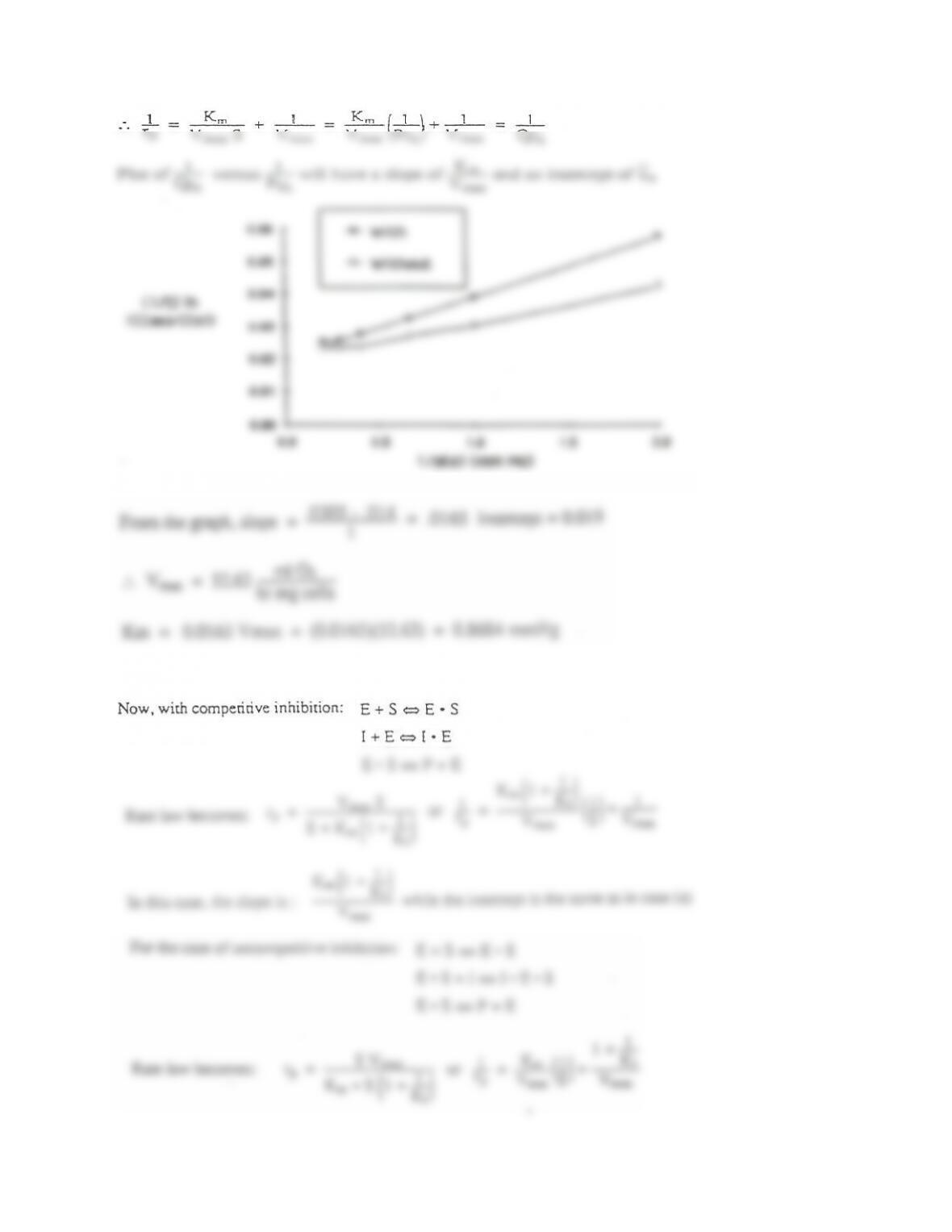
9-28$
P9–11)(a))continued$
$
$
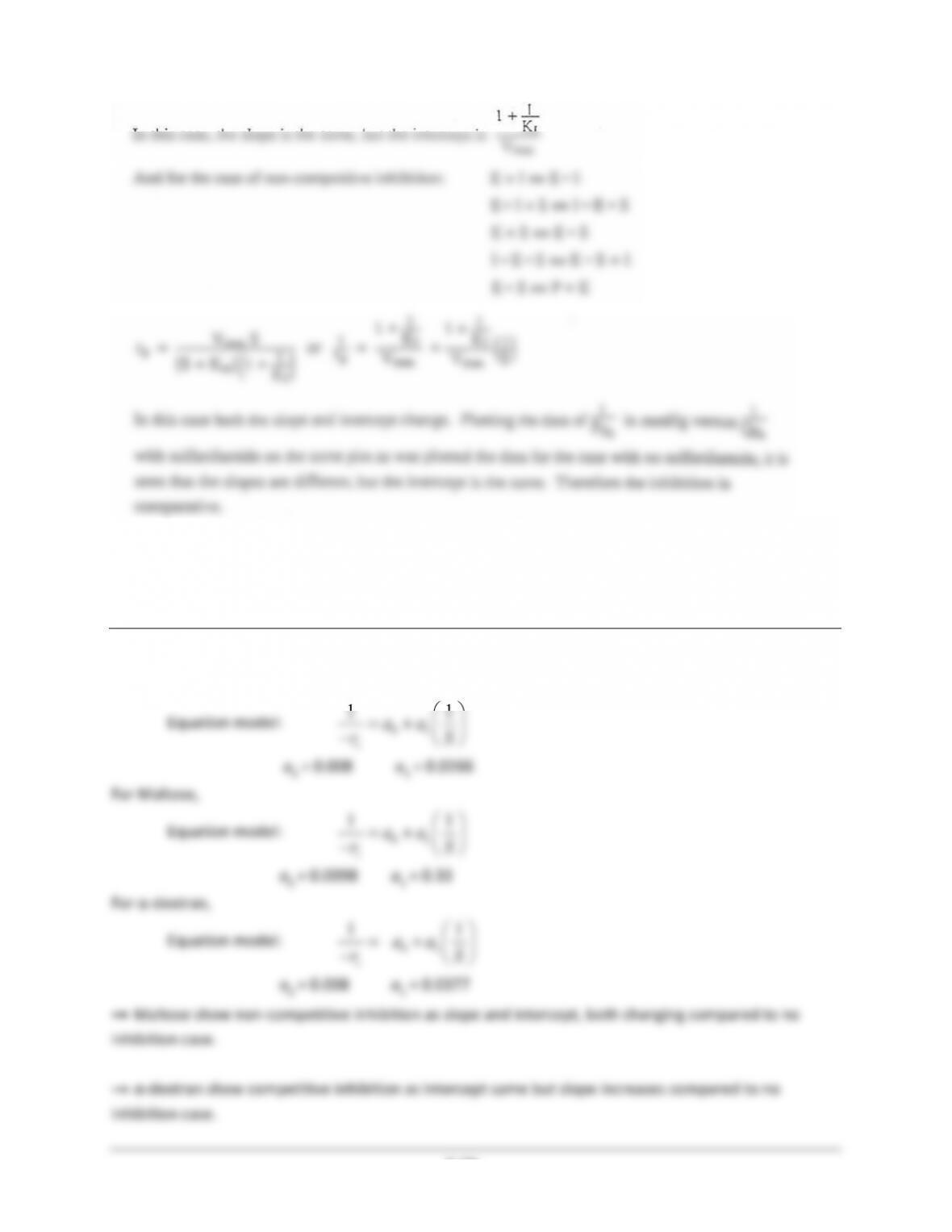
P9–11)(b)$
$
9-29$
P9–11)(b))continued$
$
$
P9–11)(c))Individualized$solution$
P9–11)(d)$Individualized$solution$
$
)
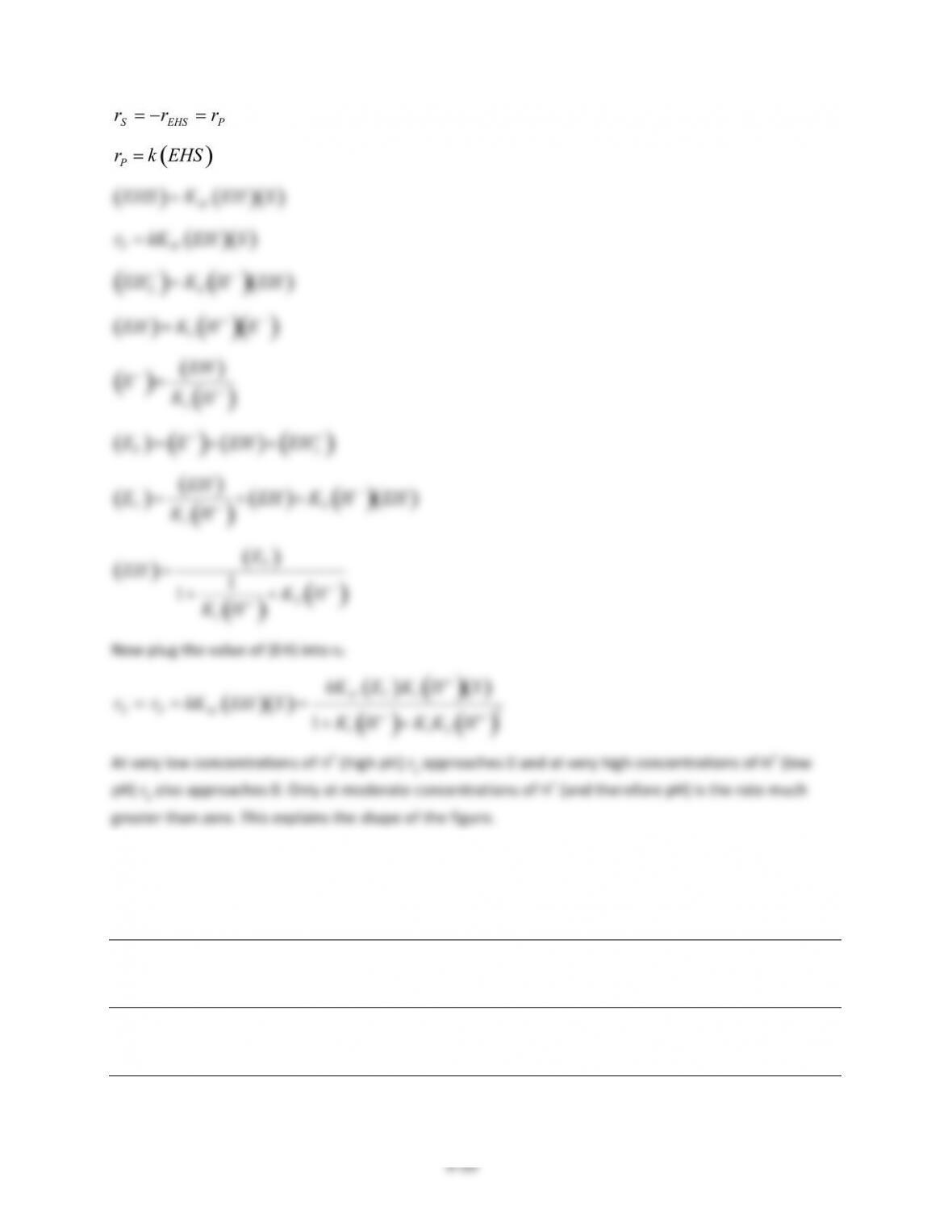
P9–12)$
For$No$Inhibition,$using$regression,$
$Equation$model:$
$
9-30$
P9–13)(a)$
$
$
$
$
P9–13)(b))Individualized$solution$
P9–13)(c)$Individualized$solution$
$
)
P9–14$No$solution$will$be$given$
$
)
P9–15$No$solution$will$be$given$
$
)
9-31$
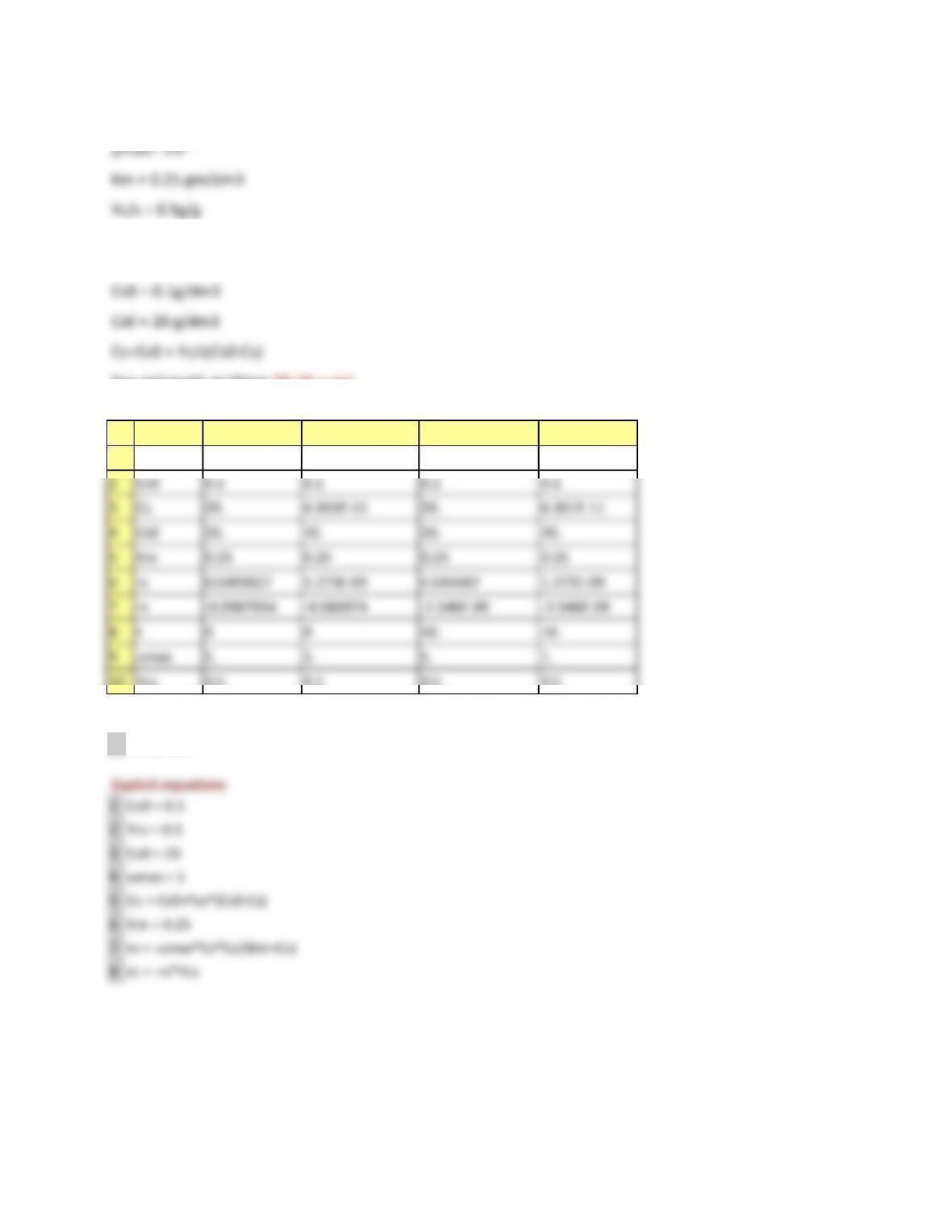
P9–16$
–rs$=$(μmax*Cs*Cc)/(Km+Cs)$
μmax=$1hr-1$
$
P9–16)(a)$
Cc0$=$0.1g/dm3$
See$polymath$problem$P9–16–a.pol$
Calculated)values)of)DEQ)variables$$
$$
Variable$
Initial$value$
Minimal$value$
Maximal$value$
Final$value$
1$$
Cc$$
0.1$$
0.1$$
10.1$$
10.1$$
2$$
Cc0$$
0.1$$
0.1$$
0.1$$
0.1$$
3$$
Cs$$
20.$$
6.301E–11$$
20.$$
6.301E–11$$
4$$
Cs0$$
20.$$
20.$$
20.$$
20.$$
5$$
Km$$
0.25$$
0.25$$
0.25$$
0.25$$
6$$
rc$$
0.0493827$$
1.273E–09$$
4.043487$$
1.273E–09$$
7$$
rs$$
–0.0987654$$
–8.086974$$
–2.546E–09$$
–2.546E–09$$
8$$
t$$
0$$
0$$
10.$$
10.$$
9$$
umax$$
1.$$
1.$$
1.$$
1.$$
10$$
Ycs$$
0.5$$
0.5$$
0.5$$
0.5$$
)
Differential)equations$$
1$$
d(Cs)/d(t)$=$rs$$
)
1$$
Cc0$=$0.1$$
2$$
Ycs$=$0.5$$
3$$
Cs0$=$20$$
4$$
umax$=$1$$
5$$
Cc$=$Cc0+Ycs*(Cs0–Cs)$$
6$$
Km$=$0.25$$
7$$
rs$=$–umax*Cs*Cc/(Km+Cs)$$
8$$
rc$=$–rs*Ycs$$
9-32$
P9–16)(a))continued$
$
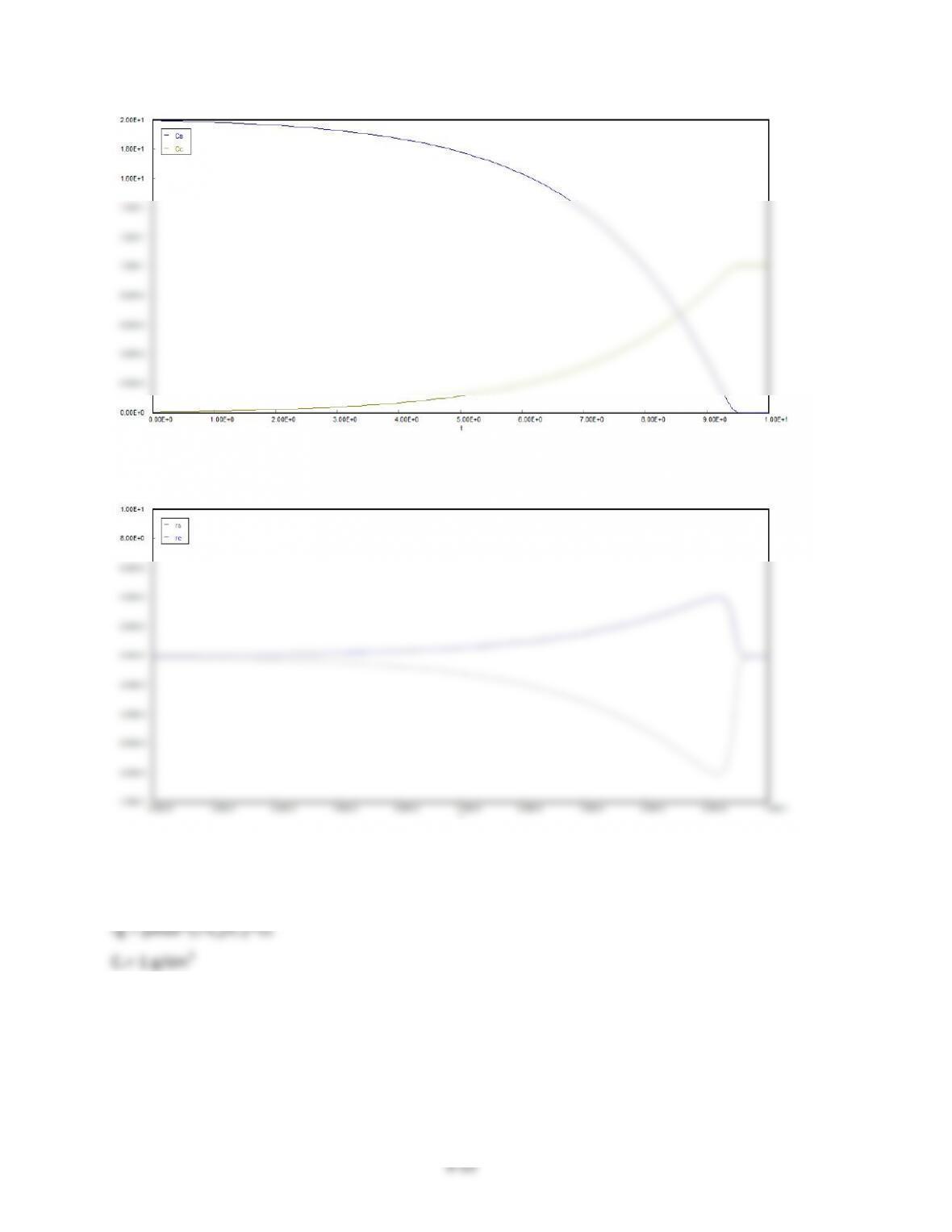
Plot$$of$$Cc$and$$Cs$$versus$time$
$
Plot$of$$rs$and$rc$with$time$
$
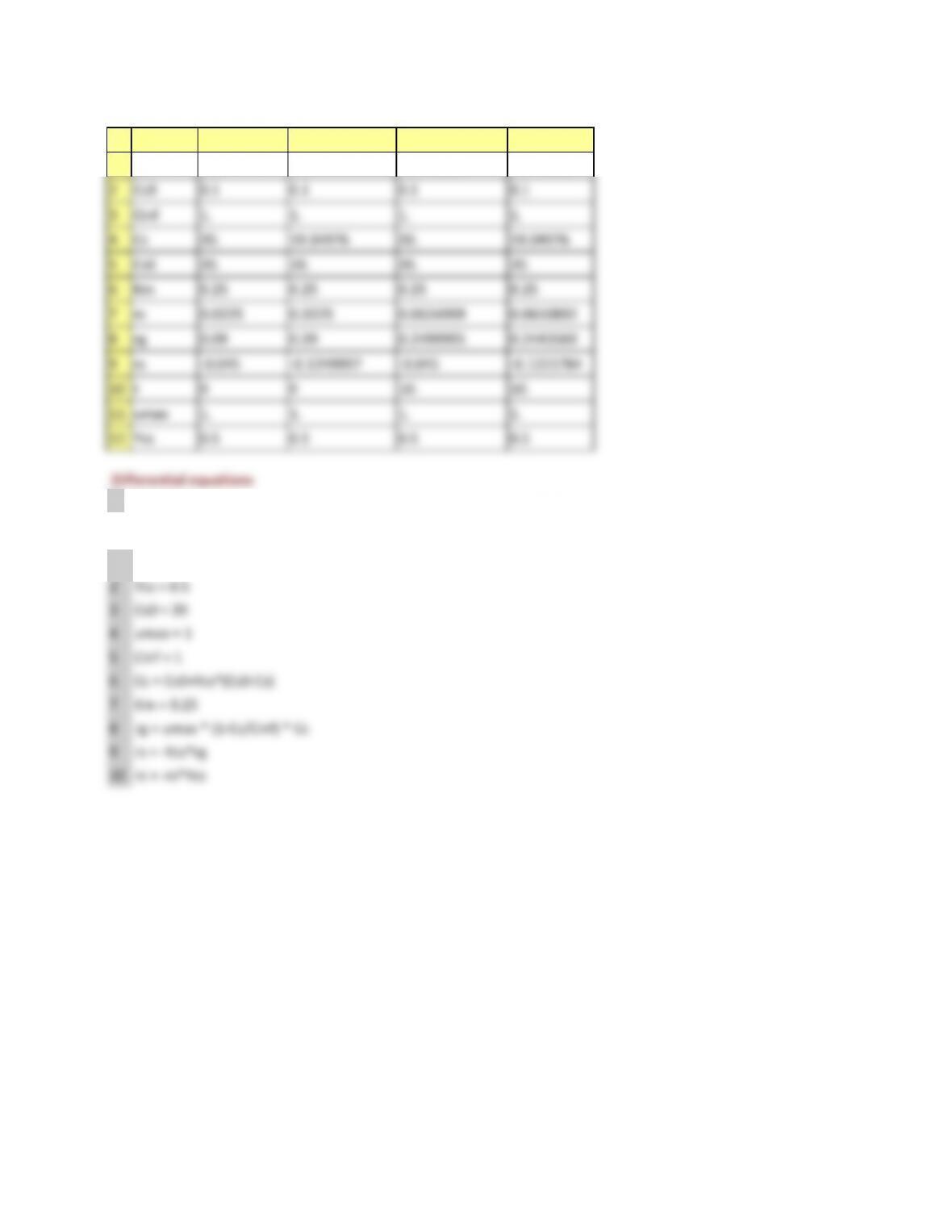
P9–16)(b)$Change$the$polymath$code$to$include$
rg$=$μmax*(1-Cc/C∞)*Cc$
$
9-33$
P9–16)(b))continued$
Calculated)values)of)DEQ)variables$$
)$
Variable$
Initial)value$
Minimal)value$
Maximal)value$
Final)value$
1$$
Cc$$
0.1$$
0.1$$
0.5751209$$
0.5751209$$
2$$
Cc0$$
0.1$$
0.1$$
0.1$$
0.1$$
3$$
Cinf$$
1.$$
1.$$
1.$$
1.$$
4$$
Cs$$
20.$$
19.04976$$
20.$$
19.04976$$
5$$
Cs0$$
20.$$
20.$$
20.$$
20.$$
6$$
Km$$
0.25$$
0.25$$
0.25$$
0.25$$
7$$
rc$$
0.0225$$
0.0225$$
0.0624999$$
0.0610892$$
8$$
rg$$
0.09$$
0.09$$
0.2499995$$
0.2443569$$
9$$
rs$$
–0.045$$
–0.1249997$$
–0.045$$
–0.1221784$$
10$$
t$$
0$$
0$$
10.$$
10.$$
11$$
umax$$
1.$$
1.$$
1.$$
1.$$
12$$
Ycs$$
0.5$$
0.5$$
0.5$$
0.5$$
$
1$$
d(Cs)/d(t)$=$rs$$
$
Explicit)equations$$
1$$
Cc0$=$0.1$$
2$$
Ycs$=$0.5$$
3$$
Cs0$=$20$$
4$$
umax$=$1$$
5$$
Cinf$=$1$$
6$$
Cc$=$Cc0+Ycs*(Cs0–Cs)$$
7$$
Km$=$0.25$$
8$$
rg$=$umax$*$(1–Cc/Cinf)$*$Cc$$
9$$
rs$=$–Ycs*rg$$
10$$
rc$=$–rs*Ycs$$
9-34$
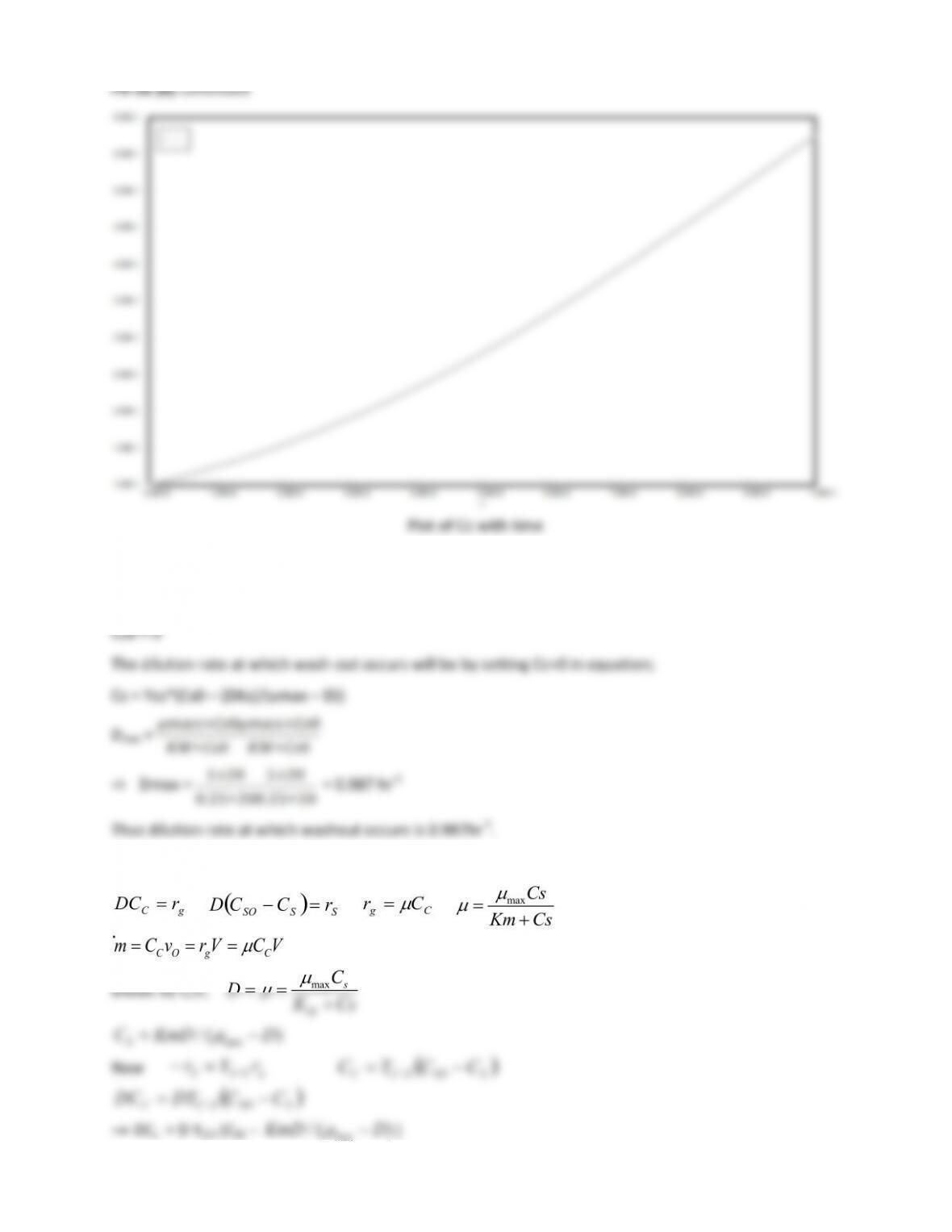
P9–16)(b))continued$
$
P9–16)(c))
Cs0$=$20g/dm3$
Cc0$=$0$
P9–16)(d)$
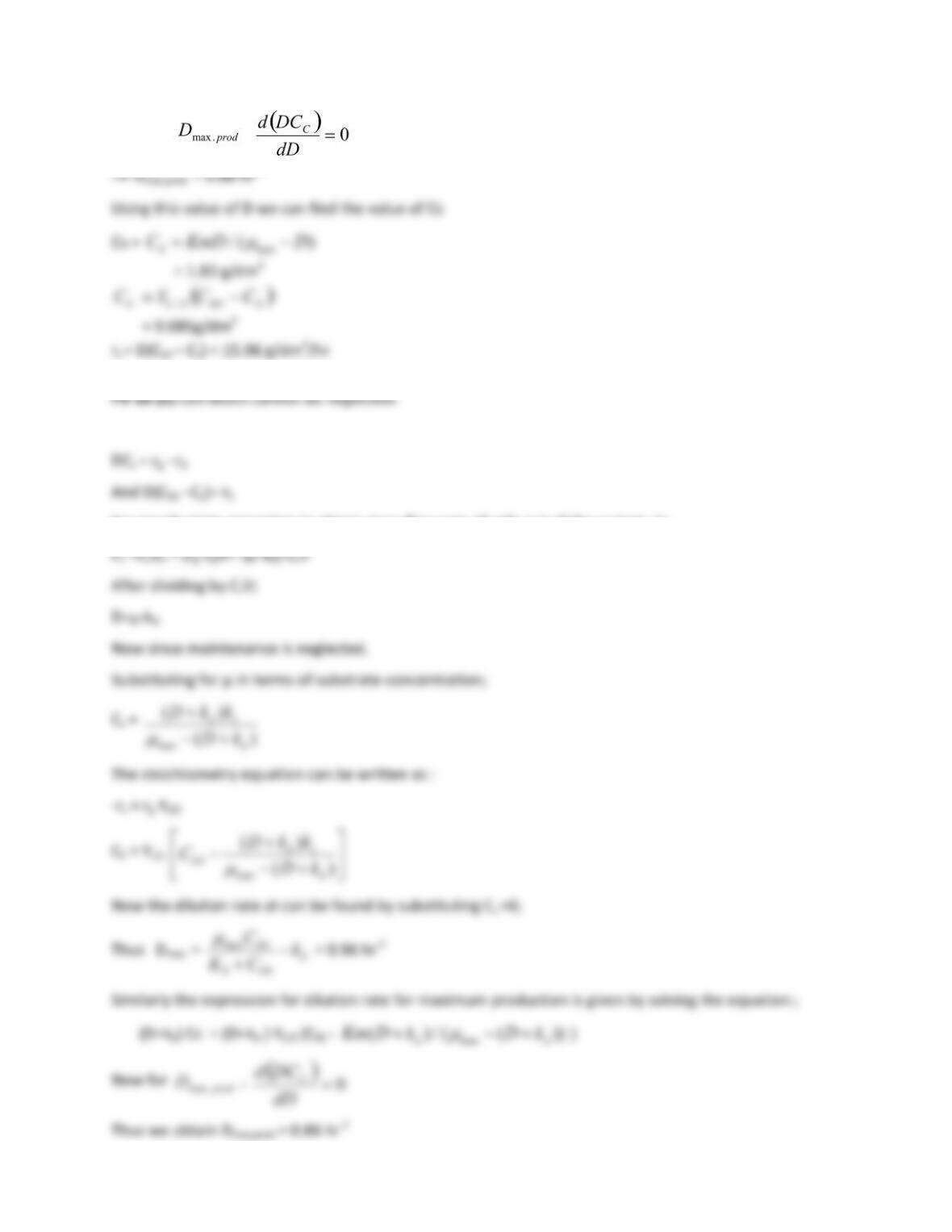
$$,$$ $$,$$ $$,$$$$
$
Divide$by$CCV,$
$
9-35$
P9–16)(d))continued$
Now,$for$ $,$ $
$
$
⇒$Dmax,prod$$=$0.88$hr-1$
$
P9–16)(e)$Cell$death$cannot$be$neglected.$
Kd$=0.02$hr-1$
DCc$=$rg$–rd$$$
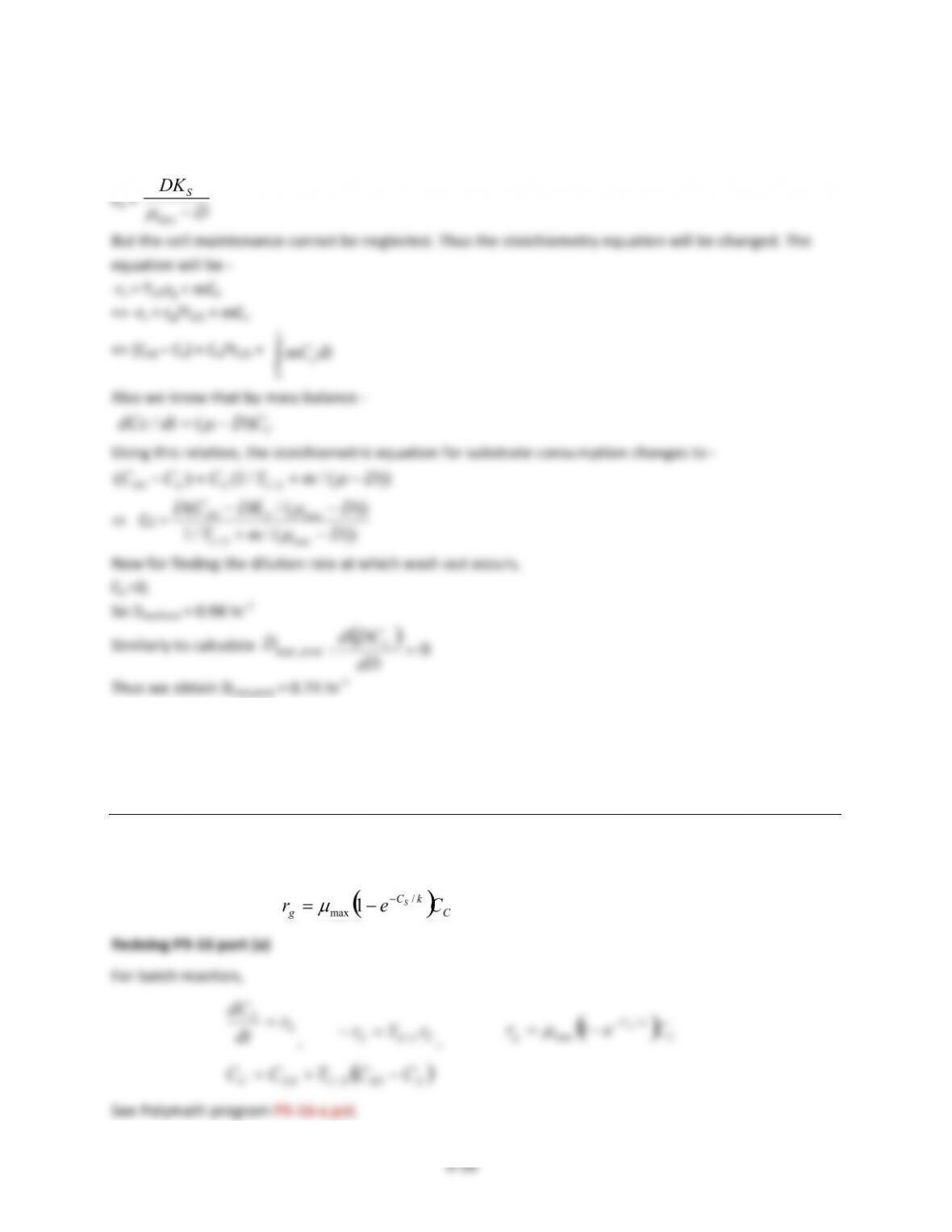
For$steady$state$operation$to$obtain$mass$flow$rate$of$cells$out$of$the$system,$Fc$
FC$=CCv0$=$(rg-rd)V=$(µ-kd)$CCV$
9-36$
P9–16)(f)$
In$this$case$the$maintenance$cannot$be$neglected.$
$m$=$0.2$g/hr/dm3$
The$correlation$for$steady$substrate$concentration$will$remain$the$same.$
Cs$=$
$
)
P9–16)(g)$Individualized$solution$
)
P9–16)(h)$Individualized$solution$
$
)
P9–17)$
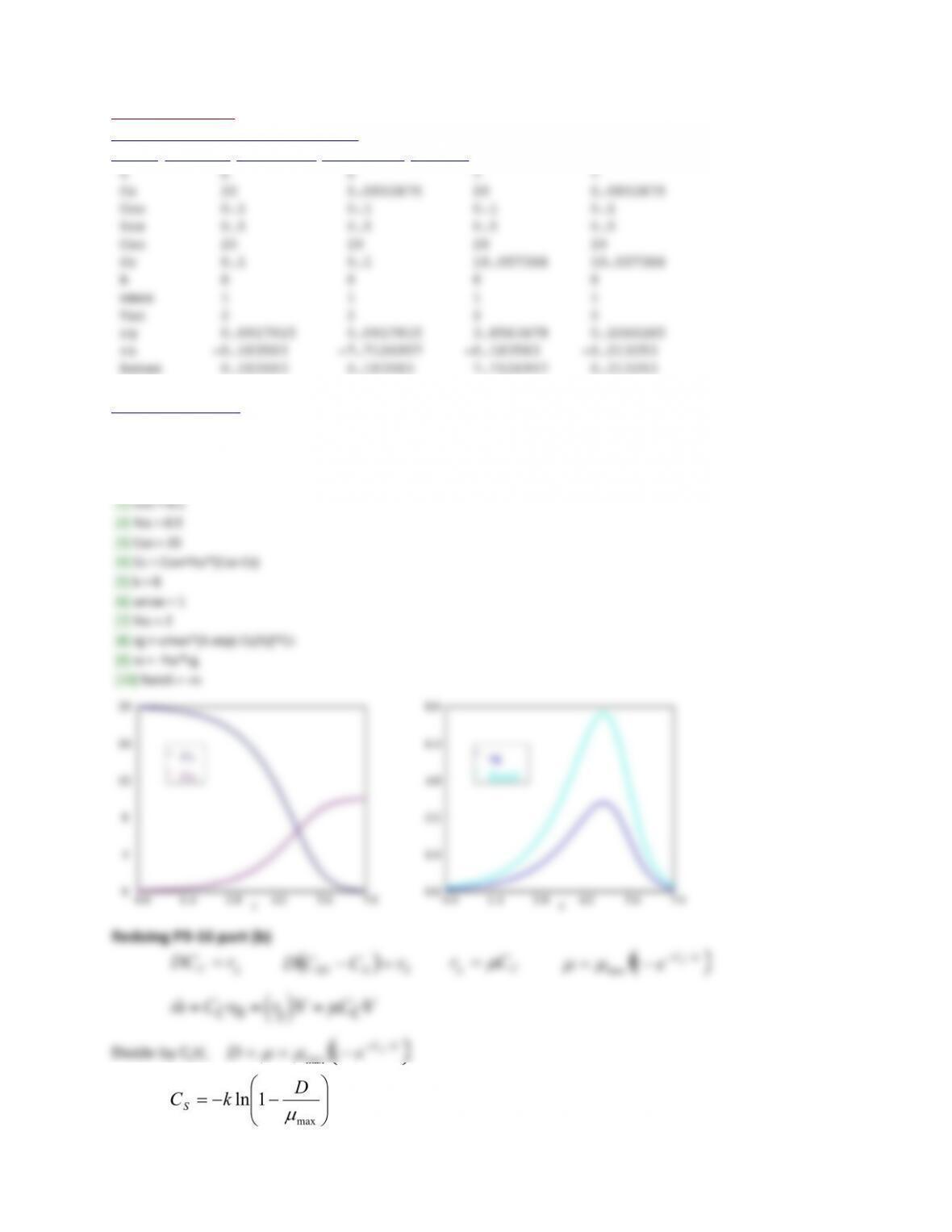
Tessier$Equation,$
$ $ $ $
9-37$
P9–17)continued$
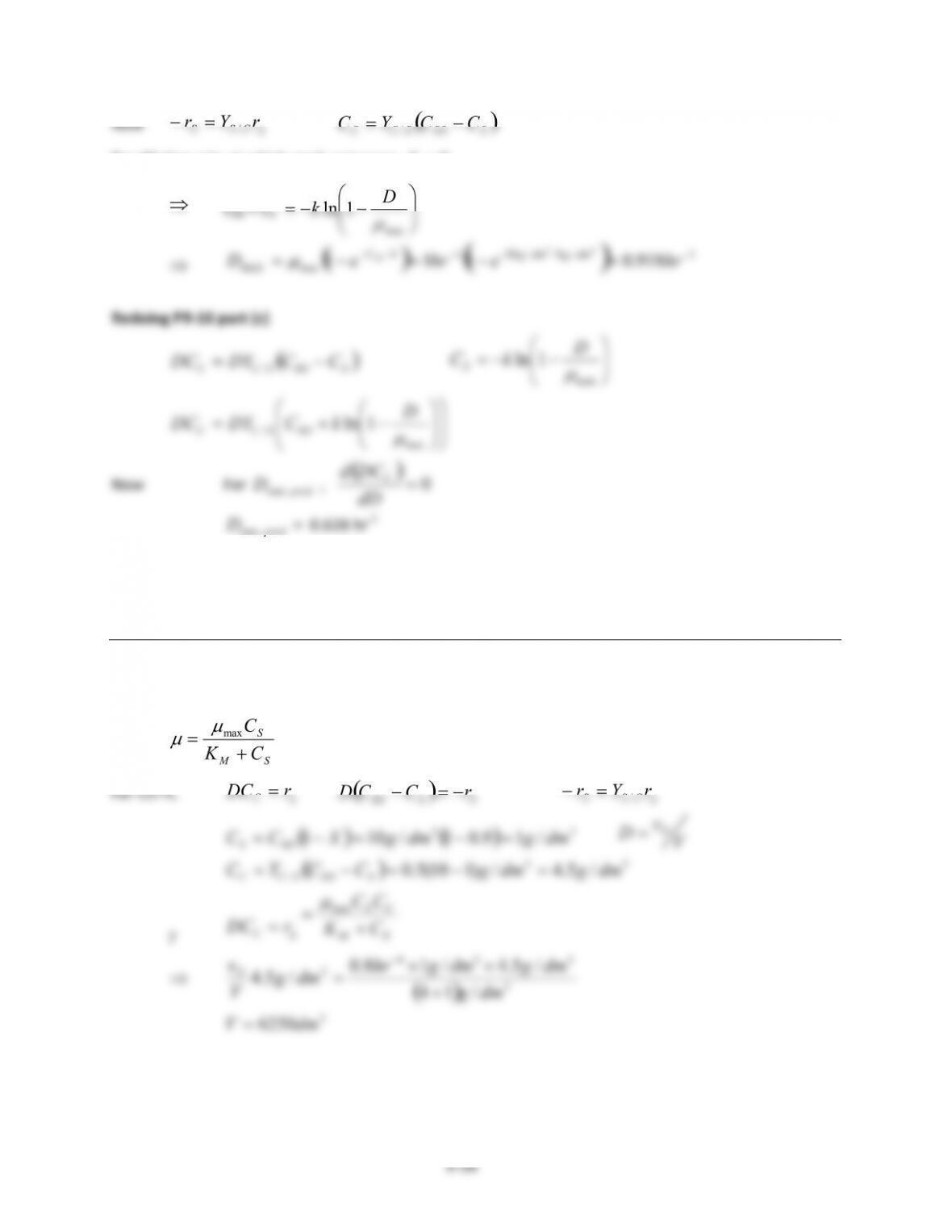
POLYMATH)Results$
Calculated)values)of)the)DEQ)variables$
Variable$$initial$value$$minimal$value$$maximal$value$$final$value$
t 0 0 7 7
ODE)Report)(RKF45)$
Differential$equations$as$entered$by$the$user$
$[1]$d(Cs)/d(t)$=$rs$
$
$Explicit$equations$as$entered$by$the$user$
$[1]$Cco$=$0.1$
$ $
9-38$
P9–17)continued$
Now$$ $ $
For$dilution$rate$at$which$wash$out$occur,$$CC$=$0$
$ $ CSO$=$CS$$
$
$
P9–17)(a))Individualized$solution$
P9–17)(b))Individualized$solution$
$
)
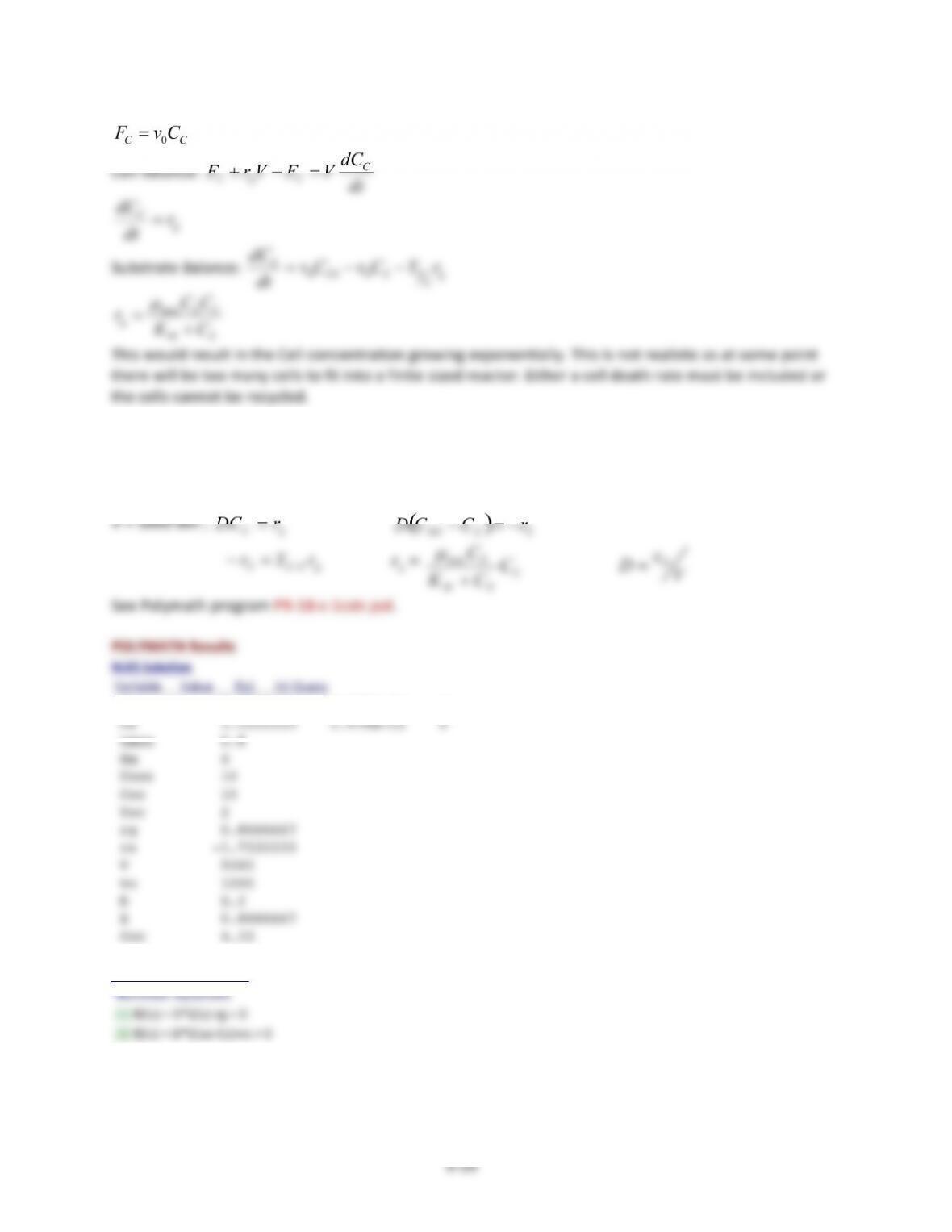
P9–18)(a))
rg$=$µCC$
$ $
For$CSTR,$ $ $ $ $
9-39$
P9–18)(b)$
Flow$of$cells$out$=$Flow$of$cells$in$
$
Cell$Balance:$
$
P9–18)(c)$
Two$CSTR’s$
For$1st$CSTR,$
V$=$5000$dm3,$ $$ $ $$
Cs 1.3333333 1.976E–11 5
NLES)Report)(safenewt)$$
$Nonlinear$equations$$
9-40$
P9–18)(c))continued$
$Explicit$equations$$
$[1]$umax$=$0.8$
$[2]$Km$=$4$
$[3]$Csoo$=$10$
$[4]$Cso$=$10$
Cs 0.1261699 6.008E–10 5
Km 4
Ysc 2
rg 0.120683
V 5000
X 0.987383
$
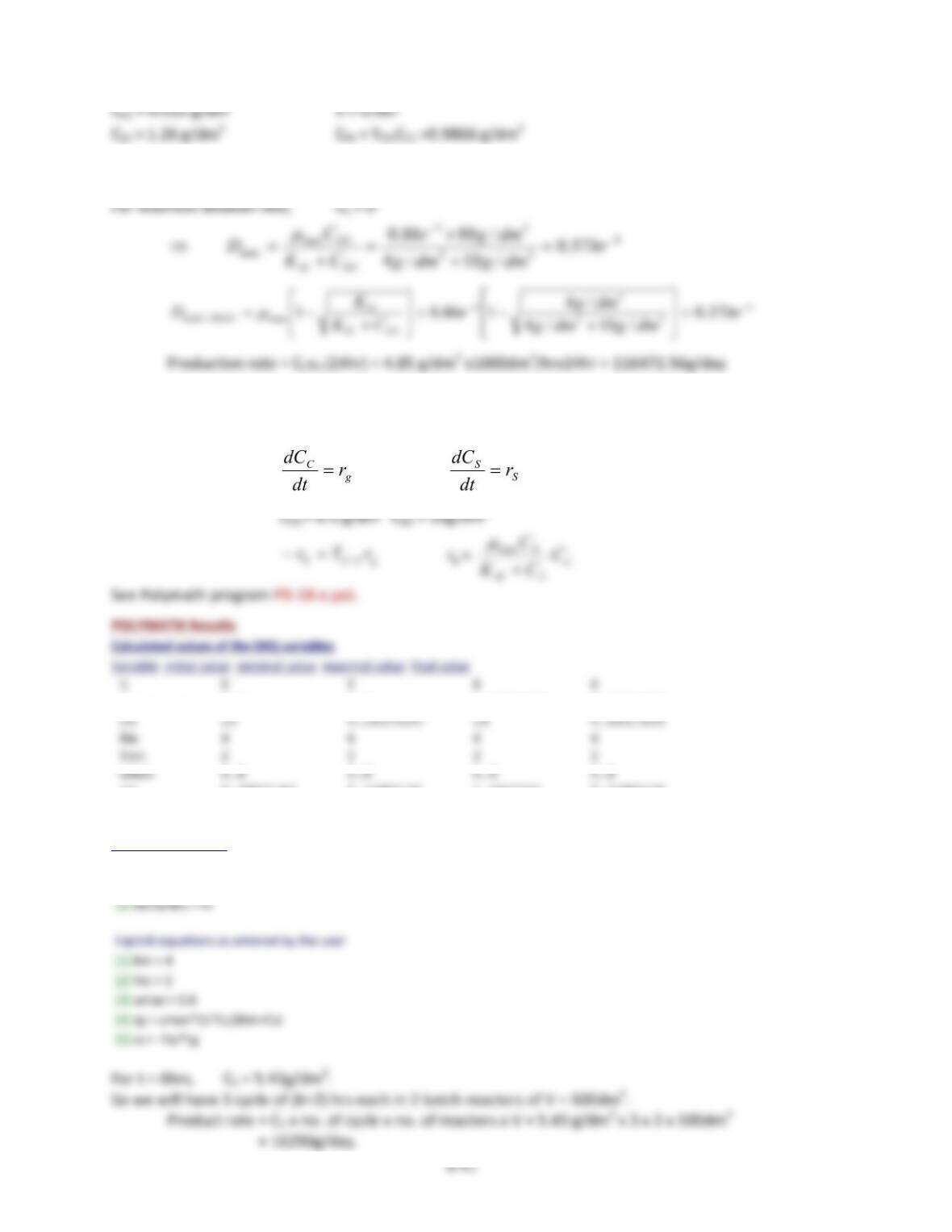
NLES)Report)(safenewt)$$
$Nonlinear$equations$$
$[1]$f(Cc)$=$D*(Cc–Cc1)–rg$=$0$
$[2]$f(Cs)$=$D*(Cs1–Cs)+rs$=$0$
9-41$
P9–18)(c))continued$
CC2$=$4.933$g/dm3$ $X$=$0.987$
$
P9–18)(d)$
For$washout$dilution$rate,$ CC$=$0$
$
P9–18)(e)$
For$batch$reactor,$
$V$=$500dm3,$ $$ $ $$
$$$CCO$=$0.5$g/dm3$ CSO$=$10g/dm3$
Cs 10 0.1417155 10 0.1417155
rs –0.5714286 –2.8064061 –0.2972271 –0.2972271
)
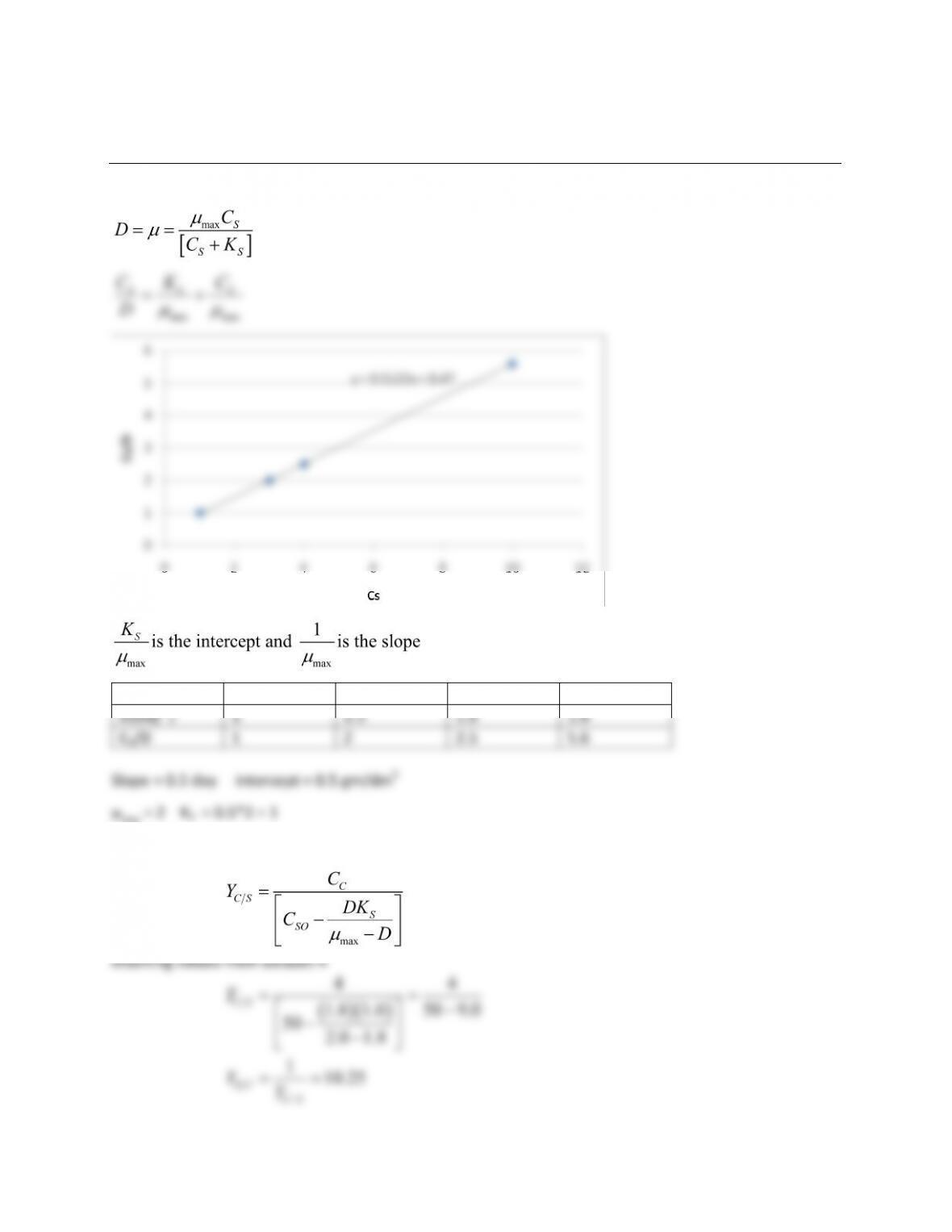
ODE)Report)(RKF45)$
Differential$equations$as$entered$by$the$user$
$[1]$d(Cc)/d(t)$=$rg$
$[2]$d(Cs)/d(t)$=$rs$
9-42$
P9–18)(f))Individualized$solution$
$
P9–18)(g))Individualized$solution$
$
)
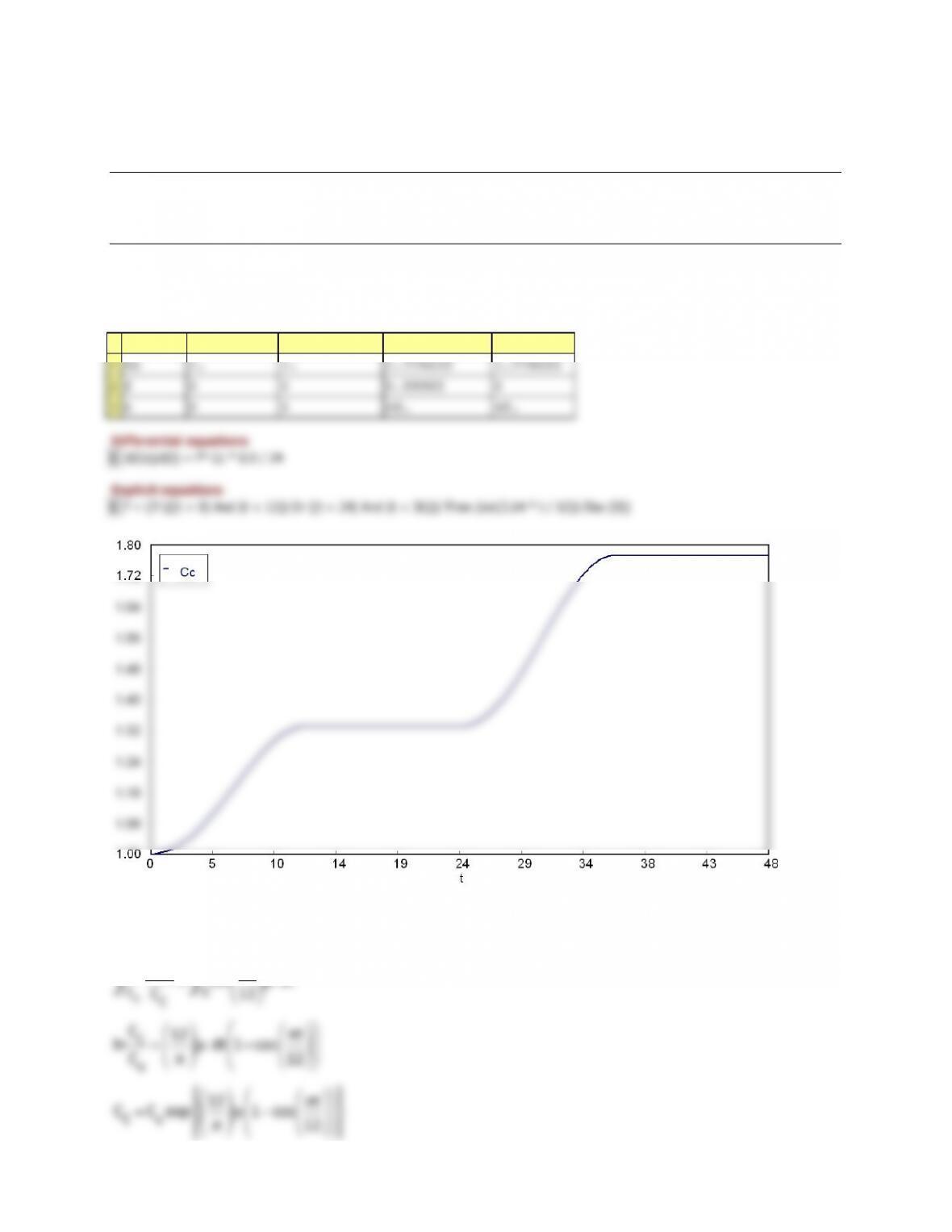
P9–19)(a)$
$
$
$
$
CS$gm$/dm2$
1$
3$
4$
10$
D(day-1)$
1$
1.5$
1.6$
1.8$
CS/D$
1$
2$
2.5$
5.6$
$
$
P9–19)(b)$
$ $ $
Inserting$values$from$dataset$4$
9-43$
P9–19)(c))Individualized$solution$
$
P9–19)(d))Individualized$solution$
$
)
P9–20)$No$solution$will$be$given$
$
)
P9–21)(a)$
See$Polymath$program$P9–20–a.pol.$
Calculated values of DEQ variables $
$
Variable$
Initial value$
Minimal value$
Maximal value$
Final value$
1
Cc
1.
1.
1.774022
1.774022
2
f
0
0
0.99985
0
3
t
0
0
48.
48.
Differential equations $
1 $
d(Cc)/d(t) = f* Cc * 0.9 / 24 $
Explicit equations $
1 $
f = (If (((t > 0) And (t < 12)) Or ((t > 24) And (t < 36))) Then (sin(3.14 * t / 12)) Else (0)) $
$
$
P9–21)(b)$
Given$the$initial$concentration$as$Co$=$0.5$mg/liter$we$have,$
dCC
CC
Co
CC
∫=sin
0
t
∫πt
12
#
$
%&
‘
(µ+dt
lnCC
Co
=12
π
#
$
%&
‘
(µ+dt 1−cos πt
12
#
$
%&
‘
(
#
$
%
%
&
‘
(
(
CC=Coexp 12
π
#
$
%&
‘
(µ1−cos πt
12
#
$
%&
‘
(
#
$
%
%
&
‘
(
(
*
+
,
–
,
.
/
,
0
,
$
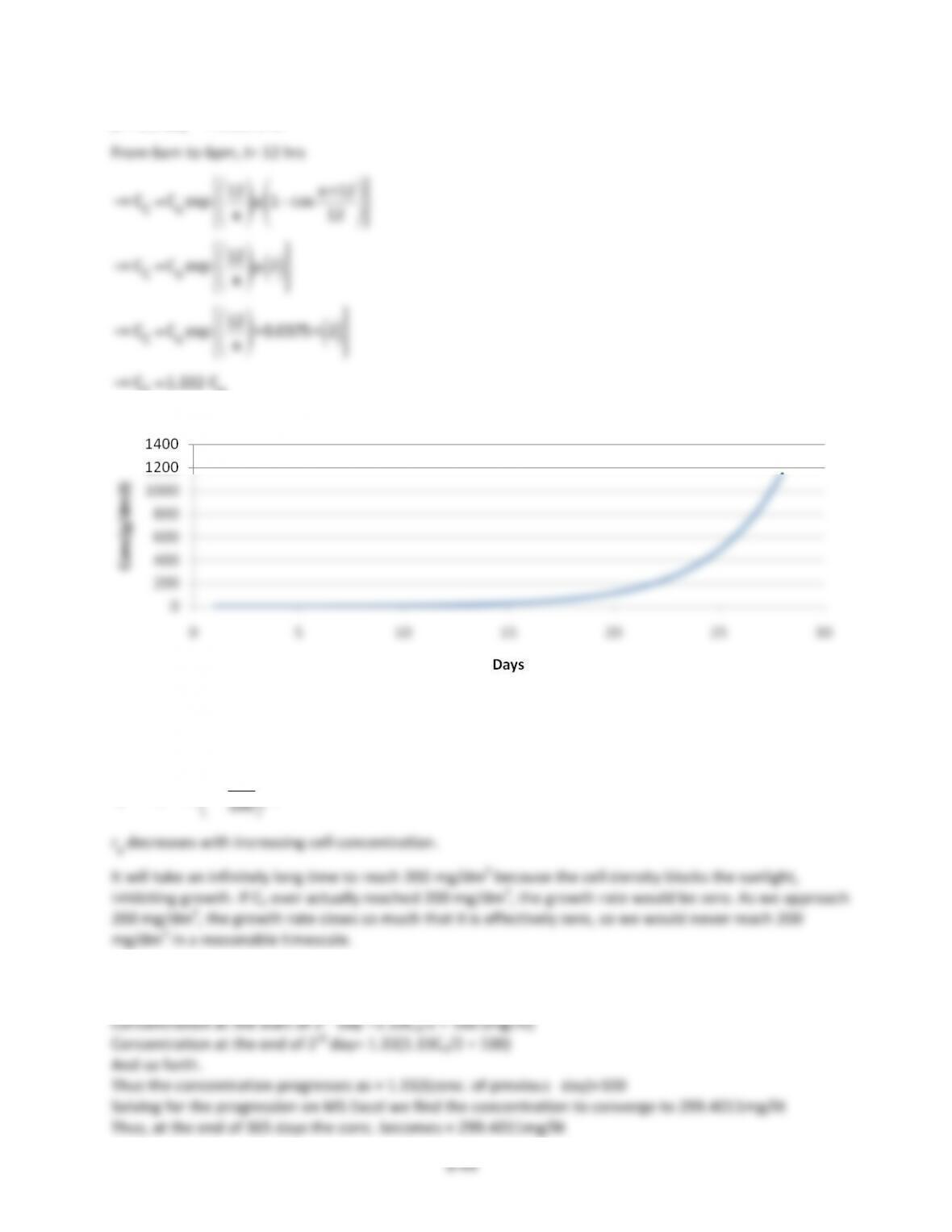
9-44$
P9–21)(b))Continued$
µ$=$0.9$day$–1$$=$0.0375$hr–1$
From$6am$to$6pm,$t=$12$hrs$
⇒CC=Coexp 12
π
#
$
%&
‘
(∗0.0375∗2
( )
+
,
–
.
–
/
0
–
1
–
⇒CC=1.332/Co
Thus$the$concentration$progresses$as$=$1.332(conc.$of$previous$day)$
$
Therefore$the$time$taken$to$reach$the$concentration$of$200$mg/dm3$using$MS$Excel$is$22$days.$
$
P9–21)(c)$Now$𝜇$is$a$function$of$Cc.$
rg=
µ
CC=
µ
01−CC
200
“
#
$
$
%
&
‘
‘CC
$
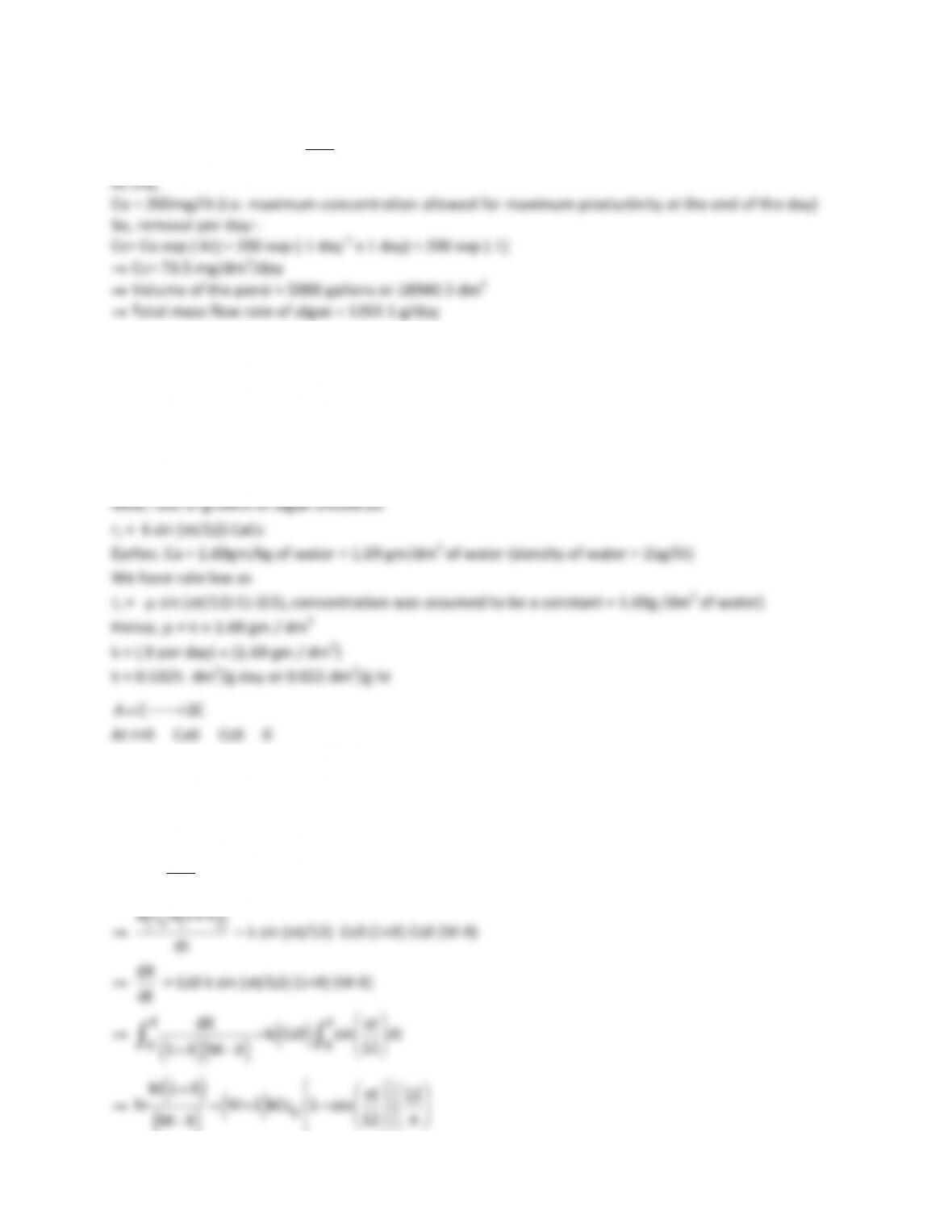
rg$decreases$with$increasing$cell$concentration.$
P9–21)(d)$From$part$(b)$
Concentration$at$the$end$of$1st$day$=$1.33Co$
Concentration$at$the$start$of$2nd$day$=1.33Co/2$+$100$(mg/lit)$
9-45$
P9–21)(e)$Assuming$that$dilution$and$removal$of$algae$is$done$at$the$end$of$the$day$after$the$growth$
period$is$over.$Then,$
Rate$of$decrease$of$conc.$=$
dCC
dt
$=$–k$CC$where,$k$=$1$(day–1)$
At$t=0,$
P9–21)(f)$Now,$since$CO2$will$affect$the$rate$of$growth$of$algae$too,$then$let$the$reaction$be:$
CO2$+$Algae$
! →!
$more$algae$
Hence,$
A+C! →! 2C
$
Where,&&A :&&CO2
C :&&algae
$
Now,$rate$of$growth$of$algae$should$be$
A+C! →! 2C
$
Let$conversion$with$respect$to$C$is$X$
Then,$at$t=t$$$$$$Ca0$–$XCc0$$$$$$Cc0$(1-X)$$$$$$2Cc0X$$$$$$thus,$total$number$of$moles$of$C$
Cc=$Cc0$(1$+$X)$
Ca=$Ca0$–$XCc0$=$Cc0$(M$–$X)$$$$$$where,$M=$Ca0/Cc0$$$
Hence,$
dCC
dt
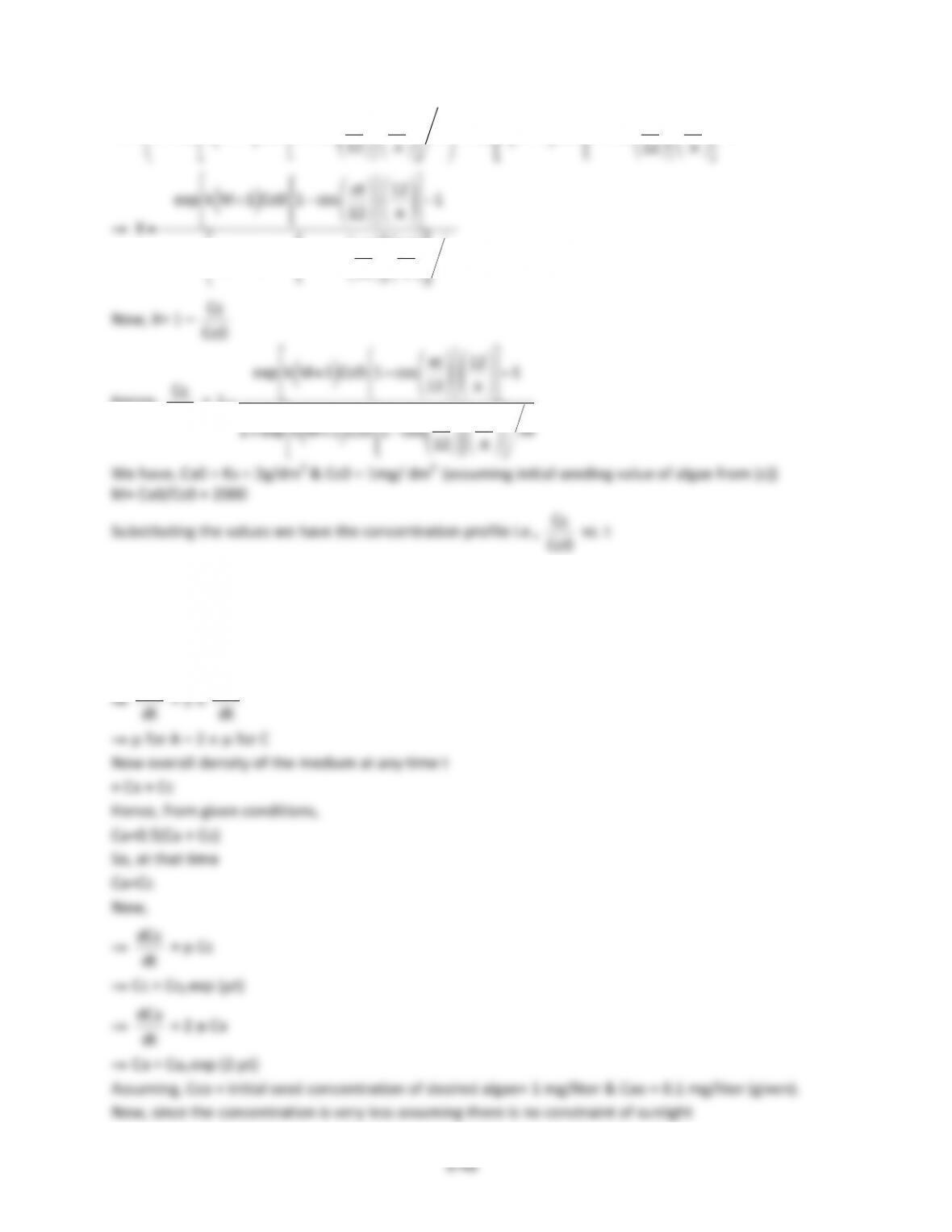
$=$k$sin$(πt/12)$$CaCc$$
⇒$
d CC0 1 +X
( )
( )
dt
$=$k$sin$(πt/12)$$Cc0$(1+X)$Cc0$(M–X)$$
P9–21)(f))Continued$
⇒$
X 1+exp k M+1
( )
Cc0 1−cos πt
12
#
$
%&
‘
(
)
*
+
,
+
–
.
+
/
+
12
π
#
$
%&
‘
(
0
1
2
2
3
4
5
5M
#
$
%
%
&
‘
(
(=exp k M+1
( )
Cc0 1−cos πt
12
#
$
%&
‘
(
)
*
+
,
+
–
.
+
/
+
12
π
#
$
%&
‘
(
0
1
2
2
3
4
5
5−1
$
⇒$
X=
exp k M+1
( )
Cc0 1−cos πt
12
#
$
%&
‘
(
)
*
+
,
+
–
.
+
/
+
12
π
#
$
%&
‘
(
0
1
2
2
3
4
5
5−1
#
)
–
#
0
3
$

9-47$
P9–21)(g))Continued$
⇒$Ca$=$Cc$
⇒$Cc0$exp$(µt)$=$Ca0$exp$(2$µt)$
$
)
P9–22)No$solution$will$be$given$
$
)
$