13-1$
Solutions)for)Chapter)13)–)Unsteady)State)Non–isothermal)
Reactor)Design)
)
P13-1)(a))Example)13-1)
(i)$The$reaction$runs$away$at$T0$=$282.2$K$
$
(ii)$$
(1)$Runaway$occurs$at$Ta1$=$292$K$
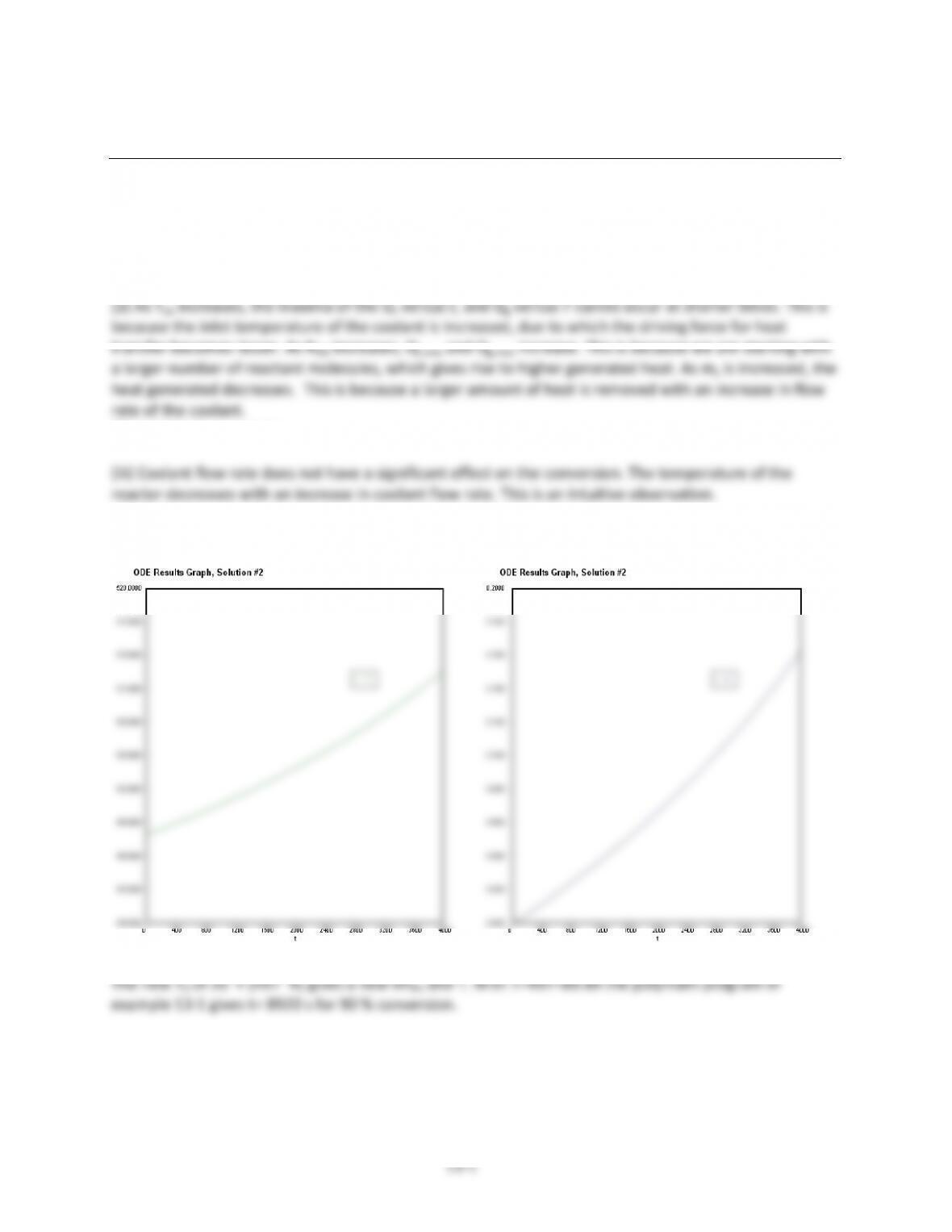
(2)$As$Ta1$increases,$the$maxima$of$the$Qr$versus$t,$and$Qg$versus$T$curves$occur$at$shorter$times.$This$is$
$
(iv)$$
If$the$heat$of$mixing$had$been$neglected,$the$shape$of$the$graphs$would$have$been$as$follows:$
)
(v)$$
The$new$T0$of$20$˚F$(497$˚R)$gives$a$new$δHRn$and$T.$With$T=497+89.8X$the$polymath$program$of$
13-2$
P13-1)(a)$Continued$
(vi)$
Calculated values of DEQ variables$$
Variable
Initial value
Minimal value
Maximal value
Final value
1
t
0
0
9000.
9000.
2
X
0
0
1.
1.
3
T
480.
480.
894.193
894.193
4
k
8.307E–06
8.307E–06
56.65781
56.65781
5
Ta
896.4
896.4
896.4
896.4
6
Ua
0.22
0.22
0.22
0.22
7
Qr
91.608
0.4855311
91.608
0.4855311
8
V
1.2
1.2
1.2
1.2
9
Nao
1.
1.
1.
1.
10
NiCpi
403.
403.
403.
403.
11
Ca
0.8333333
–5.468E–07
0.8333333
–1.392E–09
12
ra
–6.923E–06
–0.0038571
8.639E–06
7.887E–08
13
Qg
–0.3016323
–168.055
0.3763917
0.0034364
Differential equations$$
1
d(X)/d(t) = k * (1 – X)
2
d(T)/d(t) = (Qr – (-36309) * (–ra) * V) / NiCpi
$
Explicit equations$$
1
k = 0.000273 * exp(16306 * ((1 / 535) – (1 / T)))
2
Ta = 896.4
3
Ua = .22
4
Qr = Ua * (Ta – T)
5
V = 1.2
6
Nao = 1
7
NiCpi = 403
8
Ca = (Nao/V) * (1 – X)
9
ra = –k * Ca
10
Qg = (–36309) * (–ra) * V
13-3$
P13-1)(a)$Continued$
$
P13-1)(b))Example)13-2)
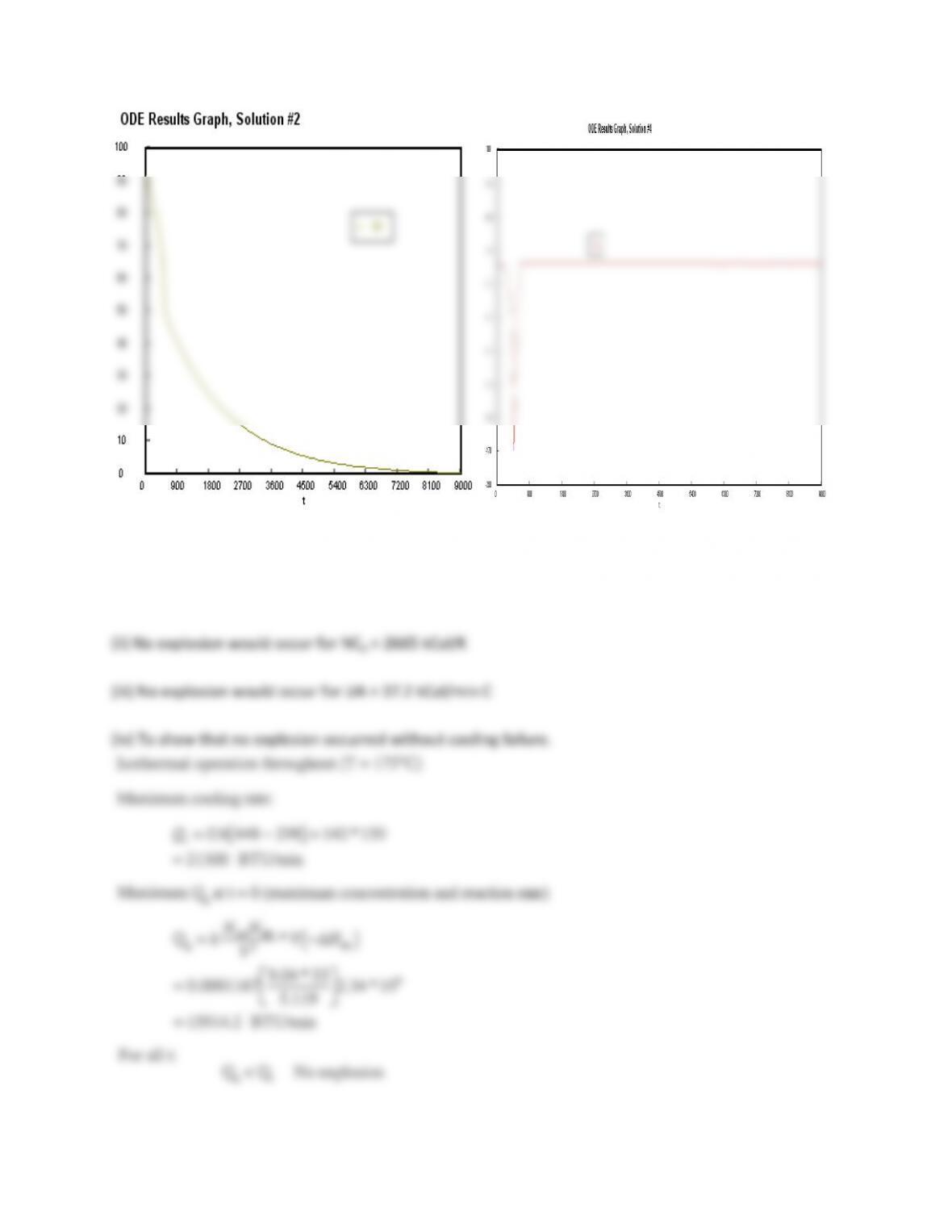
(i)$No$explosion$would$occur$for$NA0$<$8.9$kmol.$Similarly,$no$explosion$would$have$occurred$for$NB0$<$
32.2$kmol$
$
13-4$
P13-1)(b)$Continued$
(v)$
$
P13-1)(c))Example)13-3)
(i)$1650$lbmol/hr$
$
(ii)$No,$it$is$not$possible.$
13-5$
P13-1)(c)$Continued$
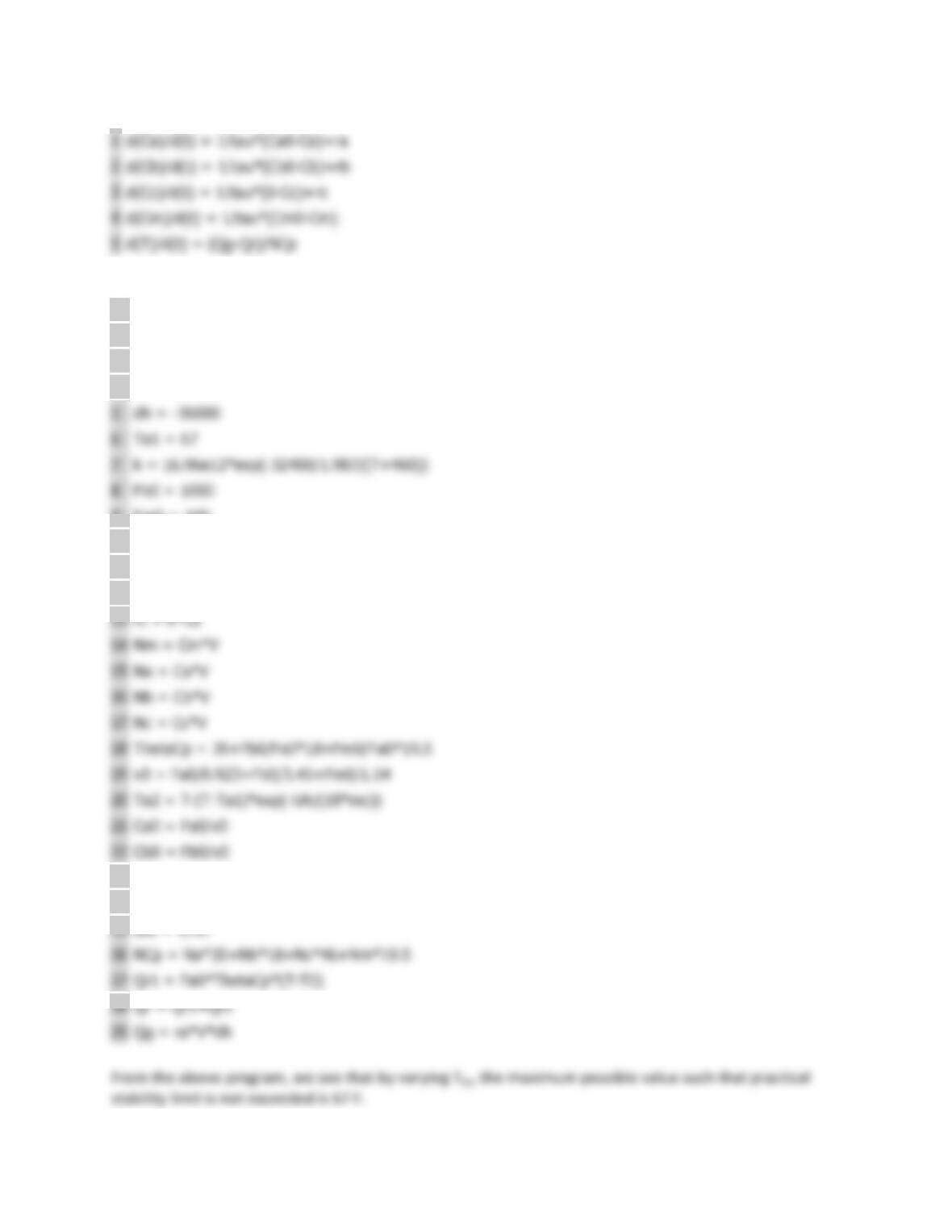
POLYMATH Report
Ordinary Differential Equations
Calculated values of DEQ variables
Variable
Initial value
Minimal value
Maximal value
Final value
1
Ca
0.1
0.0074672
0.1
0.0309593
2
Ca0
0.1812152
0.1812152
0.1812152
0.1812152
3
Cb
3.45
2.114934
3.45
2.114934
4
Cb0
2.26519
2.26519
2.26519
2.26519
5
Cc
0
0
0.1502559
0.1502559
6
Cm
0
0
0.226519
0.226519
7
Cm0
0.226519
0.226519
0.226519
0.226519
8
dh
–3.6E+04
–3.6E+04
–3.6E+04
–3.6E+04
9
Fa0
80.
80.
80.
80.
10
Fb0
1000.
1000.
1000.
1000.
11
Fm0
100.
100.
100.
100.
12
k
41.71035
31.59807
144.4831
32.06998
13
mc
1000.
1000.
1000.
1000.
14
Na
6.680919
0.4988795
6.680919
2.068369
15
Nb
230.4917
141.2971
230.4917
141.2971
16
Nc
0
0
10.03847
10.03847
17
NCp
4382.683
3372.614
4382.683
3372.614
18
Nm
0
0
15.13355
15.13355
19
Qg
1.003E+07
2.339E+06
1.003E+07
2.388E+06
20
Qr
2.586E+06
2.377E+06
3.578E+06
2.388E+06
21
Qr1
1.706E+06
1.564E+06
2.383E+06
1.571E+06
22
Qr2
8.798E+05
8.133E+05
1.195E+06
8.168E+05
23
ra
–4.171035
–4.171035
–0.9725584
–0.9928658
24
rb
–4.171035
–4.171035
–0.9725584
–0.9928658
25
rc
4.171035
0.9725584
4.171035
0.9928658
26
T
150.
143.7291
179.7336
144.0607
27
t
0
0
4.
4.
28
T0
75.
75.
75.
75.
29
Ta1
67.
67.
67.
67.
30
Ta2
115.8777
112.1848
133.3874
112.3801
31
tau
0.1513355
0.1513355
0.1513355
0.1513355
32
ThetaCp
284.375
284.375
284.375
284.375
33
UA
1.6E+04
1.6E+04
1.6E+04
1.6E+04
34
V
66.80919
66.80919
66.80919
66.80919
35
v0
441.464
441.464
441.464
441.464
13-6$
P13-1)(c)$Continued$
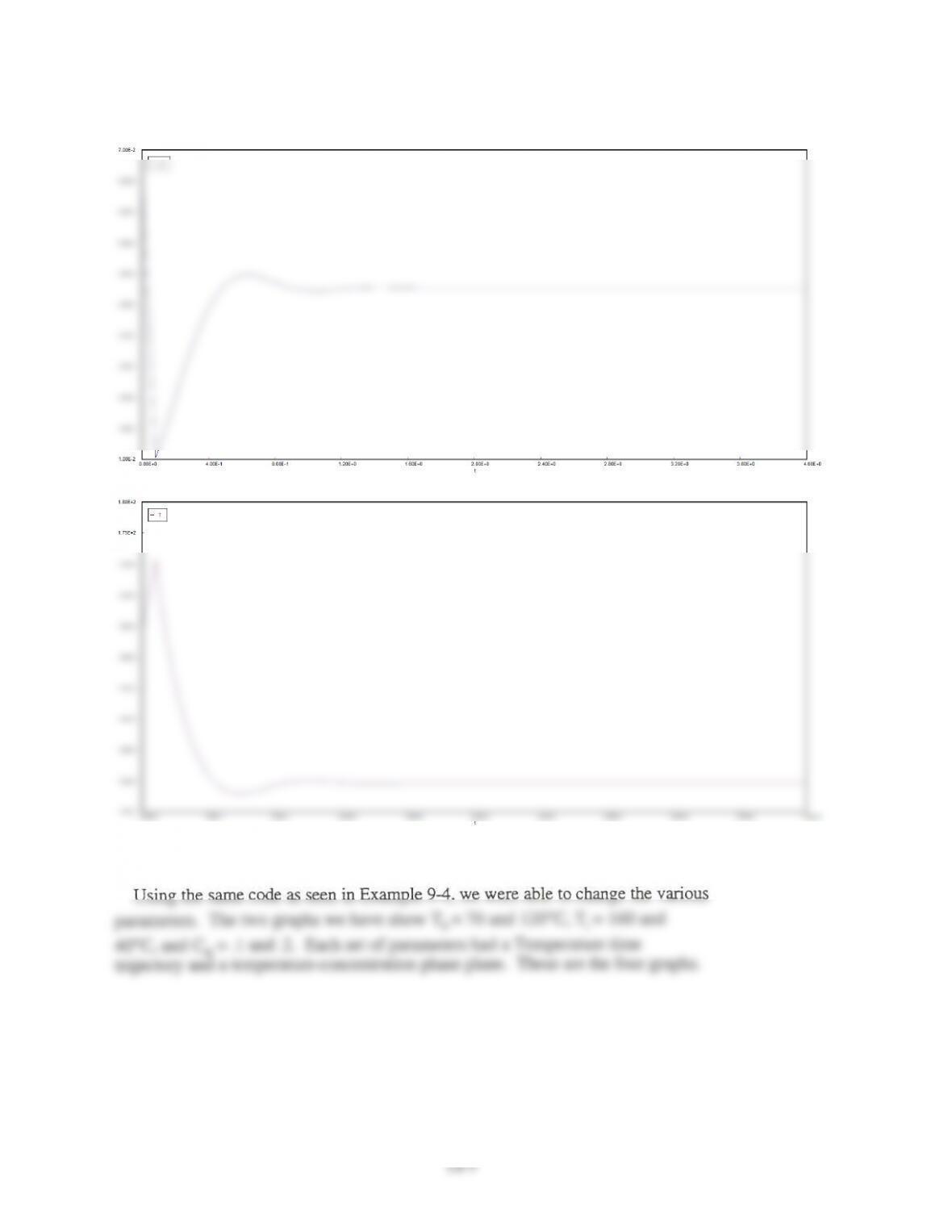
Differential equations
1
d(Ca)/d(t) = 1/tau*(Ca0–Ca)+ra
2
d(Cb)/d(t) = 1/tau*(Cb0–Cb)+rb
3
d(Cc)/d(t) = 1/tau*(0–Cc)+rc
4
d(Cm)/d(t) = 1/tau*(Cm0–Cm)
5
d(T)/d(t) = (Qg–Qr)/NCp
Explicit equations
1
Fa0 = 80
2
T0 = 75
3
V = (1/7.484)*500
4
UA = 16000
5
dh = –36000
6
Ta1 = 67
7
k = 16.96e12*exp(–32400/1.987/(T+460))
8
Fb0 = 1000
9
Fm0 = 100
10
mc = 1000
11
ra = –k*Ca
12
rb = –k*Ca
13
rc = k*Ca
14
Nm = Cm*V
15
Na = Ca*V
16
Nb = Cb*V
17
Nc = Cc*V
18
ThetaCp = 35+Fb0/Fa0*18+Fm0/Fa0*19.5
19
v0 = Fa0/0.923+Fb0/3.45+Fm0/1.54
20
Ta2 = T–(T–Ta1)*exp(–UA/(18*mc))
21
Ca0 = Fa0/v0
22
Cb0 = Fb0/v0
23
Cm0 = Fm0/v0
24
Qr2 = mc*18*(Ta2–Ta1)
25
tau = V/v0
26
NCp = Na*35+Nb*18+Nc*46+Nm*19.5
27
Qr1 = Fa0*ThetaCp*(T–T0)
28
Qr = Qr1+Qr2
29
Qg = ra*V*dh
$
13-7$
P13-1)(c)$Continued$
(v)$See$polymath$program$p13–1cv.pol$
$
$
$
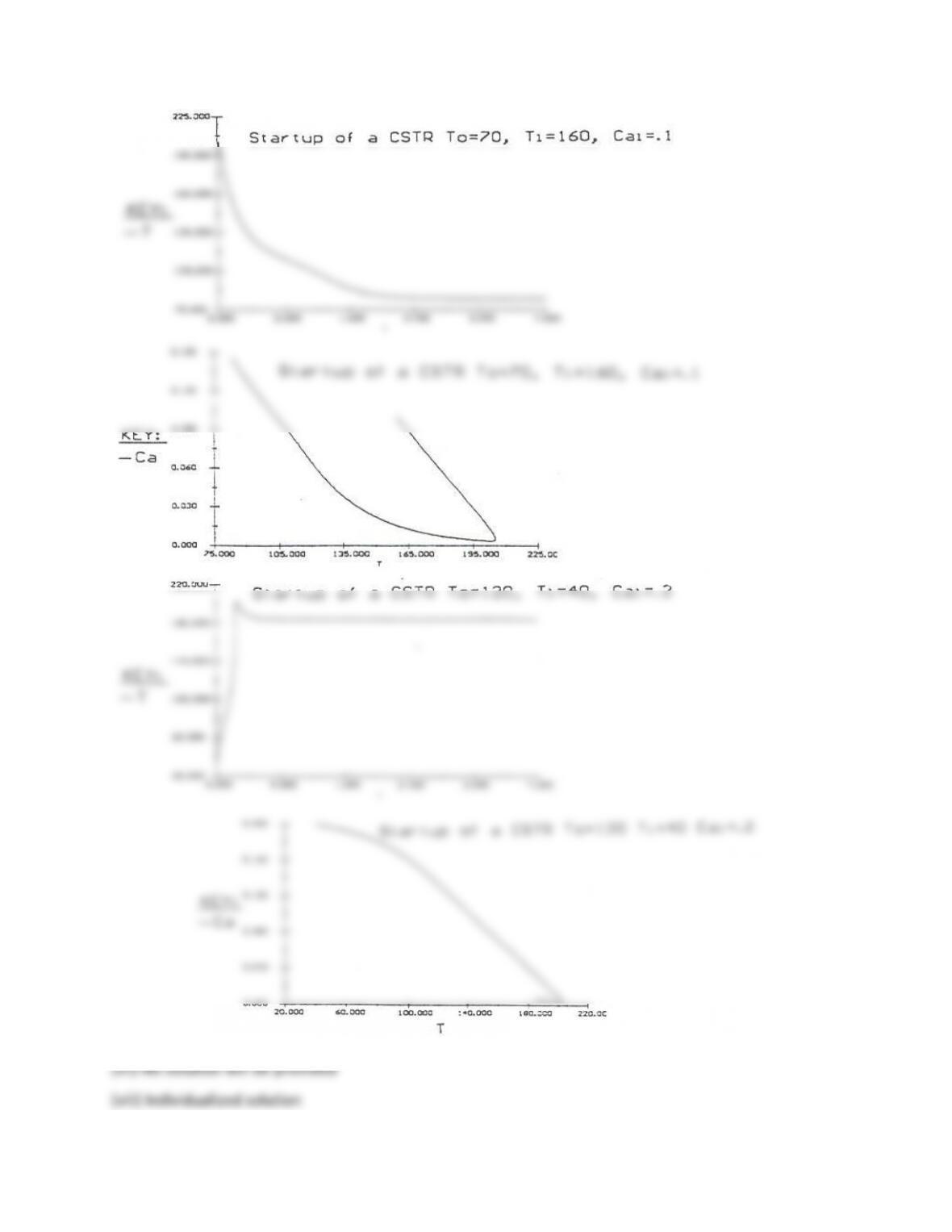
(vi)$
$
13-8$
P13-1)(c)$Continued$
$
$
$
$
$
(vii)$No$solution$will$be$provided$
13-9$
P13–1)(c)$Continued$
(ix)$Time$to$reach$steady$state$increases$with$increase$in$tank$volume.$When$the$tank$volume$is$at$its$
minimum,$practical$stability$limit$is$not$exceeded$for$any$of$the$three$sets$of$initial$conditions.$However,$
as$we$increase$the$volume,$it$is$observed$that$for$Ti$=$340$K$and$CAi$=$1.4$M,$the$practical$stability$is$
P13-1)(d))Example)13-4$
(i)$The$maximum$in$CC$increases$with$an$increase$in$CB0.$
$
P13-1)(e))Example)13-5$
(i)$One$of$the$possible$combinations$is$CA0$=$8$mol/dm3$and$𝑣!=$240$dm3/h.$
$
13–10$
P13-1)(e)$Continued$
$
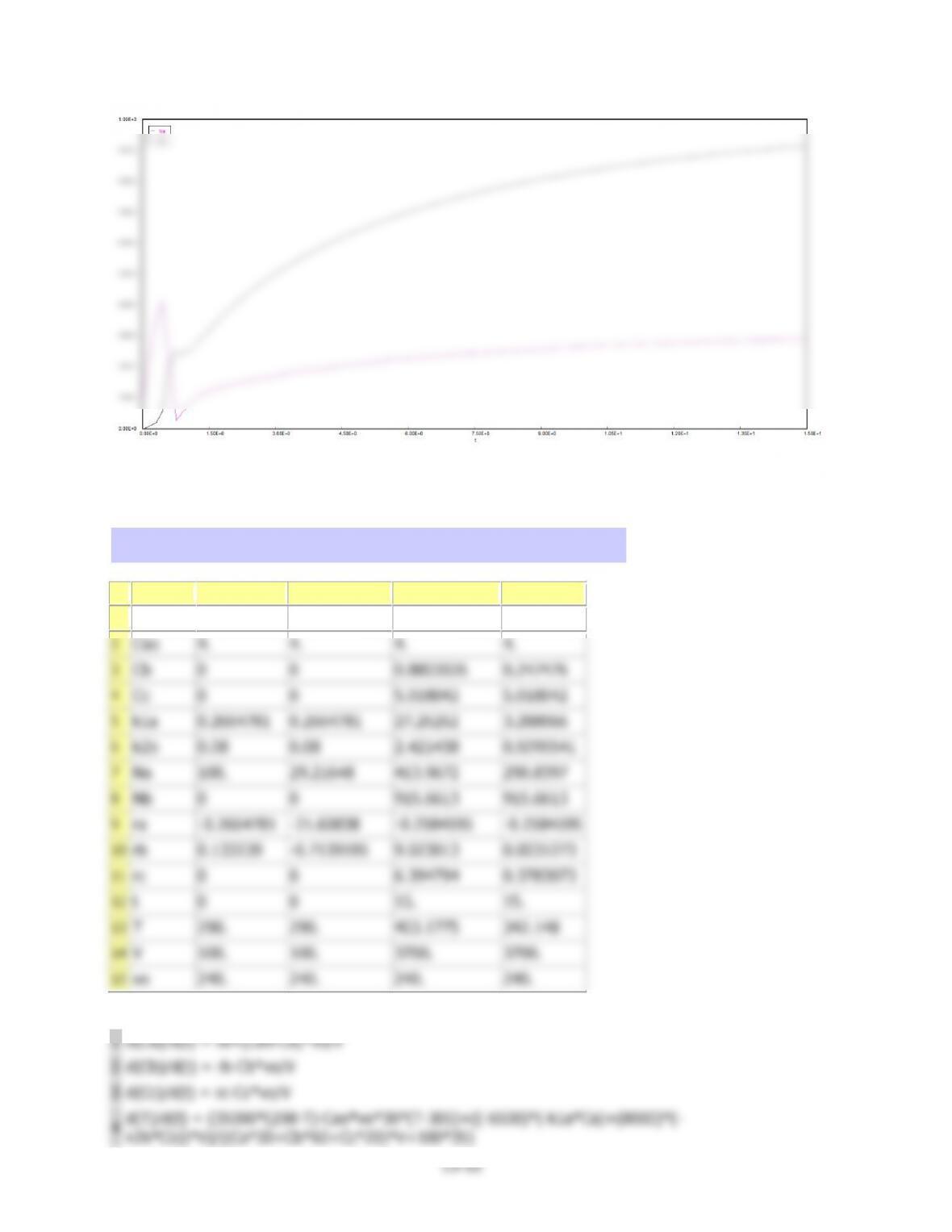
We$can$see$from$the$graph$that$NA$and$NB$become$constant$at$large$times.$
(vi)$See$polymath$program$P13–1evi.pol$
$
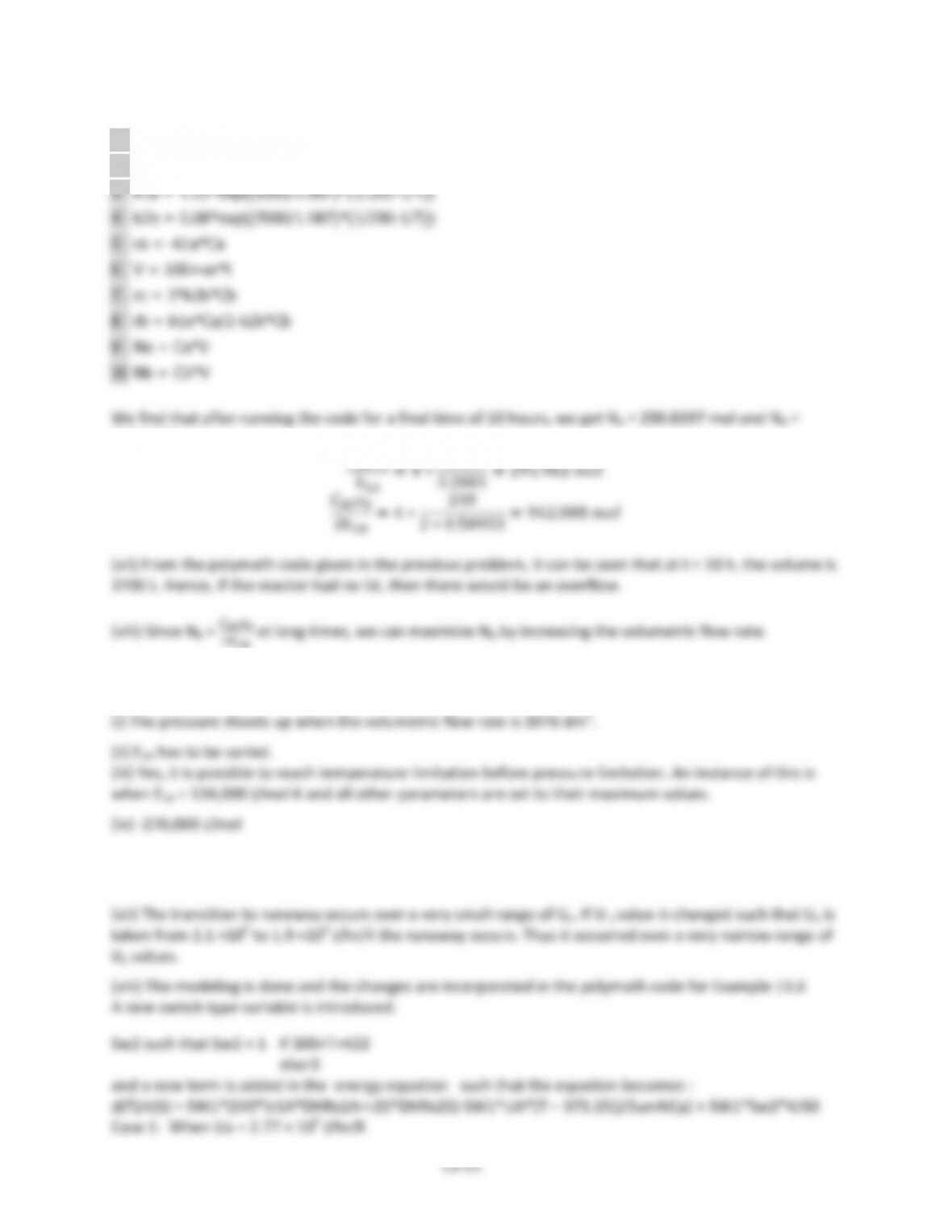
POLYMATH Report
Ordinary Differential Equations
Calculated values of DEQ variables
Variable
Initial value
Minimal value
Maximal value
Final value
1
Ca
1.
0.0786053
2.036072
0.0786053
2
Cao
4.
4.
4.
4.
3
Cb
0
0
0.8803026
0.247476
4
Cc
0
0
5.018042
5.018042
5
k1a
0.2664781
0.2664781
27.26262
3.288066
6
k2b
0.08
0.08
2.421438
0.5095541
7
Na
100.
29.21648
413.9672
290.8397
8
Nb
0
0
915.6613
915.6613
9
ra
–0.2664781
-21.60838
–0.2584595
–0.2584595
10
rb
0.133239
–0.7139195
9.023013
0.0031273
11
rc
0
0
6.394794
0.3783073
12
t
0
0
15.
15.
13
T
290.
290.
403.1775
342.148
14
V
100.
100.
3700.
3700.
15
vo
240.
240.
240.
240.
Differential equations
1
d(Ca)/d(t) = ra+(Cao–Ca)*vo/V
2
d(Cb)/d(t) = rb–Cb*vo/V
3
d(Cc)/d(t) = rc–Cc*vo/V
4
d(T)/d(t) = (35000*(298–T)–Cao*vo*30*(T–305)+((–6500)*(–k1a*Ca)+(8000)*(–
k2b*Cb))*V)/((Ca*30+Cb*60+Cc*20)*V+100*35)
13–11$
P13-1)(e)$Continued$
Explicit equations
1
Cao = 4
2
vo = 240
3
k1a = 1.25*exp((9500/1.987)*(1/320–1/T))
4
k2b = 0.08*exp((7000/1.987)*(1/290–1/T))
5
ra = –k1a*Ca
6
V = 100+vo*t
7
rc = 3*k2b*Cb
8
rb = k1a*Ca/2–k2b*Cb
9
Na = Ca*V
10
Nb = Cb*V
$
We$find$that$after$running$the$code$for$a$final$time$of$10$hours,$we$get$NA$=$290.8397$mol$and$NB$=$
915.6613$mol.$$
𝐶
!!𝑣!
𝑘!!
=4∗
240
3.2881
=291.962 𝑚𝑜𝑙$
$
P13-1)(f))Example)13-6)
(i)$The$pressure$shoots$up$when$the$volumetric$flow$rate$is$3976$dm3.$
(v)$Individualized$solution$
(vi)$Individualized$solution$
(vii)$The$transition$to$runaway$occurs$over$a$very$small$range$of$Ua.$If$U$a$value$is$changed$such$that$Ua$is$
13–12$
P13-1)(f)$Continued$
But$the$cooling$starts$only$for$T>455K$
Thus$Ua$=$2.77$×$106$J/hr/K,$T>$455K$
$$$$$$$$$$$$$$$=$0$for$T<$455K$
$
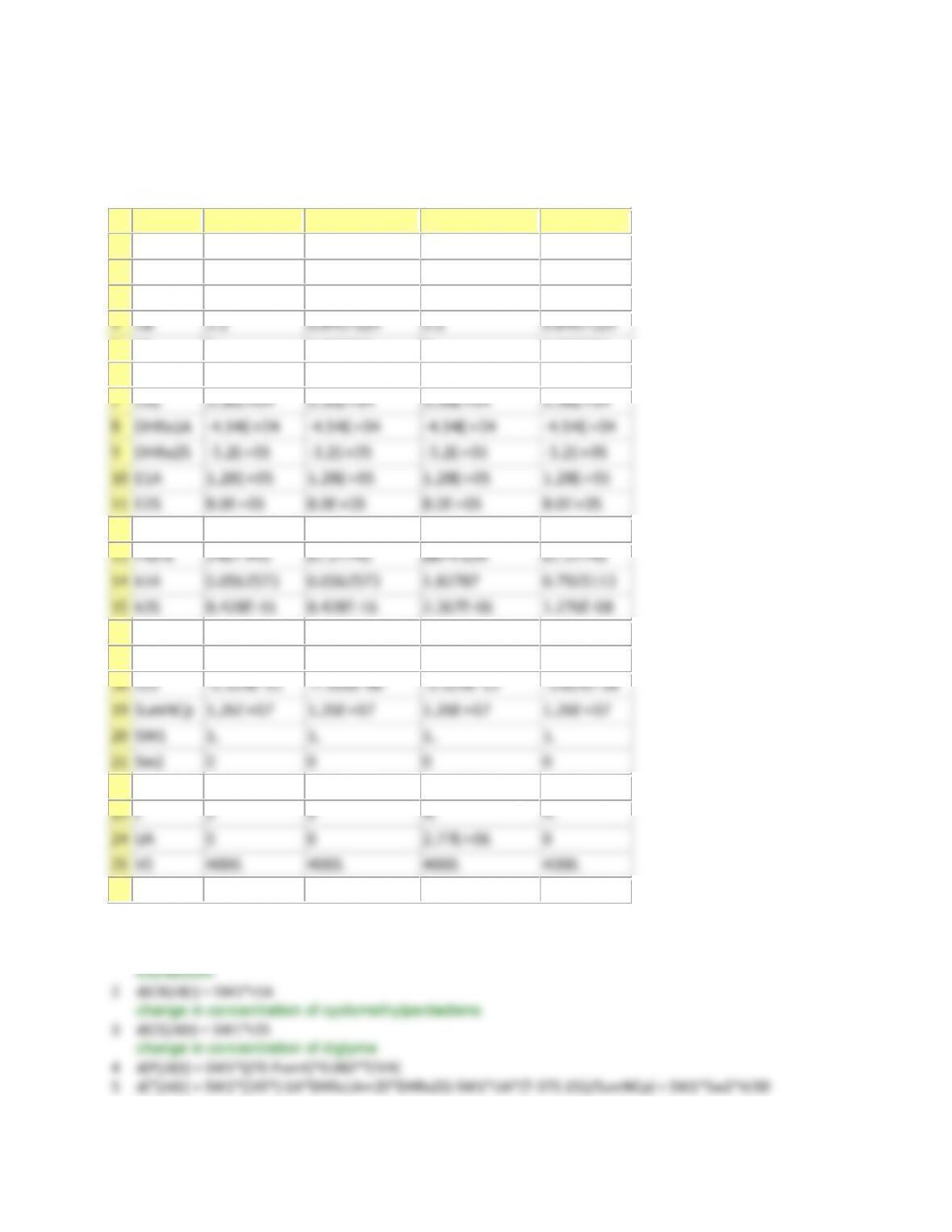
Calculated values of DEQ variables$$
Variable
Initial value
Minimal value
Maximal value
Final value
1
A1A
4.0E+14
4.0E+14
4.0E+14
4.0E+14
2
A2S
1.0E+84
1.0E+84
1.0E+84
1.0E+84
3
CA
4.3
0.0457129
4.3
0.0457129
4
CB
5.1
0.8457129
5.1
0.8457129
5
CS
3.
2.999997
3.
2.999997
6
Cv1
3360.
3360.
3360.
3360.
7
Cv2
5.36E+04
5.36E+04
5.36E+04
5.36E+04
8
DHRx1A
–4.54E+04
–4.54E+04
–4.54E+04
–4.54E+04
9
DHRx2S
–3.2E+05
–3.2E+05
–3.2E+05
–3.2E+05
10
E1A
1.28E+05
1.28E+05
1.28E+05
1.28E+05
11
E2S
8.0E+05
8.0E+05
8.0E+05
8.0E+05
12
FD
2467.445
61.27745
8874.034
61.27745
13
Fvent
2467.445
61.27745
8874.034
61.27745
14
k1A
0.0562573
0.0562573
1.82787
0.7925113
15
k2S
8.428E–16
8.428E–16
2.367E–06
1.276E–08
16
P
4.4
4.4
4.4
4.4
17
r1A
–1.233723
–4.437017
–0.0306385
–0.0306385
18
r2S
–2.529E–15
–7.102E–06
–2.529E–15
–3.829E–08
19
SumNCp
1.26E+07
1.26E+07
1.26E+07
1.26E+07
20
SW1
1.
1.
1.
1.
21
Sw2
0
0
0
0
22
T
422.
422.
466.4882
454.9731
23
t
0
0
4.
4.
24
UA
0
0
2.77E+06
0
25
V0
4000.
4000.
4000.
4000.
26
VH
5000.
5000.
5000.
5000.
$
Differential equations
1$$
d(CA)/d(t)$=$SW1*r1A$$
$$$
mol/dm3/hr$$
2$$
d(CB)/d(t)$=$SW1*r1A$$
$$$
change in concentration of cyclomethylpentadiene$$
3$$
d(CS)/d(t)$=$SW1*r2S$$
$$$
change in concentration of diglyme$$
4$$
d(P)/d(t)$=$SW1*((FD–Fvent)*0.082*T/VH)$$
5$$
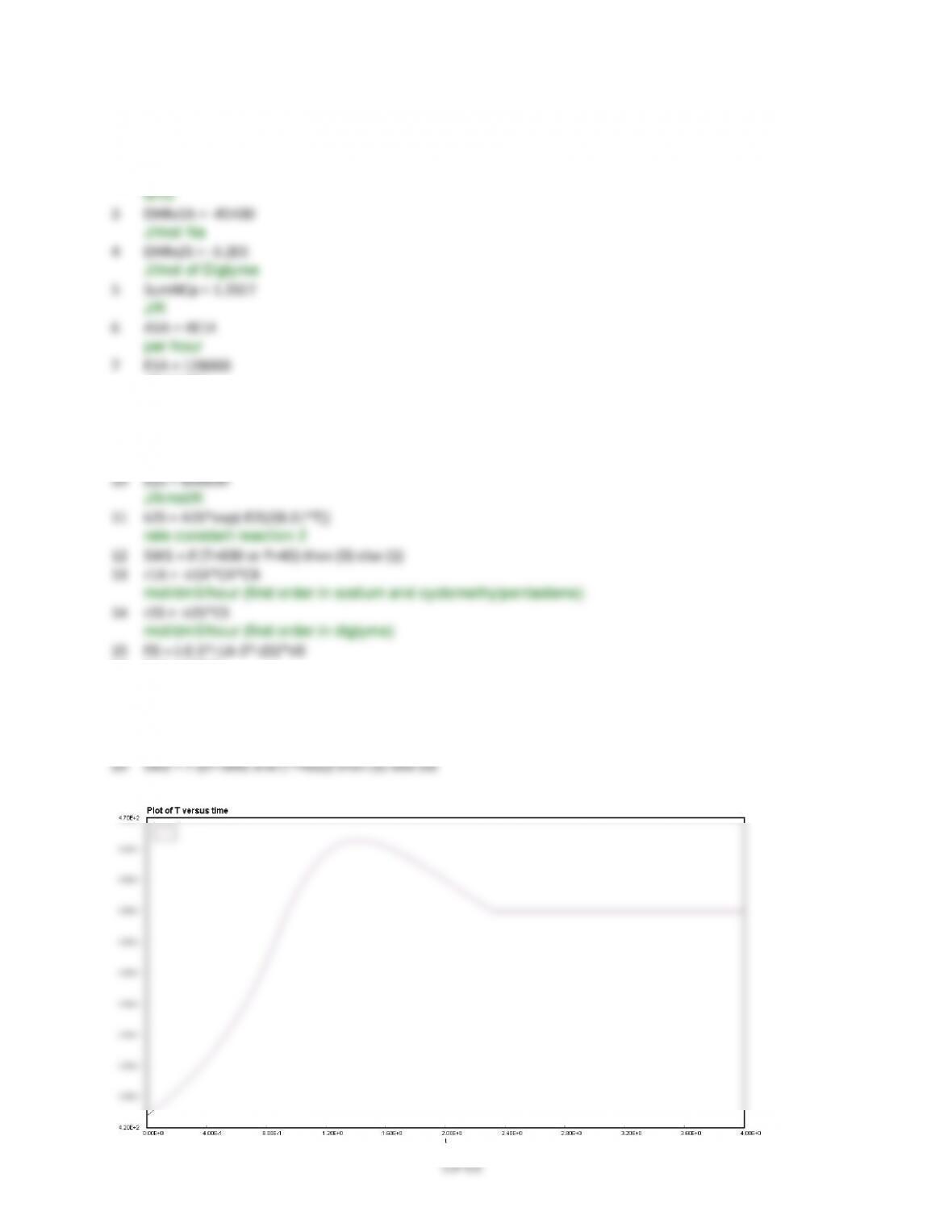
d(T)/d(t)$=$SW1*((V0*(r1A*DHRx1A+r2S*DHRx2S)–SW1*UA*(T–373.15))/SumNCp)$+$SW1*Sw2*4/60$$
13–13$
P13-1)(f)$Continued$
Explicit equations
1$$
V0$=$4000$$
$$$
dm3$$
2$$
VH$=$5000$$
$$$
dm3$$
3$$
DHRx1A$=$–45400$$
$$$
J/mol Na$$
4$$
DHRx2S$=$–3.2E5$$
$$$
J/mol of Diglyme$$
5$$
SumNCp$=$1.26E7$$
$$$
J/K$$
6$$
A1A$=$4E14$$
$$$
per hour$$
7$$
E1A$=$128000$$
$$$
J/kmol/K$$
8$$
k1A$=$A1A*exp(–E1A/(8.31*T))$$
$$$
rate constant reaction 1$$
9$$
A2S$=$1E84$$
$$$
per hour$$
10$$
E2S$=$800000$$
$$$
J/kmol/K$$
11$$
k2S$=$A2S*exp(–E2S/(8.31*T))$$
$$$
rate constant reaction 2$$
12$$
SW1$=$if$(T>600$or$P>45)$then$(0)$else$(1)$$
13$$
r1A$=$–k1A*CA*CB$$
$$$
mol/dm3/hour (first order in sodium and cyclomethylpentadiene)$$
14$$
r2S$=$–k2S*CS$$
$$$
mol/dm3/hour (first order in diglyme)$$
15$$
FD$=$(–0.5*r1A–3*r2S)*V0$$
16$$
Cv2$=$53600$$
17$$
Cv1$=$3360$$
18$$
Fvent$=$if$(FD<11400)$then$(FD)$else(if$(P<28.2)$then$((P–1)*Cv1)$else$($(P–1)*(Cv1$+Cv2)))$$
19$$
UA$=$if$T>$455$then$(2.77e6)$else$(0)$$
$$$
no cooling$$
20$$
Sw2$=$if$((T>300)$and$(T<422))$then$(1)$else$(0)$$
$
$
13–14$
P13-1)(f)$Continued$
$ $
$
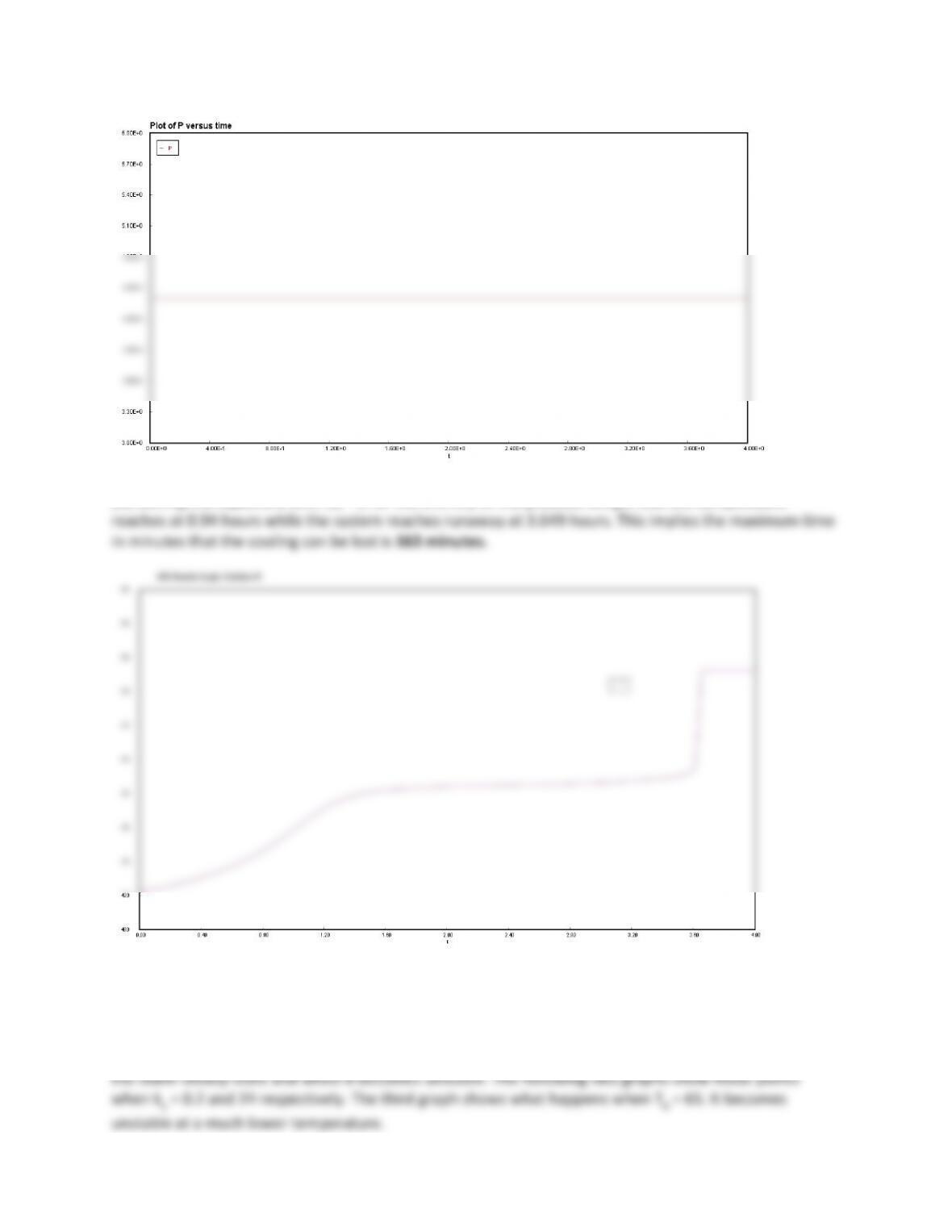
(ix)$Solving$the$equations$with$Ua$=$0$for$the$entirety$of$the$process,$we$get$that$the$temperature$
reaches$at$0.94$hours$while$the$system$reaches$runaway$at$3.649$hours.$This$implies$the$maximum$time$
$
$
(x)$Individualized$solution$
)
P13-1)(g)$Example)RE13-1)
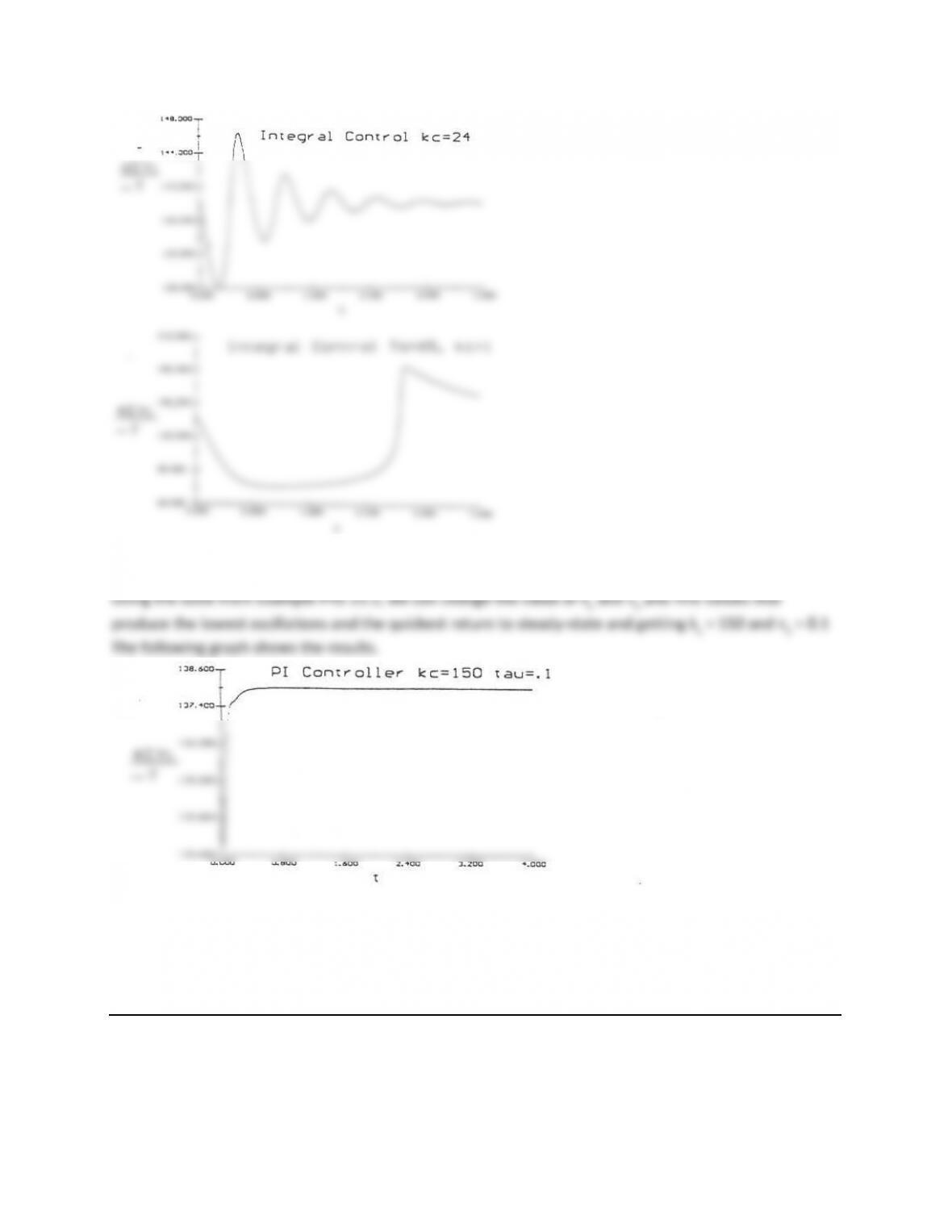
Using$the$code$from$Example$PRS$13.5,$we$can$determine$the$value$of$kc$for$which$the$reactor$will$fall$to$
the$lower$steady–state$and$when$it$becomes$unstable.$The$following$two$graphs$show$those$points$
13–15$
P13-1)(g)$Continued$
$
P13-1)(h))Example)RE13-2$
Using$the$code$from$Example$PRS$13.5,$we$can$change$the$value$of$kc$and$τ1$and$find$values$that$
$
$
P13-1)(i))No$solution$will$be$given$
$
P13–1)(j))Individualized$solution$
$
)
13–16$
P13-2)
After$the$feed$was$shut$off,$$$
)
$
)
See$Polymath$program$P13-2.pol$
Calculated values of DEQ variables
Variable
Initial value
Minimal value
Maximal value
Final value
1
Cpa
0.38
0.38
0.38
0.38
2
dH
–336.
–336.
–336.
–336.
3
k
0.0081711
0.0081711
4.285E+17
4.285E+17
4
T
980.
980.
3.302E+20
3.302E+20
5
t
0
0
4.
4.
Differential equations
1
d(T)/d(t) = –dH * k / Cpa
Explicit equations
1
dH = –336
2
Cpa = .38
3
k = (0.307/60)* exp(44498 * (1 / 970 – 1 / T))
13–17$
P13-2$Continued$
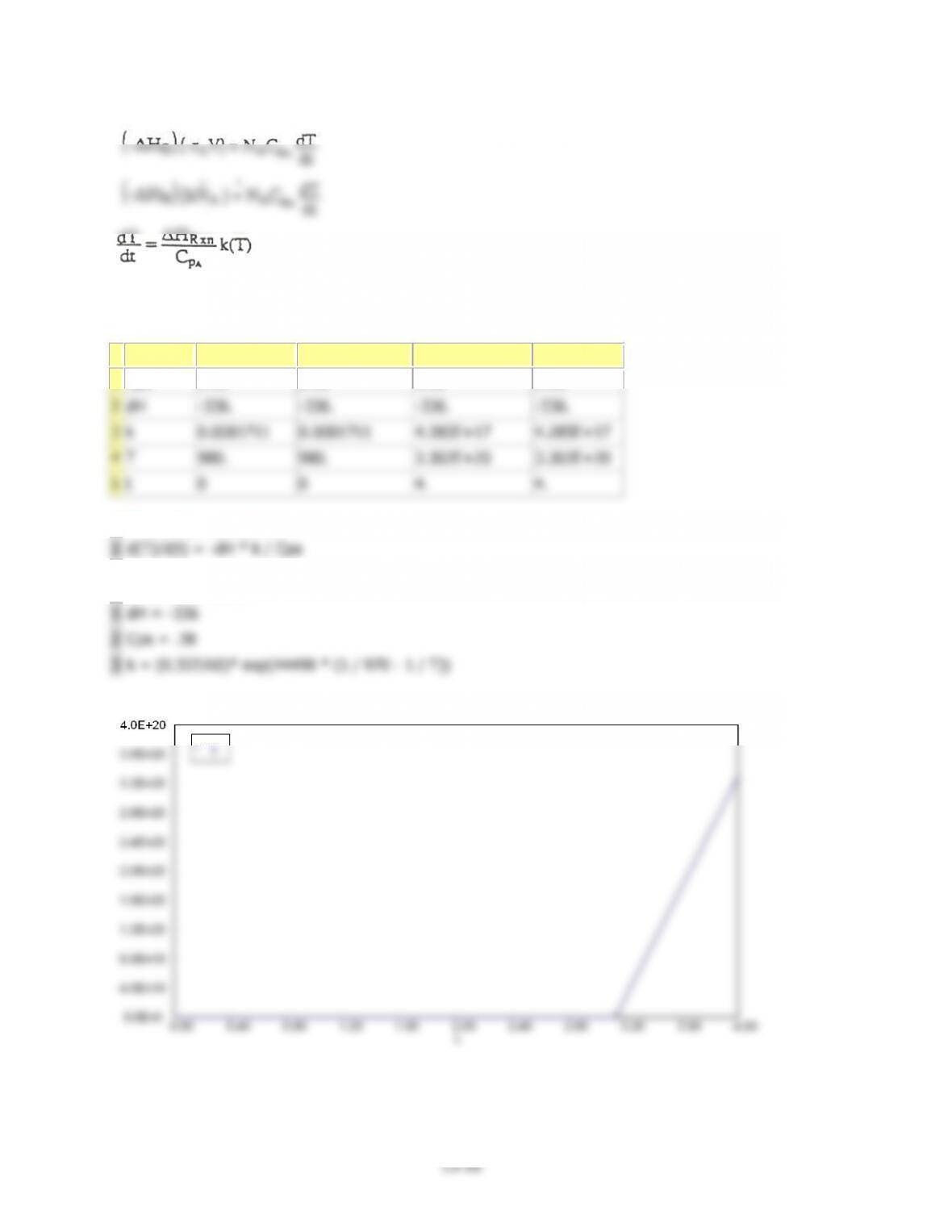
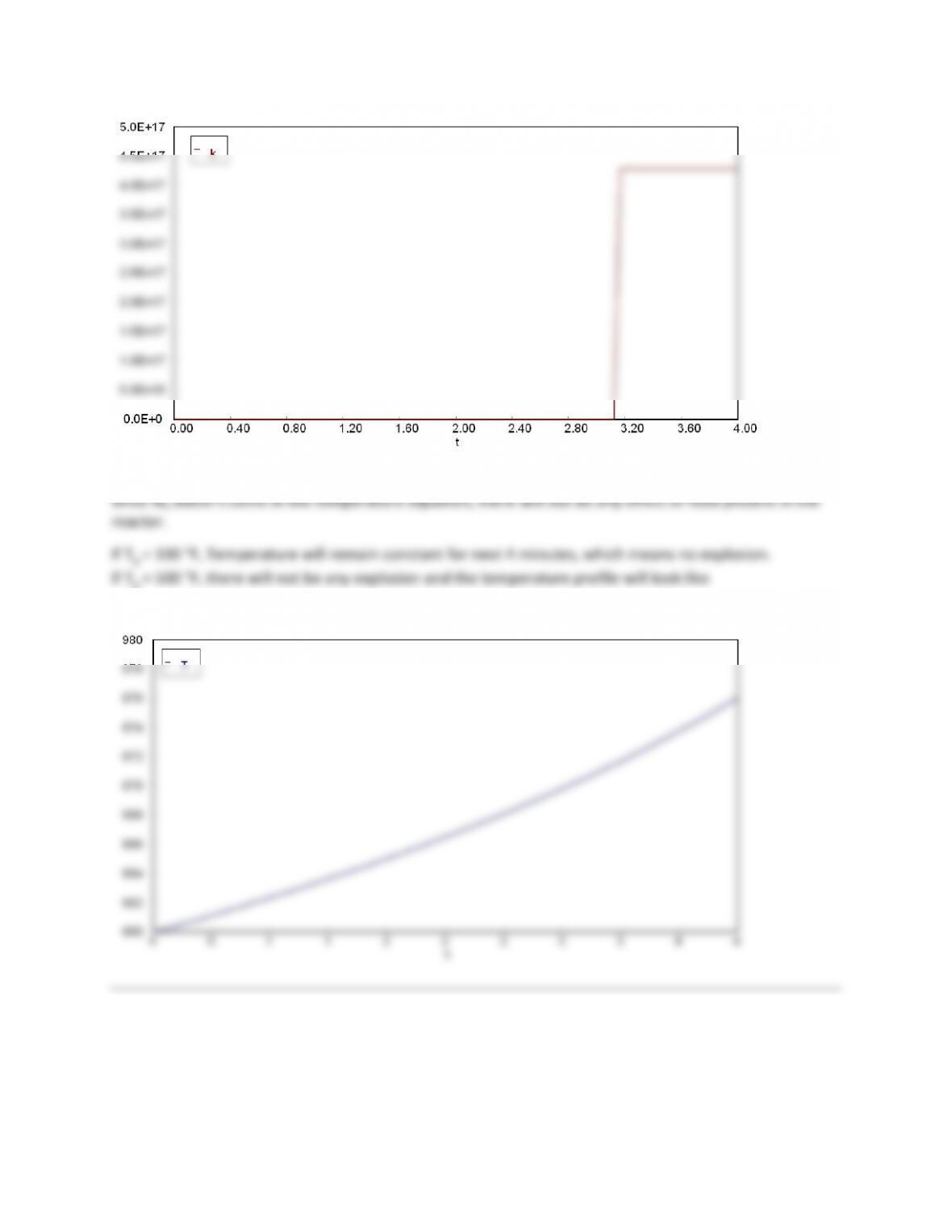
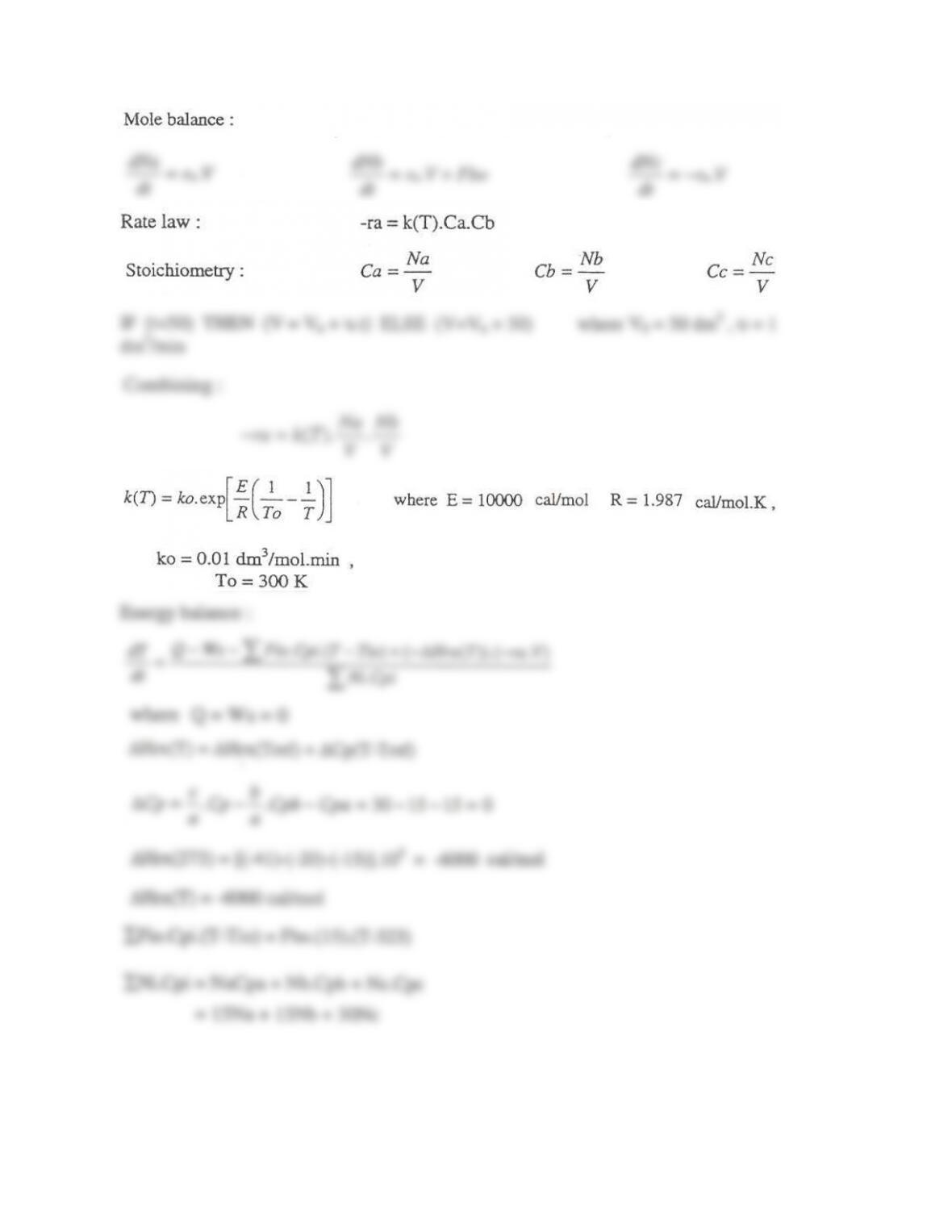
As$can$be$seen$from$the$above$plots,$temperature$shoots$at$time$t)=)3.16)mins)
Since$NA$doesn’t$come$in$the$temperature$equation,$there$will$not$be$any$effect$of$feed$present$in$the$
$
)
13–18$
P13-3)(a))
$
$
$
$
$
$
13–19$
P13-3)(a)$Continued$
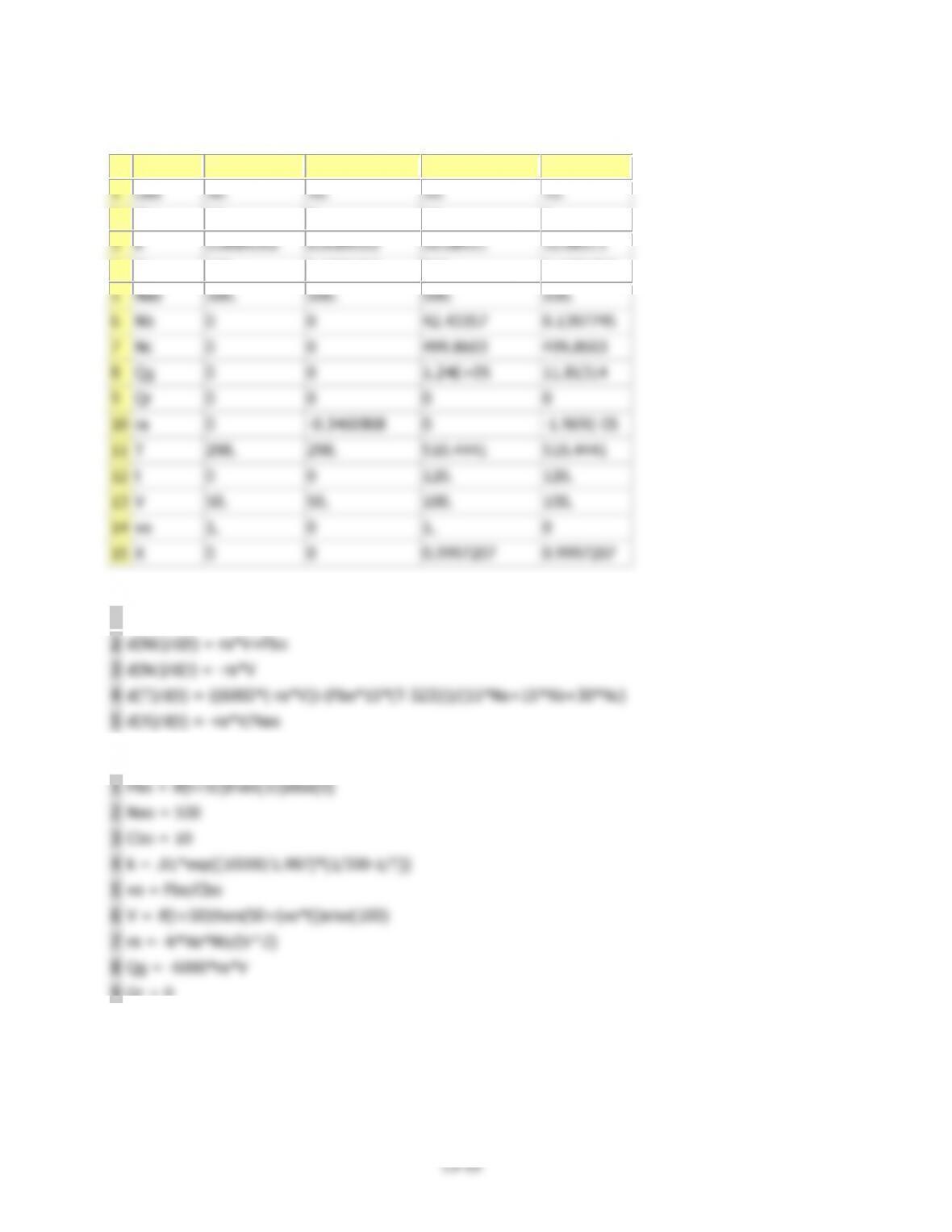
See$Polymath$program$P13-3-a.pol$
Calculated values of DEQ variables
Variable
Initial value
Minimal value
Maximal value
Final value
1
Cbo
10.
10.
10.
10.
2
Fbo
10.
0
10.
0
3
k
0.0089352
0.0089352
10.08511
10.08511
4
Na
500.
0.1396707
500.
0.1396707
5
Nao
500.
500.
500.
500.
6
Nb
0
0
42.43357
0.1397745
7
Nc
0
0
499.8603
499.8603
8
Qg
0
0
1.24E+05
11.81314
9
Qr
0
0
0
0
10
ra
0
–0.3460808
0
–1.969E–05
11
T
298.
298.
510.4441
510.4441
12
t
0
0
120.
120.
13
V
50.
50.
100.
100.
14
vo
1.
0
1.
0
15
X
0
0
0.9997207
0.9997207
Differential equations
1
d(Na)/d(t) = ra*V
2
d(Nb)/d(t) = ra*V+Fbo
3
d(Nc)/d(t) = –ra*V
4
d(T)/d(t) = ((6000*(–ra*V))–(Fbo*15*(T–323)))/(15*Na+15*Nb+30*Nc)
5
d(X)/d(t) = –ra*V/Nao
Explicit equations
1
Fbo = if(t<50)then(10)else(0)
2
Nao = 500
3
Cbo = 10
4
k = .01*exp((10000/1.987)*(1/300–1/T))
5
vo = Fbo/Cbo
6
V = if(t<50)then(50+(vo*t))else(100)
7
ra = –k*Na*Nb/(V^2)
8
Qg = –6000*ra*V
9
Qr = 0