12-1$
Solutions)for)Chapter)12)–)Steady–State)Nonisothermal)
Reactor)Design$
)
P12-1)(a)))
(i)–(vii)$Individualized$solution$
(viii)$They$separate$at$θI$=$1.1.$At$θI$=$1.2,$we$find$that$X$and$Xe$profiles$meet$at$low$α$but$separate$at$
(xii–xiv)$Individualized$solution$
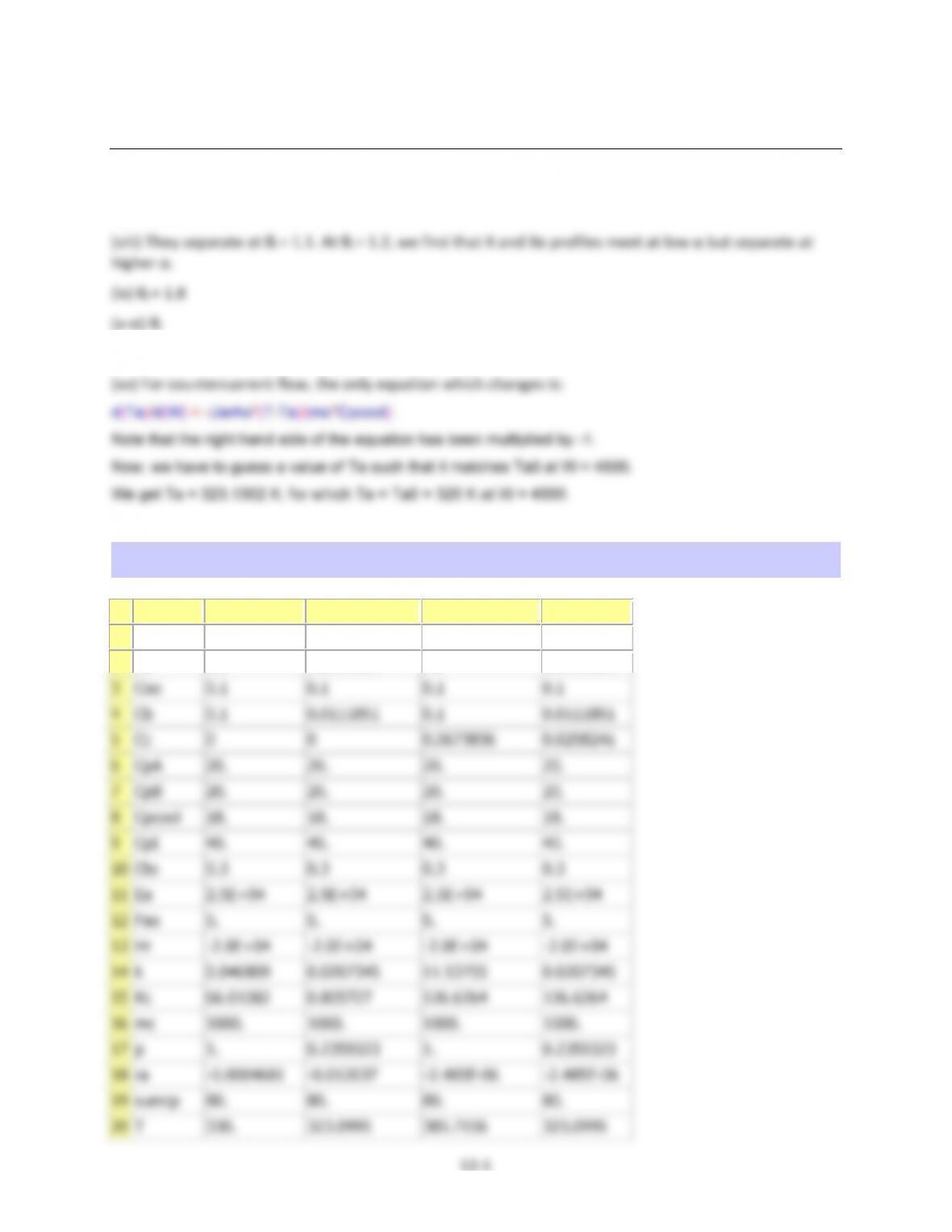
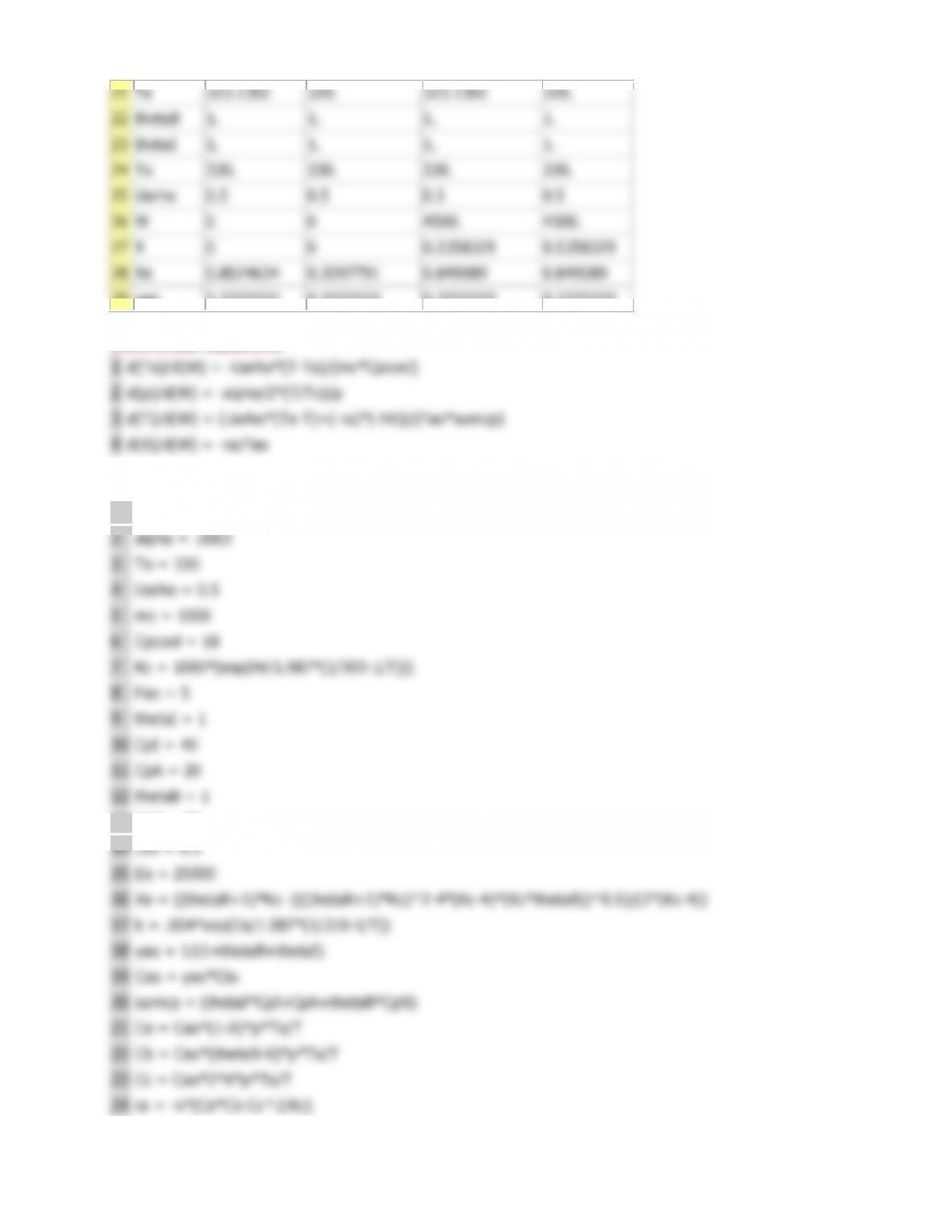
(xv)$For$countercurrent$flow,$the$only$equation$which$changes$is:$
See$Polymath$program$P12–1a–1.pol$
POLYMATH Report
Ordinary Differential Equations
Calculated values of DEQ variables
Variable
Initial value
Minimal value
Maximal value
Final value
1
alpha
0.0002
0.0002
0.0002
0.0002
2
Ca
0.1
0.0111851
0.1
0.0111851
3
Cao
0.1
0.1
0.1
0.1
4
Cb
0.1
0.0111851
0.1
0.0111851
5
Cc
0
0
0.0673836
0.0258241
6
CpA
20.
20.
20.
20.
7
CpB
20.
20.
20.
20.
8
Cpcool
18.
18.
18.
18.
9
CpI
40.
40.
40.
40.
10
Cto
0.3
0.3
0.3
0.3
11
Ea
2.5E+04
2.5E+04
2.5E+04
2.5E+04
12
Fao
5.
5.
5.
5.
13
Hr
–2.0E+04
–2.0E+04
–2.0E+04
–2.0E+04
14
k
0.046809
0.0207345
11.53755
0.0207345
15
Kc
66.01082
0.805727
126.6264
126.6264
16
mc
1000.
1000.
1000.
1000.
17
p
1.
0.2359323
1.
0.2359323
18
ra
–0.0004681
–0.012037
–2.485E–06
–2.485E–06
19
sumcp
80.
80.
80.
80.
20
T
330.
323.0995
385.7156
323.0995
12-2$
21
Ta
323.1302
320.
323.1302
320.
22
thetaB
1.
1.
1.
1.
23
thetaI
1.
1.
1.
1.
24
To
330.
330.
330.
330.
25
Uarho
0.5
0.5
0.5
0.5
26
W
0
0
4500.
4500.
27
X
0
0
0.5358329
0.5358329
28
Xe
0.8024634
0.3097791
0.849089
0.849089
29
yao
0.3333333
0.3333333
0.3333333
0.3333333
Differential equations
1
d(Ta)/d(W) = –Uarho*(T–Ta)/(mc*Cpcool)
2
d(p)/d(W) = –alpha/2*(T/To)/p
3
d(T)/d(W) = (Uarho*(Ta–T)+(–ra)*(–Hr))/(Fao*sumcp)
4
d(X)/d(W) = –ra/Fao
Explicit equations
1
Hr = –20000
2
alpha = .0002
3
To = 330
4
Uarho = 0.5
5
mc = 1000
6
Cpcool = 18
7
Kc = 1000*(exp(Hr/1.987*(1/303–1/T)))
8
Fao = 5
9
thetaI = 1
10
CpI = 40
11
CpA = 20
12
thetaB = 1
13
CpB = 20
14
Cto = 0.3
15
Ea = 25000
16
Xe = ((thetaB+1)*Kc– (((thetaB+1)*Kc)^2–4*(Kc–4)*(Kc*thetaB))^0.5)/(2*(Kc–4))
17
k = .004*exp(Ea/1.987*(1/310–1/T))
18
yao = 1/(1+thetaB+thetaI)
19
Cao = yao*Cto
20
sumcp = (thetaI*CpI+CpA+thetaB*CpB)
21
Ca = Cao*(1–X)*p*To/T
22
Cb = Cao*(thetaB–X)*p*To/T
23
Cc = Cao*2*X*p*To/T
24
ra = –k*(Ca*Cb–Cc^2/Kc)
$
12-3$
P12-1)(a))Continued$
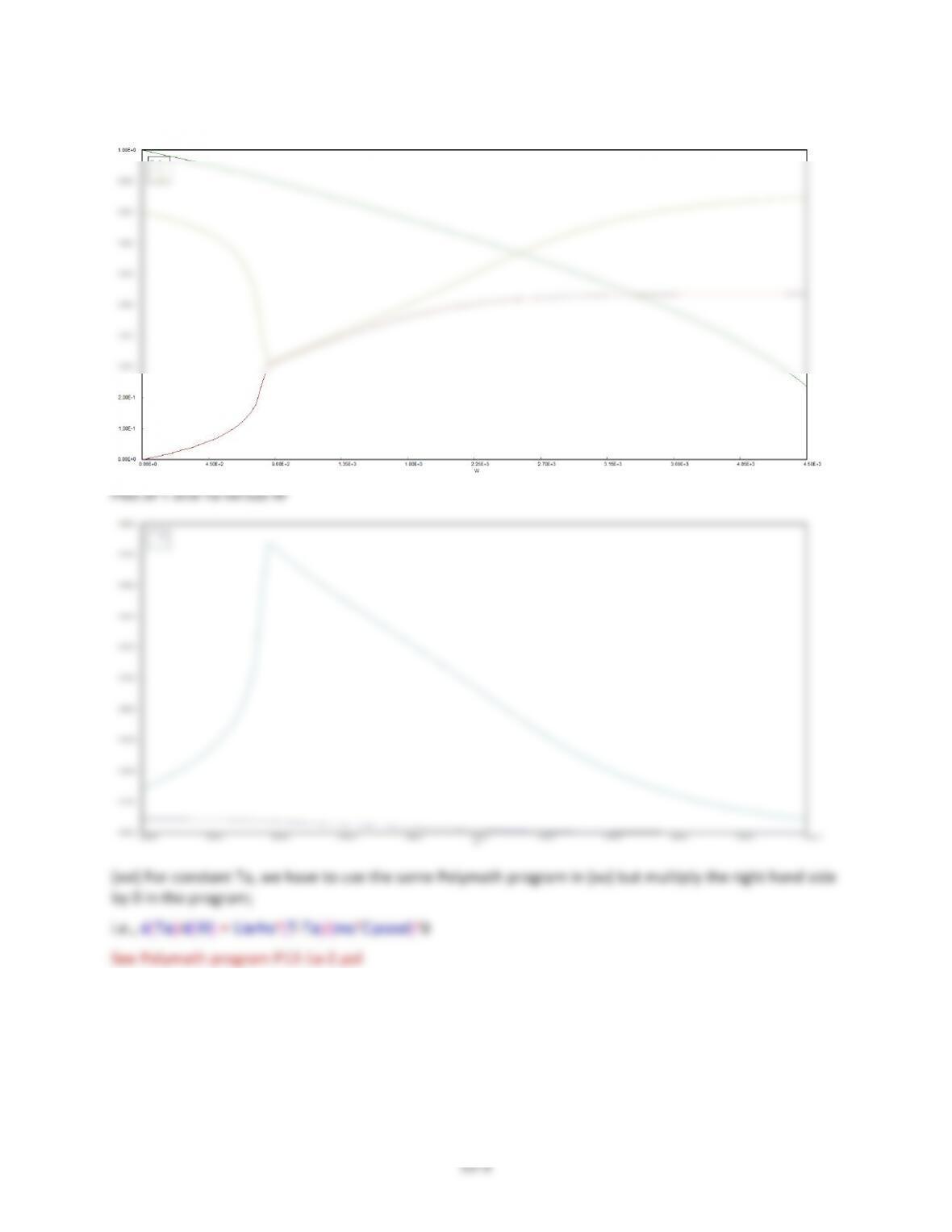
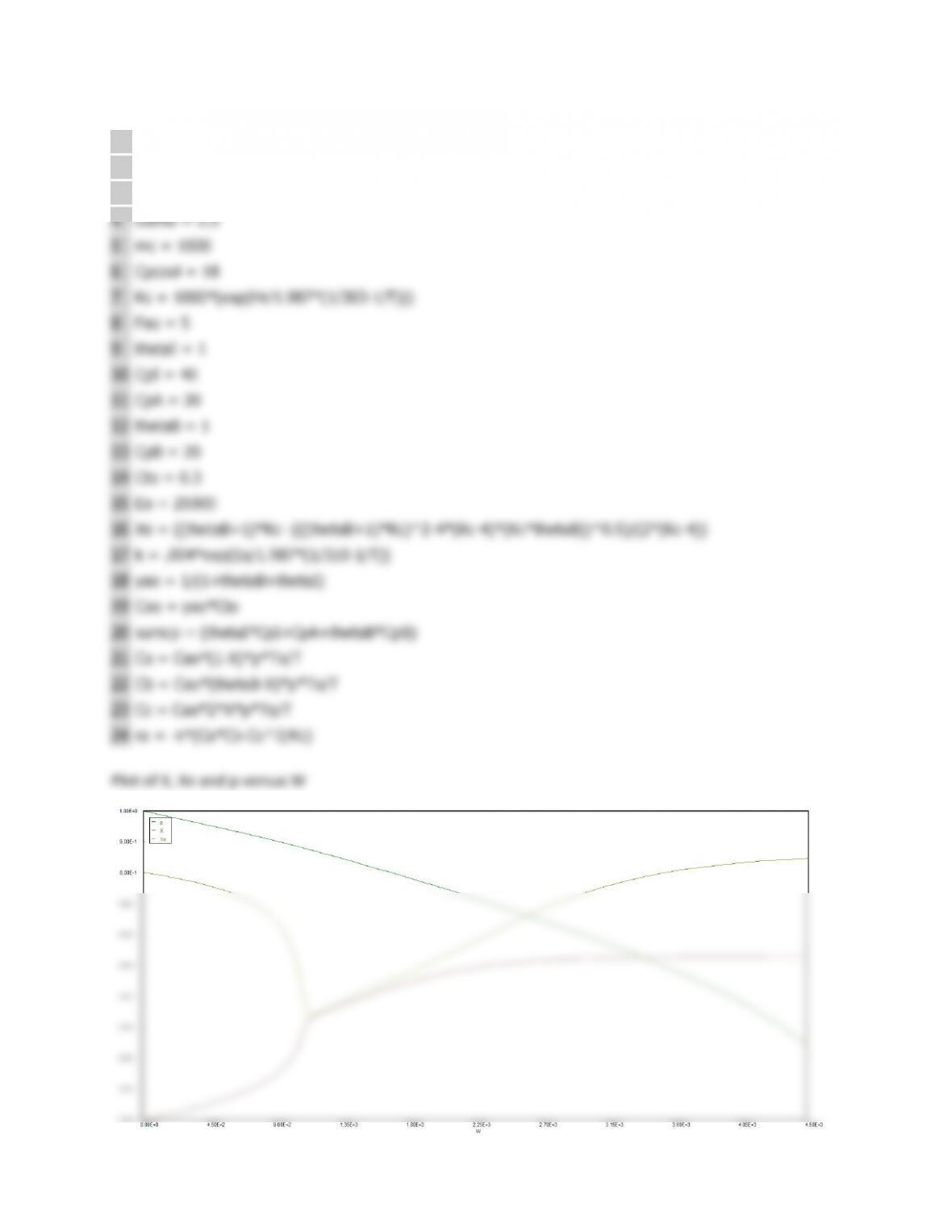
Plot$of$X,$Xe$and$p$versus$W$
$
Plot$of$T$and$Ta$versus$W$
12-4$
P12-1)(a))Continued$
POLYMATH Report
Ordinary Differential Equations
Calculated values of DEQ variables
Variable
Initial value
Minimal value
Maximal value
Final value
1
alpha
0.0002
0.0002
0.0002
0.0002
2
Ca
0.1
0.011675
0.1
0.011675
3
Cao
0.1
0.1
0.1
0.1
4
Cb
0.1
0.011675
0.1
0.011675
5
Cc
0
0
0.0659781
0.026488
6
CpA
20.
20.
20.
20.
7
CpB
20.
20.
20.
20.
8
Cpcool
18.
18.
18.
18.
9
CpI
40.
40.
40.
40.
10
Cto
0.3
0.3
0.3
0.3
11
Ea
2.5E+04
2.5E+04
2.5E+04
2.5E+04
12
Fao
5.
5.
5.
5.
13
Hr
–2.0E+04
–2.0E+04
–2.0E+04
–2.0E+04
14
k
0.046809
0.021188
8.254819
0.021188
15
Kc
66.01082
1.053204
124.4536
124.4536
16
mc
1000.
1000.
1000.
1000.
17
p
1.
0.2441145
1.
0.2441145
18
ra
–0.0004681
–0.0080133
–2.769E–06
–2.769E–06
19
sumcp
80.
80.
80.
80.
20
T
330.
323.2791
381.7968
323.2791
21
Ta
320.
320.
320.
320.
22
thetaB
1.
1.
1.
1.
23
thetaI
1.
1.
1.
1.
24
To
330.
330.
330.
330.
25
Uarho
0.5
0.5
0.5
0.5
26
W
0
0
4500.
4500.
27
X
0
0
0.5314832
0.5314832
28
Xe
0.8024634
0.3391177
0.8479767
0.8479767
29
yao
0.3333333
0.3333333
0.3333333
0.3333333
Differential equations
1
d(Ta)/d(W) = –Uarho*(T–Ta)/(mc*Cpcool) *0
2
d(p)/d(W) = –alpha/2*(T/To)/p
3
d(T)/d(W) = (Uarho*(Ta–T)+(–ra)*(–Hr))/(Fao*sumcp)
4
d(X)/d(W) = –ra/Fao
12-5$
P12-1)(a))Continued$
Explicit equations
1
Hr = –20000
2
alpha = .0002
3
To = 330
4
Uarho = 0.5
5
mc = 1000
6
Cpcool = 18
7
Kc = 1000*(exp(Hr/1.987*(1/303–1/T)))
8
Fao = 5
9
thetaI = 1
10
CpI = 40
11
CpA = 20
12
thetaB = 1
13
CpB = 20
14
Cto = 0.3
15
Ea = 25000
16
Xe = ((thetaB+1)*Kc– (((thetaB+1)*Kc)^2–4*(Kc–4)*(Kc*thetaB))^0.5)/(2*(Kc–4))
17
k = .004*exp(Ea/1.987*(1/310–1/T))
18
yao = 1/(1+thetaB+thetaI)
19
Cao = yao*Cto
20
sumcp = (thetaI*CpI+CpA+thetaB*CpB)
21
Ca = Cao*(1–X)*p*To/T
22
Cb = Cao*(thetaB–X)*p*To/T
23
Cc = Cao*2*X*p*To/T
24
ra = –k*(Ca*Cb–Cc^2/Kc)
)
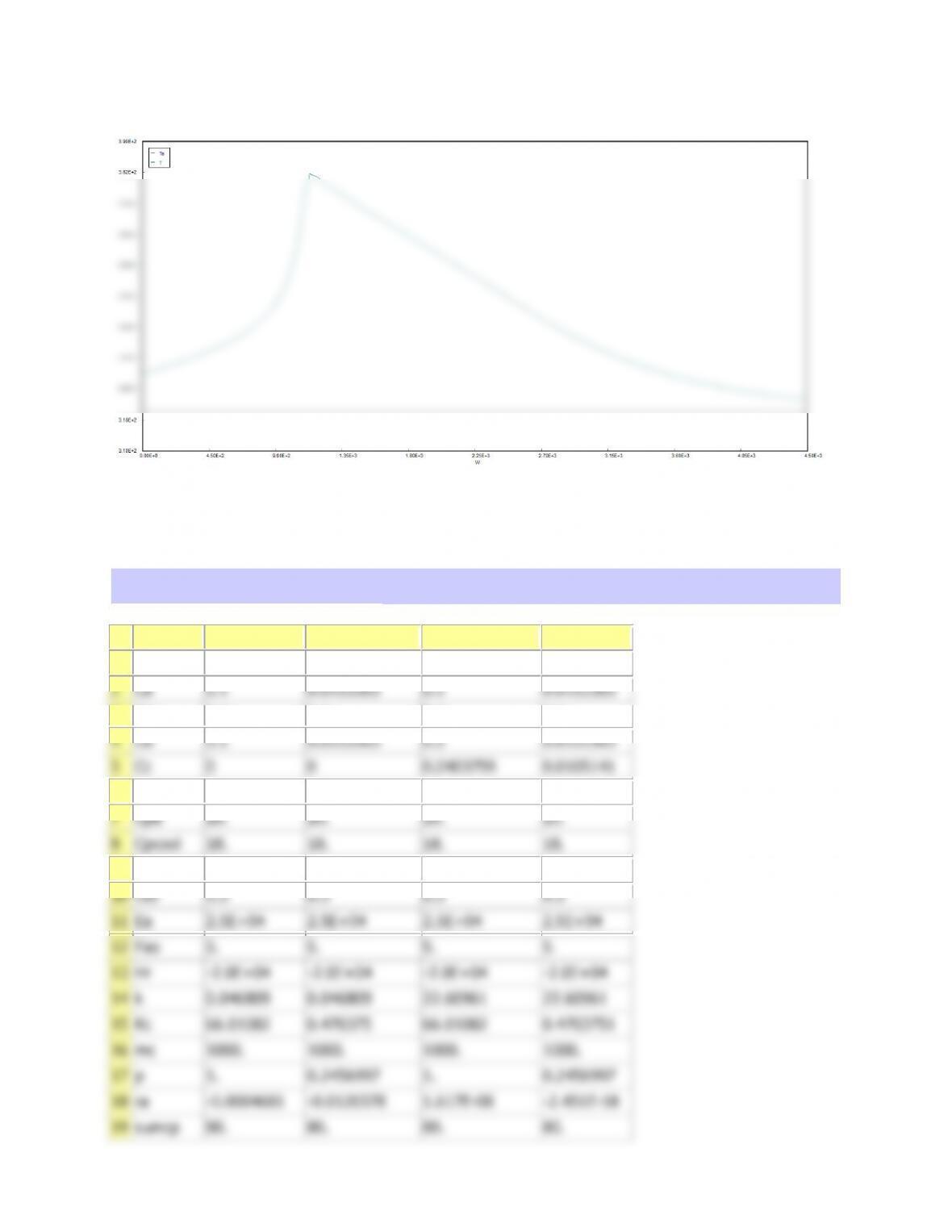
Plot$of$X,$Xe$and$p$versus$W$
$
12-6$
P12-1)(a))Continued$
Plot$of$T$and$Ta$versus$W$
$
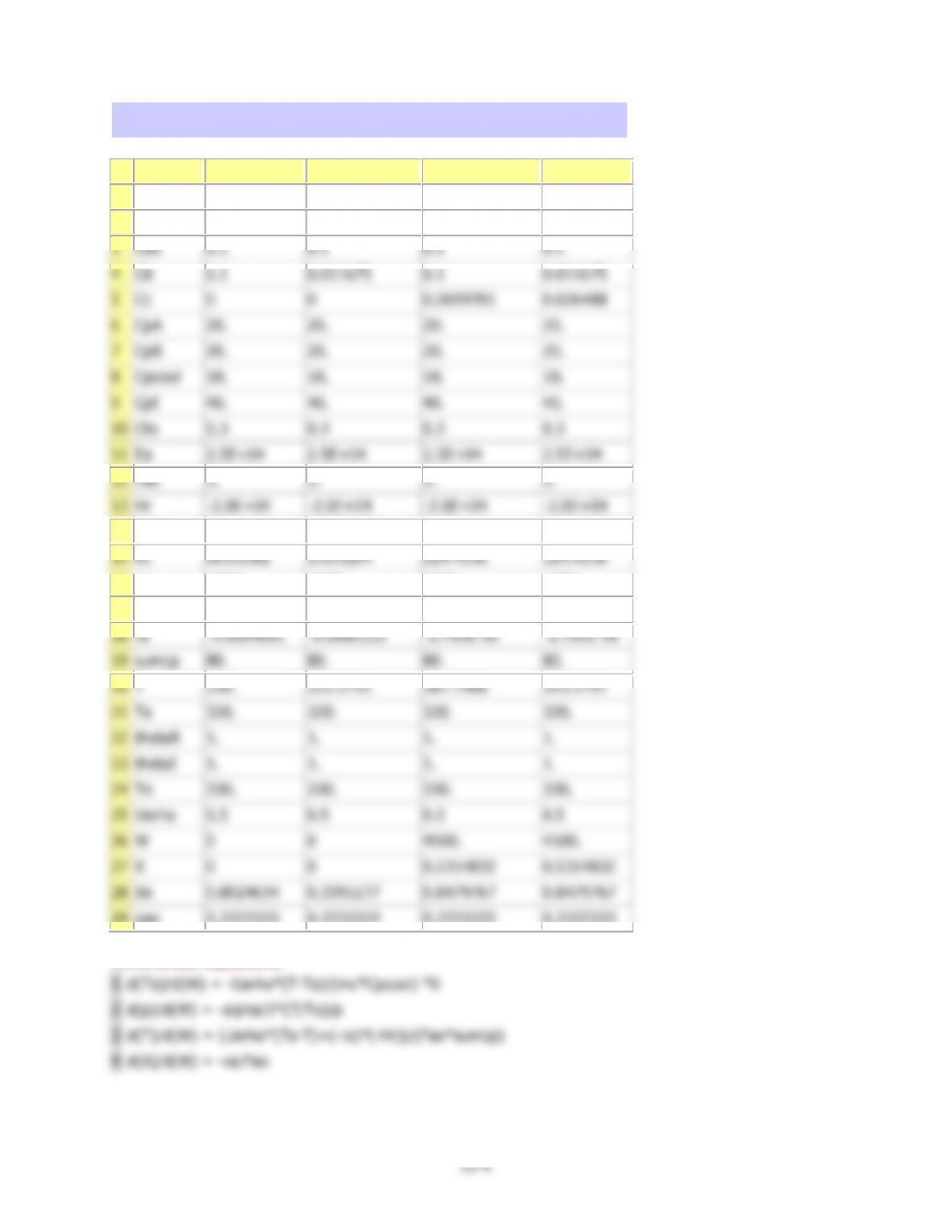
Ta$will$remain$constant$with$W$
For$adiabatic$operation,$
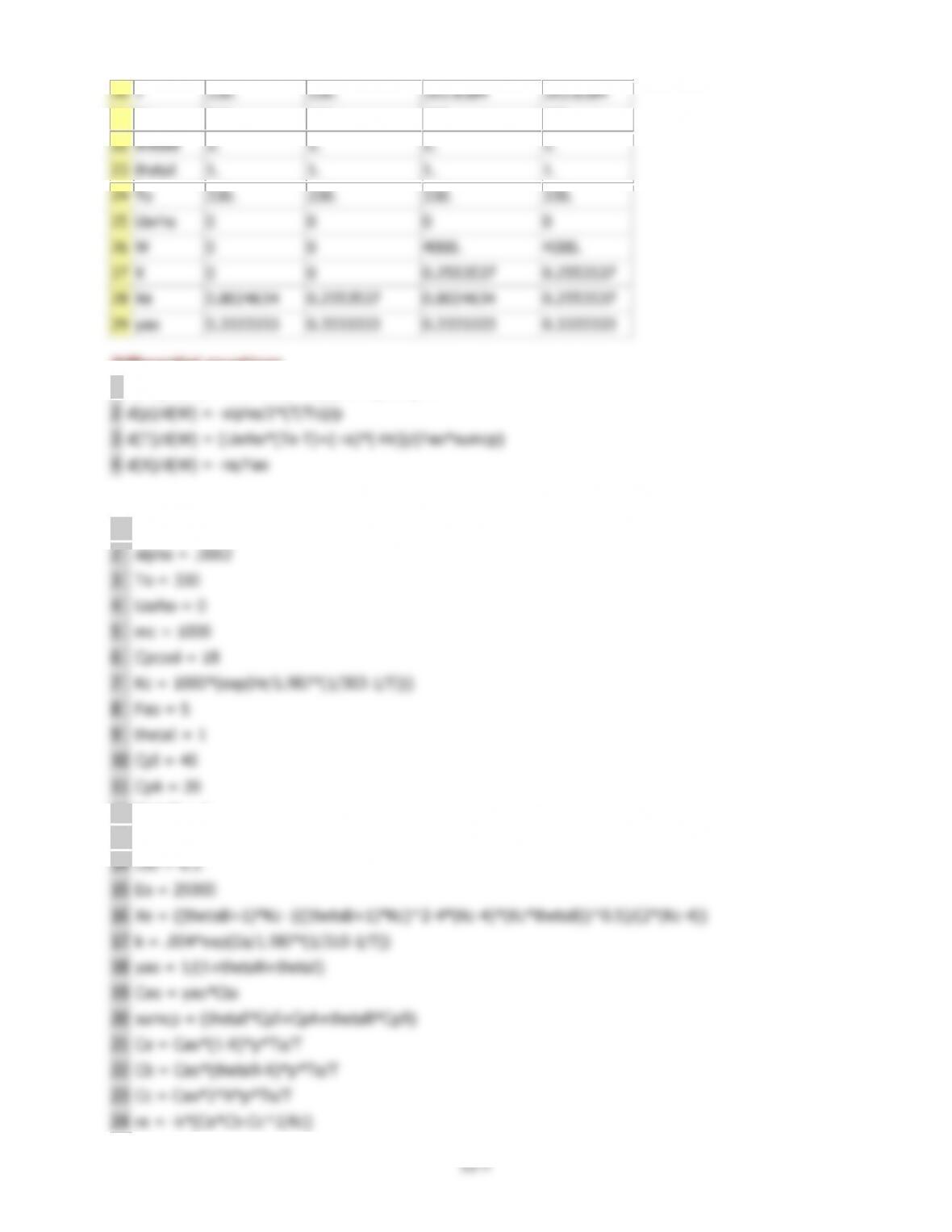
Using$the$Polymath$program$of$part$(xv)$and$making$the$parameter$Ua$=0;$we$have;$
See$Polymath$program$P12–1a–3.pol$
POLYMATH Report
Ordinary Differential Equations
Calculated values of DEQ variables
Variable
Initial value
Minimal value
Maximal value
Final value
1
alpha
0.0002
0.0002
0.0002
0.0002
2
Ca
0.1
0.0153303
0.1
0.0153303
3
Cao
0.1
0.1
0.1
0.1
4
Cb
0.1
0.0153303
0.1
0.0153303
5
Cc
0
0
0.0403759
0.0105141
6
CpA
20.
20.
20.
20.
7
CpB
20.
20.
20.
20.
8
Cpcool
18.
18.
18.
18.
9
CpI
40.
40.
40.
40.
10
Cto
0.3
0.3
0.3
0.3
11
Ea
2.5E+04
2.5E+04
2.5E+04
2.5E+04
12
Fao
5.
5.
5.
5.
13
Hr
–2.0E+04
–2.0E+04
–2.0E+04
–2.0E+04
14
k
0.046809
0.046809
22.60961
22.60961
15
Kc
66.01082
0.470375
66.01082
0.4703751
16
mc
1000.
1000.
1000.
1000.
17
p
1.
0.2456997
1.
0.2456997
18
ra
–0.0004681
–0.0120578
1.617E–08
–2.451E–18
19
sumcp
80.
80.
80.
80.
12-7$
20
T
330.
330.
393.8384
393.8384
21
Ta
320.
320.
320.
320.
22
thetaB
1.
1.
1.
1.
23
thetaI
1.
1.
1.
1.
24
To
330.
330.
330.
330.
25
Uarho
0
0
0
0
26
W
0
0
4000.
4000.
27
X
0
0
0.2553537
0.2553537
28
Xe
0.8024634
0.2553537
0.8024634
0.2553537
29
yao
0.3333333
0.3333333
0.3333333
0.3333333
1
d(Ta)/d(W) = –Uarho*(T–Ta)/(mc*Cpcool) *0
2
d(p)/d(W) = –alpha/2*(T/To)/p
3
d(T)/d(W) = (Uarho*(Ta–T)+(–ra)*(–Hr))/(Fao*sumcp)
4
d(X)/d(W) = –ra/Fao
$
Explicit equations
1
Hr = –20000
2
alpha = .0002
3
To = 330
4
Uarho = 0
5
mc = 1000
6
Cpcool = 18
7
Kc = 1000*(exp(Hr/1.987*(1/303–1/T)))
8
Fao = 5
9
thetaI = 1
10
CpI = 40
11
CpA = 20
12
thetaB = 1
13
CpB = 20
14
Cto = 0.3
15
Ea = 25000
16
Xe = ((thetaB+1)*Kc– (((thetaB+1)*Kc)^2–4*(Kc–4)*(Kc*thetaB))^0.5)/(2*(Kc–4))
17
k = .004*exp(Ea/1.987*(1/310–1/T))
18
yao = 1/(1+thetaB+thetaI)
19
Cao = yao*Cto
20
sumcp = (thetaI*CpI+CpA+thetaB*CpB)
21
Ca = Cao*(1–X)*p*To/T
22
Cb = Cao*(thetaB–X)*p*To/T
23
Cc = Cao*2*X*p*To/T
24
ra = –k*(Ca*Cb–Cc^2/Kc)
$
12-8$
P12-1)(a))Continued$
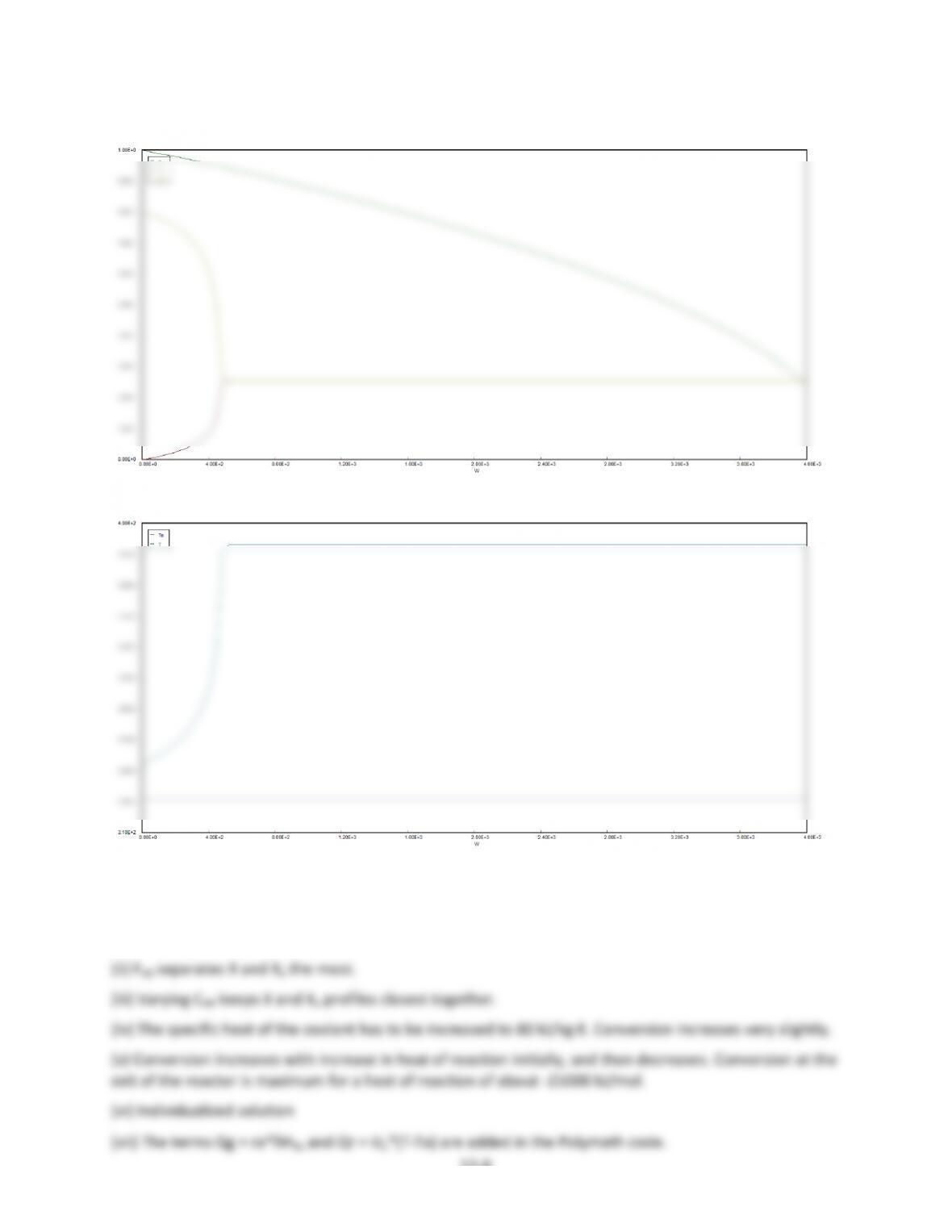
Plot$of$X,$Xe$and$p$versus$W;$
$
Plot$of$T$and$Ta$versus$W$
$
Ta$remains$a$constant$
$
P12-1)(b))
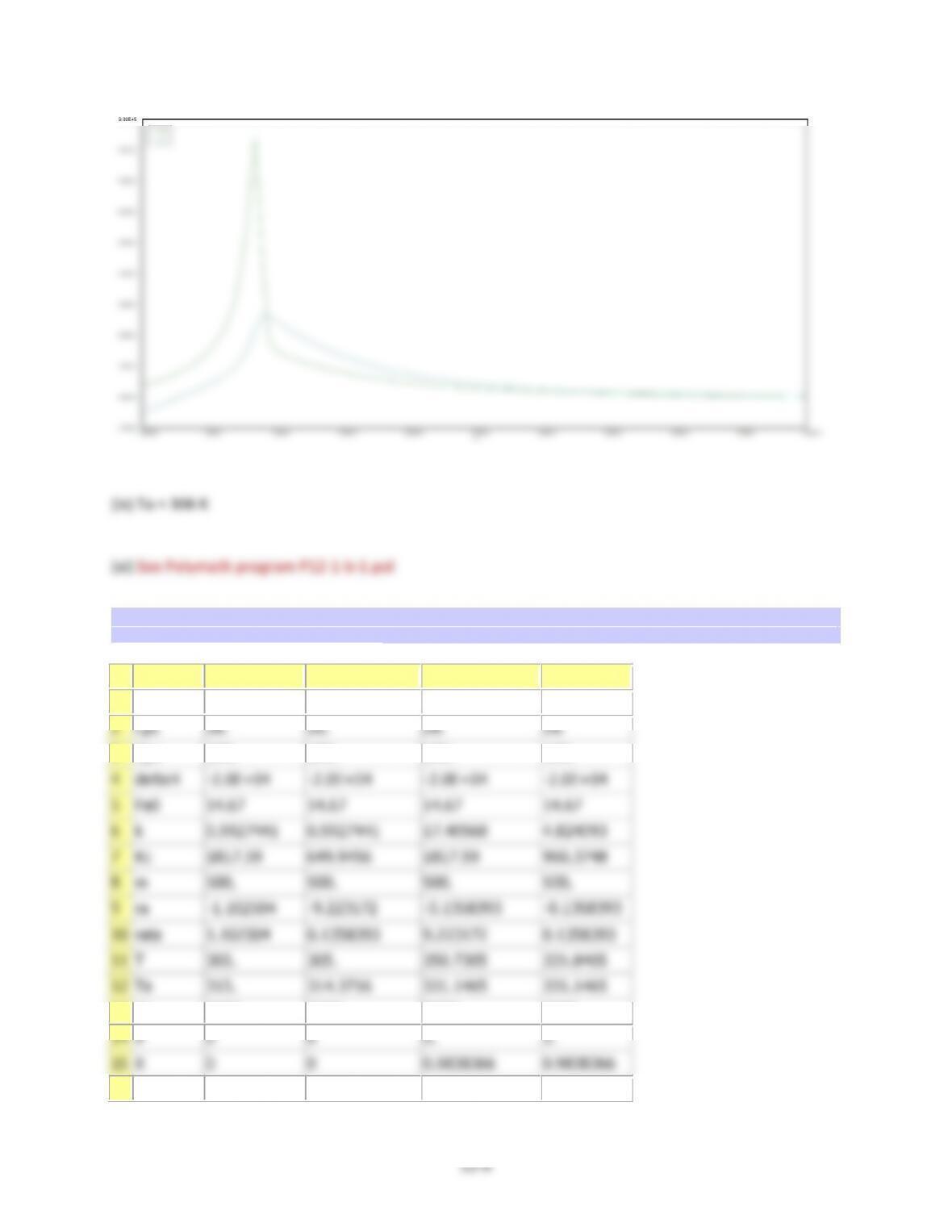
(i)$Ua$brings$the$temperature$profiles$close$together.$
(ii)$FA0$separates$X$and$Xe$the$most.$
12-9$
P12-1)(b))Continued$
$
(viii)$Individualized$solution$
(ix)$Ta$=$306$K$
(x)$Individualized$solution$
(xi)$See$Polymath$program$P12-1-b–1.pol$
POLYMATH Report
Ordinary Differential Equations
Calculated values of DEQ variables
Variable
Initial value
Minimal value
Maximal value
Final value
1
Ca0
1.86
1.86
1.86
1.86
2
Cpc
28.
28.
28.
28.
3
Cpo
159.
159.
159.
159.
4
deltaH
–2.0E+04
–2.0E+04
–2.0E+04
–2.0E+04
5
Fa0
14.67
14.67
14.67
14.67
6
k
0.5927441
0.5927441
17.40568
4.824093
7
Kc
1817.59
649.9456
1817.59
960.3748
8
m
500.
500.
500.
500.
9
ra
–1.102504
–9.223172
–0.1358393
–0.1358393
10
rate
1.102504
0.1358393
9.223172
0.1358393
11
T
305.
305.
350.7305
331.8405
12
Ta
315.
314.3716
331.1465
331.1465
13
Ua
5000.
5000.
5000.
5000.
14
V
0
0
5.
5.
15
X
0
0
0.9838366
0.9838366
16
Xe
0.9994501
0.9984638
0.9994501
0.9989598
)
12–10$
P12-1)(b))Continued$
Differential equations
1
d(Ta)/d(V) = Ua*(T–Ta)/m/Cpc
2
d(X)/d(V) = –ra/Fa0
3
d(T)/d(V) = ((ra*deltaH)–Ua*(T–Ta))/Cpo/Fa0
Explicit equations
1
Cpc = 28
2
m = 500
3
Ua = 5000
4
Ca0 = 1.86
5
Fa0 = 0.9*163*.1
6
deltaH = –20000
7
k = 31.1*exp((7906)*(T–360)/(T*360))
8
Kc = 1000*exp((deltaH/8.314)*((T–330)/(T*330)))
9
Xe = Kc/(1+Kc)
10
ra = –k*Ca0*(1–(1+1/Kc)*X)
11
Cpo = 159
12
rate = –ra
$
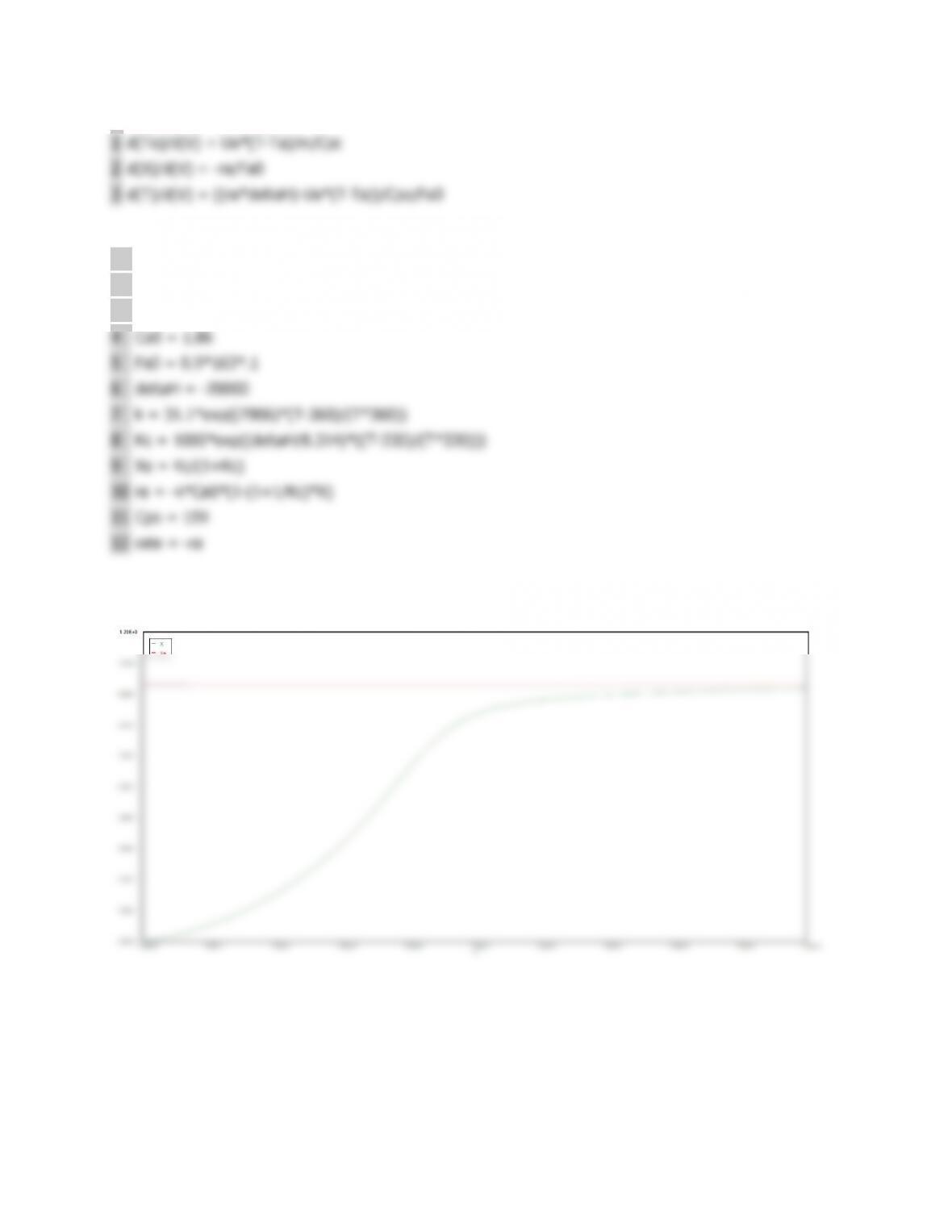
Plot$of$X$and$Xe$versus$V$
$
12–11$
P12-1)(b))Continued$
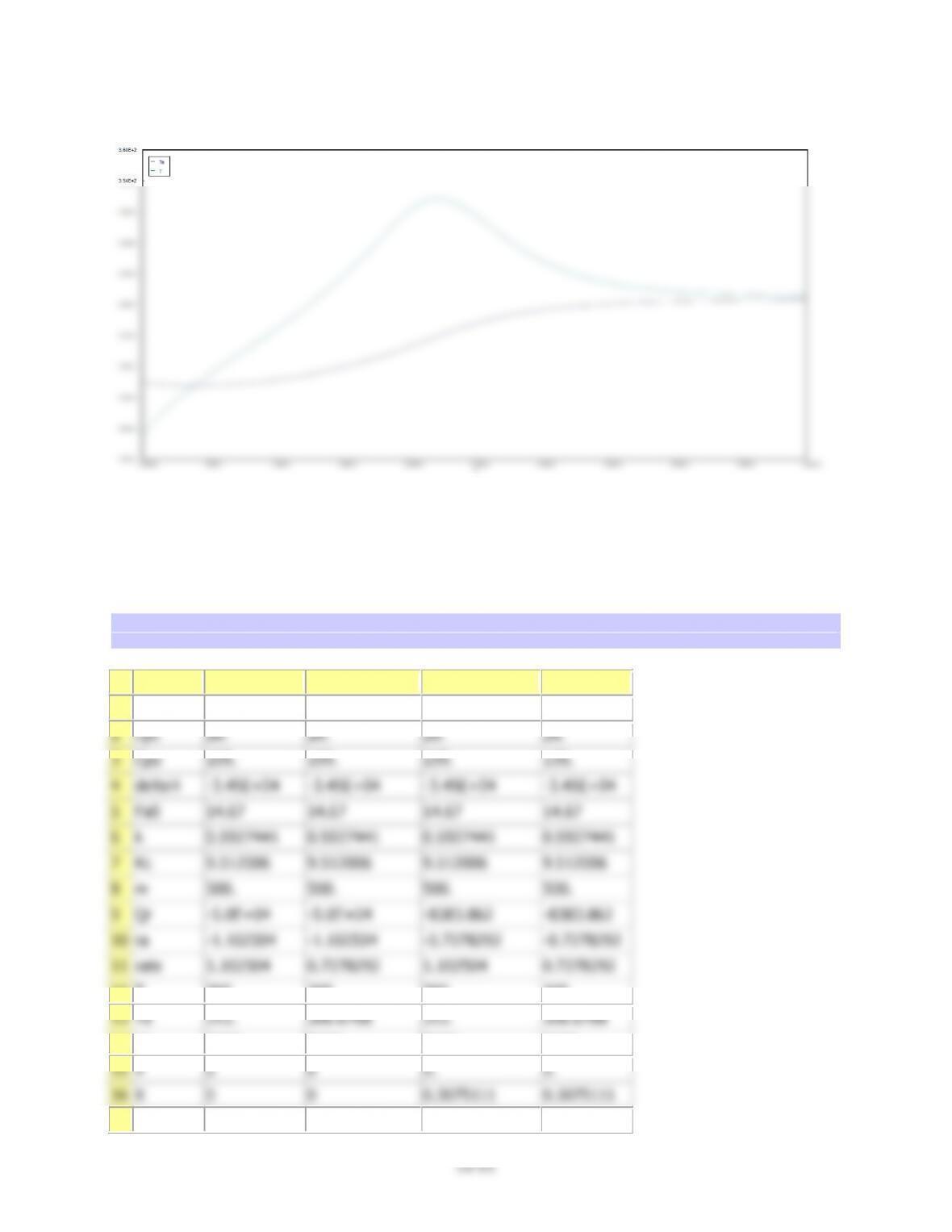
Plot$of$T$and$Ta$versus$V$
$
(xii)$For$isothermal$operation,$the$same$code$in$part$(vii)$is$used,$with$one$change:$
d(T)/d(V) = ((ra*deltaH)–Ua*(T–Ta))/Cpo/Fa0*0
Note$that$the$right$hand$side$of$the$equation$is$multiplied$by$0.$
See$Polymath$program$P12-1-b-2.pol$
POLYMATH Report
Ordinary Differential Equations
Calculated values of DEQ variables
Variable
Initial value
Minimal value
Maximal value
Final value
1
Ca0
1.86
1.86
1.86
1.86
2
Cpc
28.
28.
28.
28.
3
Cpo
159.
159.
159.
159.
4
deltaH
–3.45E+04
–3.45E+04
–3.45E+04
–3.45E+04
5
Fa0
14.67
14.67
14.67
14.67
6
k
0.5927441
0.5927441
0.5927441
0.5927441
7
Kc
9.512006
9.512006
9.512006
9.512006
8
m
500.
500.
500.
500.
9
Qr
–5.0E+04
–5.0E+04
–8383.862
–8383.862
10
ra
–1.102504
–1.102504
–0.7278292
–0.7278292
11
rate
1.102504
0.7278292
1.102504
0.7278292
12
T
305.
305.
305.
305.
13
Ta
315.
306.6768
315.
306.6768
14
Ua
5000.
5000.
5000.
5000.
15
V
0
0
5.
5.
16
X
0
0
0.3075111
0.3075111
17
Xe
0.9048707
0.9048707
0.9048707
0.9048707
12–12$
P12–1)(b))Continued
Differential equations
1
d(Ta)/d(V) = Ua*(T–Ta)/m/Cpc
2
d(X)/d(V) = –ra/Fa0
3
d(T)/d(V) = ((ra*deltaH)–Ua*(T–Ta))/Cpo/Fa0*0
Explicit equations
1
Cpc = 28
2
m = 500
3
Ua = 5000
4
Ca0 = 1.86
5
Fa0 = 0.9*163*.1
6
deltaH = –34500
7
k = 31.1*exp((7906)*(T–360)/(T*360))
8
Kc = 3.03*exp((deltaH/8.314)*((T–333)/(T*333)))
9
Xe = Kc/(1+Kc)
10
ra = –k*Ca0*(1–(1+1/Kc)*X)
11
Cpo = 159
12
rate = –ra
13
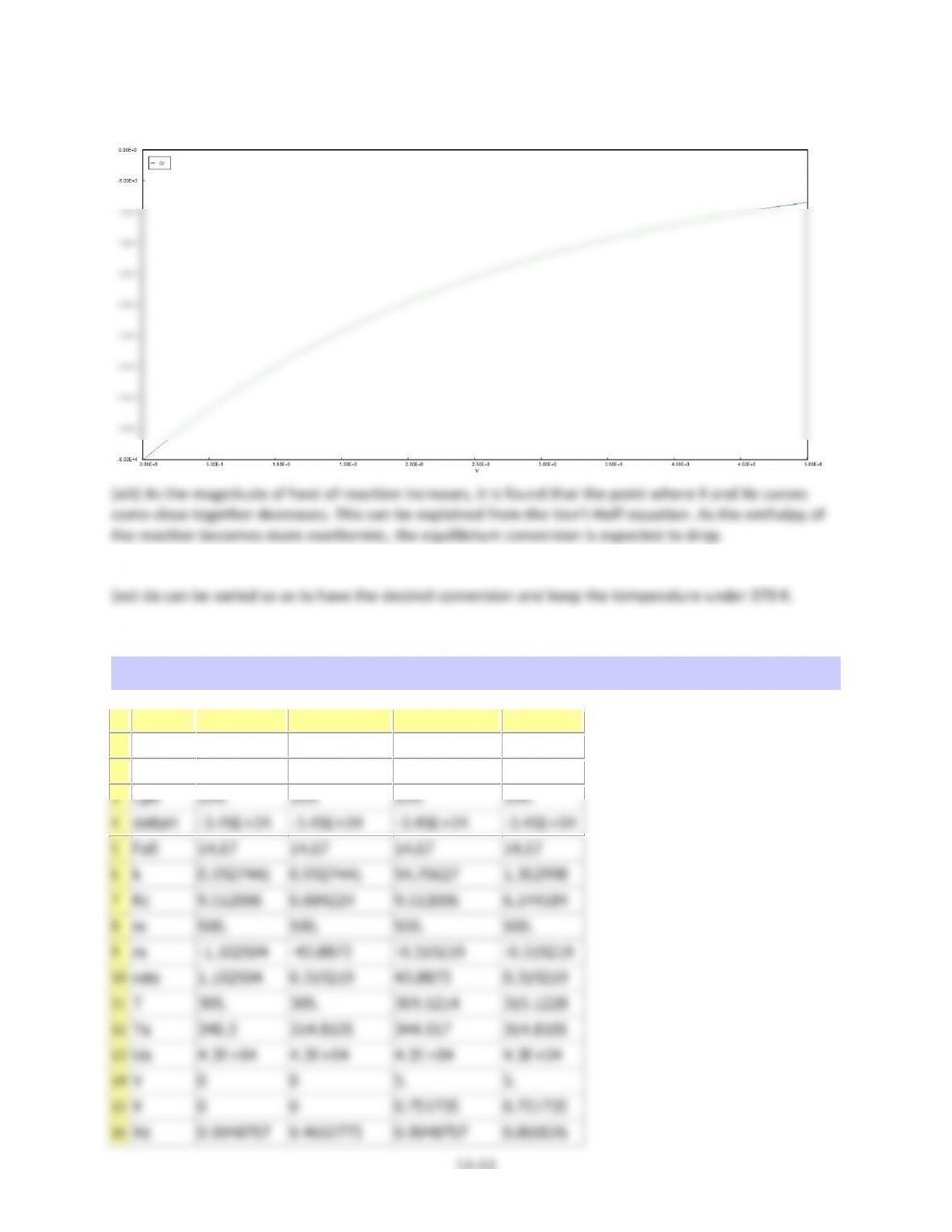
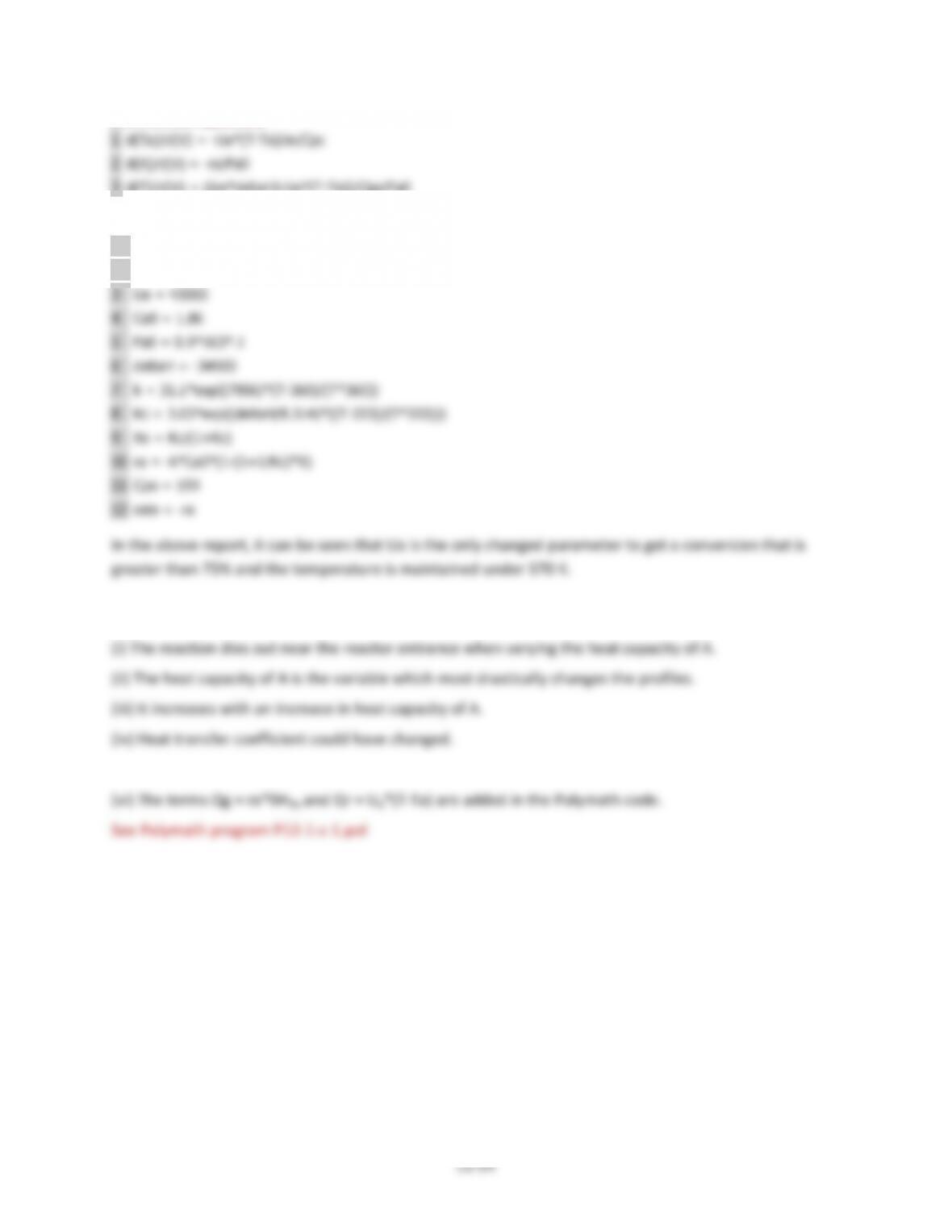
Qr = Ua*(T–Ta)
)
)
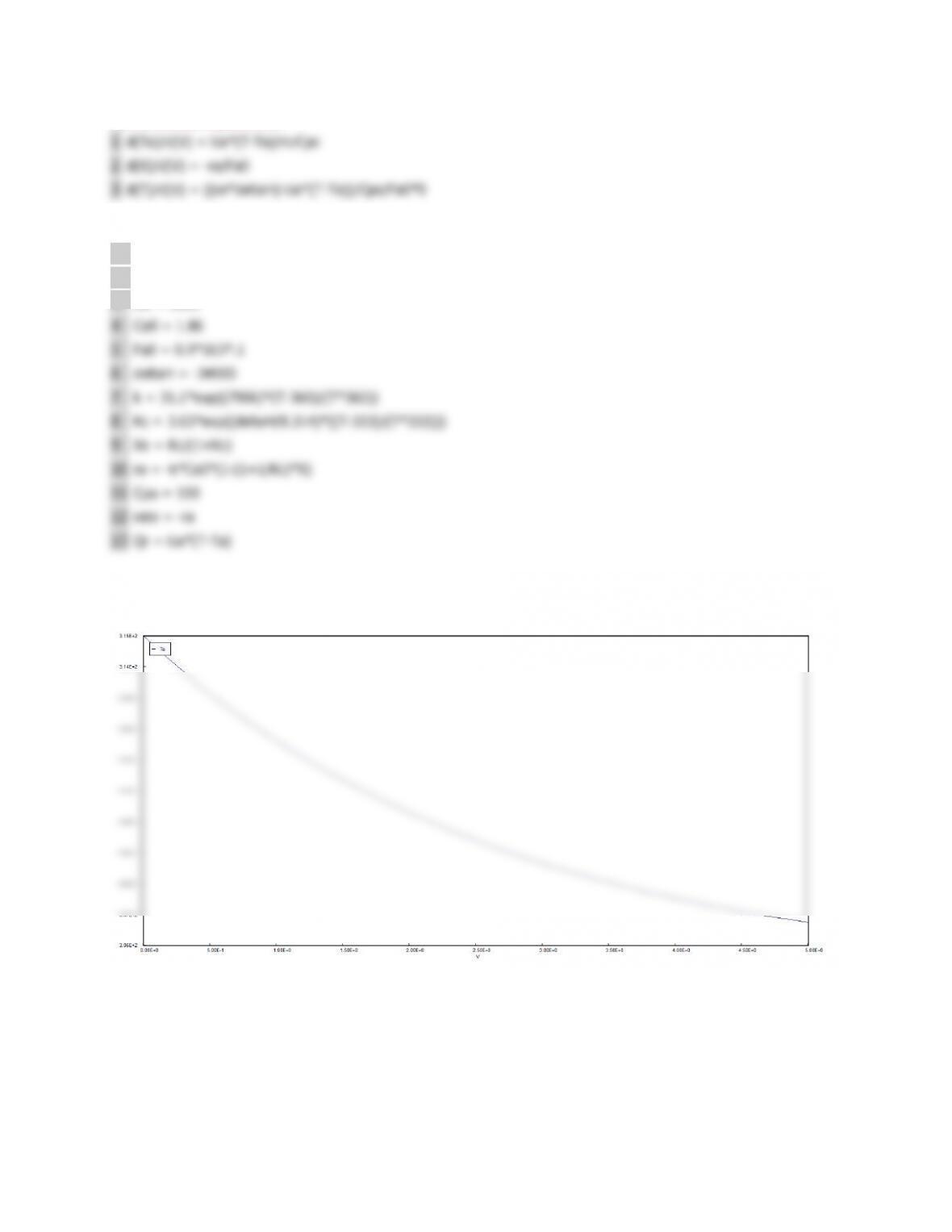
Plot$of$Ta$versus$V$to$maintain$isothermal$operation$
$
12–13$
P12-1)(b))Continued$$
Plot$of$Qr$versus$V$to$maintain$isothermal$operation$
$
(xiv)$No$solution$will$be$provided$
(xv)$Ua$can$be$varied$so$as$to$have$the$desired$conversion$and$keep$the$temperature$under$370$K.$$
See$Polymath$program$P12-1-b-3.pol$
$
POLYMATH Report
Ordinary Differential Equations
Calculated values of DEQ variables
Variable
Initial value
Minimal value
Maximal value
Final value
1
Ca0
1.86
1.86
1.86
1.86
2
Cpc
28.
28.
28.
28.
3
Cpo
159.
159.
159.
159.
4
deltaH
–3.45E+04
–3.45E+04
–3.45E+04
–3.45E+04
5
Fa0
14.67
14.67
14.67
14.67
6
k
0.5927441
0.5927441
54.76627
1.362998
7
Kc
9.512006
0.884224
9.512006
6.144184
8
m
500.
500.
500.
500.
9
ra
–1.102504
–43.8873
–0.319219
–0.319219
10
rate
1.102504
0.319219
43.8873
0.319219
11
T
305.
305.
369.5214
315.1228
12
Ta
340.3
314.8105
344.917
314.8105
13
Ua
4.3E+04
4.3E+04
4.3E+04
4.3E+04
14
V
0
0
5.
5.
15
X
0
0
0.751735
0.751735
16
Xe
0.9048707
0.4692775
0.9048707
0.860026
12–14$
P12-1)(b))Continued$$
Differential equations
1
d(Ta)/d(V) = –Ua*(T–Ta)/m/Cpc
2
d(X)/d(V) = –ra/Fa0
3
d(T)/d(V) = ((ra*deltaH)–Ua*(T–Ta))/Cpo/Fa0
Explicit equations
1
Cpc = 28
2
m = 500
3
Ua = 43000
4
Ca0 = 1.86
5
Fa0 = 0.9*163*.1
6
deltaH = –34500
7
k = 31.1*exp((7906)*(T–360)/(T*360))
8
Kc = 3.03*exp((deltaH/8.314)*((T–333)/(T*333)))
9
Xe = Kc/(1+Kc)
10
ra = –k*Ca0*(1–(1+1/Kc)*X)
11
Cpo = 159
12
rate = –ra
$
In$the$above$report,$it$can$be$seen$that$Ua$is$the$only$changed$parameter$to$get$a$conversion$that$is$
greater$than$75%$and$the$temperature$is$maintained$under$370$K.$$
$
P12-1$(c)$
(i)$The$reaction$dies$out$near$the$reactor$entrance$when$varying$the$heat$capacity$of$A.$
(v)$Individualized$solution$
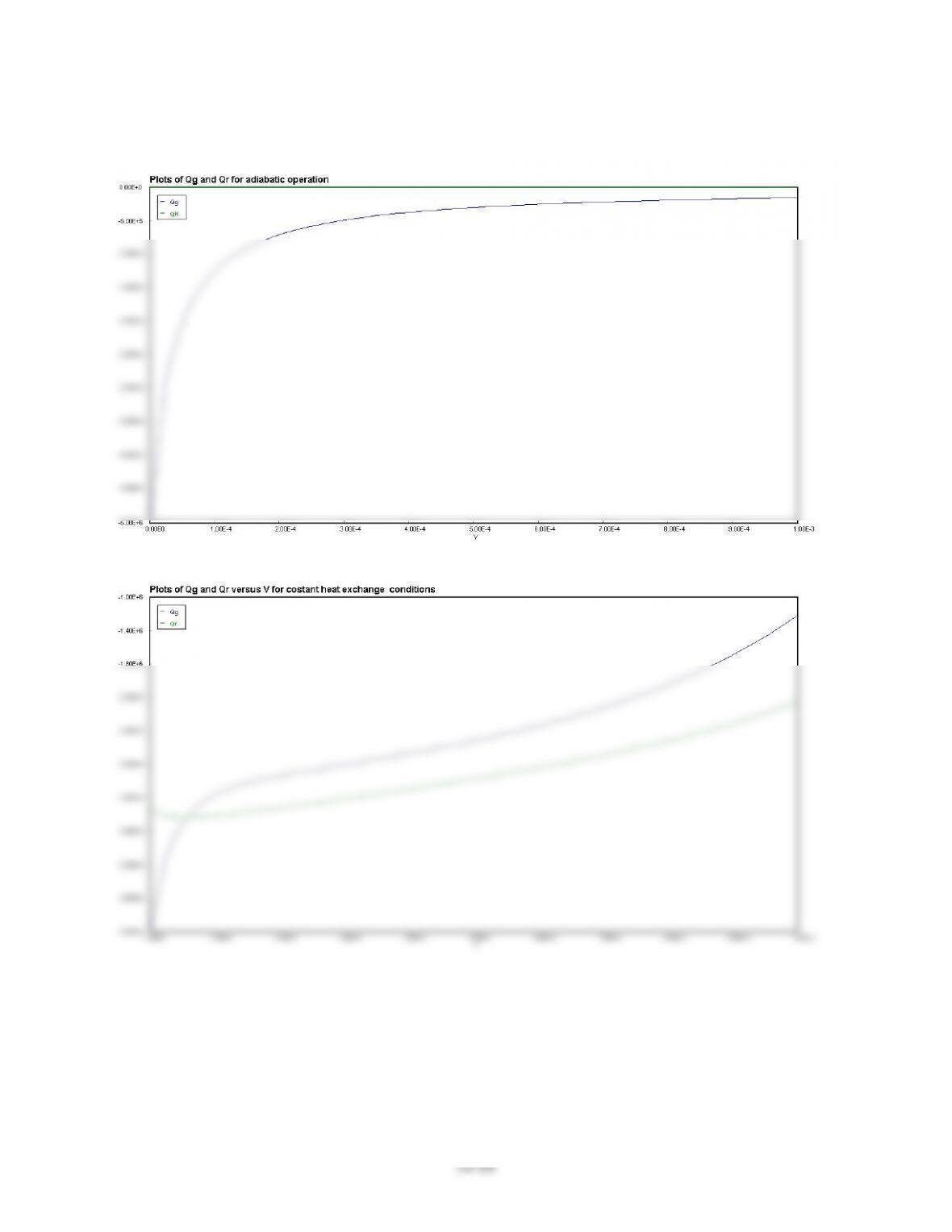
(vi)$The$terms$Qg$=$ra*δHRx$and$Qr$=$Ua*(T–Ta)$are$added$in$the$Polymath$code.$
12–15$
P12-1)(c))Continued$
Case1:))adiabatic)operation$
Qr=0$in$this$case$$$
$
Case)2:)For)constant)heat)exchange)conditions$
$
12–16$
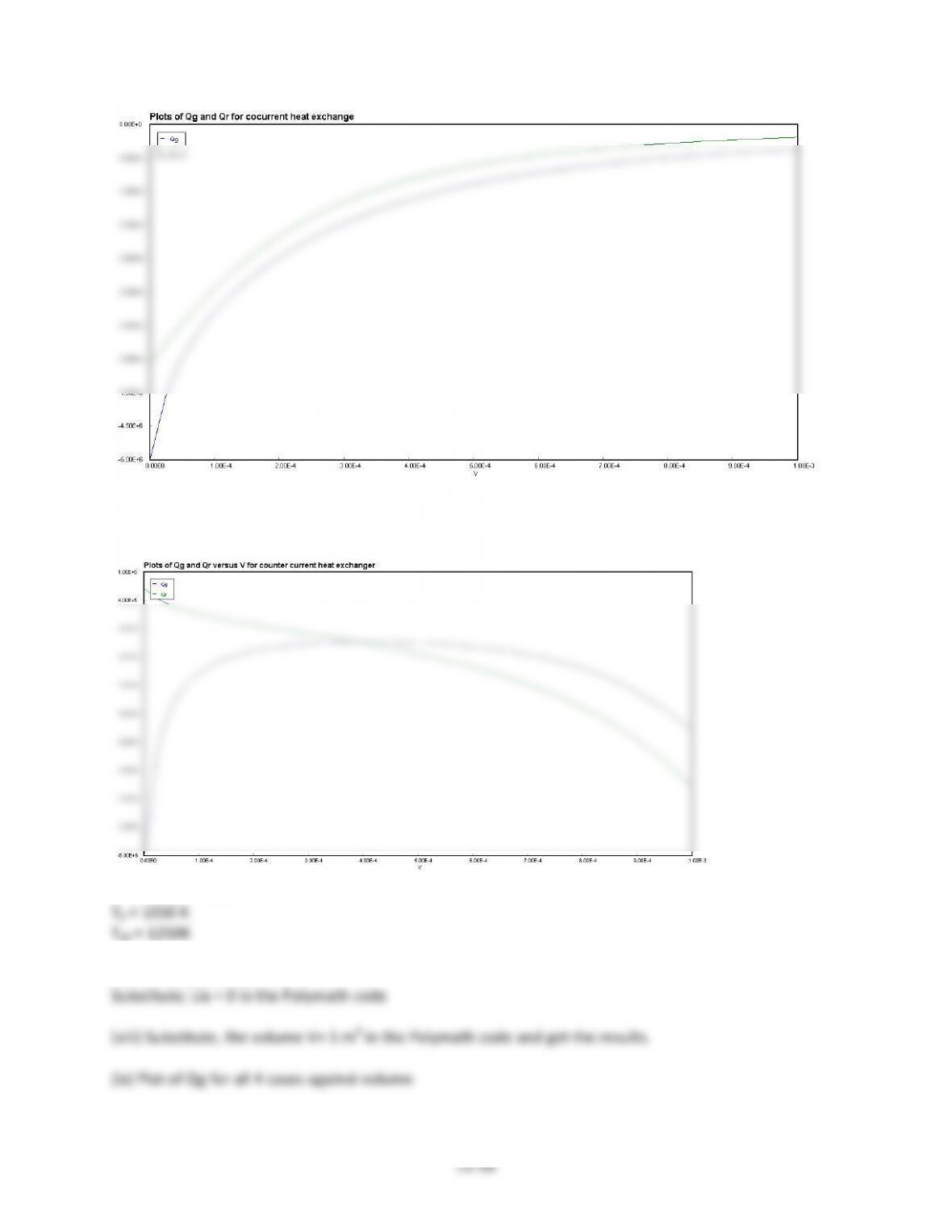
Case)3:)Co–current)heat)exchange)$
$
Case)4):)counter)current)heat)exchange):)
We$$need$to$guess$a$value$of$Ta$such$that$at$exit$Ta$=$1250K$
If$we$take$Ta(0)$=$995.15K$then$this$can$be$done.$
$
(vii)$Now,$V$=$0.5$m3)
T0$=$1050$K$
Case)1:$adiabatic$operation;$
Substitute;$Ua$=$0$in$the$Polymath$code$
12–17$
P12-1)(c))Continued$
$
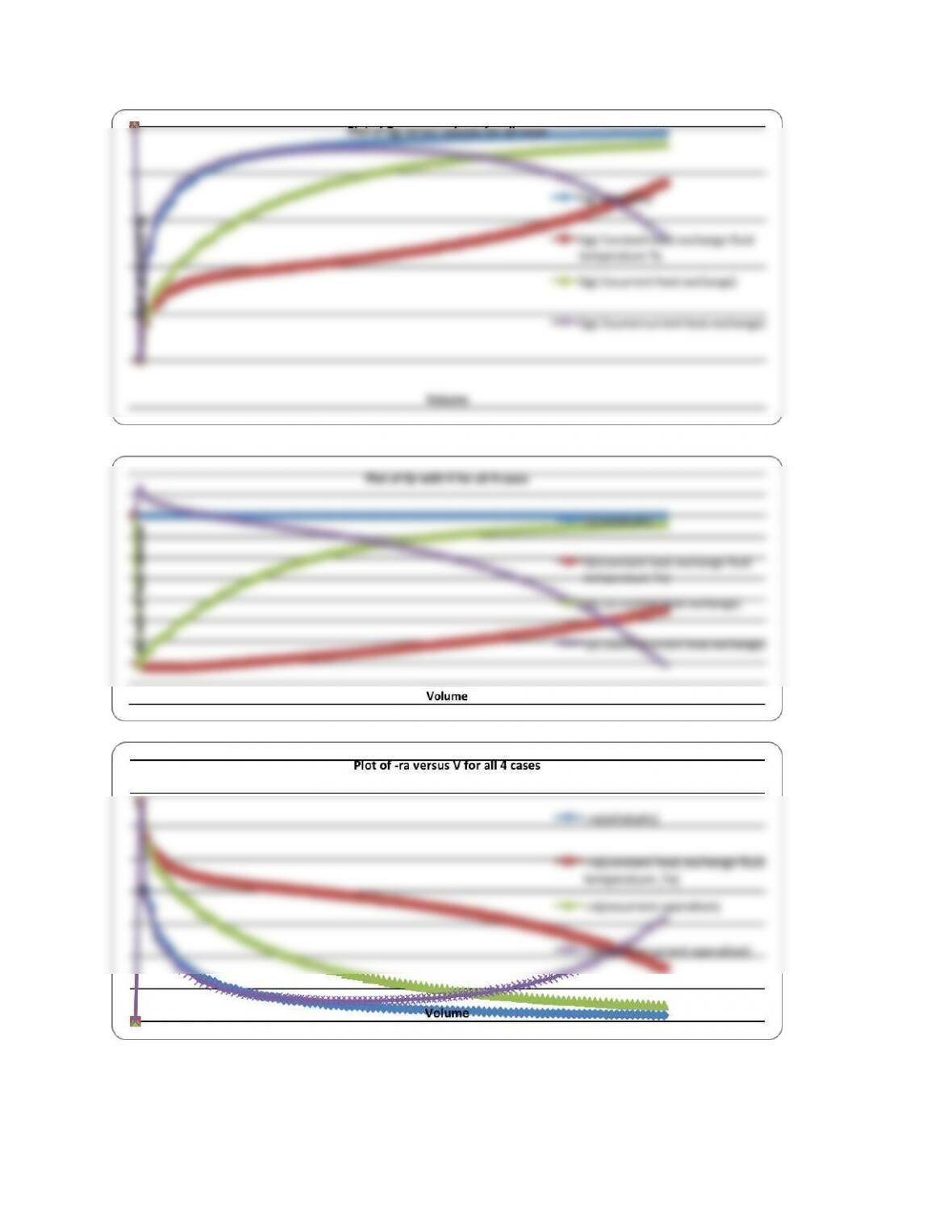
Plot$of$Qr$versus$volume$for$all$cases
$
Plot$of$$–ra$(rate)$versus$V
$
$
It$can$be$seen$that$the$rate$for$constant$heat$exchange$fluid$temperature$Ta,$is$higher$than$the$rest$of$
cases$because$the$difference$between$heat$generated$and$heat$removed$in$this$case$is$highest.$$
$
12–18$
P12-1)(c))Continued$
The$rate$of$reaction$for$all$cases$is$decreasing$because$the$temperature$of$the$system$is$decreasing$with$
volume.$
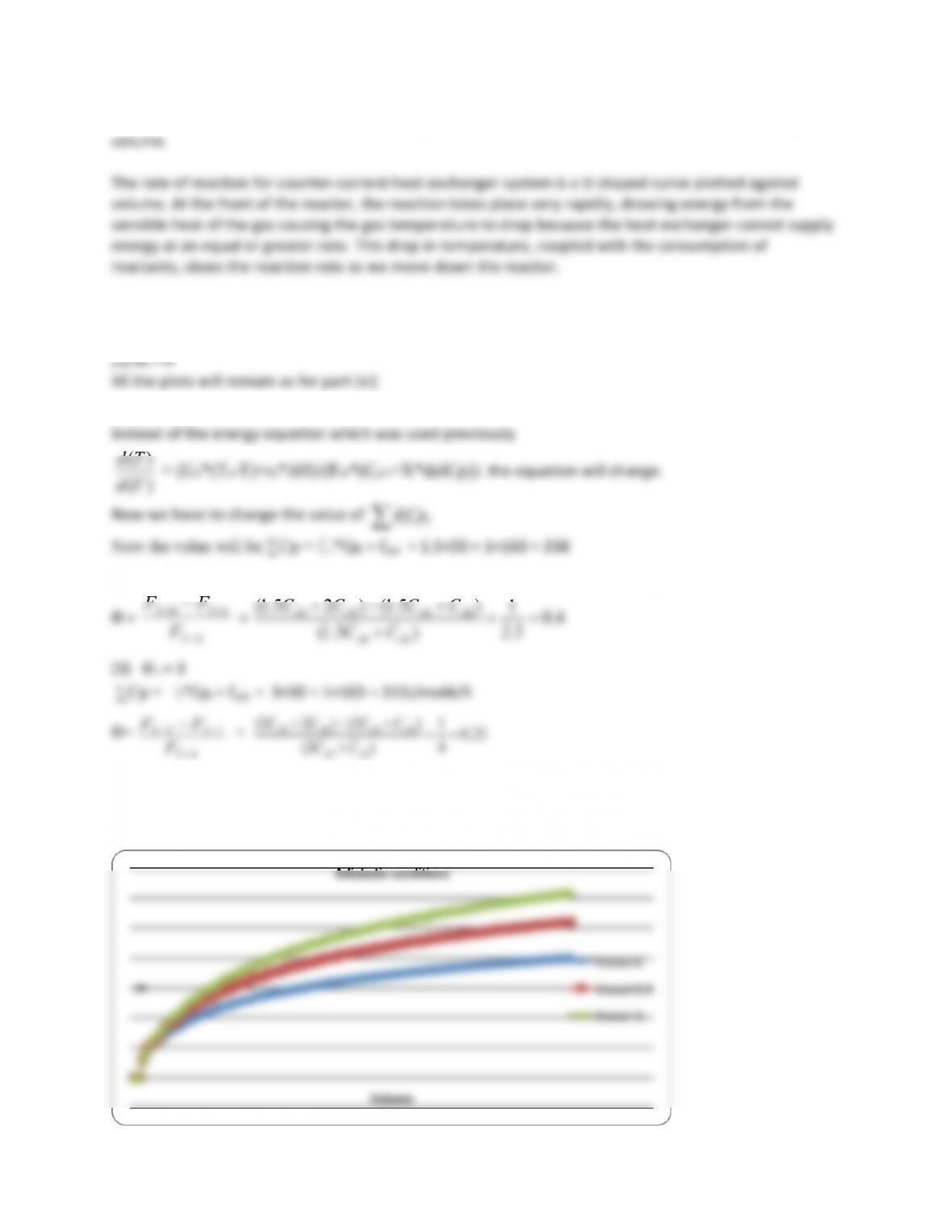
(x)$Introduction$of$inert$will$introduce$a$change$in$energy$balance$equation$and$the$value$of$Ѳ1$as$well.$
(xi)$$
(1)$ѲI$=$0$
(2)$ѲI$=$1.5$
Instead$of$the$energy$equation$which$was$used$previously$$
Value$of$Ѳ$will$change$as$well$
Ѳ$=$
=$
$
$$
$
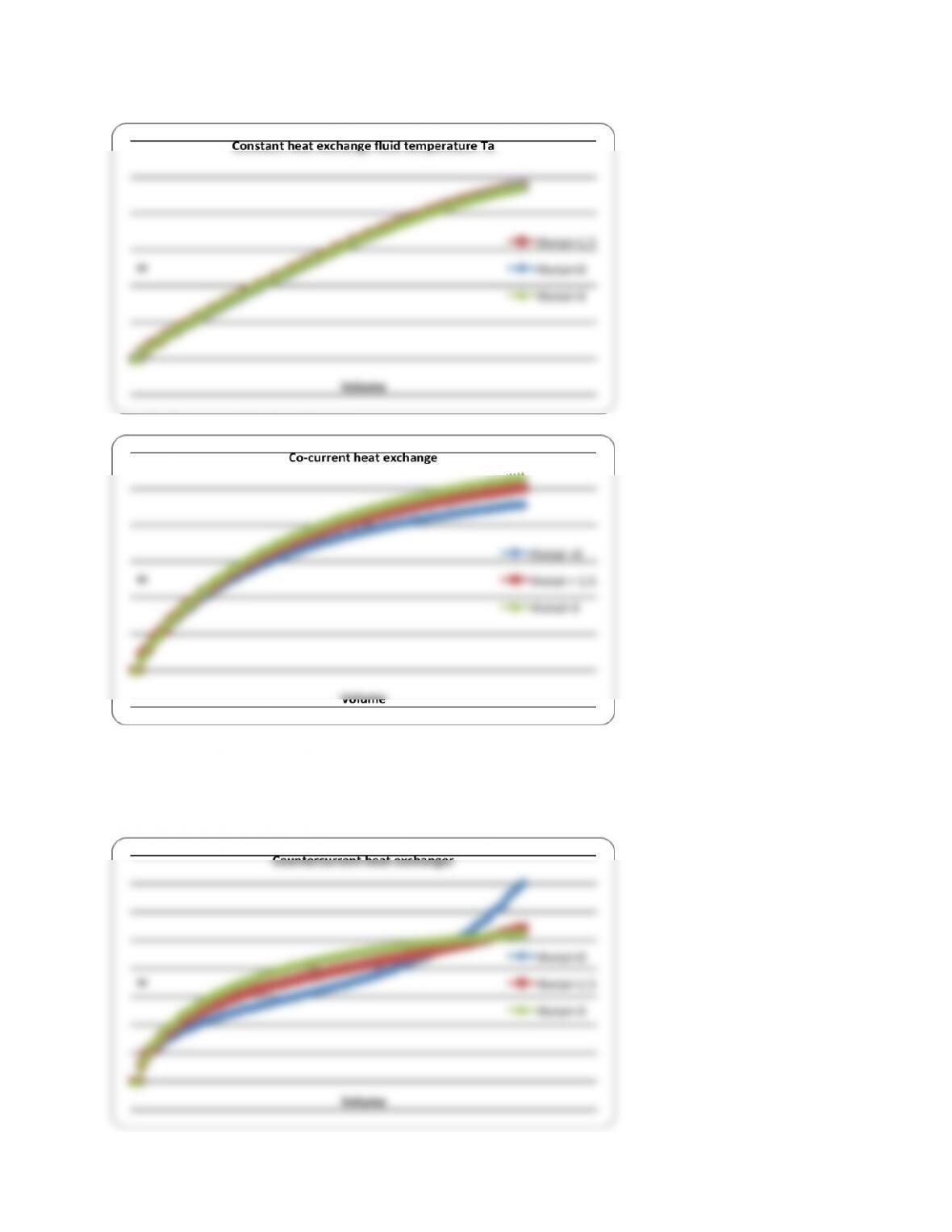
Incorporating$these$changes$in$the$code$and$plotting$X$versus$V$for$different$cases.$
The$analysis$is$as$follows:$
Case$I:$$adiabatic$operation:$
$
12–19$
P12-1)(c))Continued$
Case2:$Constant$heat$exchange$fluid$temperature$Ta$
$
$
The$Polymath$program$for$reference$is$for$the$case$of$co–current$heat$exchange$with$ѲI$=3.$
By$changing$values$of$∑Cp$and$ε$variables$as$shown$we$can$change$the$program$for$various$cases$and$
sub$cases.$
Case$4:$$Countercurrent$heat$exchange$
$
12–20$
P12-1)(c))Continued$
Remarks:$Thus$we$can$see$that$for$all$cases$when$inert$gas$concentration$is$more,$then$the$reaction$
proceeds$faster$but$then$the$overall$yield$is$less$as$well.$In$the$case$of$adiabatic$operation$this$
phenomenon$is$very$significant.$In$case$of$constant$heat$exchange$fluid$temperature$the$effect$of$inert$
gas$is$negligible.$
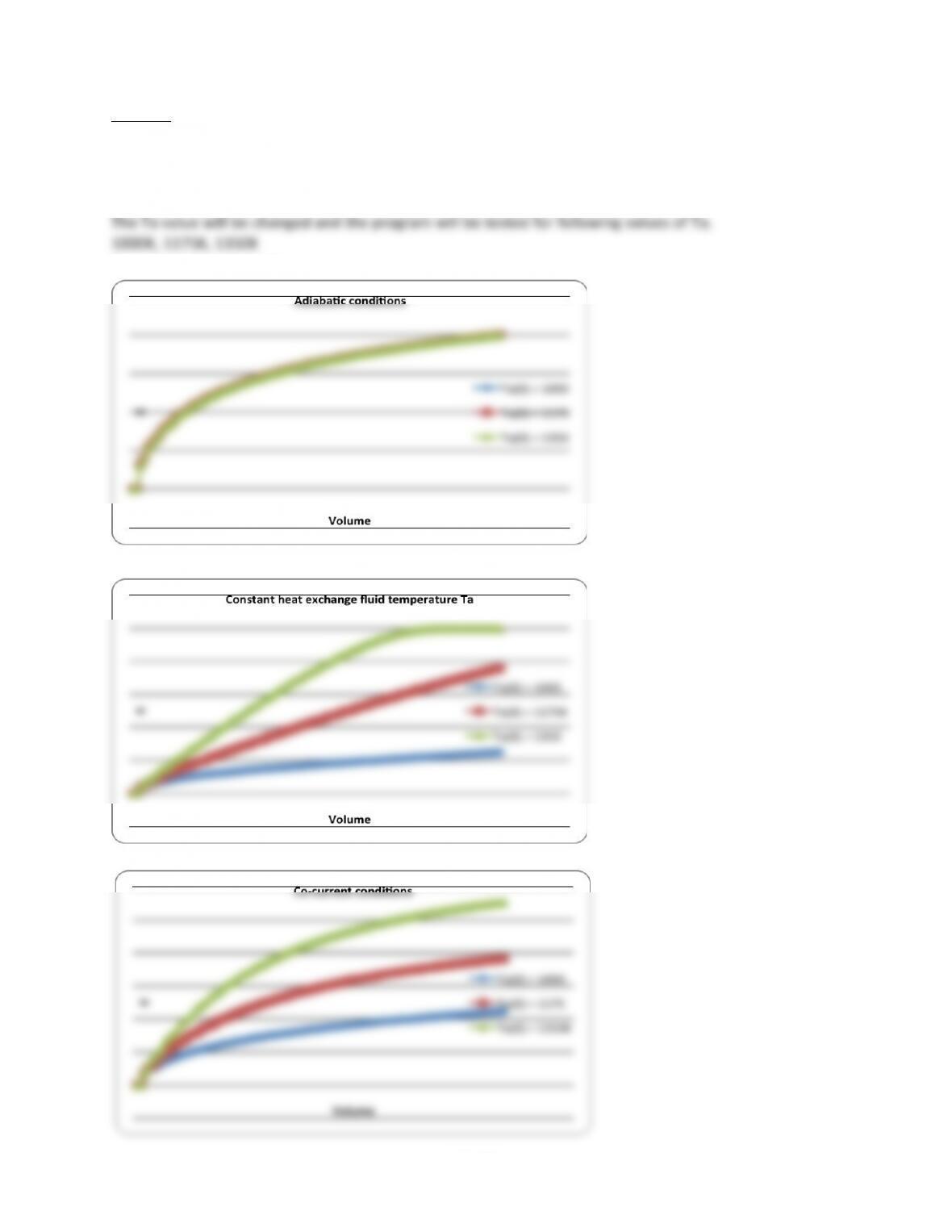
(xii)$Here$we$will$change$the$Polymath$program$as$entered$in$P12–2(c)$part$(vi).$
The$Ta$value$will$be$changed$and$the$program$will$be$tested$for$following$values$of$Ta.$
Case)1:$adiabatic$conditions$
$
Case$2:$Constant$heat$exchange$fluid$temperature$Ta$
$
Case$3:$Co–current$conditions$
$ $