10–21$
P10–10)(a))Continued$
)
)
)
)
)
$
$
$
10–22$
P10–10)(b))$
)
)
)
)
Substituting$the$expressions$for$CV$and$CA·S$into$the$equation$for$–r’A$
$
$
)
P10–10)(c))Individualized$solution$
)
10–23$
P10–10)(d))
First$we$need$to$calculate$the$rate$constants$involved$in$the$equation$for$–r’A$in$part$
(a).$We$can$rearrange$the$equation$to$give$the$following$
$
$
$
$
$
$
$
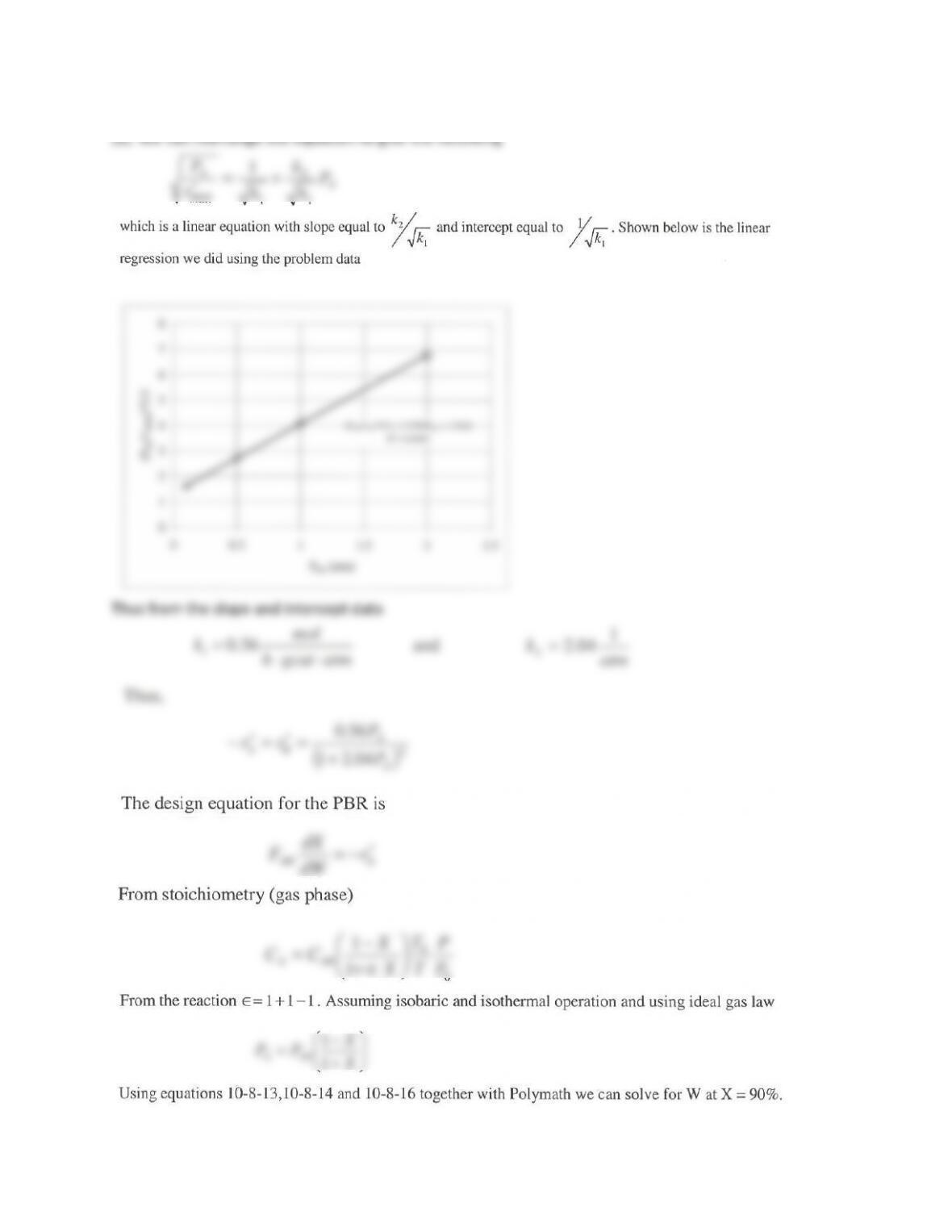
See$Polymath$program$P10–10–d.pol.$
10–24$
P10–10)(d)$continued$
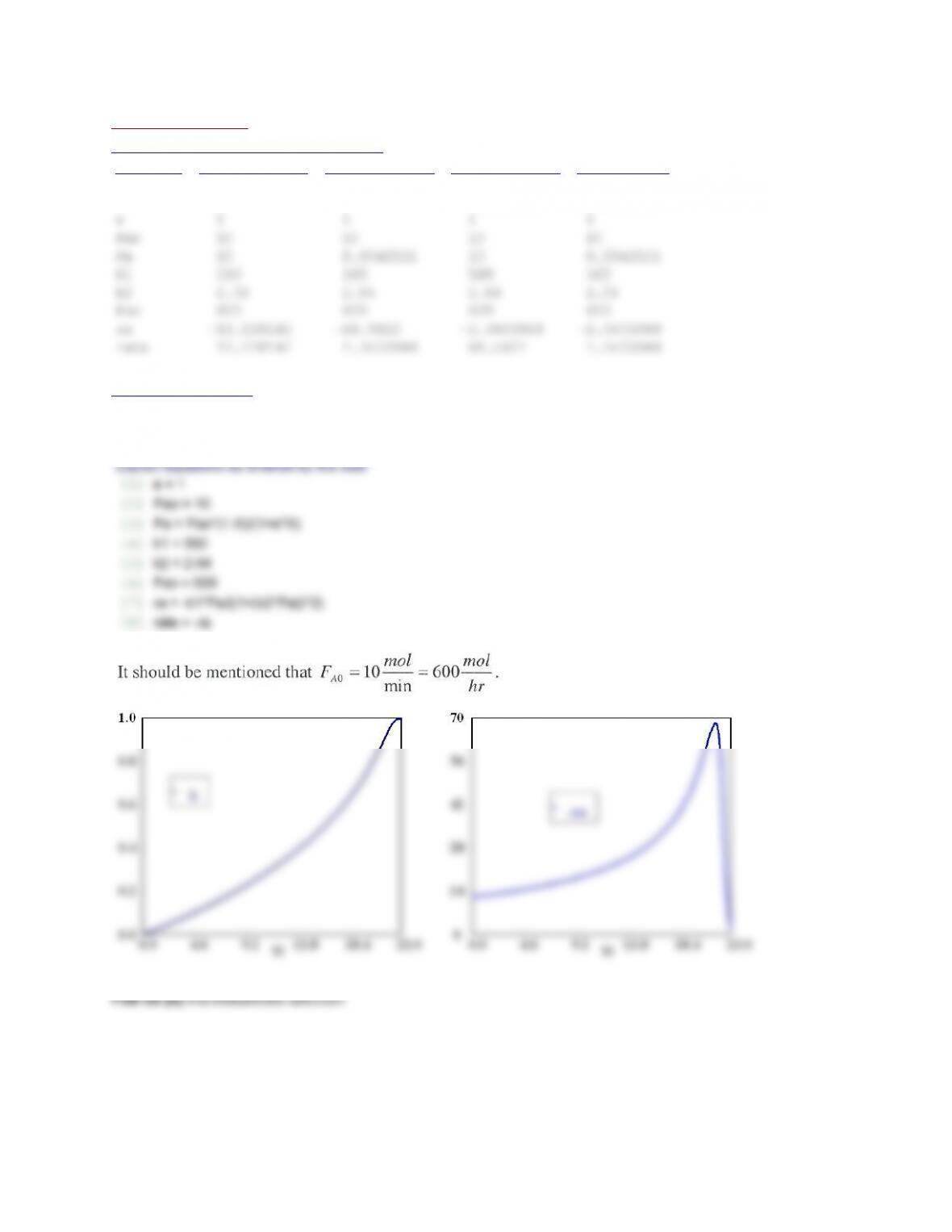
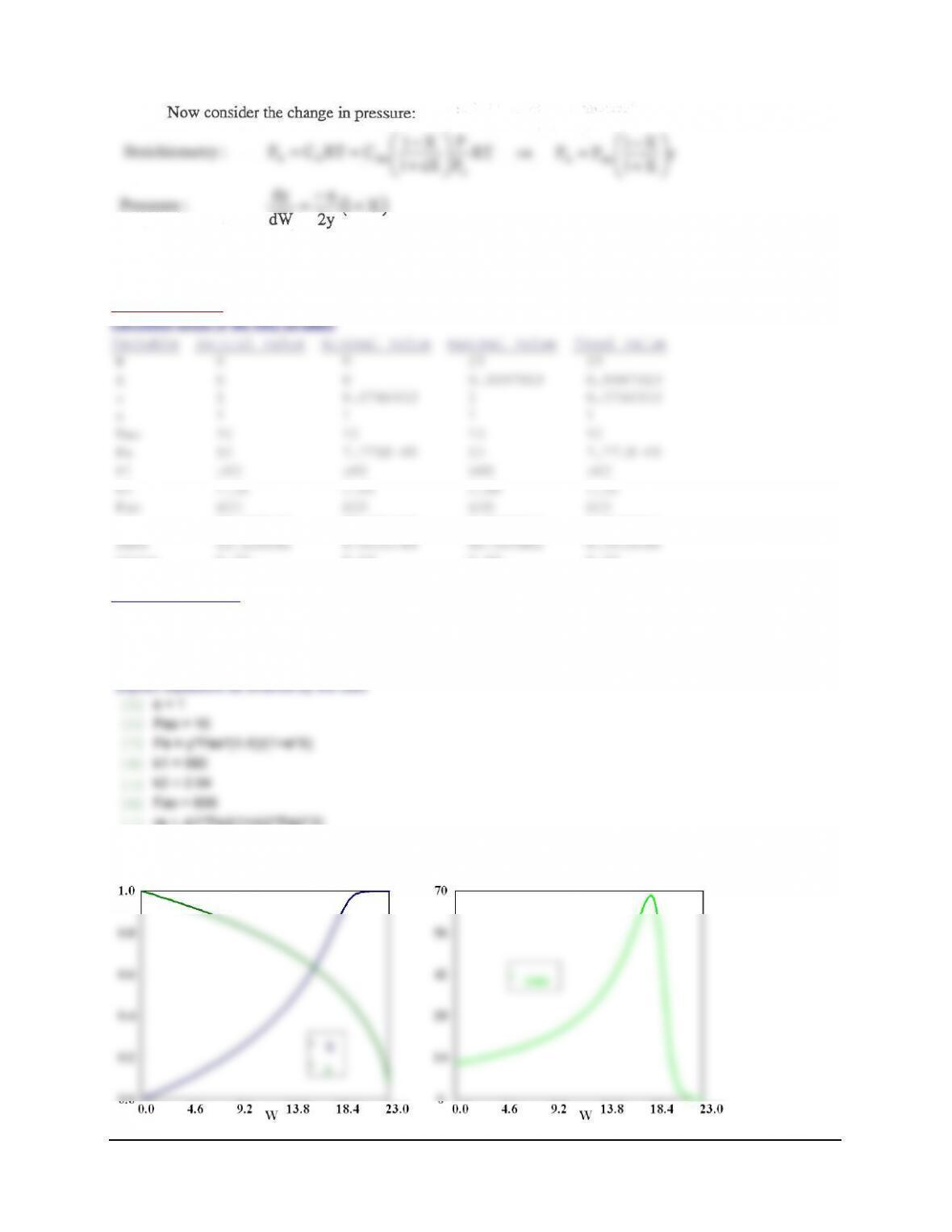
POLYMATH)Results
Calculated)values)of)the)DEQ)variables
Variable initial value minimal value maximal value final value
W 0 0 23 23
X 0 0 0.9991499 0.9991499
e 1 1 1 1
ODE)Report)(RKF45)
Differential equations as entered by the user
[1] d(X)/d(W) = –ra/Fao
Explicit equations as entered by the user
$
$
P10–10)(e)$Individualized$solution$
)
10–25$
P10–10)(f)$
$
$
Use$these$new$equations$in$the$Polymath$program$from$part$(d).$
See$Polymath$program$P10–10–f.pol.$
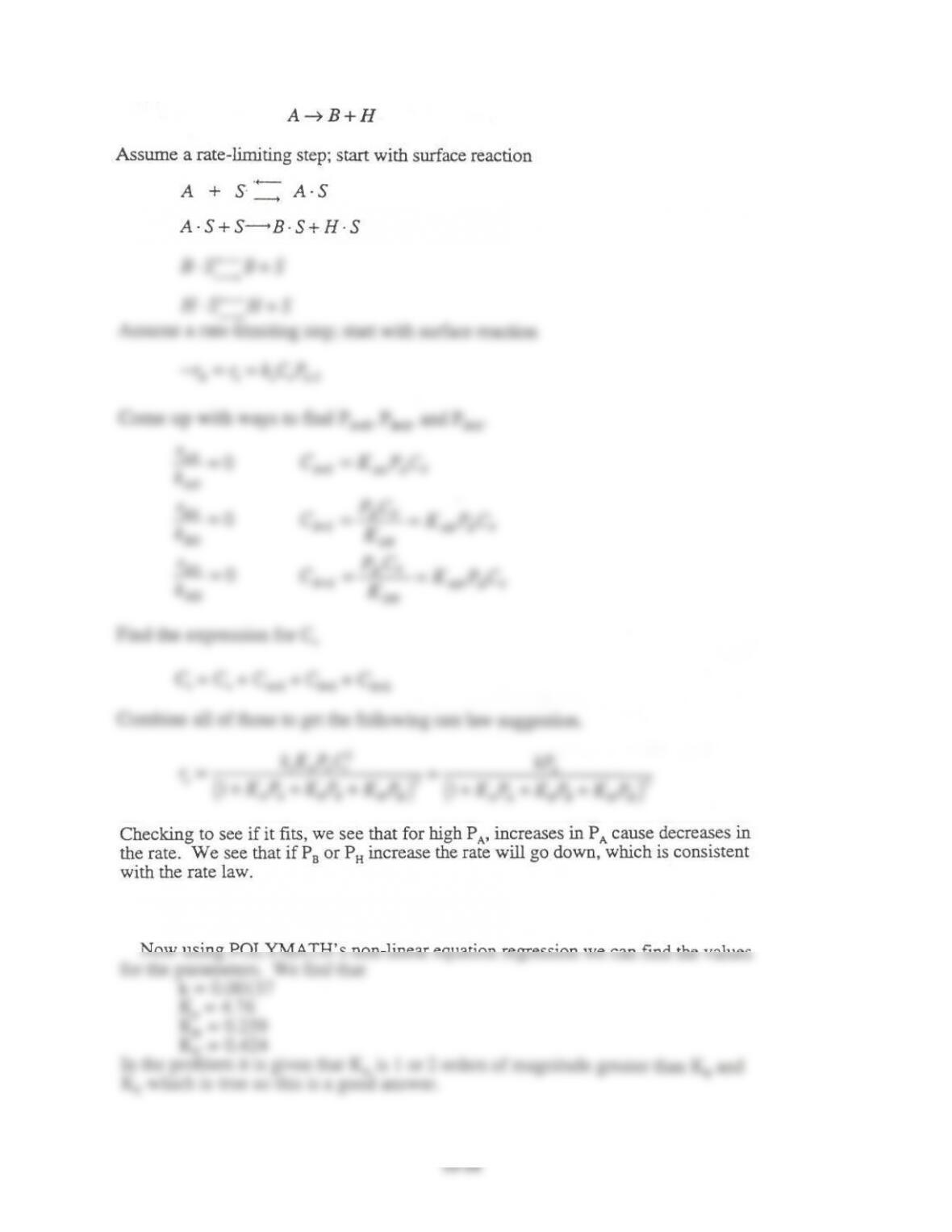
POLYMATH)Results
Calculated)values)of)the)DEQ)variables
rate 12.228142 0.0435044 68.584462 0.0435044
ODE)Report)(RKF45)
Differential equations as entered by the user
[1] d(X)/d(W) = –ra/Fao
[2] d(y)/d(W) = –alpha*(1+X)/2/y
Explicit equations as entered by the user
[8] rate = –ra
[9] alpha = .03
$
$
10–26$
P10-11)(a))$
)
)
)
)
P10–11)(b))
)
10–27$
P10–11)(b))Continued$
)
)
P10–11)(c))
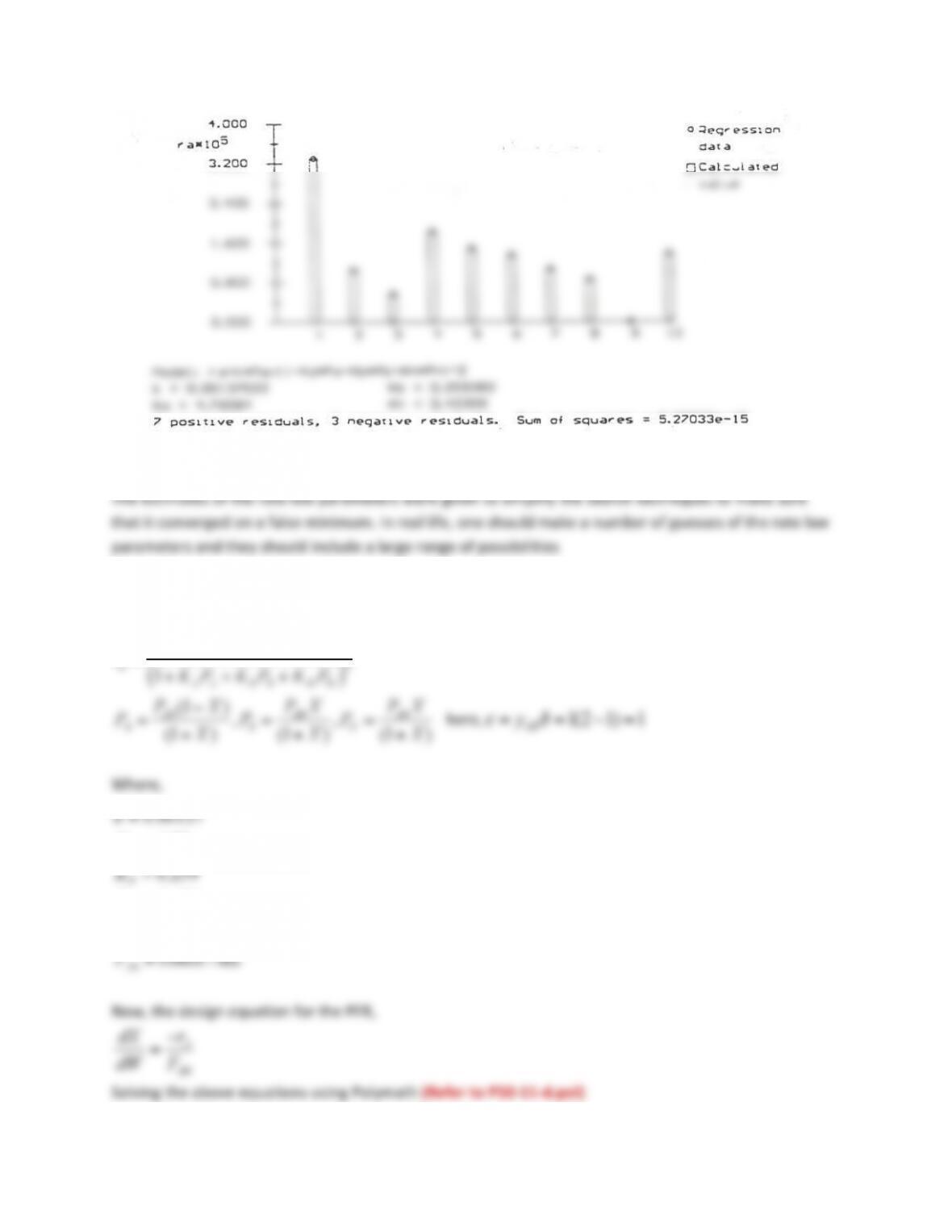
The$estimates$of$the$rate$law$parameters$were$given$to$simplify$the$search$techniques$to$make$sure$
)
P10–11)(d))
ABH⎯⎯→ +
)
( )
2
1
A
a
AA BB H H
kP
r
KP KP K P
−
=+++
$
000
(1 ) ,,
(1 ) (1 ) (1 )
AAA
ABH
PX PX PX
PPP
XXX
−
===
+++
$$$here,
01(2 1) 1
A
y
εδ
==−=
$
$
Where,$
0
0
0.00137
4.77
0.259
0.424
15
10 / sec
A
B
H
A
A
k
K
K
K
P atm
F mol
=
=
=
=
=
=
$
$
10–28$
P10–11)(d)$continued$
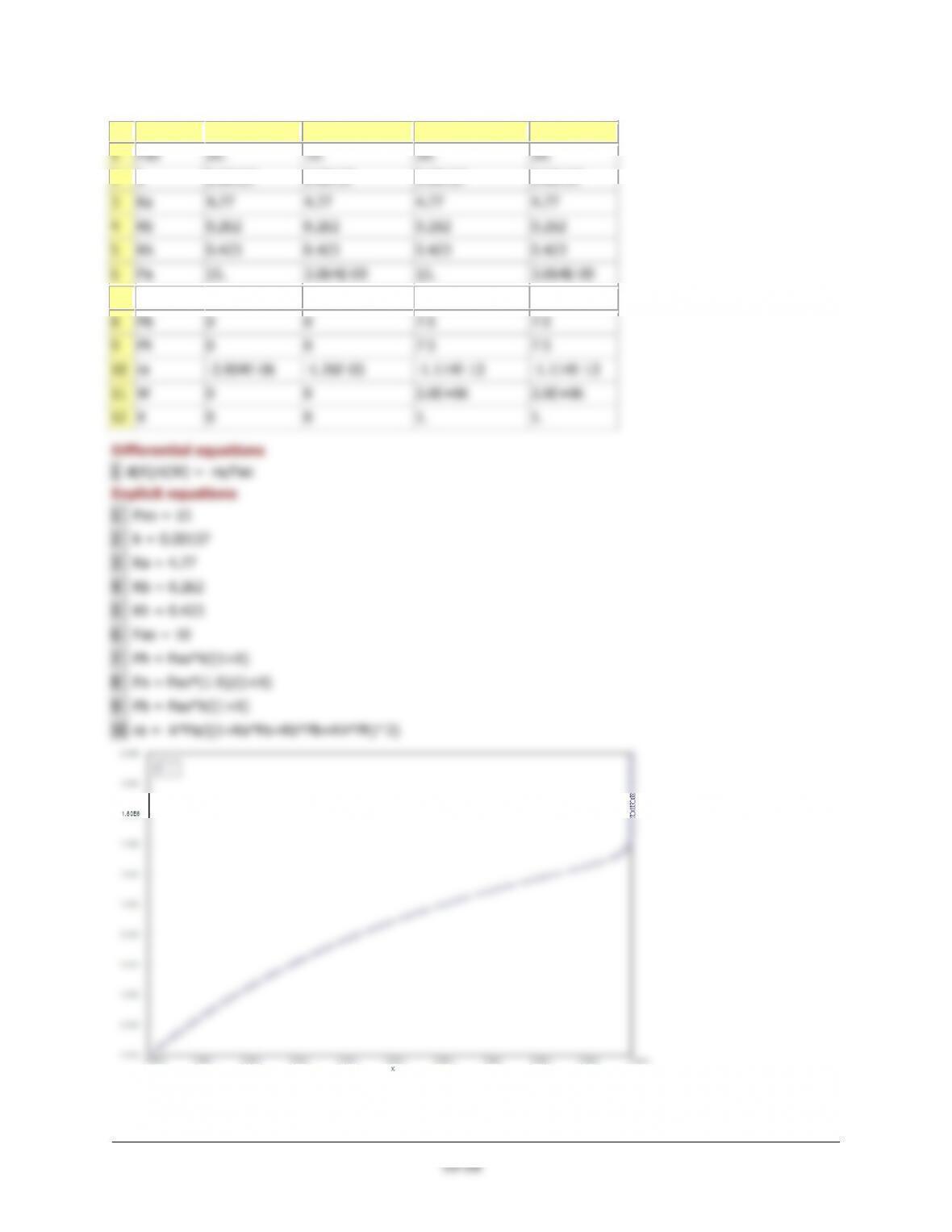
Calculated values of DEQ variables$$
Variable
Initial value
Minimal value
Maximal value
Final value
1
Fao
10.
10.
10.
10.
2
k
0.00137
0.00137
0.00137
0.00137
3
Ka
4.77
4.77
4.77
4.77
4
Kb
0.262
0.262
0.262
0.262
5
Kh
0.423
0.423
0.423
0.423
6
Pa
15.
3.064E–09
15.
3.064E–09
7
Pao
15.
15.
15.
15.
8
Pb
0
0
7.5
7.5
9
Ph
0
0
7.5
7.5
10
ra
–3.904E–06
–1.26E–05
–1.114E–13
–1.114E–13
11
W
0
0
2.0E+06
2.0E+06
12
X
0
0
1.
1.
$
Differential equations$$
1
d(X)/d(W) = –ra/Fao
Explicit equations$$
1
Pao = 15
2
k = 0.00137
3
Ka = 4.77
4
Kb = 0.262
5
Kh = 0.423
6
Fao = 10
7
Ph = Pao*X/(1+X)
8
Pa = Pao*(1–X)/(1+X)
9
Pb = Pao*X/(1+X)
10
ra = –k*Pa/((1+Ka*Pa+Kb*Pb+Kh*Ph)^2)
$
From$the$above$graph,$we$get$the$weight$of$catalyst$required$for$85%$conversion$is$1.2083×10⁶)kg.)$
The$required$catalyst$weight$is$so$high$because$of$very$low$value$of$reaction$constant$’k’.$
$$$$$$$$$$$$$$
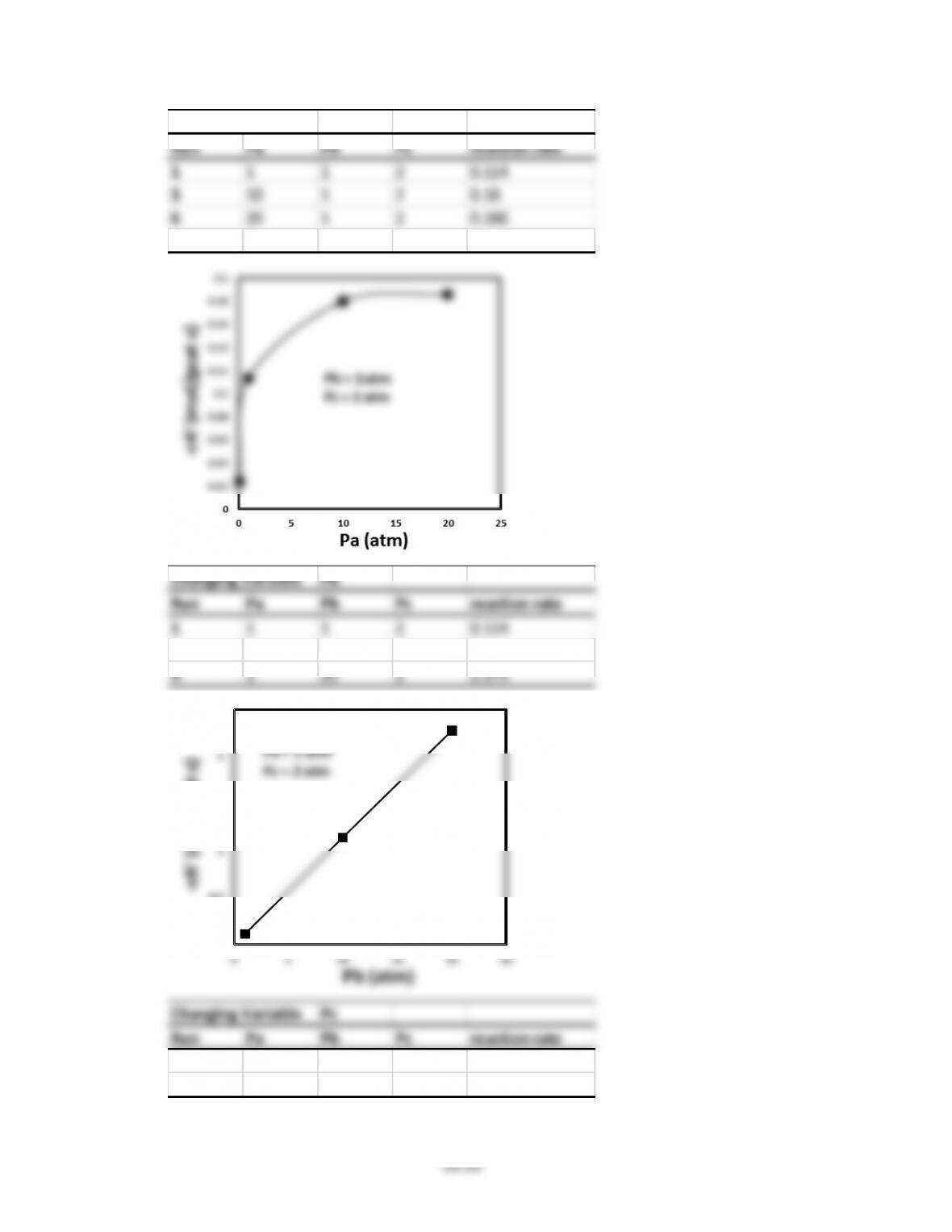
P10–12)(a))
)
)
)
)
Pa
Run Pa Pb Pc reaction-rate
11 1 2 0.114
310 1 2 0.18
620 1 2 0.186
70.1 1 2 0.0243
Changing-Variable
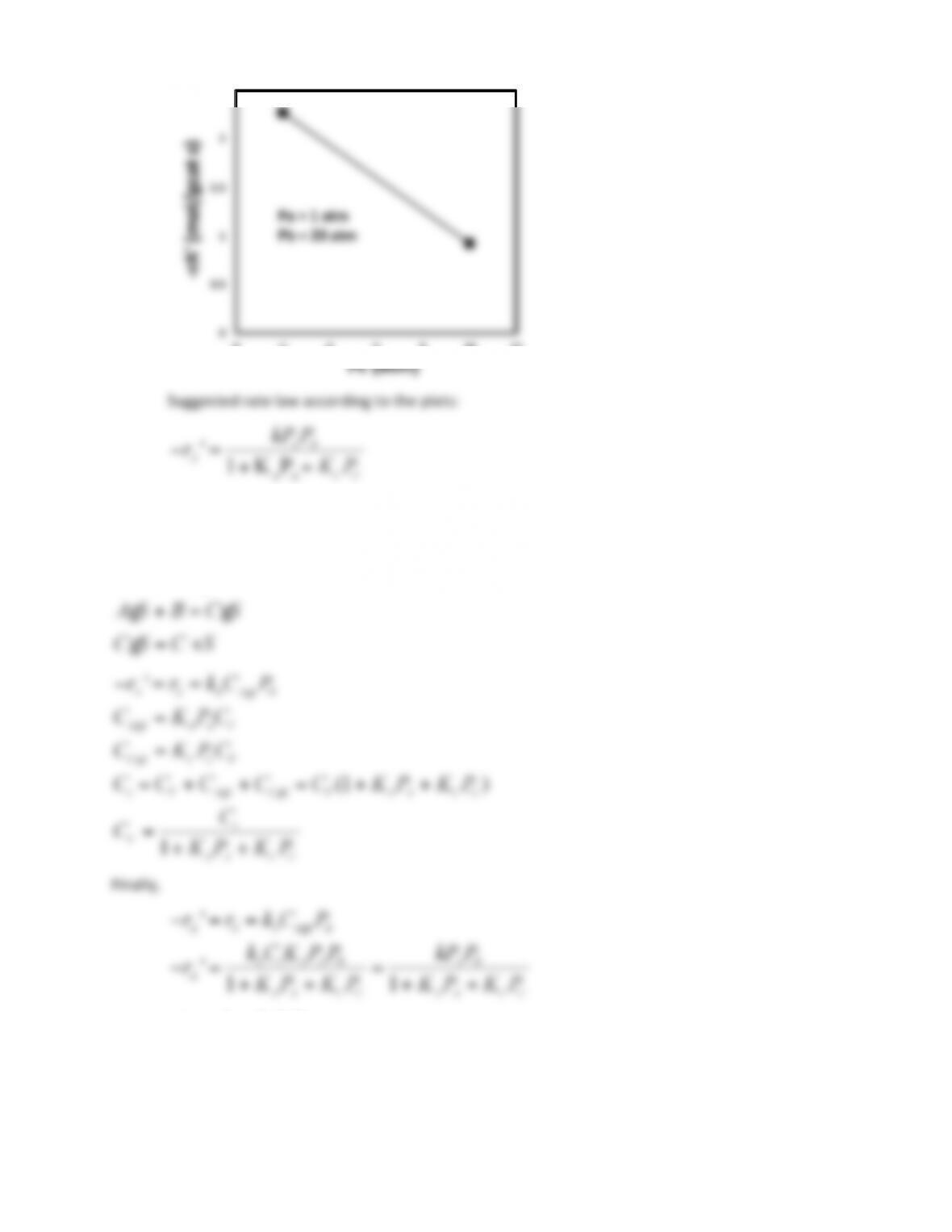
Pb
Run Pa Pb Pc reaction-rate
11 1 2 0.114
2110 21.14
4120 22.273
Changing-Variable
0
0.5
1
1.5
2
2.5
0 5 10 15 20 25
-rA’*(mol/gcat*s)
Pb*(atm)
Pa*=*1*atm
Pc*=*2*atm
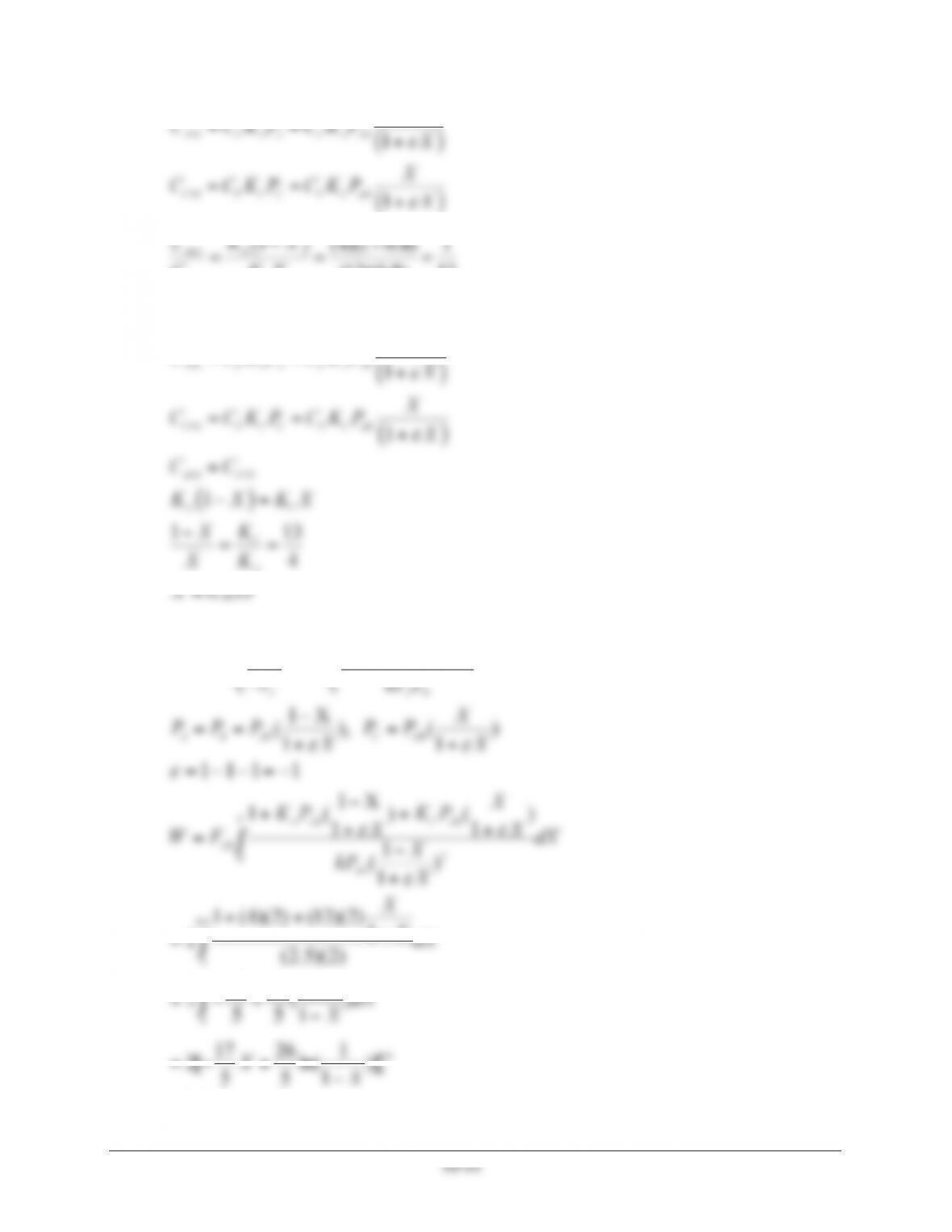
Pc
Run Pa Pb Pc reaction-rate
4120 22.273
5120 10 0.926
Changing-Variable
)
AA CC
P10–12)(b))Species$A$and$C$are$on$the$surface$
)
P10–12)(c))
AS AS
AS B CS
CS C S
+=
+=
=+
g
gg
g
$
‘
(1 )
1
ASSASB
AS A A V
CS C C V
tV ASCSV AA CC
t
V
AA CC
rrkCP
CKPC
CKPC
CC C C C KPKP
C
C
KP KP
−==
=
=
=+ + = + +
=++
g
g
g
gg
$
Finally,$$
‘
‘
11
ASSASB
St AAB AB
A
AA CC AA CC
rrkCP
kCK PP kPP
r
KP KP KP KP
−==
−= =
++ ++
g
$
Where$
St A
kkCK=
$
0
0.5
1
1.5
2
2.5
0 2 4 6 8 10 12
-rA’-(mol/gcat-s)
Pc-(atm)
Pa-=-1-atm
Pb-=-20-atm
P10–12)(d))
( )
( )
( )
0
0
1
1
1
AS V A A V A A
CS V C C V C A
X
CCKPCKP
X
X
CCKPCKP
X
ε
ε
•
•
−
== +
== +
$
( )
1(4)(1 0.8) 1
(13)(0.8) 13
A
AS
CS C
KX
C
CKX
•
•
−−
== =
$
)
P10–12)(e))
( )
( )
( )
( )
0
0
1
1
1
1
1 13
4
0.235
AS V A A V A A
CS V C C V C A
AS C S
AC
C
A
X
CCKPCKP
X
X
CCKPCKP
X
CC
KXKX
XK
XK
X
ε
ε
•
•
••
−
== +
== +
=
−=
−==
=
)
)
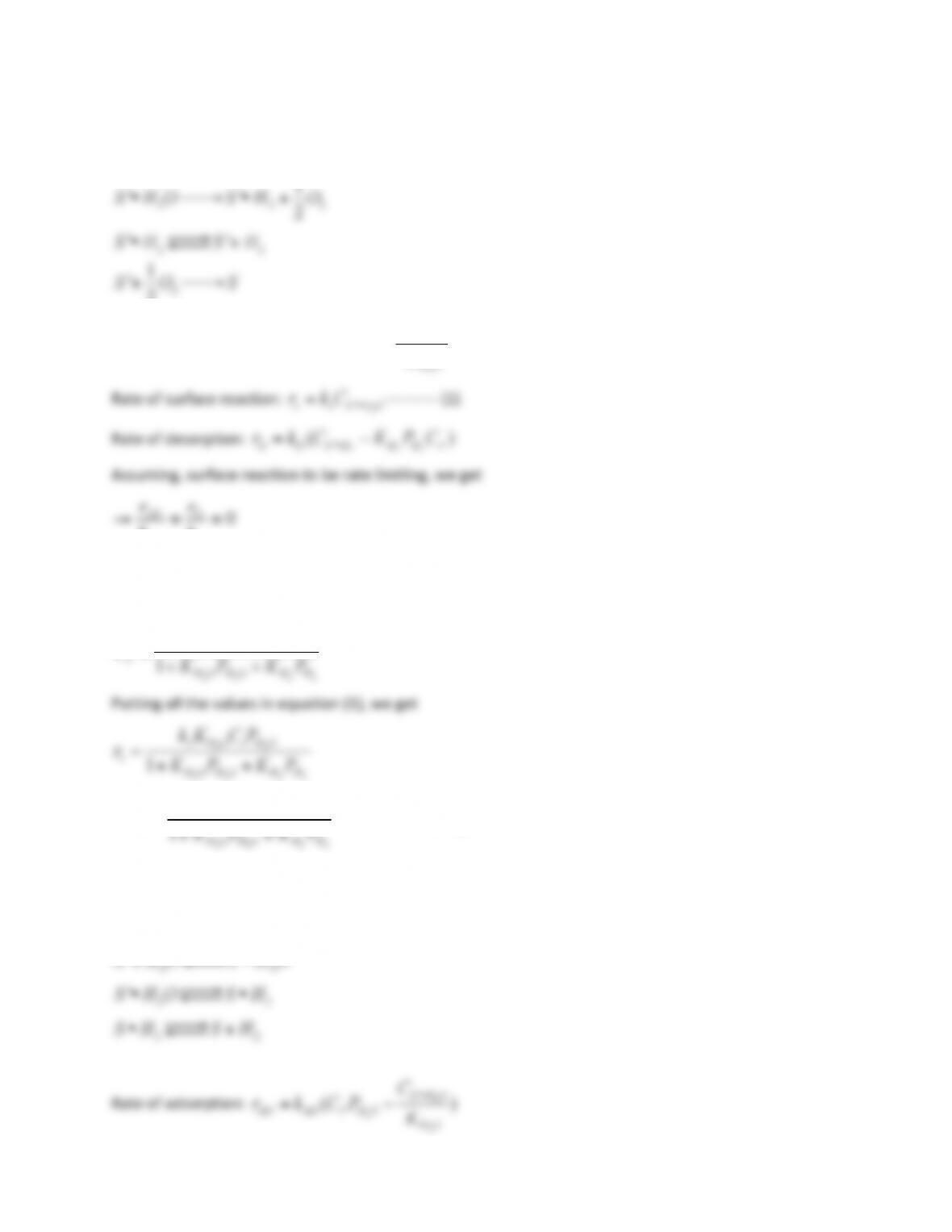
P10–12)(f))
00
00
00
00
0
2
0
0
1
‘
1X
( ), ( )
11
111 1
1X
1()()
11
1
()
1
XX
AA CC
AA
AAB
AB A C A
XAA CA
A
A
dX K P K P
W F F dX
rkPP
X
PPP PP
XX
X
KP KP
XX
W F dX
X
kP
X
εε
ε
εε
ε
++
==
−
−
== =
++
=−−=−
−
++
++
=−
+
∫∫
∫
P10–13)(a))
Proposed$Single$site$Mechanism:$$
22
222
22
2
”
1
”
2
”
1
‘
2
SHO SHO
SHO SH O
SH S H
SO S
⎯⎯→
+•
←⎯⎯
•⎯⎯→•+
⎯⎯→
•+
←⎯⎯
+⎯⎯→
$
Rate$of$adsorption:$
2
2
2
‘
‘
()
SHO
AD AD v H O
HO
C
rkCP
K
•
=−
$
Rate$of$surface$reaction:$
2
‘ssSHO
rkC
•
=
———-$(1)$
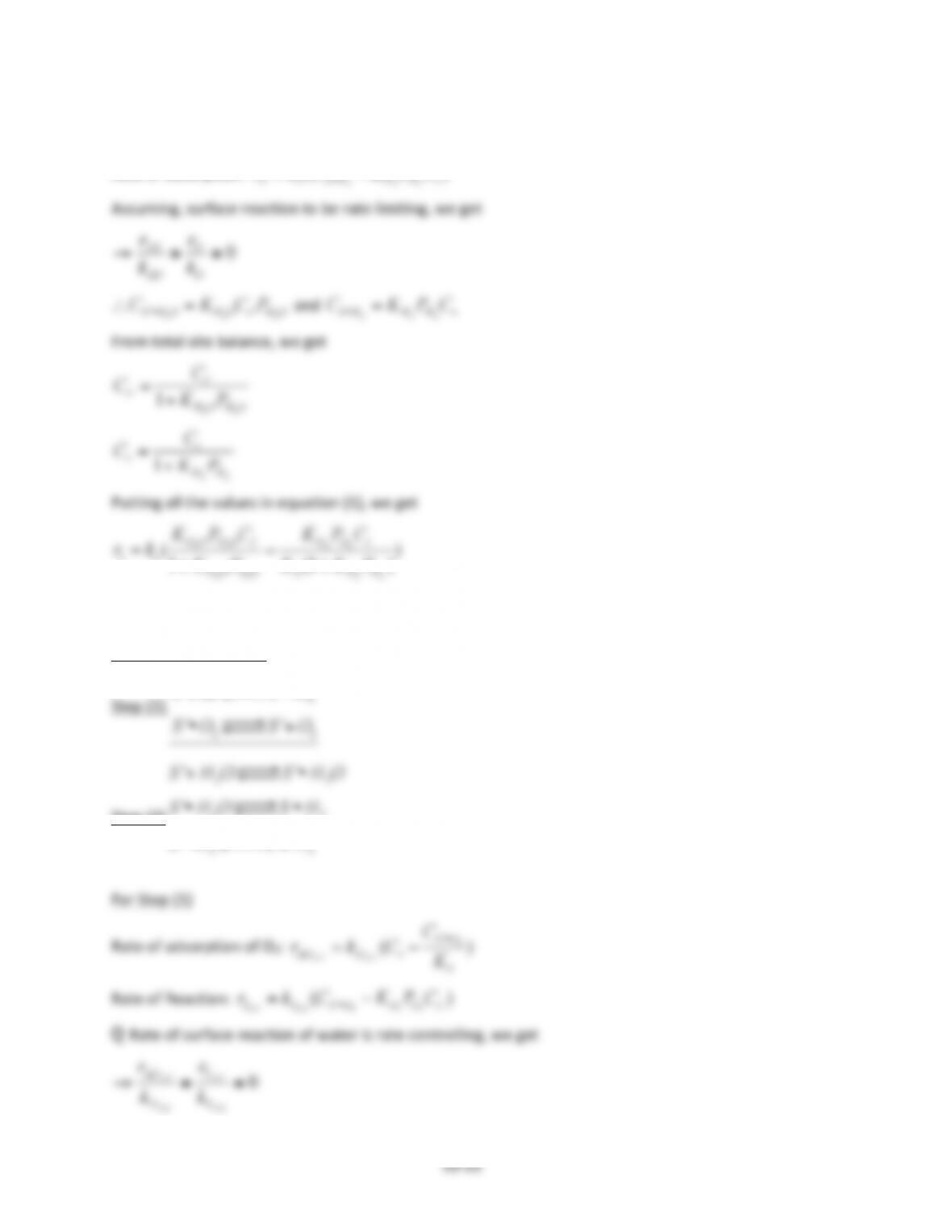
P10–13)(b))Continued$
Rate$of$surface$reaction:$
22
‘
(/K)
ssSHO SH S
rkC C
••
=−
$$$$$$$———-$(1)$!
Rate$of$desorption:$
222
()
DDSH HHv
rkC KPC
•
=−
$
Assuming,$surface$reaction$to$be$rate$limiting,$we$get$
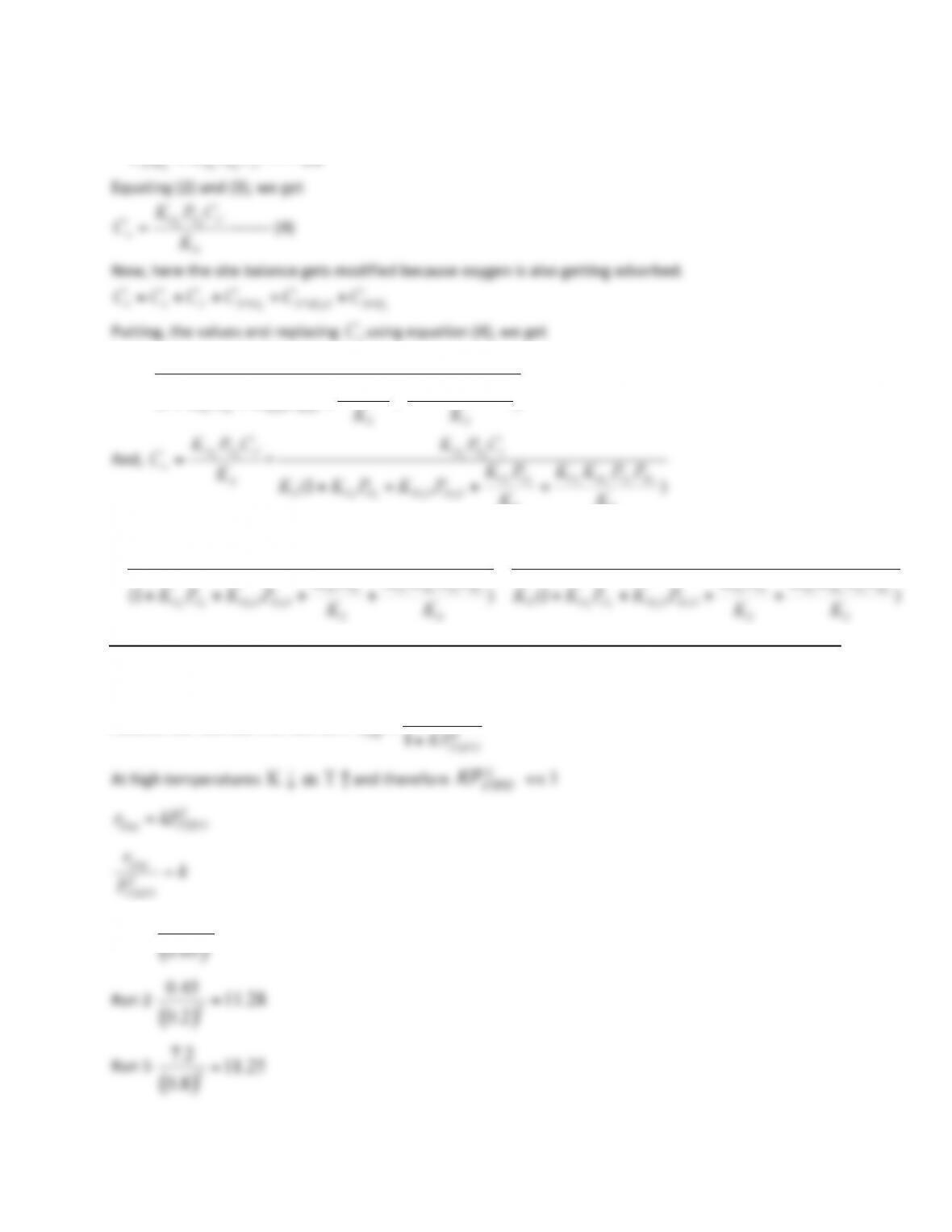
P10–13)(c))Continued$
∴
2
‘SO v S
CCK
•=
$———–$(2)$$
$$$$
222
”SO O O v
CKPC
•=
——-$(3)$
Equating$(2)$and$(3),$we$get$
22 2 22 2
22 2 2
‘
(1 )
t
v
OO O H O H
OO HOHO
SS
C
CKP KK PP
KP K P
KK
=
++ + +
$
And,$
v
C=
22 ‘OO v
KPC
=
22
OO t
KPC
KP KK PP
$
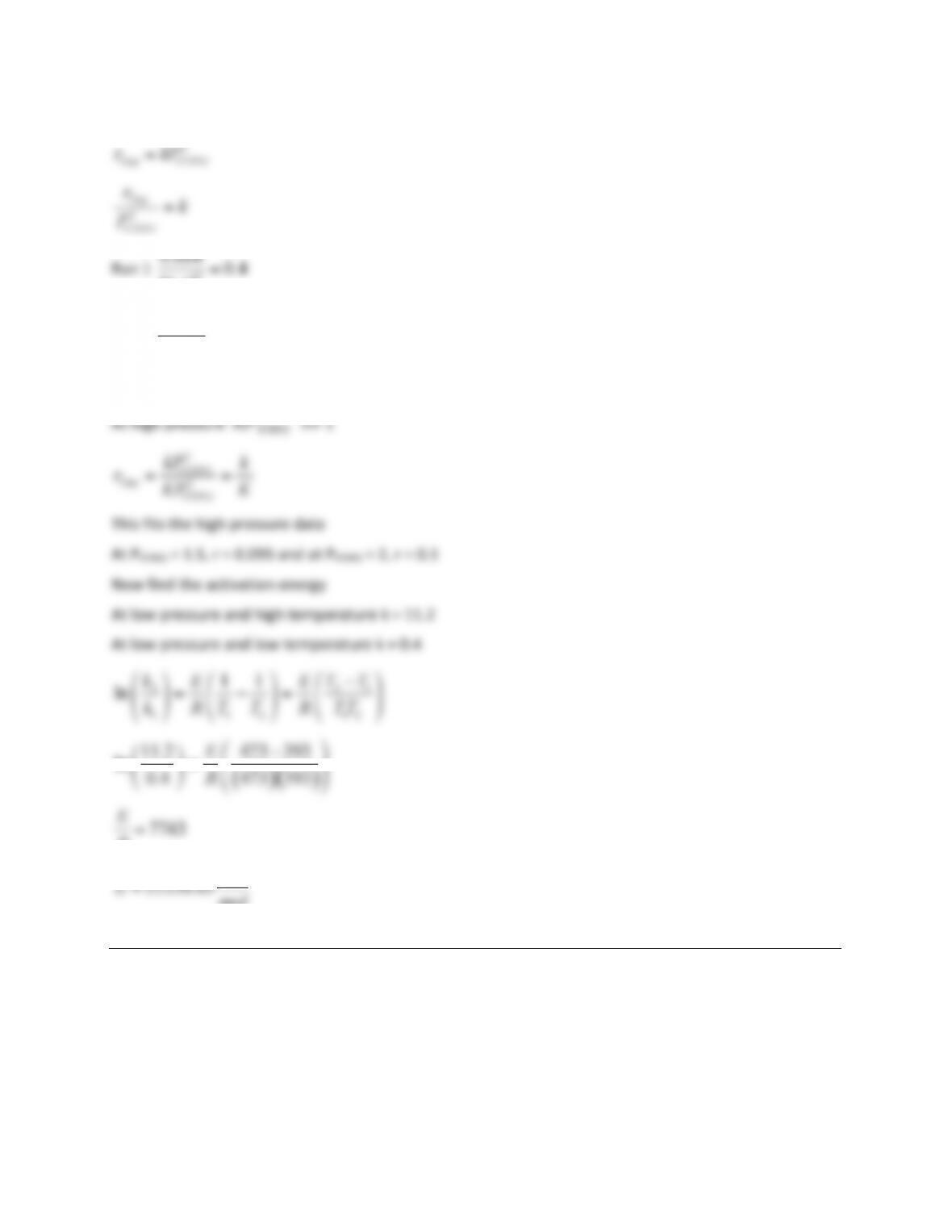
P10–14)continued$
At$low$temperature$and$low$pressure$
2
Dep VTIPO
r kP=
$
2
Dep
VTIPO
rk
P=
$
Run$1$
( )2
0.004 0.4
0.1
=
$
Run$2$
( )2
0.015 0.375
0.2
=
$
These$fit$the$low–pressure$data$
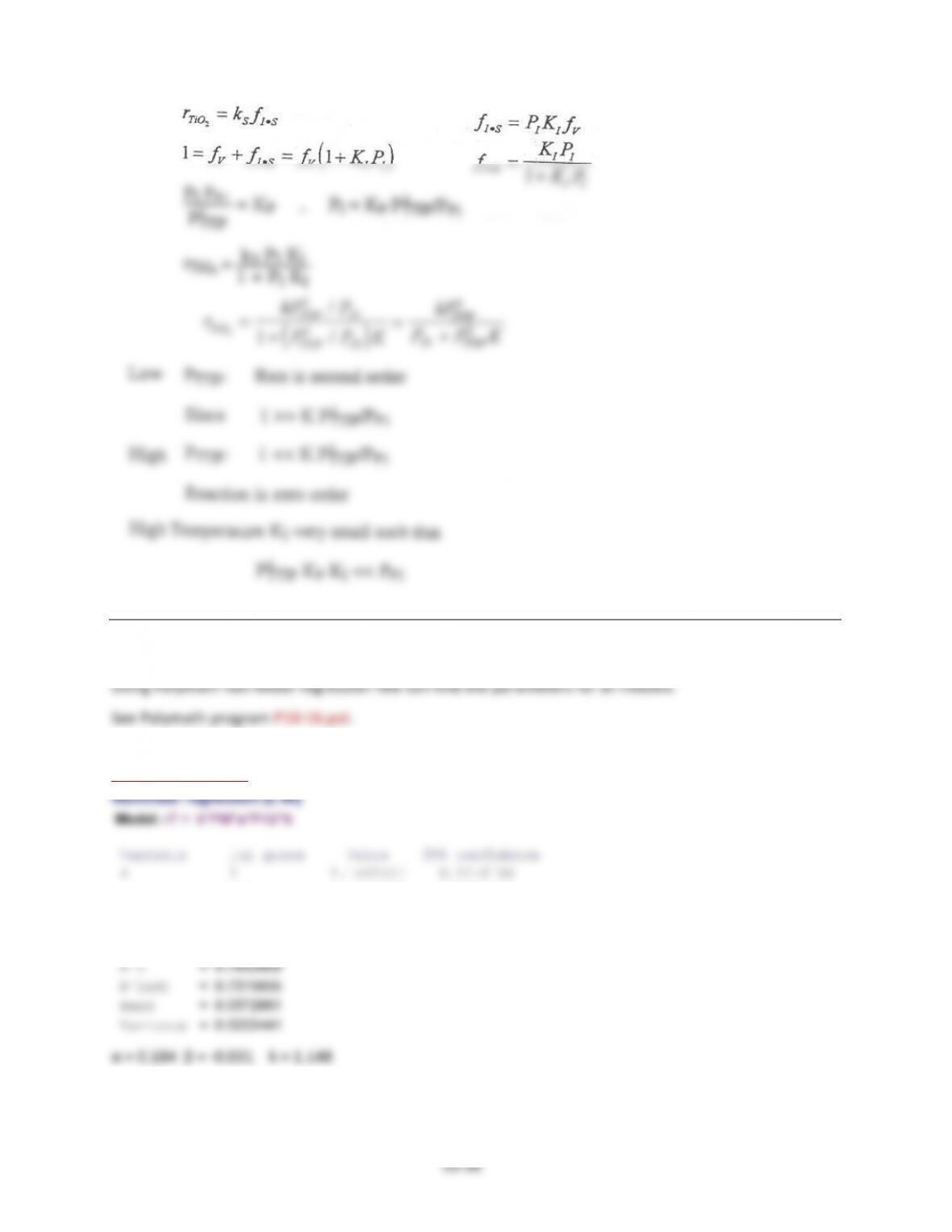
At$high$pressure$
1
2>>
VTIPO
KP
$
10–36$
P10–15)
$
$
P10–16)(a))
Using$Polymath$non–linear$regression$few$can$find$the$parameters$for$all$models:$
(1)$
POLYMATH)Results
Nonlinear)regression)(L–M))
b 0.1 –0.0308691 0.1311507
Precision
R^2 = 0.7852809
10–37$
P10–16)(a))Continued$
$(2)$
POLYMATH)Results
Nonlinear)regression)(L–M))
Model: rT = k*PM/(1+KM*PM)
Variable Ini guess Value 95% confidence
(3)$
POLYMATH)Results
Nonlinear)regression)(L–M))
Model: rT = k*PM*PH2/((1+KM*PM)^2)
Variable Ini guess Value 95% confidence
(4)$
POLYMATH)Results
Nonlinear)regression)(L–M))
Model: rT = k*PM*PH2/(1+KM*PM+KH2*PH2
Variable Ini guess Value 95% confidence
10–38$
P10–16)(b))
We$can$see$from$the$precision$results$from$the$Polymath$regressions$that$rate$law$(2)$best$describes$the$
P10–16)(c))Individualized$solution$
)
P10–16)(d)))
We$have$chosen$rate$law$(2)$
Proposed$Mechanism$
MS MS
⎯⎯→
+•
←⎯⎯
)
2( ) ( )gg
MS H T•→+
)
Rate$of$adsorption:$
()
MS
AD AD v M
M
C
rkCP
K
•
=−
$
Rate$of$surface$reaction:$
ssMS
rkC
•
=
———-$(1)$
Assuming,$surface$reaction$to$be$rate$limiting:$
0
AD
AD
r
k
⇒≅
$
MS v M M
CCPK
•
⇒=
$
Putting,$the$value$of$
MS
C•
in$Equation$(1)$
ssvMM
rkCPK=
—————–$(2)$
Now,$applying$site$balance$
tvMS
CCC
•
=+
$
tvvMM
CCCPK⇒=+
$
1
t
v
MM
C
C
PK
⇒=
+
$
Putting$in$Equation$(2),$we$get$
1
sMtM
s
MM
kK CP
r
KP
⇒=+
$
1
M
s
MM
kP
r
KP
⇒=
+
$Where,$k$=$
sMt
kK C
$
$
)
P10–17)(a))
)
)
$
$
––A$better$solution$is$to$put$this$equation$directly$into$polymath.$