Solutions)for)Chapter)10)–)Catalysis)and)Catalytic)Reactors$
)
P10–1)(a))Example)10-1)
(i)$$
.0
(1 ) (1 )
TS v T T T T T
CCKPKP X
KX
−−
== =
$
10-2$
P10–1)(c))Example)10-3)(1)$
(b)$Continued)
Precision
R^2 = 0.9735965
R^2adj = 0.9702961
Rmsd = 0.0759032
R^2adj = 0.9573327
Rmsd = 0.0909706
Variance = 0.1034455
(d)$
POLYMATH)Results
P10–1)(c))Example)10-3)(2))
(e)$
POLYMATH)Results
Nonlinear)regression)(L–M))
Model: ReactionRate = k*Pe*Ph/((1+Ka*Pea+Ke*Pe)^2)
Variable Ini guess Value 95% confidence
10-3$
P10–1)(c))Example)10-3)(2))
(f)$Continued$
Precision
R^2 = –0.343853
P10–1)(d))Example)10-4)
(i)$About$90%$
$
$
(ii)$Individualized$solution$
(iii)$Individualized$solution$
/
1
1(1 ) d
dkk
d
X
kt
=−+
))
0
100
200
300
400
500
time
0.0
0.2
0.4
0.6
0.8
1.0
Conversion
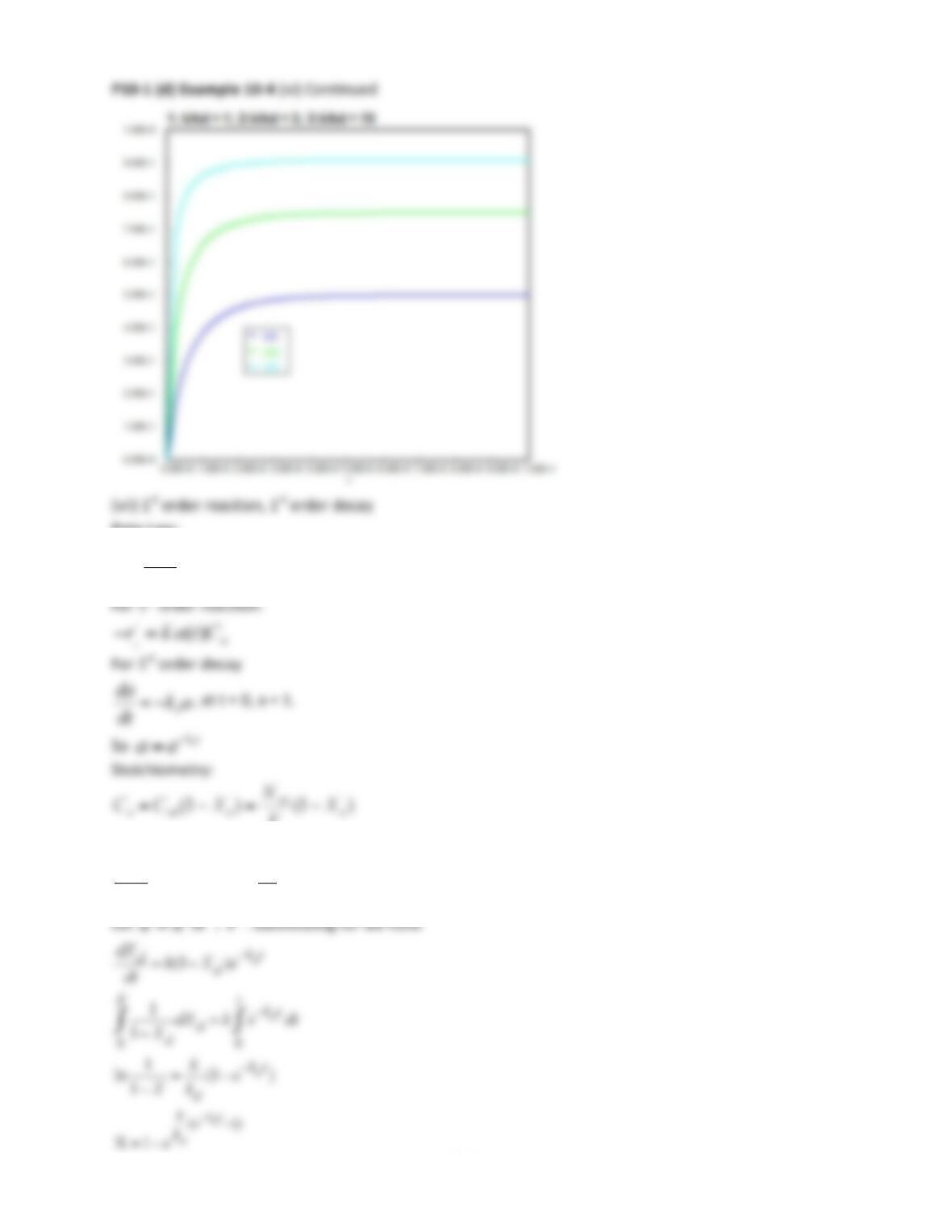
P10–1)(d))Example)10–4)(v)$Continued$
Rate$Law:$
‘
0
d
AA
dX
NrW
dt =−
$
For$2nd$order$reaction:$
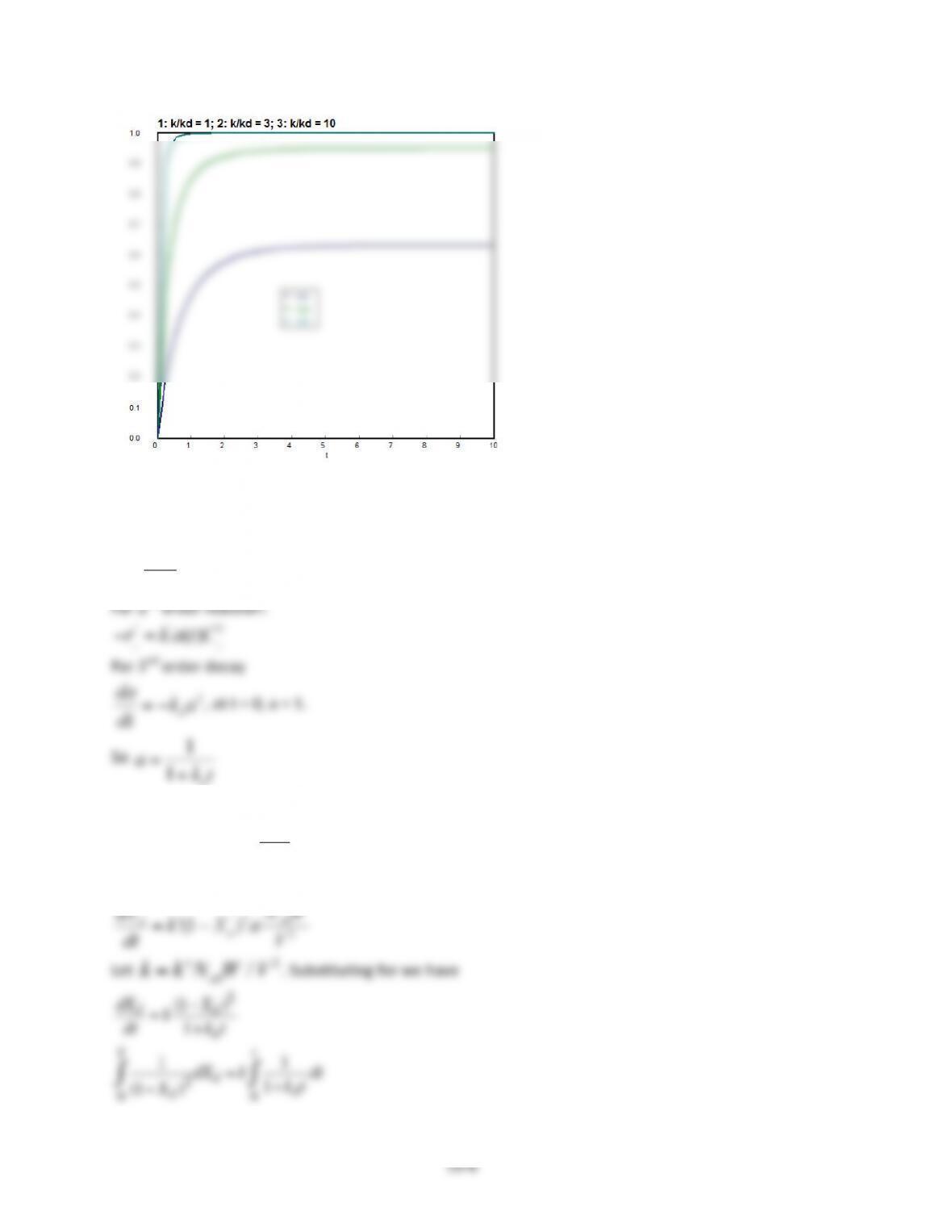
P10–1)(d))Example)10–4)(vi)$Continued$
Rate$Law:$
‘
0
d
AA
dX
NrW
dt =−
$
For$1st$order$reaction:$
10-6$
P10–1)(d))Example)10–4)(vii)$Continued$
$
(viii)$2nd$order$reaction,$2nd$order$decay$
Rate$Law:$
‘
0
d
AA
dX
NrW
dt =−
$
For$2nd$order$reaction:$
Stoichiometry:$
0
0(1 ) (1 )
A
AA d d
N
CC X X
V
=−=−
$
Combine:$
20
2
‘(1 )
dA
d
dX N W
kXa
dt V
=−
$
Let$
2
0
‘/
A
kkNWV=
.$Substituting$for$we$have$
dXd
dt =k(1−Xd)2
1+kdt
1
(1−Xd)2
0
X
∫dXd=k1
1+kdt
dt
0
t
∫
$
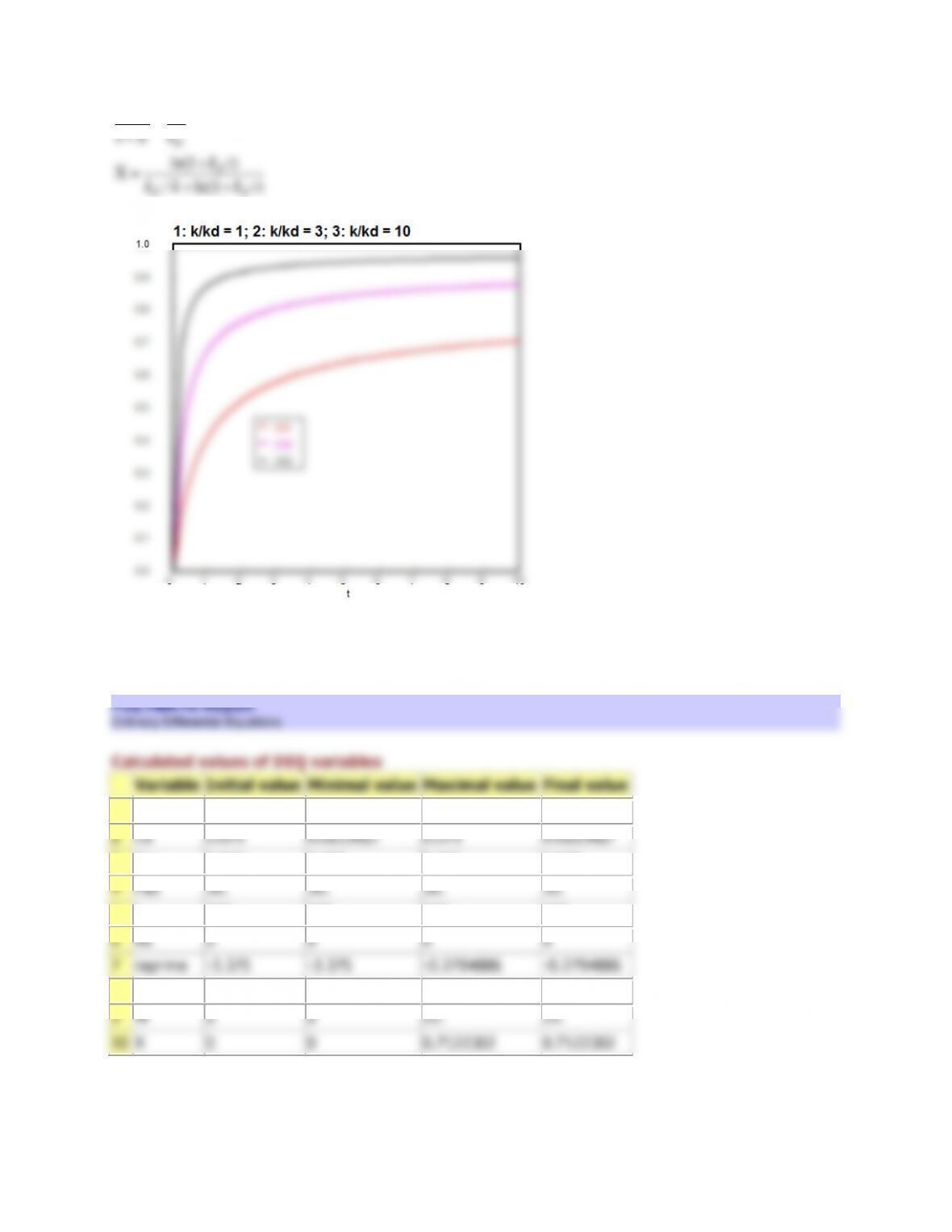
P10–1)(d))Example)10–4)(viii)$Continued$
X
1−X=k
kd
ln(1+kdt)
X=ln(1+kdt)
kd/k+ln(1+kdt)
$
P10–1)(e)))
(i)$See$polymath$program$P10-1-e.pol$
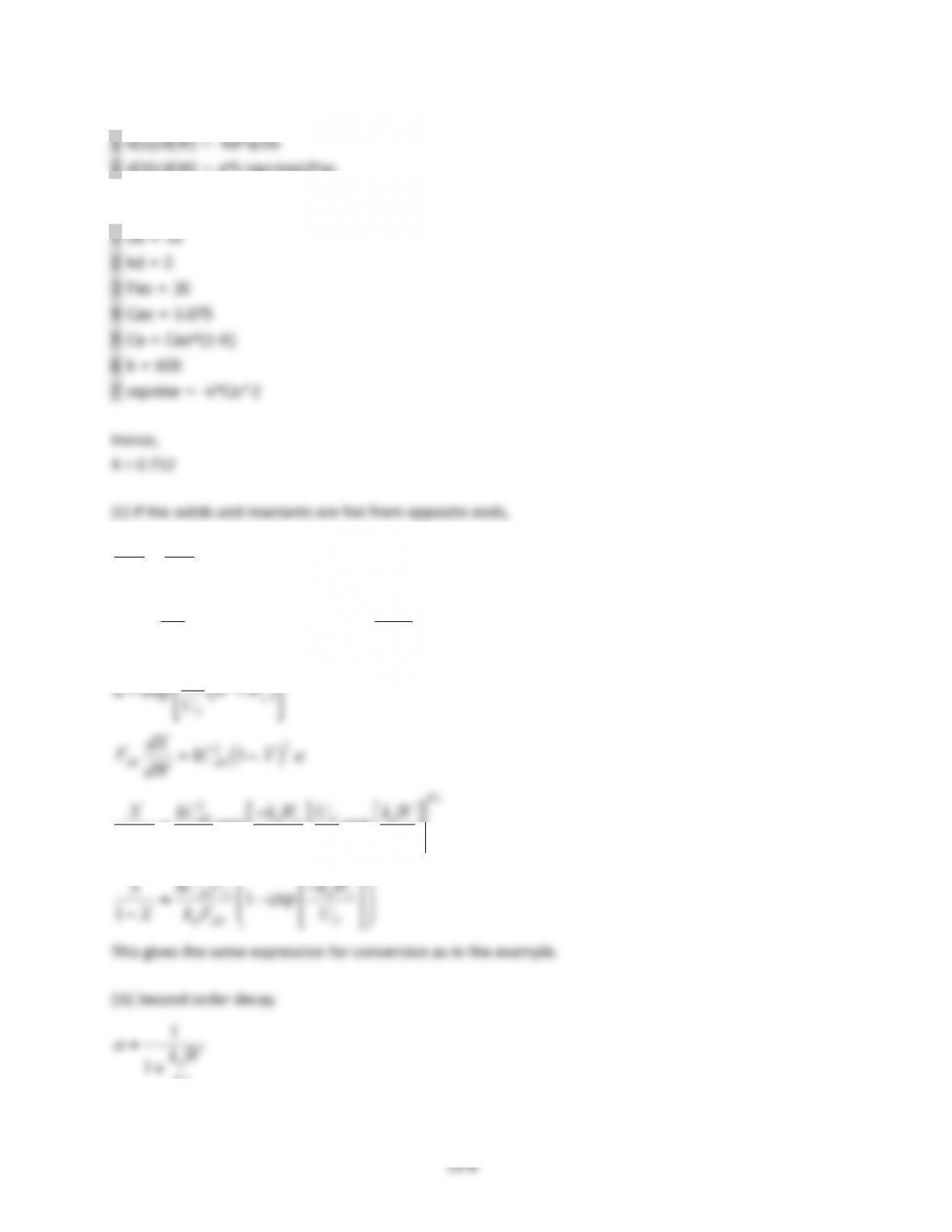
POLYMATH Report
Ordinary Differential Equations
Calculated values of DEQ variables
Variable
Initial value
Minimal value
Maximal value
Final value
1
a
1.
1.
1.
1.
2
Ca
0.075
0.0215827
0.075
0.0215827
3
Cao
0.075
0.075
0.075
0.075
4
Fao
30.
30.
30.
30.
5
k
600.
600.
600.
600.
6
kd
0
0
0
0
7
raprime
–3.375
–3.375
–0.2794886
–0.2794886
8
Us
10.
10.
10.
10.
9
W
0
0
22.
22.
10
X
0
0
0.7122302
0.7122302
10-8$
P10–1)(e))Continued$
Differential equations
1
d(a)/d(W) = –kd*a/Us
2
d(X)/d(W) = a*(–raprime)/Fao
Explicit equations
1
Us = 10
2
kd = 0
3
Fao = 30
4
Cao = 0.075
5
Ca = Cao*(1–X)
6
k = 600
7
raprime = –k*Ca^2
$
Hence,$$
X$=$0.712$
$
(ii)$If$the$solids$and$reactants$are$fed$from$opposite$ends,$
d
S
ka
da
dW U
=
$$$$at$W$=$We,$a$=$1$
1
ln d
S
k
aWC
U
=+
$ $
1
de
S
kW
C
U
=
$
( )
exp d
e
S
k
aWW
U
⎡⎤
=−
⎢⎥
⎣⎦
$
( )
2
2
00
1
AA
dX
FkCXa
dW =−
$
2
0
00
exp exp
1
We
AdeSd
ASdS
kC k W U k W
X
XF U k U
⎡⎤ ⎡⎤
−
=⎢⎥ ⎢⎥
−⎣⎦ ⎣⎦
$
2
0
0
1exp
1
AS de
dA S
kC U k W
X
XkF U
⎛⎞
⎡⎤
−
=−
⎜⎟
⎢⎥
⎜⎟
−⎣⎦
⎝⎠
$
This$gives$the$same$expression$for$conversion$as$in$the$example.$
$
(iii)$Second$order$decay$
1
1d
S
akW
U
=
+
$
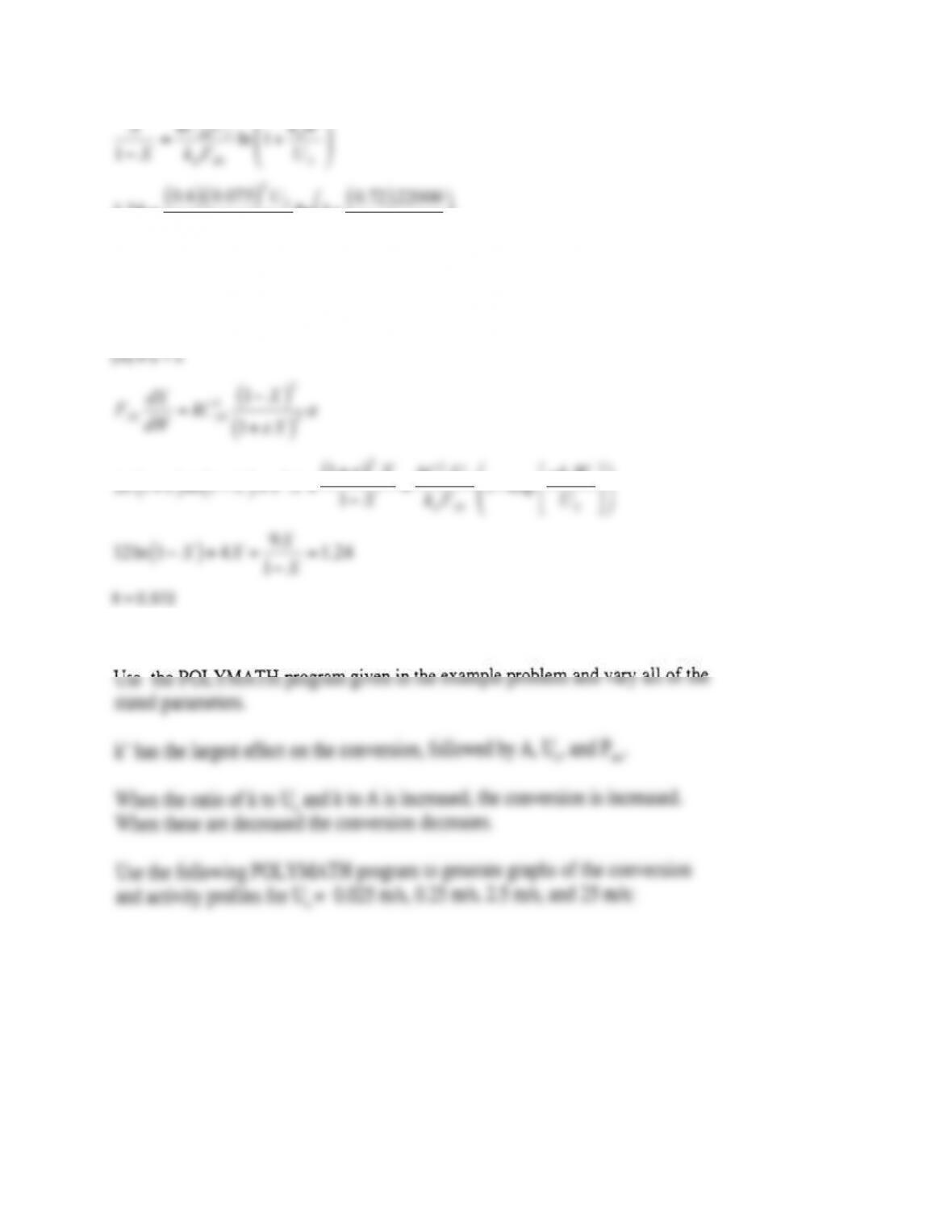
P10–1)(e))Continued$
2
0
0
ln 1
1
AS d
dA S
kC U k W
X
XkF U
⎛⎞
=+
⎜⎟
−⎝⎠
$
( )( )
( )( )
( )
2
0.6 0.075 0.72 22000
1.24 ln 1
0.72 30
S
S
U
U
⎛⎞
=+
⎜⎟
⎝⎠
$
Solve$for$US$by$trial$and$error$or$a$non–linear$equation$solver.$
US$=$0.902$
$
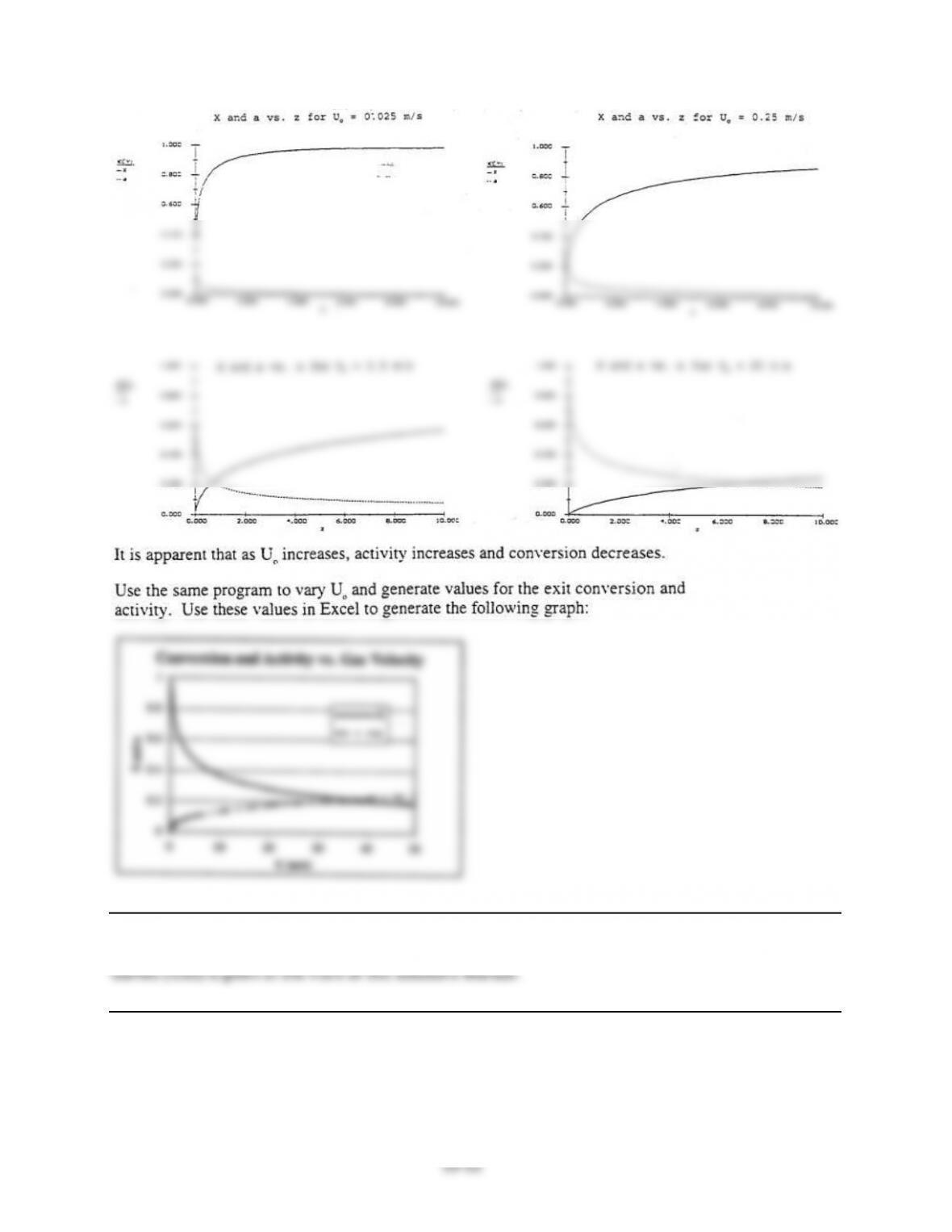
(iv)$If$ε$=$2$
10–10$
P10–1)(f))Continued$
$
$
$
$
P10-2)The$key$for$decoding$the$algorithm$to$arrive$at$a$numerical$score$for$the$Interaction$Computer$
Games$(ICGs)$is$given$at$the$front$of$this$Solutions$Manual.$
$
$
10–11$
P10-3)$
$
P10–3)(a))))$
$
$
P10–3)(b))$
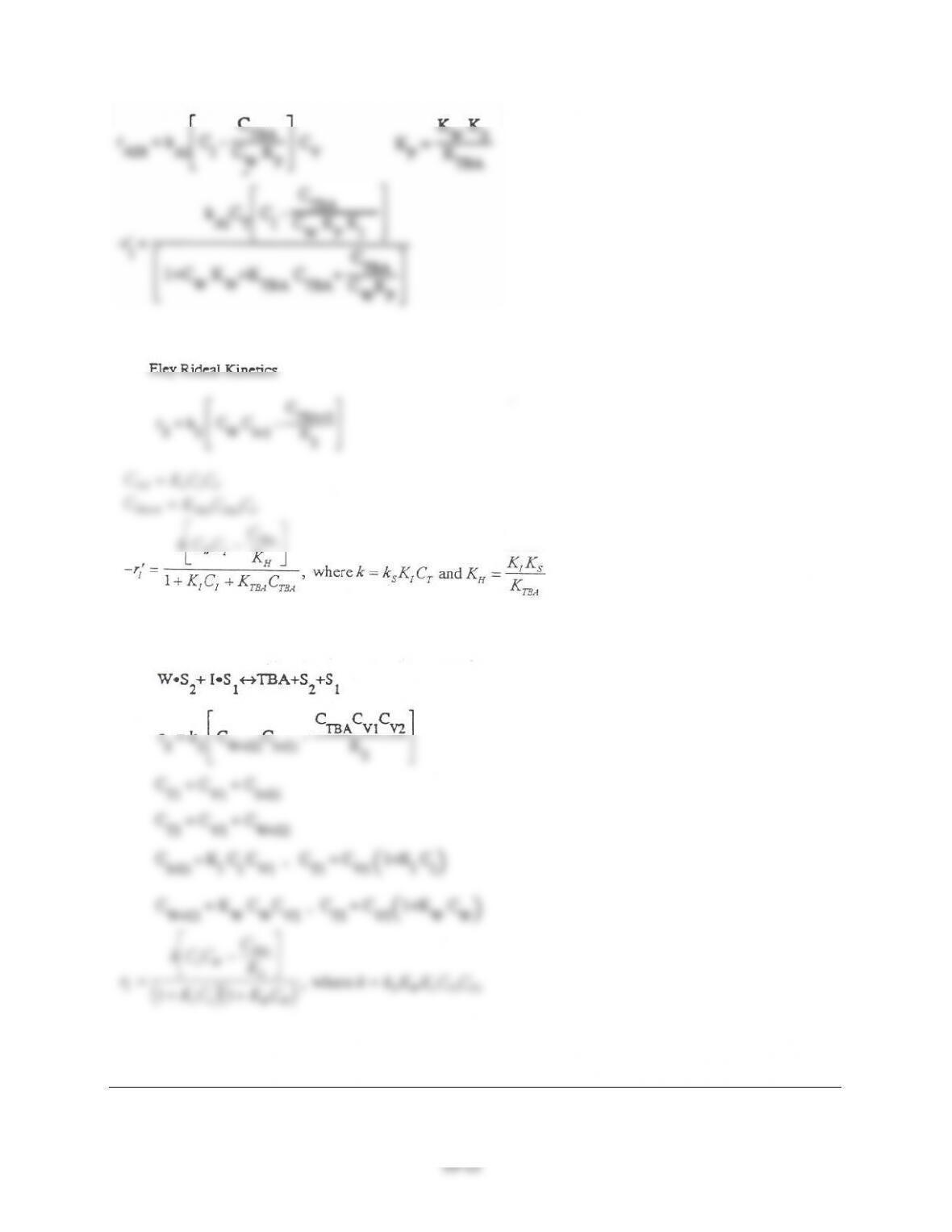
Adsorption$of$isobutene$limited$
$
10–12$
P10–3)(b))Continued$
$
P10–3)(c))Site$balance:$CT$=$CV$($1$+$KI$CI$+$KTBACTBA)$
$
$
$
P10–3)(d))
)
P10–3)(e))Individualized$solution$
$
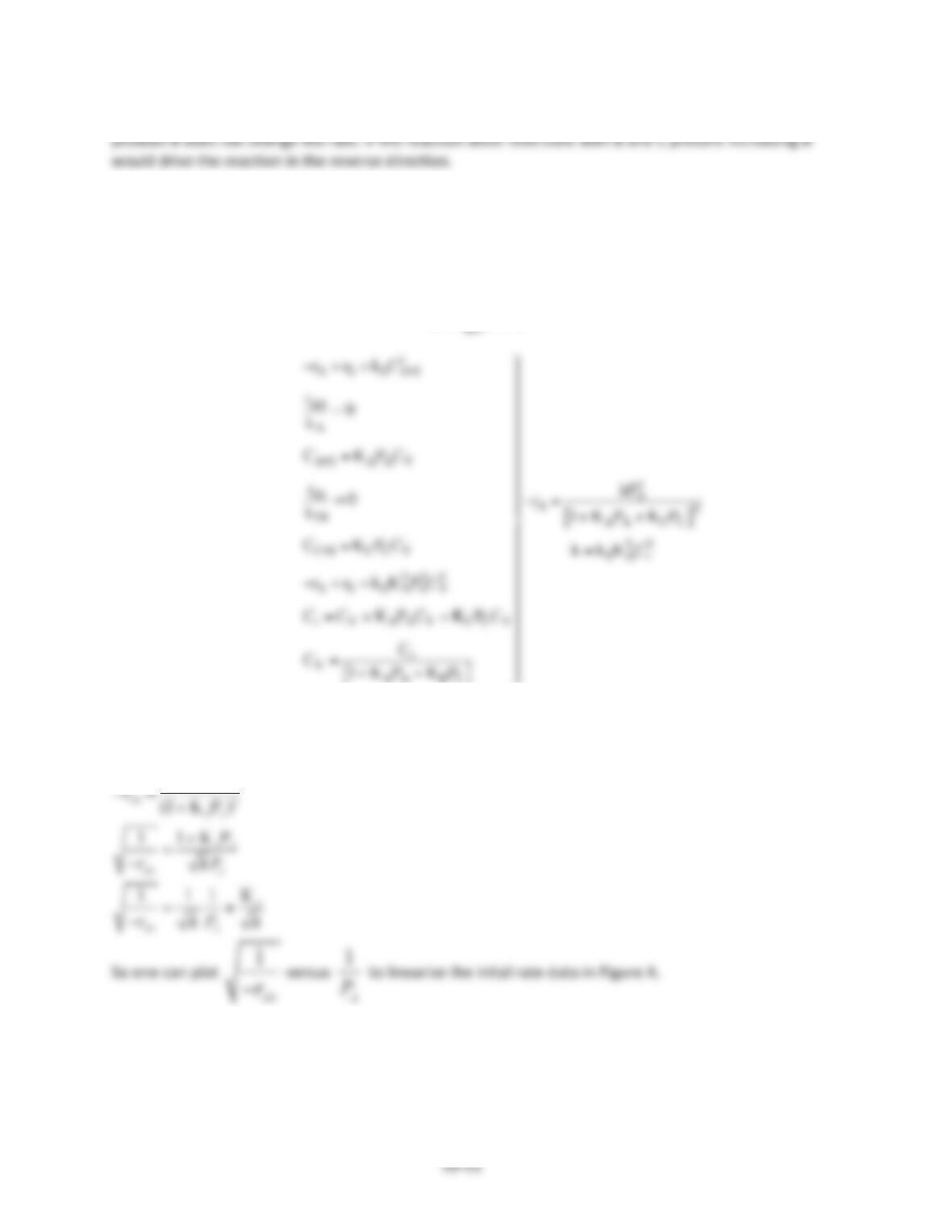
P10–4)(a))Species$A$&$C.$
P10–4)(b))Figure$B$tells$us$that$the$reaction$is$irreversible$because$when$PC0$=$1$atm,$increasing$the$
product$B$does$not$change$the$rate.$If$the$reaction$were$reversible$with$B$and$C$present$increasing$B$
P10–4)(c))Assume$surface$reaction$is$the$rate$limiting$step)
P10–4)(d))$
00
2
02
0
0
0
(1 K P )
11KP
111K
BC
A
A
AA
AA
AA
A
AA
PP
kP
r
rkP
rP
kk
==
−=
+
+
=
−
=+
−
$
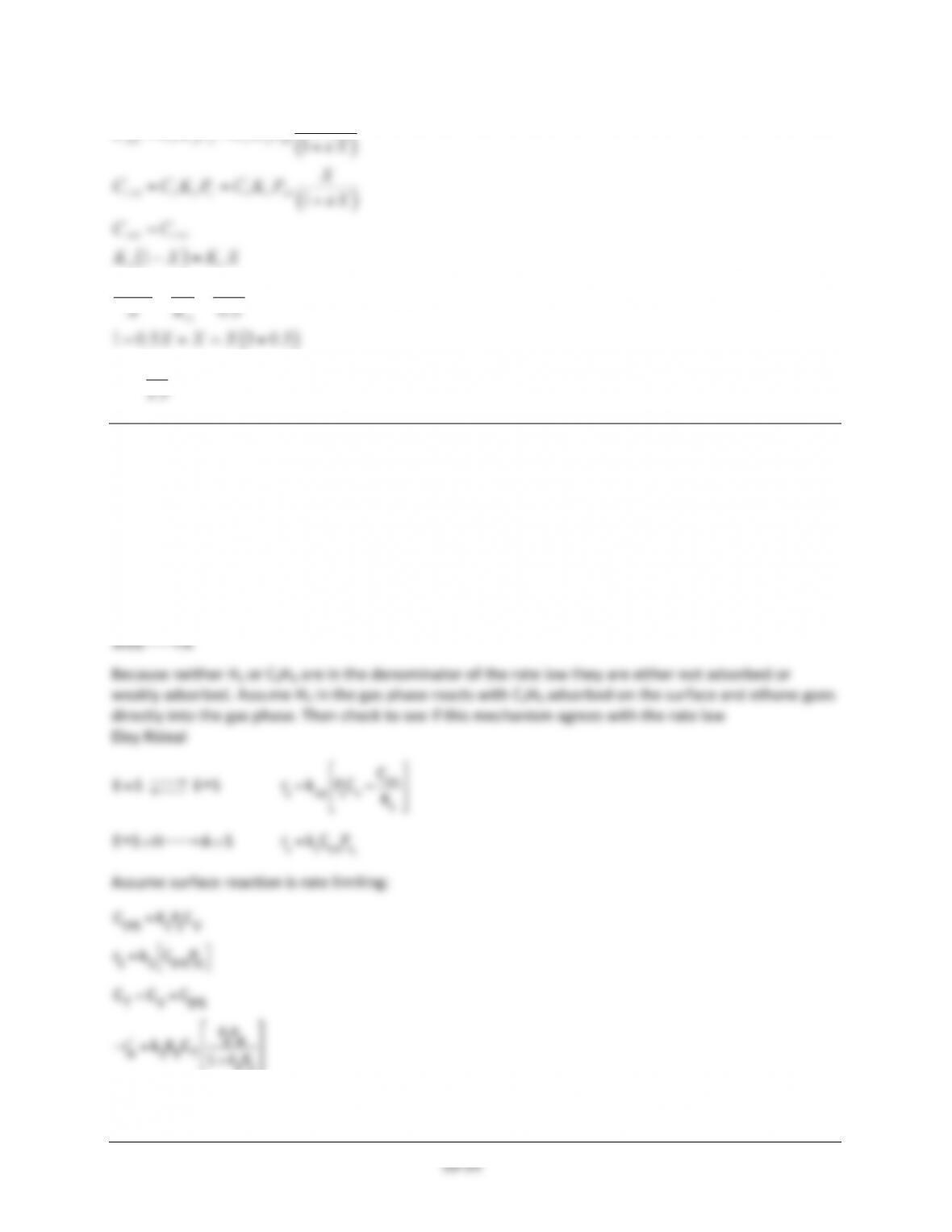
So$one$can$plot$
0
1
A
r−
$versus$
1
A
P
$to$linearize$the$intial$rate$data$in$Figure$A.$
A+S→
←A•S
A•S+A•S→B(g) +C•S
C•S→
←C+S
−rA=rS=kSCA•S
2
rA0
kA
~ 0
CA•S=KAPACV
rDI
kDI
≈0
CC•S=KCP
CCV
−rA=rS=kSKA
2PA
2CV
2
Ct=CV+KAPACV+KCP
CCV
CV=Ct
1+KAPA+KBP
C
[ ]
$
%
&
&
&
&
&
&
&
&
&
‘
&
&
&
&
&
&
&
&
&
−rA=kPA
2
1+KAPA+KCP
C
[ ]
2
k=kSKA
2Ct
2
P10–4)(e))$
( )
( )
( )
( )
( )
0
0
1
1
1
1
1 0.25 0.5
0.5
1 0.5 1 0.5
10.66
1.5
AS V A A V A A
CS V C C V C A
AS C S
AC
C
A
X
CCKPCKP
X
X
CCKPCKP
X
CC
KXKX
XK
XK
XXX
X
ε
ε
•
•
••
−
== +
== +
=
−=
−== =
=+=+
==
$
)
P10–5)(a))
H=H2
E=Ethylene
A=Ethane
H2+C2H4cat
! →! C2H6
H+E!→! A
$
Because$neither$H2$or$C2H6$are$in$the$denominator$of$the$rate$law$they$are$either$not$adsorbed$or$
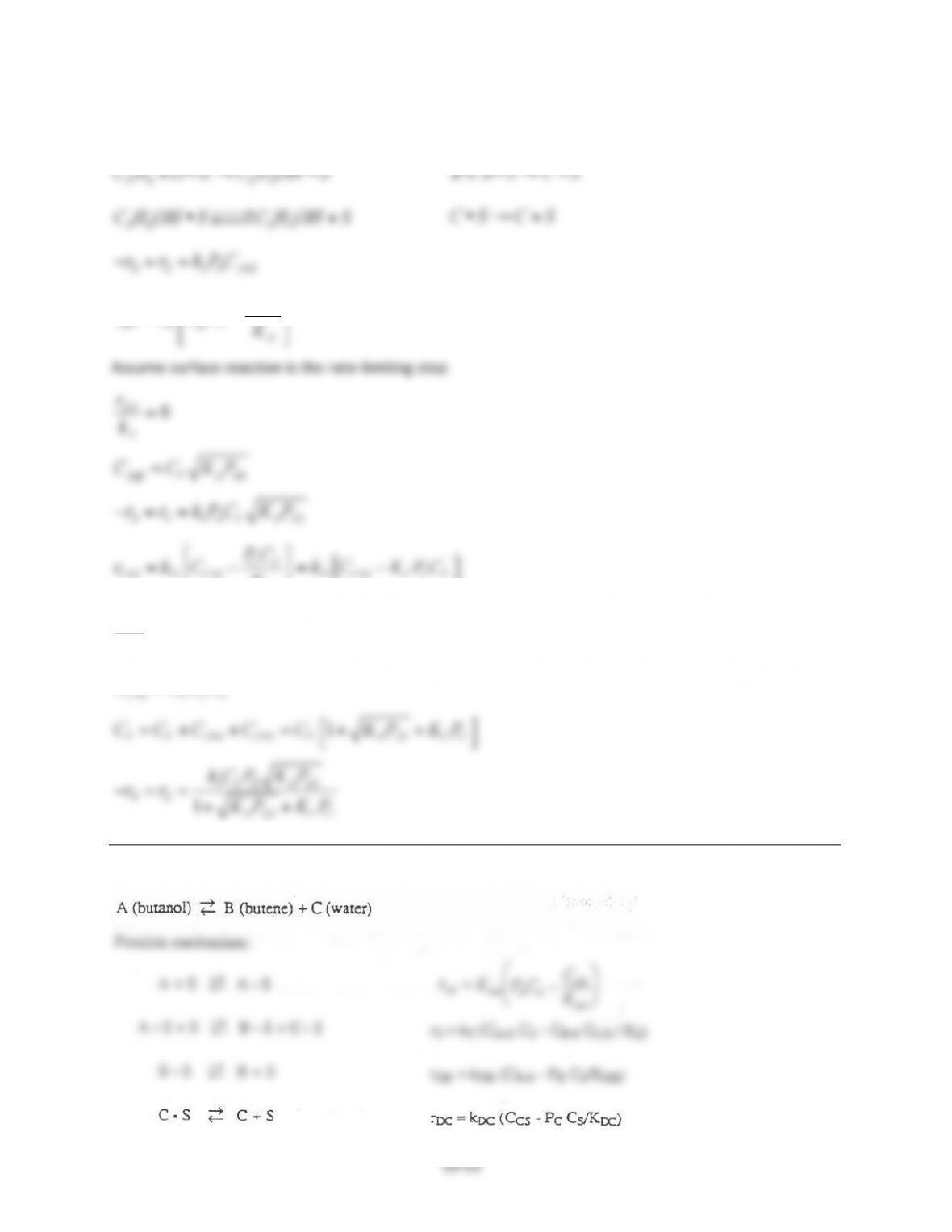
10–15$
P10-6)
22 2O S O S
⎯⎯→
+ •
←⎯⎯
) ) ) )
22 2A S A S
⎯⎯→
+ •
←⎯⎯
)
3 6 3 5
C H O S C H OH S+ • →•
)) )
B A S C S+ • →•
)
3 6 3 5
C H OH S C H OH S
⎯⎯→
• +
←⎯⎯
) )
C S C S•→+
)
3B S B A S
r r k P C •
−= =
)))$
2
2
2A S
AD A A V
A
C
r k P C
K
•
⎡ ⎤
=−
⎢ ⎥
⎣ ⎦
)
Assume$surface$reaction$is$the$rate–limiting$step$
0
AD
A
r
k=
)
2AS V A A
CCKP=
g
)
32BS BV AA
rrkPCKP−= =
)
[ ]
C V
C S D C S D C S C C V
P C
r k C k C K P C
• • •
⎡ ⎤
=−=−
⎢ ⎥
$
0
C S
D
r
k
•=
$
C S C C V
C K P C
•=
$
2
1
TVASCSV AA CC
CCC C C KP KP
•• ⎡⎤
=+ + = + +
⎣⎦
$
32
2
1
TB AA
BS
AA CC
kC P K P
rr
KP KP
−= =
++
)
$
)
P10–7)(a))
$
$
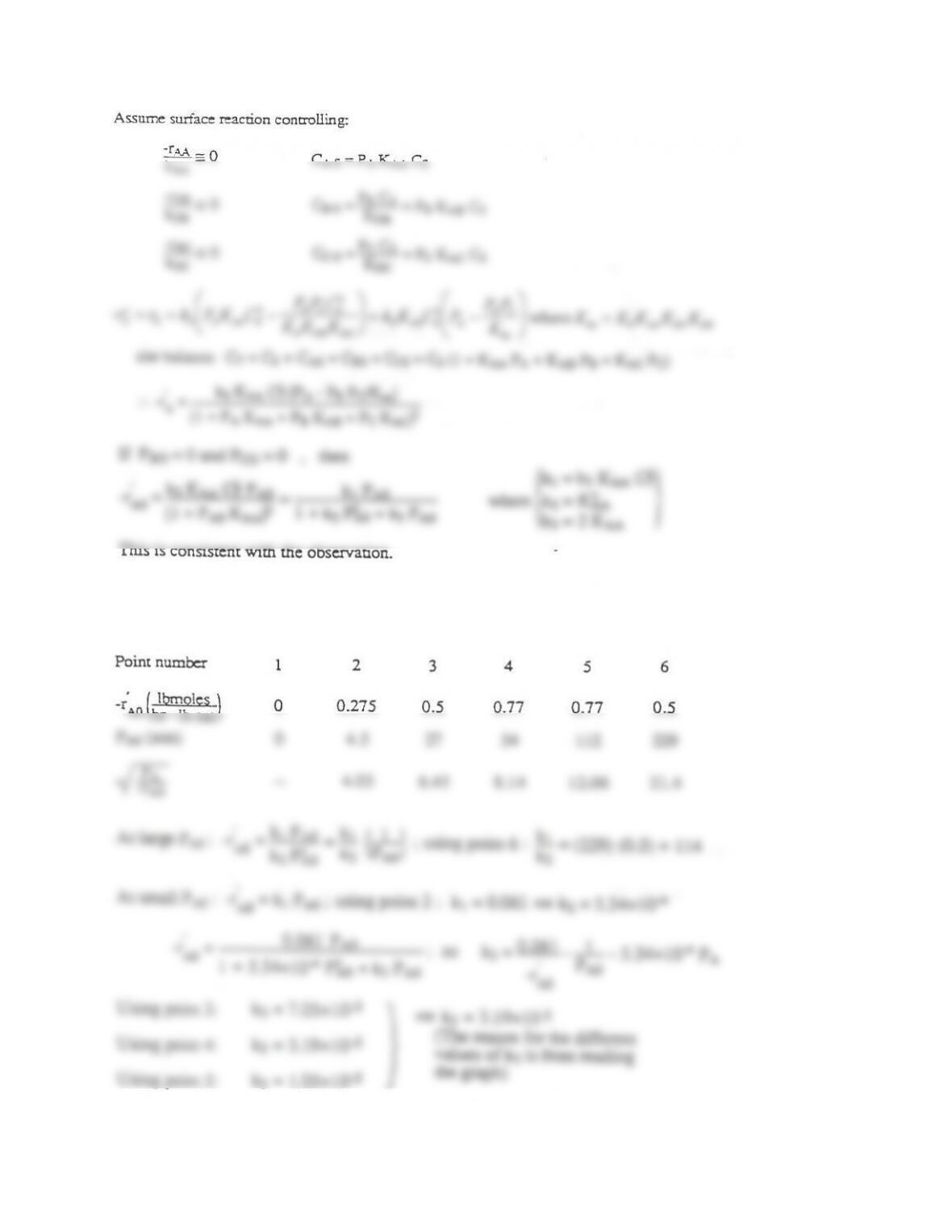
10–16$
P10–7)(a))Continued$
$
$
$
P10–7)(b))
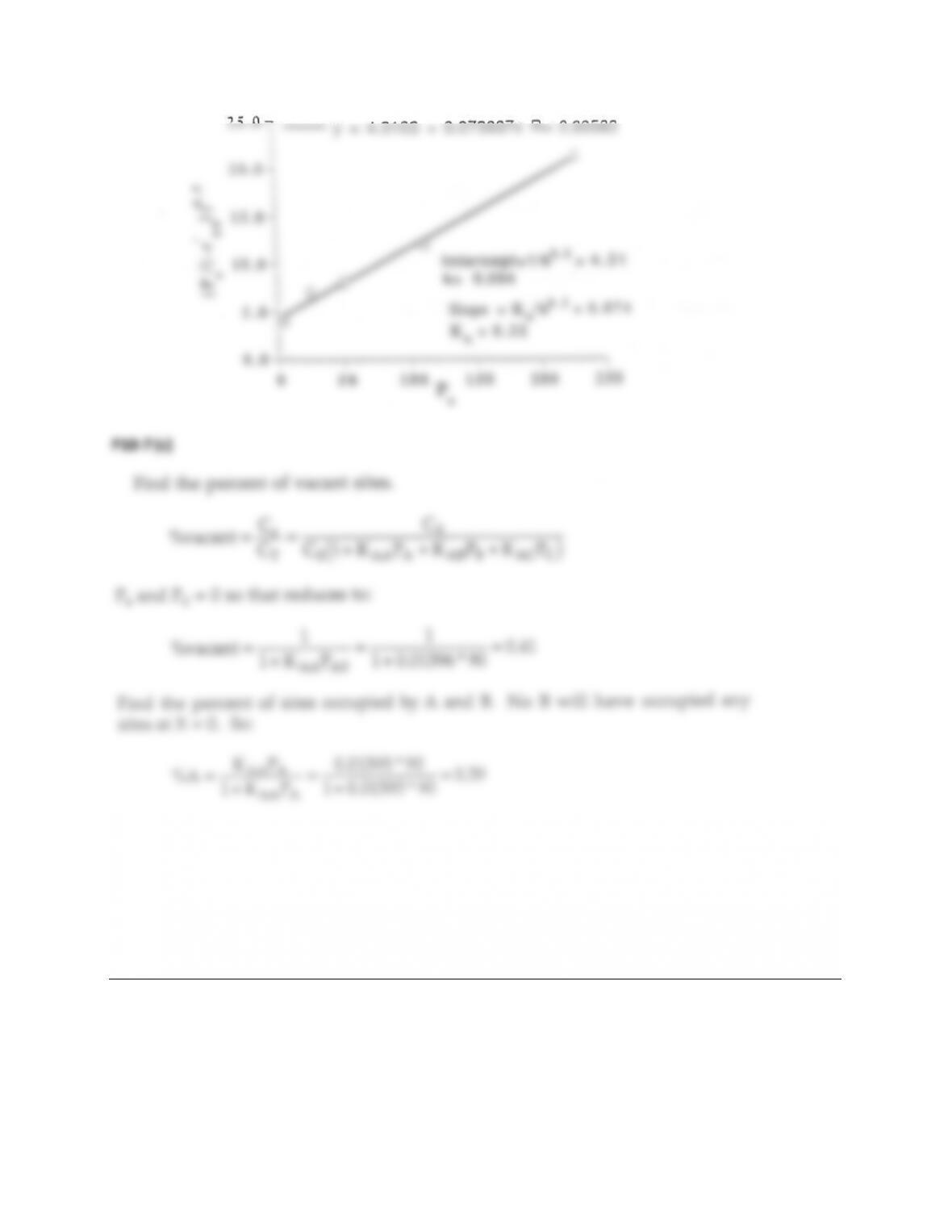
From$the$figure,$
$
$
10–17$
P10–7)(b))Continued$
$
$
P10–7)(d))Individualized$solution$
P10–7)(e))Individualized$solution$
P10-7)(f))Individualized$solution$
$
)
10–18$
P10-8)
2ME$→$DME$+$W$
P10–8)(a))
$
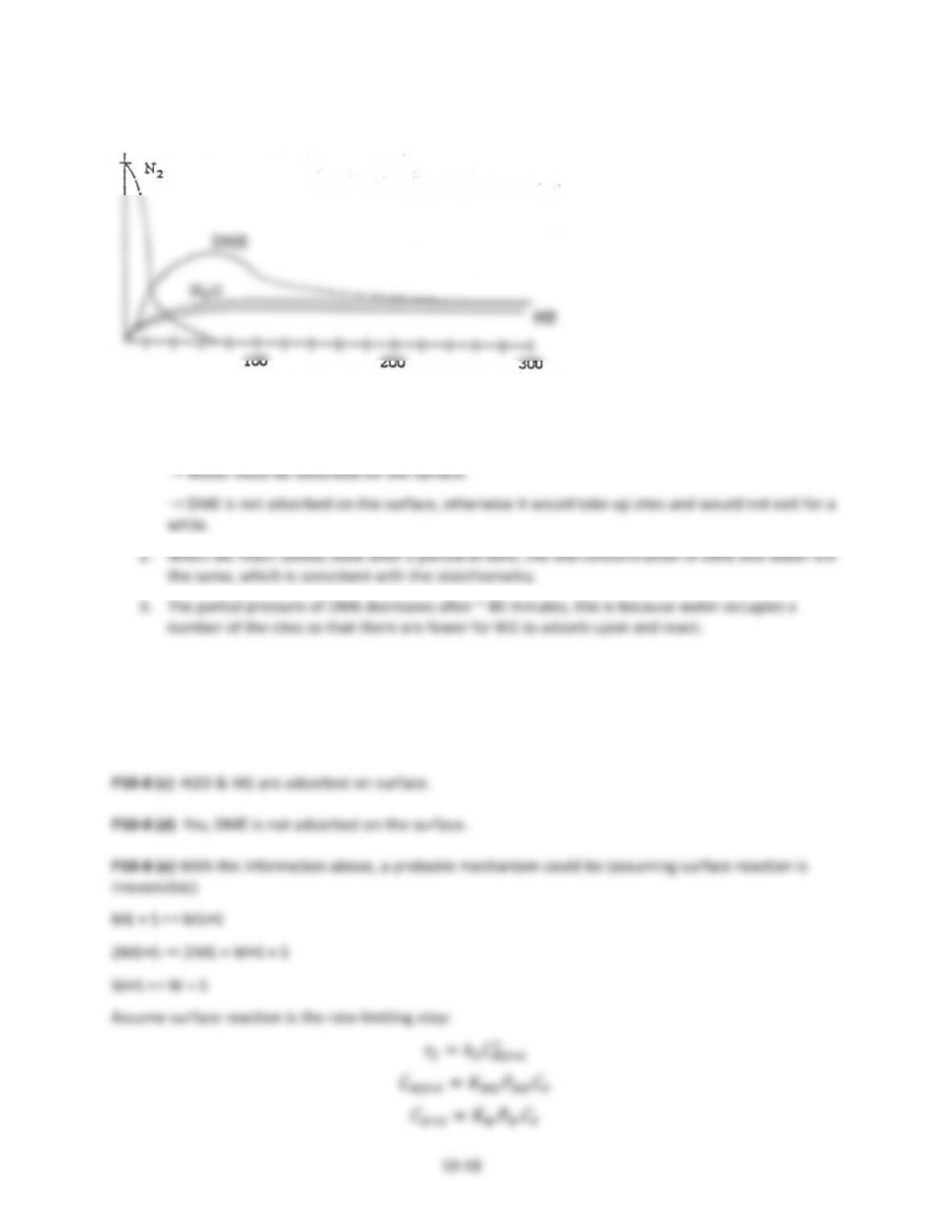
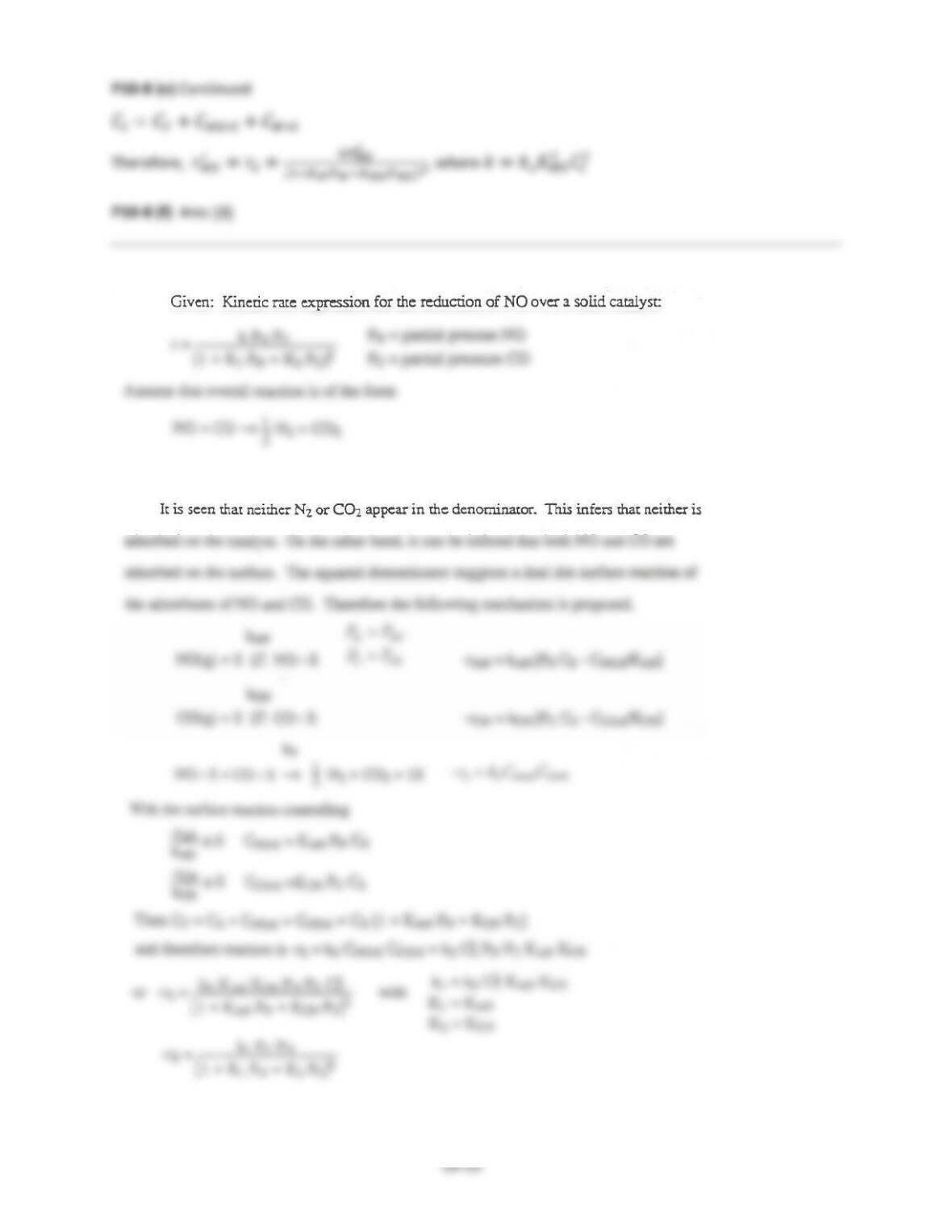
From$the$plot$we$can$conclude:$
1. The$partial$pressure$of$DME$is$greater$initially,$while$the$generation$rate$of$water$and$DME$are$
the$same$according$to$stoichiometry.$$
→$Water$must$be$adsorbed$on$the$surface.$
$
P10–8)(b)))H2O$&$ME$took$longer$than$others$to$exit$the$reactor.$
For$ME,$this$is$because$it’s$adsorbed$on$the$surface$and$consumed$in$the$reaction.$
For$H2O,$this$is$because$it’s$adsorbed$on$the$surface.$
$
10–19$
P10-8)(e))Continued$
𝐶!=𝐶!+𝐶!”•!+𝐶!•!$$$$
Therefore,$$𝑟
!”
!=𝑟
!=!!
!”
!
(!!!!!!!!!”!!”)!,$where$𝑘=𝑘!𝐾!”
!𝐶!
!$
$
P10–8)(f)))Ans:)(4))
$
)
P10-9)
)
P10–9)(a))
$
P10–9)(b))
)
$
)
P10–10)
)
)
P10–10)(a))
)