CHAPTER 13 AG G R EG A T E PL A N N I N G A N D S&O P 217
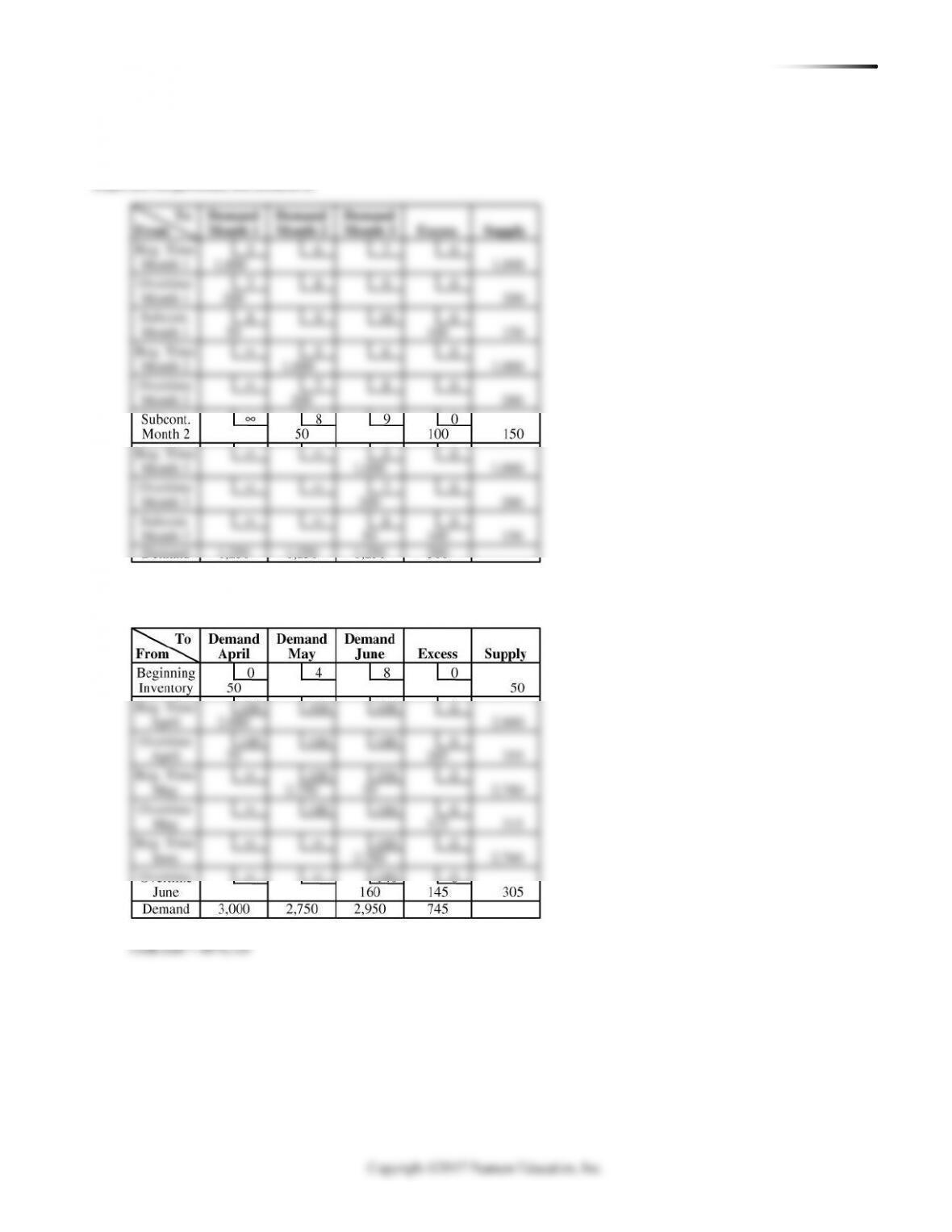
13.20* The intent of the authors is that this problem be solved
using the transportation problem format. Assuming that back
218 CHAPTER 13 AG G RE G AT E PL A N N I N G AND S&OP
Copyright ©2017 Pearson Education, Inc.
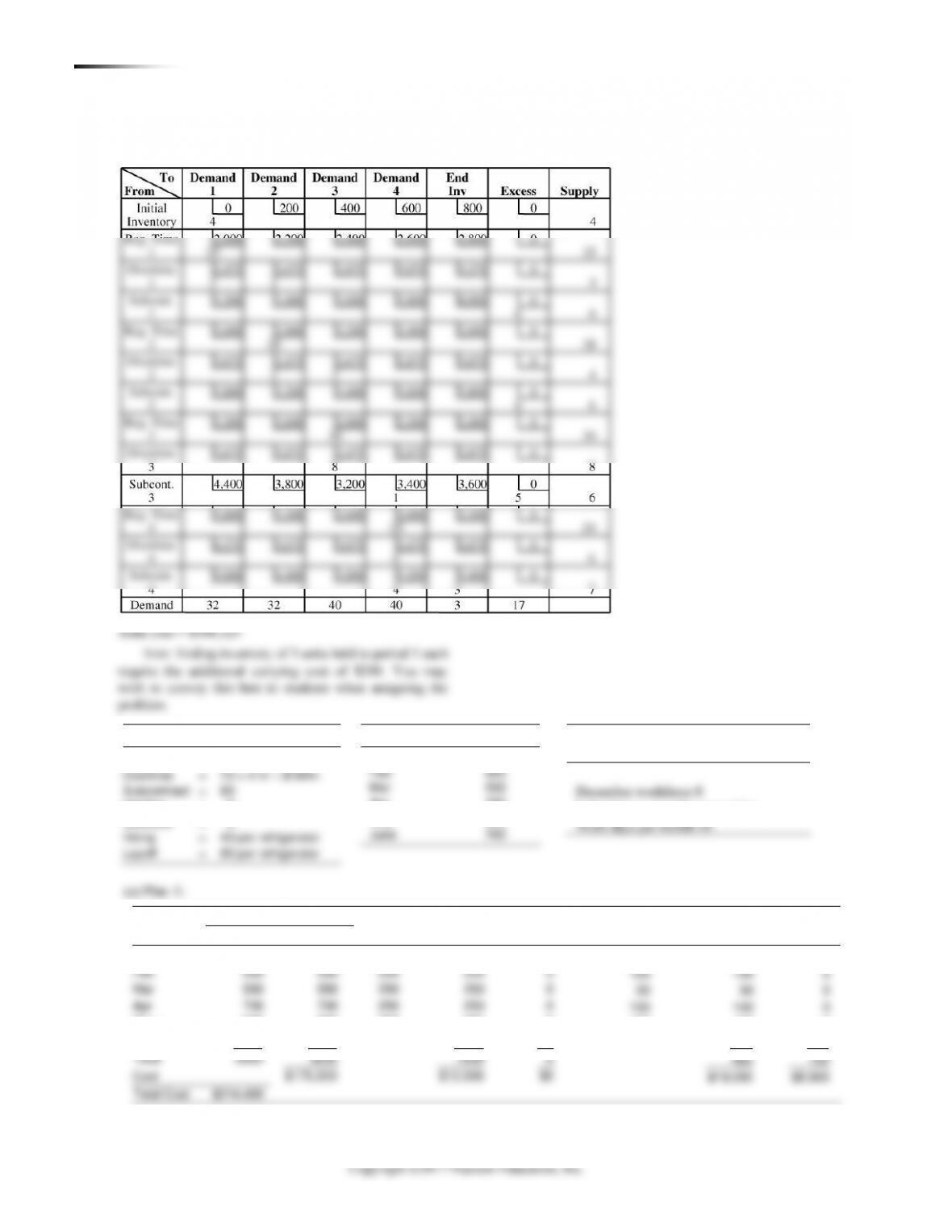
Total cost = $308,125
13.23*
Overtime
=
72 = 4 hr $18/hr.
Subcontract
=
Holding
=
8
Stockout
=
0
Hiring
=
40 per refrigerator
Layoff
=
80 per refrigerator
Feb
500
Mar
550
Apr
700
May
800
June
Mar
550
550
250
250
0
50
50
0
150
150
0
Cost
$175,200
$12,000
13.22* Even though back orders are permitted, note they are not
used. One of the multiple optimal solutions is:
Costs (per refrigerator)
Reg time
=
$48 = 4 hr $12/hr.
Forecast
Demand
Jan
400
Initial inventory
250
Units demanded last period
320
Reg Time
Period
Demand
Production
Inventory
Holding
Shortage
Change
Increase
Decrease
Jan
400
400
250
250
0
80
80
0
Feb
500
500
250
250
0
100
100
0
May
800
800
250
250
0
100
100
0
June
700
700
250
250
0
–100
0
100
Total
3650
3650
1500
0
480
100
Total Cost
$214,400
CHAPTER 13 AG G R E G A T E PL A N N I N G A N D S&O P 219
(b) Plan B:
Each employee produces 2 units per day. So, 2 10 employees 20 days = 400 units per period
Period
Increase
Jan
400
400
250
250
0
80
0
Feb
500
400
150
150
0
0
0
0
Mar
550
400
0
0
0
0
0
0
Apr
700
400
0
0
300
0
0
0
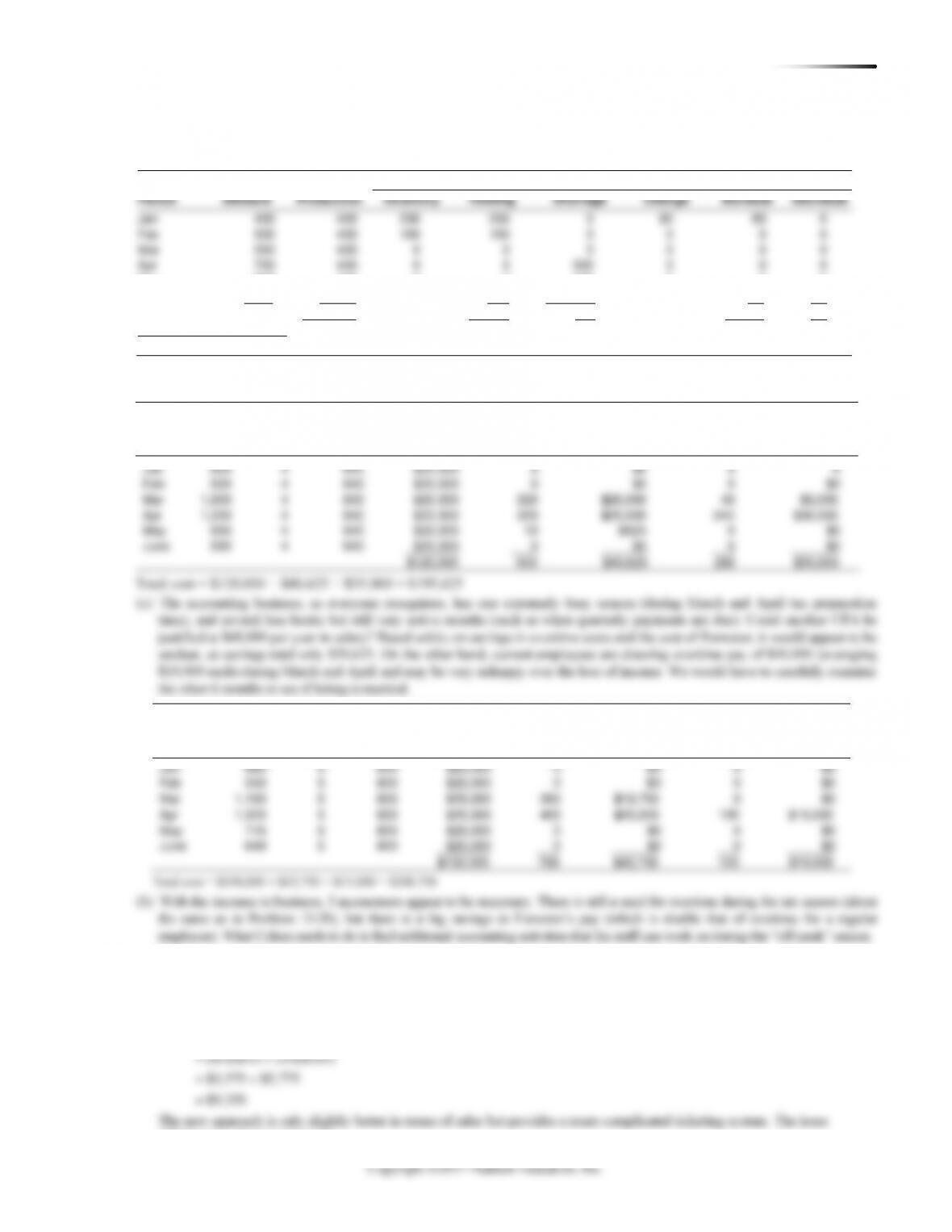
13.24 (a, b) Aggregate plan and its costs
Feb
500
4
640
$20,000
0
0
$0
Mar
1,000
4
640
$20,000
320
$5,000
Apr
1,200
4
640
$20,000
320
240
$30,000
May
650
4
640
$20,000
10
$625
0
$0
June
590
4
640
$20,000
0
0
$0
$120,000
650
$40,625
280
$35,000
13.25
Jan
660
800
$25,000
0
0
$0
Feb
550
800
$25,000
0
$0
0
$0
Apr
1,320
800
$25,000
400
$25,000
120
$15,000
May
715
800
$25,000
0
$0
0
$0
June
649
800
$25,000
0
$0
0
$0
$150,000
700
$43,750
120
$15,000
13.26 (a) Current model—Single price at Southeastern Airlines
Sales 80 passengers (Net price / s eat)
= 80 ($140 25) $9,200
=
− =
(b) Proposed model—two price points
Sales 65 passengers ($80 $25) 35 passengers ($190 $25)
(65)($55) (35)($165)
$3,575 $5,775
$9,350
= − + −
=+
=+
=
The new approach is only slightly better in terms of sales but provides a more complicated ticketing system. The issue
of fairness is always paramount.
Estimated
Reg. time
Billable
billable
Reg. Time
“Overtime”
Overtime
Forrester
Forrester
Month
hours
CPAs
hours
cost
hours
cost
hours
cost
Jan
600
4
640
$20,000
0
$0
0
0
Forecast
Reg Time
UNITS
May
800
400
0
0
400
0
0
0
June
700
400
0
0
300
0
0
0
Total
3650
2400
400
1,000
80
0
Cost
$115,200
$3,200
$0
$3,200
$0
Total Cost
$121,600
(a)
Estimated
Reg. Time
Billable
Billable
Reg. Time
Overtime
Overtime
Forrester
Forrester
Month
hours
CPAs
Hours
Cost
Hours
Cost
Hours
Cost
220 CHAPTER 13 AG G RE G AT E PL A N N I N G AND S&OP
1
CASE STUDY
ANDREW-CARTER, INC.
This case presents some of the basic concepts of aggregate
planning by the transportation method. The case involves solving a
rather complex set of transportation problems. Four different
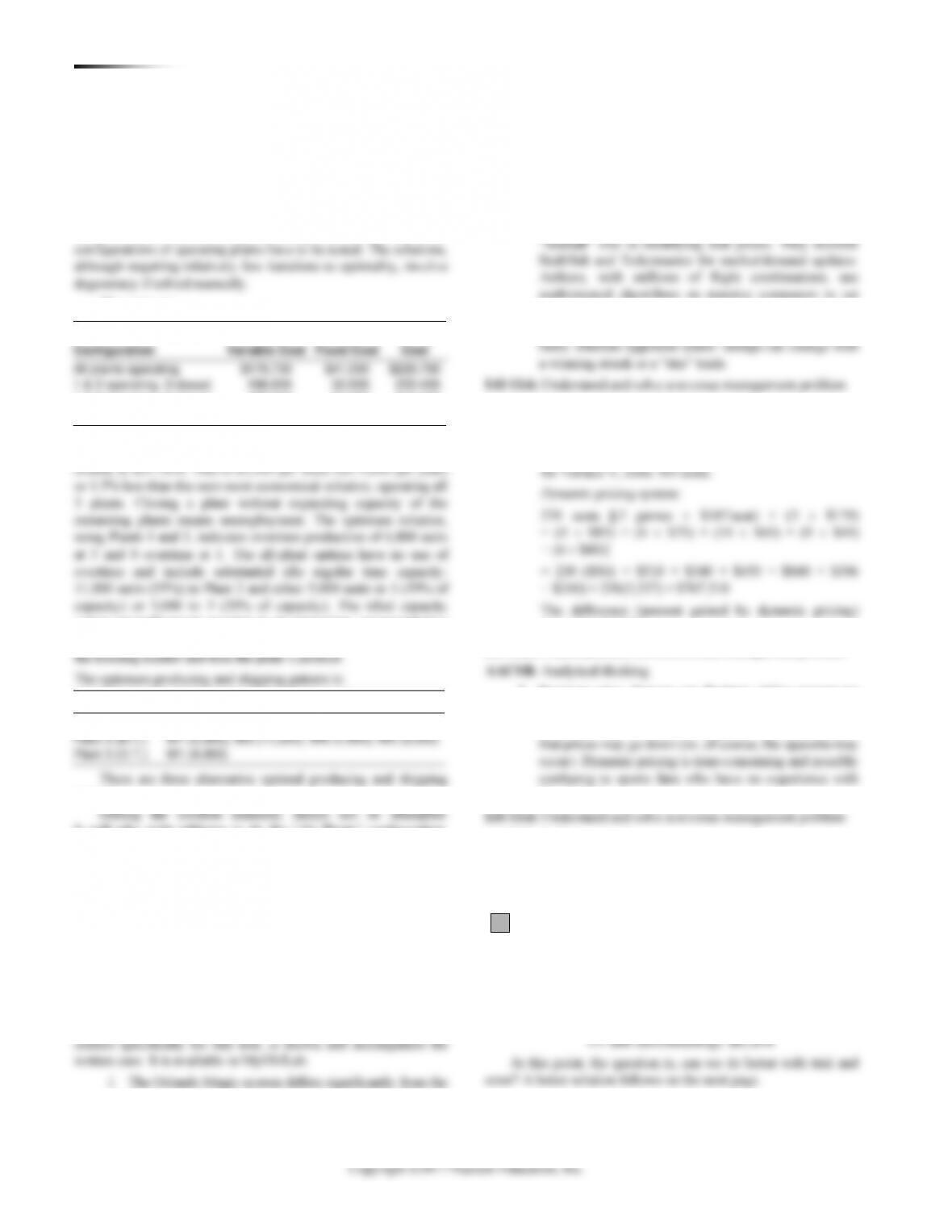
The costs are:
Configuration
All plants operating
$179,730
$41,000
1 & 2 operating, 3 closed
188,930
33,500
The lowest weekly total cost, operating Plants 1 and 3 with 2
versus unemployment question is an interesting, nonquantitative
aspect of the case and could lead to discussion of the forecasts for
From
To (Amount)
Plant 1 (R.T.)
W2 (13,000); W4 (14,000)
Plant 3 (R.T.)
W1 (5,000); W3 (11,000); W4 (1,000); W5 (8,000)
Plant 3 (O.T.)
W1 (4,000)
patterns.
It will take eight tableaux to do the “All Plants” configuration,
with degeneracy appearing in the seventh tableau; the “1 & 2”
configuration takes five tableaux, etc. It is strongly suggested that
POM for Windows, Excel, or other software be used.
LO 13.5: Solve an aggregate plan via the transportation method
AACSB: Analytical thinking
VIDEO CASE STUDY
USING REVENUE MANAGEMENT TO SET
ORLANDO MAGIC TICKET PRICES
This video case study works best if the short video (10½ min.),
revenue (yield) management system used by airlines—
and yet it follows the same basic principal (that is, to
maximize revenue and fill every seat before the
game/flight, as an empty seat has zero value the next
day). The systems airlines use are almost completely
automated, and seats on the same flight (as we discussed
in the Ethical Dilemma in this chapter) may have dozens
of different prices. Airlines change prices constantly,
whereas Anthony Perez and Chris Dorso play a more
sophisticated algorithms on massive computers to set
and reset prices by the minute. The “popularity” of
specific airline routes tends to be constant on a seasonal
AACSB: Application of knowledge
2. Original pricing system yields:
230 seats $68/seat 45 games = $703,800
is equal to $63,710.
3. Frequent price changes can frustrate airline passengers
and may do the same to basketball fans. The approach
may encourage delayed purchases if the perception is
the concept.
AACSB: Reflective thinking
ADDITIONAL CASE STUDIES
(AVAILABLE IN MYOMLAB)
CORNWELL GLASS
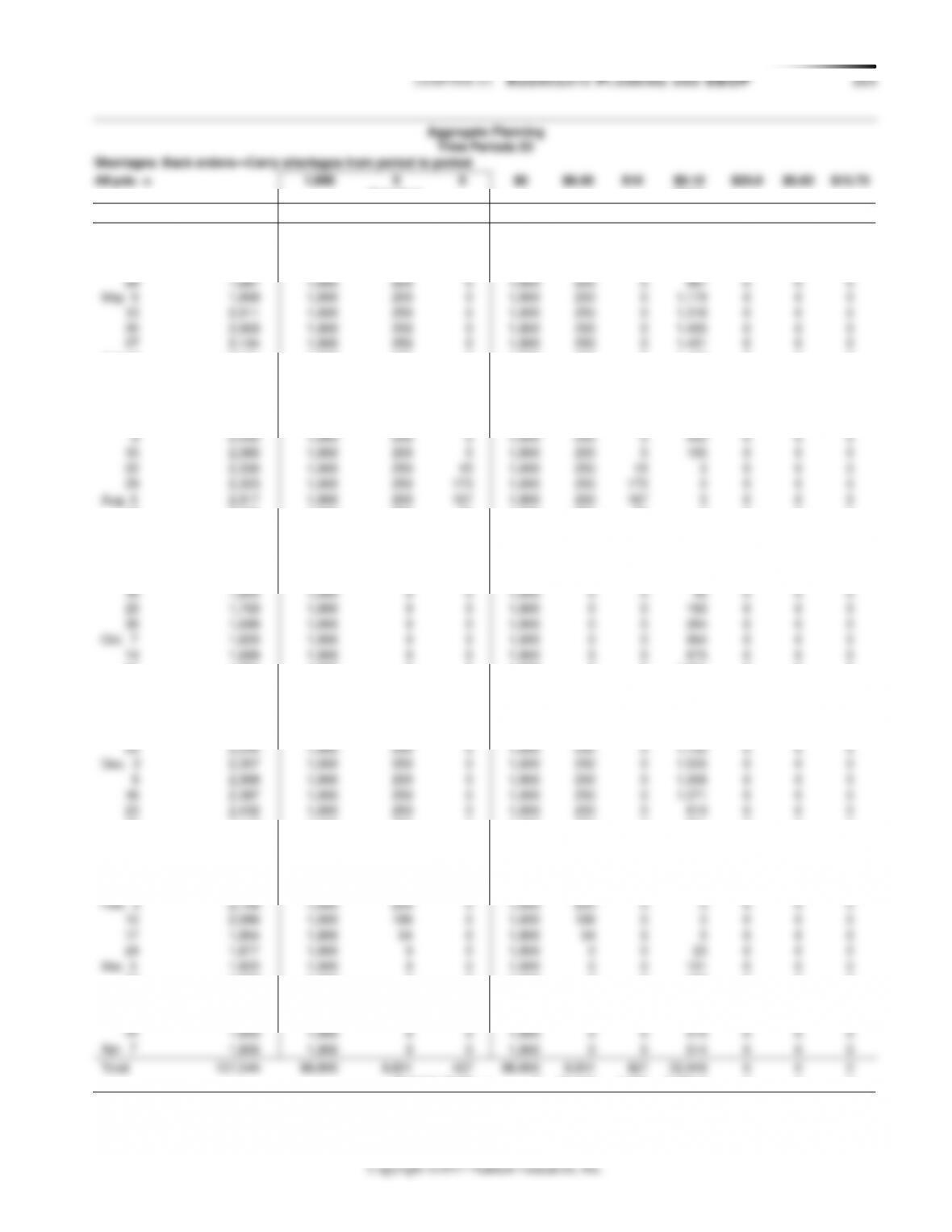
Entering the data provided into software, then toggling the pure
strategies and trying them yields the following costs:
Plan 1 (smooth production): $849,077
Plan 2 (meet demand exactly): $104,575
Plan 3 (produce 1,900 as base, then use
Total
Total
Total
1 & 3 operating, 2 closed
183,430
34,000
217,430
2 & 3 operating, 1 closed
188,360
33,000
221,360
Copyright ©2017 Pearson Education, Inc.
May 6
1,958
1,900
250
0
1,900
250
0
1,179
0
0
0
13
2,011
1,900
250
0
1,900
250
0
1,318
0
0
0
20
2,063
1,900
250
0
1,900
250
0
1,405
0
0
0
27
2,104
1,900
250
0
250
0
1,451
0
0
0
15
2,385
1,900
250
0
1,900
250
0
165
0
0
0
22
2,330
1,900
250
15
1,900
250
15
0
0
0
0
29
2,323
1,900
250
173
1,900
250
173
0
0
0
0
23
1,763
1,900
0
0
1,900
0
0
183
0
0
0
30
1,699
1,900
0
0
1,900
0
0
384
0
0
0
1,620
1,900
0
0
1,900
0
0
664
0
0
0
25
2,244
1,900
250
0
1,900
250
0
1,733
0
0
0
Dec. 2
2,357
1,900
250
0
1,900
250
0
1,526
0
0
0
9
2,368
1,900
250
0
1,900
250
0
1,308
0
0
0
16
2,387
1,900
250
0
1,900
250
0
1,071
0
0
0
23
2,402
1,900
250
0
1,900
250
0
819
0
0
0
Feb. 3
2,168
1,900
250
0
1,900
250
0
0
0
0
0
Mar. 3
1,822
1,900
0
0
1,900
0
0
101
0
0
0
10
2,086
1,900
186
0
1,900
186
0
0
0
0
0
17
1,954
1,900
54
0
1,900
54
0
0
0
0
0
24
1,877
1,900
0
0
1,900
0
0
23
0
0
0
31
1,803
1,900
0
0
1,900
0
0
519
0
0
0
1,805
1,900
0
0
1,900
0
0
614
0
0
0
98,800
8,931
427
98,800
8,931
427
32,949
0
0
0
8
2,402
1,900
250
0
1,900
250
0
400
0
0
0
Aug. 5
2,317
1,900
250
167
1,900
250
167
0
0
0
0
16
1,854
1,900
0
0
1,900
0
0
46
0
0
0
14
1,689
1,900
0
0
1,900
0
0
875
0
0
0
Schedule
Units
Pd
Demnd
Regtm
Ovrtm
Subcon
Regtm
Ovrtm
Subcon
Holdng
Shortg
Incres
Decres
Init
73
1,900
0
0
April 15
1,829
1,900
250
0
1,900
250
0
394
0
0
0
22
1,820
1,900
250
0
1,900
250
0
724
0
0
0
29
1,887
1,900
250
0
1,900
250
0
987
0
0
0
June 3
2,161
1,900
250
0
1,900
250
0
1,440
0
0
0
10
2,258
1,900
250
0
1,900
250
0
1,332
0
0
0
17
2,307
1,900
250
0
1,900
250
0
1,175
0
0
0
24
2,389
1,900
250
0
1,900
250
0
936
0
0
0
July 1
2,434
1,900
250
0
1,900
250
0
652
0
0
0
12
2,222
1,900
250
72
1,900
250
72
0
0
0
0
19
2,134
1,900
234
0
1,900
234
0
0
0
0
0
26
2,065
1,900
165
0
1,900
165
0
0
0
0
0
Sept. 2
1,973
1,900
73
0
1,900
73
0
0
0
0
0
9
1,912
1,900
12
0
1,900
12
0
0
0
0
0
21
1,754
1,900
0
0
1,900
0
0
1,021
0
0
0
28
1,800
1,900
207
0
1,900
207
0
1,328
0
0
0
Nov. 4
1,864
1,900
250
0
1,900
250
0
1,614
0
0
0
11
1,989
1,900
250
0
1,900
250
0
1,775
0
0
0
18
2,098
1,900
250
0
1,900
250
0
1,827
0
0
0
30
2,418
1,900
250
0
1,900
250
0
551
0
0
0
Jan. 6
2,417
1,900
250
0
1,900
250
0
284
0
0
0
13
2,324
1,900
250
0
1,900
250
0
110
0
0
0
20
2,204
1,900
250
0
1,900
250
0
56
0
0
0
27
2,188
1,900
250
0
1,900
250
0
18
0
0
0
10
1,803
1,900
0
0
1,900
0
0
198
0
0
0
17
1,777
1,900
0
0
1,900
0
0
321
0
0
0
24
1,799
1,900
0
0
1,900
0
0
422
0
0
0
Subtotal Costs →
0
71,448
4,270
3,953.9
0
0
0
Total cost = $79,671.88
LO 13.5: Solve an aggregate plan via the transportation method
AACSB: Analytical thinking
All pds →
$10
$0.12
222 CHAPTER 13 AG G R E G A T E PL A N N I N G AND S&OP
SOUTHWESTERN UNIVERSITY: (G)
This case provides the student with quantitative information to
develop an aggregate capacity plan, but, as often occurs in
services, demand is so variable that there are not many viable
should be able to gain insight into the aggregate planning problem
and help the chief justify his personnel requests. Students may
1. Which variations in demand for police services should be con-
sidered in an aggregate plan for resources? Which variations
determine times of the year for training, vacations, and other
nonessential duties; and establish an agreed-upon level of
Short-term scheduling adjustments can be made for different
days of the week, shifts, and special events.
2. Evaluate the current staffing plan. What does it cost? Are
26 officers sufficient to handle the normal workload?
Cost of current staffing plan:
Salaries:
26 officers $28,000 per year
Overtime:
2,400 hours per year $18 per hour
= $43,200
Subcontractors:
40 officers 9 hours $18 per hour
5 football games per year
= $32,400
25 part-timers 9 hours $9 per hour
5 football games per year
= $10,125
$813,725
1st shift
2nd shift
3rd shift
Number of 24-hour positions each week = 8.4/3 = 2.8
Number of persons required = 2.8 positions 5 persons/position
= 14 persons
Twenty-six officers is more than enough to handle the normal
used to meet the demands of the normal workweek.
LO 13.4: Prepare a graphical aggregate plan
3. What would be the additional cost of the chief’s proposal?
How would you suggest that the chief justify his request?
Salary: 4 officers $28,000 per year = $112,000
positions (representing $56,000) are needed to pursue the uni-
versity’s request for more crime prevention, safety, and health
to maintain the desired level of police services. On a per-hour
basis, the salaried services are more cost-effective than
4. How much does it currently cost the university to provide
police services for football games? What would be the pros
and cons of subcontracting this work completely to outside
8 officers work 16 hours overtime @ $18/hr
40 outside officers work 9 hours @ $18/hr
Cost [(18 8 18) (8 16 18) (40 9 18)
(25 9 9)] 5
[2,592 2,304 6,480 2,025] 5
= + +
+
= + + +
2
CHAPTER 13 AG G R E G A T E PL A N N I N G A N D S&O P 223
LO 13.4: Prepare a graphical aggregate plan
AACSB: Analytical thinking
5. Can you propose any other alternatives?
Many of the innovative suggestions for handling the
variability in demand for services involve using part-time
workers. Police officers require extensive training, so this
LO 13.3: Identify optional strategies for developing an aggregate
plan
AACSB: Reflective thinking