19–11
19–25 a. Both U.S. GAAP and IFRS standards generally contain similar
requirements for assessing the impairment of assets, including
value of goodwill exceeds its fair value.
b. The auditor would need to examine evidence and assumptions
management used to determine its estimate of the fair value of
goodwill, which is used to determine the impairment amount.
future developments.
c. Arriving at estimates of expected discounted future cash flows of a
business can be extremely complex, requiring an extensive amount
of business judgment. Because financial statement auditors may
macroeconomic conditions, industry and market conditions,
anticipated changes in costs of business, and other relevant
company–specific events, among a number of other matters.
Business valuation specialists have unique skills and
values are reasonable and appropriate.
Case – Ward Publishing Company
and lease acquisitions and cash disbursements, even though the
specific sample tested does not include any such transaction.
Thus, if the results of the tests are favorable, it is concluded that
19–12
19–26 (continued)
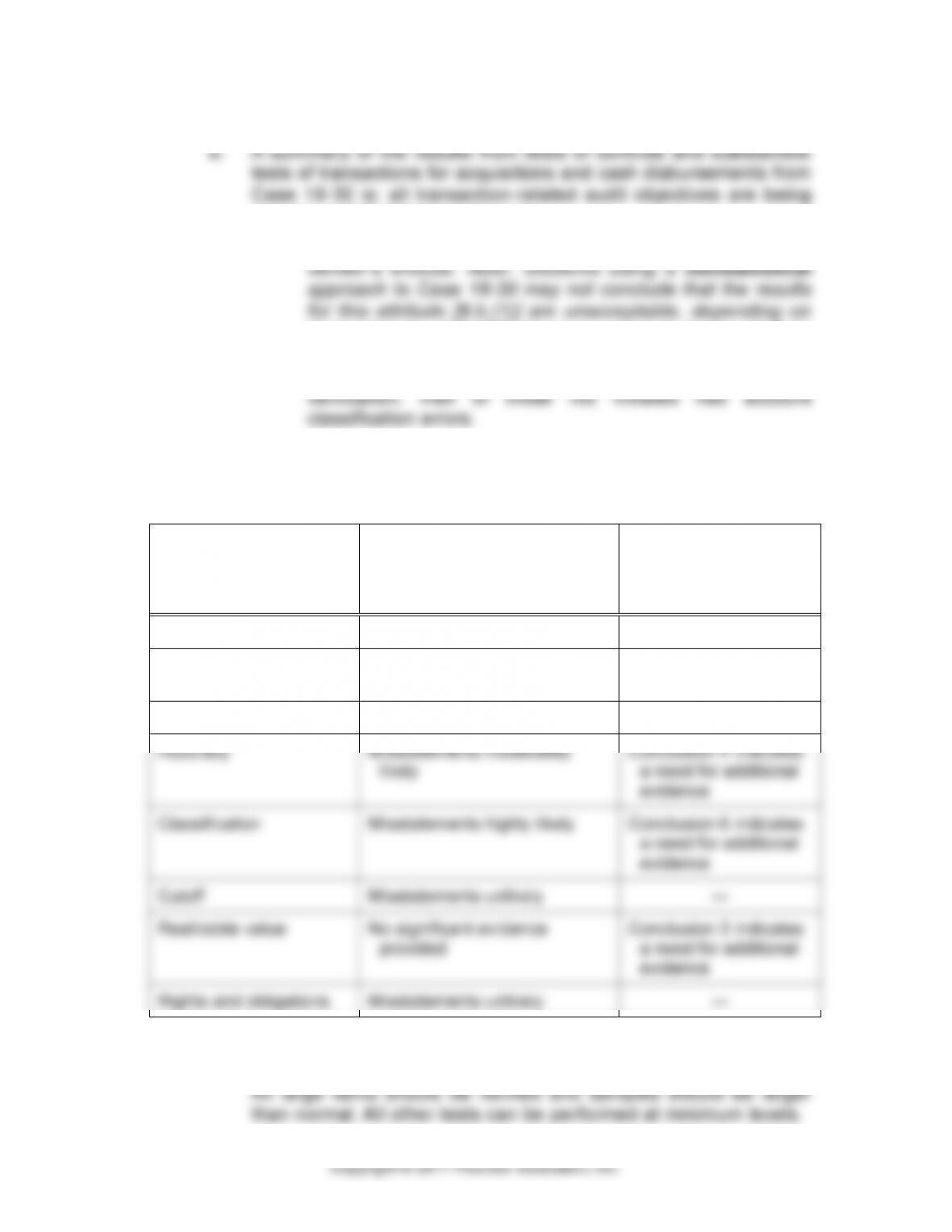
met at a satisfactory level except:
1. All supporting documents are not always attached to the
their estimate of CUER. However, most students will likely
conclude that the results are unacceptable.
2. All vendors’ invoices are not initialed for internal
The impact of these results and the results from items 1
through 7 affect the balance–related audit objectives for plant and
equipment in the following way:
BALANCE–RELATED
AUDIT OBJECTIVE
RESULTS OF
TESTS OF CONTROLS AND
SUBSTANTIVE TESTS OF
TRANSACTIONS
RESULTS FROM
CONCLUSIONS 1–7
Detail tie–in
Misstatements unlikely
—
Existence
Misstatements moderately
likely
—
Completeness
Misstatements unlikely
Conclusion 1 supports
Accuracy
Misstatements moderately
likely
Conclusion 4 indicates
a need for additional
evidence
Classification
Misstatements highly likely
Conclusion 6 indicates
a need for additional
evidence
Cutoff
Misstatements unlikely
—
Realizable value
No significant evidence
provided
Conclusion 3 indicates
a need for additional
evidence
Rights and obligations
Misstatements unlikely
—
Conclusions 3, 5, and 7 indicate a need for more extensive
auditing for existence, completeness, accuracy, and classification.

19–13
19–14
19–26 (continued)
c. The results of tests of controls and substantive tests of transactions
are directly related to the tests of many expense accounts,
primarily through tests for account classification, but also through
tests of accuracy and existence. For example, if the auditor
concludes that the internal controls are effective for recording
acquisition transactions, the likelihood of misstatements for accounts
such as supplies, purchases, and repairs and maintenance is
d. The results of tests of controls and substantive tests of transactions
indicate the potential for significant classification misstatements.
(See the results for Audit Procedure 9b(5) for classification in Part
2 of Case 18–30.) This potential for misclassification misstatement
combined with the substantive analytical procedures results in
19–27 a. Items 1 through 6 would have been found in the following way:
1. The company’s policies for depreciating equipment are
available from several sources:
Form 10–K.
c) Company procedures manuals.
d) Detailed fixed asset records.
2. The ten–year lease contract would be found when supporting
data for current year’s equipment additions were examined.
19–15
19–27 (continued)
3. The building wing addition would be apparent by the addition
method was followed, the actual costs could be determined
4. The paving and fencing could be discovered when support
was examined for the addition to land.
5. The details of the retirement transactions could be deter–
retirement in the machinery account or the review of cash
receipts records.
6. The auditor would become apprised of a new plant in several
ways:
a) Volume would increase.
location.
c) The transaction may be indicated in documents such
as the minutes of the board, press releases, and
reports to stockholders.
new plant.
One or more of these occurrences should lead the
auditor to investigate the reasons and circumstances
examined to determine the details involved.
b. The appropriate adjusting journal entries are as follows:
1. No entry necessary.
19–16
19–27 (continued)
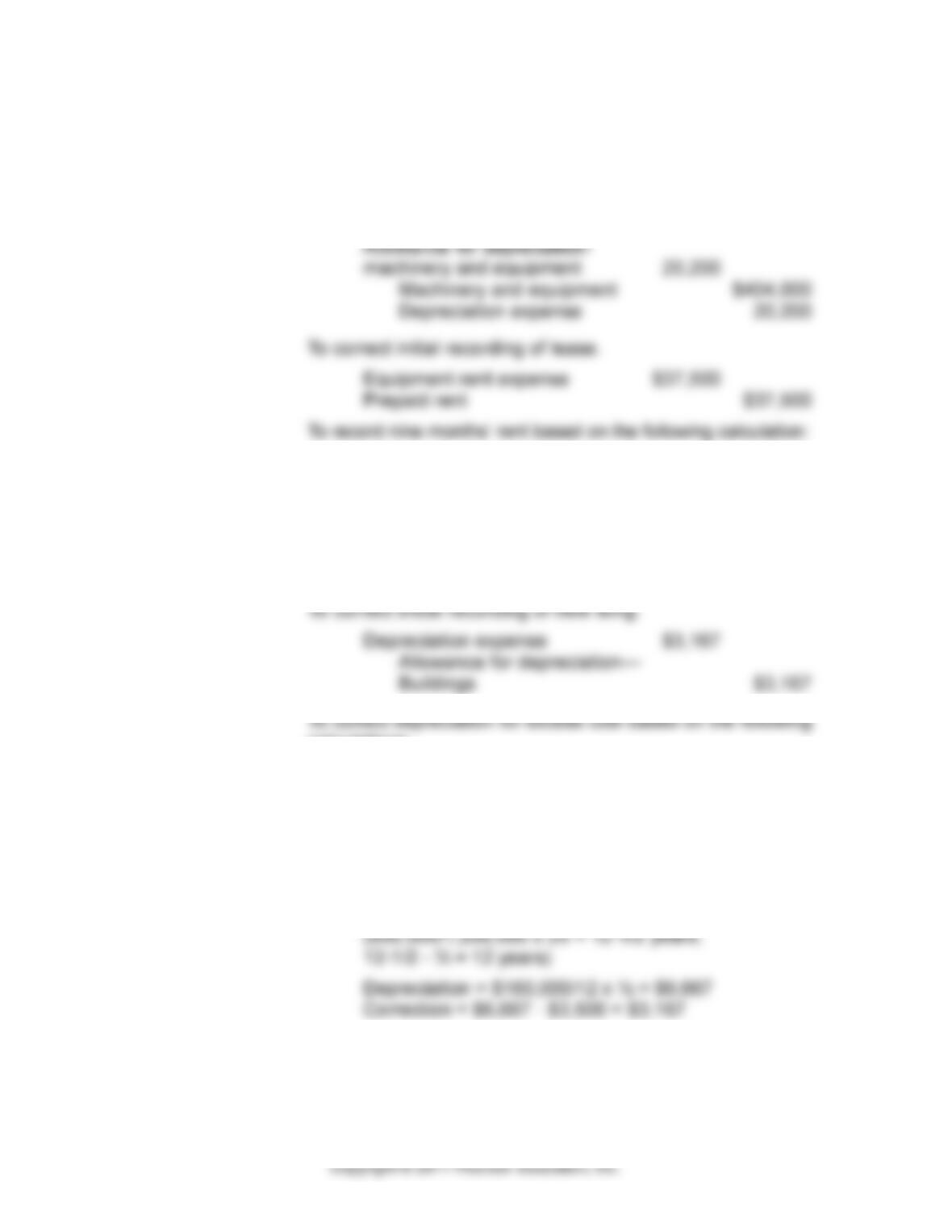
2. This is an operating lease and should not have been
capitalized.
Prepaid rent $ 50,000
Lease liability 354,000
9/12 x $50,000 = $37,500
3. The wing should have been recorded at its cost to the
company.
(Accounts originally credited) $15,000
Buildings $15,000
calculations:
Depreciation on beginning balance
1,200,000/25 = 48,000
Depreciation recorded on addition
51,500 – 48,000 = 3,500
Correct depreciation for addition:
Remaining useful life of addition is 12 years