5
C H A P T E R
Design of Goods and Services
1. Explicit documentation accomplishes two things:
(a) It provides the information necessary to produce (capacity,
training, routing, costs, etc.) the product in the appropriate
fashion
variations in production or assembly do not adversely affect the
product.
9. CAD benefits: maintain various kinds of engineering stand-
ards; check interference on parts that must fit together; and effi-
ciently analyze existing and new designs for technical attributes
52 CHAPTER 5 DE S I G N O F GO O D S A N D SE R V I C E S
10. A bill of material lists the components, their description, and
the quantity of each required to make one unit of the product.
11. An engineering drawing shows the dimensions, tolerances,
matrials, and finishes of a component.
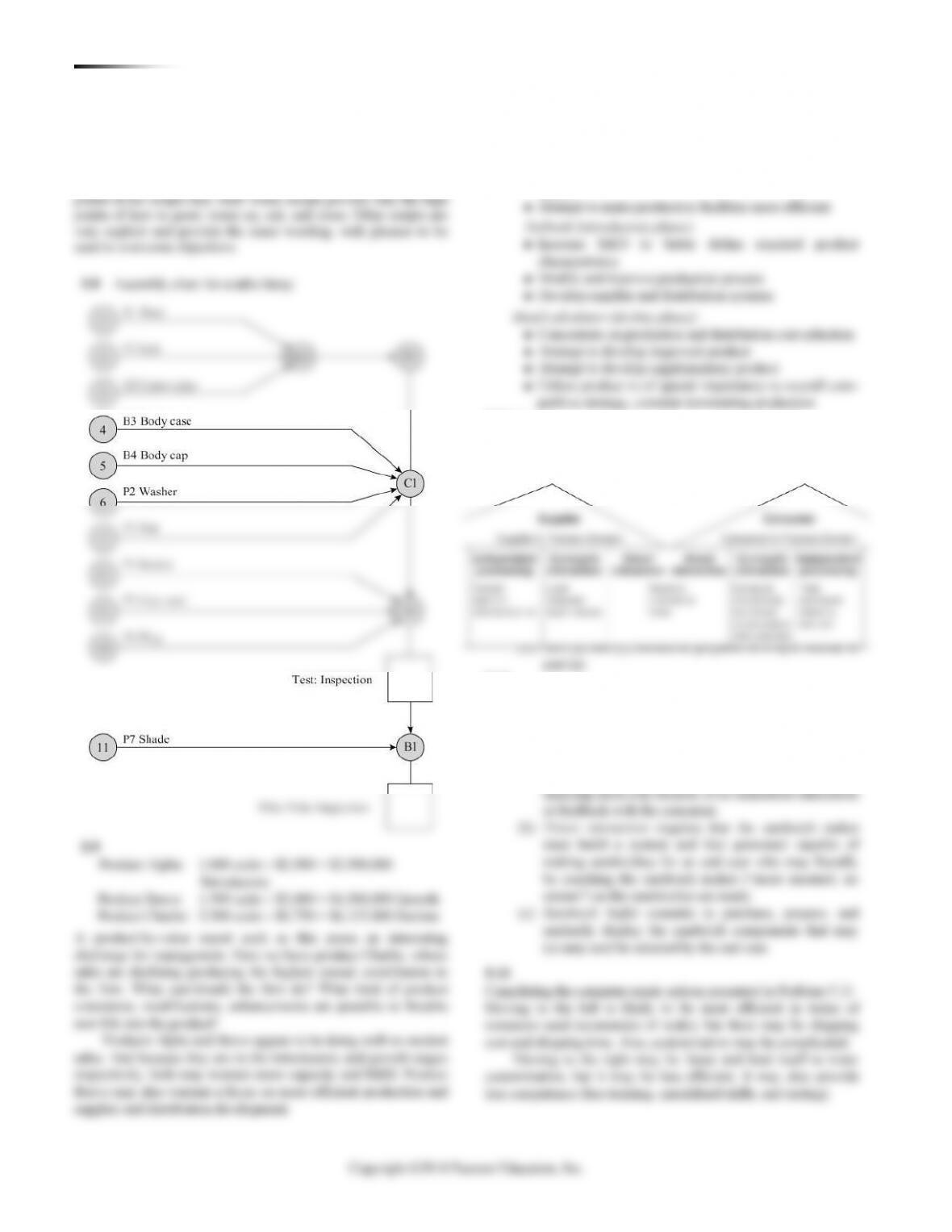
12. An assembly chart shows in schematic form how a product
is assembled. Along with a list of the operations necessary to pro-
duce a component, the process sheet includes specific methods of
13. The moment of truth is the moment that exemplifies,
detracts from, or enhances the customer’s expectations.
14. House of quality is a rigorous method aimed at that specific
result. It identifies customer wants, and relates them to product
attributes and firm abilities. It orders the wants and measures the
15. CAD aids all three strategy concepts—differentiation, low
cost, and response.
◼ CAD allows more designs to be developed, evaluated, and
submitted to production faster. It does this by fostering
16. Process chain is a sequence of steps that accomplishes a
purpose by providing value to process participants.
17. Direct interactions in PCN analysis are those steps that
involve interaction between participants. Surrogate interaction in
PCN analysis includes process steps in which one participant is
18. Documents for releasing services for production are analo-
gous to those for tangible products. The product must be defined—
such as a recipe for a cook, job instructions for a tailor, or a tele-
phone script for telephone sales. The definition is followed by an
authorization to produce. Orders to produce may be in the form
the following comes from an unknown source and some from the
U.S. Consumer Products Safety Commission.)
Parker Brothers had big plans for a toy called Riviton.
Riviton consisted of plastic parts, rubber rivets, and a riveting tool
with which children could put together anything from a windmill
to an airplane. In the first year on the market, Riviton seemed on
its way to becoming one of those classic toys that parents would
buy everlastingly. However, one of the 450,000 Riviton sets
ended up under the Christmas tree of an 8-year-old boy. He
played with it daily for 3 weeks. Then he put one of the quarter–
inch-long rubber rivets into his mouth and choked to death. Ten
months later, with Riviton sales well on their way to an expected
$8.5 million for the year, a second child strangled on a rivet.
Parker Brothers could have ignored the strangulations, as-
cribed the deaths to chance, and tried to shift the blame to parental
failure to supervise and police their children at play; or it could have
assigned responsibility to the child’s abnormal misuse or abuse of
the product. “After all, peanuts are the greatest cause of strangula–
tion among children, and nobody advocates the banning of the
However, when you manufacture for children, you produce
for the improvident, the impetuous, and the irresponsible. As a
judge put it: “the concept of a prudent child, God forbid, is a
grotesque combination.” The motto of childhood seems to be
“When in doubt, eat it.” Knowledge of such childish propensity is
Cases abound to document this axiom.
Considering the many stakeholders of a firm and the legal
setting sketched above, what is the proper response for the ethical
dilemma in the text?
the company was sensitive not only to the constraints of the law
(liability follows the chain for defective products) but also to the
imperatives of moral duty and social responsibility, as well as the
commercial value of an untarnished public image. Parker
Brothers, with 125,000 units in inventory, decided to halt sales
and recall 900,000 Riviton sets. As the company president
death No. 3?” The conduct of Parker Brothers is commendable.
However, we can assume that Parker Brothers was in better
financial condition than the manufacturer in our Ethical Dilemma.
Our manufacturer will be “laying off” his employees while further
product refinement takes place or new products are developed.
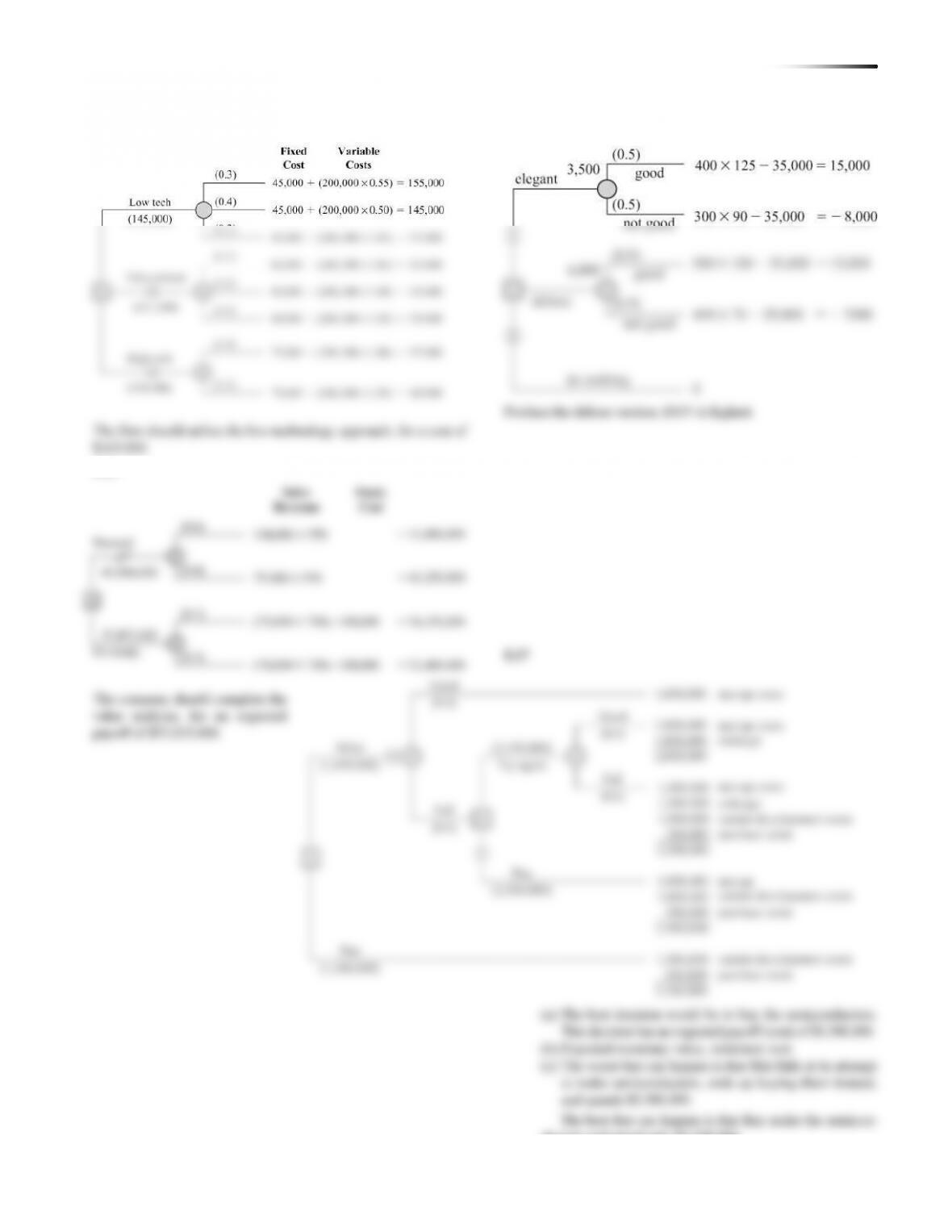
1. For what range of probabilities of high sales should we pur-
chase the CAD system?
Any probability above .27
2. “Favorable market sales” has been defined as 25,000 units.
Suppose this is optimistic. At what value would we change our de-
cision and hire engineers?
19,200
3. “Unfavorable market sales” has been defined as 8,000 units.
Suppose this is optimistic. At what value would we change our de–
cision and hire engineers?
4,100
CHAPTER 5 DE S I G N O F GO O D S A N D SE RV I CE S 53
4. How does the price affect our decision?
At low prices we hire engineers while at high prices we
use CAD. The break-even point is $74.
5. How sensitive is the decision to the manufacturing costs
without CAD?
At low costs we hire engineers. At high costs we use CAD.
6. How sensitive is the decision to the manufacturing costs with
CAD?
At low costs we purchase CAD, while at high costs we
on the Web. This house includes features and comparisons for
three options. Importance and rating of features are subjective and
just developed for this example.
5.2 For an existing organization, the student should build a
house of quality, entering the wants on the left and entering the
hows at the top—as in Problem 5.1. An example of a house of
5.3

54 CHAPTER 5 DE S I G N O F GO O D S A N D SE R V I C E S
5.4 Individual answer for a bicycle customer in the style of
Problem 5.1.
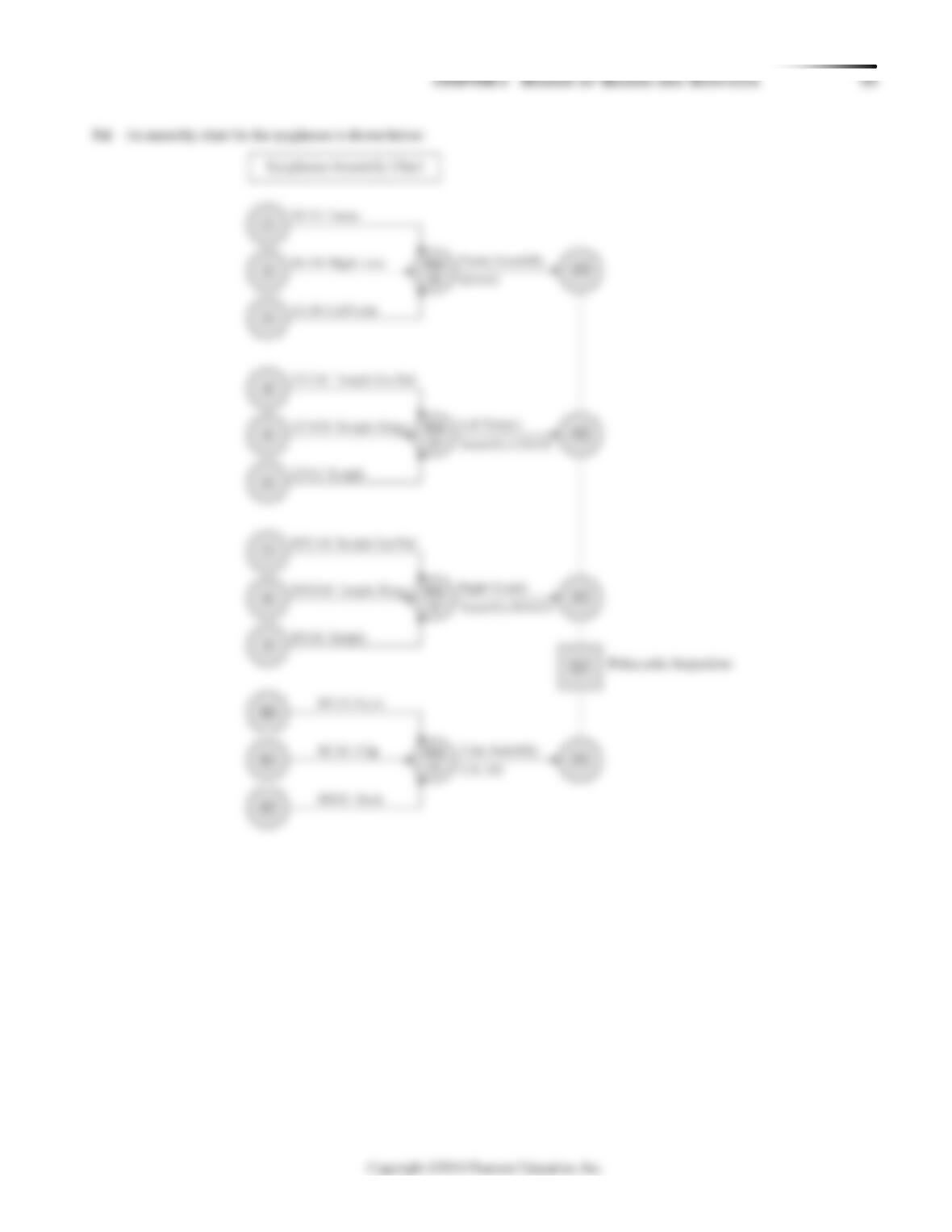
5.5 A typical bill of material is shown here:
(a)
Bill of Material for a Pair of Glasses in a Case
Part Number
Description
Quantity
G1001
Sun Ban Large in Black Case
1
CBL101
Black Leather Case
1
BF101
Black Leather Front
1
BB101
Black Leather Back
1
BC101
Black Leather Pocket Clip
1
SBL101
Sun Ban Large Glasses
1
SFA101
Frame Assembly
1
SF101
Alloy Frame
1
RL101
Right Sun Ban Large Lens
1
LL101
Left Sun Ban Large Lens
1
LTA101
Left Temple Assembly—Large
1
LT101
Left Temple
1
LTH101
Left Temple Hinge
1
LTE101
Left Temple Ear Pad
1
RTA101
Right Temple Assembly—Large
1
RT101
Right Temple
1
RTH101
Right Temple Hinge
1
RTE101
Right Temple Ear Pad
1
S1001
Hinge Screws
2
(b) There are obviously a very large number of possibilities.
1 Tbsp. chopped onion, and 1/2 oz. honey-mustard sauce.
It is wrapped in a 12 square deli paper.
56 CHAPTER 5 DE S I G N O F GO O D S A N D SE R V I C E S
5.7 Services need documents for the transition to production.
Creative students may have fun with this assignment, and you
may have students who have actually done “cold calls” for a firm
or the university and can discuss in detail the strong and weak
5.10 Possible strategies:
Kindle 2 (growth phase):
◼ Increase capacity and improve balance of production
system
5.11 (a)
For computer repair service, customer interaction is a strategic
choice.
5.12
All 10 strategic OM decisions are impacted by where the process
occurs in the PCN diagram. Comparing just 1 of these 10 deci-
sions, product design:
(a) Sandwich manufacturer must commit to product
decisions based on historical data of user preferences,
52 CHAPTER 5 DE S I G N O F GO O D S A N D SE R V I C E S
10. A bill of material lists the components, their description, and
the quantity of each required to make one unit of the product.
11. An engineering drawing shows the dimensions, tolerances,
matrials, and finishes of a component.
12. An assembly chart shows in schematic form how a product
is assembled. Along with a list of the operations necessary to pro-
duce a component, the process sheet includes specific methods of
13. The moment of truth is the moment that exemplifies,
detracts from, or enhances the customer’s expectations.
14. House of quality is a rigorous method aimed at that specific
result. It identifies customer wants, and relates them to product
attributes and firm abilities. It orders the wants and measures the
15. CAD aids all three strategy concepts—differentiation, low
cost, and response.
◼ CAD allows more designs to be developed, evaluated, and
submitted to production faster. It does this by fostering
16. Process chain is a sequence of steps that accomplishes a
purpose by providing value to process participants.
17. Direct interactions in PCN analysis are those steps that
involve interaction between participants. Surrogate interaction in
PCN analysis includes process steps in which one participant is
18. Documents for releasing services for production are analo-
gous to those for tangible products. The product must be defined—
such as a recipe for a cook, job instructions for a tailor, or a tele-
phone script for telephone sales. The definition is followed by an
authorization to produce. Orders to produce may be in the form
the following comes from an unknown source and some from the
U.S. Consumer Products Safety Commission.)
Parker Brothers had big plans for a toy called Riviton.
Riviton consisted of plastic parts, rubber rivets, and a riveting tool
with which children could put together anything from a windmill
to an airplane. In the first year on the market, Riviton seemed on
its way to becoming one of those classic toys that parents would
buy everlastingly. However, one of the 450,000 Riviton sets
ended up under the Christmas tree of an 8-year-old boy. He
played with it daily for 3 weeks. Then he put one of the quarter–
inch-long rubber rivets into his mouth and choked to death. Ten
months later, with Riviton sales well on their way to an expected
$8.5 million for the year, a second child strangled on a rivet.
Parker Brothers could have ignored the strangulations, as-
cribed the deaths to chance, and tried to shift the blame to parental
failure to supervise and police their children at play; or it could have
assigned responsibility to the child’s abnormal misuse or abuse of
the product. “After all, peanuts are the greatest cause of strangula–
tion among children, and nobody advocates the banning of the
However, when you manufacture for children, you produce
for the improvident, the impetuous, and the irresponsible. As a
judge put it: “the concept of a prudent child, God forbid, is a
grotesque combination.” The motto of childhood seems to be
“When in doubt, eat it.” Knowledge of such childish propensity is
Cases abound to document this axiom.
Considering the many stakeholders of a firm and the legal
setting sketched above, what is the proper response for the ethical
dilemma in the text?
the company was sensitive not only to the constraints of the law
(liability follows the chain for defective products) but also to the
imperatives of moral duty and social responsibility, as well as the
commercial value of an untarnished public image. Parker
Brothers, with 125,000 units in inventory, decided to halt sales
and recall 900,000 Riviton sets. As the company president
death No. 3?” The conduct of Parker Brothers is commendable.
However, we can assume that Parker Brothers was in better
financial condition than the manufacturer in our Ethical Dilemma.
Our manufacturer will be “laying off” his employees while further
product refinement takes place or new products are developed.
1. For what range of probabilities of high sales should we pur-
chase the CAD system?
Any probability above .27
2. “Favorable market sales” has been defined as 25,000 units.
Suppose this is optimistic. At what value would we change our de-
cision and hire engineers?
19,200
3. “Unfavorable market sales” has been defined as 8,000 units.
Suppose this is optimistic. At what value would we change our de–
cision and hire engineers?
4,100
CHAPTER 5 DE S I G N O F GO O D S A N D SE RV I CE S 53
4. How does the price affect our decision?
At low prices we hire engineers while at high prices we
use CAD. The break-even point is $74.
5. How sensitive is the decision to the manufacturing costs
without CAD?
At low costs we hire engineers. At high costs we use CAD.
6. How sensitive is the decision to the manufacturing costs with
CAD?
At low costs we purchase CAD, while at high costs we
on the Web. This house includes features and comparisons for
three options. Importance and rating of features are subjective and
just developed for this example.
5.2 For an existing organization, the student should build a
house of quality, entering the wants on the left and entering the
hows at the top—as in Problem 5.1. An example of a house of
5.3
54 CHAPTER 5 DE S I G N O F GO O D S A N D SE R V I C E S
5.4 Individual answer for a bicycle customer in the style of
Problem 5.1.
5.5 A typical bill of material is shown here:
(a)
Bill of Material for a Pair of Glasses in a Case
Part Number
Description
Quantity
G1001
Sun Ban Large in Black Case
1
CBL101
Black Leather Case
1
BF101
Black Leather Front
1
BB101
Black Leather Back
1
BC101
Black Leather Pocket Clip
1
SBL101
Sun Ban Large Glasses
1
SFA101
Frame Assembly
1
SF101
Alloy Frame
1
RL101
Right Sun Ban Large Lens
1
LL101
Left Sun Ban Large Lens
1
LTA101
Left Temple Assembly—Large
1
LT101
Left Temple
1
LTH101
Left Temple Hinge
1
LTE101
Left Temple Ear Pad
1
RTA101
Right Temple Assembly—Large
1
RT101
Right Temple
1
RTH101
Right Temple Hinge
1
RTE101
Right Temple Ear Pad
1
S1001
Hinge Screws
2
(b) There are obviously a very large number of possibilities.
1 Tbsp. chopped onion, and 1/2 oz. honey-mustard sauce.
It is wrapped in a 12 square deli paper.
56 CHAPTER 5 DE S I G N O F GO O D S A N D SE R V I C E S
5.7 Services need documents for the transition to production.
Creative students may have fun with this assignment, and you
may have students who have actually done “cold calls” for a firm
or the university and can discuss in detail the strong and weak
5.10 Possible strategies:
Kindle 2 (growth phase):
◼ Increase capacity and improve balance of production
system
5.11 (a)
For computer repair service, customer interaction is a strategic
choice.
5.12
All 10 strategic OM decisions are impacted by where the process
occurs in the PCN diagram. Comparing just 1 of these 10 deci-
sions, product design:
(a) Sandwich manufacturer must commit to product
decisions based on historical data of user preferences,