212 CHAPTER 14 MA T E RI A L RE Q U I R EM E NT S PL A N N I N G ( M R P) AND ERP
ments. These programs include an integrated set of programs
that determine an item master for each part, a bill of material, an
explosion scheme, a lead–time file, an inventory status file, and
15. In MRP, demand need not be constant. Also, in an MRP
system, the demand for one item depends on the demand for
18. (a) PeopleSoft includes the following in its CRM offerings
(see www.oracle.com/applications/peoplesoft/CRM/ent/
index.html):
Supplier Relationship Management—Manage supplier
relationships including indirect and direct goods, as
well as services procurement with:
◼ Partner relationship management solution
◼ Sales solution
◼ Service solution
◼ CRM analytics
◼ CRM industry solutions
◼ Marketing solution
(b) SAP’s Supply Chain Management product includes:
◼ Supply strategy development
◼ Supplier qualification
◼ Supplier selection
◼ Contract negotiation and management
(c) SAP’s Product Lifecycle Management product
includes:
◼ Life-cycle data management
◼ Asset life-cycle management
◼ Program & project management
◼ Life-cycle collaboration
buckets for some items. Some MRP systems now deliver to
“positions” in the production process—a “flow” criterion rather
1. Suppose that Item B must be ordered in multiples of dozens.
Which items are affected by this change?
Items D and E
2. Suppose that the minimum order quantity for Item C is 200
units. Which items are affected by this change?
Items E, F, G, and D
14.1 An exploded bill yields the following:
Item J: 200 units; Item K: 200 1 = 200 units; Item L: 200 4 =
800 units; Item M: 200 2 = 400 units.
14.2 The time-phased assembly plan for the gift bags is:

CHAPTER 14 MA T E RI AL RE Q U I R EM EN T S PL A N N I N G (M RP) AND E R P 213
Copyright ©2014 Pearson Education, Inc.
Someone should start on item M by noon.
214 CHAPTER 14 MA T E RI A L RE Q U I R EM E NT S PL A N N I N G ( M R P) AND ERP
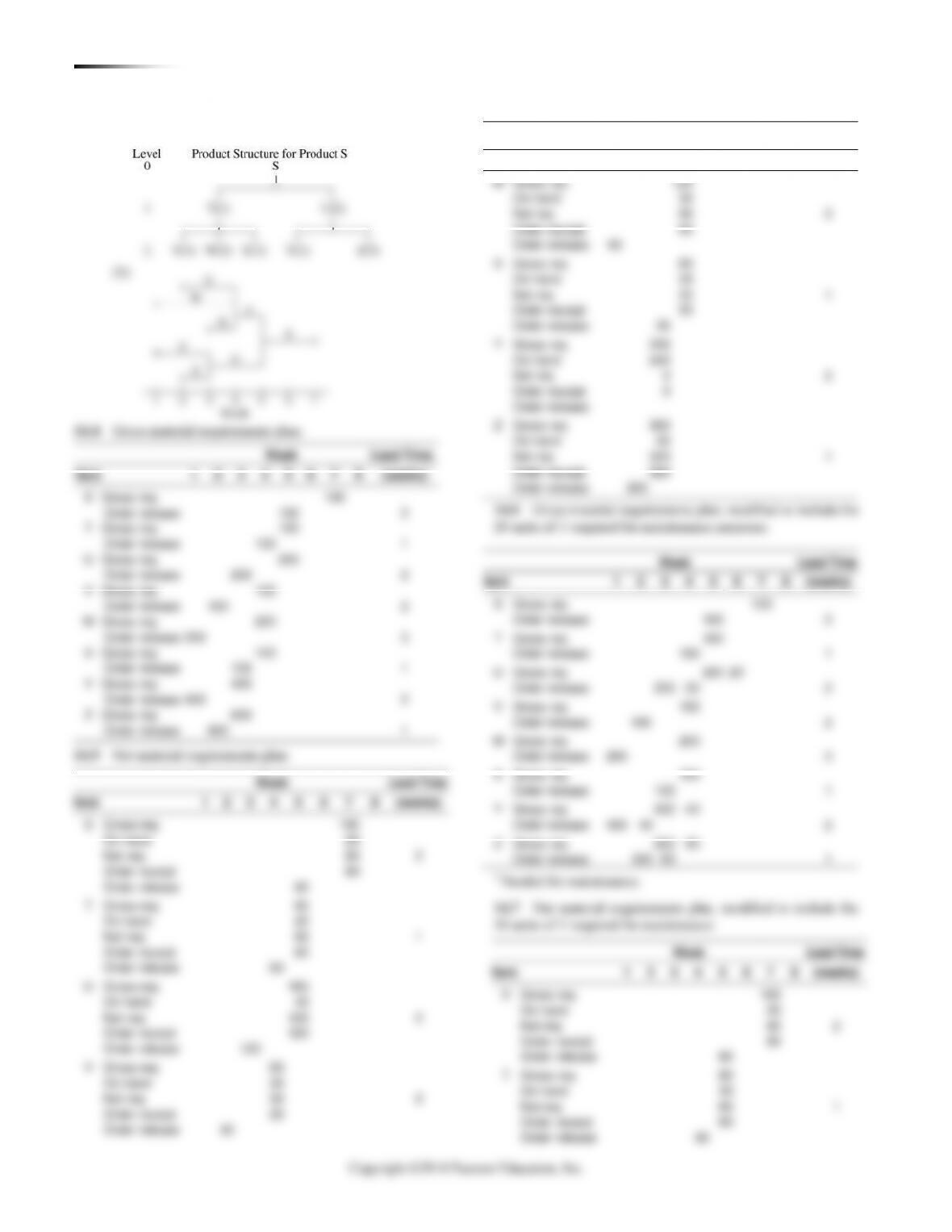
14.3 (a) Product structure:
(b)
Order receipt
35
Order release
35
Y
Gross req
240
On hand
240
Net req
0
2
Order receipt
0
Order release
Order receipt
35
Order release
35
Y
Gross req
240
On hand
240
Net req
0
2
Order receipt
0
Order release
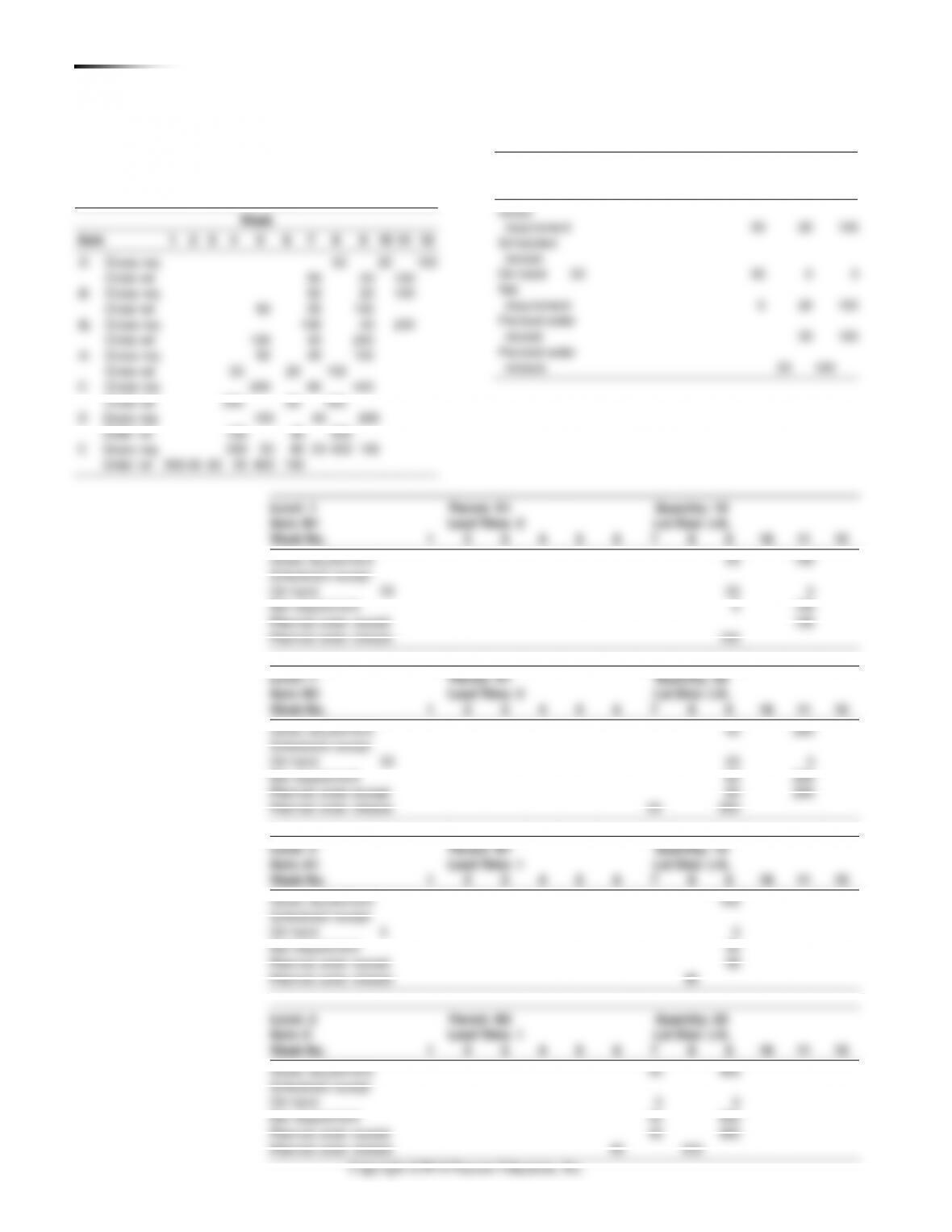
14.4 Gross material requirements plan:
Week
Lead Time
Item
1
2
3
4
5
6
7
8
(weeks)
S
Gross req
100
Order release
100
2
T
Gross req
100
Order release
100
1
U
Gross req
200
Order release
200
2
V
Gross req
100
Order release
100
2
W
Gross req
200
Order release
200
3
X
Gross req
100
Order release
100
1
Y
Gross req
400
Order release
400
2
Z
Gross req
600
Order release
600
1
14.5 Net material requirements plan:
Order receipt
80
Order release
80
T
Gross req
80
On hand
20
Net req
60
1
Order receipt
60
Order release
U
Gross req
160
On hand
40
Net req
120
2
Order receipt
120
Order release
120
V
Gross req
60
Lead Time
Item
1
2
3
4
5
6
7
8
(weeks)
S
Gross req
100
On hand
20
Net req
80
2
Order receipt
80
Order release
80
Order receipt
80
Order release
80
T
Gross req
80
On hand
20
Net req
60
1
Order receipt
60
Order release
U
Gross req
160
On hand
40
Net req
120
2
Order receipt
120
Order release
120
V
Gross req
60
Lead Time
Item
1
2
3
4
5
6
7
8
(weeks)
S
Gross req
100
On hand
20
Net req
80
2
Order receipt
80
Order release
80
14.6 Gross material requirements plan, modified to include the
20 units of U required for maintenance purposes:
Week
Lead Time
Item
1
2
3
4
5
6
7
8
(weeks)
W
Gross req
120
On hand
30
Net req
90
3
Order receipt
90
Order release
90
X
Gross req
60
On hand
25
Net req
35
1
Z
Gross req
360
On hand
40
Net req
320
1
Order receipt
320
Order release
320
Week
Lead Time
Item
1
2
3
4
5
6
7
8
(weeks)
S
Gross req
100
Order release
100
2
T
Gross req
100
Order release
100
1
U
Gross req
200
20*
Order release
200
20
2
V
Gross req
100
Order release
100
2
W
Gross req
200
Order release
200
3
X
Gross req
100
Order release
100
1
Y
Gross req
400
40
Order release
400
40
2
Z
Gross req
600
60
Order release
600
60
1
Week
Lead Time
Item
1
2
3
4
5
6
7
8
(weeks)
S
Gross req
100
On hand
20
Net req
80
2
Order release
Order release
216 CHAPTER 14 MA T E RI A L RE Q U I R EM E NT S PL A N N I N G ( M R P) AND ERP
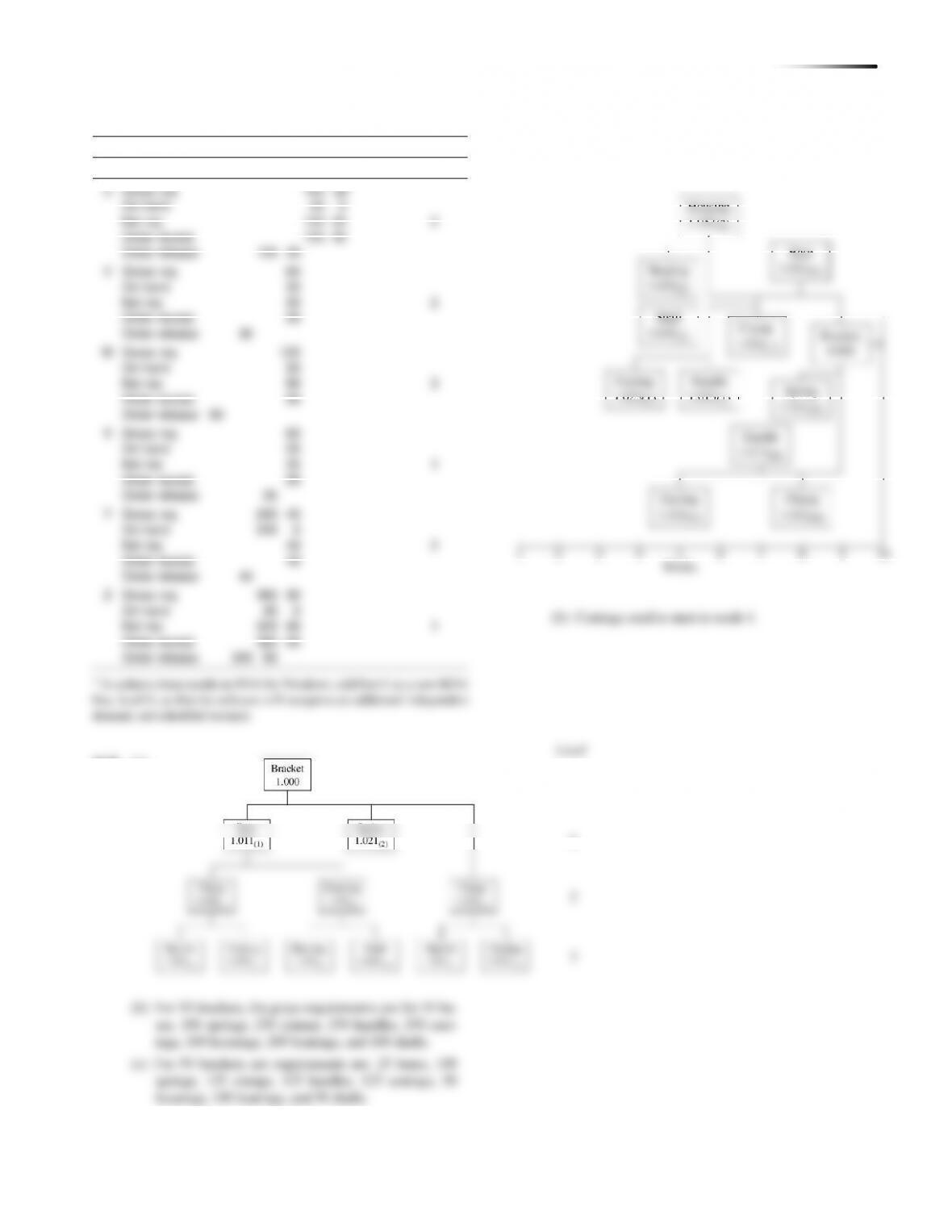
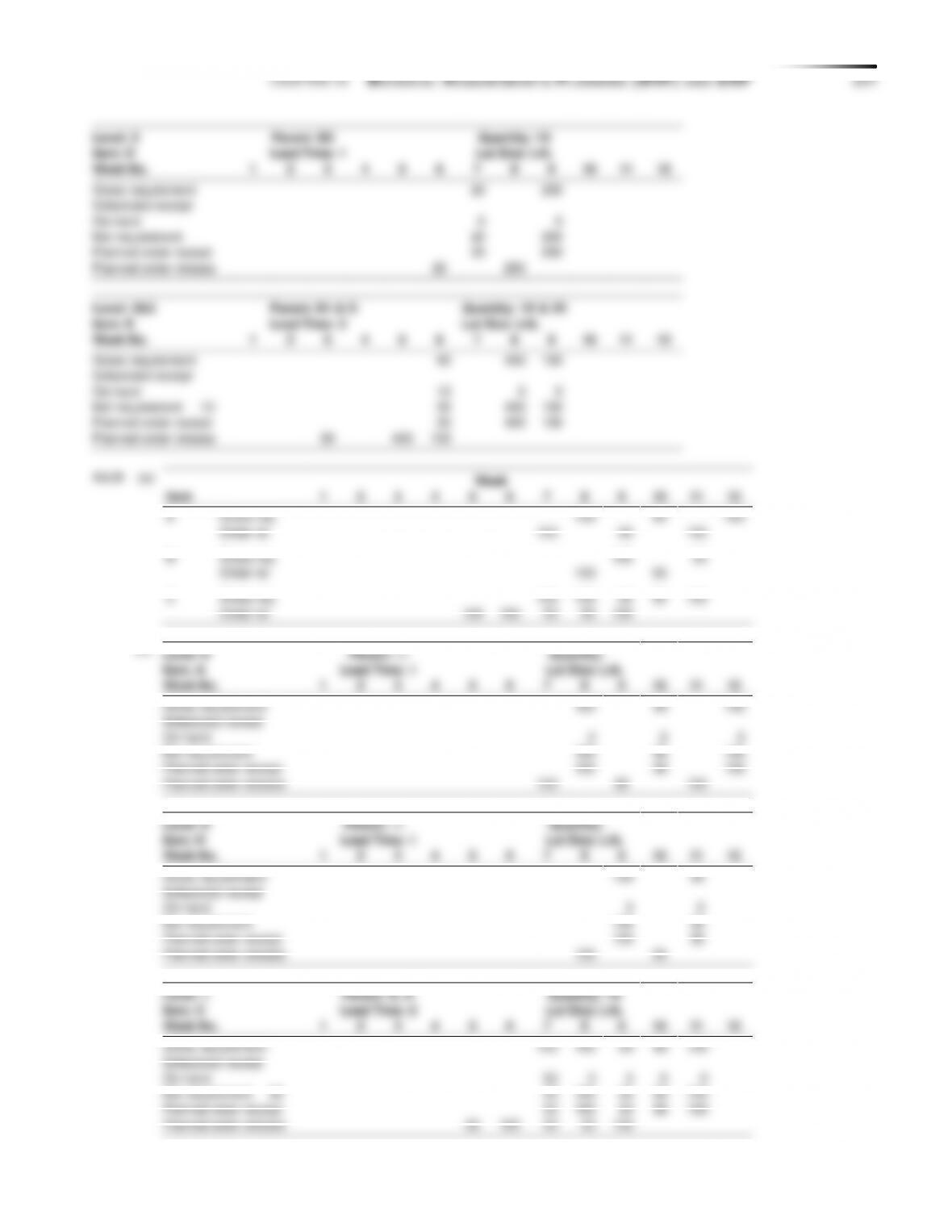
14.10 (a) Gross material requirements plan:
Note: Elements have been listed in the gross material require-
ments plan in the order of level, and within a level, from left to
right as viewed in the product structure.
Week
Item
1
2
3
4
5
6
7
8
9
10
11
12
X1
Gross req
50
20
100
Order rel
50
20
100
B1
Gross req
50
20
100
Order rel
50
20
100
B2
Gross req
100
40
200
Order rel
100
40
200
A1
Gross req
50
20
100
Order rel
50
20
100
C
Gross req
200
80
400
Order rel
200
80
400
D
Gross req
100
40
200
Order rel
100
40
200
E
Gross req
200
80
20
400
100
100
E
Gross req
200
80
20
400
100
100
Level: 1
Item: B1
Gross requirement
100
On hand 20
0
Net requirement
0
100
Planned order receipt
100
Level: 1
Item: B2
Gross requirement
200
Scheduled receipt
On hand 20
0
Net requirement
200
Planned order receipt
200
Level: 2
Item: A1
Gross requirement
100
Scheduled receipt
On hand 5
Net requirement
95
Planned order receipt
95
Level: 2
Item: C
Planned order receipt
400
Level: 1
Item: B1
Gross requirement
100
On hand 20
0
Net requirement
0
100
Planned order receipt
100
Level: 1
Item: B2
Gross requirement
200
Scheduled receipt
On hand 20
0
Net requirement
200
Planned order receipt
200
Level: 2
Item: A1
Gross requirement
100
Scheduled receipt
On hand 5
Net requirement
95
Planned order receipt
95
Level: 2
Item: C
Planned order receipt
400
(b) Net material requirements (planned order release) plan:
Level: 0
Parent:
Quantity:
Item: X1
Lead Time: 1
Lot Size: L4L
Week No.
1
2
3
4
5
6
7
8
9
10
11
12
Gross
requirement
50
20
100
Scheduled
receipt
On hand 50
50
0
0
Net
requirement
0
20
100
Planned order
receipt
20
100
Planned order
release
20
100
Copyright ©2014 Pearson Education, Inc.
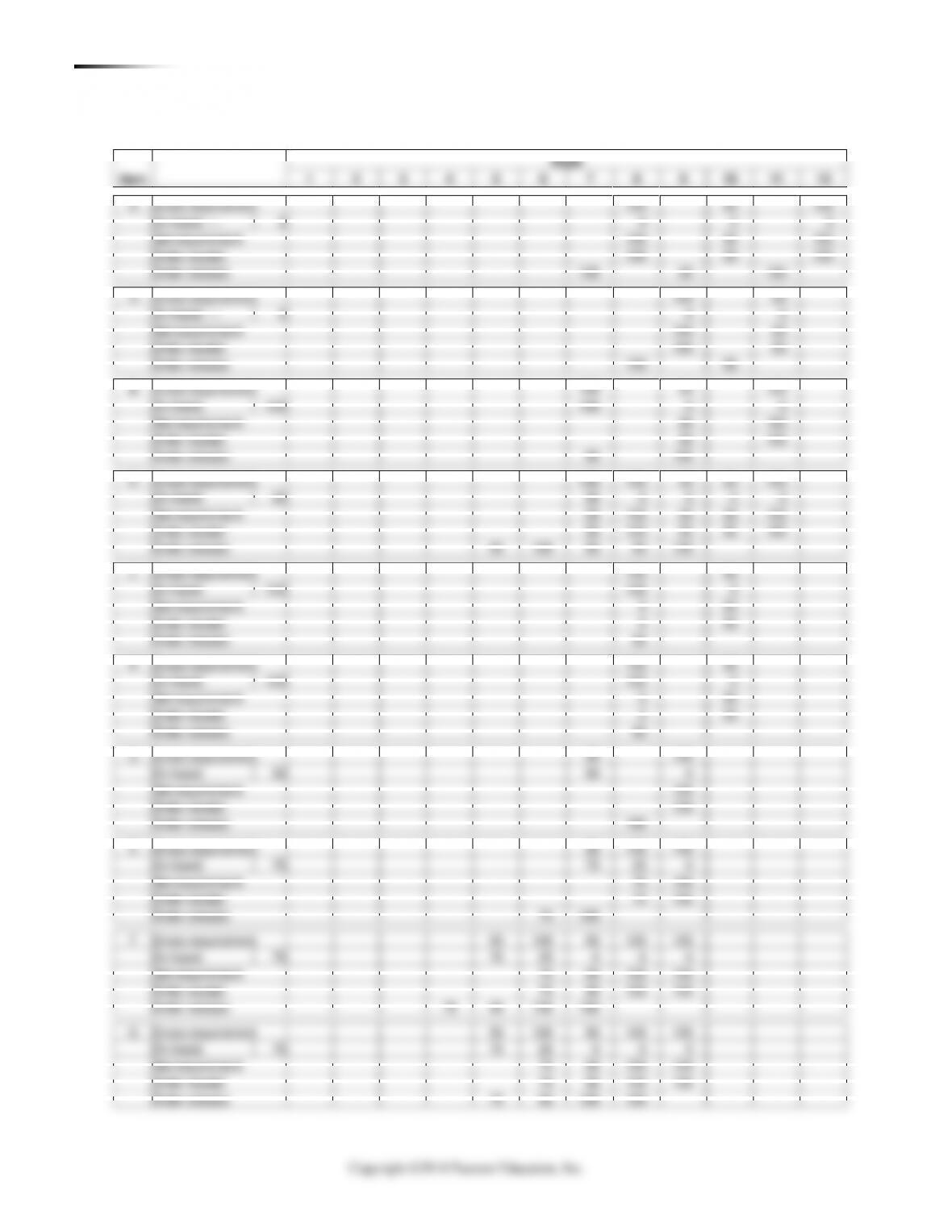
14.11 (a)
Order rel
100
50
C
Gross req
100
100
50
50
150
1
2
3
4
5
6
7
8
9
10
11
12
100
150
100
150
1
2
3
4
5
6
7
8
9
10
11
12
100
100
100
Parent: A, H
Quantity: 1X
1
2
3
4
5
6
7
8
9
10
11
12
100
100
50
150
50
100
50
150
50
100
50
150
Order rel
100
50
C
Gross req
100
100
50
50
150
1
2
3
4
5
6
7
8
9
10
11
12
100
150
100
150
1
2
3
4
5
6
7
8
9
10
11
12
100
100
100
Parent: A, H
Quantity: 1X
1
2
3
4
5
6
7
8
9
10
11
12
100
100
50
150
50
100
50
150
50
100
50
150
Week
Item
1
2
3
4
5
6
7
8
9
10
11
12
A
Gross req
100
50
150
Order rel
100
50
150
H
Gross req
100
50
Planned order release
50
100
50
50
150
Quantity: 1X
1
2
3
4
5
6
7
8
9
10
11
12
200
200
200
Quantity: 1X & 2X
1
2
3
4
5
6
7
8
9
10
11
12
40
400
100
10
30
400
100
30
400
100
Quantity: 1X
1
2
3
4
5
6
7
8
9
10
11
12
200
200
200
Quantity: 1X & 2X
1
2
3
4
5
6
7
8
9
10
11
12
40
400
100
10
30
400
100
30
400
100
218 CHAPTER 14 MA T E RI A L RE Q U I R EM E NT S PL A N N I N G ( M R P) AND ERP
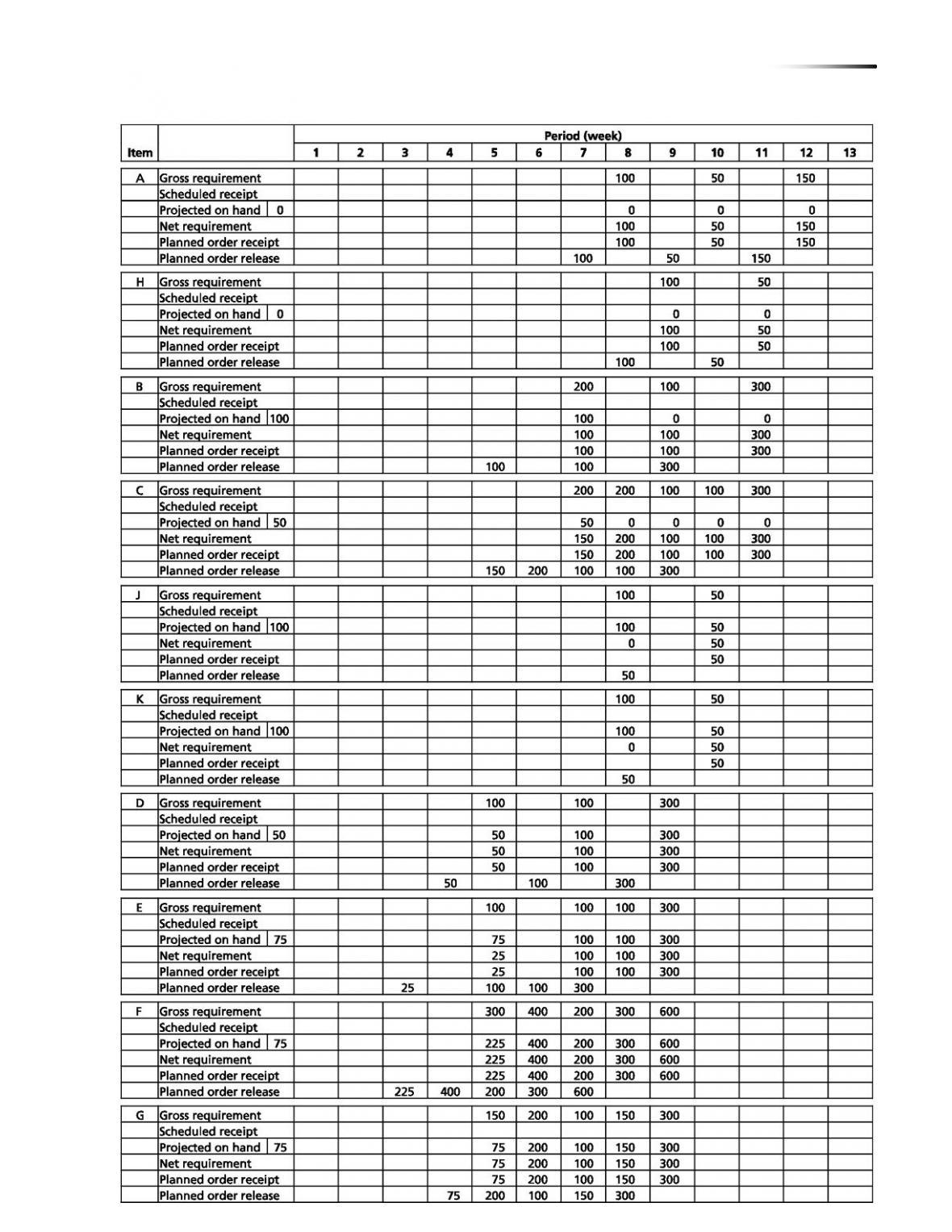
14.12 (a) Net material requirements plan:
Week
Item
1
2
3
4
5
6
7
8
9
10
11
12
A
Gross requirement
100
50
150
On hand: —
0
0
0
0
Net requirement
100
50
150
Order receipt
100
50
150
Order release
100
50
150
H
Gross requirement
100
50
On hand: —
0
0
0
Net requirement
100
50
Order receipt
100
50
Order release
100
50
B
Gross requirement
100
50
150
On hand:
100
100
0
0
Net requirement
50
150
Order receipt
50
150
Order release
50
150
C
Gross requirement
100
100
50
50
150
On hand:
50
50
0
0
0
0
Net requirement
50
100
50
50
150
Order receipt
50
100
50
50
150
Order release
50
100
50
50
150
J
Gross requirement
100
50
On hand:
100
100
0
Net requirement
0
50
Order receipt
0
50
Order release
50
K
Gross requirement
100
50
On hand:
100
100
0
Net requirement
0
50
Order receipt
0
50
Order release
50
D
Gross requirement
50
150
On hand:
50
50
0
Net requirement
150
Order receipt
150
Order release
150
E
Gross requirement
50
100
150
On hand:
75
75
25
0
Net requirement
75
150
Order receipt
75
150
Order release
75
150
F
Gross requirement
50
100
50
100
150
On hand:
75
75
25
0
0
0
Net requirement
75
50
100
150
Order receipt
75
50
100
150
Order release
75
50
100
150
G
Gross requirement
50
100
50
100
150
On hand:
75
75
25
0
0
0
Net requirement
75
50
100
150
Order receipt
75
50
100
150
Order release
75
50
100
150
Copyright ©2014 Pearson Education, Inc.
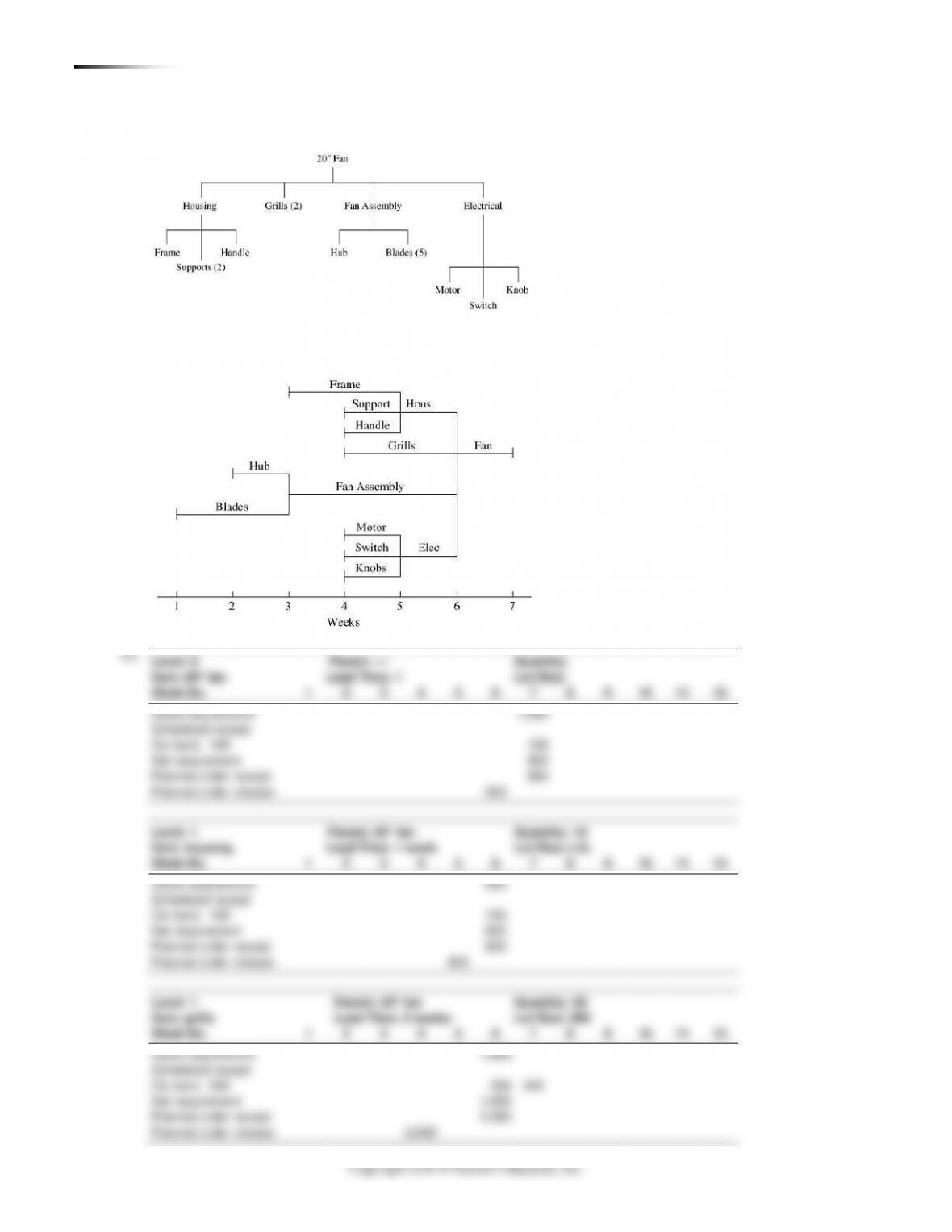
220 CHAPTER 14 MA T E RI A L RE Q U I R EM E NT S PL A N N I N G ( M R P) AND ERP
14.13 (a)
(b)
212 CHAPTER 14 MA T E RI A L RE Q U I R EM E NT S PL A N N I N G ( M R P) AND ERP
ments. These programs include an integrated set of programs
that determine an item master for each part, a bill of material, an
explosion scheme, a lead–time file, an inventory status file, and
15. In MRP, demand need not be constant. Also, in an MRP
system, the demand for one item depends on the demand for
18. (a) PeopleSoft includes the following in its CRM offerings
(see www.oracle.com/applications/peoplesoft/CRM/ent/
index.html):
Supplier Relationship Management—Manage supplier
relationships including indirect and direct goods, as
well as services procurement with:
◼ Partner relationship management solution
◼ Sales solution
◼ Service solution
◼ CRM analytics
◼ CRM industry solutions
◼ Marketing solution
(b) SAP’s Supply Chain Management product includes:
◼ Supply strategy development
◼ Supplier qualification
◼ Supplier selection
◼ Contract negotiation and management
(c) SAP’s Product Lifecycle Management product
includes:
◼ Life-cycle data management
◼ Asset life-cycle management
◼ Program & project management
◼ Life-cycle collaboration
buckets for some items. Some MRP systems now deliver to
“positions” in the production process—a “flow” criterion rather
1. Suppose that Item B must be ordered in multiples of dozens.
Which items are affected by this change?
Items D and E
2. Suppose that the minimum order quantity for Item C is 200
units. Which items are affected by this change?
Items E, F, G, and D
14.1 An exploded bill yields the following:
Item J: 200 units; Item K: 200 1 = 200 units; Item L: 200 4 =
800 units; Item M: 200 2 = 400 units.
14.2 The time-phased assembly plan for the gift bags is:
CHAPTER 14 MA T E RI AL RE Q U I R EM EN T S PL A N N I N G (M RP) AND E R P 213
Copyright ©2014 Pearson Education, Inc.
Someone should start on item M by noon.
214 CHAPTER 14 MA T E RI A L RE Q U I R EM E NT S PL A N N I N G ( M R P) AND ERP
14.3 (a) Product structure:
(b)
14.4 Gross material requirements plan:
Week
Lead Time
Item
1
2
3
4
5
6
7
8
(weeks)
S
Gross req
100
Order release
100
2
T
Gross req
100
Order release
100
1
U
Gross req
200
Order release
200
2
V
Gross req
100
Order release
100
2
W
Gross req
200
Order release
200
3
X
Gross req
100
Order release
100
1
Y
Gross req
400
Order release
400
2
Z
Gross req
600
Order release
600
1
14.5 Net material requirements plan:
14.6 Gross material requirements plan, modified to include the
20 units of U required for maintenance purposes:
Week
Lead Time
Item
1
2
3
4
5
6
7
8
(weeks)
W
Gross req
120
On hand
30
Net req
90
3
Order receipt
90
Order release
90
X
Gross req
60
On hand
25
Net req
35
1
Z
Gross req
360
On hand
40
Net req
320
1
Order receipt
320
Order release
320
Week
Lead Time
Item
1
2
3
4
5
6
7
8
(weeks)
S
Gross req
100
Order release
100
2
T
Gross req
100
Order release
100
1
U
Gross req
200
20*
Order release
200
20
2
V
Gross req
100
Order release
100
2
W
Gross req
200
Order release
200
3
X
Gross req
100
Order release
100
1
Y
Gross req
400
40
Order release
400
40
2
Z
Gross req
600
60
Order release
600
60
1
Week
Lead Time
Item
1
2
3
4
5
6
7
8
(weeks)
S
Gross req
100
On hand
20
Net req
80
2
216 CHAPTER 14 MA T E RI A L RE Q U I R EM E NT S PL A N N I N G ( M R P) AND ERP
14.10 (a) Gross material requirements plan:
Note: Elements have been listed in the gross material require-
ments plan in the order of level, and within a level, from left to
right as viewed in the product structure.
Week
Item
1
2
3
4
5
6
7
8
9
10
11
12
X1
Gross req
50
20
100
Order rel
50
20
100
B1
Gross req
50
20
100
Order rel
50
20
100
B2
Gross req
100
40
200
Order rel
100
40
200
A1
Gross req
50
20
100
Order rel
50
20
100
C
Gross req
200
80
400
Order rel
200
80
400
D
Gross req
100
40
200
Order rel
100
40
200
(b) Net material requirements (planned order release) plan:
Level: 0
Parent:
Quantity:
Item: X1
Lead Time: 1
Lot Size: L4L
Week No.
1
2
3
4
5
6
7
8
9
10
11
12
Gross
requirement
50
20
100
Scheduled
receipt
On hand 50
50
0
0
Net
requirement
0
20
100
Planned order
receipt
20
100
Planned order
release
20
100
Copyright ©2014 Pearson Education, Inc.
14.11 (a)
Week
Item
1
2
3
4
5
6
7
8
9
10
11
12
A
Gross req
100
50
150
Order rel
100
50
150
H
Gross req
100
50
Planned order release
50
100
50
50
150
218 CHAPTER 14 MA T E RI A L RE Q U I R EM E NT S PL A N N I N G ( M R P) AND ERP
14.12 (a) Net material requirements plan:
Week
Item
1
2
3
4
5
6
7
8
9
10
11
12
A
Gross requirement
100
50
150
On hand: —
0
0
0
0
Net requirement
100
50
150
Order receipt
100
50
150
Order release
100
50
150
H
Gross requirement
100
50
On hand: —
0
0
0
Net requirement
100
50
Order receipt
100
50
Order release
100
50
B
Gross requirement
100
50
150
On hand:
100
100
0
0
Net requirement
50
150
Order receipt
50
150
Order release
50
150
C
Gross requirement
100
100
50
50
150
On hand:
50
50
0
0
0
0
Net requirement
50
100
50
50
150
Order receipt
50
100
50
50
150
Order release
50
100
50
50
150
J
Gross requirement
100
50
On hand:
100
100
0
Net requirement
0
50
Order receipt
0
50
Order release
50
K
Gross requirement
100
50
On hand:
100
100
0
Net requirement
0
50
Order receipt
0
50
Order release
50
D
Gross requirement
50
150
On hand:
50
50
0
Net requirement
150
Order receipt
150
Order release
150
E
Gross requirement
50
100
150
On hand:
75
75
25
0
Net requirement
75
150
Order receipt
75
150
Order release
75
150
F
Gross requirement
50
100
50
100
150
On hand:
75
75
25
0
0
0
Net requirement
75
50
100
150
Order receipt
75
50
100
150
Order release
75
50
100
150
G
Gross requirement
50
100
50
100
150
On hand:
75
75
25
0
0
0
Net requirement
75
50
100
150
Order receipt
75
50
100
150
Order release
75
50
100
150
Copyright ©2014 Pearson Education, Inc.
220 CHAPTER 14 MA T E RI A L RE Q U I R EM E NT S PL A N N I N G ( M R P) AND ERP
14.13 (a)
(b)