11
Supply-Chain Management
1. Supply-chain management is the management of the activities
that procure raw materials, transform them into intermediate
goods and final products, and deliver the products to customers
2. The supply-chain function’s role is to help identify the
products and services that can best be obtained externally;
develop, evaluate, and determine the best supplier, price, and
through the integration of all material acquisition, movement, and
storage activities in the firm.
4. Table 11.3 identifies types of supply-chain risk:
◼ Logistics and distribution failures
◼ Political/regulatory changes
backward into purchasing raw materials for components and
forward into packaging and distribution. An example would be a
7. The adversarial relationship must be changed dramatically to
one of trust and the establishment of long-term relationships. To im-
plement long-term relationships, purchasers must move to com-
9. CPFR, which stands for collaborative planning, forecasting,
and replenishment, is another effort to manage/coordinate
10. Online auctions lower entry barriers for buyers and seller,
increasing the number of people in the market, typically reducing
cost.
11. FedEx, UPS, and DHL use the Internet to track and coordinate
pickup and delivery. This can facilitate delivery of combined orders
at opportune times, improving efficiency for both supplier and
12. Walmart often uses drop shipping to remove itself
completely from the distribution process so that orders from
various stores are received by the manufacturer and shipped
13. Blanket orders are orders that cover an extended order
period, say a year, and against which releases are issued against
14. An organization moving to JIT deliveries must ensure that
the supplier is capable of delivering quality products on time,
layout to ensure that deliveries can move quickly to where they
Internet to buy or sell goods.
16. Darden finds competitive advantage in the supply chain
through a very proactive evaluation, development, and auditing of
Supply-Chain Operations Reference (SCOR) model, that is an effort
160 CHAPTER 11 SUPPL Y–CHAIN MA NAG EM EN T
to identify the best practices, process, and metrics in the supply
chain.
11.1 This problem provides a good way to (1) get students
involved with the real world, (2) have them interact with members
of the existing workforce, and (3) get them to take a relatively
detailed look at supply chains and their relation to corporate
162 CHAPTER 11 SUPPL Y–CHAIN MA NAG EM EN T
1
3
VIDEO CASE STUDIES
DARDEN’S GLOBAL SUPPLY CHAINS
manage–
ment task that requires specialized talents, organization, budget–
3. Title changes:
◼ In the smallware supply chain, ownership changes at
4. There are lots of opportunity for discussion here. For
example, the automobile industry develops new and innovative
supply chains such as vendor-managed inventory, with suppliers
holding title to major subcomponents (modules) until delivery to
the assembly line, etc. The major distinction is that the diverse
4. Doctor Smith just returned from the Annual Physicians’
Orthopedic Conference, where she saw a new hip joint replace–
replacement joint at APH. What process will Dr. Smith have to go
through at the hospital to introduce this new product into the
designed to supplement this case and was filmed specifically for
this text.
164 CHAPTER 11 SUPPL Y–CHAIN MA NAG EM EN T
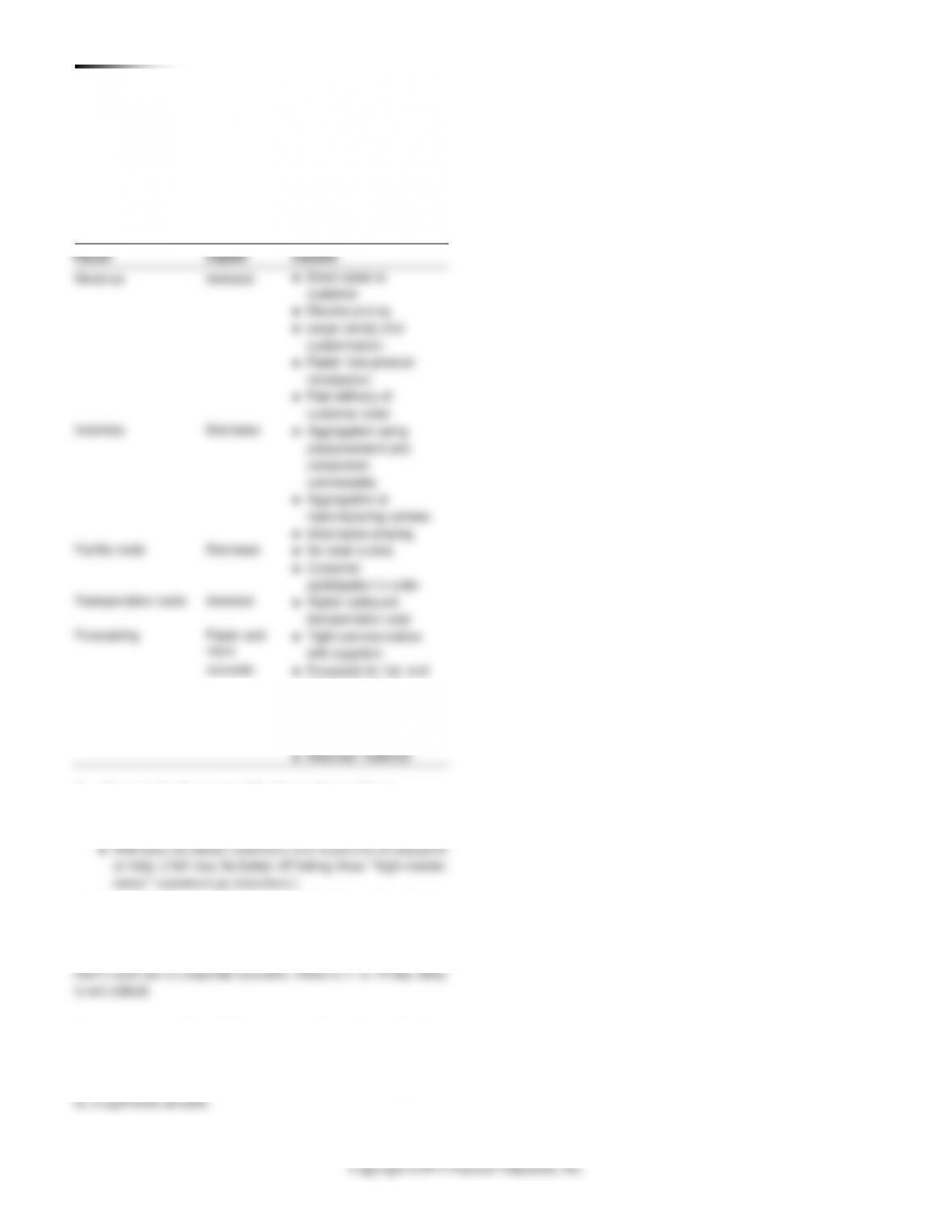
2. Dell has exploited direct sales to speed customer orders,
which allows Dell to postpone assembly until the customer has
placed the order (build-to-order). Several strategic advantages are
noted below:
Factor
Impact
Causes
Revenue
Increase
◼ Direct sales to
customer
◼ Flexible pricing
◼ Large variety and
customization
◼ Faster new product
introduction
◼ Fast delivery of
customer order
Inventory
Decrease
◼ Aggregation using
postponement and
component
commonality
◼ Aggregation at
manufacturing centers
◼ Information sharing
Facility costs
Decrease
◼ No retail outlets
◼ Customer
participation in order
Transportation costs
Increase
◼ Higher outbound
transportation cost
Forecasting
Faster and
more
◼ Tight communication
with suppliers
accurate
◼ Forecasts for 1st- and
2nd-tier suppliers
based on very current
(daily updates)
actual sales
◼ Reduced “bullwhip”
3. The main disadvantages of the direct sales model are:
◼ Dell loses customers who are unwilling to wait 5 to 10
days to receive a PC.
4. Dell does not successfully compete with the retailer who has
the desired PC in stock. But the customer has to go to the store,
while Dell customers can order from home via phone or Internet.
For customized PCs, Dell is the leader in response time. Many of
5. E-commerce allows Dell to improve forecasting and reduce
inventories by sharing information throughout the supply chain.
This dampens the bullwhip effect. This information sharing
reduces costs and improves performances in the Dell supply chain
by a significant amount.
160 CHAPTER 11 SUPPL Y–CHAIN MA NAG EM EN T
to identify the best practices, process, and metrics in the supply
chain.
11.1 This problem provides a good way to (1) get students
involved with the real world, (2) have them interact with members
of the existing workforce, and (3) get them to take a relatively
detailed look at supply chains and their relation to corporate
162 CHAPTER 11 SUPPL Y–CHAIN MA NAG EM EN T
1
3
VIDEO CASE STUDIES
DARDEN’S GLOBAL SUPPLY CHAINS
manage–
ment task that requires specialized talents, organization, budget–
3. Title changes:
◼ In the smallware supply chain, ownership changes at
4. There are lots of opportunity for discussion here. For
example, the automobile industry develops new and innovative
supply chains such as vendor-managed inventory, with suppliers
holding title to major subcomponents (modules) until delivery to
the assembly line, etc. The major distinction is that the diverse
4. Doctor Smith just returned from the Annual Physicians’
Orthopedic Conference, where she saw a new hip joint replace–
replacement joint at APH. What process will Dr. Smith have to go
through at the hospital to introduce this new product into the
designed to supplement this case and was filmed specifically for
this text.
164 CHAPTER 11 SUPPL Y–CHAIN MA NAG EM EN T
2. Dell has exploited direct sales to speed customer orders,
which allows Dell to postpone assembly until the customer has
placed the order (build-to-order). Several strategic advantages are
noted below:
Factor
Impact
Causes
Revenue
Increase
◼ Direct sales to
customer
◼ Flexible pricing
◼ Large variety and
customization
◼ Faster new product
introduction
◼ Fast delivery of
customer order
Inventory
Decrease
◼ Aggregation using
postponement and
component
commonality
◼ Aggregation at
manufacturing centers
◼ Information sharing
Facility costs
Decrease
◼ No retail outlets
◼ Customer
participation in order
Transportation costs
Increase
◼ Higher outbound
transportation cost
Forecasting
Faster and
more
◼ Tight communication
with suppliers
accurate
◼ Forecasts for 1st- and
2nd-tier suppliers
based on very current
(daily updates)
actual sales
◼ Reduced “bullwhip”
3. The main disadvantages of the direct sales model are:
◼ Dell loses customers who are unwilling to wait 5 to 10
days to receive a PC.
4. Dell does not successfully compete with the retailer who has
the desired PC in stock. But the customer has to go to the store,
while Dell customers can order from home via phone or Internet.
For customized PCs, Dell is the leader in response time. Many of
5. E-commerce allows Dell to improve forecasting and reduce
inventories by sharing information throughout the supply chain.
This dampens the bullwhip effect. This information sharing
reduces costs and improves performances in the Dell supply chain
by a significant amount.