
Appendix B-81
| Appendix B – Chapter Exercises
© 2013 by McGraw-Hill Education. This is proprietary material solely for authorized instructor use. Not authorized for sale or distribution in any manner.
This document may not be copied, scanned, duplicated, forwarded, distributed, or posted on a website, in whole or part.
Chapter Exercise 5.2
Permalco’s Recruiting Challenge
Objectives . This exercise will give the students an opportunity to do a SWOT analysis for the
recruiting function of HRM. Students should also be able to apply the analysis to workable solutions
for the organization. The importance of involving line management in the recruiting function is a
critical element in this exercise. Students will be able to identify the best sources and methods of
recruiting for a particular situation.
Description . Students should work individually for about one hour of out–of-class preparation to read
the case and answer the questions on Form 5.2.1. Following this, in class in small groups (about 4–6)
students should review each other’s responses to Form 5.2.1. They should develop a recruiting plan
for Permalco which includes short and long term strategies, measures of success, sources of
candidates, recruiting techniques to use, and recommendations for changes to be made to other HR
systems in the firm. This should take teams about 30 minutes. The professor can lead a class
discussion on each team’s findings (about 20 minutes).
Table 5.2.1
Answers to Form 5.2.1
1. Identify the SWOT at Permalco as related to recruiting production leaders.
Strengths – modernized facilities, high tech equipment, many highly trained employees (newer ones),
apparently good salary and benefits
Appendix B-82
| Appendix B – Chapter Exercises
© 2013 by McGraw-Hill Education. This is proprietary material solely for authorized instructor use. Not authorized for sale or distribution in any manner.
This document may not be copied, scanned, duplicated, forwarded, distributed, or posted on a website, in whole or part.
Threats – layoffs due to declining business, loss of personnel with history of the facility.
2. What information must the team gather before it can formulate a recruiting strategy?
More information about the details about how many can be hired. Information on the effectiveness
of various recruiting strategies has been for the firm (i.e., how effective have referrals, campus visits,
etc., been in hiring qualified applicants). New options, such as the Internet and recruiters for this
3. How might the short-term and long-term recruiting strategies differ?
For the short-term, they need to hire the two people so they may want to get them in place as
4. What sources of candidates should the team consider?
They need to establish the minimum qualifications for the positions, and hire those meeting the
5. What recruiting strategy has the highest probability of paying off for the team?
Appendix B-83
| Appendix B – Chapter Exercises
Unless there have been significant changes in the variables most related to the company’s recruiting
history, the strategy with the lowest selection ratio, highest yield ratios, and lowest associated costs
will be the one with the highest probability of success and the one(s) to use.
6. When planning the recruiting strategy, what other HR systems must the team consider?
This organization needs to conduct some training for all employees and managers on issues of
workforce diversity and sexual harassment in order to make the organization a more comfortable
place (and less hostile) for women.
7. What challenges face the recruiting team because of the focus on females and minorities?
Currently, they face considerable challenges since they have few women and minorities in their
workplace and it does not seem like the environment is very tolerant of diversity. Hence, they will
Appendix B-84
| Appendix B – Chapter Exercises
© 2013 by McGraw-Hill Education. This is proprietary material solely for authorized instructor use. Not authorized for sale or distribution in any manner.
This document may not be copied, scanned, duplicated, forwarded, distributed, or posted on a website, in whole or part.
have trouble with potential applicants learning from current employees that opportunities are not
that great for diverse employees.
Also, highly qualified minorities and women will have many career opportunities facing them, and will
be difficult to recruit in a firm with an uncomfortable working environment (physical attributes) and
few career opportunities. Many good women and minorities will take jobs elsewhere so Permalco will
need to change some of their HR systems (career, training, promotion, flexible work place) in order to
have a chance at getting some of the best women and minorities.
They may need to research a variety of places to recruit women and minorities, using magazines
(Working Women, Black Enterprise, etc) as well as visit women’s colleges or black colleges, as well as
there is the possibility of discriminating against those who are not the focus.
Appendix B-85
| Appendix B – Chapter Exercises
Chapter Exercise 5.3
Recruiting at Julia Richter’s “Dressed for Success”
* Contributed by Renee Bartlett
Develop a recruitment plan for both the Store Manager and Sales Associate positions. Provide a
specific chronology of events. Address the following: (1) What three recruiting/ advertising
methods do you recommend for Dressed for Success? Ms. Richter specifically requests information
about the costs and benefits of online recruiting and/or the use of a “headhunter” for the Store
Manager job. She requests that you do research on this issue and take a firm position. Does the
Internet provide any information about the compensation being considered for these jobs? (2) Ms.
Richter is also concerned about diversity. What recruitment methods should be implemented to
help increase diversity in the organization? (3) Ms. Richter wants your opinion of the salary levels
she has set. Conduct Internet research to determine if what she is recommending is appropriate.
She also wants to know if formal job descriptions should be written for the store manager job and
the human resources manager. Write Ms. Richter a memo that addresses these issues.
Each position will require the following analysis of past data:
Step 1: Job Analysis
The owner has identified what she believes are the essential KASOC’s for each position. It is HR’s
responsibility to ensure these KASOC’s are predictors of job performance. The company has been in
operation for 15 years; therefore a job analysis must be conducted using the company’s historical
internal data. This internal analysis will give the company the predictors of job performance. For
Appendix B-86
| Appendix B – Chapter Exercises
Step 3: Yield Ratios
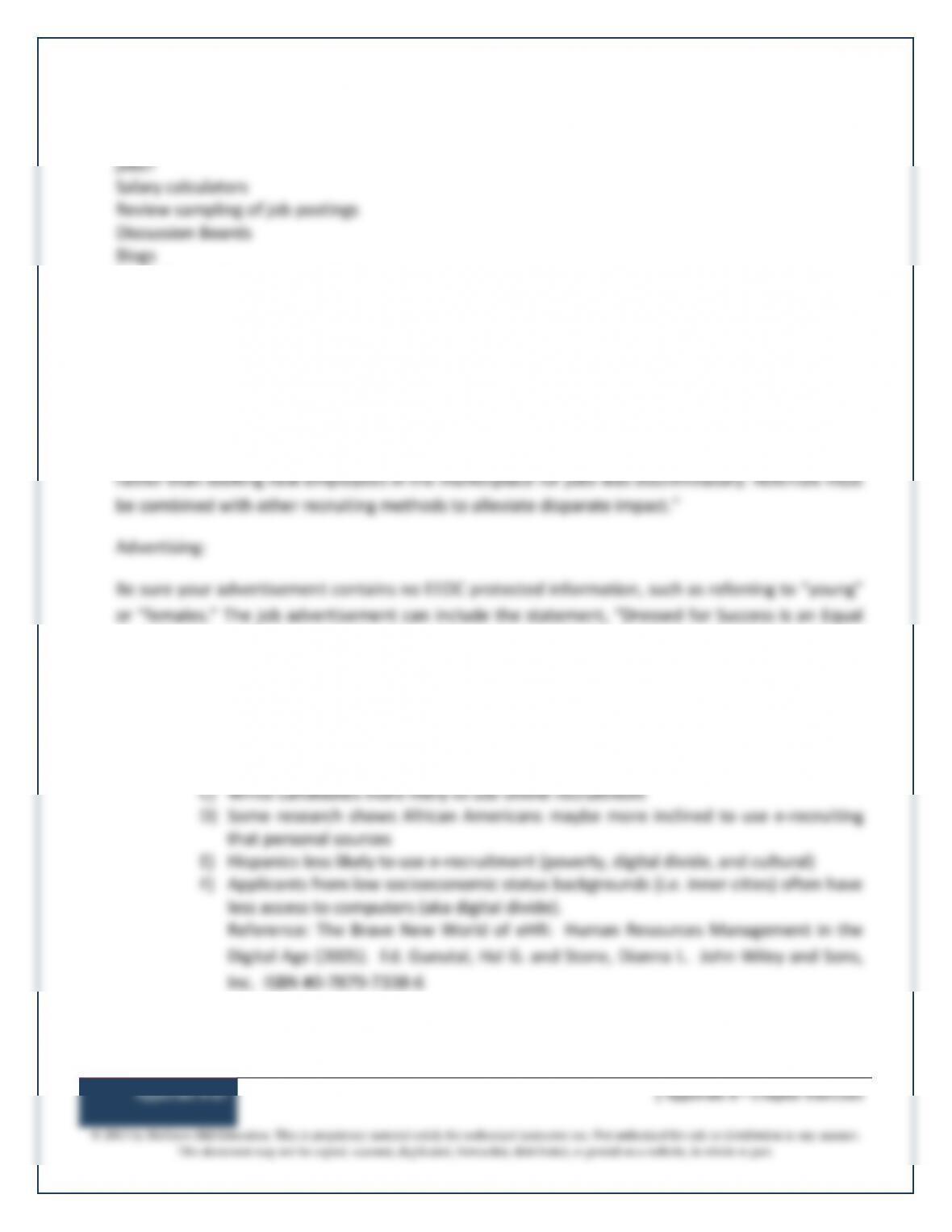
• What three recruiting/advertising methods do you recommend to Dressed for Success?
o Ms. Richter specifically requests information about the costs and benefits of on-line recruiting
and/or the use of a “headhunter” for the store manager job. She requests that you do research
on this issue and take a firm position.
Internal Sources: Transfer current employees to the new store.
Disadvantage:
Advantage:
4. If promoting a successful sales associate to store manager, creates a career path
External Sources:
Sales Associates
Store Manager
Walk-in/Unsolicited Applicant files
Walk-in/Unsolicited Applicant files
Referrals
Referrals
Local campus radio
Employment Agencies
Campus Visits
Search Firms
Internet
Internet
Public employment agency
Appendix B-87
| Appendix B – Chapter Exercises
© 2013 by McGraw-Hill Education. This is proprietary material solely for authorized instructor use. Not authorized for sale or distribution in any manner.
This document may not be copied, scanned, duplicated, forwarded, distributed, or posted on a website, in whole or part.
Be sure to see if students had creative suggestions.
B) Does the internet provide any information about the compensation being considered for these
Cost of Living Comparison calculators
2) Ms. Richter is also concerned about diversity. What recruitment methods should be
implemented to help increase diversity in the organization?
Referrals can be used but be careful:
EEOC v. Detroit Edison: “the practice of relying on referrals by a predominately white workforce
Opportunity Employer encouraging diversity in the workplace.”
You should also consider if your advertising method is actually reaching diversity candidates.
1. Online
A) Most likely to attract young, computer literate, and well educated individuals
B) People still prefer newspaper to online recruitment (Gueutal & Stone, 2005).
2. Does the advertising source (i.e. newspaper) have demographic information on readers?
3. Ads in movie theaters in ethnic communities
Appendix B-88
| Appendix B – Chapter Exercises
© 2013 by McGraw-Hill Education. This is proprietary material solely for authorized instructor use. Not authorized for sale or distribution in any manner.
This document may not be copied, scanned, duplicated, forwarded, distributed, or posted on a website, in whole or part.
4. You must be creative and consciously recruit diversity candidates.
5. Track if your past ads actually attract diversity candidates
Employment Agencies & Search Firms:
These firms can help pre-screen qualified diversity candidates before he or she even reaches your
organization.
Campus Visits:
These visits are a great opportunity to recruit new employees and actively increase diversity.
Professional Associations
Many Women and Minority Associations have job boards that allow you to post open positions.
For example, the NAACP in association with monster.com allows candidates to search for jobs by
organizations committed to diversity. http://naacp.monster.com/
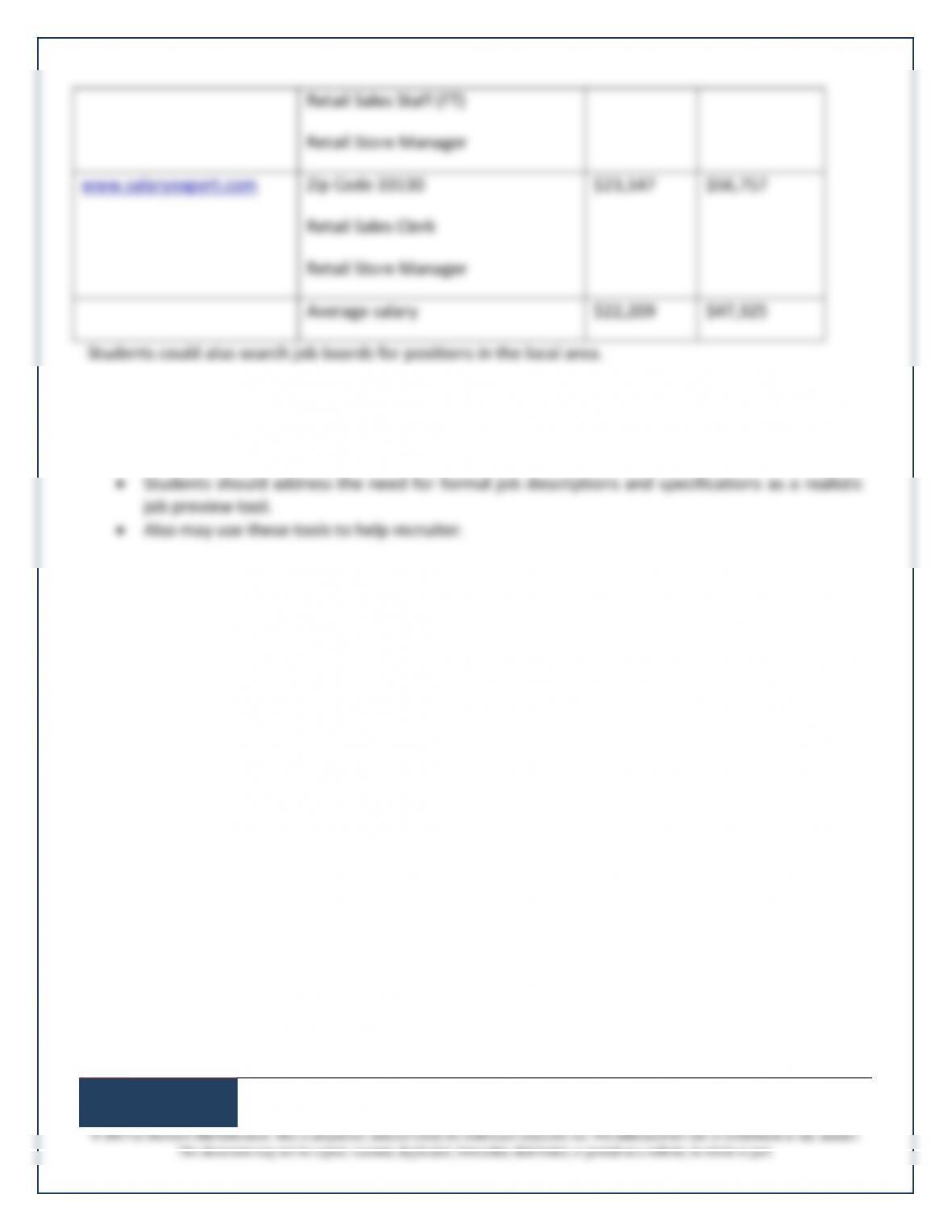
3) Ms. Richter wants your opinion of the salaries levels she has set.
A) Conduct internet research to determine if what she is recommending is appropriate.
Annual Salary per position:
Search Criteria
Sales
Associates
Store
Manager
http://online.onetcenter.o
rg/
Retail Sales Person + Florida
First-Line Supervisors/Managers
of Retail Sales Workers + Florida
Median
$22,100
Median
$37,600
www.salary.com
Zip code 33130
$22,282
$48,220
Appendix B-89
| Appendix B – Chapter Exercises
© 2013 by McGraw-Hill Education. This is proprietary material solely for authorized instructor use. Not authorized for sale or distribution in any manner.
This document may not be copied, scanned, duplicated, forwarded, distributed, or posted on a website, in whole or part.
Retail Sales Staff (FT)
Retail Store Manager
www.salaryexpert.com
Zip Code 33130
Retail Sales Clerk
Retail Store Manager
$23,147
$56,757
Average salary
$22,209
$47,325
Students could also search job boards for positions in the local area.
B) She also wants to know if formal job descriptions should be written for the store manager job and
the human resource manager. Write Ms. Richter a memo in which these items are covered.

Appendix B-90
| Appendix B – Chapter Exercises
Chapter Exercise 5.4
HR Planning at COMPTECH
David Herst
Objectives. This exercise will help students understand how a company plans for and responds to its
human resource needs. Internal and external strengths, weaknesses, opportunities, and threats will
be identified through the use of an environmental scan. In addition labor supply forecasting, demand
forecasting, gap analysis, and HR planning evaluation will be conducting using the COMPTECH
scenario presented in the exercise. Finally, students will learn to tie all aspects of the HR plan back to
COMPTECH’s strategic business plan.
Description. Prior to class students should spend between 1 and 2 hours reading the background
information and answering the questions on Form 5.4.1. During class time the students should break
into small groups (4-6 individuals) and formulate an HR plan for COMPTECH. Each group should take
one of the five steps in HR planning (environmental scanning, labor demand forecasting, labor supply
forecasting, gap analysis, and action planning) and determine issues and strategies for facing the
issues relevant to that area. Finally, groups will come together to determine and HR plan for
COMPTECH.
Table 5.4.1
Answers to Form 5.4.1
1. What are the major SWOTs at COMPTECH? Use information from the chapter to determine
the internal issues that will need attention. Review recent business trends in the retail
computer sales sector and in the labor market in general (both domestic and foreign) to help
you complete the environmental scan.
COMPTECH’s strengths are many. To begin with, its business model of one–stop shopping combined
with outstanding customer service can differentiate it from other one-stop-shop outlets. Next,
Appendix B-91
| Appendix B – Chapter Exercises
© 2013 by McGraw-Hill Education. This is proprietary material solely for authorized instructor use. Not authorized for sale or distribution in any manner.
This document may not be copied, scanned, duplicated, forwarded, distributed, or posted on a website, in whole or part.
provides an additional outlet for sales. Fifth, the company continues to use innovative sales
programs, such as their Newcomer’s package and trade-in program. Finally, COMPTECH’s human
resource practices emphasizing employee training, incentive pay, and development help to reduce
turnover and save on recruitment expenses.
Weaknesses include shrinking hardware margins and the company’s high overhead costs compared to
on-line only competitors such as Dell Computers. Personal computer sales have leveled off in North
America, reducing or eliminating growth from this sector. PC sales in general are based on
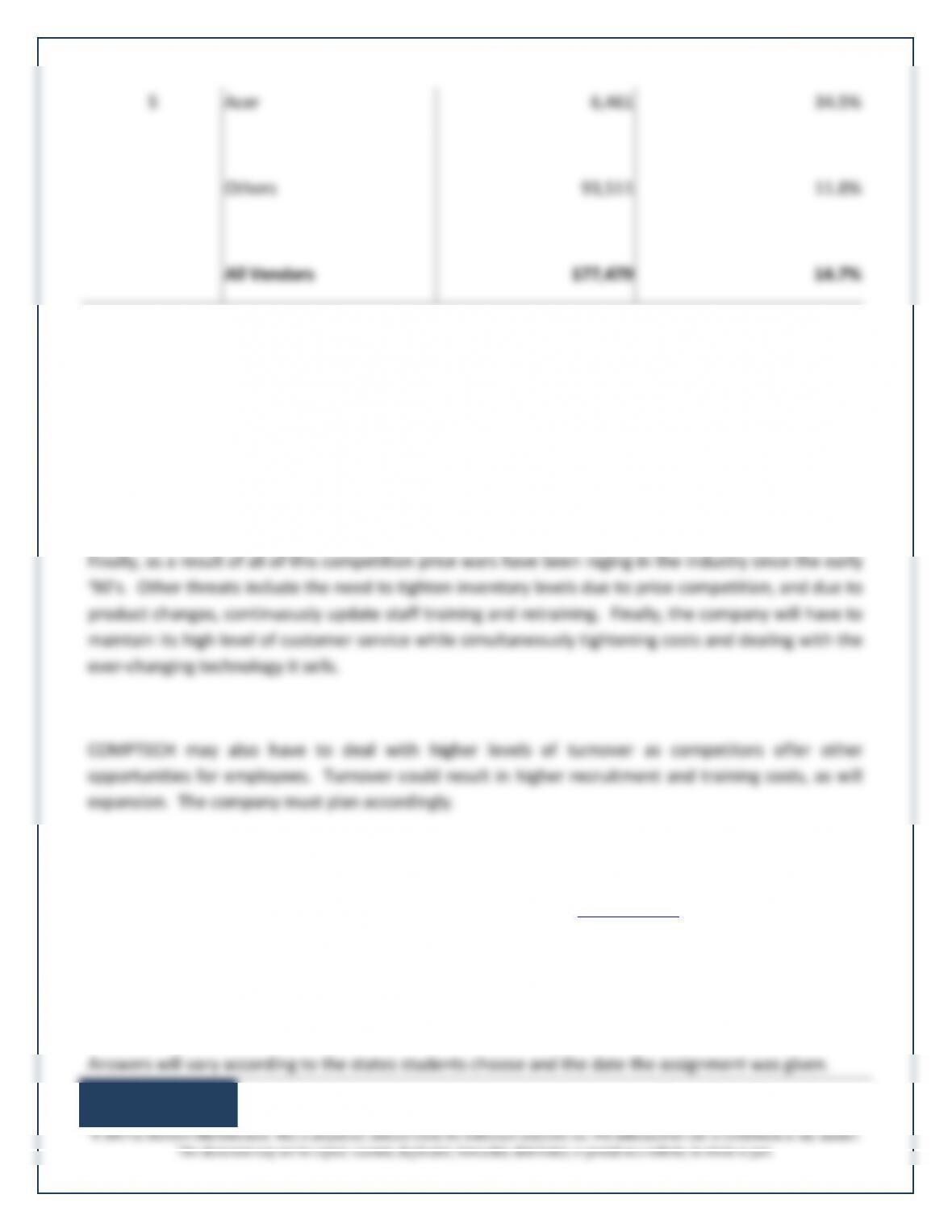
Table 5.4.2
Worldwide Computer Sales Growth, 2003-2004
2004 Rank
Vendor
2004 Shipments
Growth 2004/2003
1
Dell
31,771
23.0%
2
HP
28,063
12.0%
3
IBM
10,492
16.3%
4
Fujitsu/Fujitsu Siemens
7,182
13.6%
Appendix B-92
| Appendix B – Chapter Exercises
5
Acer
6,461
34.5%
Others
93,511
11.8%
All Vendors
177,479
14.7%
Source: IDC, January 18, 2005
Threats to COMPTECH are extensive. Threats from imitators also abound, such as BESTPRICE and
other retail outlets that are expanding into the retail computer market. Dell Computer continues to
be COMPTECH’s largest competitor and has an advantage with its web-only, low overhead model.
2. Determine the external labor supply available this year in five different states by using
statistics from the Bureau of Labor Statistics (Web site www.bls.gov) or some other source.
Employment statistics can be found at the State and Local Employment link under the
Employment and Unemployment section. HINT: After clicking on the link, scroll down until
you see the link for Create Customized Tables. These will help you find the applicable
statistics.
Appendix B-93
| Appendix B – Chapter Exercises
3. What type, or types, of HR planning analysis do you propose for the data presented in Table
5.4.1? How do you propose to assess the internal trends in employee movement? Indicate
what positions will require more training/retention efforts and which will require greater
recruitment/selection efforts.
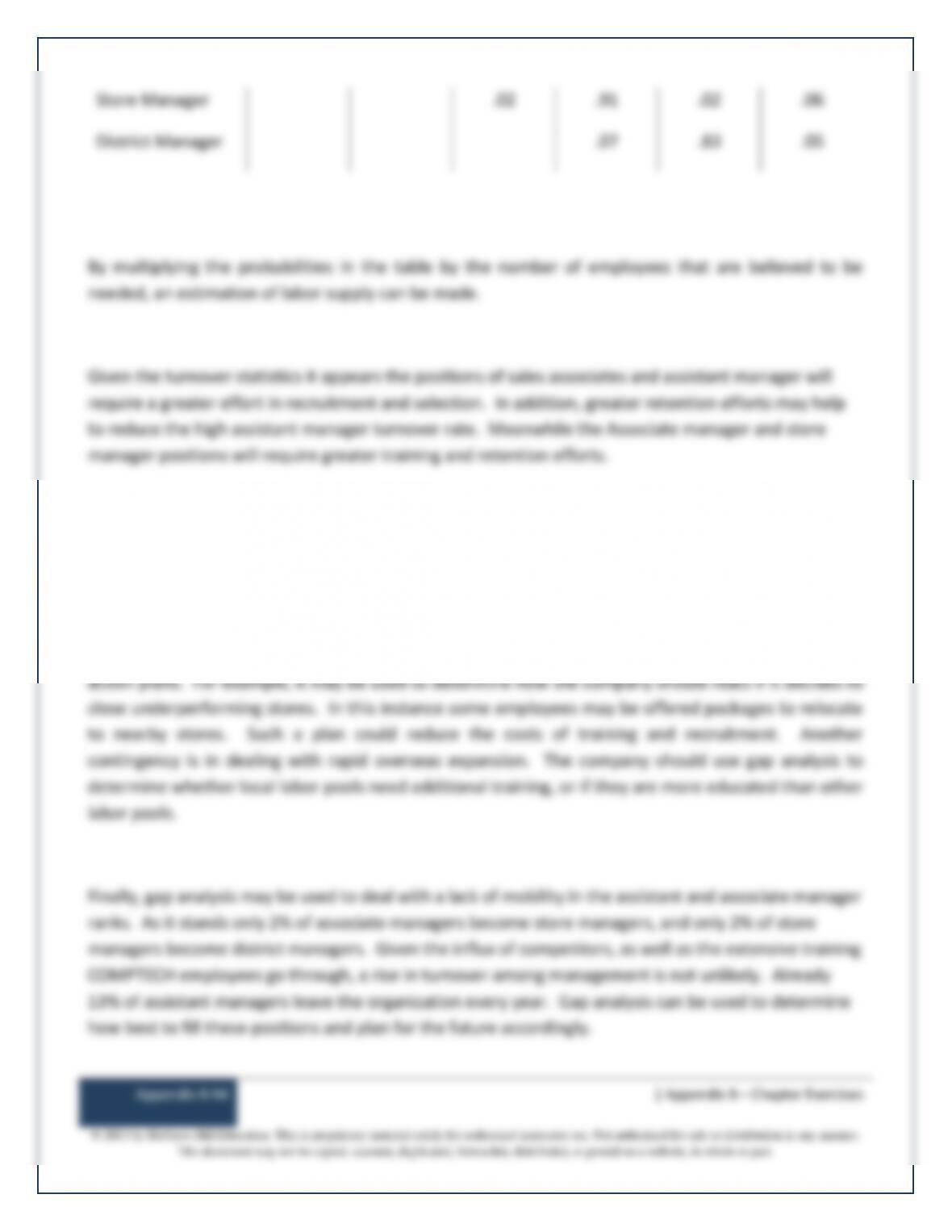
The data in Table 5.4.1 could be combined with other data or used independently to help determine
labor supply and demand. For example, demand forecasting could be determined using the nominal
or Delphi techniques. In these techniques the information from Table 5.4.1 may be used to indicate
Table 5.4.3
Probabilities of Employee Movement at COMPTECH
Sales
Associate
Assistant
Manager
Associate
Manager
Store
Manager
District
Manager
Exit
Sales Associate
.71
.01
.28
Assistant Mngr.
.77
.10
.13
Associate Mngr.
.02
.88
.03
.07
Appendix B-94
| Appendix B – Chapter Exercises
© 2013 by McGraw-Hill Education. This is proprietary material solely for authorized instructor use. Not authorized for sale or distribution in any manner.
This document may not be copied, scanned, duplicated, forwarded, distributed, or posted on a website, in whole or part.
Store Manager
.02
.91
.02
.06
District Manager
.07
.83
.05
By multiplying the probabilities in the table by the number of employees that are believed to be
needed, an estimation of labor supply can be made.
Given the turnover statistics it appears the positions of sales associates and assistant manager will
require a greater effort in recruitment and selection. In addition, greater retention efforts may help
to reduce the high assistant manager turnover rate. Meanwhile the Associate manager and store
manager positions will require greater training and retention efforts.
4. How would you use gap analysis for dealing with immediate HR issues and for HR planning?
At minimum gap analysis can be used to reconcile labor supply and demand forecasts. This will help
COMPTECH determine if they have enough of a labor pool to adequately fill position at their stores
and in management. In addition, gap analysis should be used proactively to determine contingency
Appendix B-95
| Appendix B – Chapter Exercises
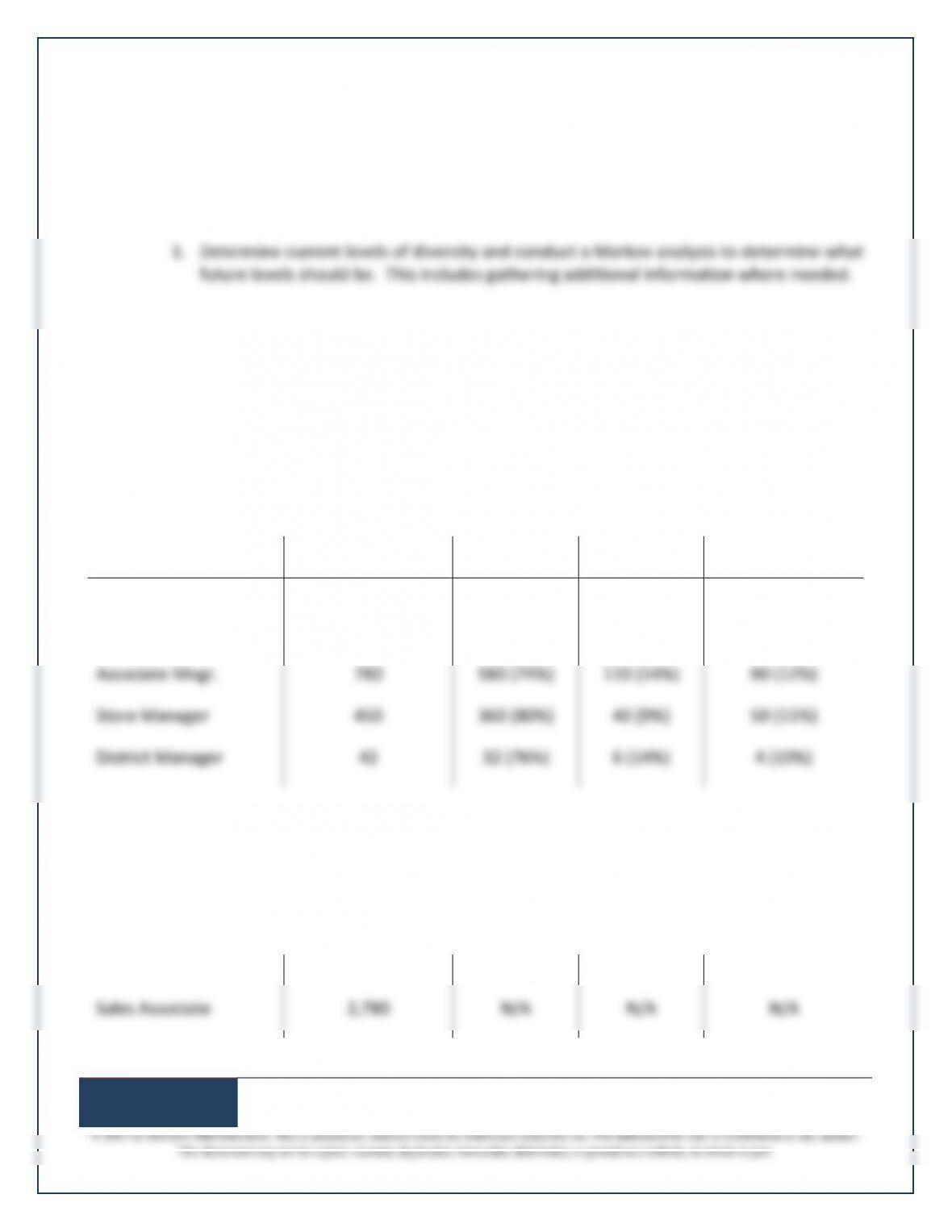
5. COMPTECH executives set the goal of increasing the diversity of COMPTECH but there was
no specificity to the goal. They have requested that you provide a game plan for achieving
this goal. Provide a chronological outline of your strategy.
Table 5.4.4
Levels of Diversity at COMPTECH
Staffing Level
White (%)
Black (%)
Hispanic (%)
Sales Associate
10,000
N/A
N/A
N/A
Assistant Mngr.
1,300
N/A
N/A
N/A
Associate Mngr.
780
580 (74%)
110 (14%)
90 (12%)
Store Manager
450
360 (80%)
40 (9%)
50 (11%)
District Manager
42
32 (76%)
6 (14%)
4 (10%)
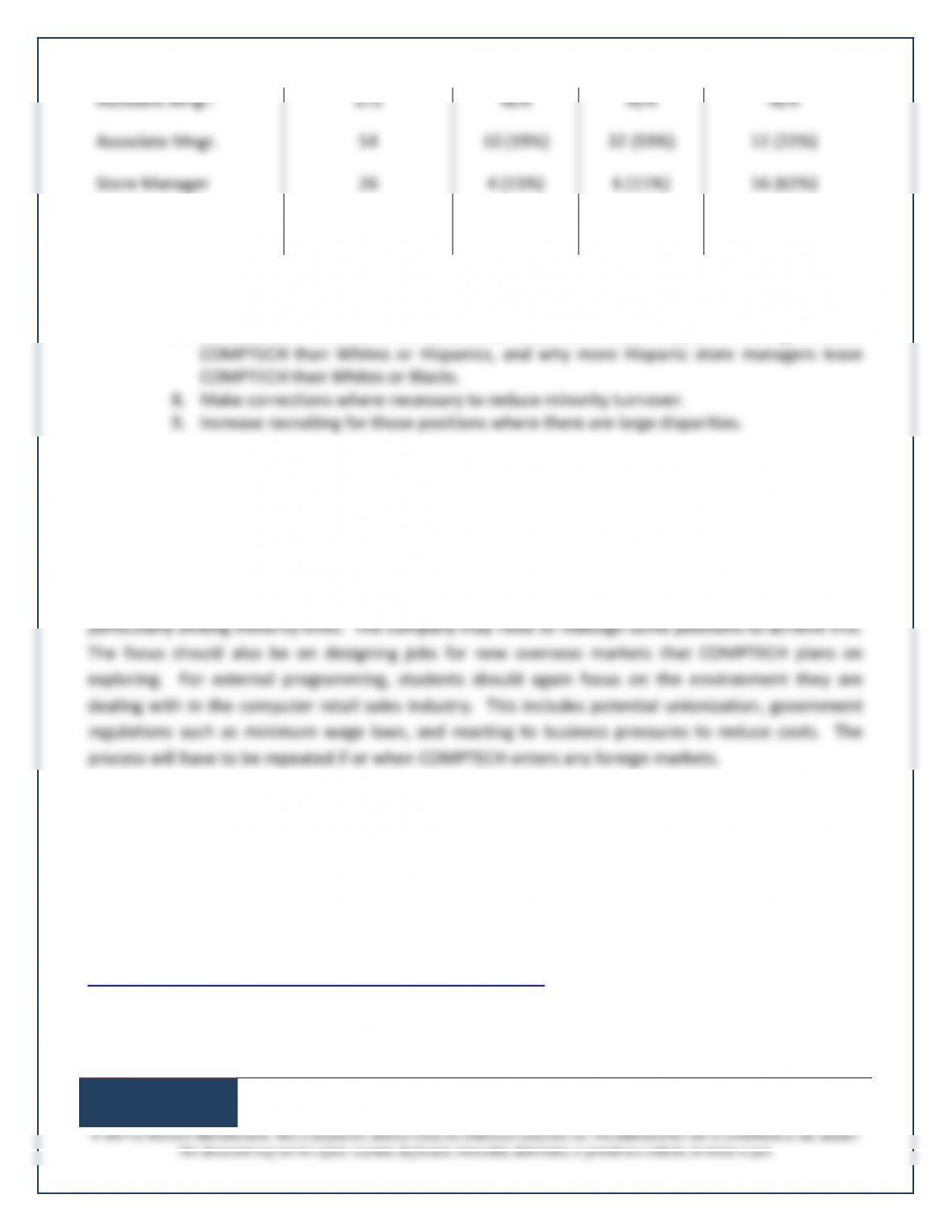
Table 5.4.5
Diversity Audit of Organizational Exit
Exit Level
White (%)
Black (%)
Hispanic (%)
Sales Associate
2,780
N/A
N/A
N/A
Appendix B-96
| Appendix B – Chapter Exercises
Assistant Mngr.
172
N/A
N/A
N/A
Associate Mngr.
54
10 (19%)
32 (59%)
12 (22%)
Store Manager
26
4 (15%)
6 (11%)
16 (62%)
District Manager
2
0 (0%)
1 (50%)
1 (50%)
6. Determine if there are any violations of the 4/5ths rule.
7. Conduct exit interviews to determine why more Black associate managers leave
6. Given all of the data presented in the case, what is your chronological HR action plan for
COMPTECH, INC?
Answers will vary according to level of importance a student places on each of the SWOTs. For
internal programming, students should focus on policies and procedures that reduce turnover,
References
Perez, J.C. (2006). PC sales expected to slow in 2006: Mobile PCs will remain popular, but fewer users
will replace their desktops, analysts say. PCWorld.com,
http://www.pcworld.com/news/article/0,aid,125039,00.asp.

Appendix B-97
| Appendix B – Chapter Exercises
© 2013 by McGraw-Hill Education. This is proprietary material solely for authorized instructor use. Not authorized for sale or distribution in any manner.
This document may not be copied, scanned, duplicated, forwarded, distributed, or posted on a website, in whole or part.
Rai, S. (2006). Dell to double India work force. The New York Times, March 21st.
CHAPTER 6 – CHAPTER EXERCISES
Chapter Exercise 6.1
Should Tenneco Use the Wonderlic Test?
Objective. The purpose of Exercise 6.1 is to have students consider one of the most difficult problems
confronting organizational staffing specialists, the use of a mental or cognitive ability test that makes
valid assessments but has the potential of facilitating adverse impact. The data presented are
representative of data that result from the use of cognitive ability tests such as the Wonderlic.
Description. The individual component of the exercise should take the student no more than one
hour to complete out of class. About 40 minutes should be allotted for group discussion and another
15 minutes should be set aside for group presentations. The text makes the argument that the
cognitive ability tests are valid for virtually all jobs and Tenneco proposes to use one as one source of
information about candidates. A review of disparate impact theory and the major provisions of the
1991 Civil Rights Act will be useful here as they clearly apply to this case. Table 6.1.1 presents
recommended answers to Form 6.1.1.
Table 6.1.1
Answers to Form 6.1.1
1. Is there evidence of adverse impact against minorities if the Wonderlic Personnel
Test is used as the sole basis for entry into the training? Explain your answer.
A passing rate of 60% (scores of 24 or higher) was required for minorities so as not to violate the 80%
Appendix B-98
| Appendix B – Chapter Exercises
© 2013 by McGraw-Hill Education. This is proprietary material solely for authorized instructor use. Not authorized for sale or distribution in any manner.
This document may not be copied, scanned, duplicated, forwarded, distributed, or posted on a website, in whole or part.
rule. Thus, adverse impact would be found against Blacks (51% pass rate) and Hispanics (58% pass rate)
and a class of minorities could then challenge the initial cut-off decision (Recall Connecticut v. Teal, see
page 208). In addition, the method of selecting the 40 individuals would be critical. If the method was
“top–down” selection, there would be adverse impact against minorities.
2. Given your response to question 1, what are the policy options for this situation? What
policy do you recommend that Tenneco adopt for the use of the Wonderlic? Defend your
response by considering the job situation, the need for further research, legal and social
implications, and alternative methods of selection. Provide a detailed recommendation and
a rationale for action. If you take a position to drop the use of the Wonderlic, how do you
propose to identify the 40 candidates?
See page 183. Of course, one option is to drop the use of the test altogether. However, the validity
evidence on cognitive ability tests like the Wonderlic is quite strong (.51; see Figure 6-2)) and
replacement with some other method (e.g., assessment centers) is much more expensive (particularly
for 400 people; the Wonderlic may cost about $15 to use while assessment centers average over $300
3. What if you conducted a PAQ analysis that indicated that the Wonderlic was a valid test for
this job? Do you believe that this result establishes the legality of the Wonderlic? Given
Appendix B-99
| Appendix B – Chapter Exercises
that the Wonderlic consultant recommended a particular passing score, is Tenneco on safe
legal ground if candidates are selected based on that Wonderlic passing score?
One (and only one) fully litigated case, discussed in chapter 4 (James River) did establish the ”job
relatedness” of a cognitive ability test based strictly on the PAQ results that recommended that such a
4. Could Tenneco convert the raw score on the Wonderlic to a percentile based on the
ethnicity of the test taker? How might such a policy affect adverse impact?
While such a conversion based on the ethnicity of the test taker could reduce or eliminate adverse
impact, the practice of race (or sex) norming is illegal under the Civil Rights Act of 1991. Prior to 1991,
5. Tenneco is also considering an interviewing process as the final hurdle for selecting trainees.
What is your view of this option? If interviews are to be conducted, are there any
recommendations for the interview ?
Structured interviews, which represent a standardized approach to systematically collecting and
rating applicant information, have yielded higher reliability and validity results than unstructured
interviews (.43 versus .31; see Figure 6-2, page 175). Research findings also suggest that the
Appendix B-100
| Appendix B – Chapter Exercises
© 2013 by McGraw-Hill Education. This is proprietary material solely for authorized instructor use. Not authorized for sale or distribution in any manner.
This document may not be copied, scanned, duplicated, forwarded, distributed, or posted on a website, in whole or part.
participated as group or team members. Probing may involve work assignments, examples of good
and bad teamwork, difficulties in completing the project, and other related projects.
While situational interviews are valid, the behavioral interviewing approach where candidates
describe actual experiences or accomplishments with important job-related situations has been
shown to be reliably more valid, particularly when reported achievements or accomplishments are
verified or validated. So, a “high validity” interview should be structured with behavioral questions
derived from a job analysis and involving more than one trained interviewer using a structured
interview rating form. If this cannot be done, the use of three and preferably more independent
interviewers will probably get you comparable validity to the “high validity” just described.
Interview data should not be overemphasized but appropriately weighed with other
valid information. When done as recommended, interviews can contribute to the prediction of job
performance over and above tests of cognitive abilities and other personal characteristics and
accomplishments.
6. Another suggestion is to review the Wonderlic test and to remove all culturally biased
questions to eliminate the adverse impact. Do you agree with this suggestion? Explain your
answer.