Chapter 06 – Intercompany Inventory Transactions
Q6-1 All inventory transfers between related companies must be eliminated to avoid an
Q6-2 An inventory transfer at cost results in an overstatement of sales and cost of goods sold.
Q6-3 An upstream sale occurs when the parent purchases items from one or more
subsidiaries. A downstream sale occurs when the sale is made by the parent to one or more
Q6-4 As in all cases, the total amount of the unrealized profit must be eliminated in preparing
Q6-5 Consolidated net income is reduced by the full amount of the unrealized profits. In the
upstream sale, the unrealized profits are apportioned between the parent company
Q6-6 The elimination of unrealized intercompany profits on an upstream sale will have a
greater effect on income assigned to the noncontrolling interest. Income assigned to the
Q6-7 The basic consolidation entry needed when the item is resold before the end of the
period is:
Sales
XXXXXX
Cost of Goods Sold
XXXXXX
Copyright © 2016 by McGraw-Hill Education. This is proprietary material solely for authorized instructor use. Not authorized
for sale or distribution in any manner. This document may not be copied, scanned, duplicated, forwarded, distributed, or posted
on a website in whole or part.
Q6-8 The consolidation entry needed when one or more of the items are not resold before the
end of the period is:
Sales
XXXXXX
Cost of Goods Sold
XXXXXX
Inventory
XXXXXX
The debit to sales is for the full amount of the transfer price. Inventory is credited for the
unrealized profit at the end of the period and cost of goods sold is credited for the amount
charged to cost of goods sold by the company making the intercompany sale. Additionally, the
basic consolidation entry would need to be adjusted to reflect the deferred gross profit.
Q6-9 Cost of goods sold is reported by the consolidated entity when inventory is sold to an
external party. The amount reported as cost of goods sold is based on the amount paid for the
Q6–10 No adjustment to retained earnings is needed if the intercorporate sales have been
made at cost or if all intercorporate sales have been resold to an external party in the same
accounting period. If all of the intercorporate sales have not been resold by the end of the
Q6–11 A proportionate share of the realized retained earnings of the subsidiary are assigned to
Q6–12 When inventory profits from a prior period intercompany transfer are realized in the
current period, the profit is added to consolidated net income and to the income assigned to the
shareholders of the company that made the intercompany sale. If the unrealized profits arise
Q6–13 Under the fully adjusted equity method, consolidated retained earnings is not affected
directly by unrealized profits. Unrealized profits are deferred in the investment in sub and
income from sub accounts on the parent’s books. Income from sub is closed out to retained
Copyright © 2016 by McGraw-Hill Education. This is proprietary material solely for authorized instructor use. Not authorized
for sale or distribution in any manner. This document may not be copied, scanned, duplicated, forwarded, distributed, or posted
on a website in whole or part.
C6-1 Measuring Cost of Goods Sold
a. While the rule covers only a part of the elimination needed, Charlie is correct in that the cost
of goods sold recorded by the selling company must be eliminated to avoid overstating that
portion of the consolidated income statement.
profit.
Copyright © 2016 by McGraw-Hill Education. This is proprietary material solely for authorized instructor use. Not authorized
for sale or distribution in any manner. This document may not be copied, scanned, duplicated, forwarded, distributed, or posted
on a website in whole or part.
E6-1 Multiple-Choice Questions on Intercompany Inventory Transfers
1. a – All intercompany sales and cost of goods sold must be eliminated in consolidation to
prevent double counting.
(b) Incorrect. The entire amount of sales and cost of goods gold must be eliminated.
(c) Incorrect. Net income is not directly reduced with a consolidation entry. Instead, sales
and cost of goods sold are adjusted.
(d) Incorrect. Adjustments to sales and cost of goods sold are required.
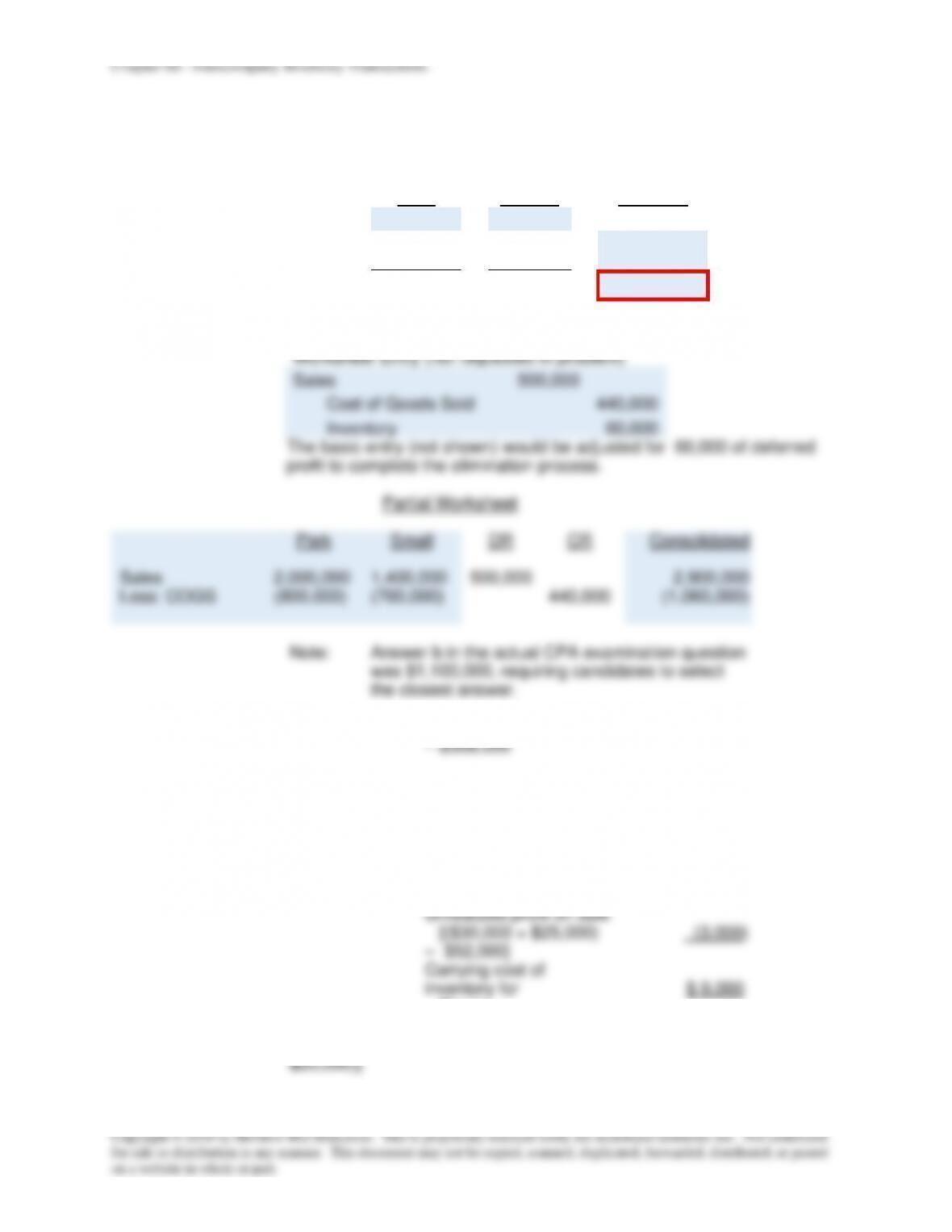
2. c – $500,000 = ($400,000 +$350,000 – $250,000)
3. a – $56,000 = ($40,000 *1.4)
4. c – $56,000. The revenue would be overstated by the amount of cost of goods sold that
should have been eliminated.
5
c –
Net assets reported
$320,000
Profit on intercompany sale
$48,000
Proportion of inventory unsold at year end
($60,000 / $240,000)
x 0.25
Unrealized profit at year end
(12,000)
Amount reported in consolidated statements
$308,000
6
c –
Inventory reported by Banks ($175,000 + $60,000)
$235,000
Inventory reported by Lamm
250,000
Total inventory reported
$485,000
Unrealized profit at year end
[$50,000 x ($60,000 / $200,000)]
(15,000)
Amount reported in consolidated statements
$470,000