Problem 9-21A (continued)
2. Students’ answers may differ in some details from this solution.
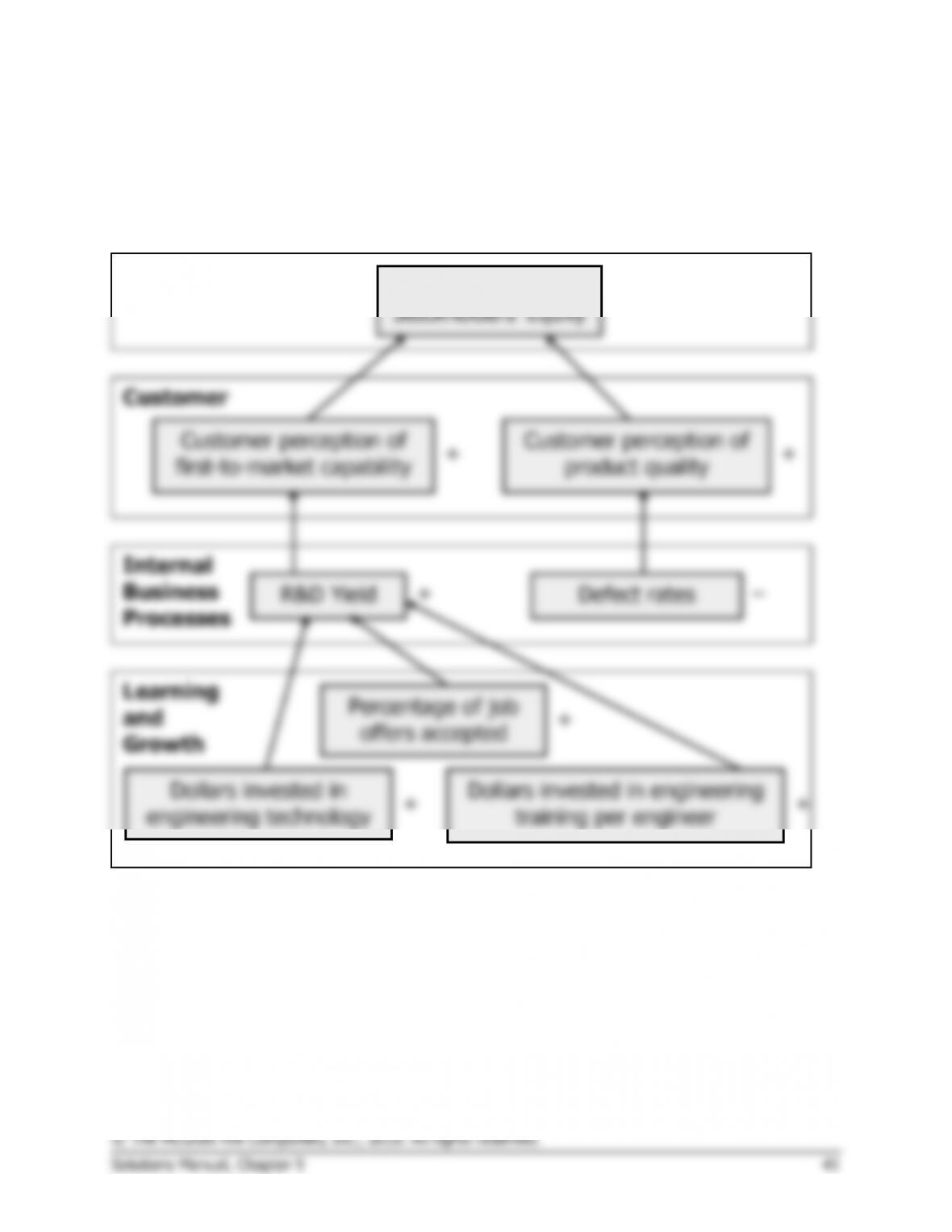
Applied Pharmaceuticals
Return on
Stockholders’ Equity
Financial
Customer perception of
first-to-market capability
Customer perception of
product quality
Customer
R&D Yield
Defect rates
Internal
Business
Processes
Dollars invested in
engineering technology
Percentage of job
offers accepted
Dollars invested in engineering
training per engineer
Learning
and
Growth
+
+
+
+
–
+
+
+
Problem 9-21A (continued)
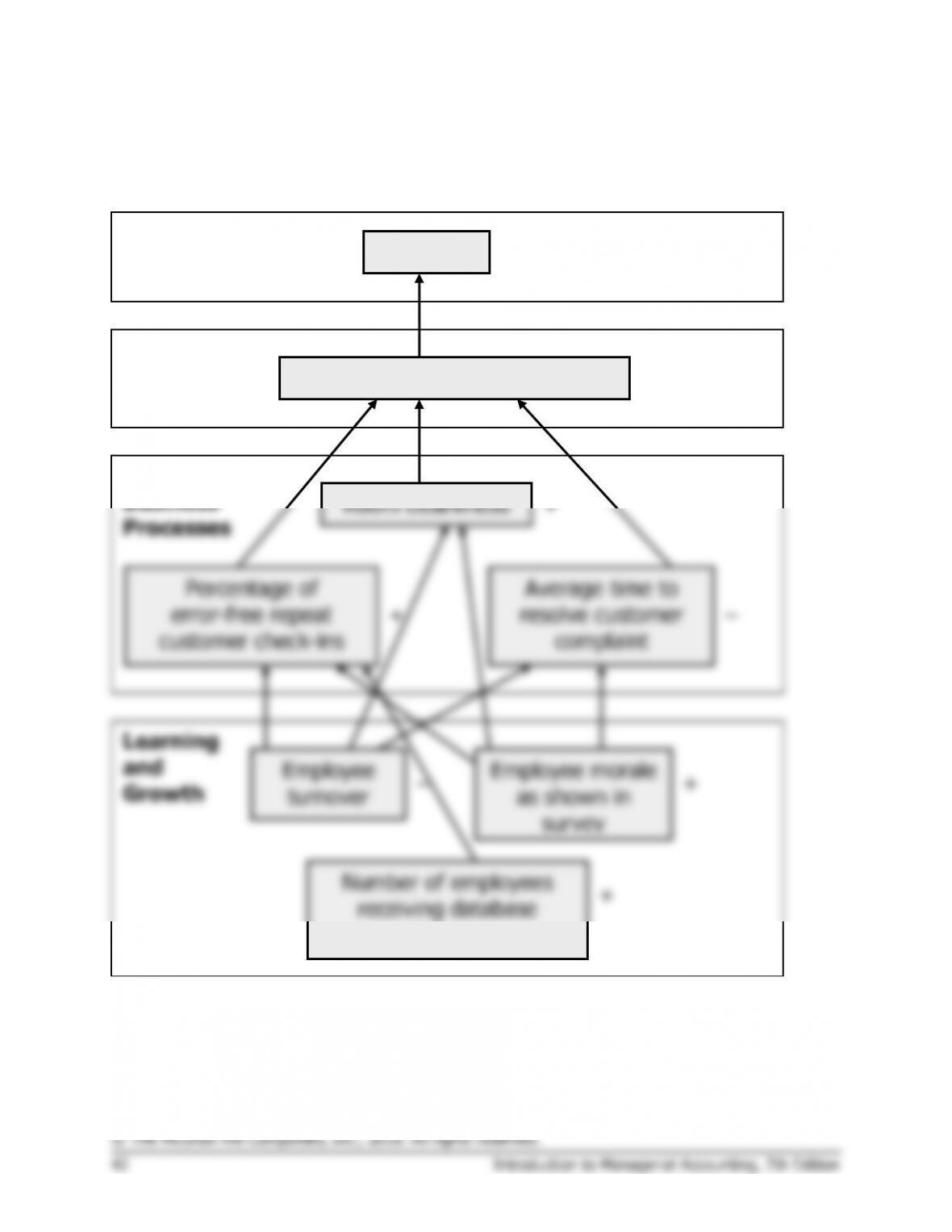
Destination Resorts International
Financial
Sales
+
Customer
+
Number of repeat customers
Internal
receiving database
training
Problem 9-21A (continued)
3. The hypotheses underlying the balanced scorecards are indicated by the
arrows in each diagram. Reading from the bottom of each balanced
scorecard, the hypotheses are:
Applied Pharmaceuticals
o If the dollars invested in engineering technology increase, then the
then the return on stockholders’ equity will increase.
o If the customer perception of product quality increases, then the
return on stockholders’ equity will increase.
Destination Resort International
o If the employee turnover decreases, then the percentage of error–

Problem 9-21A (continued)
Each of these hypotheses is questionable to some degree. For example,
in the case of Applied Pharmaceuticals, R&D yield is not the sole driver
of the customers’ perception of first–to-market capability. More
Problem 9-22A (45 minutes)
The answers below are not the only possible answers. Ingenious people
1. Speed-to-market can be improved by taking on less ambitious projects.
Instead of working on major product innovations that require a great
2. In this case, the ground crews raced from one arriving airplane to
another in an effort to unload luggage from these airplanes as soon as
possible. However, once the luggage was unloaded from the airplane it
3. In real life, the production manager simply added several weeks to the
delivery cycle time. In other words, instead of promising to deliver an

Problem 9-22A (continued)
4. As stated above, ratios can be improved by changing either the
numerator or the denominator. Managers who are under pressure to
increase the revenue per employee may find it easier to eliminate
$1.2 million.
Before eliminating
the business unit
After eliminating
the business unit
Total revenue …………….
$120,000,000
$110,000,000
Total employees …………
1,000
800
Revenue per employee ..
$120,000
$137,500
Total profits ………………
$2,000,000
$800,000
As these examples illustrate, performance measures should be selected
with a great deal of care and managers should avoid placing too much
emphasis on any one performance measure.
© The McGraw-Hill Companies, Inc., 2016. All rights reserved.
Learning
and
Growth
+
−
−
Processes
Financial
Case (60 minutes)
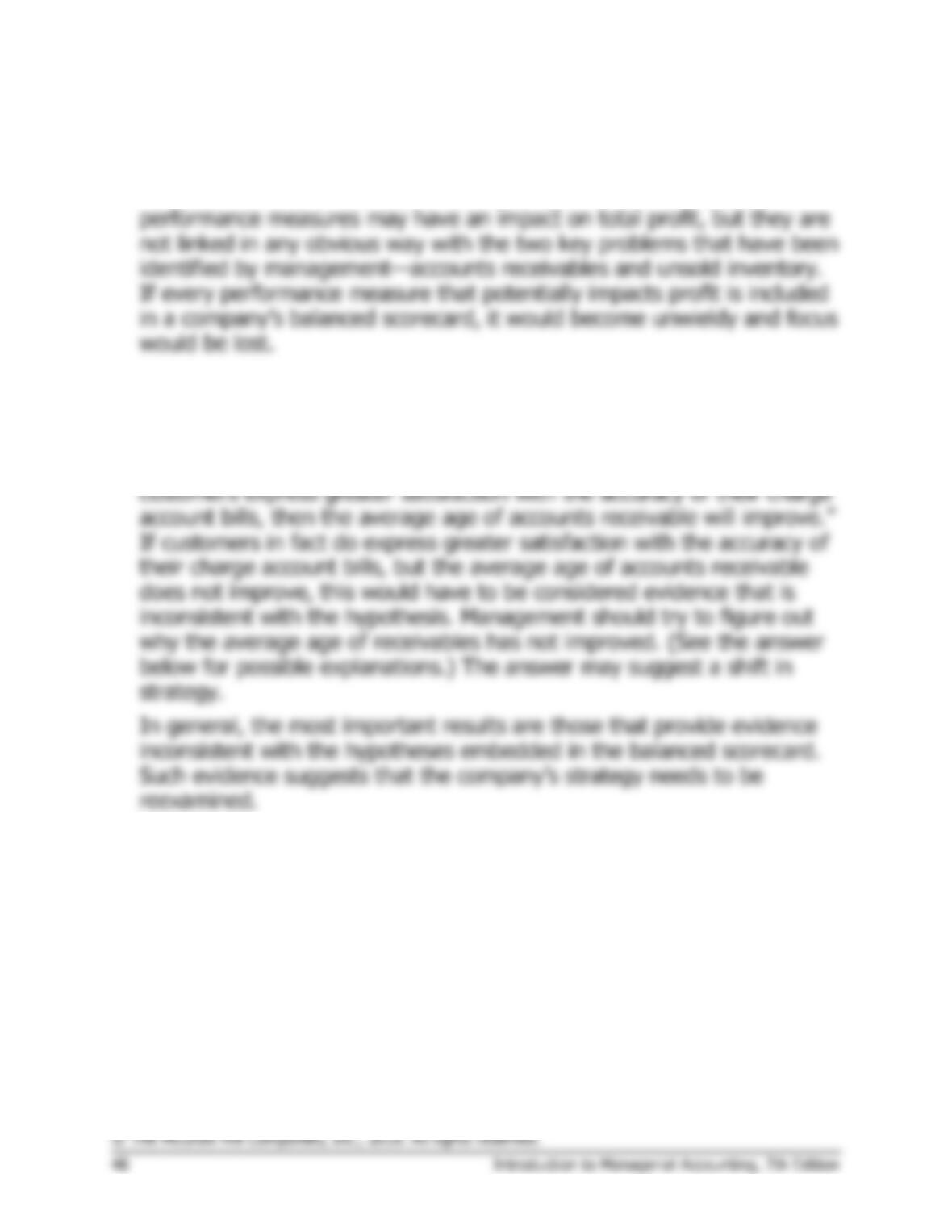
1. Student answers may differ concerning which category—learning and
growth, internal business processes, customers, or financial—a
particular performance measure belongs to.
Total profit
Average age of
accounts receivable
Written-off
accounts receivable
containing errors
percentage of total
cost of sales
Percentage of
suppliers making
just-in-time
deliveries
Percentage of sales
clerks trained to
correctly enter data
on charge account
slips
+
+
+
−
−
Case (continued)
A number of the performance measures suggested by managers have
not been included in the above balanced scorecard. The excluded
2. The results of operations can be exploited for information about the
company’s strategy. Each link in the balanced scorecard should be
regarded as a hypothesis of the form “If …, then …”. For example, the
balanced scorecard on the previous page contains the hypothesis “If
Case (continued)
3. a. This evidence is inconsistent with two of the hypotheses underlying
the balanced scorecard. The first of these hypotheses is “If customers
express greater satisfaction with the accuracy of their charge account
bills, then the average age of accounts receivable will improve.” The
second of these hypotheses is “If customers express greater
billing errors to improving the internal business processes dealing
with collections and credit screening. And in that case, the balanced
scorecard should be modified.
b. This evidence is inconsistent with three hypotheses. The first of these
is “If the average age of receivables declines, then profits will
percentage of sales could be decreased by drastically cutting back on
extensions of credit to customers—perhaps even canceling some
charge accounts. (Bad debts would be zero if there were no credit
sales.) This would have the effect of reducing bad debts, but might
irritate otherwise loyal credit customers and reduce sales and profits.

Case (continued)
The reduction in unsold inventories at the end of the season as a
percentage of cost of sales could have occurred for a number of
reasons that are not necessarily good for profits. For example,
Communicating in Practice
Date: Current date
To: Instructor
From: Student’s Name