VISUAL #16-1
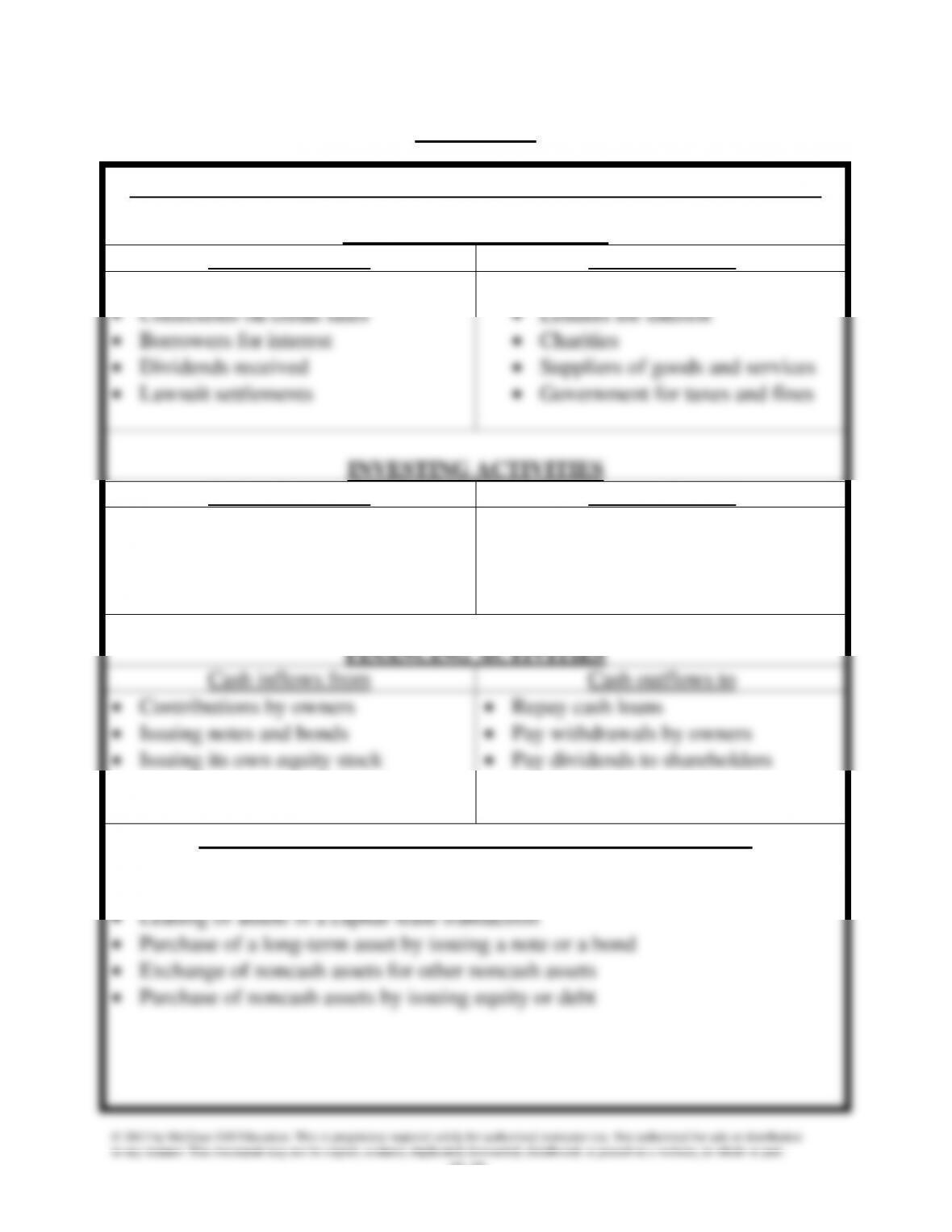
CLASSIFYING ACTIVITIES IN THE STATEMENT OF CASH FLOWS
OPERATING ACTIVITIES
Cash inflows from
Cash outflows to
• Customers for cash sales
• Collections on credit sales
• Borrowers for interest
• Dividends received
• Lawsuit settlements
• Salaries and wages
• Lenders for interest
• Charities
• Suppliers of goods and services
• Government for taxes and fines
INVESTING ACTIVITIES
Cash inflows from
Cash outflows to
• Selling investments in securities
• Selling (discounting) notes
• Collecting principal on notes
• Selling long-term productive assets
• Make loans to others
• Purchase long-term productive assets
• Purchase investments in securities
Cash inflows from
Cash outflows to
• Contributions by owners
• Issuing notes and bonds
• Issuing its own equity stock
• Issuing short-term and long-term
debt
• Repay cash loans
• Pay withdrawals by owners
• Pay dividends to shareholders
• Purchase treasury stock
NONCASH INVESTING AND FINANCING ACTIVITIES
• Retirement of debt by issuing equity stock
• Conversion of preferred stock to common stock
16–11
1. Find change in Cash—This is the target number.
2. Find cash flow from operations
(Using direct or indirect method)
3. Find Cash Flow from A. Financing and
B. Investing
Procedure:
4. Combine cash flows from all three activities (from 2 and 3) to find
net cash flow and prove change in cash. (Target number
determined in Step 1).
16–12
VISUAL #16-3
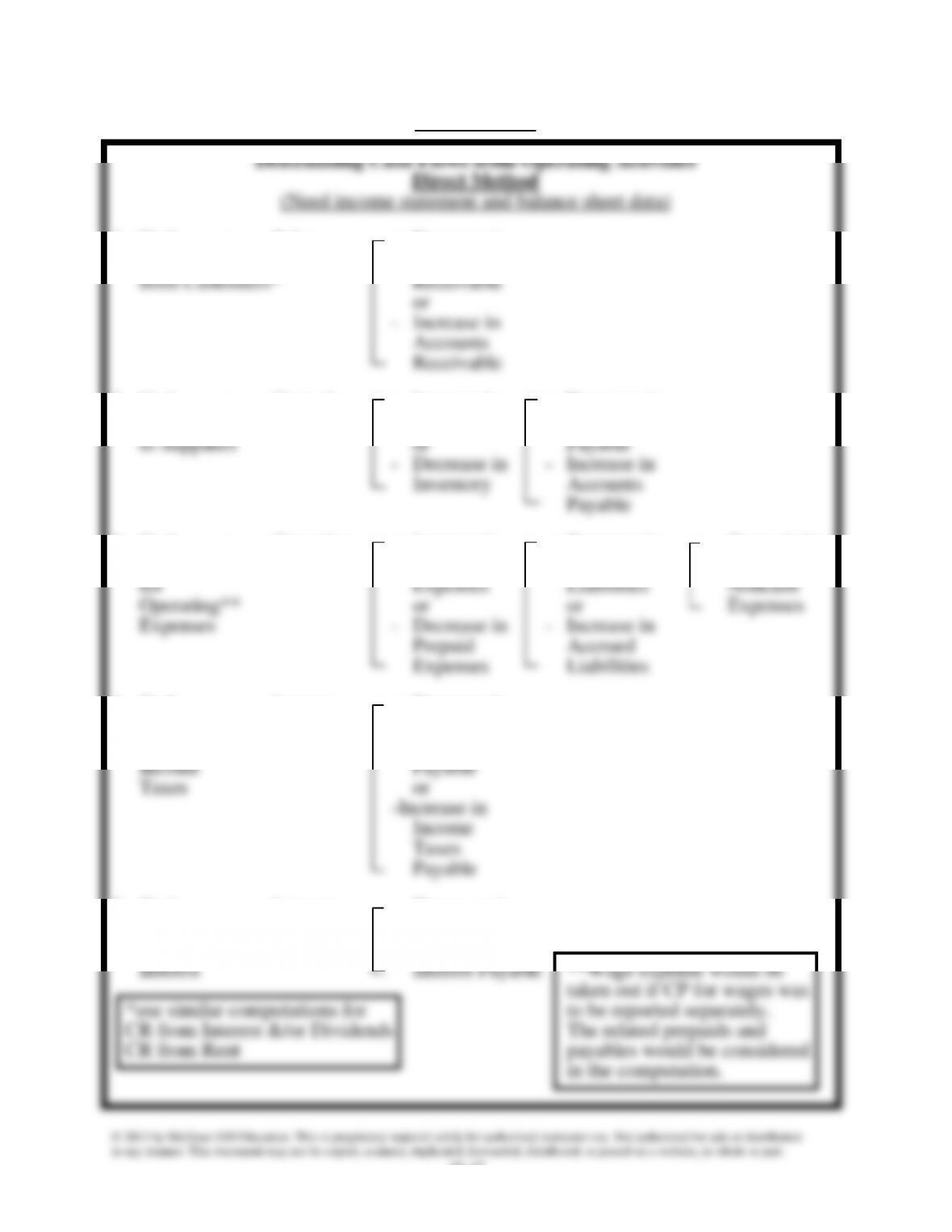
1. Cash = Sales + Decrease in
Receipts Accounts
2. Cash = Cost of + Increase in + Decrease in
Payments Goods Sold Inventory Accounts
3. Cash = Operating + Increase in + Decrease in – Depreciation
Payments Expenses Prepaid Accrued and Other
4. Cash = Income + Decrease in
Payments Taxes Income
for Expense Taxes
5. Cash = Interest + Decreases in
Payments Expense Interest Payable
for – Increase in
VISUAL #16-4
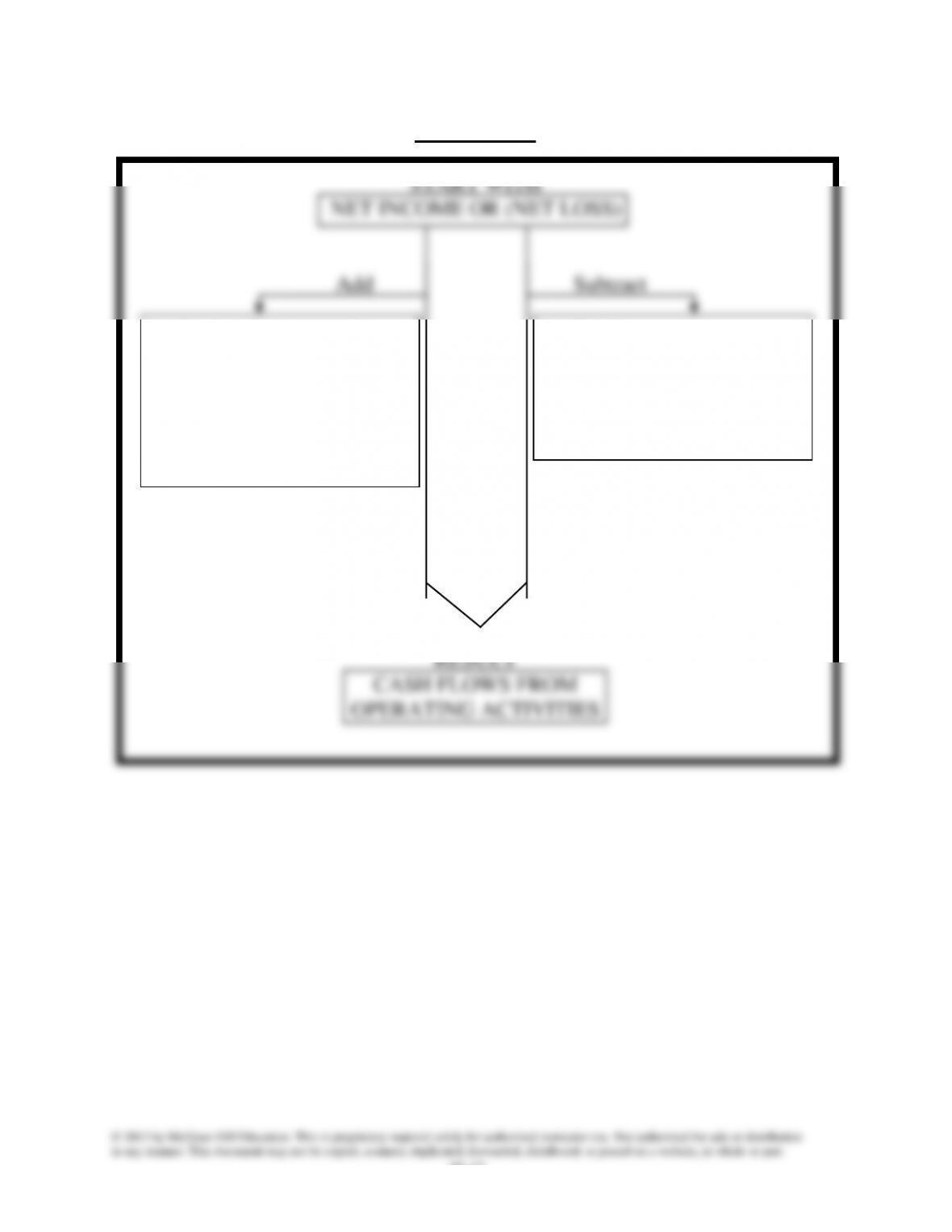
1. Write-offs or noncash 1. Gains
expenses 2. Increases in current assets
2. Losses 3. Decreases in current
3. Decreases in current assets liabilities
4. Increases in current
liabilities.
16–14
Alternate Demonstration Problem
Chapter Sixteen
The Carpet Company’s 2013 and 2014 balance sheets included the
following items:
December 31
2014
2013
Debits
Cash ……………………………………………………………………
$10,500
$ 4,000
Accounts receivable …………………………………………….
8,000
9,000
Merchandise inventory …………………………………………
21,000
18,000
Equipment ……………………………………………………………
18,000
15,000
Totals ………………………………………………………….
$57,500
$46,000
Credits
Accumulated depreciation, equipment ………………….
$ 4,000
$ 3,000
Accounts payable …………………………………………………
7,000
5,000
Taxes payable ………………………………………………………
1,000
2,000
Dividends payable ………………………………………………..
1,500
0
Common stock, $10 par value ……………………………….
27,000
25,000
Contributed capital in excess of par, common stock
6,000
5,000
Retained earnings ………………………………………………..
11,000
6,000
Totals ………………………………………………………….
$57,500
$46,000
The Carpet Company’s income statement was as follows:
CARPET COMPANY
Income Statement
For the Year Ended December 31, 2014
Sales ……………………………………………………………………
$61,000
Cost of goods sold ……………………………………………….
$40,000
Wages and other operating expenses……………………
6,300
Income taxes expense ………………………………………….
4,200
Depreciation expense …………………………………………..
1,500
52,000
Net income …………………………………………………………..
$ 9,000

16–15
Required:
Prepare the statement of cash flows under both the direct method and the
indirect method for the year ended December 31, 2014. Additional
information includes the following:
a. Equipment costing $3,500 was purchased during the year.
b. Fully depreciated equipment that cost $500 was discarded and its
cost and accumulated depreciation were removed from the
accounts.
c. Two hundred shares of stock were sold and issued at $15 per
share.
d. The company declared $4,000 of cash dividends and paid $2,500.
16–16
Solution: Alternate Demonstration Problem
Chapter Sixteen
Direct Method:
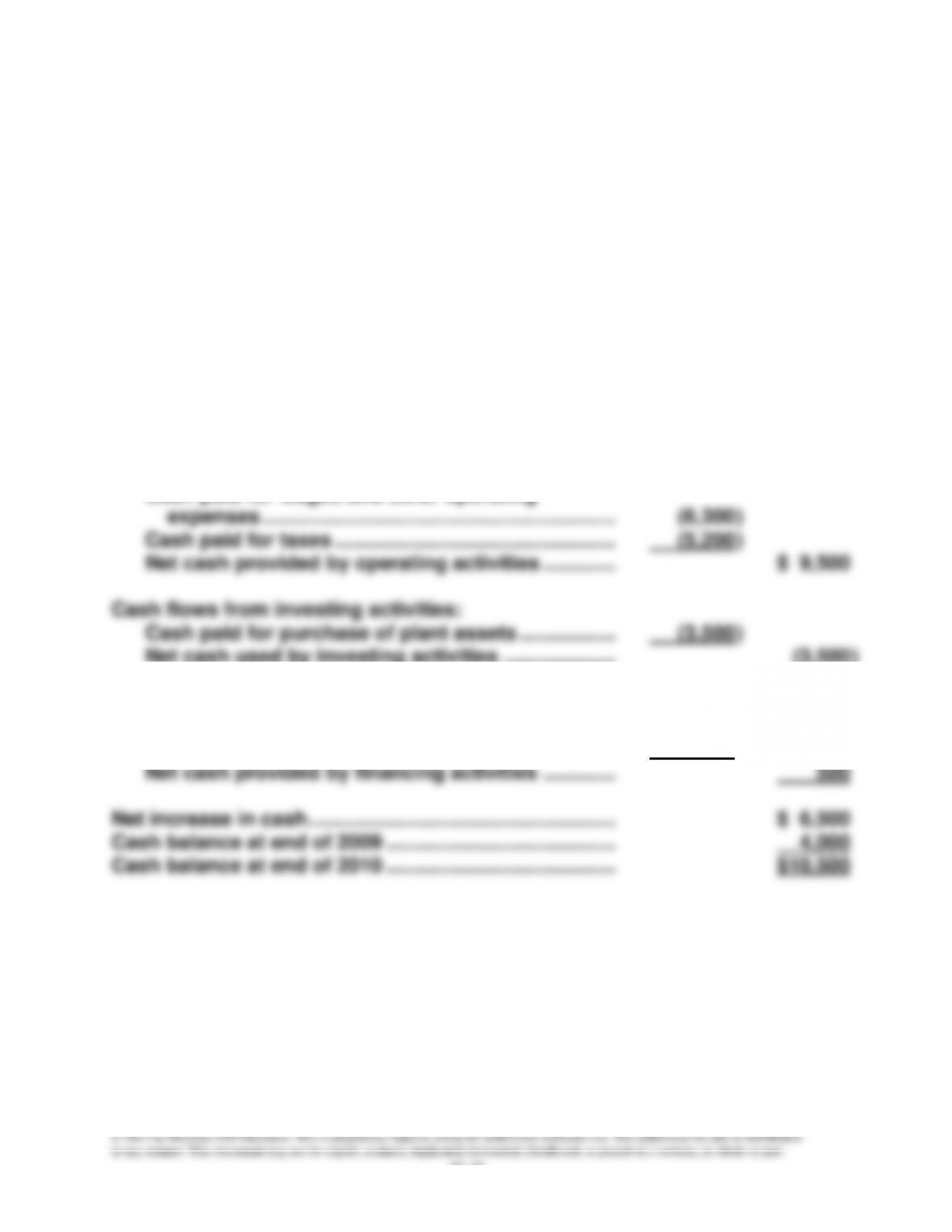
CARPET COMPANY
Statement of Cash Flows
For Year Ended December 31, 2014
Cash flows from operating activities:
Cash received from customers ………………………….
$ 62,000
Cash paid for merchandise ……………………………….
(41,000
)
Cash paid for wages and other operating
expenses ………………………………………………………
(6,300
)
Cash paid for taxes …………………………………………..
(5,200
)
Net cash provided by operating activities ………….
$ 9,500
Cash flows from investing activities:
Cash paid for purchase of plant assets ……………..
(3,500
)
Net cash used by investing activities ………………..
(3,500
)
Cash flows from financing activities:
Cash received from issuing stock ……………………..
3,000
Cash paid for dividends …………………………………….
( 2,500
)
Net cash provided by financing activities ………….
500
Net increase in cash ……………………………………………….
$ 6,500
Cash balance at end of 2009 …………………………………..
4,000
Cash balance at end of 2010 …………………………………..
$10,500
16–17
Indirect Method:
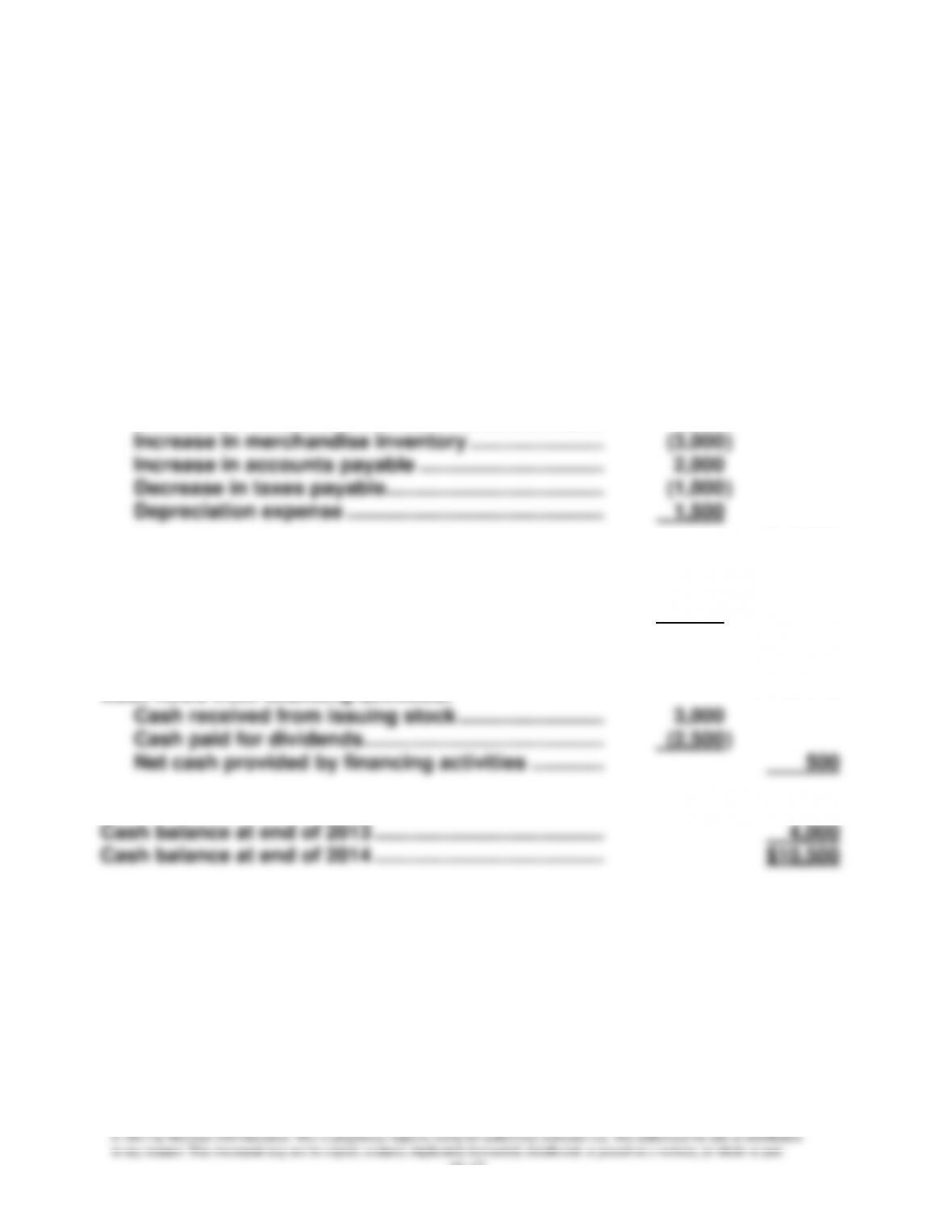
CARPET COMPANY
Statement of Cash Flows
For Year Ended December 31, 2014
Cash flows from operating activities:
Net income …………………………………………………………….
$ 9,000
Adjustments to reconcile net income to net cash
provided by operating activities:
Decrease in accounts receivable ……………………….
1,000
Increase in merchandise inventory ……………………
(3,000
)
Increase in accounts payable …………………………...
2,000
Decrease in taxes payable …………………………………
(1,000
)
Depreciation expense ……………………………………….
1,500
Net cash provided by operating activities ………….
$ 9,500
Cash flows from investing activities:
Cash paid for purchase of plant asset ……………….
(3,500
)
Net cash used by investing activities ………………..
(3,500
)
Cash flows from financing activities:
Cash received from issuing stock ……………………..
3,000
Cash paid for dividends …………………………………….
(2,500
)
Net cash provided by financing activities ………….
500
Net increase in cash ……………………………………………….
6,500
Cash balance at end of 2013 …………………………………..
4,000
Cash balance at end of 2014 …………………………………..
$10,500