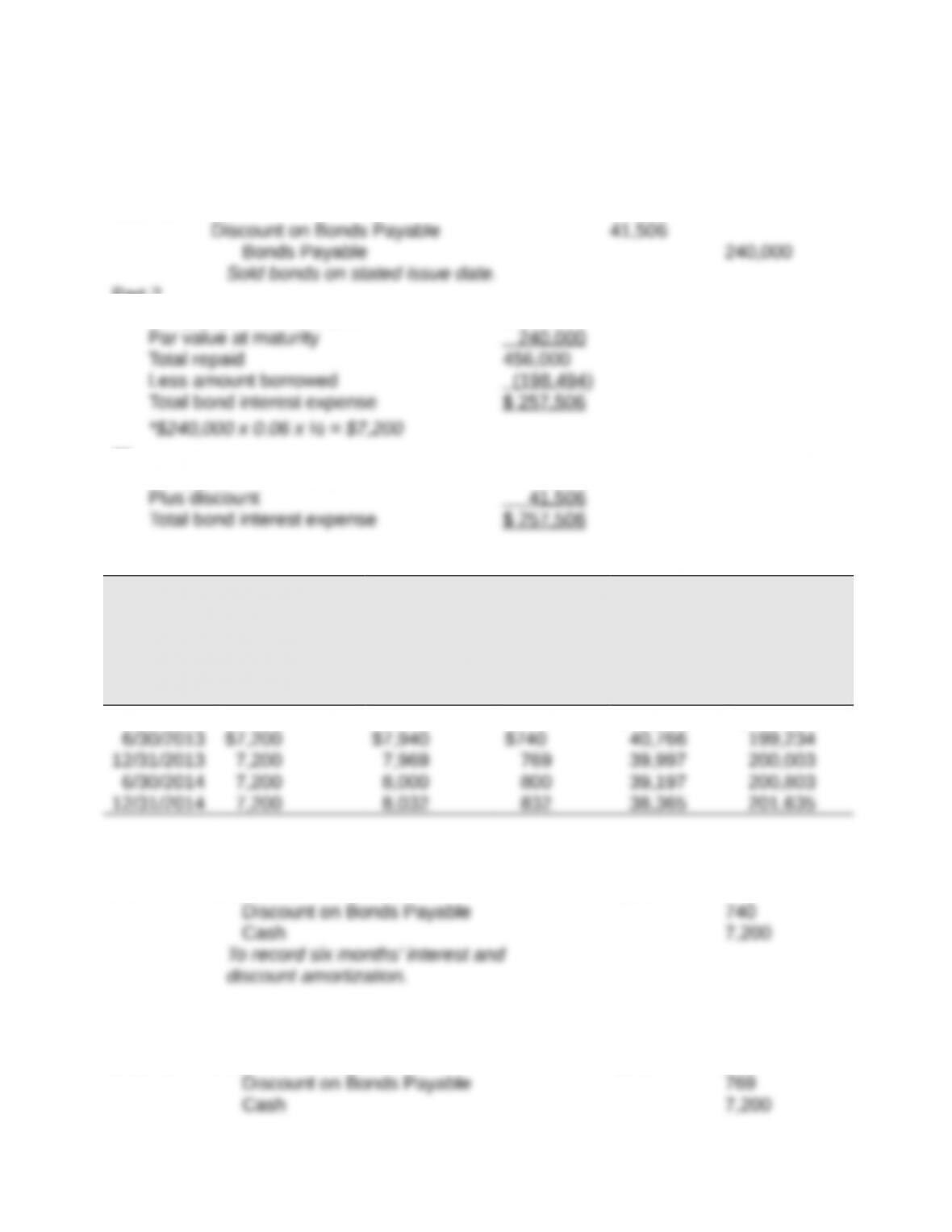
Title: Problem 14-7B
QA_Ori:
Part 1
2013
Jan. 1 Cash 198,494
Part 2
Thirty payments of $7,200*$ 216,000
or:
Thirty payments of $7,200 $ 216,000
Part 3
Semiannua
l
Interest
Period-End
(A)
Cash Interest
Paid
[3% x
$240,000]
(B)
Bond Interest
Expense
[4% x Prior
(E)]
(C)
Discount
Amortizatio
n
[(B) – (A)]
(D)
Unamortize
d
Discount
[Prior (D) –
(C)]
(E)
Carrying
Value
[$240,000 –
(D)]
1/01/2013 $41,506 $198,494
Part 4
2013
June 30 Bond Interest Expense 7,940
2013
Dec. 31 Bond Interest Expense 7,969
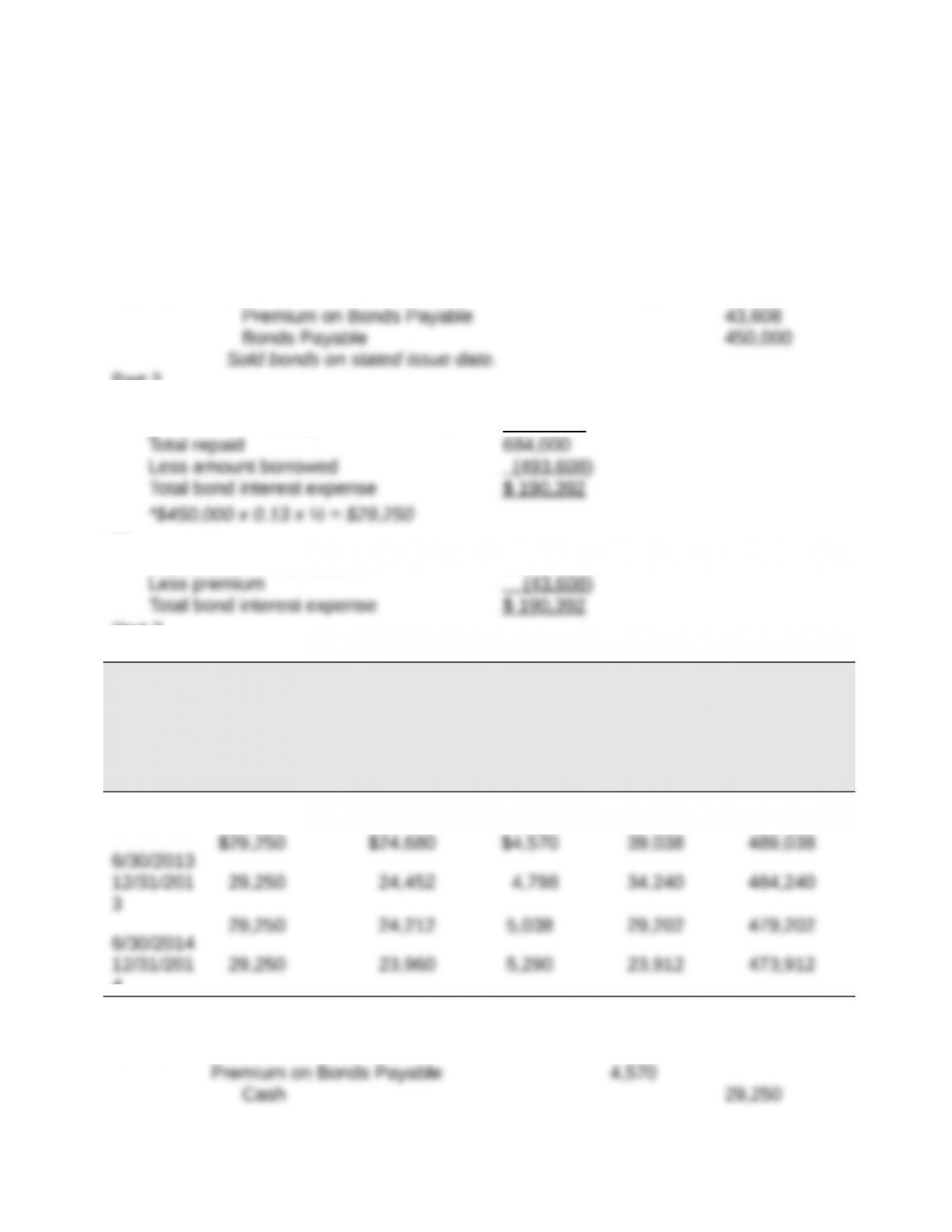
To record six months’ interest and
discount amortization.
Title: Problem 14-8B
QA_Ori:
Part 1
2013
Jan. 1 Cash 493,608
Part 2
Eight payments of $29,250* $ 234,000
Par value at maturity 450,000
or:
Eight payments of $29,250 $ 234,000
Part 3
Semiannu
al
Interest
Period-En
d
(A)
Cash Interest
Paid
[6.5% x
$450,000]
(B)
Bond Interest
Expense
[5% x Prior
(E)]
(C)
Premium
Amortizatio
n
[(A) – (B)]
(D)
Unamortize
d
Premium
[Prior (D) –
(C)]
(E)
Carrying
Value
[$450,000 +
(D)]
1/01/2013
$43,608 $493,608
4
Part 4
2013
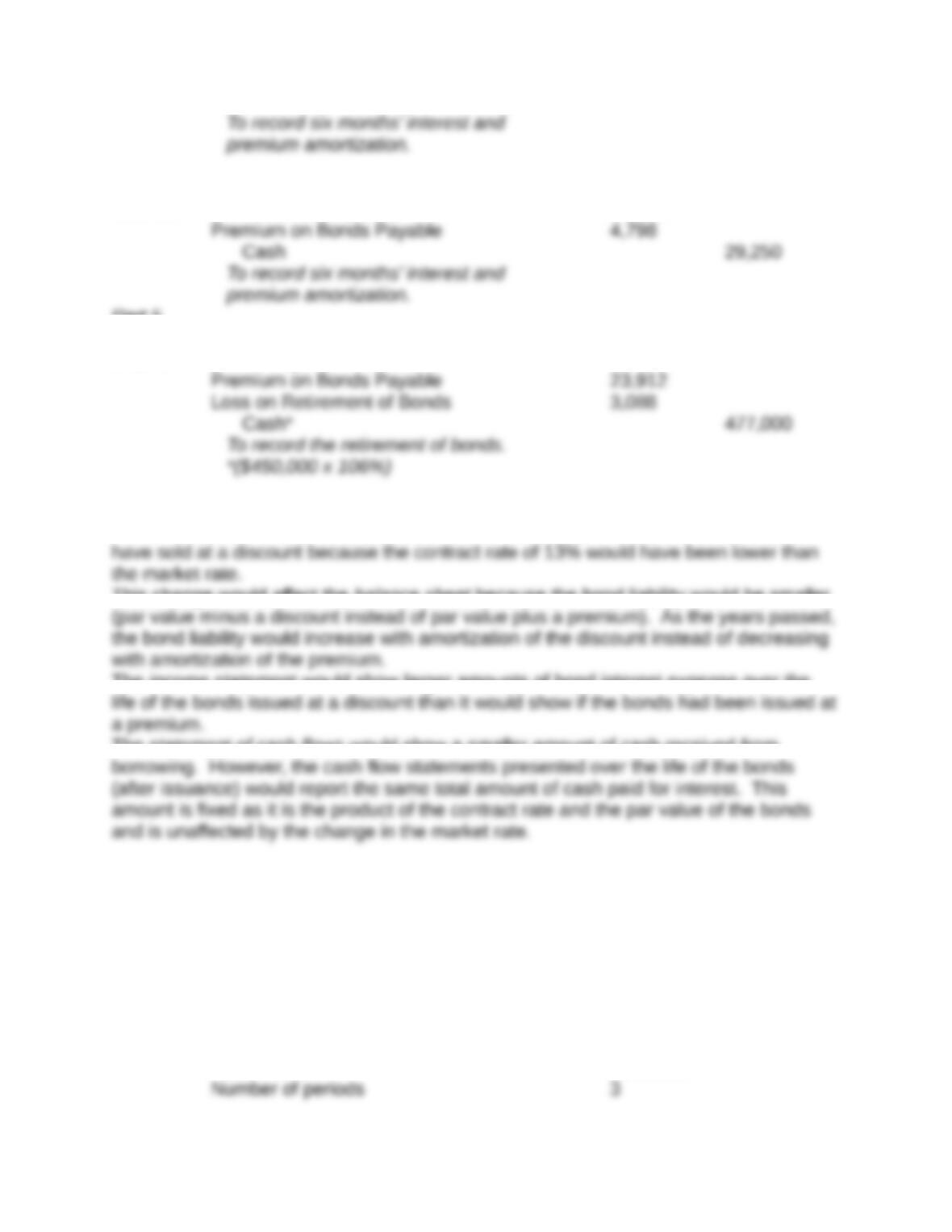
June 30 Bond Interest Expense 24,680
2013
Dec. 31 Bond Interest Expense 24,452
Part 5
2015
Jan. 1 Bonds Payable 450,000
Part 6
If the market rate on the issue date had been 14% instead of 10%, the bonds would
This change would affect the balance sheet because the bond liability would be smaller
The income statement would show larger amounts of bond interest expense over the
The statement of cash flows would show a smaller amount of cash received from
Part 3
Title: Problem 14-9B
QA_Ori:
Part 1
Amount of Payment
Note balance $150,000
Part 2
Payments
Period
Ending
Date
(A)
Beginning
Balance
[Prior (E)]
(B)
Debit
Interest
Expense
[10% x (A)]
+
(C)
Debit Notes
Payable
[(D) – (B)] =
(D)
Credit
Cash
[computed]
(E)
Ending
Balance
[(A) – (C)]
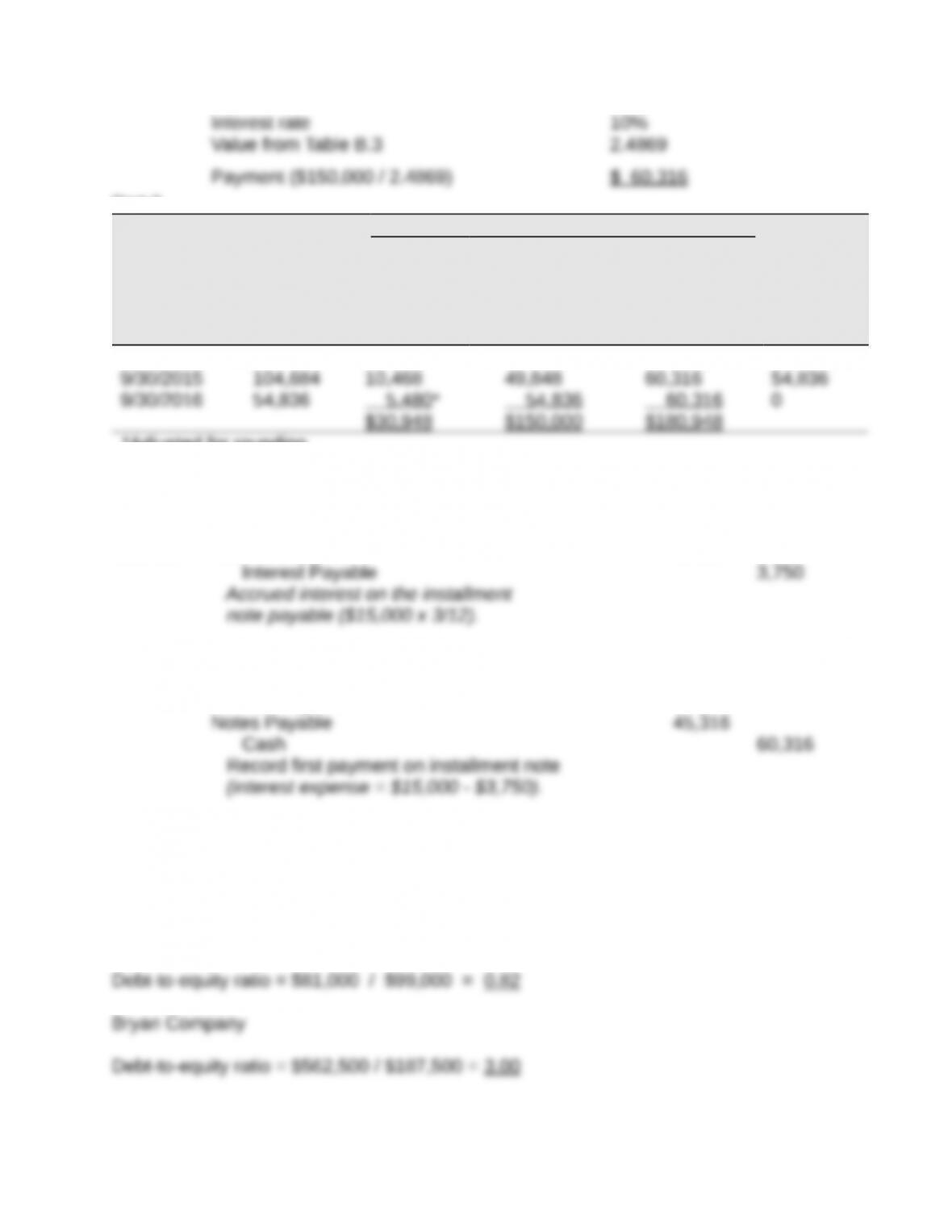
9/30/2014 $150,000 $15,000 $ 45,316 $ 60,316 $104,684
*Adjusted for rounding.
Part 3
2013
Dec. 31 Interest Expense 3,750
2014
Sept. 30 Interest Expense 11,250
Interest Payable 3,750
Title: Problem 14-10B
QA_Ori:
Part 1
Atlas Company
Part 2
Bryan’s debt-to-equity ratio is much higher than that for Atlas. This implies that Bryan
Title: Problem 14-11B
QA_Ori:
Part 1
Part 2
Leased Asset—Office Equipment 75,816
Part 3
Capital Lease Liability Payment (Amortization) Schedule
Period
Ending
Date
Beginning
Balance of
Lease
Liability
Interest on
Lease Liability
(10%)
Reduction of
Lease
Liability
Cash
Lease
Payment
Ending
Balance of
Lease
Liability
Year 1 $75,816 $ 7,582* $12,418 $ 20,000 $63,398
* Rounded to nearest dollar.
** Adjusted for prior period rounding errors.
Part 4
Depreciation Expense—Office Equipment 15,163
Title: Serial Problem
QA_Ori:
Part 1
This implies that:
Max. total liabilities – Present liability balance = Max. that can be borrowed
Part 2
Assume the secured loan is taken, then the percent of assets financed by:
a. Debt
b. Equity
Part 3
Adria Lopez should understand the risks she is taking by borrowing funds from the
bank. She currently has no interest-bearing debt (per prior chapter serial problems), but
In addition, and probably more important, Adria Lopez should understand the terms of
the loan and have the ability to pay the loan back when it is due.
Title: Reporting in Action 1
QA_Ori:
Polaris’s Long-Term Debt consists of:
Title: Reporting in Action 2
QA_Ori:
The interest that Polaris must pay on $100,000 thousand of 4.25% convertible
Title: Reporting in Action 3
QA_Ori:
From the statement of cash flows for the year ended December 31, 2011, Polaris
Title: Reporting in Action 4
QA_Ori:
Answer depends on the financial statement information obtained.
Title: Comparative Analysis 1
QA_Ori:
Polaris’s current year debt-to-equity ratio= $ 727,968 / $ 500,056 = 1.46
Polaris’s prior year debt-to-equity ratio = $ 690,656 / $ 370,991 = 1.86
Title: Comparative Analysis 2
QA_Ori:
For both years, Polaris’s debt-to-equity ratio is above that of the industry average
Of the two companies, Polaris has the higher risk level based on this measure.
Title: Ethics Challenge 1
QA_Ori:
The ethics of the Traverse County officials are questionable. The financial impact
of the leasing arrangement is the same as bond financing in that the county has a debt
In reality, the taxpayers of Traverse County reacted very negatively to the actions
of the county officials when they learned of the leasing arrangement. The taxpayers felt
Title: Ethics Challenge 2
QA_Ori:
Because the lease requires payments of a non-binding nature, investors who
Title: Communicating in Practice
QA_Ori:
MEMORANDUM
TO:
FROM:
SUBJECT:
The body of the memorandum should make the following points:
The associate is confused about the concept of a bond premium. Bonds that sell at a
premium provide the issuing company more cash than they are required to pay the
The bottom line is that the market prices the bonds according to their perceived risks
A cordial closing that indicates willingness to discuss the issue further would be
appropriate.
Title: Taking It to the Net 1
QA_Ori:
Home Depot’s long-term liabilities include:
Title: Taking It to the Net 2
QA_Ori:
a. These Home Depot notes offer a 5.875% interest rate. If the interest rate for
were issued at a discount, the interest rate for similar notes at similar risk must have
Title: Teamwork in Action
QA_Ori:
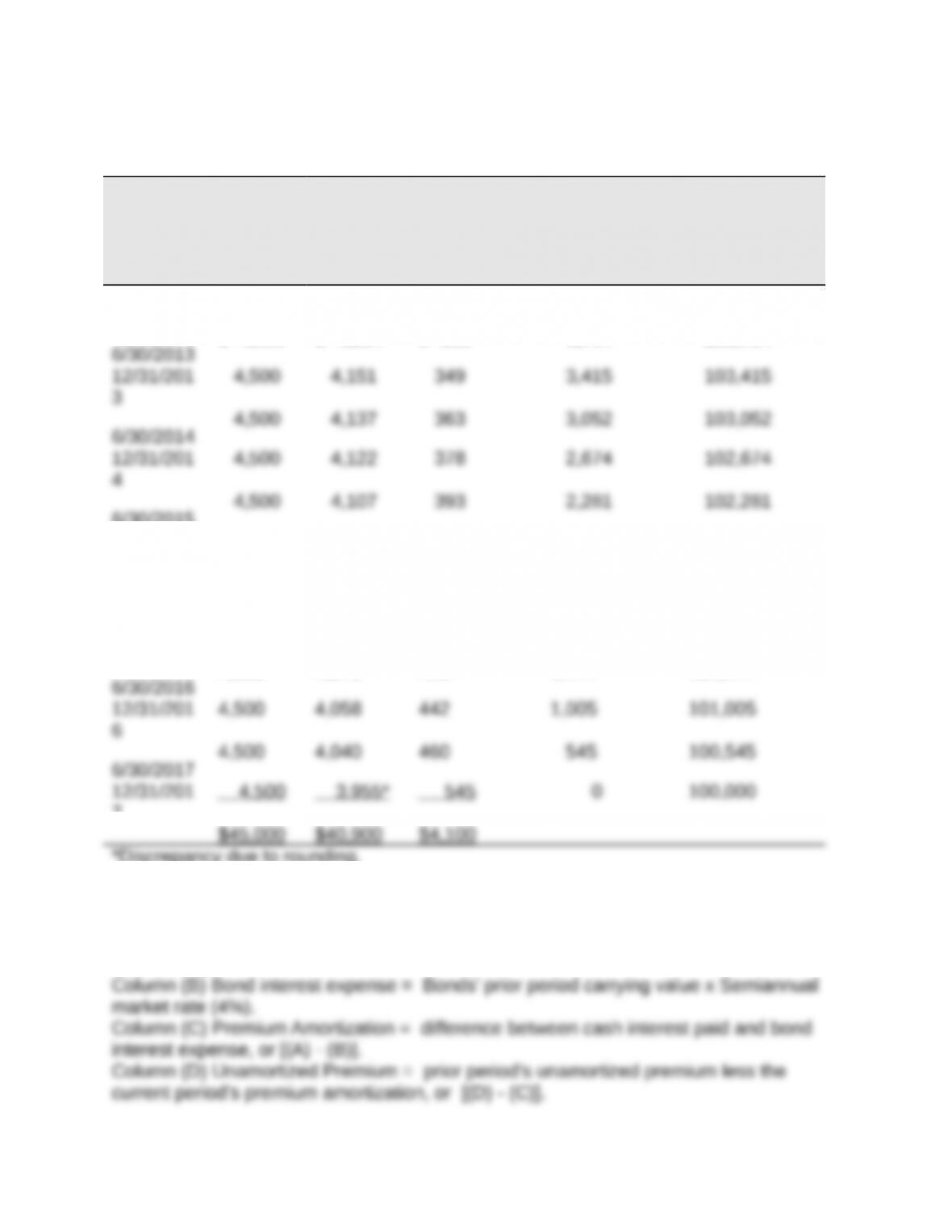
Parts 1 and 2
Effective Interest Amortization of Bond Premium
Semi-
annual
Period-en
d
(A)
Cash
Interest
Paid
(B)
Bond
Interest
Expense
(C)
Premium
Amortization
(D)
Unamortized
Premium
(E)
Carrying
Value
1/01/2013
$ 4,100 $ 104,100
$ 4,500 $ 4,164 $ 336 3,764 103,764
6/30/2015
Since teams generally have 4 or 5 members, the team solution will likely end about
here. The remainder of the table is shown for help in answering part 3.
12/31/201
5
4,500 4,091 409 1,872 101,872
4,500 4,075 425 1,447 101,447
*Discrepancy due to rounding.
The following computations should be articulated by team members as each line is
explained and prepared:
Column (A) Cash Interest Paid = Bonds’ par value ($100,000) x Semiannual contract
rate (4.5%).
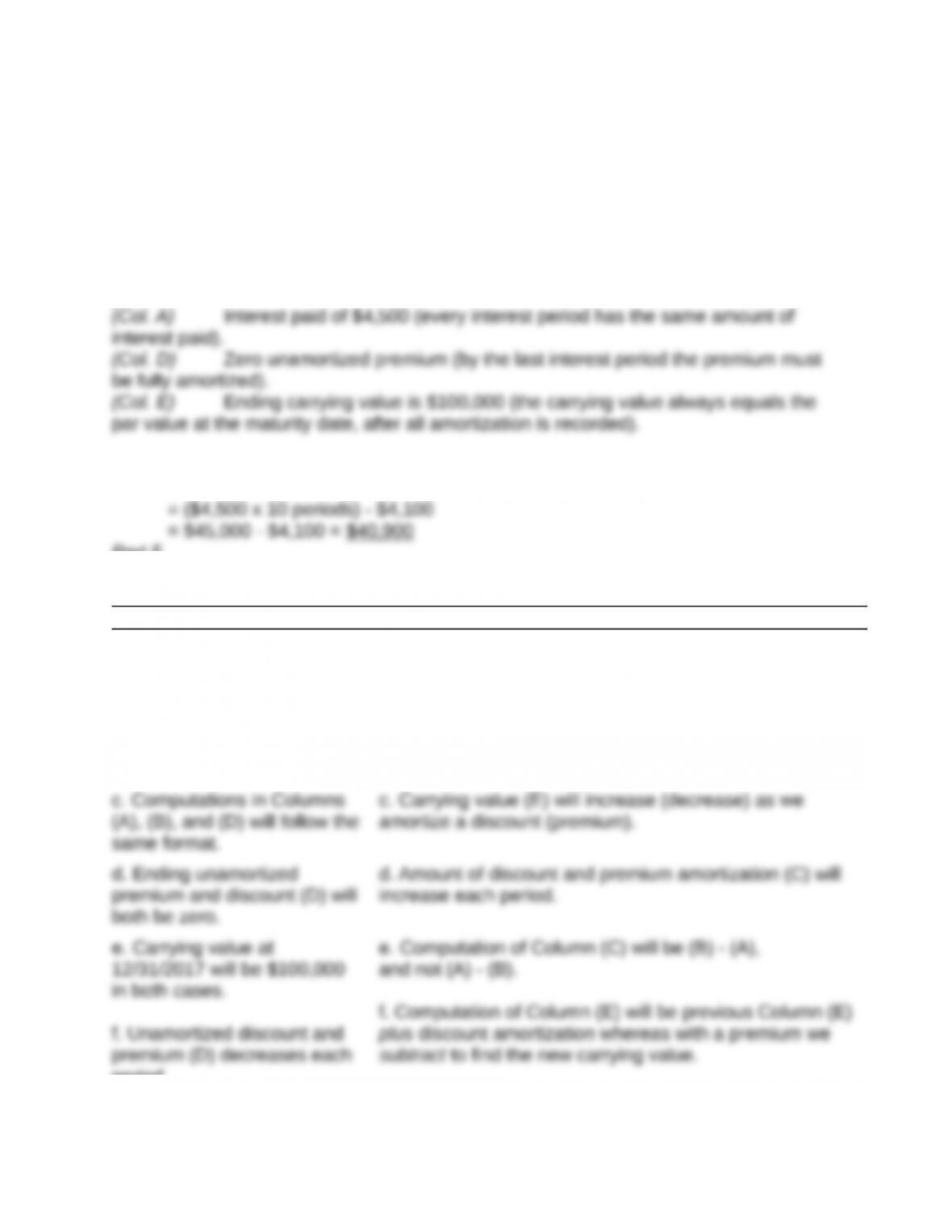
Column (E) Bonds’ Carrying Value = Bonds’ par value plus unamortized premium, or
[$100,000 + (D)] or Previous book value – Period’s amortization.
Part 3
Without completing the table, team members should be able to project the final number
in the first column and for each of the columns (A), (D), and (E). Specifically:
(Col. 1) Last interest period date is 12/31/2017 because this is a five-year bond,
issued 1/1/2013, with semiannual interest payments made on 6/30 and 12/31 of each
year.
Part 4
Total Bond interest expense = Interest Paid – Premium
Part 5
List likely includes:
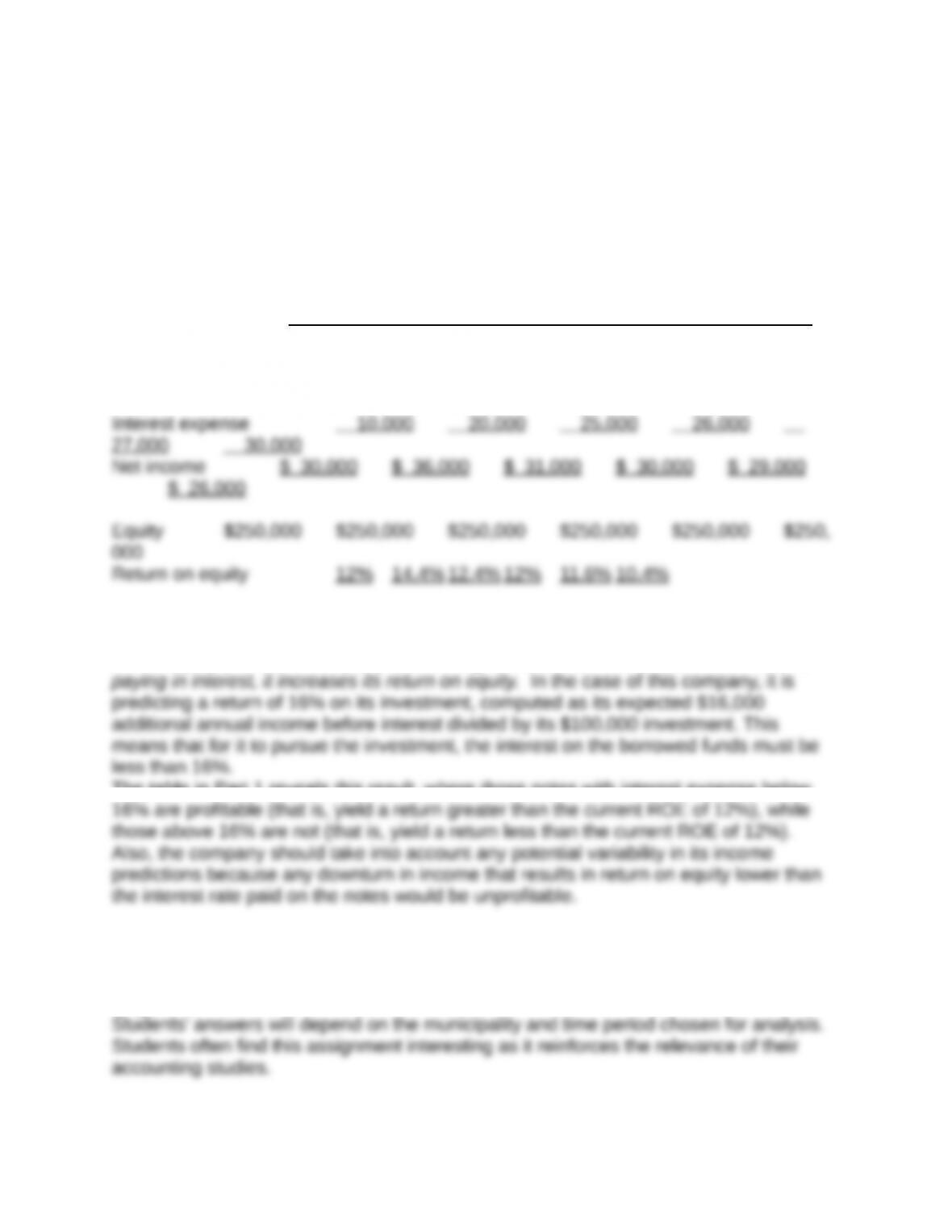
Similarities Differences
a. Table column headings for
the period and for columns
(A), (B), and (E).
a. Column (C) will be Discount Amortization and Column
(D) will be Unamortized Discount.
b. Dates in the period column
and interest paid in column
(A).
b. Bond interest expense is higher (lower) than the
interest paid and will increase (decrease) as we amortize
a discount (premium).
period
Title: Entrepreneur Decision
QA_Ori:
Part 1
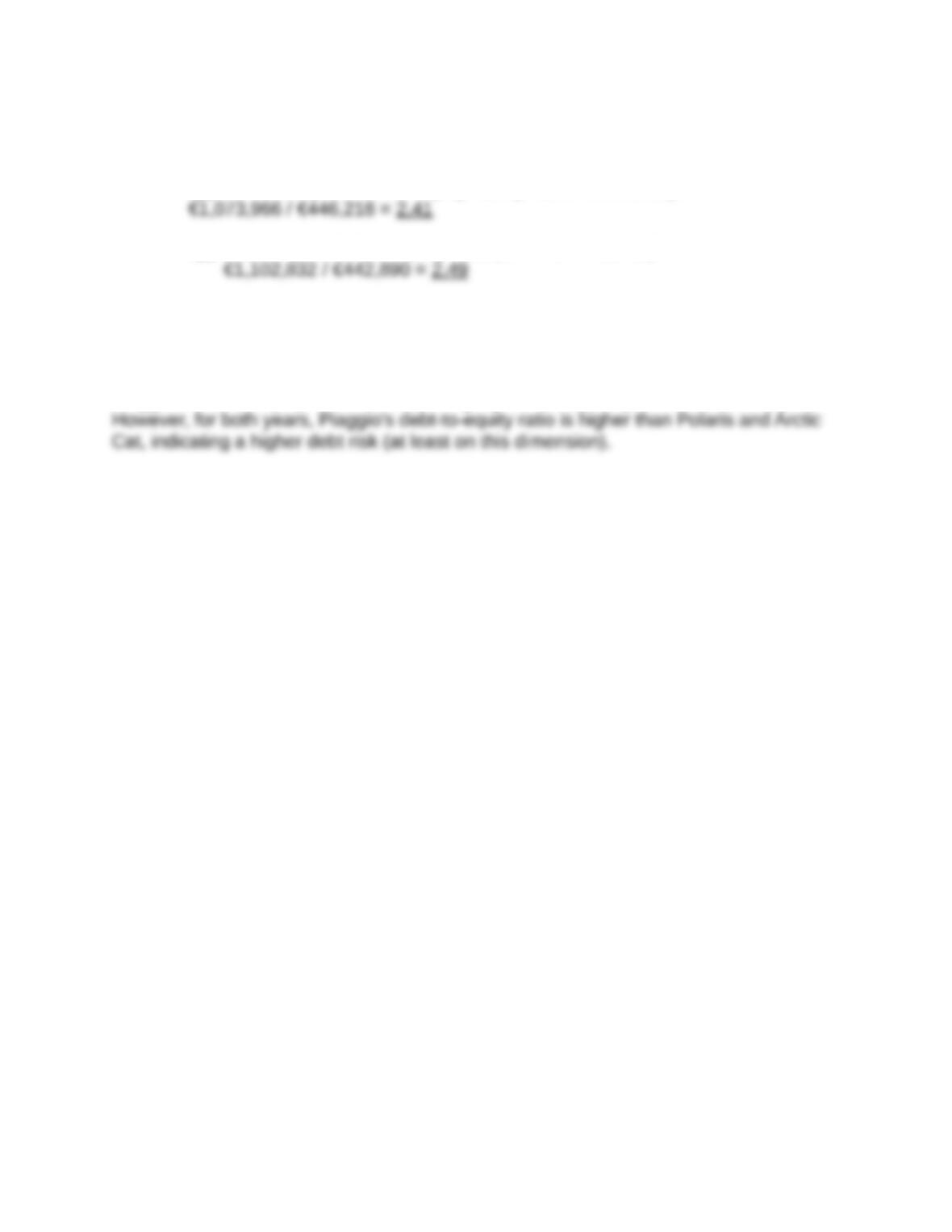
The table below reveals how the five alternative interest-bearing notes would affect this
company’s interest expense, net income, equity, and return on equity (net
income/equity):
Alternative Notes for Expansion
Current 10% Note 15% Note 16% Note 17% Note 20% Note
Income before
interest $ 40,000 $ 56,000 $ 56,000 $ 56,000 $
56,000 $ 56,000
Part 2
The analysis in Part 1 illustrates the general rule (called “financial leverage” or “trading
on the equity”): When a company earns a higher return with borrowed funds than it is
The table in Part 1 reveals this result, where those notes with interest expense below
Title: Hitting the Road
QA_Ori:
Title: Global Decision 1
QA_Ori:
Piaggio’s current year debt-to-equity ratio (in Euro thousands):
Piaggio’s prior year debt-to-equity ratio (in Euro thousands):
Title: Global Decision 2
QA_Ori:
Piaggio’s debt-to-equity ratio decreased slightly from the prior year to the current year.