Title: Exercise C-4
QA_Ori:
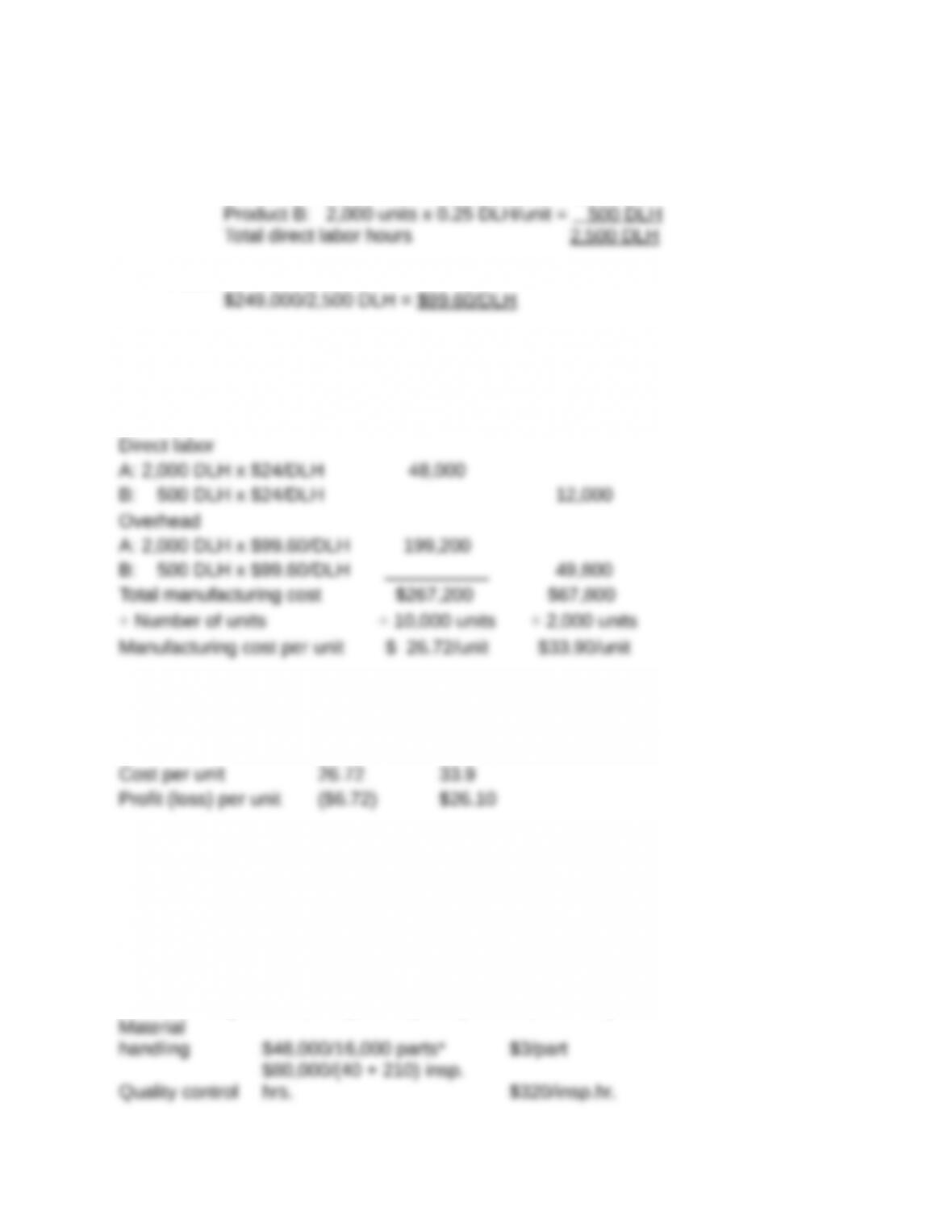
1. Total direct labor hours:
Product A: 10,000 units x 0.20 DLH/unit = 2,000 DLH
Plant-wide overhead rate:
Product A Product B
Direct materials
A: 10,000 units x $2/unit $20,000
B: 2,000 units x $3/unit $6,000
2.
Product A Product B
Price per unit $20.00 $60.00
It appears that Product A is not profitable. The company may decide that this product
line should be eliminated if it cannot reduce the cost of Product A or increase the selling
price.
3.
Overhead
rates
Machine setup $121,000/(10 + 12) setups $5,500/setup
16,000 parts
Product A Product B
Direct Materials (from part
1) $20,000 $6,000
Direct labor (from part 1) 48,000 12,000
Overhead
Machine setup
÷ Number of units
units
units
Manufacturing cost per unit $ 16.58/unit
$
84.60/unit
4.
Product A Product B
Price per unit $20.00 $60.00
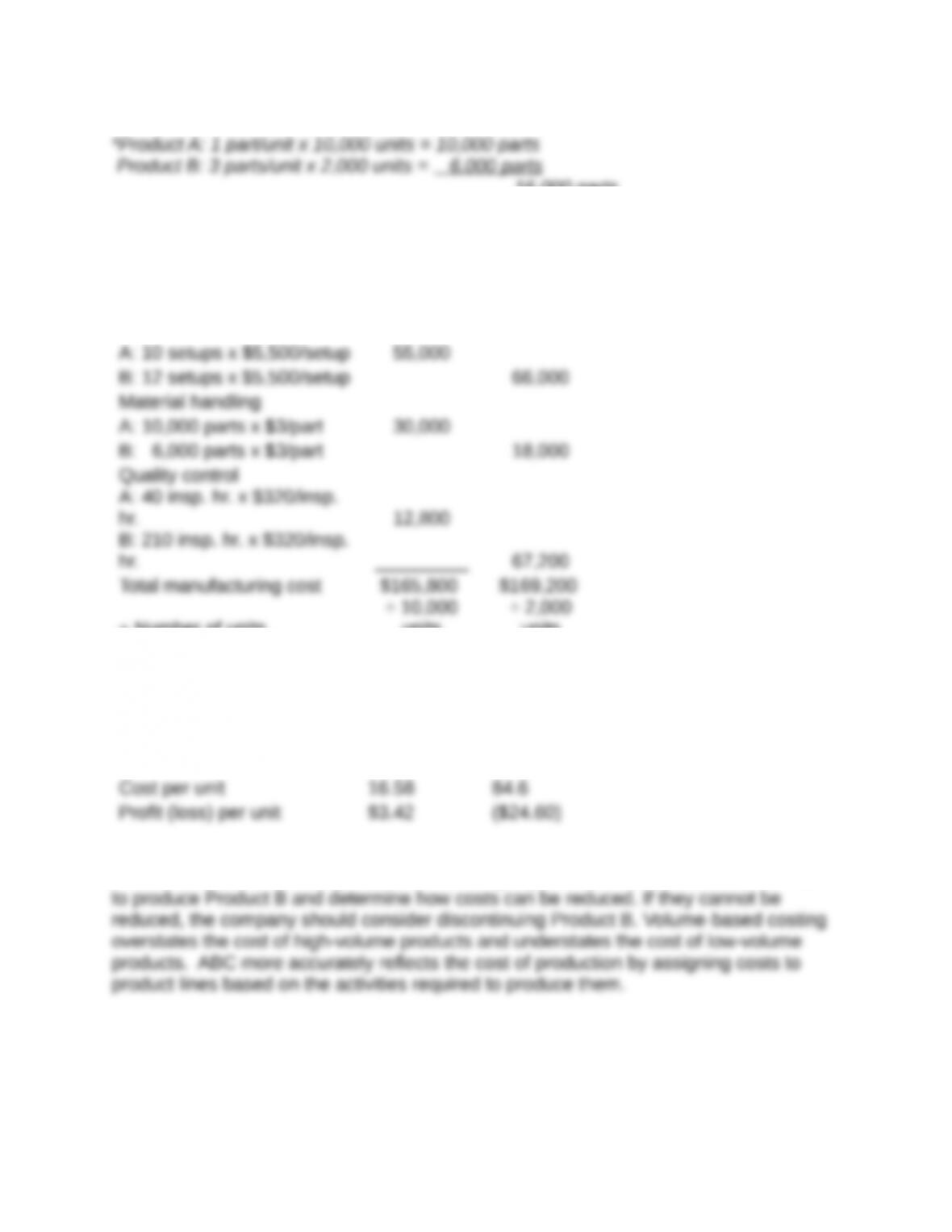
Using this approach (activity based costing) the company sees that Product B is not
profitable, and Product A is profitable. The company should evaluate the activities used
*Product A: 1 part/unit x 10,000 units = 10,000 parts
4.
Title: Exercise C-5
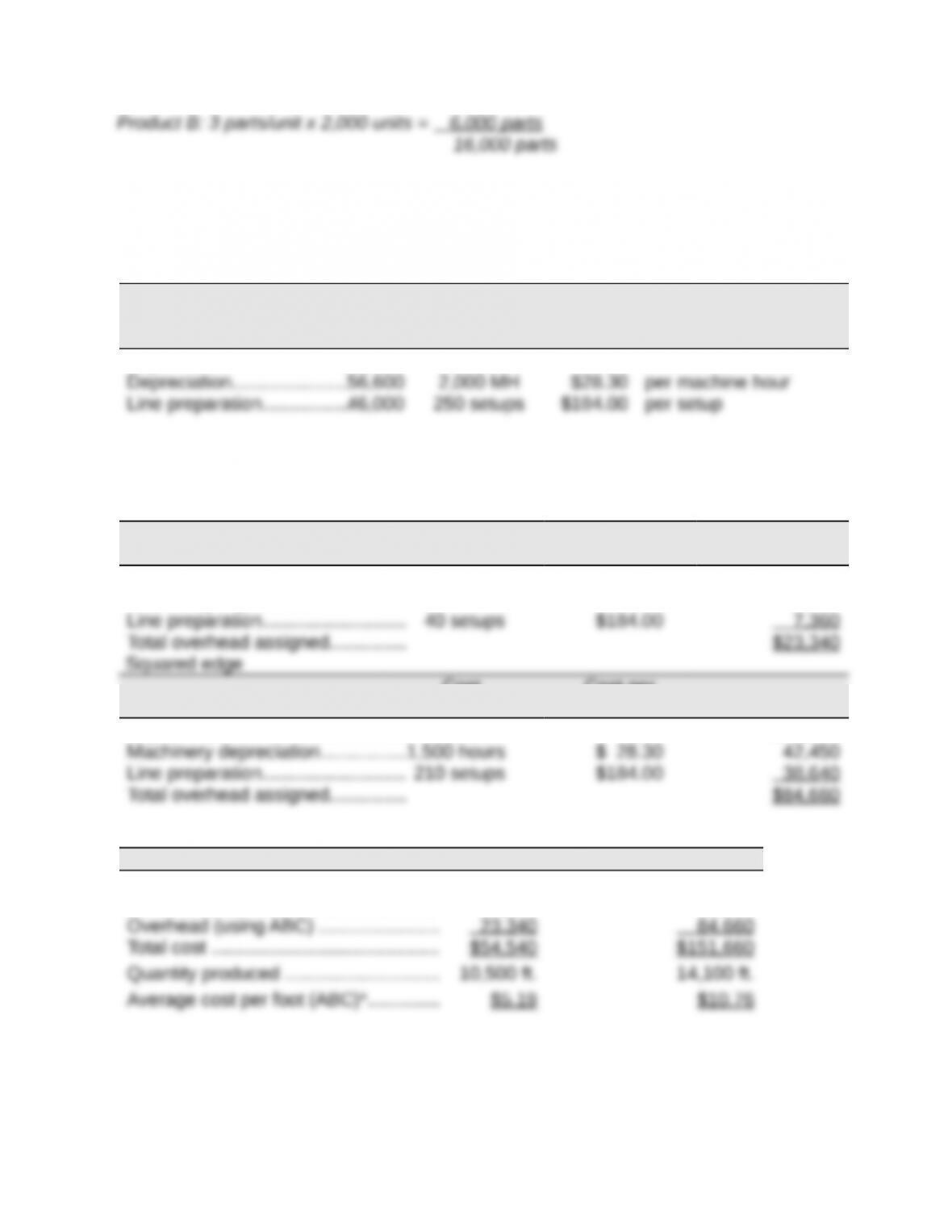
Calculation of predetermined overhead rates to apply ABC
Overhead Cost
Category (Activity
Cost Pool)
Total
Cost
Total Amount
of Cost Driver Predetermined Overhead Rate
Supervision………….…..…...$ 5,400 $36,000 15% of direct labor cost
QA_Ori:
1. Assignment of overhead costs to the two products using ABC
Rounded edge
Cost
Driver
Cost per
Driver Unit Assigned Cost
Supervision……………………..…..…. $12,200 15% $ 1,830
Machinery depreciation................ 500 hours $ 28.30 14,150
Cost
Driver
Cost per
Driver Unit Assigned Cost
Supervision……………………..…..…. $23,800 15% $ 3,570
2. Average cost per foot of the two products
Rounded edge Squared edge
Direct materials …………..….…..….….... $19,000 $ 43,200
Direct labor …………………………..…..…. 12,200 23,800
*Rounded
QA_Ori:
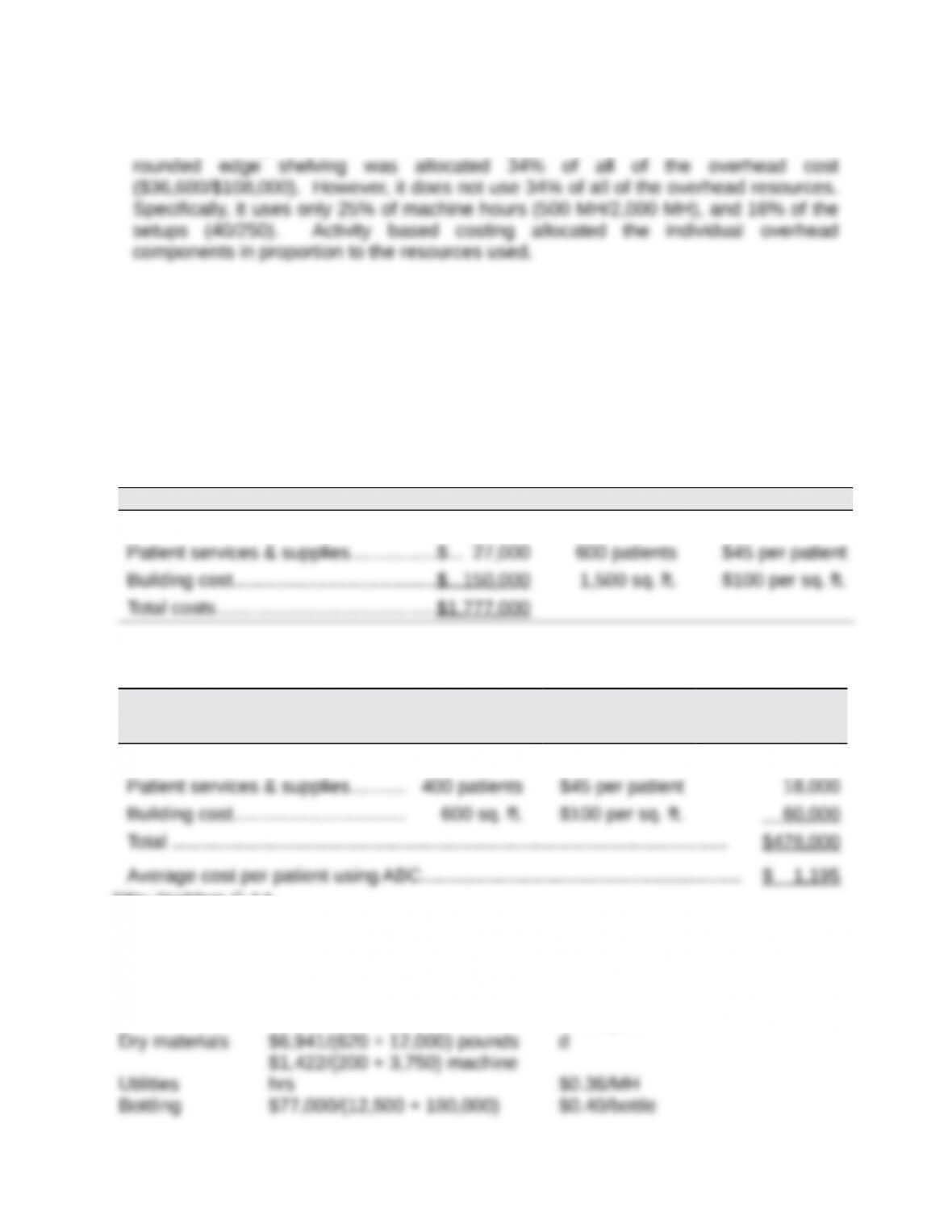
3. Using ABC, the average cost of rounded edge shelves declines and the average cost
of squared edge shelves increases. Under the current allocation method, the
Title: Exercise C-6
QA_Ori:
Part 1
Average cost per patient = $2,337,500/600 = $3,896 (rounded)
Part 2
Determination of cost per driver unit
Cost Center Cost Driver Cost per Driver
Professional salaries……….…..…..….…....$1,600,000 10,000 hours $160 per hour
Part 3
GENERAL SURGERY
Cost
Driver
Cost per Driver
Unit
Allocated Cost
Professional salaries………………… 2,500 hours $160 per hr. $400,000
Title: Problem C-1A
QA_Ori:
1.
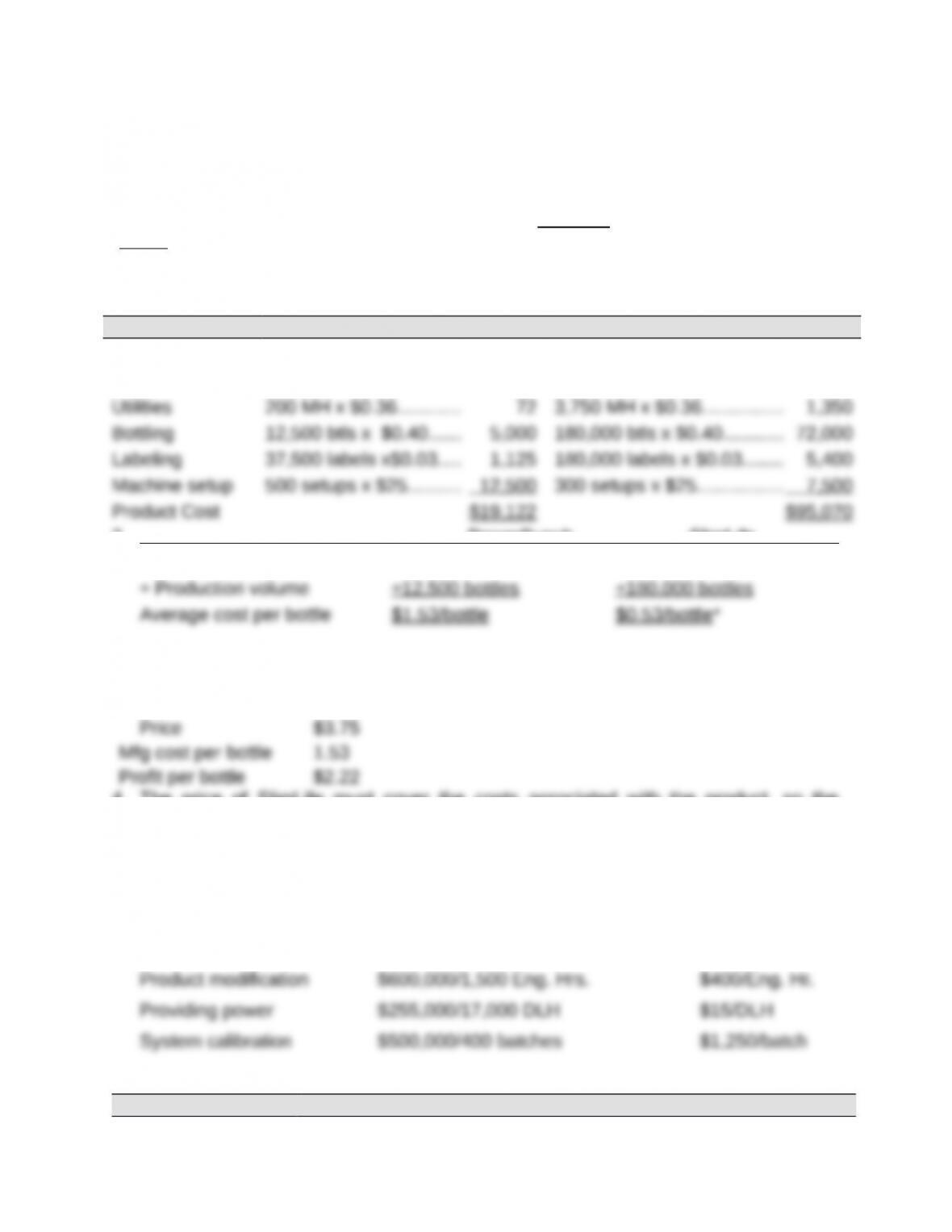
Liquid materials $2,304/(1,400 + 37,000) gallons $0.06/gallon
$0.55/poun
bottles
Labeling $6,525/217,500 labels* $0.03/label
Machine setup $20,000/(500 + 300) setups $25/setup
* PowerPunch: 12,500 bottles x 3 labels/bottle = 37,500 labels
SlimLife: 180,000 bottles x 1 label / bottle = 180,000
labels
Total labels 217,500
labels
PowerPunch SlimLife
Liquid material 1,400 gal x $0.06……..... $ 84 37,000 gal x $0.06…........... $ 2,220
Dry material 620 pounds x $0.55...... 341 12,000 pounds x $0.55....... 6,600
2. PowerPunch SlimLife
Total cost of line $19,122 $95,070
*Rounded
3.
For PowerPunch:
4. The price of SlimLife must cover the costs associated with the product, so the
minimum price for this product is $0.53/bottle.
*Rounded
Title: Problem C-2A
QA_Ori:
1. Grinding & Polishing ($320,000+$135,000)/13,000 MH$35/MH
2.
Job 3175 Job 4286
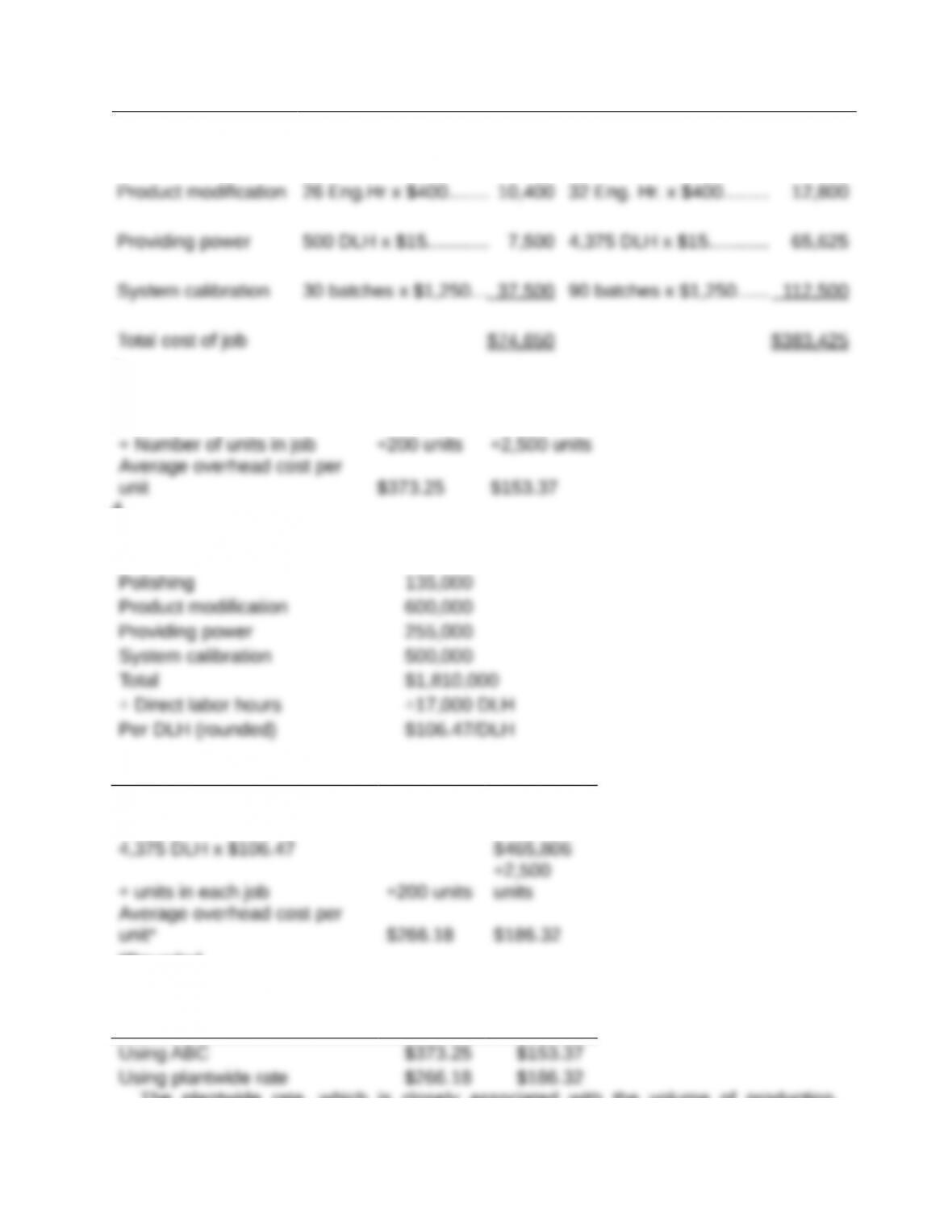
Grinding & polishing 550 MH x $35.............$19,250 5,500 MH x $35……......$192,500
3.
Job 3175 Job 4286
Total overhead cost of job $74,650 $383,425
4.
Plantwide rate
Grinding $320,000
Job 3175 Job 4286
Overhead
500 DLH x $106.47 $53,235
*Rounded
Average overhead cost
Job 3175 Job 4286
The plantwide rate, which is closely associated with the volume of production,
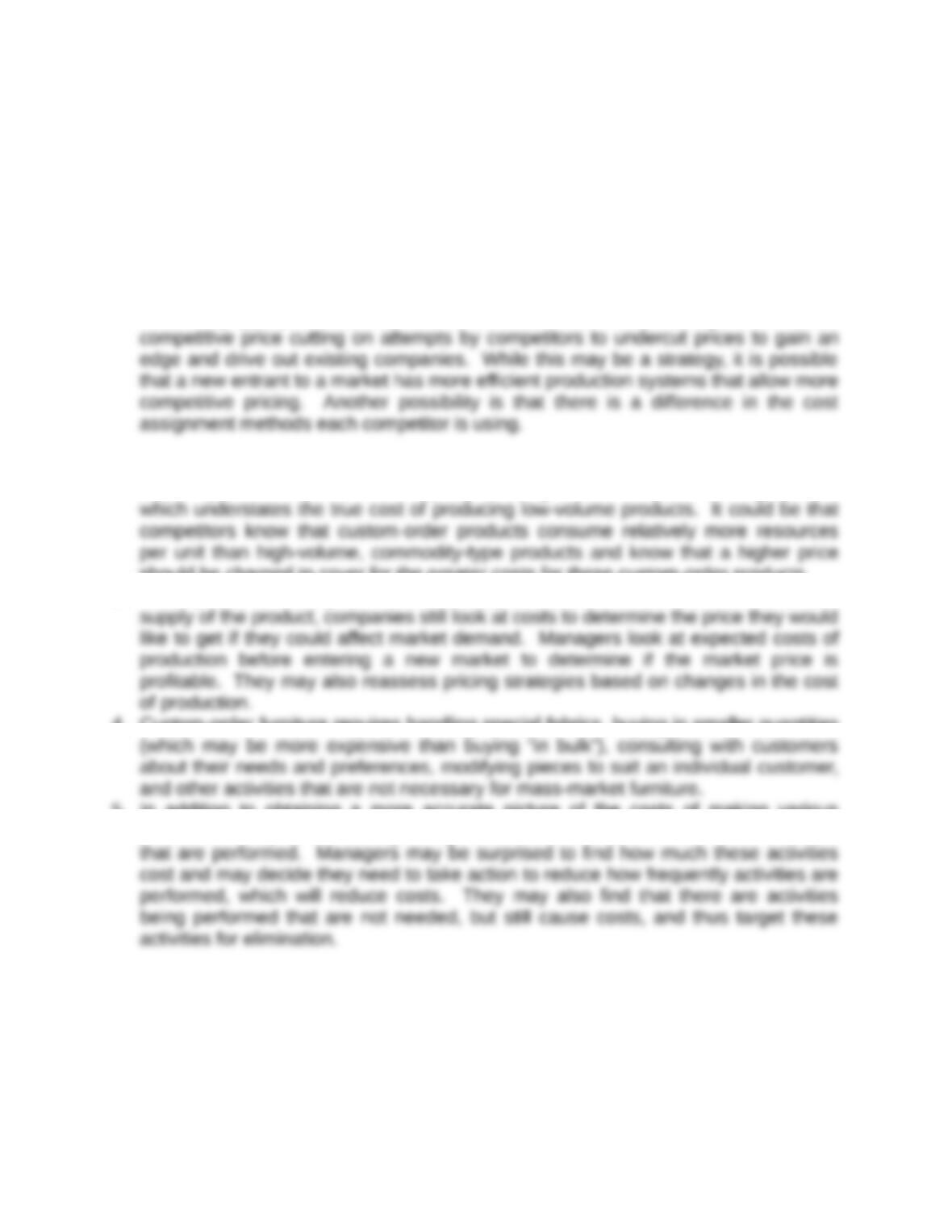
overstates the cost of the high-volume product (in this case Job 4286), and
understates the cost of the low-volume product (Job 3175). ABC more accurately
represents the cost of producing a product because it considers how much of each
resource is consumed by each product in the manufacturing process.
Title: Problem C-3A
QA_Ori:
1. When companies experience strong price pressure on their high-volume,
commodity-type products, they should be concerned. Many managers will blame
2. The company may be charging less for its low-volume, custom-order products than
the competitors because the company is using a volume-based costing system,
should be charged to cover for the greater costs for these custom-order products.
3. While prices are really set in the marketplace based on customer demand and
4. Custom-order furniture requires handling special fabrics, buying in smaller quantities
5. In addition to obtaining a more accurate picture of the costs of making various
products, activity based costing also gives information about the cost of the activities