
EASTERN GEAR, INC.: Job Shop
Teaching Notes
1
Synopsis and Purpose
Eastern Gear is a company that traditionally produced custom gears in small lots, and has recently
been given the opportunity to begin producing larger volumes of gears per order. This is a typical
small job shop which is owner operated. In addition, Eastern Gear has experienced a large
increase in sales which is causing major problems in operations. Because of the wide range of
problems presented, the case permits an overview of a job shop type of operation and practice at
looking at the entire scope of operations including objectives, capacity, production and inventory
control, organization, and quality.
The purpose of this case is to allow students to examine a complex manufacturing problem and the
associated decisions in some detail. The case illustrates how problems are interrelated and how
objectives might be clarified before decisions can be made. It also provides a fundamental
understanding of what a job shop is like and the typical problems faced in job shop management.
Discussion Questions
1. What are the major problems being faced by Eastern Gear?
2. What action should Mr. Rhodes take to solve his problems?
3. How can this case be related to operations strategy and process design concepts?
Analysis
Eastern Gear is experiencing a wide range of problems including:
1. Need for objectives in operations. It is not clear at the present time whether
operations should emphasize cost, flexibility, delivery, or quality. The desired
emphasis on these objectives needs to be clarified.
2. Lack of an order size policy. Eastern Gear has accepted a wide range of order
sizes as shown in Exhibit 2. Furthermore, Eastern Gear’s President has just
decided to accept a few larger orders. The two types of order sizes are best served
by different operations strategies and different process designs.
3. Lack of planning for growth. It does not appear that the company has a strategy or
plan for future growth. As a result, the company could experience cash flow
problems, capacity problems and other problems associated with rapid growth.
4. Production and inventory control. At the present time expediting seems to be the
rule rather than the exception. Twenty percent of the orders have rush tags on
them. Production processing time has increased from two to four weeks, and there
does not seem to be a production and inventory control system in place. Also,
certain orders are being handled on a rush basis and this may be disruptive to the
smooth flow of production. Finally, Joe Irvine has expressed concern about
bottlenecks which are caused by the lack of effective production and inventory
control.

EASTERN GEAR, INC.: Job Shop
Teaching Notes
5. Poor Quality. There seems to be a lack of quality control as evidenced by the six
6. Organization chart. The present organizational structure does not have a clear
7. Raw material inventory. Due to lack of a raw material inventory, delivery lead time
8. Layout. The present layout of the shop results in irregular material flows and
excessive travel distances.
The solution to these problems is intertwined and can start in many different places. We will
discuss the possible solutions in order of the problems presented.
With regard to objectives for operations, it appears that delivery lead time is very important for the
custom gear business. However, the operations objectives for larger order sizes are not
necessarily the same; cost becomes more important in that situation.
The case refers to additional profits available from reduced delivery times. Based on Exhibit 4, the
variable cost of material and labor is about 50% of total cost (assuming for the moment that other
costs are fixed or semi-fixed). If sales can be increased by $500,000 through reduced delivery
times or other means, as much as $250,000 could flow to the bottom line.
The custom gear business places more importance on delivery lead time as an objective than on
cost. The gears are used for R&D where the costs of the gears themselves are probably a small
percentage of the total customer‘s costs. However, the entire R&D project can be held up if the
gears are not available in time.
Quality is important, at least to the extent that it affects the functioning of the customer product or
causes a delay in schedule while repairs are being made.
Flexibility is also of great importance for Eastern Gear‘s customer gear business. As a result,
Engineering and Marketing should be working closely with the customers to make sure they get
what they need. Flexibility is the key to providing customer service. Generally speaking, the
importance of flexibility is decreased with larger orders.
My ranking of the objectives from most important to least important for the custom gear business is:
1) flexibility, 2) delivery, 3) quality, and 4) cost. Larger order sizes might emphasize quality and
cost rather than flexibility and delivery.
The decision by the President of Eastern Gear to accept a few larger orders has many implications
for the manufacturing organization and its present problems. First of all, it aggravates the problem
of lengthening delivery intervals, given the present job shop environment. Secondly,

EASTERN GEAR, INC.: Job Shop
Teaching Notes
3
manufacturing in larger lot sizes is better accomplished using a line flow manufacturing process
and layout.
The lack of planning for growth can be solved by developing at least a one-year plan. The plan
should include market objectives, financial projections, and capacity plans, as a minimum. An
elaborate plan is not needed, but the basic issues need to be addressed. As a result of this plan, a
strategy for acquisition of space by operations should be determined.
Production and inventory control can be improved in several ways. First, a production load or
schedule should be developed and constantly kept up to date. When a new order is accepted, it
should be placed on the schedule and the delivery date promised accordingly depending on the
load on the factory at the time of order acceptance. For a company of this size, the schedule could
probably be kept on a personal computer. An elaborate system is not warranted for a small
company such as Eastern Gear.
operations should then be checked off as the order is routed through the factory. The operations
sheet should stay with the order during production.
An inspector should be designated to check each order before it is shipped. Final inspection
should include checking the operations sheet to be sure all operations were performed. Other final
inspections should also be made as specified by the engineer. This amounts to “inspecting quality
into the product“, but is probably needed until the processes can be controlled.
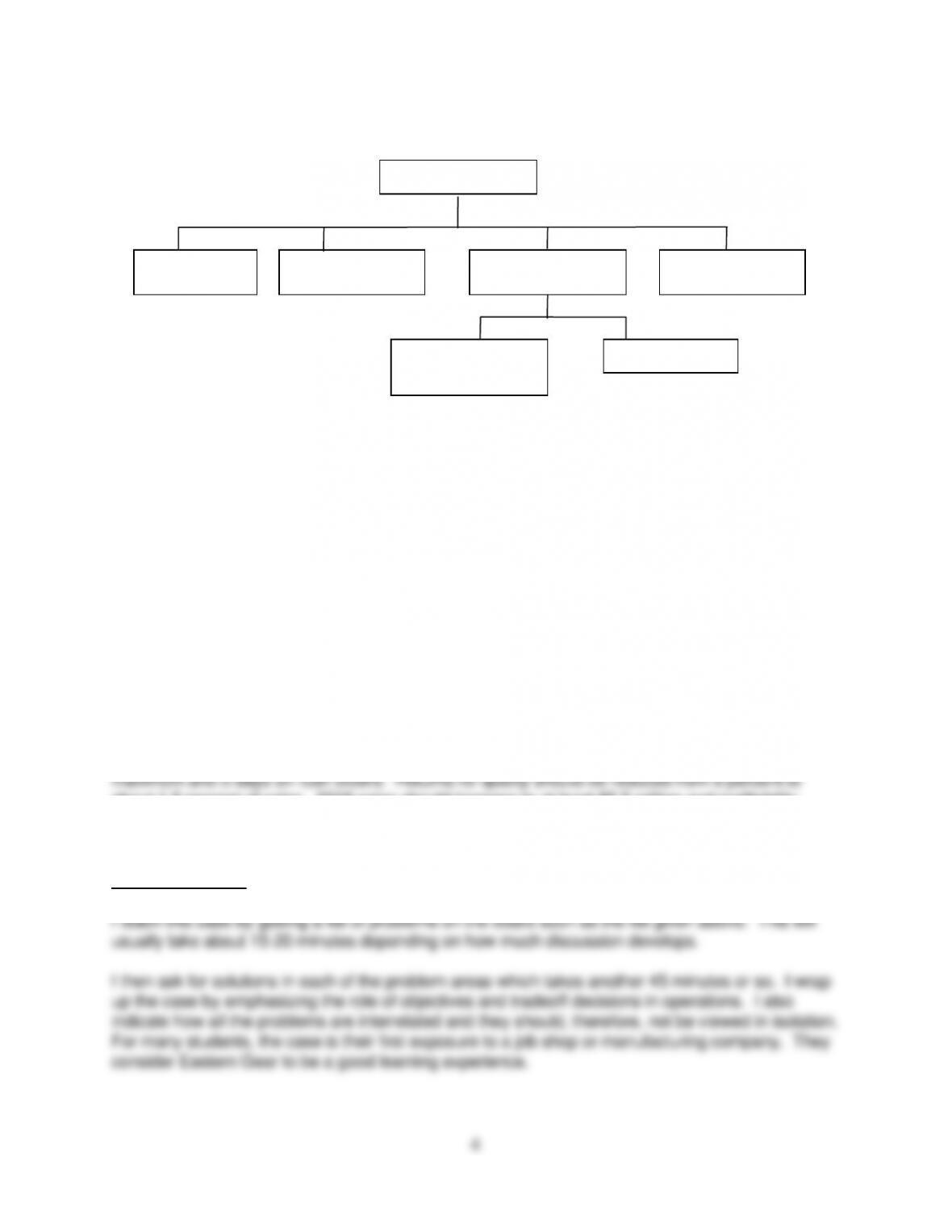
The company should be reorganized to clearly separate functions. Engineering should be
separated from manufacturing. With the present organization, critical engineering functions are not
being done because the engineer is busy managing manufacturing.
Expediting should be eliminated and replaced by a production and inventory control manager.
Purchasing should also be placed under manufacturing to form a materials management position
responsible for coordinating scheduling, inventory and purchasing.
Perhaps a finance function should be developed in place of the controller and marketing should
replace sales. The resulting organization chart would be as follows:
EASTERN GEAR, INC.: Job Shop
Teaching Notes
President
Marketing Engineering Manufacturing Finance
Materials Foreman
Management
This organizational structure would require hiring one additional person, a manufacturing manager.
It might also require training or replacing some of the present managers.
A small raw materials inventory could be carried at low cost. Since delivery lead time is of the
essence, some raw material inventory would probably be a good idea. Carrying three items (E, H,
J) would cover 47 percent of usage. Carrying an additional five items (A, D, G, I, and K) would
raise the coverage to 82 percent of usage. If delivery lead time is as important as the case
indicates, it might pay to carry all eight items. In this case 82 percent of usage is covered by 20
percent of the items – a good illustration of the ABC principle.
The layout needs to be improved by streamlining materials flows. One way to do this is to
interchange the heat treating and drilling departments. If this is done, there will be little
backtracking and a smooth flow of materials. Eastern Gear should consider incorporating a
manufacturing cell into its facility. The cell would utilize a line flow layout and would serve as a
more appropriate method for manufacturing large orders or possibly rush orders.
If the above steps are taken, delivery lead time should be reduced to its previous level of 3-4 weeks
about 1.5 percent of sales. 2016 sales should increase to at least $5.5 million and profitability
should be improved.
Teaching Strategy