
Teaching Notes
The purpose of this chapter is to show how product design relates to the operations
In teaching this chapter, I stress the notion of product-process interaction, the role of
technology in product and process design, QFD and the modular design ideas. Examples are
Some of the references that might be useful in presenting this chapter are: Mallick and
Schroeder (2005) and Ogawa and Piller (2006) on new product introduction; Hauser and
Clausing (1988) and Mahanti (2009) on QFD. For background reading see Parler, Zsidisin and
Ragatz (2008) and Pullan, Bhasi and Madhu (2010). Each of these references provides
1. Inter-functional cooperation is important in selecting the “right” new product that can be
concentrating solely on “what you can sell” and selecting products that are incompatible
If the new-product design approach is technology-push, there may be technical
2. A market-pull approach might be appropriate in situations where the process is simple
A technology-push approach would be best in the opposite situation. A good example
3. This is probably best handled by treating the script for the play as the product

4. There are two primary reasons for the increase in product variety. The first is the
marketing concept of meeting consumer needs. Since people have a wide variety of
needs, a wide variety of products are required. The second reason is the general business
philosophy of increasing profits by growth rather than through cost reduction. Products,
even if only marginally successful, will produce this growth.
5. By using the modular approach to product design, the production variety will be
decreased since only the modules need be produced. Product variety will be greatly
increased since the modules can be theoretically assembled in all possible combinations.
Even though some combinations may be impossible or impractical, the number of
potential products will still be large.
6. Operations should be involved in all stages of product design. Since the operations
function has knowledge of production capabilities and how to use these capabilities in the
most effective manner, they should interact with marketing and with engineering to
ensure that the product will be designed with production needs considered.
7. A travel agency. For prepackaged tours, the product specification would be the travel
brochure put out by the tour’s organizers. For individual trips, the product specification
would be the itinerary or ticket of the individual traveler.
A beer company. The recipe to be followed to produce beer and the packaging to be used
for the beer (bottles, cans, kegs, etc.).
8. a. Stapler:
Objective: to secure together several pieces of paper or materials
Basic Function: use a fastener to hold material together
Secondary Function: drives a staple through several pieces of material
Alternatives: to perform the same basic function with a different secondary function,
1. use a paper clip
2. use a spiral binder
3. glue the papers together with a spine
b. A Mouse for Computer Operation:
Objective: to enable user to provide inputs to the computer
Basic Function: to select objects and initiate actions on the computer
1. use the keyboard to perform basically similar functions
2. use a light-pen to perform the basic function
3. use your finger as the mouse on a tablet device to perform the basic function
c. A Desk for Use by Students for Studying:
Objective: to provide a place for studying
Basic Functions: students will be able to read and write on the desk
9. Students’ answers will vary. Some examples follow: A great variety of baseball type
hats can be constructed from a few basic styles, sizes, colors, materials such as poplin,
polyester or corduroy. Car manufacturers often mix and match various “options” to
provide a great variety of selection within a specific make and model of automobile.
10. Student answers will vary.
11. The potential benefits of using a QFD approach include: meeting or exceeding customer
requirements; better communications across departments in design, production, and sales
of the product; compatible components within a design; reduced costs of redesign; fewer
engineering change orders; lower production costs and higher quality. Potential hazards
of using a QFD approach include, increased initial design costs, having to cope with
changes in the way that design and/or production occurs, engineers failing to establish
12. Students’ answer will vary. Possible examples will be banking, online shopping,
restaurants, consulting, etc. They need to draw the house of quality as shown on Figure
3.6 with the customer attributes and engineering (design) characteristics.
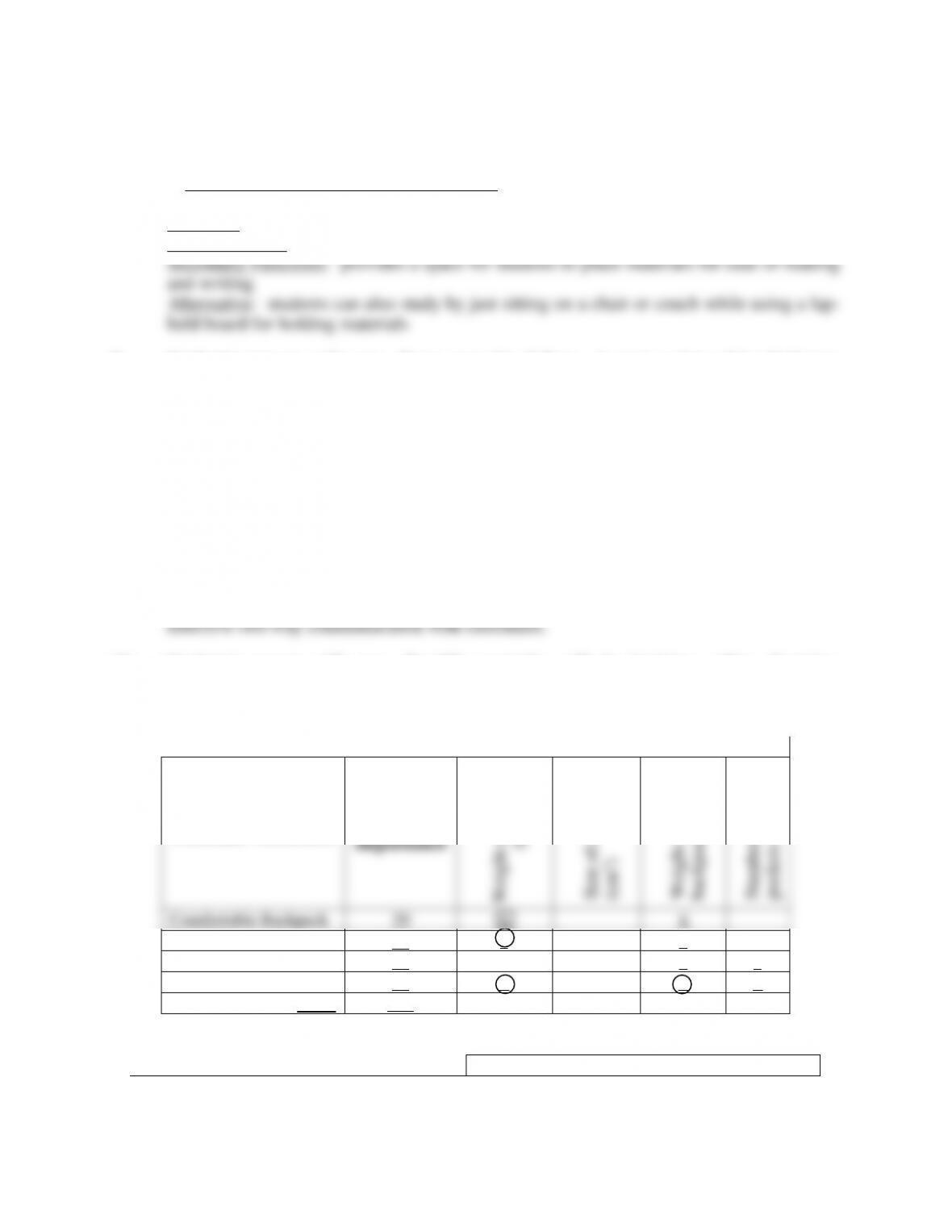
13.
Engineering Characteristics
Customer Attributes
Relative
importance
Weight of material
(kg)
Size of cloth
(cm2)
Weight of the
backpack (kg)
Number of
pockets
Comfortable Backpack
30
X
X
Durable
20
Enough room
25
Not too heavy to carry
25
X
X
X
Total
100
14.
Engineering Characteristics
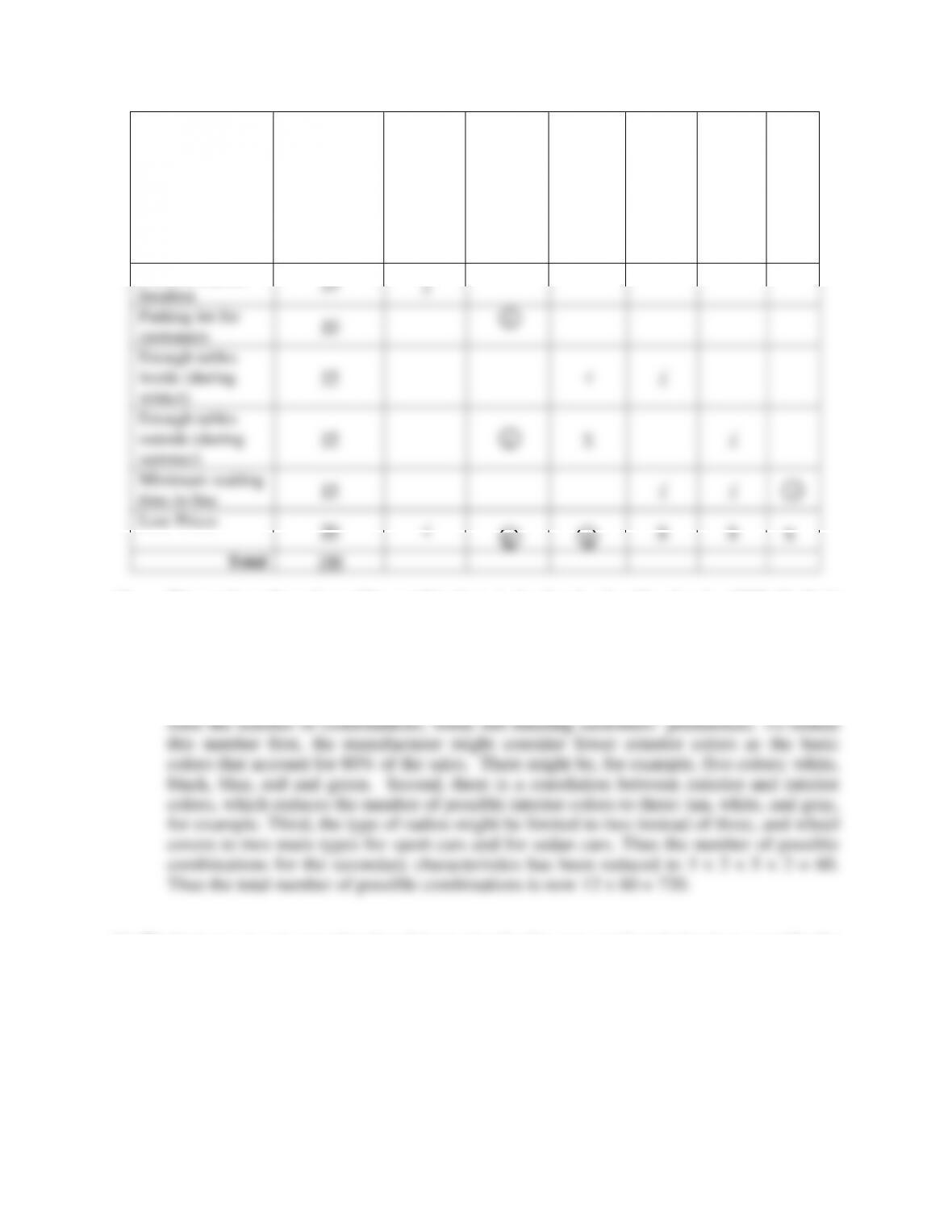
Customer
Attributes
Relative
importance
Distance from
school (m)
Size of lot (m2)
Size of building
without lot (m2)
Number of seats
inside (#)
Number of seats
outside (#)
Number of
cashiers (#)
Close to school
location
25
Parking lot for
customers
10
Enough tables
inside (during
winter)
15
Enough tables
outside (during
summer)
15
Minimum waiting
time in line
15
Low Prices
20
X
X
X
X
X
Total
100
15. The total number of possible combinations is 5 x 3 x 3 x 2 x 10 x 2 x 4 = 7200. To limit
the number of combinations, we can combine all the characteristics into two different
groups (design modules) that will reduce costs and keep enough variety at the same time.
The type of engine, type of battery, and type of transmission are core characteristics of
the car, so we cannot reduce that number of combinations: 3 x 2 x 2 = 12. Interior and
exterior colors, type of radios, and wheel covers are secondary characteristics and we can
16. The best way to get cross-functional teams involved in new product design is to consider the
following actions.
a. Provide incentives (financial and non-financial) for participating. Give team awards out
at a recognition banquet or event.
b. Management should take a direct role in forming teams and encouraging membership.
Visibility of team members is a way to encourage cross-functional teams.

4. There are two primary reasons for the increase in product variety. The first is the
marketing concept of meeting consumer needs. Since people have a wide variety of
needs, a wide variety of products are required. The second reason is the general business
philosophy of increasing profits by growth rather than through cost reduction. Products,
even if only marginally successful, will produce this growth.
5. By using the modular approach to product design, the production variety will be
decreased since only the modules need be produced. Product variety will be greatly
increased since the modules can be theoretically assembled in all possible combinations.
Even though some combinations may be impossible or impractical, the number of
potential products will still be large.
6. Operations should be involved in all stages of product design. Since the operations
function has knowledge of production capabilities and how to use these capabilities in the
most effective manner, they should interact with marketing and with engineering to
ensure that the product will be designed with production needs considered.
7. A travel agency. For prepackaged tours, the product specification would be the travel
brochure put out by the tour’s organizers. For individual trips, the product specification
would be the itinerary or ticket of the individual traveler.
A beer company. The recipe to be followed to produce beer and the packaging to be used
for the beer (bottles, cans, kegs, etc.).
8. a. Stapler:
Objective: to secure together several pieces of paper or materials
Basic Function: use a fastener to hold material together
Secondary Function: drives a staple through several pieces of material
Alternatives: to perform the same basic function with a different secondary function,
1. use a paper clip
2. use a spiral binder
3. glue the papers together with a spine
b. A Mouse for Computer Operation:
Objective: to enable user to provide inputs to the computer
Basic Function: to select objects and initiate actions on the computer
1. use the keyboard to perform basically similar functions
2. use a light-pen to perform the basic function
3. use your finger as the mouse on a tablet device to perform the basic function
c. A Desk for Use by Students for Studying:
Objective: to provide a place for studying
Basic Functions: students will be able to read and write on the desk
9. Students’ answers will vary. Some examples follow: A great variety of baseball type
hats can be constructed from a few basic styles, sizes, colors, materials such as poplin,
polyester or corduroy. Car manufacturers often mix and match various “options” to
provide a great variety of selection within a specific make and model of automobile.
10. Student answers will vary.
11. The potential benefits of using a QFD approach include: meeting or exceeding customer
requirements; better communications across departments in design, production, and sales
of the product; compatible components within a design; reduced costs of redesign; fewer
engineering change orders; lower production costs and higher quality. Potential hazards
of using a QFD approach include, increased initial design costs, having to cope with
changes in the way that design and/or production occurs, engineers failing to establish
12. Students’ answer will vary. Possible examples will be banking, online shopping,
restaurants, consulting, etc. They need to draw the house of quality as shown on Figure
3.6 with the customer attributes and engineering (design) characteristics.
13.
Engineering Characteristics
Customer Attributes
Relative
importance
Weight of material
(kg)
Size of cloth
(cm2)
Weight of the
backpack (kg)
Number of
pockets
Comfortable Backpack
30
X
X
Durable
20
Enough room
25
Not too heavy to carry
25
X
X
X
Total
100
14.
Engineering Characteristics
Customer
Attributes
Relative
importance
Distance from
school (m)
Size of lot (m2)
Size of building
without lot (m2)
Number of seats
inside (#)
Number of seats
outside (#)
Number of
cashiers (#)
Close to school
location
25
Parking lot for
customers
10
Enough tables
inside (during
winter)
15
Enough tables
outside (during
summer)
15
Minimum waiting
time in line
15
Low Prices
20
X
X
X
X
X
Total
100
15. The total number of possible combinations is 5 x 3 x 3 x 2 x 10 x 2 x 4 = 7200. To limit
the number of combinations, we can combine all the characteristics into two different
groups (design modules) that will reduce costs and keep enough variety at the same time.
The type of engine, type of battery, and type of transmission are core characteristics of
the car, so we cannot reduce that number of combinations: 3 x 2 x 2 = 12. Interior and
exterior colors, type of radios, and wheel covers are secondary characteristics and we can
16. The best way to get cross-functional teams involved in new product design is to consider the
following actions.
a. Provide incentives (financial and non-financial) for participating. Give team awards out
at a recognition banquet or event.
b. Management should take a direct role in forming teams and encouraging membership.
Visibility of team members is a way to encourage cross-functional teams.