Chapter 04 – Demanding Ethical and Socially Responsible Behavior
Name: ___________________________
Date: ___________________________
critical thinking exercise 4-2
ETHICAL DILEMMAS
Below are several situations that present ethical questions in a business. Discuss each situation (a)
1. A disgruntled employee of your major competitor mails top-secret information or new product
samples to you. Do you begin to do a dance on your desktop or do you immediately mail the in-
formation back to your competitor? What would you do?
2. You are the general manager of a regional chemical company. In the course of producing your
bulk chemicals, large amounts of particles and smoke are emitted through your plant’s smoke-
stack. The level of pollutants is below current EPA regulations, and you are violating no laws, but
neighborhood groups are complaining about minor health problems caused by the smoke. After
investigating numerous alternatives, you find the most effective solution would be to install a
“scrubber” system, which will remove 90% of the pollutants and ash. Cost: $1 million. Do you
install the system?
3. You are a general manager in a cosmetics firm. The results of a study show that your major brand
could cause skin cancer. What do you do?
4. You have the opportunity to offer a job to a friend who really needs it. Although you believe that
the friend could perform adequately, there are more qualified applicants. What would you do?
5. You are the vice president of a beer company in a state that sets the legal drinking age at 21. Your
boss asks you to organize a lobbying effort to have the drinking age reduced to 18. What would
you do?
6. Because of a loophole in federal laws you find that you could legally pay your workers less than
the minimum wage. The cost savings you recommend may mean your getting a choice promo-
tion. What would you do?

4-62
7. You are an accountant in a large firm. Your boss tells you to use a controversial accounting prac-
tice, which will make the company’s profits seem higher. She tells you it is only to impress
stockholders and will not be used in statements submitted to the IRS. What would you do?
8. You are required to fire a worker for persistent absenteeism, but you know that her absence is be-
cause she is caring for her father who is in the advanced stage of Alzheimer’s disease. You feel
that the organization is being inhumane in its attitude, but your boss remains insistent. What
would you do?
9. A worker is repeatedly late for work. You know she has family problems and is going through a
difficult period with an alcoholic husband. Her work is inconsistent—sometimes average, often
excellent. She has been with the company for nine years. On Monday she was two hours late for
work. What would you do?
10. You believe that your (male) boss is overly friendly with a (female) member of your staff and that
she is taking advantage of the situation. What would you do?
Chapter 04 – Demanding Ethical and Socially Responsible Behavior
notes on critical thinking exercise 4-2
1. This actual situation is at the heart of a dispute between rivals 3M Corporation and Johnson &
Johnson. It seems a 3M employee named Philip Stegora mailed samples he stole of a new casting
tape to J&J and three other competitors. He offered to meet and explain the technology for a fee
2. In considering whether to install the scrubber, both the short- and long-term consequences should
be addressed. While the level of pollution is legal today, is it likely to be regulated tomorrow?
What would be the public relations impact for the company if it installed the system? If it did not?
Should the company publicize the scrubber installation or avoid discussing pollution at all?
3. The key word in this question is could. The evidence is inconclusive. How would the company be
affected if the product were pulled prematurely? How would it be affected if the product causes
dozens of cancers and results in huge lawsuits?
4. This is a gray area. Hiring a friend may smack of favoritism. However, with a friend you already
6. Many smaller companies are exempt from minimum wage laws but still pay the prevailing wage.
7. This is the only black and white dilemma. To use dual accounting practices to deceive investors is
illegal.
8. This is a direct order from your superior. You might take a meeting with the supervisor to explain
9. This worker is going through a difficult time. Her work is, however, “often excellent.” The costs
4-64
10. Your boss is guilty of sexual harassment. The female member of your staff may be taking ad-
vantage of it, but that does not change the reality. The boss’s actions may open up your company
Name: ___________________________
Date: ___________________________
critical thinking exercise 4-3
RESEARCHING CODES OF ETHICS
Most companies now publish codes of ethics to provide ethical guidelines for employees. Many
1. Locate the codes of ethics for an educational institution, a media organization, and a business or-
ganization. What do the three codes have in common? In what ways do they differ?
Chapter 04 – Demanding Ethical and Socially Responsible Behavior
2. Find a company for which a previous code is available (such as IBM). Review the key sections.
How has the code changed?
critical thinking exercise 4-4
ETHICS MINICASES
Below are six short cases about real-world ethical dilemmas. For each minicase, consider what
decision you would make or action you would take.
MINICASE 1. Recycling and Unintended Consequences
4-66
1. If you were a member of the state legislature, what would you do, if anything?
2. If you were a public official (county or parish), what would you do, if anything?
3. If you were the CEO of a company manufacturing TVs, what would you do, if anything?
MINICASE 2. Wireless Wardriving
A car equipped with a laptop computer, a portable GPS receiver, and a wireless network card
drives through your neighborhood. Unknown to onlookers, the people in this car are actually “wardriv-
ing,” scanning for any wireless access points. Anyone with a wireless router is vulnerable.
open, including 8 in a local school and 1 in a firehouse.
Gathering information is no crime, but it’s illegal to access found networks. In 2003 Paul Tim-
mins and Adam Botbyl, members of the Michigan 2600 group of hackers, found this out. They were war-
driving in Southfield, Michigan, when they came upon a Lowe’s hardware store with an open wireless
network. What Timmins did next was technically illegal: He used the Lowe’s network to check his e-
mail. When he realized it was Lowe’s private network, however, he disconnected. Lowe’s became aware
of the breach and contacted the FBI, who charged Timmins with one count of unauthorized computer ac-
cess.
Some insiders believe that Lowe’s was partially responsible for the breach for not ensuring its
private wireless network was not leaking information. Others ask why consumers should not be able to
sue companies that are negligent with their personal data. California has passed a law that makes compa-
nies more responsible for protecting personal information, with stiff penalties for failure to report any
compromises.ix
1. Who is more responsible for breach in wireless security—the drivers who search for unsecured
networks or the owners/managers who leave their networks unprotected?
2. Are the wardrivers’ actions ethical? Explain.
Chapter 04 – Demanding Ethical and Socially Responsible Behavior
4-67
3. Do you believe wardriving is harmless or a crime?
MINICASE 3. Funding Cancer Research
In October 2006, Dr. Claudia Henschke released a study that showed that 80% of the lung cancer
deaths could be prevented through widespread use of CT scans. Lung cancer, by far the biggest cause of
cancer deaths in the United States, kills 160,000 people a year. The death rate is particularly depressing
Select, Eve, Grand Prix, Quest, and Pyramid cigarette brands.
An increasing number of universities do not accept grants from cigarette makers. A growing
awareness of the influence that companies can have over research outcomes has led nearly all medical
journals and associations to demand that researchers accurately disclose financing sources. Following the
New York Times article publication, the Journal of the American Medical Association published correc-
tions about unreported financial disclosures of. Dr. Henschke and Dr. Yankelevitz. The editor’s note stat-
ed that the journal was not aware of Dr. Henschke’s association with Liggett.x
1. Should the funding for the study have been disclosed? Why or why not?
2. Do you believe that the funding source affected the results?
3. What was the responsibility of the medical journals to determine the study’s validity and funding?
Chapter 04 – Demanding Ethical and Socially Responsible Behavior
MINICASE 4. Off-Label Drug Prescriptions
Before it can be prescribed in the United States, a pharmaceutical manufacturer must convince
the Food and Drug Administration (FDA) that a drug is both safe and effective against at least one dis-
ease. Any potential new drug must undergo a demanding sequence of tests to win FDA approval. If the
preliminary first stage test-tube trials go well, the proposed medicine then moves into clinical trials using
human subjects. Many drugs fail in preliminary or clinical trial levels. This kind of drug trial is consid-
ered the “gold standard” of proof for a drug’s value. According to industry estimates, it costs around $800
million to bring a drug to market. Once the drug is approved for one use, the race is on to profit from the
investment before the patent expires.
1. Should the practice of prescribing drugs off-label be restricted or regulated? Why or why not?
2. Did Warner-Lambert sales personnel act ethically in encouraging off-label use for Neurontin?
Unethically? Explain.
3. What are the prescribing physicians’ ethical responsibilities in writing off-label prescriptions?
4. Should physicians be required to disclose to patients when they have been compensated by a drug
company?
4-69
notes on critical thinking exercise 4-4
MINICASE 1.
The students’ reactions to this case will depend upon their view on regulation. Interesting discus-
sion topic in today’s political environment.
MINICASE 2.
MINICASE 3.
Regardless of the validity of this study, the results will be questioned because of the tobacco
funding. Sad result—wasted resources and no progress in medical care.
MINICASE 4.
4-70
critical thinking exercise 4-5
SOCIAL RESPONSIBILITY SUCCESSES AND FAILURES
Name at least one example of a company that succeeded or failed to be socially responsible in
each of the categories below. Describe the success or failure. Record the exact URL (Web address) of the
site you visit.
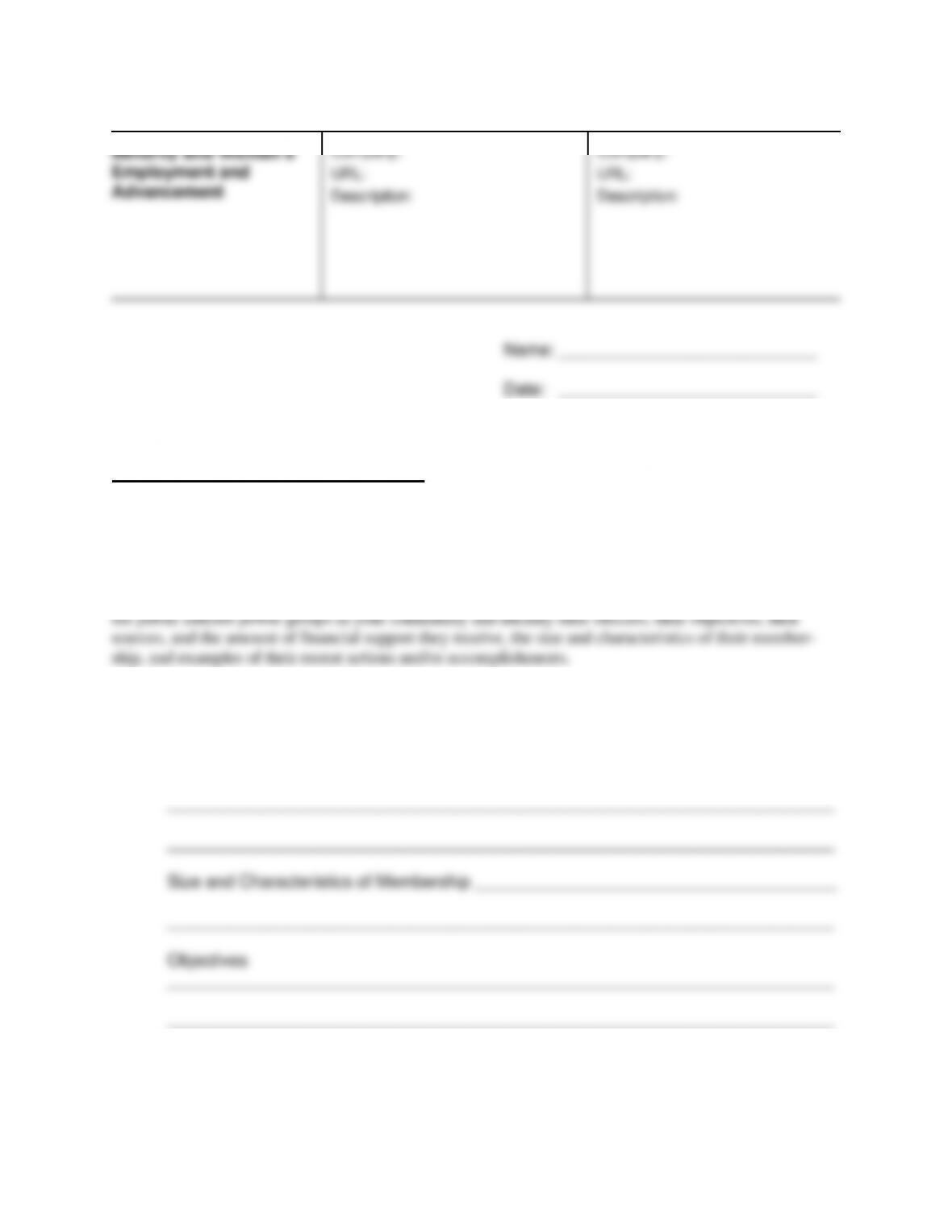
CATEGORY
SUCCESS
FAILURE
Corporate Philanthropy
Company:
URL:
Description:
Company:
URL:
Description:
Employee Health and
Safety
Company:
URL:
Description:
Company:
URL:
Description:
Environmental
Stewardship
Company:
URL:
Description:
Company:
URL:
Description:
Chapter 04 – Demanding Ethical and Socially Responsible Behavior
Minority and Women’s
Employment and
Advancement
Company:
URL:
Description:
Company:
URL:
Description:
Name: ___________________________
Date: ___________________________
critical thinking exercise 4-6
SURVEYING PUBLIC INTEREST ORGANIZATIONS
Newspapers and the Internet are full of stories about individuals and organizations that are not
socially responsible. What about those individuals and organizations that do take social responsibility se-
riously? We don’t read about them as often. Do a little investigative reporting of your own. List two of
1. ORGANIZATION Sources of Funds Annual Budget
______________________ ___________________ ____________________
Officers
Chapter 04 – Demanding Ethical and Socially Responsible Behavior
4-72
2. ORGANIZATION Sources of Funds Annual Budget
______________________ ___________________ ____________________
Officers
______________________________________________________________________
Chapter 04 – Demanding Ethical and Socially Responsible Behavior
4-73
notes on critical thinking exercise 4-6
Students can research these organizations on the Internet or call the local Chamber of Commerce
bonus case 4-1
WAL-MART’S VIRGINIA BATTLEGROUND
Although many criticisms have been lodged against Wal-Mart, perhaps the most common com-
plaint is the negative effects the retail giant’s stores have on the small communities they inhabit. After all,
Wal-Mart has long been the enemy of local businesses that can’t compete with the company’s low prices.
1. Why did Wal-Mart give up the fight to build near the historic site? Discuss.
2. What type of research does Wal-Mart do before picking a site for a new store?
3. Do you think that Wal-Mart had a right to build on a site that was near an official historic site and
that already had other retail stores? Explain.
Chapter 04 – Demanding Ethical and Socially Responsible Behavior
4-74
1. Why did Wal-Mart give up the fight to build near the historic site? Discuss.
2. What type of research does Wal-Mart do before picking a site for a new store?
3. Do you think that Wal-Mart had a right to build on a site that was near an official historic site
and that already had other retail stores? Explain.
Chapter 04 – Demanding Ethical and Socially Responsible Behavior
bonus case 4-2
MERCK AND ETHICS (PART II)
Discovered in a Merck lab in 1994, the drug was one of a new class of painkillers called COX-2
inhibitors, which reduce pain and inflammation without the side effects—ulcers and gastrointestinal
bleeding—that painkillers such as ibuprofen can cause. Vioxx worked beautifully in clinical trials with
lems. Even before FDA approval, researchers outside Merck had found evidence that it might increase the
risk of a heart attack. In 1998 a group at the University of Pennsylvania discovered that COX-2 inhibitors
interfere with enzymes thought to ward off cardiovascular disease. A 2001 study testing the drug against
nonprescription naproxen showed that Vioxx was safer than naproxen, but it also found that Vioxx dou-
bled the risk of cardiovascular problems. Merck put a positive spin on the data, highlighting the lower risk
window might be as little as three months.
The researchers who told Merck CEO Ray Gilmartin about the APPROVe results pointed out that
the company was under no obligation to recall the drug. Merck could take the data to the FDA and have
the labeling changed. In fact, the majority of outside clinicians whom Merck consulted in the first few
days suggested it do just that, since there were millions of people who were benefiting from Vioxx and
4-76
discussion questions for bonus case 4-2
1. If Merck can donate $50 million in free doses of ivermectin, what does that say about the amount
of revenue the company generates in the drug research and distribution industry?
2. In the case of Vioxx, known serious side effects were being reported and yet the company was
slow to suspend or remove the drug from the market. What does this say about the approval pro-
cess of drugs to the market and why companies would be reluctant to give up the revenue stream
for a commonly used drug like Vioxx?
3. Merck finally pulls Vioxx from the market and has 11,000 lawsuits to handle. How would you
feel if you were the company president and you were a known name and face of a company that
was responsible for the stroke or heart attack of a past user of the drug?
1. If Merck can donate $50 million in free doses of ivermectin, what does that say about the amount
of revenue the company generates in the drug research and distribution industry?
2. In the case of Vioxx, known serious side effects were being reported and yet the company was
slow to suspend or remove the drug from the market. What does this say about the approval pro-
cess of drugs to the market and why companies would be reluctant to give up the revenue stream
for a commonly used drug like Vioxx?
3. Merck finally pulls Vioxx from the market and has 11,000 lawsuits to handle. How would you feel
if you were the company president and you were a known name and face of a company that was
responsible for the stroke or heart attack of a past user of the drug?
Chapter 04 – Demanding Ethical and Socially Responsible Behavior
4-77
bonus case 4-3
A GLANCE INTO THE FUTURE: YOUR COMPUTER KNOWS
Microsoft has been on a patent roll. In recent years, it has been one of the U.S. Patent and Trade-
mark Office’s biggest customers.
But it’s one particular filing that has been grabbing headlines recently. That is a patent application
The system could also “automatically detect frustration or stress in the user” and “offer and pro-
vide assistance accordingly.” Physical changes to an employee would be matched to an individual psy-
chological profile based on a worker’s weight, age, and health. If the system picked up an increase in
heart rate or facial expressions suggestive of stress or frustration, it would tell management that he or she
needed help.
discussion questions for bonus case 4-3
1. Do you think Microsoft’s patent application should be approved by the U.S. Patent and Trade-
mark Office? Why or why not?
2. Do you think monitoring of employees in this way is ethical or unethical? Legal or illegal? Ex-
plain.
3. Would you work for a company if you knew a computer system was monitoring your perfor-
mance and measuring your vital signs? Why or why not?
Chapter 04 – Demanding Ethical and Socially Responsible Behavior
4-78
notes on discussion questions for bonus case 4-3
1. Do you think Microsoft’s patent application should be approved by the U.S. Patent and Trade-
mark Office? Why or why not?
2. Do you think monitoring of employees in this way is ethical or unethical? Legal or illegal? Ex-
plain.
3. Would you work for a company if you knew a computer system was monitoring your performance
and measuring your vital signs? Why or why not?
Chapter 04 – Demanding Ethical and Socially Responsible Behavior
4-79
endnotes
i Source: Douglas MacMillan, “Philanthropy: Causes, the Socially Conscious Network,” Bloomberg Businessweek,
October 21, 2010.
ii Sources: Corporate websites.
x Source: Gardiner Harris, “Cigarette Company Paid for Lung Cancer Study,” The New York Times, March 26,
2008.
xi Sources: Daren Fonda and Barbara Kiviat, “Curbing the Drug Marketers,” Time, July 5, 2004; “‘Off-Label Pre-
scription Drug Use Common,” Forbes, May 8, 2006; Bernadette Tansy, “Why Doctors Prescribe Off Label,” San
Francisco Chronicle, May 1, 2005; “Warner-Lambert Pleads Guilty and Is Sentenced for Criminal Health Care
Fraud Relating to Off-Label Promotion of Drug Neurontin, Reports U.S. Attorney,” PR Newswire, June 7, 2004;
Rita Rubin, “Study: Off-Label Drugs Should Be Researched for Safety,” USA Today, November 24, 2008.

Chapter 04 – Demanding Ethical and Socially Responsible Behavior
4-80