Chapter 03 – Doing Business in Global Markets
3-41
PPT 3-53
World Trade Organization
(See complete PowerPoint slide notes on page 3.73)
Chapter 03 – Doing Business in Global Markets
3-42
a. The 2001 WTO Round addressed many unre-
solved issues.
b. The Doha Round ended in 2008 with no signif-
countries that have a common external tariff, no
a. In 1999, the EU officially launched its JOINT

3-43
PPT 3-54
Common Markets
(See complete PowerPoint slide notes on page 3.73)
PPT 3-55
EU Members
TEXT FIGURE 3.8
Members of the European Union
(Text page 78)
(See complete PowerPoint slide notes on page 3.73)
Chapter 03 – Doing Business in Global Markets
that includes Brazil, Argentina, Paraguay, Uru-
currency.

3-45
PPT 3-56
NAFTA
(See complete PowerPoint slide notes on page 3.74)
Chapter 03 – Doing Business in Global Markets
property rights
3-47
PPT 3-57
CAFTA
(See complete PowerPoint slide notes on page 3.72)
PPT 3-58
New Free Trade Agreements
(See complete PowerPoint slide notes on page 3.72)
progress
assessment
(Text page 79)
PPT 3-59
Progress Assessment
(See complete PowerPoint slide notes on page 3.72.)
Chapter 03 – Doing Business in Global Markets
3-48
ers feel that the world is DIVIDING ITSELF IN-
TO MAJOR TRADING BLOCKS.
learning goal 6
Discuss the changing landscape of the global market and the issue of offshore out-
sourcing.
A. New markets present new opportunities for trade
and development.
1. ADVANCED COMMUNICATIONS have made
distant markets instantly accessible, particularly
China.
a. China’s 1.3 billion population represents a
tremendous business opportunity.
PPT 3-60
Future of Global Trade
(See complete PowerPoint slide notes on page 3.72)
lecture link 3-8
EGYPT AND THE RELIABILITY
OF SOCIAL MEDIA
The Egyptian revolution in 2010 showed how powerful ad-
vance communications can be for information circulation of
both the good and the bad. (See the complete lecture link on
page 3.82 in this manual.)
lecture link 3-9
GOOGLE VS. CHINA
Ever since Google started a Chinese version of its service,
the company has been beset with ethical dilemmas. (See the
complete lecture link on page 3.83 in this manual.)
Chapter 03 – Doing Business in Global Markets
SIA’S 150 million potential customers are
prized by global traders.
services from sources outside a firm rather than
providing them within the company.

Chapter 03 – Doing Business in Global Markets
3-51
bonus case 3-4
AFRICA: THE NEW INDIA
While many big corporations are focusing on the Indian
market, some are giving their attention to a region much like
India 20 years ago. (See the complete case, discussion ques-
tions, and suggested answers beginning on page 3.96 of this
manual.)
PPT 3-61
Outsourcing
(See complete PowerPoint slide notes on page 3.7672)
TEXT FIGURE 3.9
The Pros and Cons of Offshore
Outsourcing
(Text page 82)
There are advantages and disadvantages to the trend toward
offshore outsourcing.
MAKING
ethical
decisions
(Text page 83)
PPT 3-62
See the Sights,
Meet the Doctors
(See complete PowerPoint slide notes on page 3.76.)
Chapter 03 – Doing Business in Global Markets
3-52
lecture link 3-10
INDIAN CALL CENTERS
EXPAND TO THE UNITED
STATES
Indian companies are opening call centers in the United
States and hiring American workers to staff them .(See the
complete lecture link on page 3.56 of this manual.)
(See complete PowerPoint slide notes on page 3.77.)
progress
assessment
(Text page 83)
businesses.
C. GLOBALIZATION AND YOUR FUTURE
1. Students are encouraged to study foreign lan-
VIII. SUMMARY
Chapter 03 – Doing Business in Global Markets
3-53
PowerPoint slide notes
PPT 3-1
Chapter Title
PPT 3-2
Learning Goals
PPT 3-3
Learning Goals
Chapter 03 – Doing Business in Global Markets
PPT 3-4
Yang Lan
PPT 3-5
Name That Company
PPT 3-6
Business in the Global Market
1. The U.S. is a market of over 310 million potential cus-
tomers, but the world market is over 6.9 billion.
2. It is easy for students in the United States to lose sight
of the importance of the global market. This slide
helps them see that the international marketplace offers
businesses opportunities due to the size of the market.
Companies like Procter & Gamble and Wal-Mart have
found the international market offers opportunities for
additional revenue growth.
Chapter 03 – Doing Business in Global Markets
PPT 3-15
How Free Trade Benefits the World
1. Often it is difficult for students to see how world
trade has improved the living conditions of millions
of the world’s poorest individuals.
2. This slide shows some of the improvement in liter-
acy rates and life expectancy since 1950. These
improvements in the standard of living can be
somewhat attributed to free trade.
3. From The Economist, January 26, 2008, print edi-
tion: Twenty-five years ago two-thirds of the popu-
lation or 600 million people were living in extreme
poverty (on less than $1 a day). Now, the number
living on $1 a day is below 180 million and yet the
world’s population has increased.
4. To start a discussion ask the students: Why has
China been able to improve the living conditions of
so many of its citizens in the last twenty-five years?
(More liberal economic policies have led to greater
economic growth and an increase in the standard
of living for individuals.)
PPT 3-16
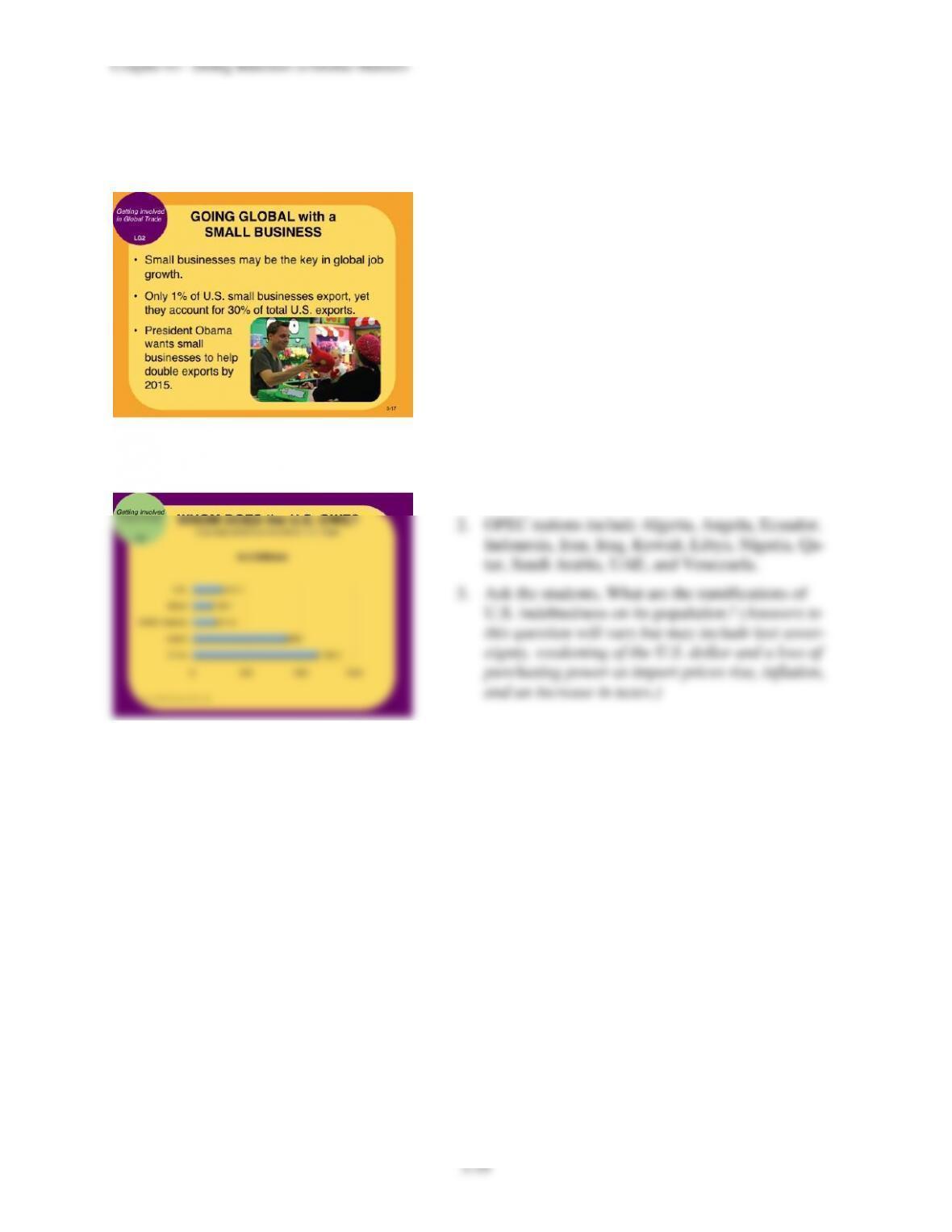
Comparative and Absolute Advantage
David Ricardo expanded on Adam Smith’s theory of ab-
solute advantage with the theory of comparative advantage.
This theory can be difficult for students to grasp. A country
should produce only what it can produce efficiently, buying
what it cannot produce as efficiently. This theory of inter-
national trade, along with Adam Smith’s Theory of Abso-
lute Advantage, has been a guiding tenet of international
trade since the late 1700s.
3-60
PPT 3-19
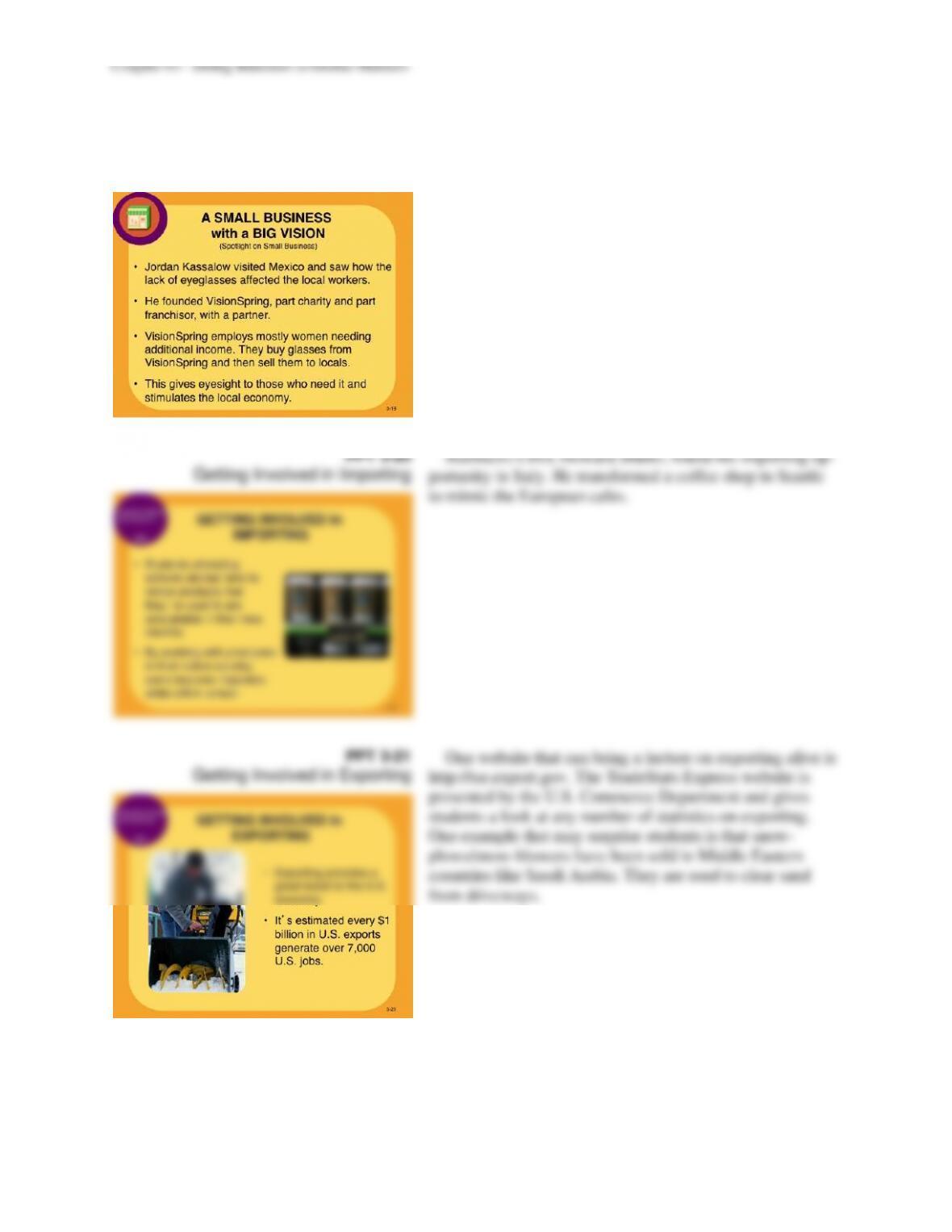
A Small Business with a Big Vision
VisionSpring is still growing, but it operates at a loss.
Donations are still essential to maintain operations.
PPT 3-20
Getting Involved in Importing
Starbucks CEO, Howard Shultz, found his importing op-
portunity in Italy. He transformed a coffee shop in Seattle
to mimic the European cafes.
PPT 3-21
Getting Involved in Exporting
One website that can bring a lecture on exporting alive is
http://tse.export.gov. The TradeStats Express website is
presented by the U.S. Commerce Department and gives
students a look at any number of statistics on exporting.
One example that may surprise students is that snow-
plows/snow-blowers have been sold in Middle Eastern
countries like Saudi Arabia. They are used to clear sand
from driveways.