Chapter 16 – Using Effective Promotions
16–61
Vehicle wrapping started in 1993 when PepsiCo bought the rights to paint six Seattle city buses
with its logo. Pepsi planned to put the buses in a paint shop for six weeks, but Louis Hoffman, general
manager for a Seattle printing company called SuperGraphics, persuaded Pepsi to have the buses wrapped
instead. Wrapping, using a vinyl material made by 3M, could be applied in less than two days. 3M uses
an adhesive similar to the one on its Post-it notes that makes the “wrap” possible. Far from hurting the
paint job, the wrap preserves it.
Brian Katz has had his car wrapped for several companies, including Jamba Juice and Verizon
Wireless. Katz says the experience has been great, although he often has to roll down his window to an-
swer strangers’ questions about Verizon’s calling plans.
Katz was matched with his advertisers by FreeCar Media, a Los Angeles ad agency that has a da-
tabase of more than a million car owners who say they will wrap their cars for a fee, says Drew Living-
ston, president of the company. According to Livingston, companies like Procter & Gamble believe the
wrap advertising is a low-cost, effective way to reach the demographic they desire. For example, the tar-
get market for a new version of Tide detergent could be defined as “stay-at–home moms with two-plus
children who live in selected markets.” Livingston’s company would then find drivers in that demograph-
ic. “We feel that when you can wrap a mom’s car and get it to her P.T.A. meeting or Curves gym, you are
getting the acceptance from her social circle.”
Another FreeCar participant, Jerome Harris, was in his junior year at Temple University when he
had his Nissan Altima wrapped for a promotion for Trolls dolls. He earned $500 a month while his car
was wrapped. In addition, he was required to hand out Trolls pens to fellow students during finals week.
The vehicle ad technique seems to pay off. Brian Morris, owner of We Fix Ugly Pools, a pool re-
pair company in Phoenix, wrapped more than 30 vehicles in his fleet in ads for his company. He says he
has earned more than $1 million in revenue over a year from people seeing one of his trucks in a driveway
or in traffic. Morris advises his drivers to find the slowest lane in rush-hour traffic and “sit in it.” He pays
for the time and the gas. “The people behind you can’t help but sit and stare.”vi
lecture link 16-8
CONAN’S TWITTER TRIUMPH
In the winter of 2010, the future looked dim for late-night TV personality Conan O’Brien. Having
taken over hosting duties on NBC’s Tonight Show just seven months earlier, Conan left the show in a fu-
ror after a scheduling dispute would have pushed his timeslot forward a half-hour. Although his exit
reaped him a cool $32.5 million, a contract stipulation that prohibited him from appearing on television
for months left him depressed. After 17 years as a fixture of late-night television, Conan’s ban from the
airwaves could have destroyed his career completely.
Luckily, Conan had the good fortune to get fired just as Twitter was growing from a niche online
tool to a widespread communication service among young people. As his battle with NBC raged, a devot-
ed fan stayed up all night crafting a triumphant picture of Conan placed in front of an American flag em-
blazoned with the message “I’m with Coco.” A Facebook fan page quickly appeared and used the image
as the standard bearer of its cause, attracting hundreds of thousands of fans in a short time. After seeing
the success of this grassroots social media movement, Conan launched his own Twitter account shortly
after he left the Tonight Show for good. The feed gathered hundreds of fans overnight, which soon turned
into thousands, then hundreds of thousands. Today, Conan’s Twitter boasts more than 2.7 million follow-
ers and counting.
Chapter 16 – Using Effective Promotions
16–62
Conan’s social media presence ensured that viewers would not forget him during the months they
had to wait before his new talk show on TBS premiered. During this downtime Conan and his producers
realized the potential of his massive online following. Conan’s live act, “The Legally Prohibited from Be-
ing Funny on Television Tour,” was advertised solely through Twitter, with most shows selling out hours
Chapter 16 – Using Effective Promotions
16–63
critical
thinking exercises
Name: ___________________________
Date: ___________________________
critical thinking exercise 16-1
ADVERTISING ON GOOGLE
1. Explain how the price of an ad on Google is calculated.
2. When purchasing search term advertising, a critical decision is identifying as many possible key
terms to describe your product as possible. Suppose you were an online organic food store and
you wanted to advertise your vegetarian spaghetti sauce on Google. What specific keywords
would you want to include? (Hint: Use the “keyword tool.”) List the best prospects.
3. Assume your daily advertising budget is $50. What would be the best combination of key terms
and cost per click to reach your target audience?
Chapter 16 – Using Effective Promotions
16–64
Name: ___________________________
1. Identify television commercials that use the following appeals:
2. What TV commercial in the last year do you remember best? Why do you remember it?
3. What is the most obnoxious or irritating or disgusting TV advertisement you have seen recently?
Why do you remember it?
16–65
1. Identify television commercials that use the following appeals: honesty, fear, emotion, sex, hu-
mor, irritation, and cost-comparison.
Honesty. Ads featuring children are perceived by the public as more honest than those featuring
adults. Children project an innocent, honest image. To an extent, celebrity testimonials try to use honesty
as an appeal, but may not work.
2. What TV commercial in the last year do you remember best? Why do you remember it?
3. What is the most obnoxious or irritating or disgusting TV advertisement you have seen recently?
Why do you remember it?

Chapter 16 – Using Effective Promotions
Name: ___________________________
Date: ___________________________
critical thinking exercise 16-3
IDENTIFYING PRODUCT PLACEMENT
Your assignment is to watch prime-time television. Not a bad assignment, right? Watch at least
two hours of prime-time programming. Try to include one drama, one comedy, and one reality program.
Watch closely and try to identify brand-name products that are featured. Record the name of the program
and the television channel. Then analyze the effect of the product placement and whether the placement is
positive or negative.
Program Name
Network
Products
Featured
Is Placement Ef-
fect Positive or
Negative? Why?
Drama
Comedy
Reality
Chapter 16 – Using Effective Promotions
16–67
Name: ___________________________
2. What is the mission of the AAAA?
3. Find the AAAA’s Standards of Practice. What does this document say about the basic beliefs or
codes of conduct for advertisers?
Chapter 16 – Using Effective Promotions
4. What advertising practices are specifically excluded on ethical grounds?
16–69
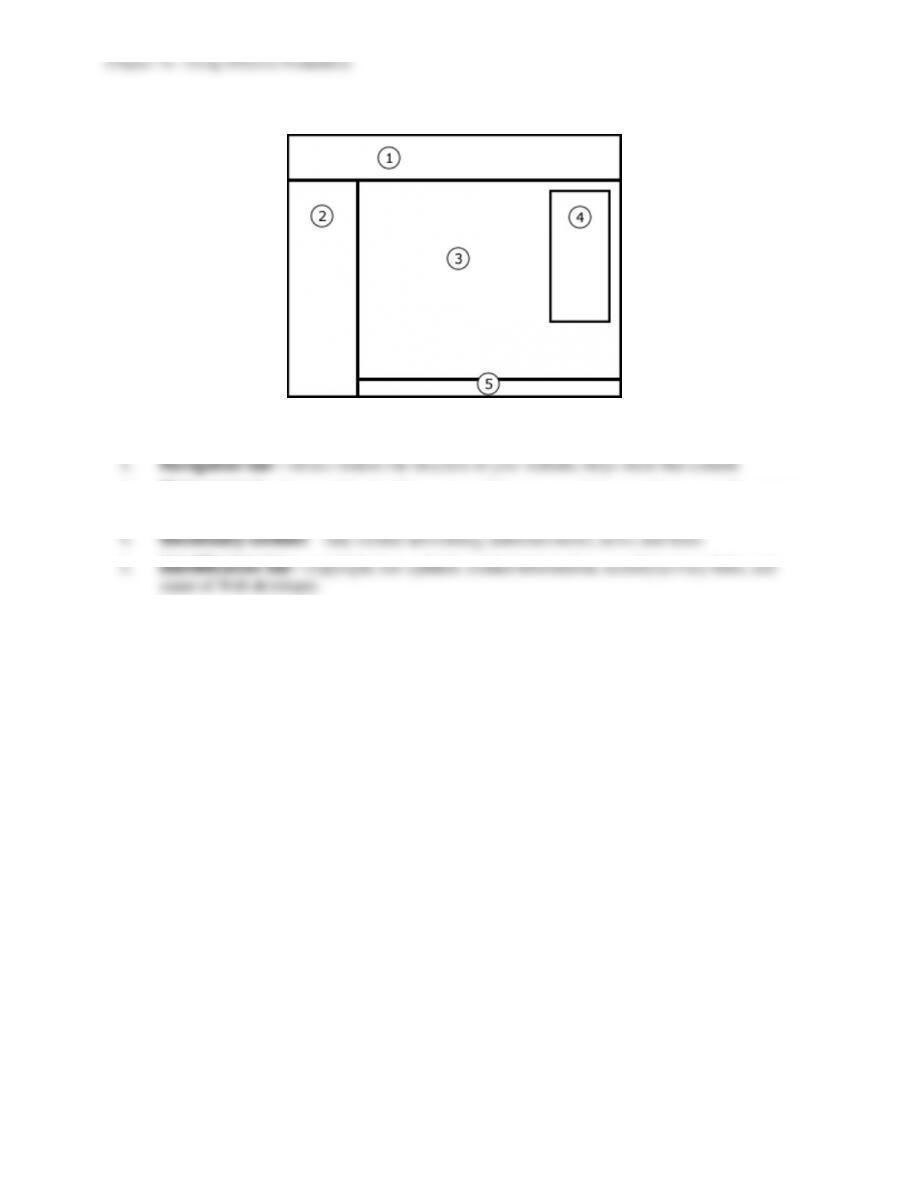
1. Site identifier—lets visitors know where they are; may include logo, name, or other graphics.
3. Main content—the page title, headings, text, and images are what your visitors actually come to
see.

critical thinking exercise 16-5 (continued)
Chapter 16 – Using Effective Promotions
16–71
bonus
cases
Only time will tell if he made the right decision. One thing is certain, though: Groupon is not as-
sured the throne of Internet discount dominance. The company faces several high-profile start-ups such as
Tippr and the Amazon-backed LivingSocial as well as established review sites like Yelp. Also, a new
study shows that employees disgruntled about the influx in deal seekers can actually harm the business
more than the promotion helps. Restaurant servers and workers in niche industries not accustomed to
1. Will Groupon’s Super Bowl ad disaster cause permanent damage to the brand?
2. What’s the major challenge for Groupon going forward?
16–72
1. Will Groupon’s Super Bowl ad disaster cause permanent damage to the brand?
2. What’s the major challenge for Groupon going forward?
Chapter 16 – Using Effective Promotions
16–73
1. What have you learned from this case about the changing role of the salesperson? What was the
biggest influence on this change?
2. What changes might new technologies like TiVo have on TV advertising?
3. Has the role of the salesperson changed dramatically or is it just different now that the salesper-
son has so many technological tools to help?
1. What have you learned from this case about the changing role of the salesperson? What was the
biggest influence on this change?
2. What changes might new technologies like TiVo have on TV advertising?
3. Has the role of the salesperson changed dramatically or is it just different now that the salesper-
son has so many technological tools to help?
Chapter 16 – Using Effective Promotions
16–74
bonus case 16-3
BP’S CRUDE REPUTATION
We’ve passed the anniversary of the catastrophic oil spill at BP’s Deepwater Horizon drilling rig.
Although the story disappeared from the front page, the effects of the spill are still glaringly apparent to
the residents of the Gulf shore. Oil slicks continue to sheen the water’s surface in certain areas. Even
worse, the 1.9 million gallons of toxic dispersants used by BP to counteract the spill led to a wave of
sickness and even deaths of Gulf residents.
Nevertheless, BP’s reputation at the corporate level remains strong. The company recently placed
in the top three on the Lundquist Employer Branding list, which studies what a company offers, its re-
cruitment process, and the accessibility of its website. But for a modern company in the age of social me-
dia and constant connectivity, industry accolades are not enough. Companies need to demonstrate a legit-
imate interest in the consequences of their actions rather than obsessing solely over how their failures will
affect the brand. If a business chooses the latter option, as BP did, consumers have countless avenues at
their disposal to express their outrage. And even after the mainstream media have moved on to the next
scandal, Internet denizens will make sure that the company’s unflattering online image remains intact.
For instance, a month after the spill a young comedy writer began the Twitter account BPGlob-
alPR. Sarcastic tweets like “Can’t we just start calling it the oil ocean and move on please?” quickly gar-
1. How are the social media changing the process of public relations?
2. Moving forward, what’s the best course for BP to follow?
16–75
1. How are the social media changing the process of public relations?
2. Moving forward, what’s the best course for BP to follow?
bonus case 16-4
GUERILLA MARKETING
Many a student sits with a can of Red Bull next to him or her when preparing for a big exam. Red
Bull, Monster, and Full Throttle are all energy drinks with giant doses of caffeine in them.
Dietrich Mateschitz is the man who introduced Red Bull to the U.S. market. Mateschitz graduated
from the Vienna University of Economics and Business Administration. His major was world trade, and
for a while he worked on the marketing of Procter & Gamble’s Blendax toothpaste. He also did some
marketing for Unilever and Jacobs Coffee. In 1987, he founded Red Bull with two Thai partners. Now he
is a billionaire.
Mateschitz is an example of a billionaire who did not invent a wonderful new product. Instead, he
made his money through creative marketing. Mateschitz bought a Thai company that already had an ener-
gy drink called Krating Daeng fired water buffalo). He changed the ingredients and the name (a little) and
added carbonation. Red Bull is not known for tasting great. Furthermore, the name isn’t very appealing
and the price is high. So what made it so popular? For one thing, Red Bull has a lot of wake-up power,
Chapter 16 – Using Effective Promotions
1. In this case of Red Bull, is it a success because of the producer discovering a real market need or
is it strictly an example of all marketing hype and very little product substance? Could it be a
combination of both factors?
2. If you were to define the marketing demographics of the target customer for Red Bull, what
would they be? How has their success created more products that are similar in the marketplace?
3. How have the entire marketing efforts of the Red Bull product been different than some of the
traditional marketing efforts or other drink products? Describe what is meant by “guerrilla mar-
keting”?
4. How much do you see the success of Red Bull to market timing or marketing perseverance? Ex-
1. In this case of Red Bull, is it a success because of the producer discovering a real market need or
is it strictly an example of all marketing hype and very little product substance? Could it be a
combination of both factors?
2. If you were to define the marketing demographics of the target customer for Red Bull, what would
they be? How has their success created more products that are similar in the marketplace?
3. How have the entire marketing efforts of the Red Bull product been different then some of the tra-
ditional marketing efforts or other drink products? Describe what is meant by “guerrilla market-
ing”?
16–77
4. How much do you see the success of Red Bull to market timing or marketing perseverance? Ex-
plain.
bonus case 16-5
WIEDEN + KENNEDY: EXPERIMENTAL PROMOTIONS
You may not know the name Dan Wieden, but you are likely to have seen his work. He is the per-
son who created the “Just Do It” slogan for Nike. His company, Wieden + Kennedy, is known as one of
the most creative advertising agencies in the United States.
One of the most controversial Nike ads from W+K featured a streaker running around a stadium
during a soccer game. The filming was so realistic that many people thought that they were witnessing an
actual event. In fact, the people in the stands were extras who were hired for the shoot. The commercial
took five days to create in near freezing weather. It’s no wonder the man in the commercial ran so fast!
With the tagline “MoreGo,” the commercial promoted Nike’s ShoxNZ.
W+K was started in Portland, Oregon, in 1982 with Nike as its sole client. By the 1990s, Nike
ads featuring Michael Jordan, Spike Lee, and Tiger Woods were being hailed as industry leaders. Wieden
was credited with bringing in a new, postmodern school of advertising that blended influences from the
popular culture, the art scene, independent film, and rock and rap music. For example, rapper Snoop
Dogg was featured in a disco Nike ad. W+K now has many other clients, including ESPN and Miller
Brewing.
As an independent ad agency, W+K is freer to experiment and take risks than traditional agencies
are. Part of that risk-taking is to move the agency into entertainment as well as advertising. For example,
W+K is putting together a Broadway musical about basketball that is set to a hip-hop beat. Its Tokyo of-
fice is launching a record label. You might also see documentary films, a weekly TV series, and MTV
music videos coming out of the agency. W+K’s first piece of self-funded entertainment was a book about
dogs in Portland. It hit the bestseller lists overseas. You can see the appeal of the book by looking at the
cover. It says, “Cat Spelled Backward Doesn’t Spell God,” an obvious dig at cat owners.
Why is an advertising agency getting involved in so many other ventures? Part of the answer is
16–78
1. What are your favorite commercials or magazine ads? What makes them special to you?
2. What celebrities’ endorsements have attracted you to buy a product? Which have turned you
away from such a purchase?
3. If you were to obtain a job in advertising, what would you enjoy doing the most: creative, writing
ad material, creating art, selling advertising to businesses, analyzing markets, shooting commer-
cials, buying media, or what?
1. What are your favorite commercials or magazine ads? What makes them special to you?
2. What celebrities’ endorsements have attracted you to buy a product? Which have turned you
away from such a purchase?
3. If you were to obtain a job in advertising, what would you enjoy doing the most: creative, writing
ad material, creating art, selling advertising to businesses, analyzing markets, shooting commer-
cials, buying media, or what?
Chapter 16 – Using Effective Promotions
16–79
endnotes
i Sources: Barbara Kiviat, “Voice Lessons,” Time Inside Business, June 2005; “Guess the Celebrity Voice-Over,”
Entertainment Weekly, August 5, 2011.
ii Source: Burt Helm, “He Puts the Soda in Pop Songs,” Bloomberg Businessweek, December 2, 2010.
iii Source: Emily Steele, “New Tools for Picking TV Hits,” The Wall Street Journal, May 23, 2011.
iv Source: Lacey Rose, “Shill Shocked,” Forbes, November 22, 2010.
v Source: Sandra M. Jones, “Coupon Use: Consumers Hunt Savings Online, Increasing Usage for First Time
since 1992,” Chicago Tribune, December 10, 2009.
vi Source: Andrew Adam Newman, “Your Ad Here, on My S.U.V.? And You’ll Pay?” The New York Times, August