Chapter 14 – Developing and Pricing Goods and Services
14–61
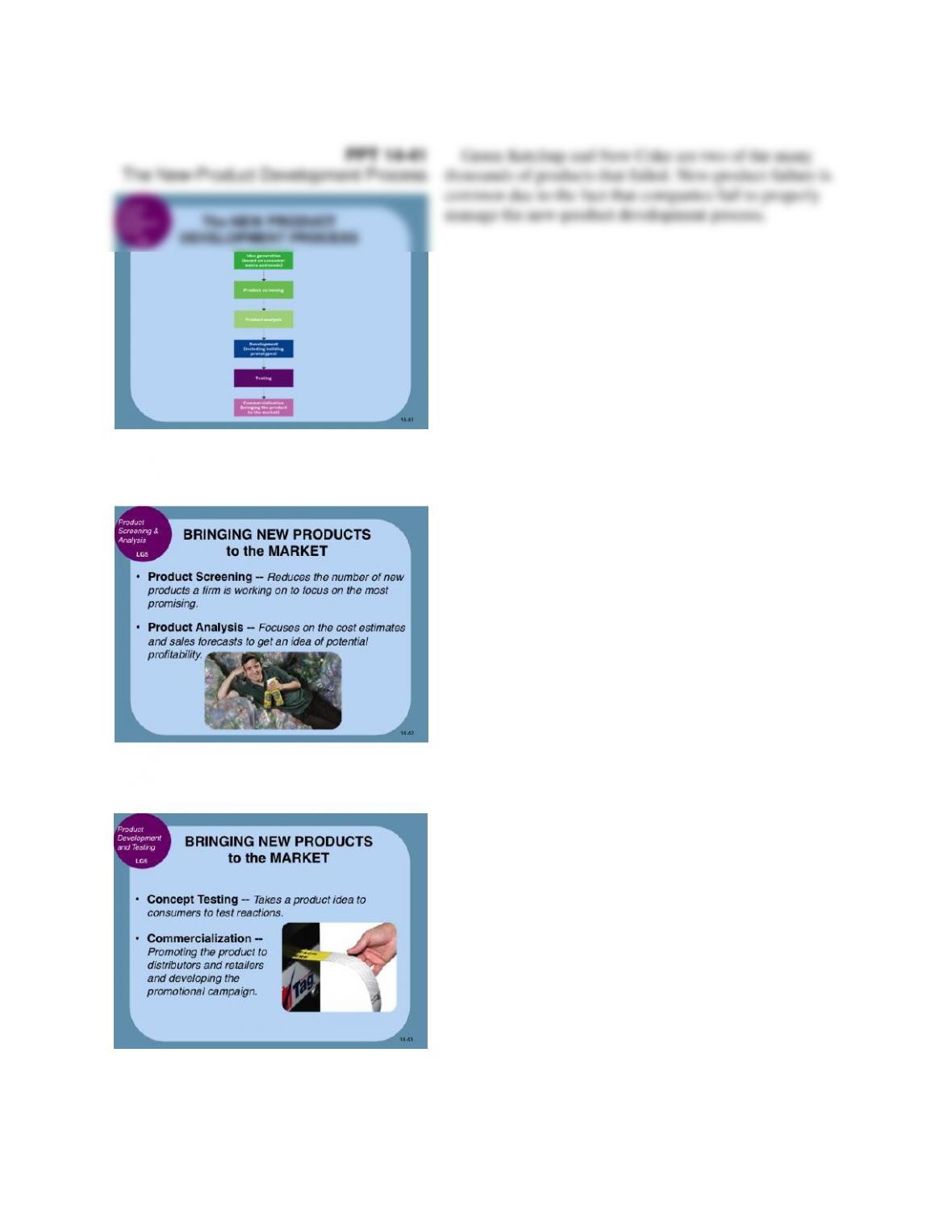
PPT 14–41
The New-Product Development Process
Green Ketchup and New Coke are two of the many
thousands of products that failed. New-product failure is
common due to the fact that companies fail to properly
manage the new-product development process.
PPT 14–42
Bringing New Products to the Market
PPT 14–43
Bringing New Products to the Market
14–62
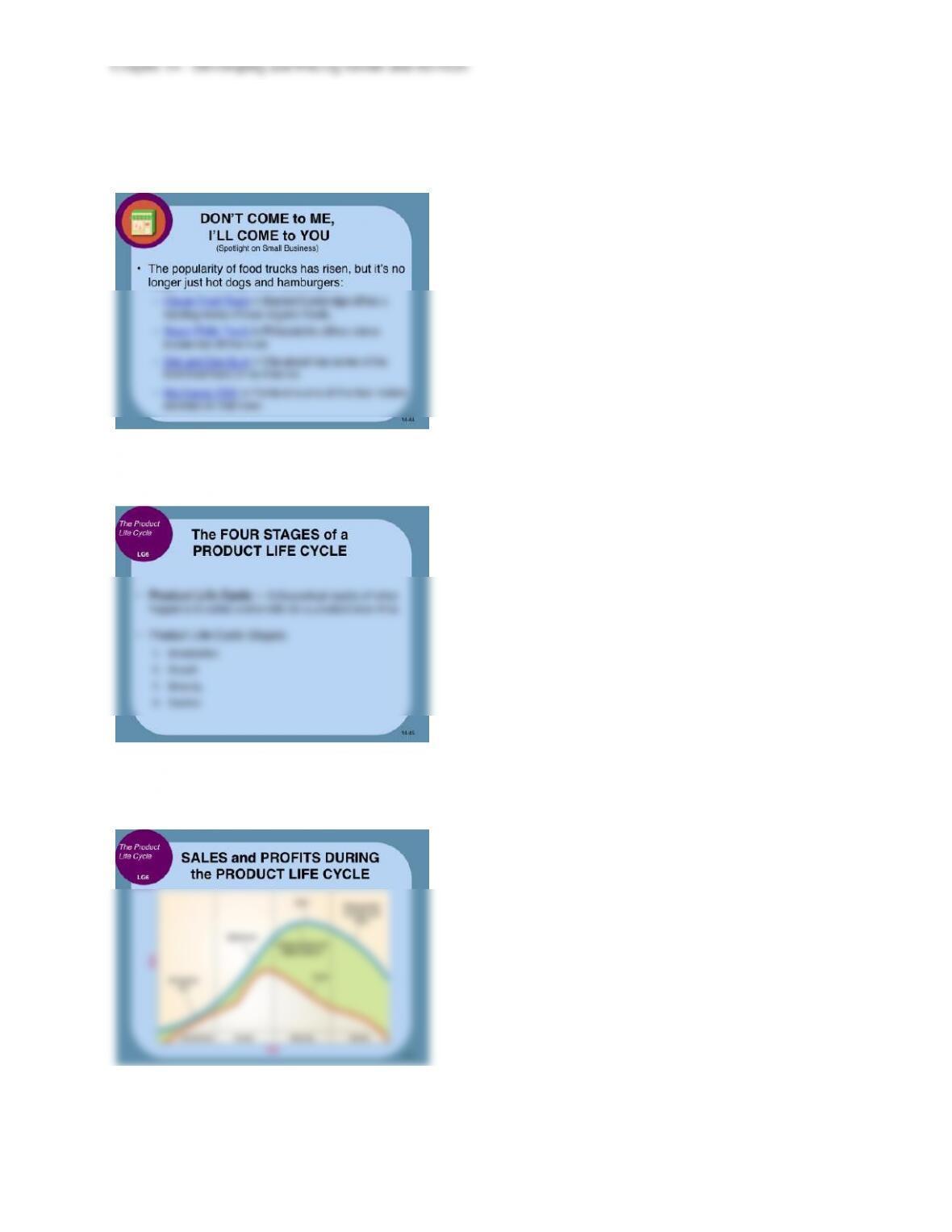
PPT 14–44
Don’t Come to Me; I’ll Come to You
PPT 14–45
The Four Stages of a Product Life Cycle
PPT 14–46
Sales and Profits during the Product Life
Cycle
Chapter 14 – Developing and Pricing Goods and Services
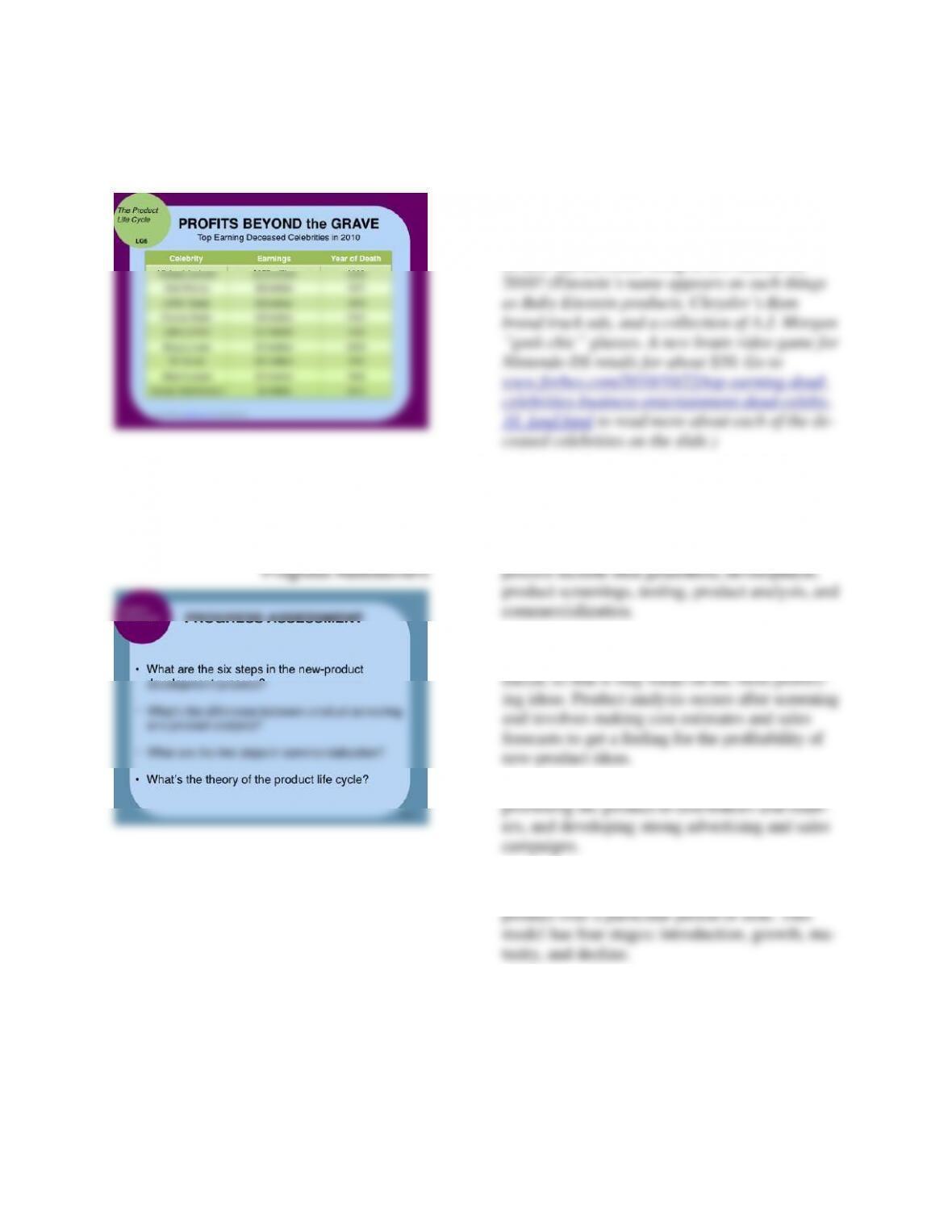
PPT 14–47
Profits beyond the Grave
1. This slide explores the top earnings of deceased
celebrities.
2. Ask the students, Albert Einstein is associated
with all things “brainy.” His earnings weren’t
generated by sales of any products he invented,
so how did his estate bring in $10 million in
2010? (Einstein’s name appears on such things
as Baby Einstein products, Chrysler’s Ram
brand truck ads, and a collection of A.J. Morgan
“geek chic” glasses. A new brain video game for
Nintendo DS retails for about $50. Go to
www.forbes.com/2010/10/22/top-earning-dead-
celebrities-business-entertainment-dead-celebs-
10_land.html to read more about each of the de-
ceased celebrities on the slide.)
3. Ask the students, What do you think the future
earnings of Michael Jackson will be?
PPT 14–48
Progress Assessment
1. The six steps in the new-product development
process include idea generation, development,
product screenings, testing, product analysis, and
commercialization.
2. During the product screening process the number
of new-product ideas a firm is working on is re-
duced, so that it may focus on the most promis-
ing ideas. Product analysis occurs after screening
and involves making cost estimates and sales
forecasts to get a feeling for the profitability of
new-product ideas.
3. The two steps in commercialization involve
promoting the product to distributors and retail-
Chapter 14 – Developing and Pricing Goods and Services
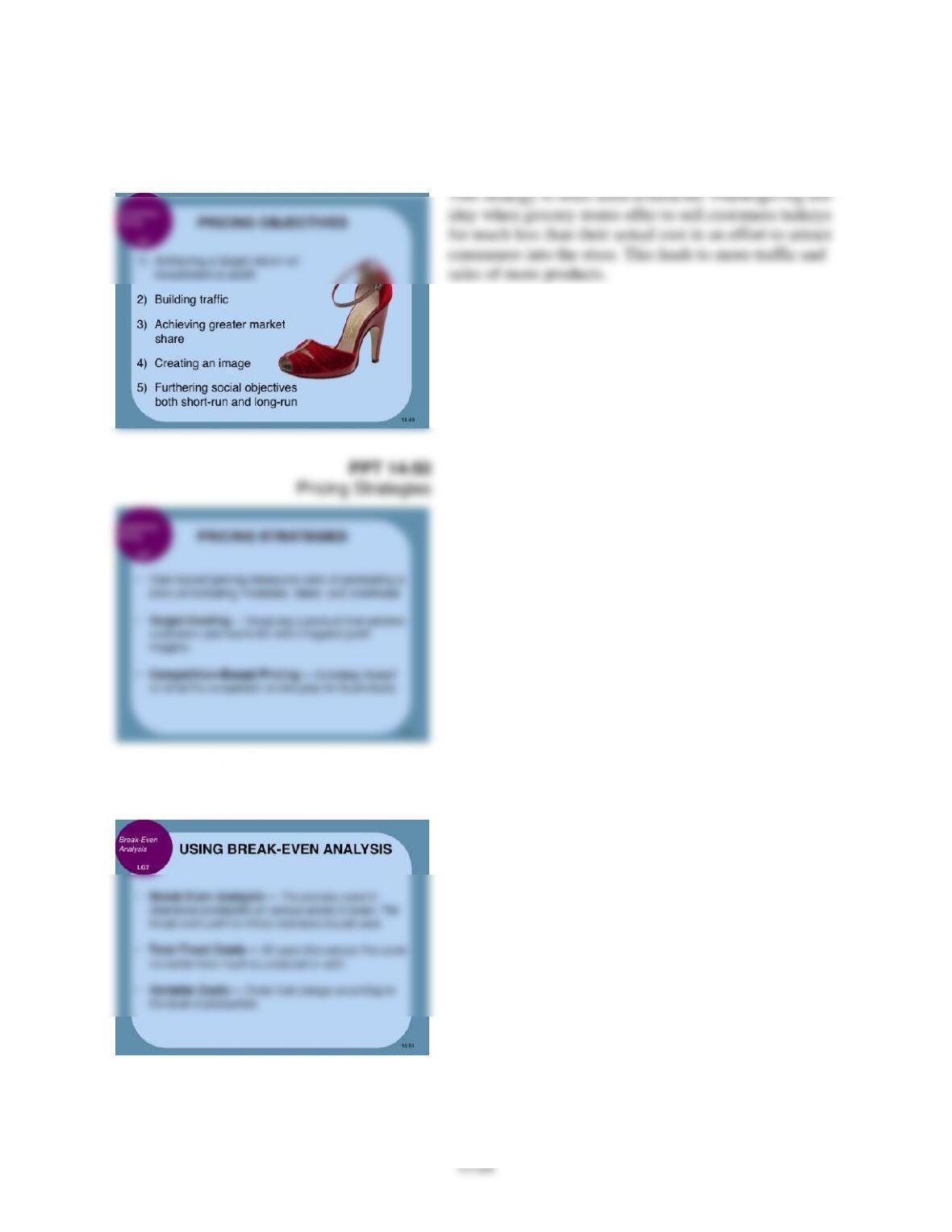
PPT 14–49
Pricing Objectives
One strategy many students have experienced but
might not fully understand is the loss leader strategy.
This strategy is often used around the Thanksgiving hol-
iday when grocery stores offer to sell customers turkeys
for much less than their actual cost in an effort to attract
consumers into the store. This leads to more traffic and
sales of more products.
PPT 14–50
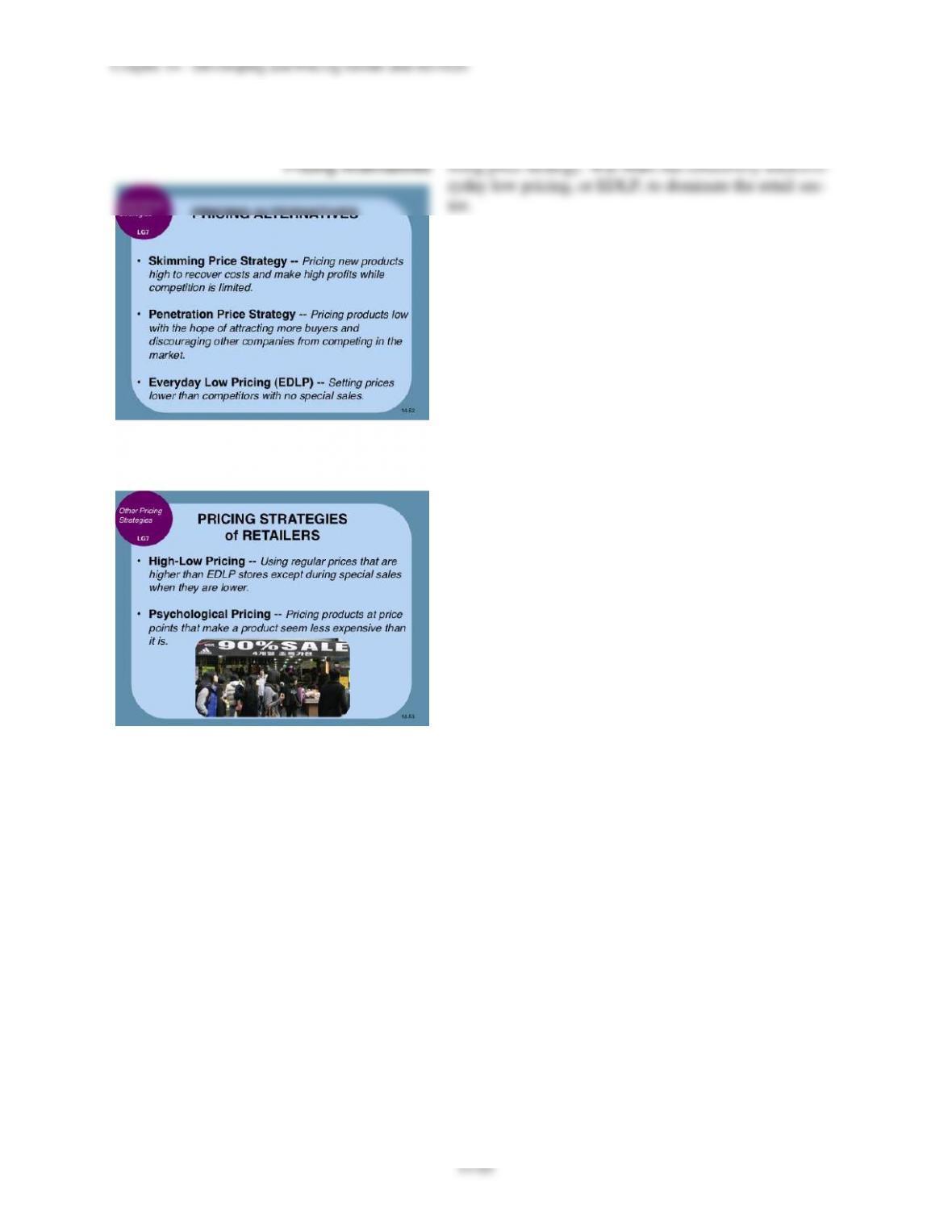
Pricing Strategies
PPT 14–51
Using Break-Even Analysis

14–66
PPT 14–54
Progress Assessment
1. Short-term pricing objectives include loss lead-
ers and are designed to build traffic as well as
achieving greater market share. Long-term pric-
ing objectives include achieving a target return
on investment and creating a certain image. It is
important that marketing managers set pricing
objectives in context of other marketing deci-
sions, since the pricing objectives may differ
greatly.
2. The limit of a cost-based pricing system is that in
the long run it is not the producer that establishes
price but rather the marketplace. To effectively es-
tablish price, the producer must take into account
competitor prices, marketing objectives, actual
cost, and the expected cost of product updates.
3. Psychological pricing involves setting the price
of goods or services at price points that make the
product appear less expensive. For example, a
TV may be priced at $999, since it sounds less
expensive than $1,000.
Chapter 14 – Developing and Pricing Goods and Services
14–67
lecture
links
“People want economy and they will pay any price to get it.”
Lee Iacocca
lecture link 14-1
THERE IS NO SUCH THING AS A “BETTER” PRODUCT
It may seem outrageous at first to see think that “There is no such thing as a ‘better’ product,” but
hear me out. Often it is best to understand a concept by looking at some examples. So, here goes. Which
school offers the better product: Harvard, Berkeley, or this school? To answer that question, one has to
Chapter 14 – Developing and Pricing Goods and Services
14–68
One mistake people make is to think that better means better quality. That often happens in engi-
neering schools, but it can happen anywhere. If you cannot afford a Cadillac and Cadillac improves the
quality of the car, is the car now a better car for you? Of course not. You couldn’t afford one without in-
For example, a BMW is not a better product than a Ford just because it costs more or has more
prestige. In fact, a Ford may be a better product for a lot more people because it is more affordable. Can
you see that a product you can’t afford is not better, at least not for you? But it’s clear that there are many
products that are perceived as better. For example, a BMW is usually perceived as better than a Ford. On
Chapter 14 – Developing and Pricing Goods and Services
14–69
lecture link 14-2
THE VENETIAN’S TROUBLES IN MACAO
The business world is no stranger to gamblers. Entrepreneurs take risks every day pursuing vari-
ous ventures that could either make them a bundle or send them home with an empty wallet. For Sheldon
As it turned out, Adelson was right about the casino, but wrong about the brand. While the Vene-
tian Macao, operated by Adelson’s Sands China, has kept afloat thanks to legions of steady gamblers, the
rest of the casino’s attractions remain lifeless. Revenues for nongambling services at the Venetian Macao
lecture link 14-3
A CANVAS ON A KLEENEX BOX
Though the cardboard box that encases a stack of tissues adds little to the functionality of the
product itself, Kleenex has turned the once unassuming tissue box into a work of art and, more important-
ly, into one of its central selling tools. Sales of Kleenex dropped 5% since 2007 as consumers turn to
cheaper generic brands. In an effort to bring sales back up, Kleenex’s parent Kimberly-Clark set its sights
on a more style conscious market by offering over 100 different Kleenex box designs.
For decades following its 1924 founding, solid colors and a small array of floral designs were the
Chapter 14 – Developing and Pricing Goods and Services
lecture link 14-4
THE NEW BARCODES
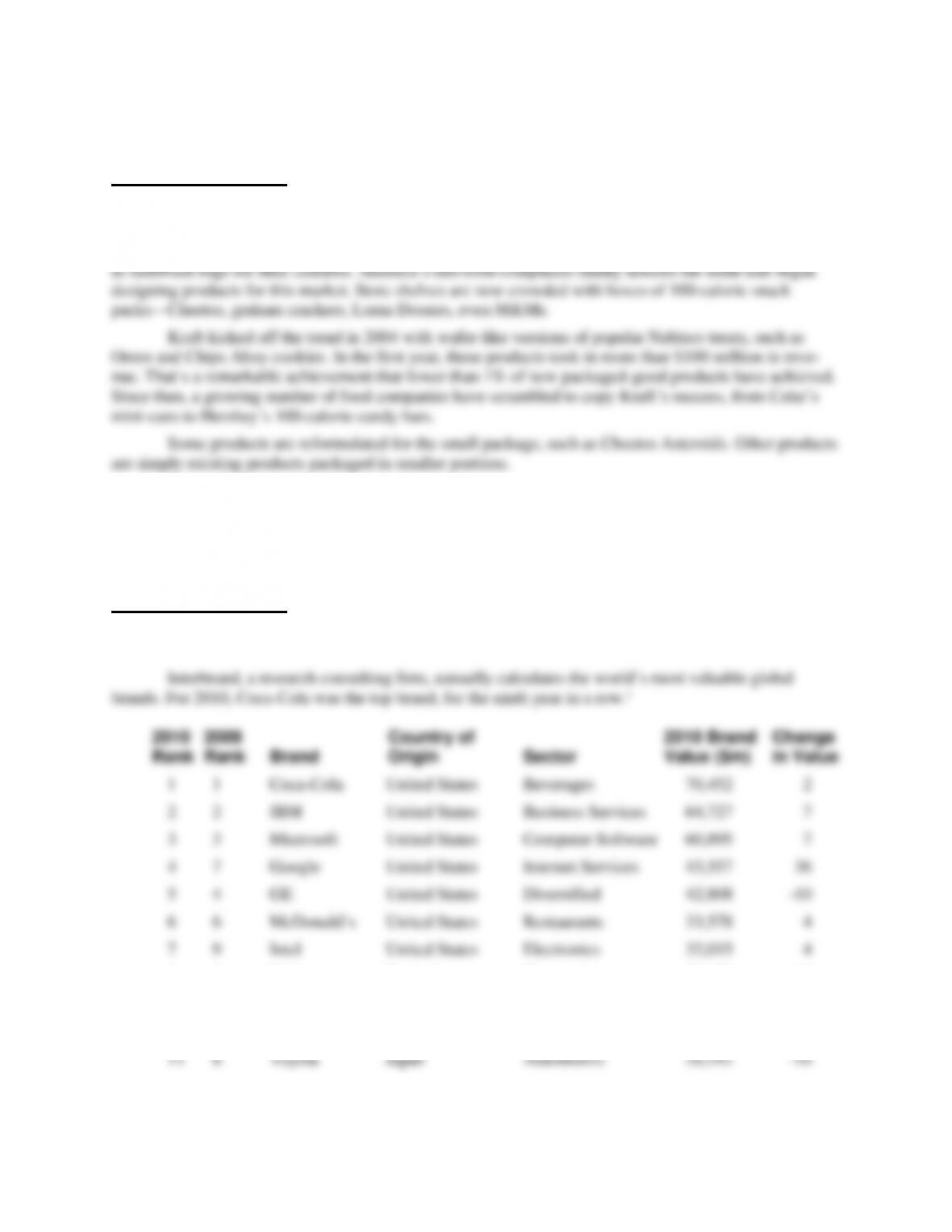
The Universal Product Code (UPC) found on all consumer products has undergone a makeover in
the U.S. market. While the rest of the world has long used a 13-digit barcode, U.S. companies resisted
changing from their 12-digit system. In 2004, the Uniform Code Council, the nonprofit industry group
that oversees barcode standards in North America, adopted the global standard in 2004, and gave retail
stores just months to update their systems to accept the new codes. For retailers, the changeover did not
affect cash-register scanning. These machines could already read the longer codes. Retailer conversion
problems involved the back-end software systems that retailers use for inventory control and automated
reordering.
manufacturers and registered in centralized databases through regional authorities like the
Uniform Code Council.
• The final digit (8) is a check digit. The 12 previous digits are run through a mathematical al-
Chapter 14 – Developing and Pricing Goods and Services
14–71
lecture link 14-5
THE 100-CALORIE SNACK ATTACK
For years, mothers have carefully portioned out handfuls of crackers or cookies and packed them
Customers could emulate those mothers and bag their own snacks, but increasingly they are let-
ting companies such as Kraft and Nabisco do it for them, even thought they pay significantly more per
serving for the product. Also driving the trend is America’s ongoing weight-loss quest. Customers appear
to be willing to pay a little more to bolster their self-control.iv
lecture link 14-6
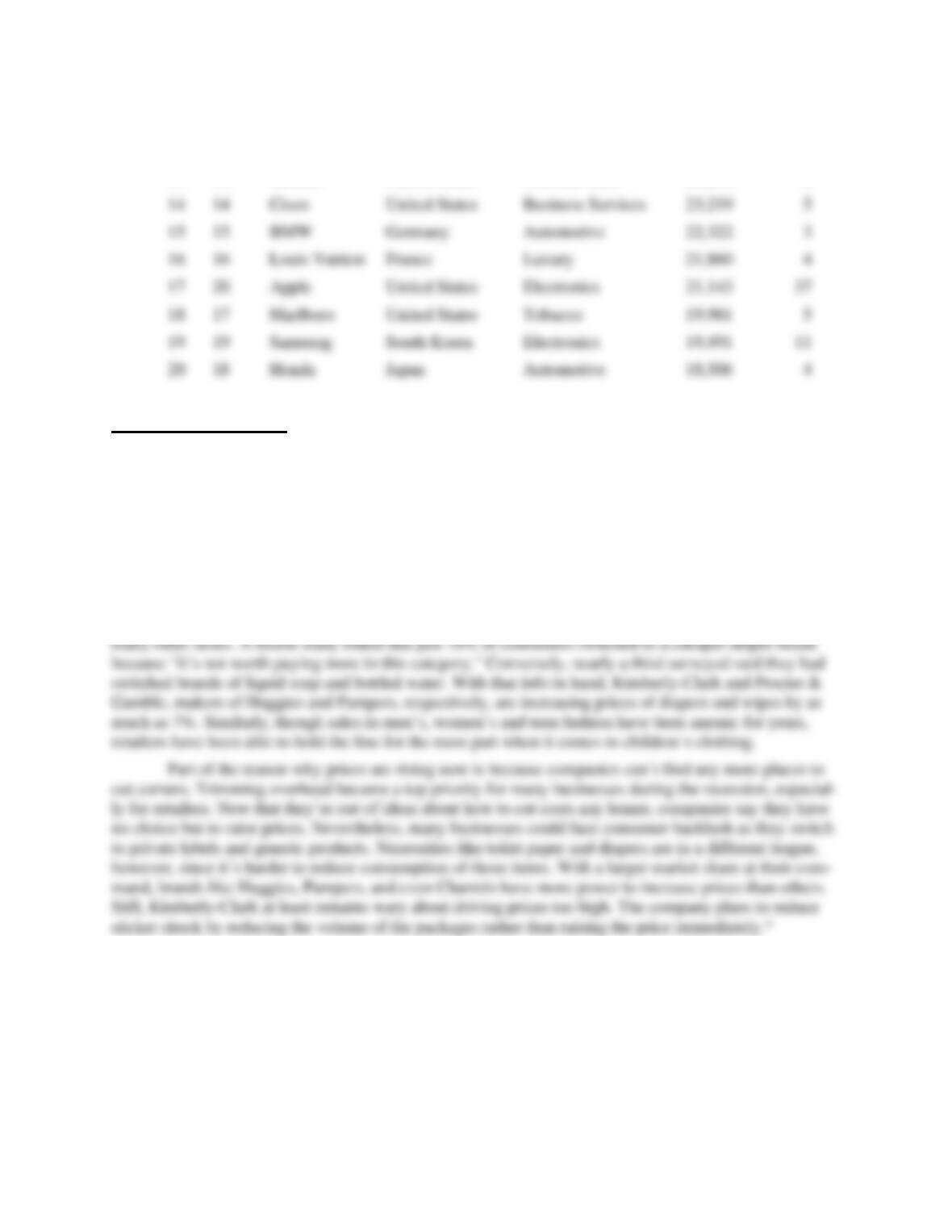
THE MOST VALUABLE BRANDS
8 5 Nokia Finland Electronics 29,495 -15
9 10 Disney United States Media 28,731 1
10 11 Hewlett-Packard United States Electronics 26,867 12
Chapter 14 – Developing and Pricing Goods and Services
14–72
12 12 Mercedes-Benz Germany Automotive 25,179 6
13 13 Gillette United States Personal Care 23,298 2
lecture link 14-7
BABY PRODUCTS STAY STRONG AS PRICES RISE
Thanks to rising commodities costs, the product discounts that people enjoyed during the reces-
sion are on the decline. With prices on brand-name items spiking across the board, consumers once again
are flocking to generic equivalents to lessen the impact on their wallets. But at least one retail sector is
enjoying stable sales at the premium level. Sales of name-brand baby items from diapers to clothing are
staying steady as parents cut corners on their own personal products, but pay the higher prices for kids’
merchandise.
Market analysts found that shoppers are less likely to buy cheaper brands of baby products than
Chapter 14 – Developing and Pricing Goods and Services
14–73
lecture link 14-8
BRAND MANAGEMENT ICONS
Most Americans recognize the Michelin man—the symbol of what is now the world’s leading tire
company. Today he is pictured as a friendly younger cousin to the cuddly Pillsbury Doughboy, but he was
far from cuddly in his earliest incarnations.
The Michelin man made his first appearance in an 1898 ad. He was pictured as a frightening,
mummy-like gladiator. Back then he was also known as the “road drunkard.” To this day his official
lecture link 14-9
THE MYSTIQUE OF COCA-COLA
One of the masters in product differentiation is Coca-Cola. The brand is worth $65 billion world-
wide. A critical element in this success is the aura of mystery around the product’s formula.
The 120-year-old formula for Coca-Cola is stored in a vault in the bowels of a SunTrust Bank in
Atlanta. That is one certainty. Everything else surrounding it—the need for a vote by Coke’s board of di-
Chapter 14 – Developing and Pricing Goods and Services
14–74
lecture link 14–10
TOP 10 NEW PRODUCTS IN HISTORY
Three hundred and fifty research and development executives were polled by New Product De-
velopment newsletter on the top 10 new products of all time. Their choices, in order, were:
3. Telegraph
7. Vaccine
8. Telephone
lecture link 14–11
EXTENDING THE LIFE CYCLE ON A ROLLER COASTER
America’s love affair with the roller coaster has lasted over a century. In the final decades of the

Chapter 14 – Developing and Pricing Goods and Services
14–75
lecture link 14–12
EXTENDING SWEETHEARTS
Every Valentine’s Day millions of them appear on desks, tables, and lunch counters—the heart-
shaped candies inscribed with messages like “I Love You” and “Kiss Me.” The Sweethearts candies are
manufactured and sold by the New England Confectionery Company (NECCO). Necco is one of the
lecture link 14–13
RISING FOOD PRICES
Throughout the recession, value reigned supreme in the retail sector. Customers continue to