Chapter 11 – Human Resource Management: Finding and Keeping the Best Employees
PPT 11–61
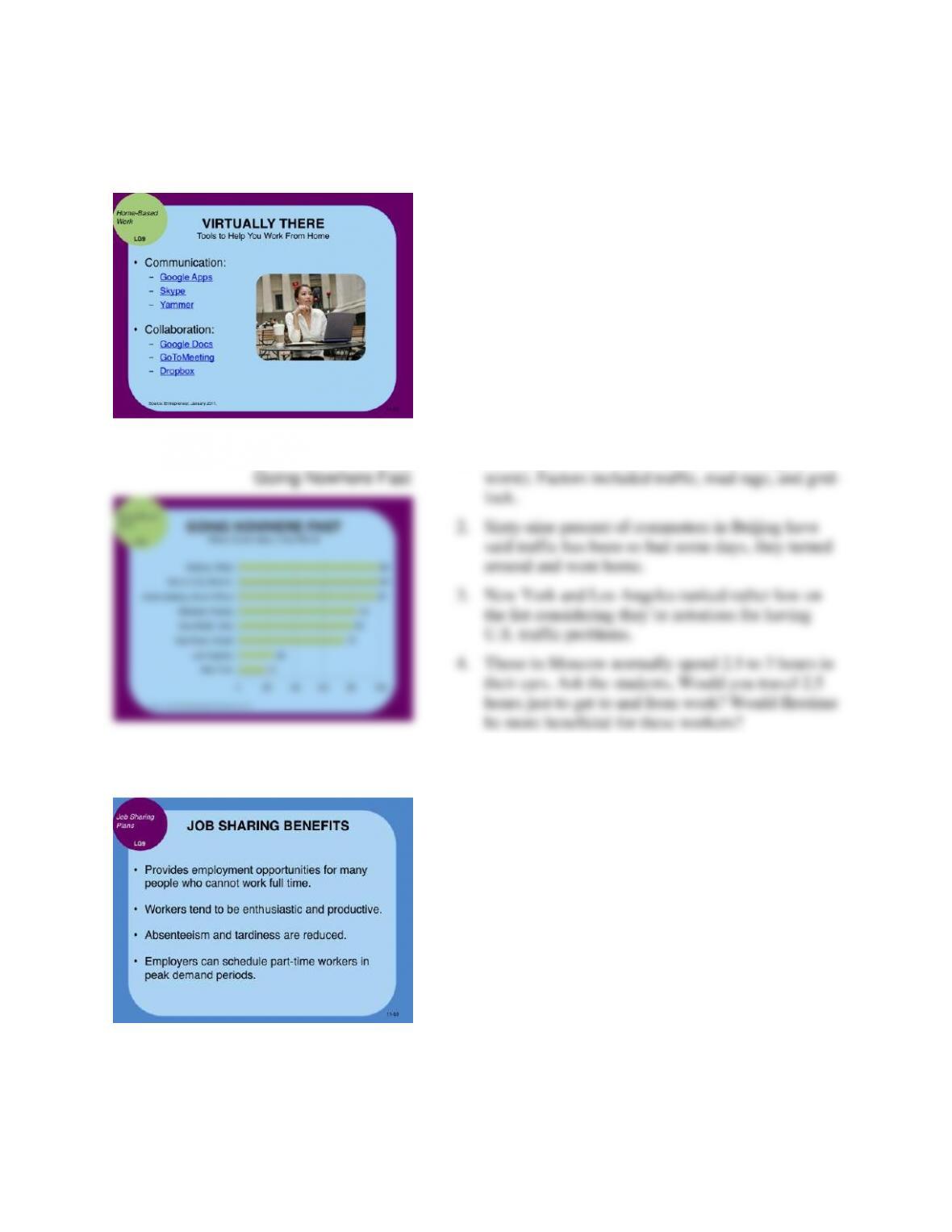
Virtually There
Click on these links to visit pages containing useful tools
for working outside the office.
PPT 11–62
Going Nowhere Fast
1. IBM ranked cities from 1 to 100 (100 being the
worst). Factors included traffic, road rage, and grid-
lock.
2. Sixty-nine percent of commuters in Beijing have
said traffic has been so bad some days, they turned
around and went home.
3. New York and Los Angeles ranked rather low on
the list considering they’re notorious for having
U.S. traffic problems.
4. Those in Moscow normally spend 2.5 to 3 hours in
their cars. Ask the students, Would you travel 2.5
hours just to get to and from work? Would flextime
be more beneficial for these workers?
PPT 11–63
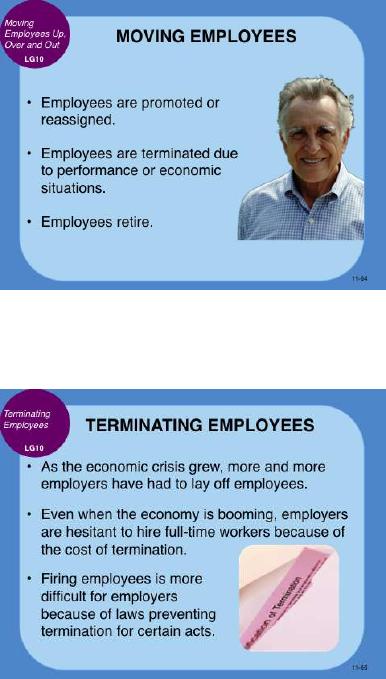
Job-Sharing Benefits
Chapter 11 – Human Resource Management: Finding and Keeping the Best Employees
11–82
PPT 11–64
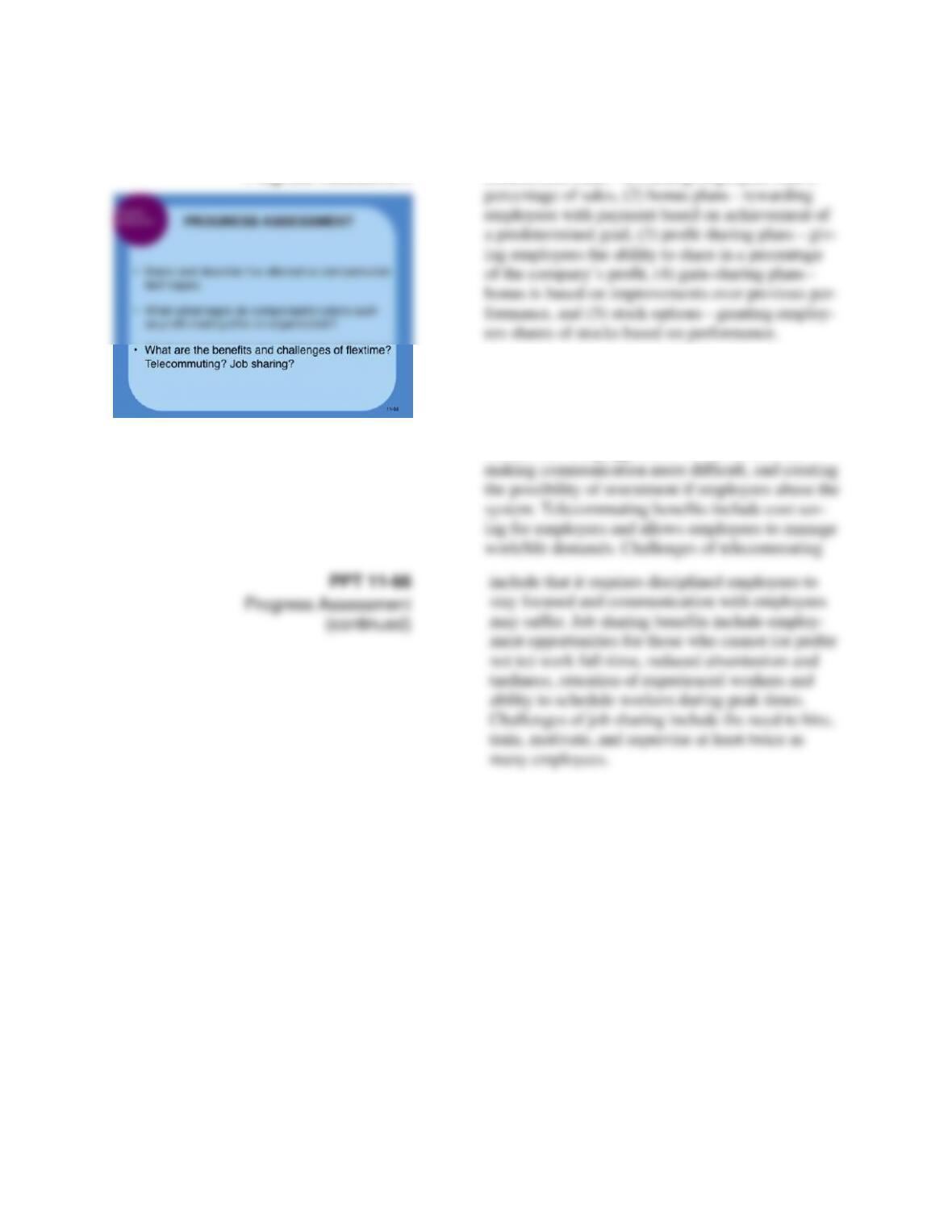
Moving Employees
PPT 11-65
Terminating Employees
Chapter 11 – Human Resource Management: Finding and Keeping the Best Employees
PPT 11-66
Progress Assessment
1. Alternative compensation techniques include: (1)
commission Plans – rewarding employees with a
percentage of sales, (2) bonus plans – rewarding
employees with payment based on achievement of
a predetermined goal, (3) profit sharing plans – giv-
ing employees the ability to share in a percentage
of the company’s profit, (4) gain-sharing plans –
bonus is based on improvements over previous per-
formance, and (5) stock options – granting employ-
ees shares of stocks based on performance.
2. The hope is that profit sharing plans will motivate
employees to think like owners.
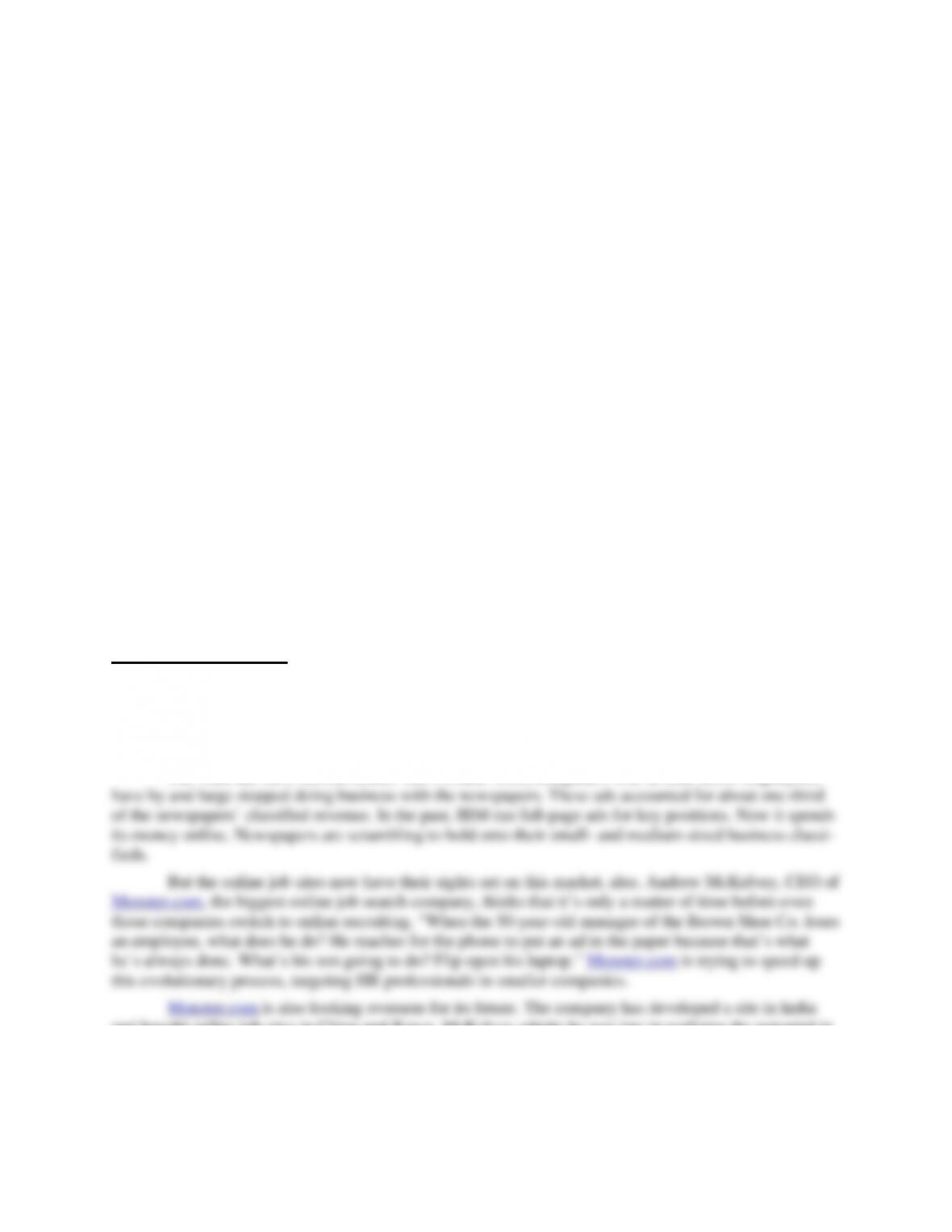
3. Flextime benefits include allowing employees to
adjust to work/life demands. Challenges of flextime
include not being applicable for all businesses,
making communication more difficult, and creating
the possibility of resentment if employees abuse the
system. Telecommuting benefits include cost sav-
ing for employers and allows employees to manage
work/life demands. Challenges of telecommuting
PPT 11-66
Progress Assessment
(continued)
include that it requires disciplined employees to
stay focused and communication with employees
may suffer. Job sharing benefits include employ-
ment opportunities for those who cannot (or prefer
not to) work full-time, reduced absenteeism and
tardiness, retention of experienced workers and
ability to schedule workers during peak times.
Challenges of job sharing include the need to hire,
train, motivate, and supervise at least twice as
many employees.
Chapter 11 – Human Resource Management: Finding and Keeping the Best Employees
11–84
lecture
links
“Never fear the want of business. A man who qualifies himself well for his call-
ing, never fails of employment.”
Thomas Jefferson
“The first quality that is needed is audacity.”
Winston Churchill
“If each of us hires people who are smaller than we are, we
shall become a company of dwarfs. But if each of us hires people who are bigger than we
are, we shall become a company of giants.”
David Ogilvy
“Every organization has an allotted number of positions to be filled by misfits.”
Owens’ Theory of Organizational Deviance (Murphy’s Law)
“Once a misfit leaves, another one will be recruited.”
Owens’ Corollary
lecture link 11-1
WHERE HAVE ALL THE WANT ADS GONE?
In 2000, the Sunday Boston Globe had about 100 pages of help-wanted classified ads. In 2011, it
had three. What happened?
The want ads have moved online. The Fortune 1000, companies with at least 2,500 employees,
and bought online job sites in China and Korea. McKelvey admits he was late in realizing the potential in
Asia and passed up an opportunity to enter the Chinese market in the early 1990s. The company can no
longer ignore the largest country in the world. He believes that China will generate more online recruiting
revenue than the United States in the next decade.
Chapter 11 – Human Resource Management: Finding and Keeping the Best Employees
11–85
lecture link 11-2
FINDING GOOGLE PEOPLE
Have you ever made a profit from a catering business or a dog walking enterprise? Do you prefer
to work alone or in groups? Have you ever set a world record in anything? The right answers could help
get you a job at Google.
Google has tried to hire people with straight-A report cards and double 800s on their SATs. Now
“As we get bigger, we find it harder and harder to find enough people,” said Laszlo Bock,
Google’s vice president for people operations. “With traditional hiring methods, we were worried we will
overlook some of the best candidates.”
As a result, Bock has been trying to make the company’s rigorous screening process more effi-
cient. Until now, head hunters said, Google largely turned up its nose at engineers who had less than a 3.7
Chapter 11 – Human Resource Management: Finding and Keeping the Best Employees
11–86
The data from this initial survey were then compared with 25 separate measures of each employ-
ee’s performance. Again there were traditional yardsticks—the employees’ reviews, both by supervisors
and peers, and their compensation—and some oddball ones.
Even as Google tries to hire more people faster, it wants to make sure that its employees will fit
into its freewheeling culture. The company boasts that only 4% of its workforce leaves each year, less
than other Silicon Valley companies. And it works hard to retain people, with free food, time to work on
personal projects, and other goodies. Stock options and grants certainly encourage employees to stay long
enough to take advantage of the company’s surging share price.ii
lecture link 11-3
MAKING AN IMPRESSION WITH VIDEO RESUMES
In this age of intense employment competition, many job seekers do whatever they can to set
themselves apart from the pack. One of the newer ways to do that is to create a video resume (CV). A
Nevertheless, video resumes are not a traditional way to list one’s qualifications. In a 2008 survey
of senior executives from the nation’s top 1,000 companies, only 24% said they accepted video resumes.
Some bosses even claim they’ve tossed out applications with video resumes if their inbox is too full. But
as the years have passed and personal video technology has grown dramatically, more and more employ-
Chapter 11 – Human Resource Management: Finding and Keeping the Best Employees
11–87
lecture link 11-4
INTERVIEW BLUNDERS
The following are a few questions interviewers should never ask prospective employees:
• Are you married/single/engaged/divorced/dating anyone?
• Do you have/plan to have children?
• How old are you?
• When was the last time you were thrown in jail?
• Do you rent or own your home?
• Have you ever declared bankruptcy?
1. They are not job-related.
2. They are often directed to members of groups that have suffered past discrimination.
Interviewees typically do not think they are in a position to refuse to answer the question. What
should an interviewee do if the interviewer asks such questions?
Chapter 11 – Human Resource Management: Finding and Keeping the Best Employees
11–88
Stay calm. Be objective and dispassionate. The interviewer probably does not intend to offend
Ask the interviewer a question. If you aren’t able to redirect the interviewer’s question (i.e.,
the question is asked again after you’ve given a response like above), ask “How is that
lecture link 11-5
MEMORABLE JOB INTERVIEWS
Everybody wants to put their best foot forward at a job interview, but the pressure of the inter-
view can sometimes make interviewees lose their common sense. Here are a few mishaps that are good
enough for a gag reel:
• One candidate arrived at an early morning interview and asked to use the interviewer’s
• An interviewer asked a job candidate, “What do you know about us?” He leaned back in his
chair and replied, “Not much. Why don’t you fill me in?”
Chapter 11 – Human Resource Management: Finding and Keeping the Best Employees
11–89
• After answering the first few questions, an interviewee picked up his cell phone and called
• The company was actually pursuing one candidate. He was impressive on the phone, and
an interview was set up at a five-star restaurant. He showed up dressed inappropriately and
• During an interview, a call came in from the applicant’s wife. The interviewer heard:
“Which company? How much? When do I start?” The interviewer said, “I assume you’re
not interested in continuing our interview?” He promptly replied, “That depends on wheth-
er you’ll pay me more.” He wasn’t hired, and it turned out there was no other job offer. His
conversation was a scam to get a higher offer.iv
lecture link 11-6
PERSONALITY TESTING FOR JOB APPLICANTS
A job applicant today is likely to be asked to take a personality test. At least 30% of employers—
from Wal-Mart to DuPont—use a version of personality tests in hiring. Even CEOs get tested. Carly Fio-
Chapter 11 – Human Resource Management: Finding and Keeping the Best Employees
11–90
Personality tests screen for five basic personality traits: extroversion, agreeableness, emotional
stability, conscientiousness, and openness to experience. There are two types of personality tests—
”screen-out” and “screen-in.” Screen-out tests like the Minnesota Multiphasic Personality Inventory
lecture link 11-7
BACKGROUND CHECKS: SECURITY AND PRIVACY ISSUES
Traditionally, employers have used background checks to screen applicants so they can find the
best new employees. Today’s heightened concerns for security coupled with improved technology means
background checking has become more widely used.
Current events illustrate some of the reasons for this increase. Child abuse and abductions
prompted the enactment of new laws that require background checks for anyone seeking to work or to
With companies increasingly relying on preemployment background checks, it’s important to get
the information right. But the background checking industry lacks consistent standards, which can cause
errors that can disqualify reputable job applicants. One applicant for an Office Depot cashier position was
rejected when a criminal background check revealed a lengthy history of drug convictions in Washington,
although she had never been to the state. She fought for six weeks to clear her name and eventually got
the job.
Even more disturbing are the cases in which preemployment screening misses something im-
Chapter 11 – Human Resource Management: Finding and Keeping the Best Employees
11–91
Despite the necessity of these background checks, applicants are not without rights. For example,
employers need to obtain written consent from applicants before performing background checks. The Fair
Some information requires the authorization of the subject. Education records and military ser-
vice records are confidential except for “directory information” such as name, dates, degrees, and military
rank. Medical records are confidential, and the subject’s specific permission is required for release. The
lecture link 11-8
THE INVASIVE DANGERS OF FACEBOOK
There is a double-edged sword when it comes to social networking websites. To their credit, sites
like Facebook and LinkedIn allow users to easily keep in touch with friends and business contacts. But
what seems at first like a private interaction between a closed network of friends is actually very public.
Chapter 11 – Human Resource Management: Finding and Keeping the Best Employees
11–92
Many Facebook users consider this use of their profiles as an invasion of their privacy. They also
feared that the website tie-ins could be exploited to hack into users’ accounts like e-mail phishers do. As
such, Facebook immediately implemented an opt-out policy, but that didn’t solve the entire problem. A
hired Lisa Brummel, a veteran product manager.
According to Brummel, her first weeks felt as though she were flying at night without instru-
ments. At first she was receiving about two e-mails a day from employees. “There was no communication
with employees—none,” she says. “It was a gulf.” Internal surveys—which at most companies help in-
form HR policy—presented a picture of a happy, contented workforce. Brummel didn’t buy the rosy find-
when the company needed to be more collaborative; it was unfair; it made frank evaluations less likely.
Here Brummel faced high-level opposition. Ballmer believed that the “forced curve” review—
giving a few people the top grade, most a pass, and laggards failing marks—was the key to Microsoft’s
we-take-the-hills culture. When Brummel approached Ballmer about an overhaul, she met with steely re-
sistance.
Chapter 11 – Human Resource Management: Finding and Keeping the Best Employees
11–93
In the first year, Brummel’s policies reduced turnover from 10 to 8.3%. Despite Ballmer’s early
fears, the new performance rating system has not led to grade inflation. The company successfully re-
leased the Vista operating system (although initial market acceptance was disappointing) and its stock
price rebounded.viii
lecture link 11–10
KEEPING TALENTED EMPLOYEES: IT’S THE FRINGE THAT COUNTS
When Celeste Volz Ford started Stellar Solutions, an aerospace engineering services firm, she
used her talent in problem solving and analytical approach to create the “ideal” working environment for
The company’s benefit package reinforces Ford’s vision of pampering talented employees. In ad-
dition to medical, disability, and life insurance, Stellar offers maternity and paternity leave, tuition reim-
bursement, and generous retirement contributions. Ford donates $1,000 a year to each employee’s charity
of choice.
Every worker also receives an individual benefit account. A lump sum equal to 25% of each em-
Chapter 11 – Human Resource Management: Finding and Keeping the Best Employees
11–94
lecture link 11–11
ENCOURAGING HEALTHY WORK–LIFE BALANCE
When it comes to work, Americans have a little problem: We don’t know when to say when.
Now E&Y encourages employees to create flexible schedules that accommodate both their per-
sonal and their professional lives. Some work full-time from January to March, then a reduced schedule
the rest of the year. Others leave work early to pick up kids from school, then work from home later.
lecture link 11-12
THE DANGERS OF FLEXTIME
During a time when many employed Americans fear the loss of their jobs, the millions of people
who either telecommute or work on flextime schedules may have the most to worry about. Reduced time
Chapter 11 – Human Resource Management: Finding and Keeping the Best Employees
11–95
But other less stringent managers see an innate benefit in flexible schedules and telecommuters.
Such arrangements offer savings on real estate and office costs, and workers are often more productive
when their schedules better fit their lifestyles. One part-timer at a Burlingame, California, consulting firm
was so productive as a reduced time worker that her boss kept her onboard while more senior full-timers
lecture link 11–13
USING THE EXIT INTERVIEW FOR FEEDBACK
Getting feedback on problems is the only way to prevent them from recurring. One often-
overlooked way of getting this feedback is through the exit interview. Interviews with employees who
voluntarily leave the organization serve a dual purpose. For employees, exit interviews are a chance to say
many things they haven’t been able to say before. For employers, the interviews can be an excellent
source of information. Many companies, however, do not conduct exit interviews, or conduct them inef-
fectively.
A good exit interview should consist of structured and unstructured questions. If the employee is
counting on a reference, he or she may be unwilling to be too truthful. To put the employee at ease and
get honest information, some human resource professionals recommend writing the reference in advance
ee a chance to figuratively change the work environment. Prepare for a candid answer.
“What best helped you achieve your goals?” This is where managers find out which employee-
support systems are working and which are not. If, for example, the vice president’s open door policy was
useful in getting some project underway, the policy could be encouraged among other senior managers.
“What did you dislike about the work environment here?” An exit interview survey at a Boston
Chapter 11 – Human Resource Management: Finding and Keeping the Best Employees
11–96
Finally, the exit interview information should be used. Managers at AT&T produce a twice-
yearly, in-depth analysis of exit interview findings, which are presented to the senior vice president of
human resources. The information is used to reexamine policies, make suggestions for change, and gener-
ally help retain skilled employees. Some of the best ideas have come from people who are leaving.
critical
thinking exercises
Name: ___________________________
Date: ___________________________
critical thinking exercise 11-1
EXPANDING THE WORKFORCE
You are the human resource manager for Kaiser Electronics, Inc. Kaiser is considering expanding
its operations in order to double its current $1.5 million in sales in five years. This means production must
double. It will require expanding the workforce and payroll. You have been asked to project the staffing
levels and payroll costs necessary to expand. You report that in addition to the current workforce, the fol-
lowing personnel will be required:
Now you must estimate the costs of adding these personnel to the payroll. Use the chart “Future
Payroll Estimates” to compute your projection figures (assume the current pay scales remain unchanged).
Then use the chart to answer the following questions:
1. What will be the projected annual payroll cost?
2. If Kaiser does double its sales in five years, what percentage of sales will payroll be in five years?
What percentage is it today?
3. Would you recommend the expansion? Why or why not?