SOLUTION Continued
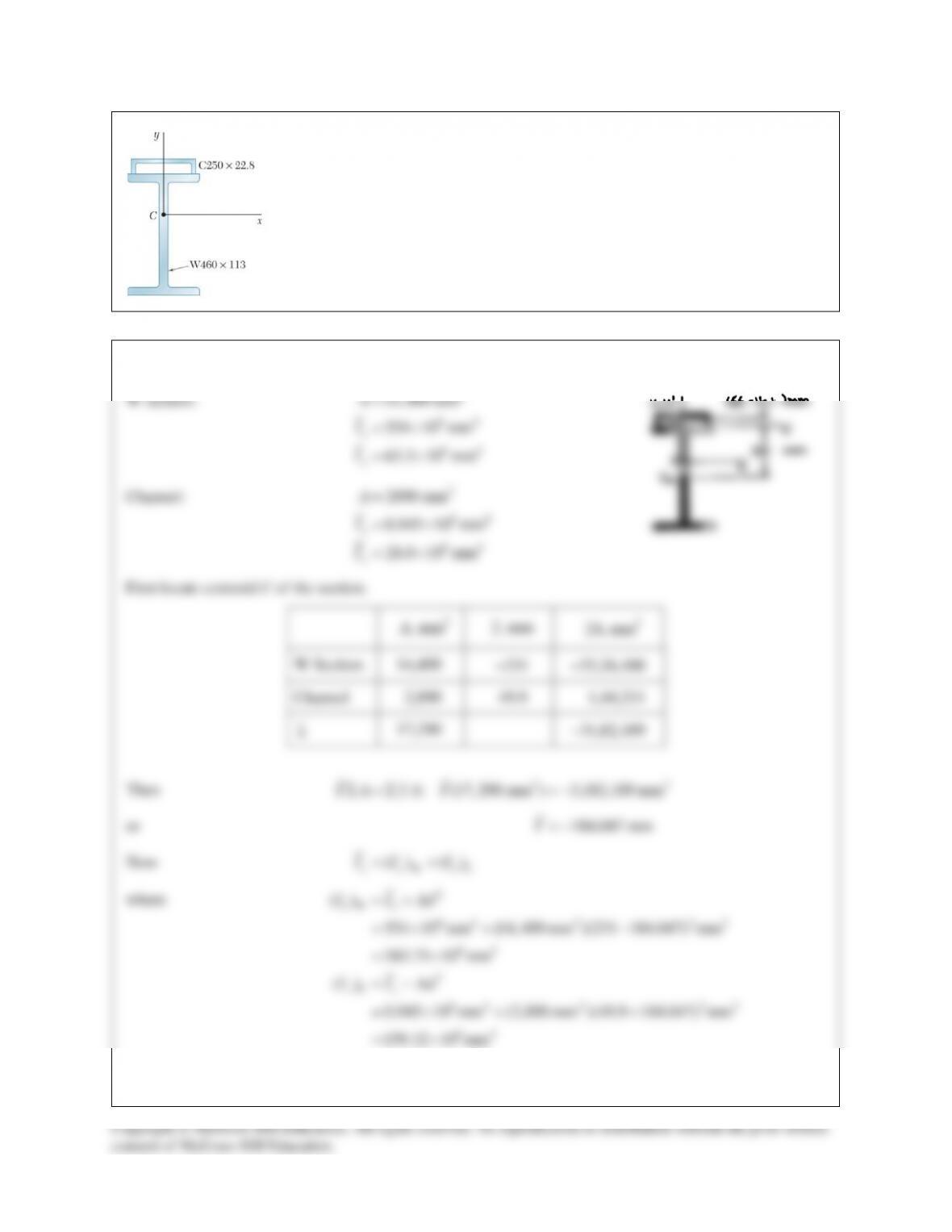
PROBLEM 7.48
The strength of the rolled W section shown is increased by welding a channel to
its upper flange. Determine the moments of inertia of the combined section with
respect to its centroidal x and y axes.
SOLUTION
W section:
2
64
64
14,400 mm
554 10 mm
63.3 10 mm
x
y
A
I
I
=
= ×
= ×
Channel:
2
64
64
2890 mm
0.945 10 mm
28.0 10 mm
x
y
A
I
I
=
= ×
= ×
First locate centroid C of the section.
A, mm2
, mmy
3
, mmyA
W Section 14,400 −231 −33,26,400
Channel 2,890 49.9 1,44,211
Σ
17,290 −31,82,189
Then
23
: (17,290 mm ) 3,182,189 mmY A yA YΣ=Σ =−
or
184.047 mmY= −
Now
WC
() ()
xx x
II I= +
where
2
W
64 2 22
64
2
C
64 2 22
64
()
554 10 mm (14,400 mm )(231 184.047) mm
585.75 10 mm
()
0.945 10 mm (2,890 mm )(49.9 184.047) mm
159.12 10 mm
xx
xx
I I Ad
I I Ad
= +
=×+ −
= ×
= −
=×+ +
= ×
SOLUTION Continued
Then
64
(585.75 159.12) 10 mm
x
I= +×
or
64
745 10 mm
x
I= ×
also
W
64
() ()
(63.3 28.0) 10 mm
y y yC
II I= +
=+×
or
64
91.3 10 mm
y
I= ×
consent of McGraw–Hill Education.
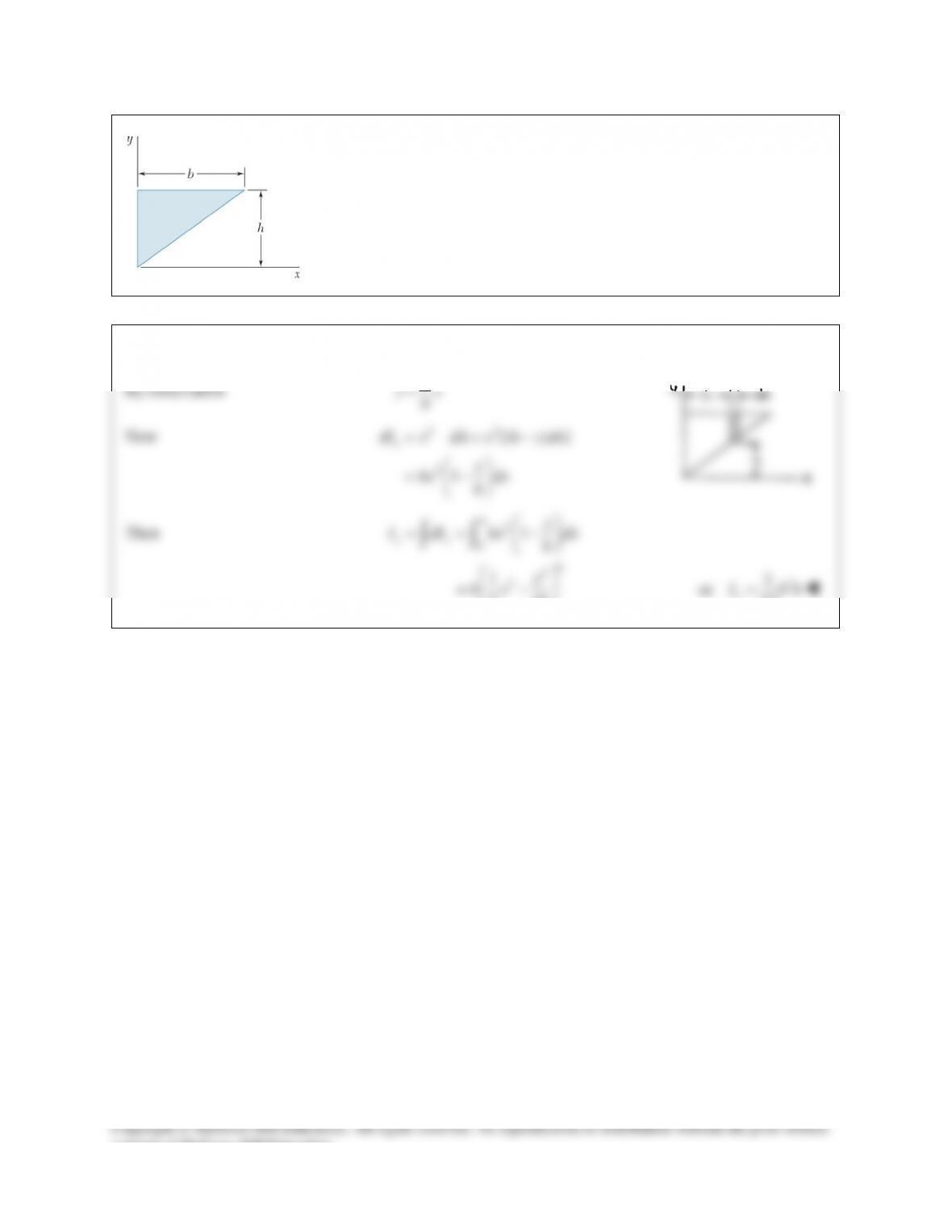
PROBLEM 7.49
Determine by direct integration the moment of inertia of the shaded area
with respect to the y axis.
SOLUTION
By observation
h
yx
b
=
Now
22
2
[( ) ]
1
y
dI x dA x h y dx
x
hx dx
b
= = −
= −
Then
2
0
1
b
yy
x
I dI hx dx
b
= = −
∫∫
4
3
0
1
34
b
x
hx b
= −
3
1
or 12
y
I bh=
consent of McGraw–Hill Education.
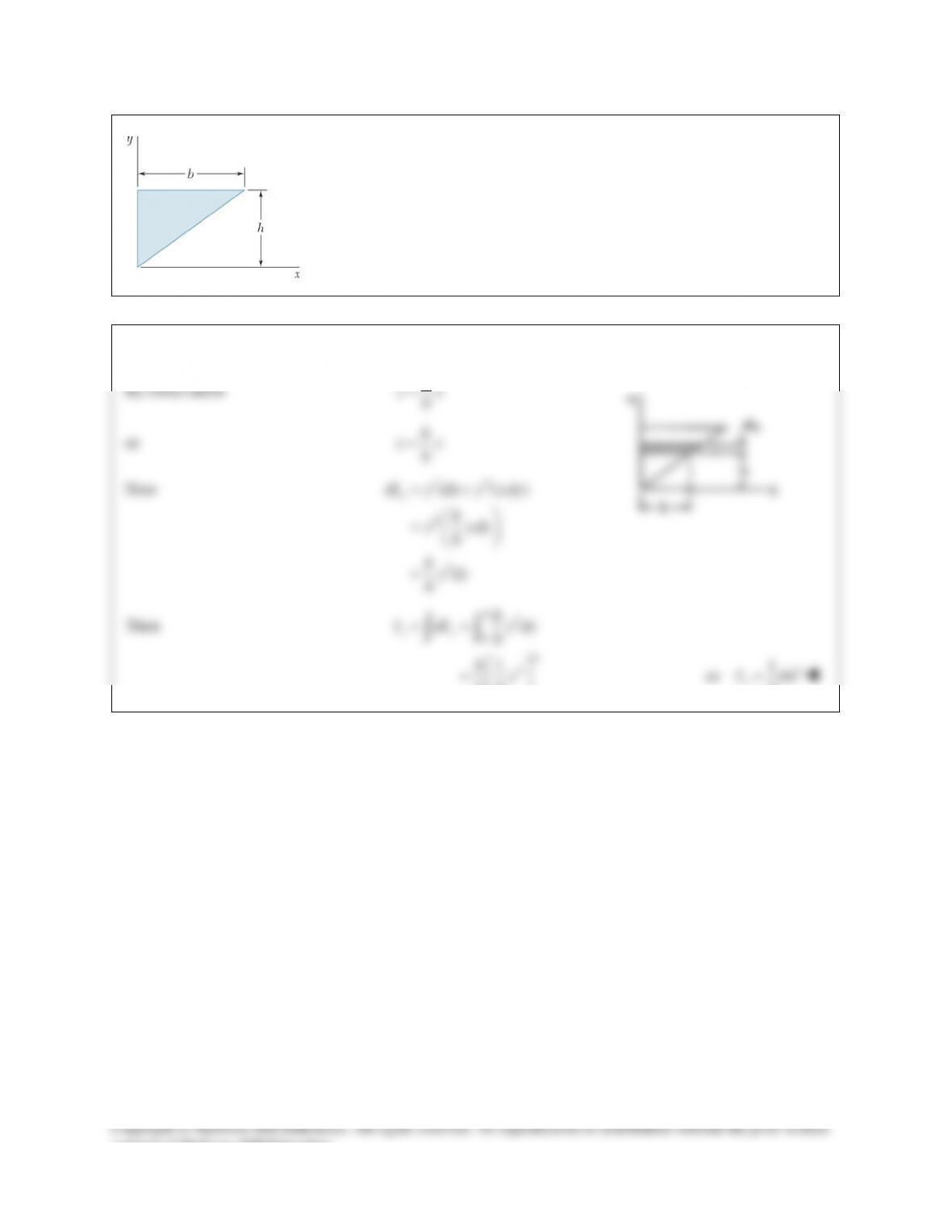
PROBLEM 7.50
Determine by direct integration the moment of inertia of the shaded area
with respect to the x axis.
SOLUTION
By observation
h
yx
b
=
or
b
xy
h
=
Now
22
2
3
()
x
dI y dA y xdy
b
y ydy
h
by dy
h
= =
=
=
Then
3
0
h
xx
b
I dI y dy
h
= =
∫∫
4
0
1
4
h
by
h
=
3
1
or 4
x
I bh=
consent of McGraw–Hill Education.
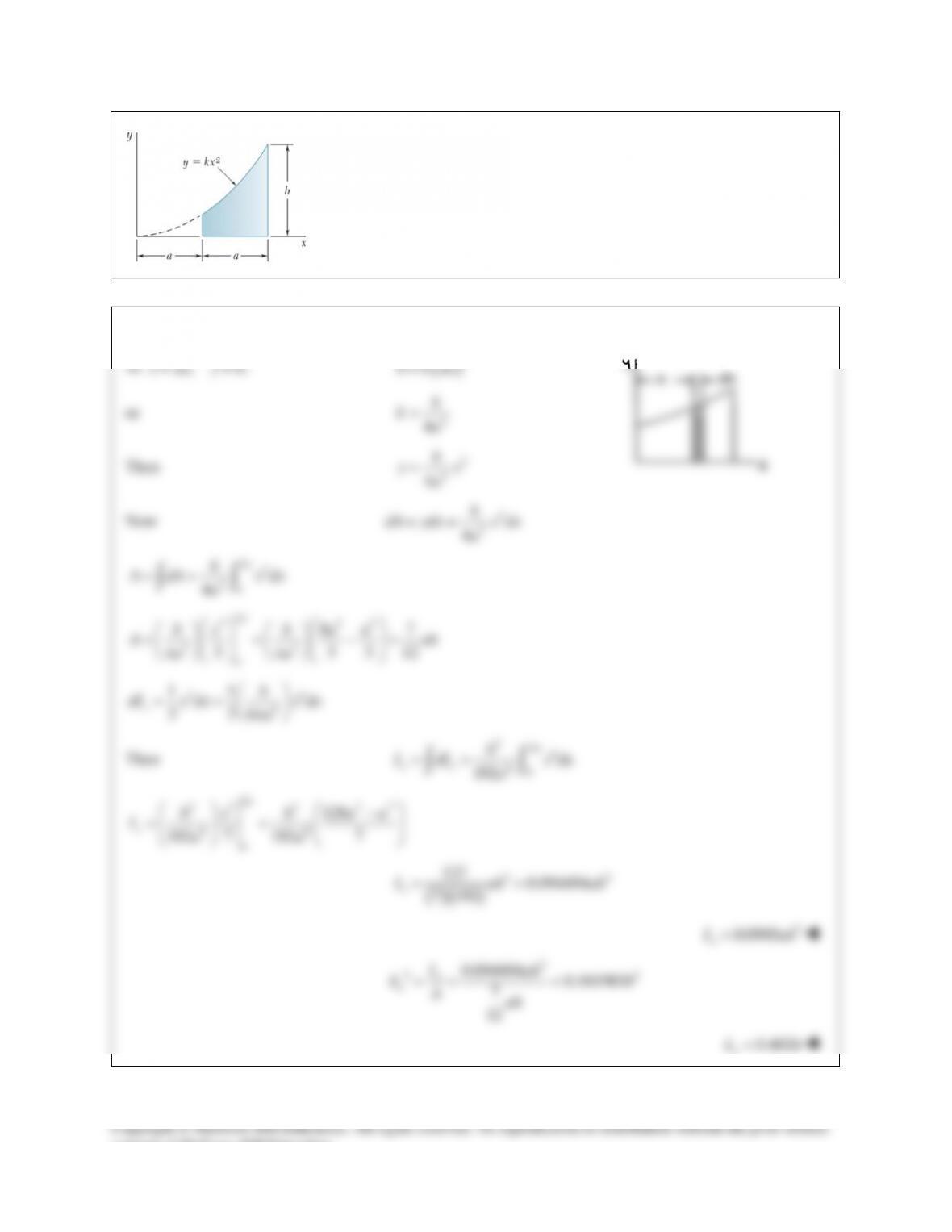
PROBLEM 7.51
Determine by direct integration the moment of inertia of the shaded area
with respect to the y axis.
SOLUTION
At
2, :
x a yh
= =
( )
2
2hka=
or
2
4
h
ka
=
Then
2
2
4
h
yx
a
=
Now
2
2
4
h
dA ydx x dx
a
= =
22
2
4
a
a
h
A dA x dx
a
= =
∫∫
2
3 33
22
87
3 3 3 12
44
a
a
h x h aa
A ah
aa
= = −=
36
6
11
33
64
xh
dI y dx x dx
a
= =
Then
326
60
192
a
xx
h
I dI x dx
a
= =
∫∫
2
3 7 3 77
66
128
77
192 192
a
x
a
h x h aa
Iaa
−
= =
( )( )
33
127 0.094494
7 192
x
I ah ah= =
3
0.0945
x
I ah=
3
22
0.094494 0.161983
7
12
x
x
Iah
kh
Aah
= = =
0.402
x
kh
=
consent of McGraw–Hill Education.
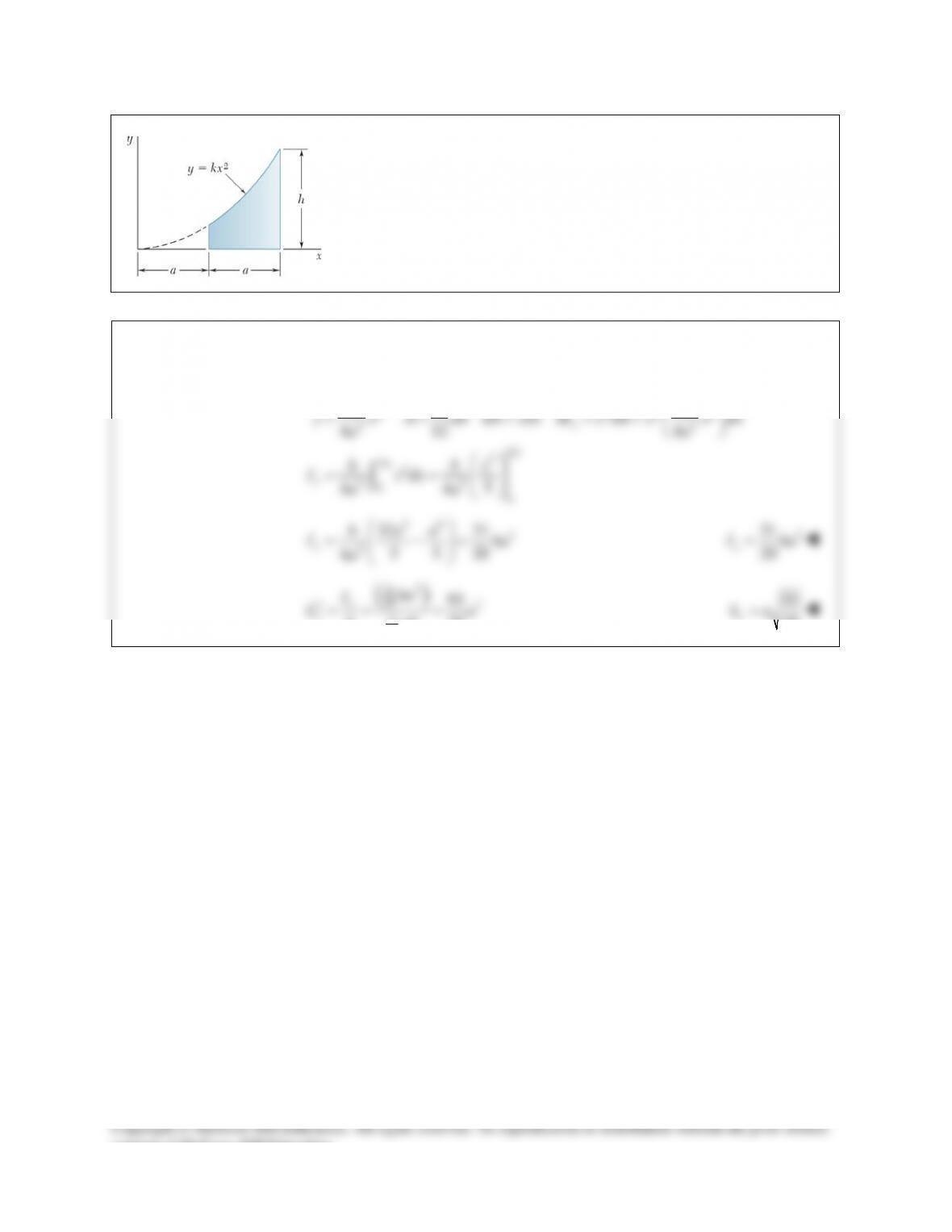
PROBLEM 7.52
Determine the moment of inertia and the radius of gyration of the shaded
area shown with respect to the y axis.
SOLUTION
See figure of solution on Problem 9.16
2 22 2
22
2
5
24
22
0
7
12
44
5
44
y
a
a
y
a
hh
y x A ah dA ydx dI x dA x x dx
aa
h hx
I x dx
aa
= = = = =
= =
∫
55 3
2
32 31
5 5 20
4
y
h aa
I ha
a
= −=
3
31
20
y
I ha=
( )
3
31
20
22
7
12
93
35
y
y
ha
I
ka
A ah
= = =
93
35
y
ka=
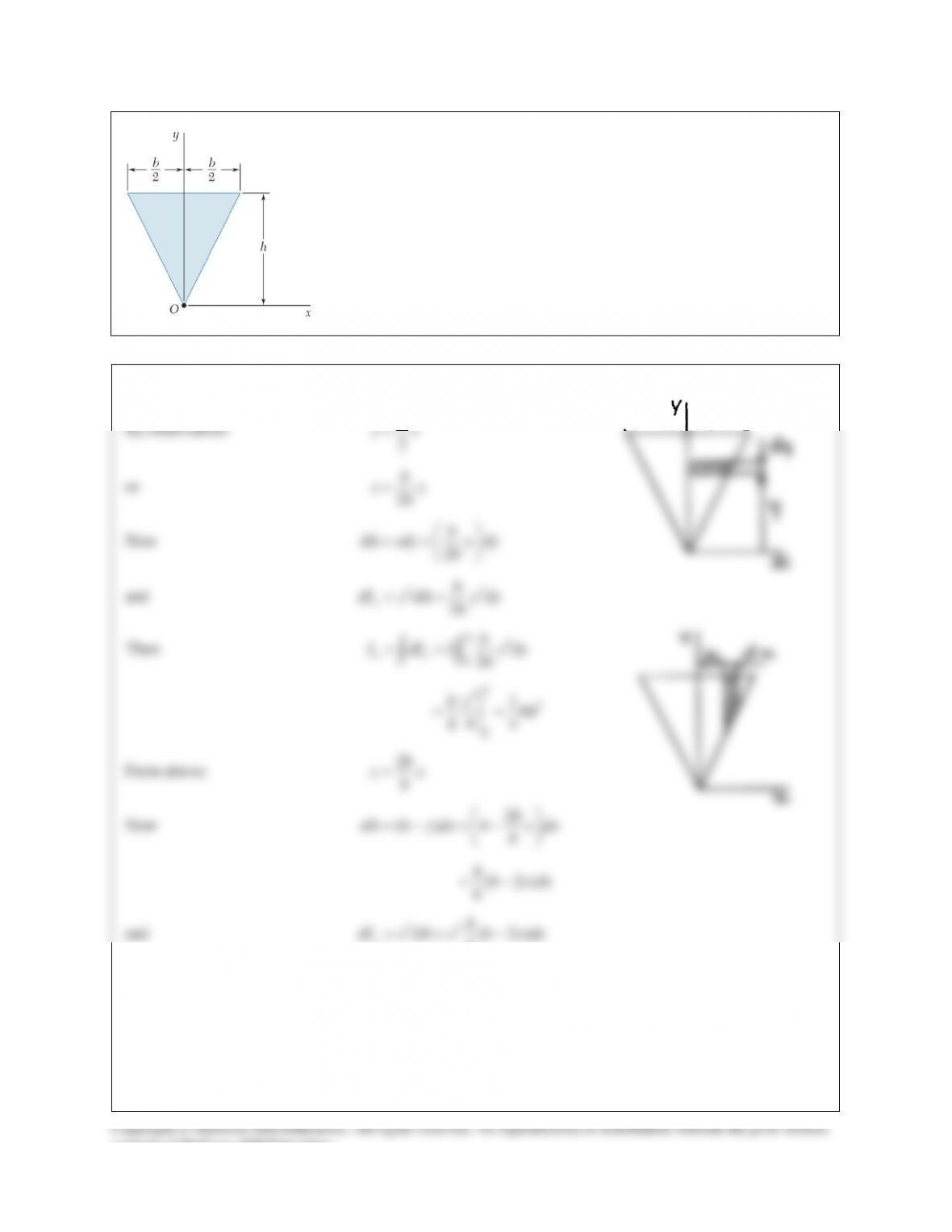
PROBLEM 7.53
Determine the polar moment of inertia and the polar radius of gyration of
the isosceles triangle shown with respect to Point O.
SOLUTION
By observation:
2
b
h
yx=
or
2
b
xy
h
=
Now
2
b
dA xdy y dy
h
= =
and
23
2
xb
dI y dA y dy
h
= =
Then
3
0
22
h
xx b
I dI y dy
h
= =
∫∫
43
0
1
44
h
by bh
h
= =
From above:
2h
yx
b
=
Now
2
() h
dA h y dx h x dx
b
=−=−
( 2)
hb x dx
b
= −
and
22
( 2)
y
h
dI x dA x b x dx
b
= = −
consent of McGraw–Hill Education.
SOLUTION Continued
Then
/2 2
0
2 ( 2)
b
yy h
I dI x b x dx
b
= = −
∫∫
/2
34
0
11
232
b
hbx x
b
= −
34
3
11
23 2 2 2 48
hbb b bh
b
= −=
Now
33
11
4 48
Oxy
J I I bh b h=+= +
22
or (12 )
48
O
bh
J hb= +
and
22
2 22
48 1
2
(12 ) 1(12 )
24
bh
O
O
hb
J
k hb
A bh
+
= = = +
or
22
12
24
O
hb
k+
=
consent of McGraw–Hill Education.
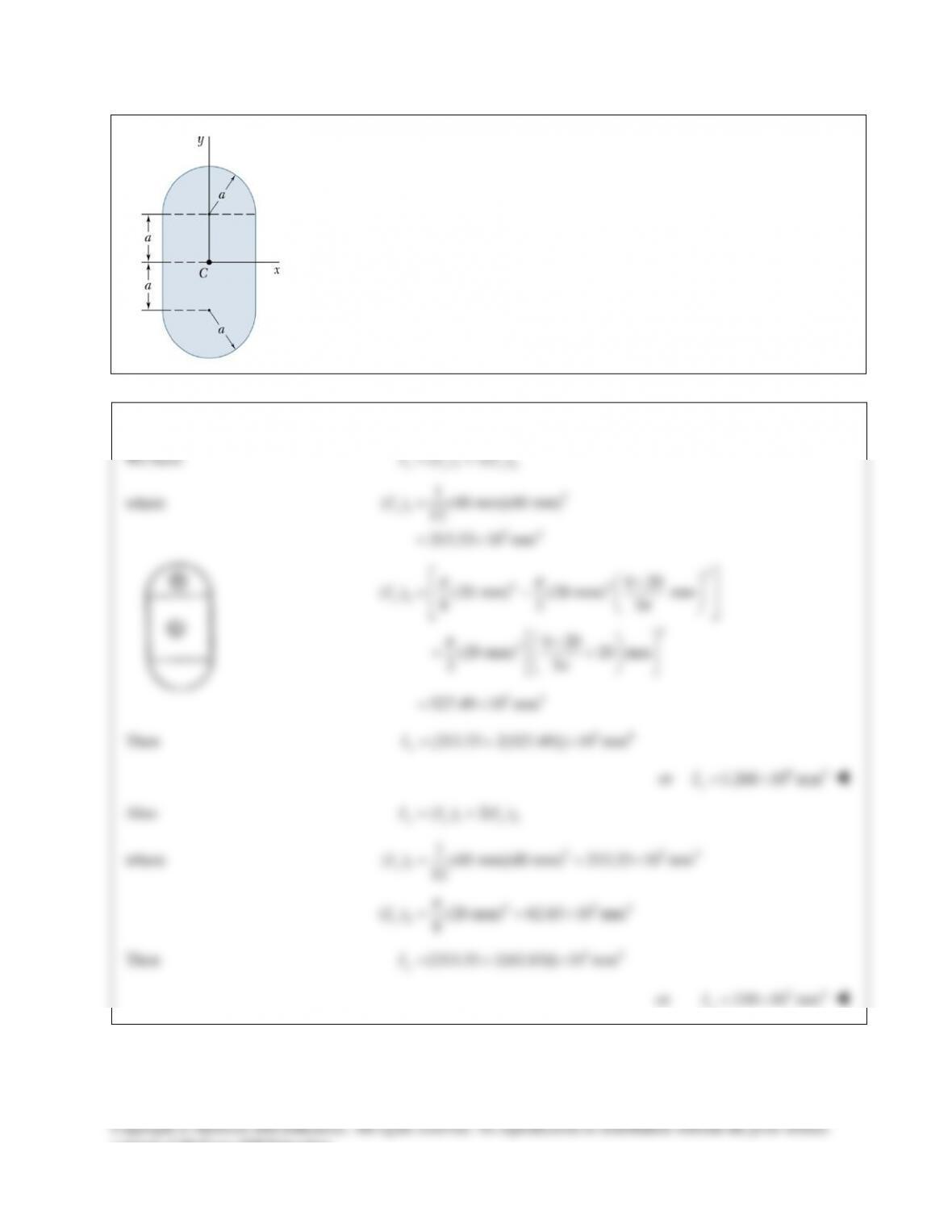
PROBLEM 7.54
Determine the moments of inertia of the shaded area shown with respect to the x
and y axes when
20 mm.a=
SOLUTION
We have
12
() 2()
xx x
II I= +
where
3
1
34
1
( ) (40 mm)(40 mm)
12
213.33 10 mm
x
I=
= ×
2
42
2
4 20
( ) (20 mm) (20 mm) mm
82 3
x
I
ππ
π
×
= −
2
24 20
(20 mm) 20 mm
23
π
π
×
++
34
527.49 10 mm= ×
Then
34
[213.33 2(527.49)] 10 mm
x
I=+×
or
64
1.268 10 mm
x
I= ×
Also
12
() 2()
yy y
II I= +
where
3 34
1
1
( ) (40 mm)(40 mm) 213.33 10 mm
12
y
I= = ×
4 34
2
( ) (20 mm) 62.83 10 mm
8
y
I
π
= = ×
Then
34
[213.33 2(62.83)] 10 mm
y
I=+×
or
34
339 10 mm
y
I= ×
consent of McGraw–Hill Education.
PROBLEM 7.48
The strength of the rolled W section shown is increased by welding a channel to
its upper flange. Determine the moments of inertia of the combined section with
respect to its centroidal x and y axes.
SOLUTION
W section:
2
64
64
14,400 mm
554 10 mm
63.3 10 mm
x
y
A
I
I
=
= ×
= ×
Channel:
2
64
64
2890 mm
0.945 10 mm
28.0 10 mm
x
y
A
I
I
=
= ×
= ×
First locate centroid C of the section.
A, mm2
, mmy
3
, mmyA
W Section 14,400 −231 −33,26,400
Channel 2,890 49.9 1,44,211
Σ
17,290 −31,82,189
Then
23
: (17,290 mm ) 3,182,189 mmY A yA YΣ=Σ =−
or
184.047 mmY= −
Now
WC
() ()
xx x
II I= +
where
2
W
64 2 22
64
2
C
64 2 22
64
()
554 10 mm (14,400 mm )(231 184.047) mm
585.75 10 mm
()
0.945 10 mm (2,890 mm )(49.9 184.047) mm
159.12 10 mm
xx
xx
I I Ad
I I Ad
= +
=×+ −
= ×
= −
=×+ +
= ×
SOLUTION Continued
Then
64
(585.75 159.12) 10 mm
x
I= +×
or
64
745 10 mm
x
I= ×
also
W
64
() ()
(63.3 28.0) 10 mm
y y yC
II I= +
=+×
or
64
91.3 10 mm
y
I= ×
consent of McGraw–Hill Education.
PROBLEM 7.49
Determine by direct integration the moment of inertia of the shaded area
with respect to the y axis.
SOLUTION
By observation
h
yx
b
=
Now
22
2
[( ) ]
1
y
dI x dA x h y dx
x
hx dx
b
= = −
= −
Then
2
0
1
b
yy
x
I dI hx dx
b
= = −
∫∫
4
3
0
1
34
b
x
hx b
= −
3
1
or 12
y
I bh=
consent of McGraw–Hill Education.
PROBLEM 7.50
Determine by direct integration the moment of inertia of the shaded area
with respect to the x axis.
SOLUTION
By observation
h
yx
b
=
or
b
xy
h
=
Now
22
2
3
()
x
dI y dA y xdy
b
y ydy
h
by dy
h
= =
=
=
Then
3
0
h
xx
b
I dI y dy
h
= =
∫∫
4
0
1
4
h
by
h
=
3
1
or 4
x
I bh=
consent of McGraw–Hill Education.
PROBLEM 7.51
Determine by direct integration the moment of inertia of the shaded area
with respect to the y axis.
SOLUTION
At
2, :
x a yh
= =
( )
2
2hka=
or
2
4
h
ka
=
Then
2
2
4
h
yx
a
=
Now
2
2
4
h
dA ydx x dx
a
= =
22
2
4
a
a
h
A dA x dx
a
= =
∫∫
2
3 33
22
87
3 3 3 12
44
a
a
h x h aa
A ah
aa
= = −=
36
6
11
33
64
xh
dI y dx x dx
a
= =
Then
326
60
192
a
xx
h
I dI x dx
a
= =
∫∫
2
3 7 3 77
66
128
77
192 192
a
x
a
h x h aa
Iaa
−
= =
( )( )
33
127 0.094494
7 192
x
I ah ah= =
3
0.0945
x
I ah=
3
22
0.094494 0.161983
7
12
x
x
Iah
kh
Aah
= = =
0.402
x
kh
=
consent of McGraw–Hill Education.
PROBLEM 7.52
Determine the moment of inertia and the radius of gyration of the shaded
area shown with respect to the y axis.
SOLUTION
See figure of solution on Problem 9.16
2 22 2
22
2
5
24
22
0
7
12
44
5
44
y
a
a
y
a
hh
y x A ah dA ydx dI x dA x x dx
aa
h hx
I x dx
aa
= = = = =
= =
∫
55 3
2
32 31
5 5 20
4
y
h aa
I ha
a
= −=
3
31
20
y
I ha=
( )
3
31
20
22
7
12
93
35
y
y
ha
I
ka
A ah
= = =
93
35
y
ka=
PROBLEM 7.53
Determine the polar moment of inertia and the polar radius of gyration of
the isosceles triangle shown with respect to Point O.
SOLUTION
By observation:
2
b
h
yx=
or
2
b
xy
h
=
Now
2
b
dA xdy y dy
h
= =
and
23
2
xb
dI y dA y dy
h
= =
Then
3
0
22
h
xx b
I dI y dy
h
= =
∫∫
43
0
1
44
h
by bh
h
= =
From above:
2h
yx
b
=
Now
2
() h
dA h y dx h x dx
b
=−=−
( 2)
hb x dx
b
= −
and
22
( 2)
y
h
dI x dA x b x dx
b
= = −
consent of McGraw–Hill Education.
SOLUTION Continued
Then
/2 2
0
2 ( 2)
b
yy h
I dI x b x dx
b
= = −
∫∫
/2
34
0
11
232
b
hbx x
b
= −
34
3
11
23 2 2 2 48
hbb b bh
b
= −=
Now
33
11
4 48
Oxy
J I I bh b h=+= +
22
or (12 )
48
O
bh
J hb= +
and
22
2 22
48 1
2
(12 ) 1(12 )
24
bh
O
O
hb
J
k hb
A bh
+
= = = +
or
22
12
24
O
hb
k+
=
consent of McGraw–Hill Education.
PROBLEM 7.54
Determine the moments of inertia of the shaded area shown with respect to the x
and y axes when
20 mm.a=
SOLUTION
We have
12
() 2()
xx x
II I= +
where
3
1
34
1
( ) (40 mm)(40 mm)
12
213.33 10 mm
x
I=
= ×
2
42
2
4 20
( ) (20 mm) (20 mm) mm
82 3
x
I
ππ
π
×
= −
2
24 20
(20 mm) 20 mm
23
π
π
×
++
34
527.49 10 mm= ×
Then
34
[213.33 2(527.49)] 10 mm
x
I=+×
or
64
1.268 10 mm
x
I= ×
Also
12
() 2()
yy y
II I= +
where
3 34
1
1
( ) (40 mm)(40 mm) 213.33 10 mm
12
y
I= = ×
4 34
2
( ) (20 mm) 62.83 10 mm
8
y
I
π
= = ×
Then
34
[213.33 2(62.83)] 10 mm
y
I=+×
or
34
339 10 mm
y
I= ×
consent of McGraw–Hill Education.