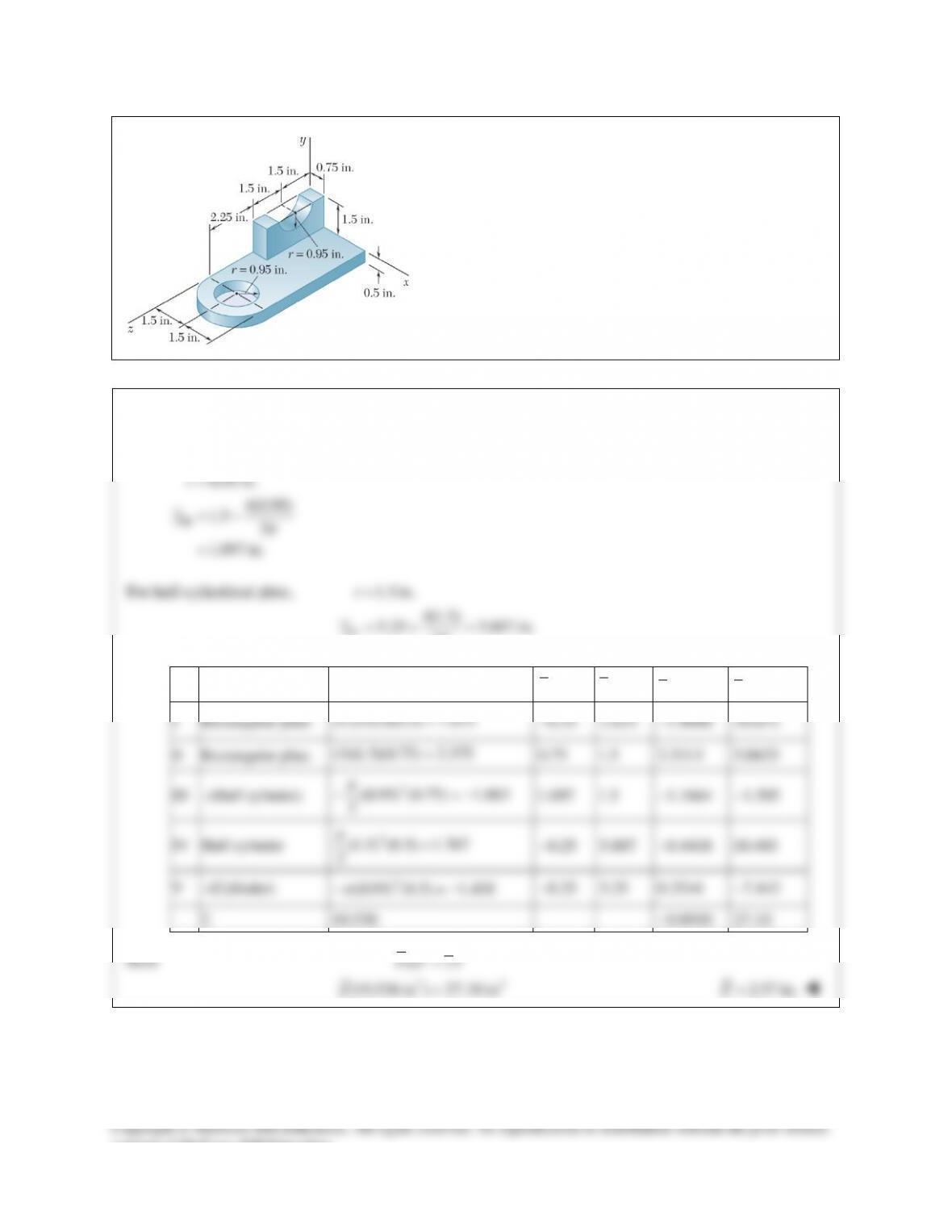
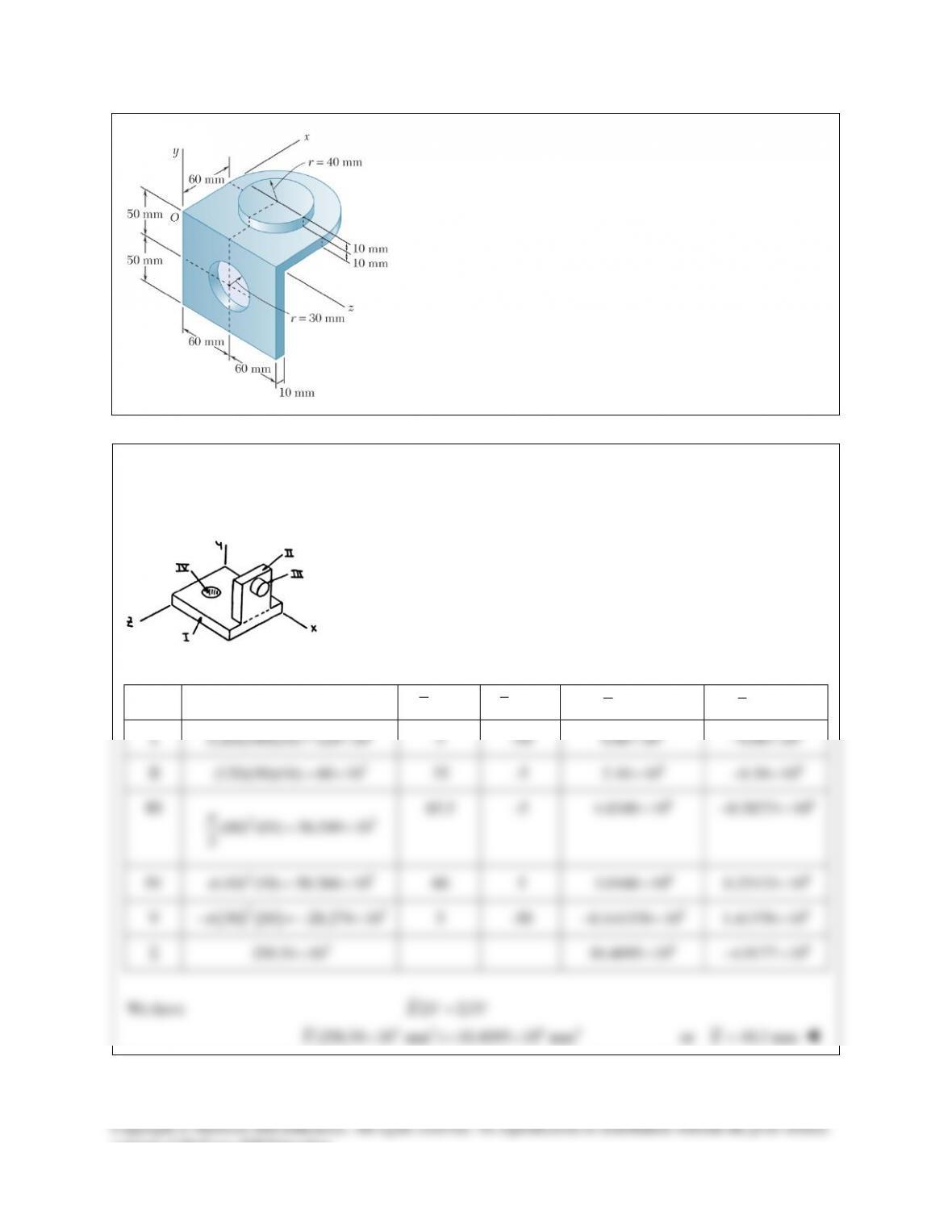
PROBLEM 5.63
For the machine element shown, locate the x coordinate of the
center of gravity.
SOLUTION
First assume that the machine element is homogeneous so that its center of gravity will coincide with the
centroid of the corresponding volume.
3
, mmV
, mmx
, mmy
4
, mmxV
4
, mmyV
I
3
(120)(100)(10) 120 10= ×
5 -50
6
0.60 10×
6
6.00 10−×
II
3
(120)(50)(10) 60 10= ×
35 -5
6
2.10 10×
6
0.30 10−×
III
23
(60) (10) 56.549 10
2
π
= ×
85.5 -5
6
4.8349 10×
6
0.28274 10−×
IV
23
(40) (10) 50.266 10
π
= ×
60 5
6
3.0160 10×
6
0.25133 10×
V
( ) ( )
23
30 10 28.274 10
π
− =−×
5 -50
6
0.141370 10−×
6
1.41370 10×
Σ
3
258.54 10×
6
10.4095 10×
6
4.9177 10−×
We have
X V xVΣ=Σ
33 64
(258.54 10 mm ) 10.4095 10 mmY×=×
or
40.3 mmX=
consent of McGraw–Hill Education.
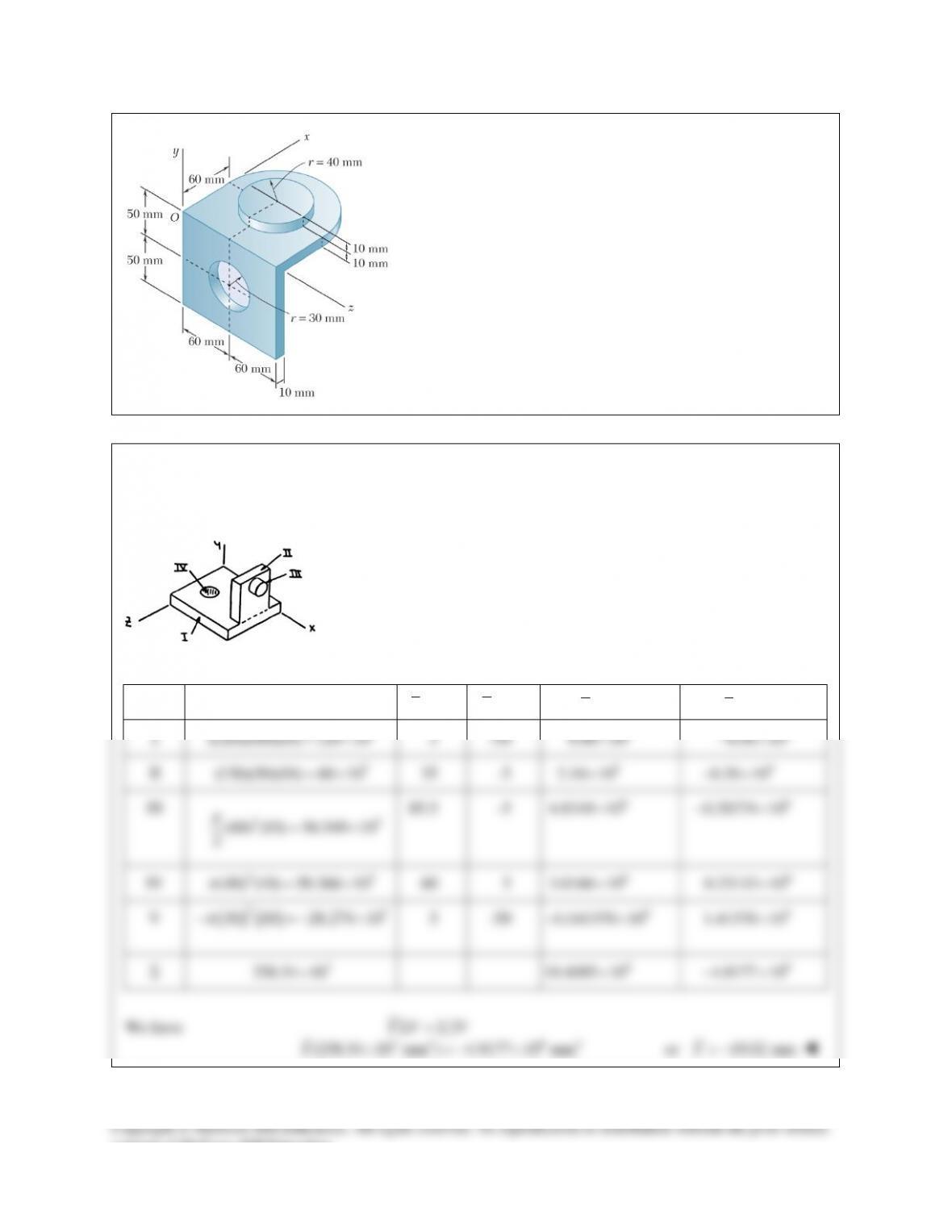
PROBLEM 5.64
For the machine element shown, locate the y coordinate of the
center of gravity.
SOLUTION
First assume that the machine element is homogeneous so that its center of gravity will coincide with the
centroid of the corresponding volume.
3
, mmV
, mmx
, mmy
4
, mmxV
4
, mmyV
I
3
(120)(100)(10) 120 10= ×
5 -50
6
0.60 10×
6
6.00 10−×
II
3
(120)(50)(10) 60 10= ×
35 -5
6
2.10 10
×
6
0.30 10−×
III
23
(60) (10) 56.549 10
2
π
= ×
85.5 -5
6
4.8349 10×
6
0.28274 10
−×
IV
23
(40) (10) 50.266 10
π
= ×
60 5
6
3.0160 10×
6
0.25133 10×
V
( ) ( )
23
30 10 28.274 10
π
− =−×
5 -50
6
0.141370 10
−×
6
1.41370 10×
Σ
3
258.54 10×
6
10.4095 10×
6
4.9177 10−×
We have
Y V yVΣ=Σ
33 64
(258.54 10 mm ) 4.9177 10 mmY× =−×
or
19.02 mmY= −
consent of McGraw–Hill Education.
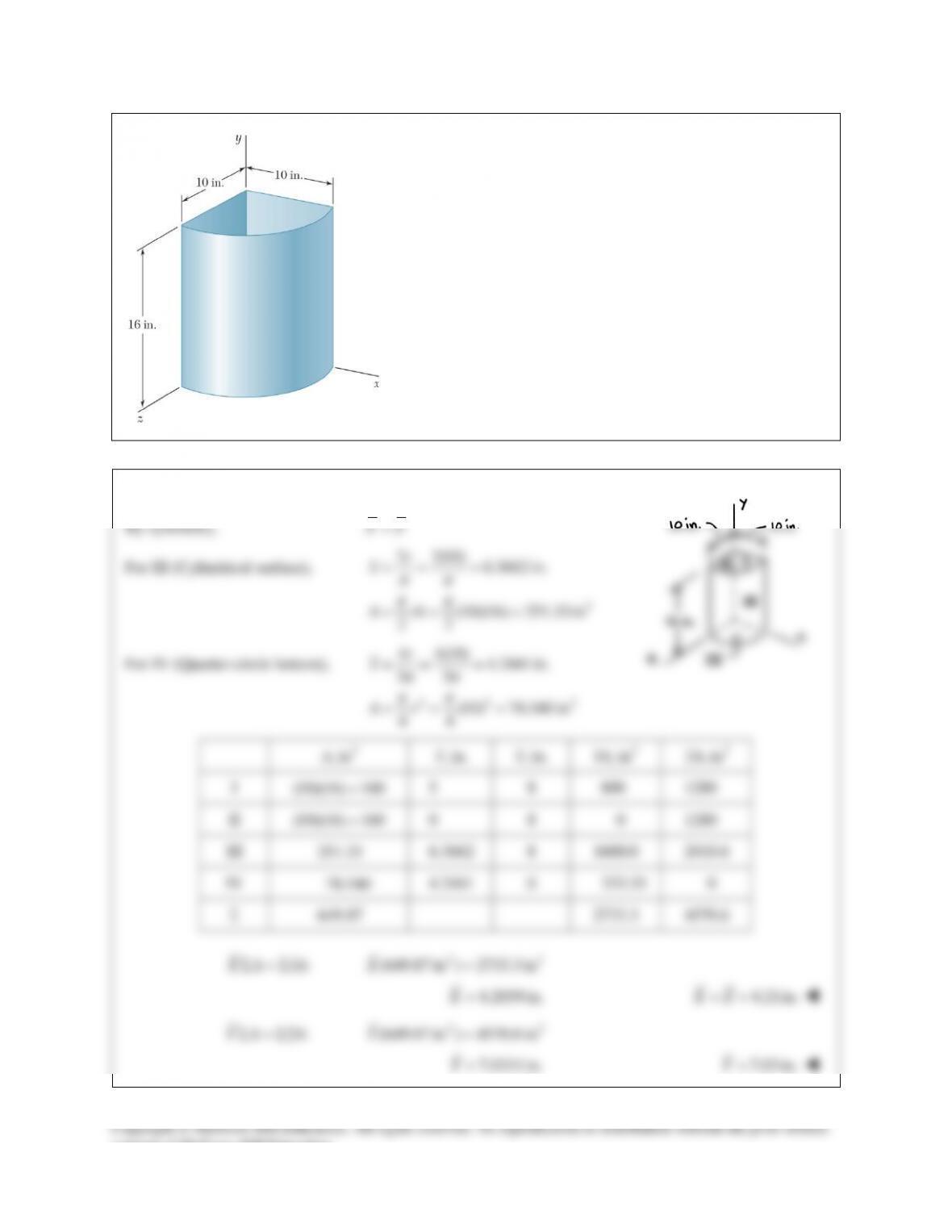
PROBLEM 5.65
A wastebasket, designed to fit in the corner of a room, is 16 in.
high and has a base in the shape of a quarter circle of radius 10
in. Locate the center of gravity of the wastebasket, knowing
that it is made of sheet metal of uniform thickness.
SOLUTION
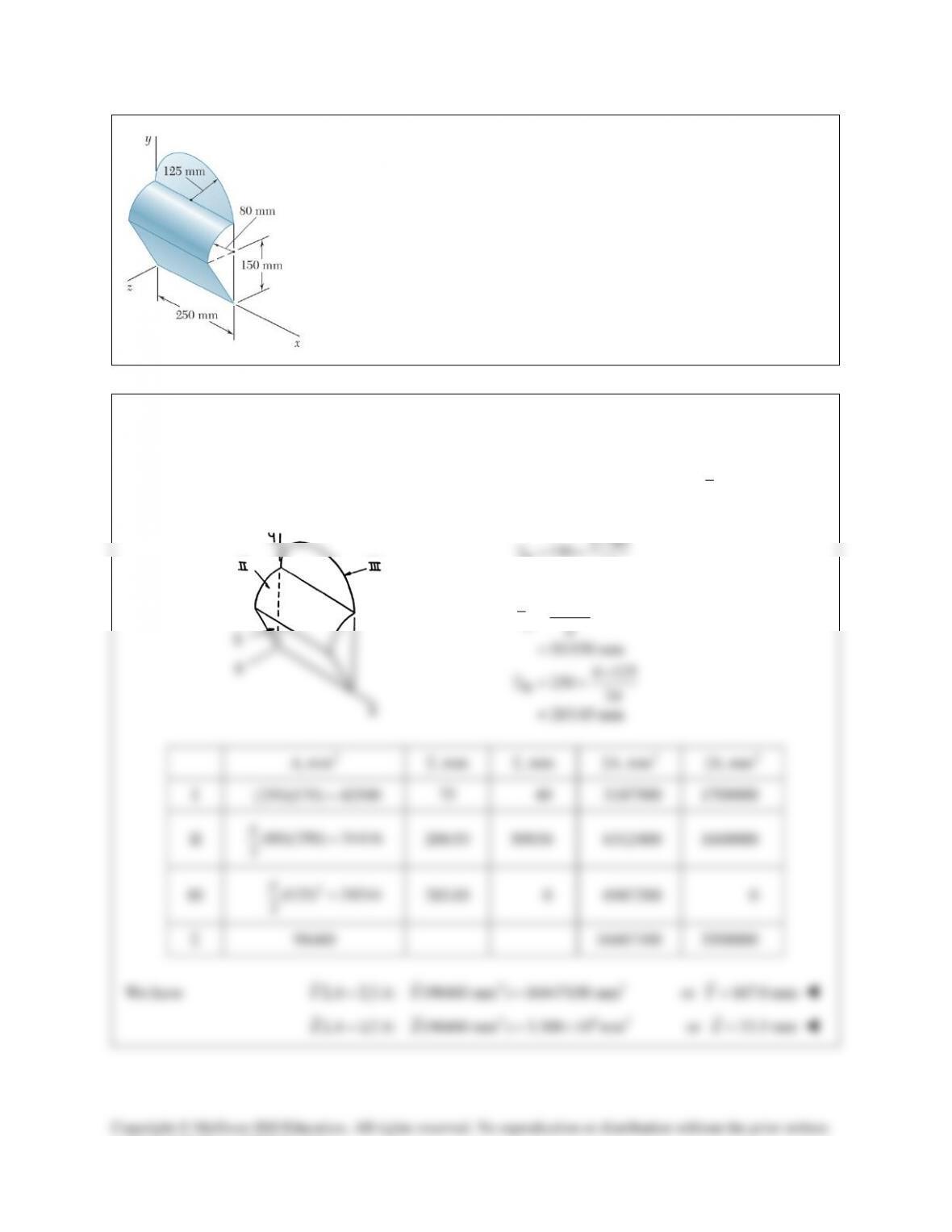
PROBLEM 5.66
Locate the center of gravity of the sheet-metal form shown.
SOLUTION
First assume that the sheet metal is homogeneous so that the center of gravity of the form will coincide
with the centroid of the corresponding area. Now note that symmetry implies
125.0 mm
X=
II
II
III
2 80
150
200.93 mm
2 80
50.930 mm
4 125
230 3
283.05 mm
y
z
y
π
π
π
×
= +
=
×
=
=
×
= +
=
2
, mmA
, mmy
, mmz
3
, mmyA
3
, mmzA
I
(250)(170) 42500=
75 40 3187500 1700000
II
(80)(250) 31416
2
π
=
200.93 50930 6312400 1600000
III
2
(125) 24544
2
π
=
283.05 0 6947200 0
Σ
98460 16447100 3300000
We have
23
: (98460 mm ) 16447100 mmY A yA YΣ=Σ =
or
167.0 mmY=
2 63
: (98460 mm ) 3.300 10 mmZ A zA ZΣ=Σ = ×
or
33.5 mmZ=
Copyright © McGraw–Hill Education. All rights reserved. No reproduction or distribution without the prior written
consent of McGraw–Hill Education.
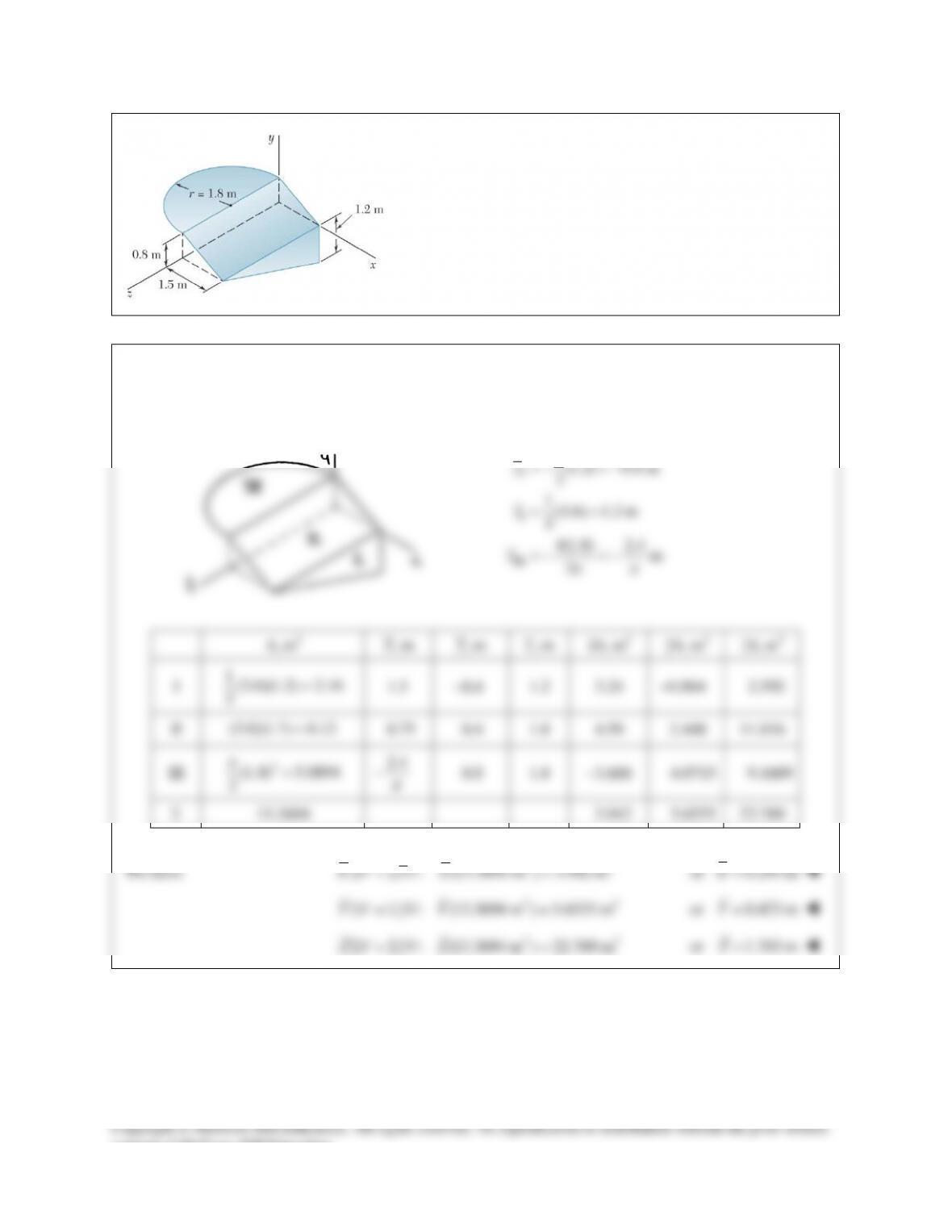
PROBLEM 5.67
Locate the center of gravity of the sheet-metal form shown.
SOLUTION
First, assume that the sheet metal is homogeneous so that the center of gravity of the form will coincide
with the centroid of the corresponding area.
I
I
III
1(1.2) 0.4 m
3
1(3.6) 1.2 m
34(1.8) 2.4 m
3
y
z
x
ππ
=−=−
= =
=−=−
2
,mA
,mx
,my
,mz
3
,mxA
3
,myA
3
,mzA
I
1(3.6)(1.2) 2.16
2=
1.5 −0.4 1.2 3.24
0.864−
2.592
II
(3.6)(1.7) 6.12=
0.75 0.4 1.8 4.59 2.448 11.016
III
2
(1.8) 5.0894
2
π
=
2.4
π
−
0.8 1.8 −3.888 4.0715 9.1609
Σ
13.3694 3.942 5.6555 22.769
23
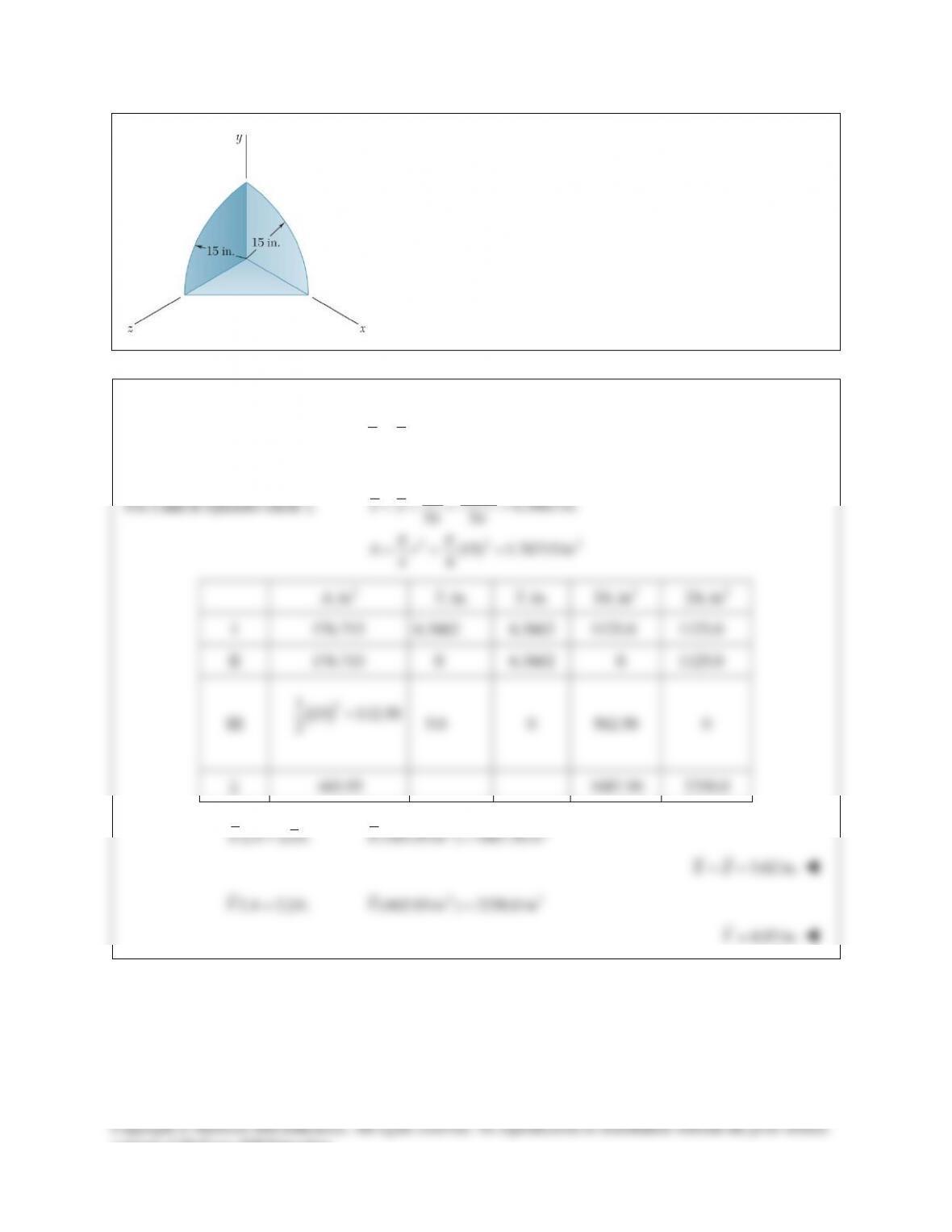
PROBLEM 5.68
A corner reflector for tracking by radar has two sides in the
shape of a quarter circle with a radius of 15 in. and one side in
the shape of a triangle. Locate the center of gravity of the
reflector, knowing that it is made of sheet metal of uniform
thickness.
SOLUTION
By symmetry,
XZ=
For I and II (Quarter–circle ),
22 2
4 4(15) 6.3662 in.
33
(15) 1.76715 in
44
r
xy
Ar
ππ
ππ
= = = =
= = =
2
, inA
, in.x
, in.
x
3
, inxA
3
, inyA
I
176.715
6.3662 6.3662 1125.0 1125.0
II
176.715
0 6.3662 0 1125.0
III
( )
2
115 112.50
2=
5.0 0 562.50 0
Σ
465.93 1687.50 2250.0
:X A xAΣ=Σ
23
(465.93 in ) 1687.50 inX=
3.62 in.XZ= =
:
Y A yAΣ=Σ
23
(465.93 in ) 2250.0 inY=
4.83 in.Y=
consent of McGraw–Hill Education.
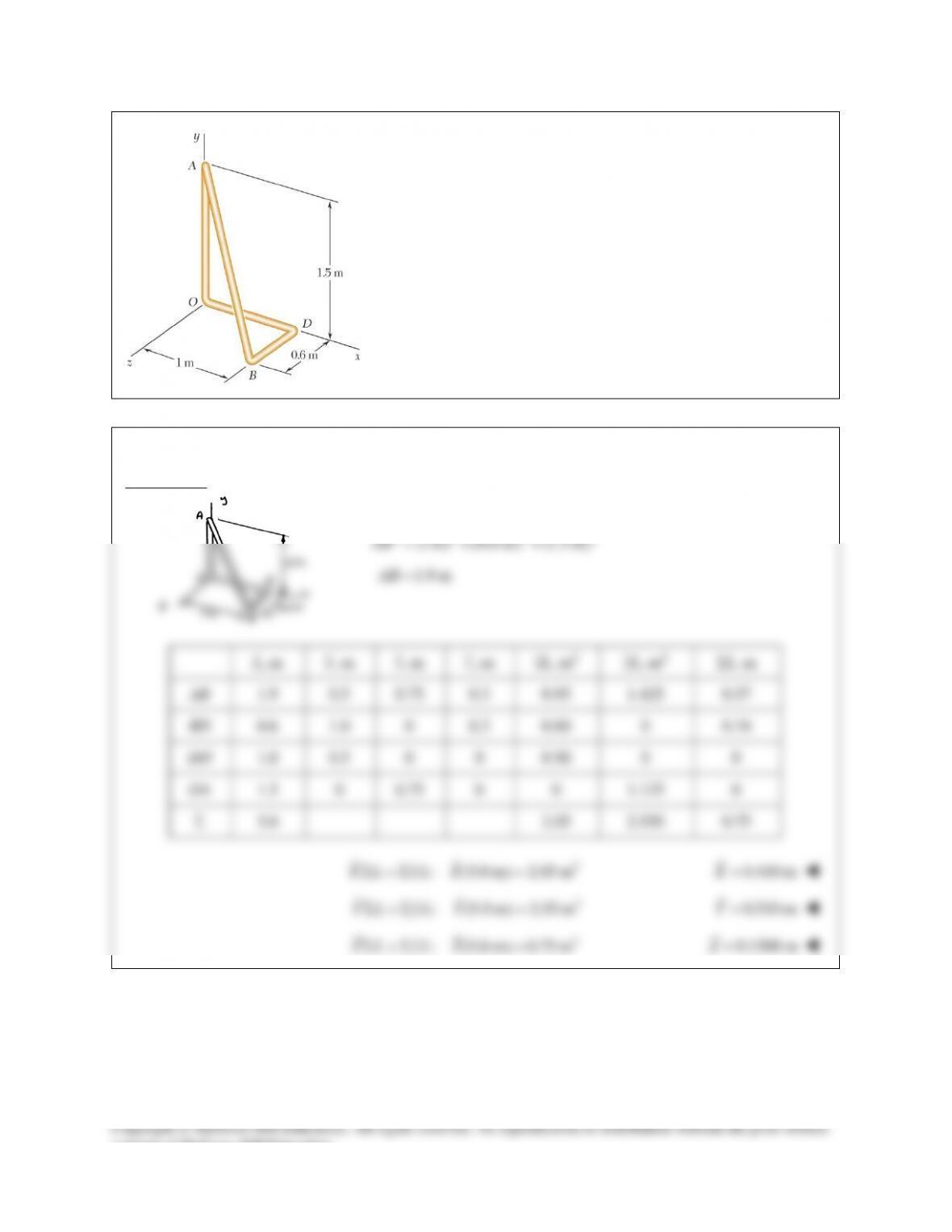
PROBLEM 5.69
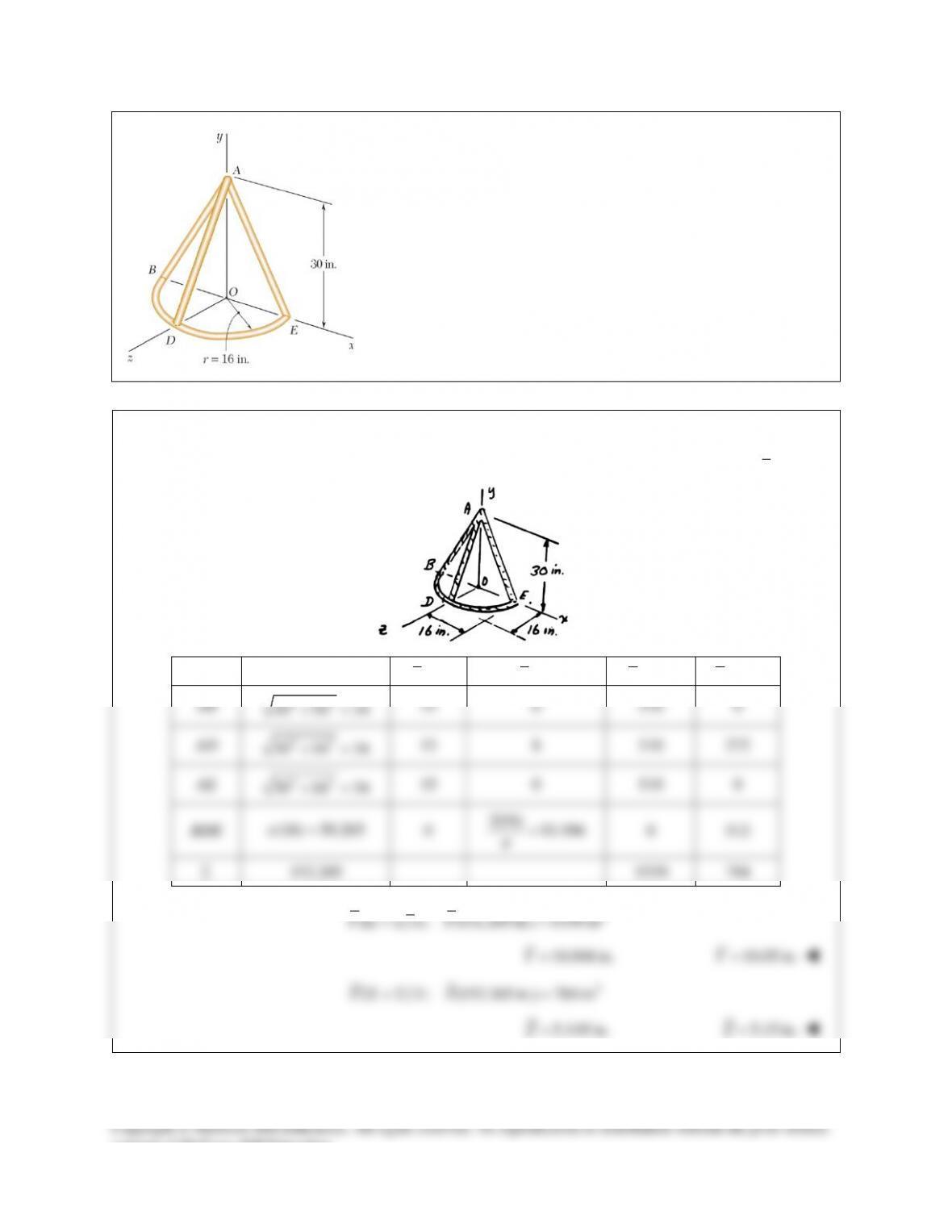
Locate the center of gravity of the figure shown, knowing that it is
made of thin brass rods of uniform diameter.
SOLUTION
Uniform rod:
22 2 2
(1m) (0.6 m) (1.5 m)AB =++
1.9 mAB =
,m
L
,mx
,my
,mz
2
,mxL
2
,myL
,mLΣ
AB 1.9 0.5 0.75 0.3 0.95 1.425 0.57
BD 0.6 1.0 0 0.3 0.60 0 0.18
DO 1.0 0.5 0 0 0.50 0 0
OA 1.5 0 0.75 0 0 1.125 0
Σ
5.0 2.05 2.550 0.75
2
: (5.0 m) 2.05 mX L xL XΣ=Σ =
0.410 mX=
2
: (5.0 m) 2.55 mY L yL YΣ=Σ =
0.510 mY=
2
: (5.0 m) 0.75 mZ L zL ZΣ=Σ =
0.1500 mZ=
consent of McGraw–Hill Education.
PROBLEM 5.70
Locate the center of gravity of the figure shown, knowing that it is
made of thin brass rods of uniform diameter.
SOLUTION
By symmetry,
0X=
L, in.
, in.y
, in.z
2
, inyL
2
, inzL
22
2
: (152.265 in.) 1530 inY L yL YΣ=Σ =
10.048 in.Y=
10.05 in.Y=
2
: (152.265 in.) 784 inZ L zL ZΣ=Σ =
5.149 in.
Z=
5.15 in.Z=
consent of McGraw–Hill Education.
PROBLEM 5.71
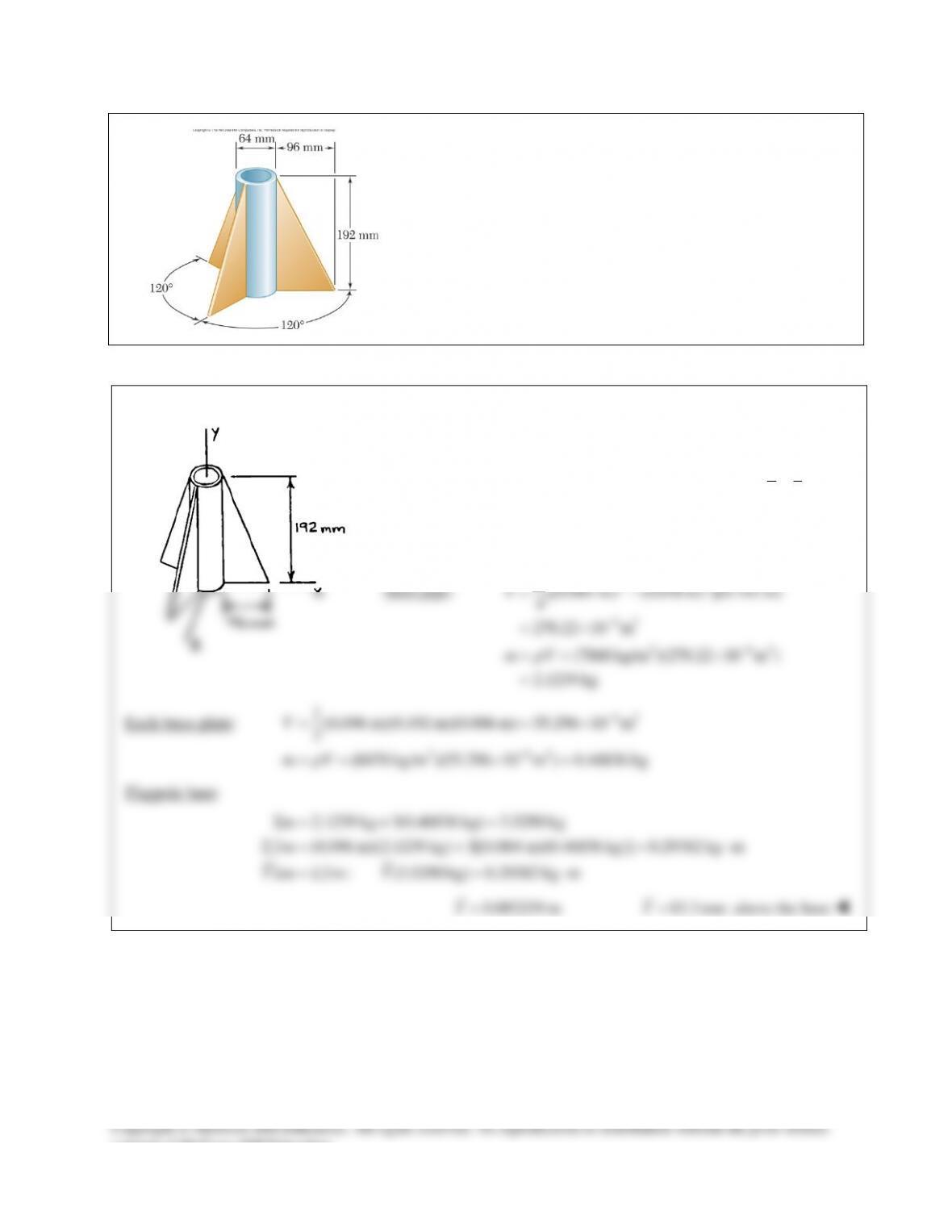
Three brass plates are brazed to a steel pipe to form the flagpole
base shown. Knowing that the pipe has a wall thickness of 8 mm
and that each plate is 6 mm thick, determine the location of the
center of gravity of the base. (Densities: brass = 8470 kg/m3;
steel = 7860 kg/m3.)
SOLUTION
Since brass plates are equally spaced, we note that
the center of gravity lies on the y–axis.
Thus,
0xz= =
Steel pipe:
22
63
3 63
[(0.064 m) (0.048 m) ](0.192 m)
4
270.22 10 m
(7860 kg/m )(270.22 10 m )
2.1239 kg
V
mV
π
ρ
−
−
= −
= ×
= = ×
=
Each brass plate:
63
3 63
1(0.096 m)(0.192 m)(0.006 m) 55.296 10 m
2
(8470 kg/m )(55.296 10 m ) 0.46836 kg
ρ
−
−
= = ×
== ×=
V
mV
Flagpole base:
2.1239 kg 3(0.46836 kg) 3.5290 kg
(0.096 m)(2.1239 kg) 3[(0.064 m)(0.46836 kg)] 0.29382 kg m
: (3.5290 kg) 0.29382 kg m
m
ym
Y m ym Y
Σ= + =
Σ= + = ⋅
Σ=Σ = ⋅
0.083259 m=Y
83.3 mm=Y
above the base
PROBLEM 5.63
For the machine element shown, locate the x coordinate of the
center of gravity.
SOLUTION
First assume that the machine element is homogeneous so that its center of gravity will coincide with the
centroid of the corresponding volume.
3
, mmV
, mmx
, mmy
4
, mmxV
4
, mmyV
I
3
(120)(100)(10) 120 10= ×
5 -50
6
0.60 10×
6
6.00 10−×
II
3
(120)(50)(10) 60 10= ×
35 -5
6
2.10 10×
6
0.30 10−×
III
23
(60) (10) 56.549 10
2
π
= ×
85.5 -5
6
4.8349 10×
6
0.28274 10−×
IV
23
(40) (10) 50.266 10
π
= ×
60 5
6
3.0160 10×
6
0.25133 10×
V
( ) ( )
23
30 10 28.274 10
π
− =−×
5 -50
6
0.141370 10−×
6
1.41370 10×
Σ
3
258.54 10×
6
10.4095 10×
6
4.9177 10−×
We have
X V xVΣ=Σ
33 64
(258.54 10 mm ) 10.4095 10 mmY×=×
or
40.3 mmX=
consent of McGraw–Hill Education.
PROBLEM 5.64
For the machine element shown, locate the y coordinate of the
center of gravity.
SOLUTION
First assume that the machine element is homogeneous so that its center of gravity will coincide with the
centroid of the corresponding volume.
3
, mmV
, mmx
, mmy
4
, mmxV
4
, mmyV
I
3
(120)(100)(10) 120 10= ×
5 -50
6
0.60 10×
6
6.00 10−×
II
3
(120)(50)(10) 60 10= ×
35 -5
6
2.10 10
×
6
0.30 10−×
III
23
(60) (10) 56.549 10
2
π
= ×
85.5 -5
6
4.8349 10×
6
0.28274 10
−×
IV
23
(40) (10) 50.266 10
π
= ×
60 5
6
3.0160 10×
6
0.25133 10×
V
( ) ( )
23
30 10 28.274 10
π
− =−×
5 -50
6
0.141370 10
−×
6
1.41370 10×
Σ
3
258.54 10×
6
10.4095 10×
6
4.9177 10−×
We have
Y V yVΣ=Σ
33 64
(258.54 10 mm ) 4.9177 10 mmY× =−×
or
19.02 mmY= −
consent of McGraw–Hill Education.
PROBLEM 5.65
A wastebasket, designed to fit in the corner of a room, is 16 in.
high and has a base in the shape of a quarter circle of radius 10
in. Locate the center of gravity of the wastebasket, knowing
that it is made of sheet metal of uniform thickness.
SOLUTION
PROBLEM 5.66
Locate the center of gravity of the sheet-metal form shown.
SOLUTION
First assume that the sheet metal is homogeneous so that the center of gravity of the form will coincide
with the centroid of the corresponding area. Now note that symmetry implies
125.0 mm
X=
II
II
III
2 80
150
200.93 mm
2 80
50.930 mm
4 125
230 3
283.05 mm
y
z
y
π
π
π
×
= +
=
×
=
=
×
= +
=
2
, mmA
, mmy
, mmz
3
, mmyA
3
, mmzA
I
(250)(170) 42500=
75 40 3187500 1700000
II
(80)(250) 31416
2
π
=
200.93 50930 6312400 1600000
III
2
(125) 24544
2
π
=
283.05 0 6947200 0
Σ
98460 16447100 3300000
We have
23
: (98460 mm ) 16447100 mmY A yA YΣ=Σ =
or
167.0 mmY=
2 63
: (98460 mm ) 3.300 10 mmZ A zA ZΣ=Σ = ×
or
33.5 mmZ=
Copyright © McGraw–Hill Education. All rights reserved. No reproduction or distribution without the prior written
consent of McGraw–Hill Education.
PROBLEM 5.67
Locate the center of gravity of the sheet-metal form shown.
SOLUTION
First, assume that the sheet metal is homogeneous so that the center of gravity of the form will coincide
with the centroid of the corresponding area.
I
I
III
1(1.2) 0.4 m
3
1(3.6) 1.2 m
34(1.8) 2.4 m
3
y
z
x
ππ
=−=−
= =
=−=−
2
,mA
,mx
,my
,mz
3
,mxA
3
,myA
3
,mzA
I
1(3.6)(1.2) 2.16
2=
1.5 −0.4 1.2 3.24
0.864−
2.592
II
(3.6)(1.7) 6.12=
0.75 0.4 1.8 4.59 2.448 11.016
III
2
(1.8) 5.0894
2
π
=
2.4
π
−
0.8 1.8 −3.888 4.0715 9.1609
Σ
13.3694 3.942 5.6555 22.769
23
PROBLEM 5.68
A corner reflector for tracking by radar has two sides in the
shape of a quarter circle with a radius of 15 in. and one side in
the shape of a triangle. Locate the center of gravity of the
reflector, knowing that it is made of sheet metal of uniform
thickness.
SOLUTION
By symmetry,
XZ=
For I and II (Quarter–circle ),
22 2
4 4(15) 6.3662 in.
33
(15) 1.76715 in
44
r
xy
Ar
ππ
ππ
= = = =
= = =
2
, inA
, in.x
, in.
x
3
, inxA
3
, inyA
I
176.715
6.3662 6.3662 1125.0 1125.0
II
176.715
0 6.3662 0 1125.0
III
( )
2
115 112.50
2=
5.0 0 562.50 0
Σ
465.93 1687.50 2250.0
:X A xAΣ=Σ
23
(465.93 in ) 1687.50 inX=
3.62 in.XZ= =
:
Y A yAΣ=Σ
23
(465.93 in ) 2250.0 inY=
4.83 in.Y=
consent of McGraw–Hill Education.
PROBLEM 5.69
Locate the center of gravity of the figure shown, knowing that it is
made of thin brass rods of uniform diameter.
SOLUTION
Uniform rod:
22 2 2
(1m) (0.6 m) (1.5 m)AB =++
1.9 mAB =
,m
L
,mx
,my
,mz
2
,mxL
2
,myL
,mLΣ
AB 1.9 0.5 0.75 0.3 0.95 1.425 0.57
BD 0.6 1.0 0 0.3 0.60 0 0.18
DO 1.0 0.5 0 0 0.50 0 0
OA 1.5 0 0.75 0 0 1.125 0
Σ
5.0 2.05 2.550 0.75
2
: (5.0 m) 2.05 mX L xL XΣ=Σ =
0.410 mX=
2
: (5.0 m) 2.55 mY L yL YΣ=Σ =
0.510 mY=
2
: (5.0 m) 0.75 mZ L zL ZΣ=Σ =
0.1500 mZ=
consent of McGraw–Hill Education.
PROBLEM 5.70
Locate the center of gravity of the figure shown, knowing that it is
made of thin brass rods of uniform diameter.
SOLUTION
By symmetry,
0X=
L, in.
, in.y
, in.z
2
, inyL
2
, inzL
22
2
: (152.265 in.) 1530 inY L yL YΣ=Σ =
10.048 in.Y=
10.05 in.Y=
2
: (152.265 in.) 784 inZ L zL ZΣ=Σ =
5.149 in.
Z=
5.15 in.Z=
consent of McGraw–Hill Education.
PROBLEM 5.71
Three brass plates are brazed to a steel pipe to form the flagpole
base shown. Knowing that the pipe has a wall thickness of 8 mm
and that each plate is 6 mm thick, determine the location of the
center of gravity of the base. (Densities: brass = 8470 kg/m3;
steel = 7860 kg/m3.)
SOLUTION
Since brass plates are equally spaced, we note that
the center of gravity lies on the y–axis.
Thus,
0xz= =
Steel pipe:
22
63
3 63
[(0.064 m) (0.048 m) ](0.192 m)
4
270.22 10 m
(7860 kg/m )(270.22 10 m )
2.1239 kg
V
mV
π
ρ
−
−
= −
= ×
= = ×
=
Each brass plate:
63
3 63
1(0.096 m)(0.192 m)(0.006 m) 55.296 10 m
2
(8470 kg/m )(55.296 10 m ) 0.46836 kg
ρ
−
−
= = ×
== ×=
V
mV
Flagpole base:
2.1239 kg 3(0.46836 kg) 3.5290 kg
(0.096 m)(2.1239 kg) 3[(0.064 m)(0.46836 kg)] 0.29382 kg m
: (3.5290 kg) 0.29382 kg m
m
ym
Y m ym Y
Σ= + =
Σ= + = ⋅
Σ=Σ = ⋅
0.083259 m=Y
83.3 mm=Y
above the base