PROBLEM 3.42
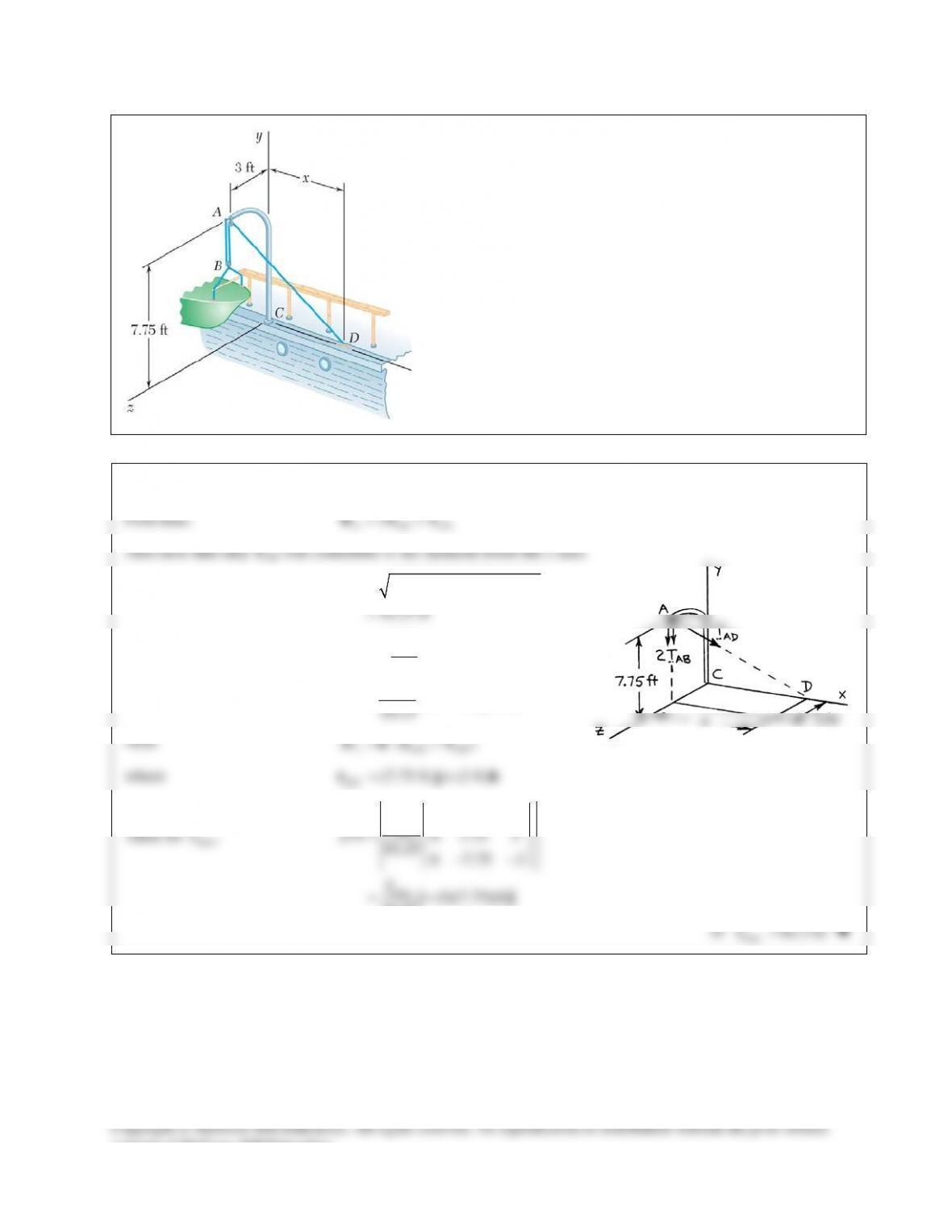
For the davit of Problem 3.41, determine the largest allowable
distance x when the tension in line ABAD is 60 lb.
SOLUTION
From the solution of Problem 3.41,
AD
T
is now
2 22
60 lb ( 7.75 3 )
( 7.75) ( 3)
AD
AD
TAD
x
x
=
= −−
+− +−
T
i jk
Then
/
()
z A C AD
M=⋅×
kr T
becomes
2 22
2
2
2
00 1
60
279 0 7.75 3
( 7.75) ( 3) 7.75 3
60
279 | (1)(7.75)( ) |
69.0625
279 69.0625 465
0.6 69.0625
xx
x
x
xx
xx
=+− +− −−
= −
+
+=
+=
Squaring both sides:
22
0.36 24.8625xx+=
2
38.848
x=
6.23 ftx=
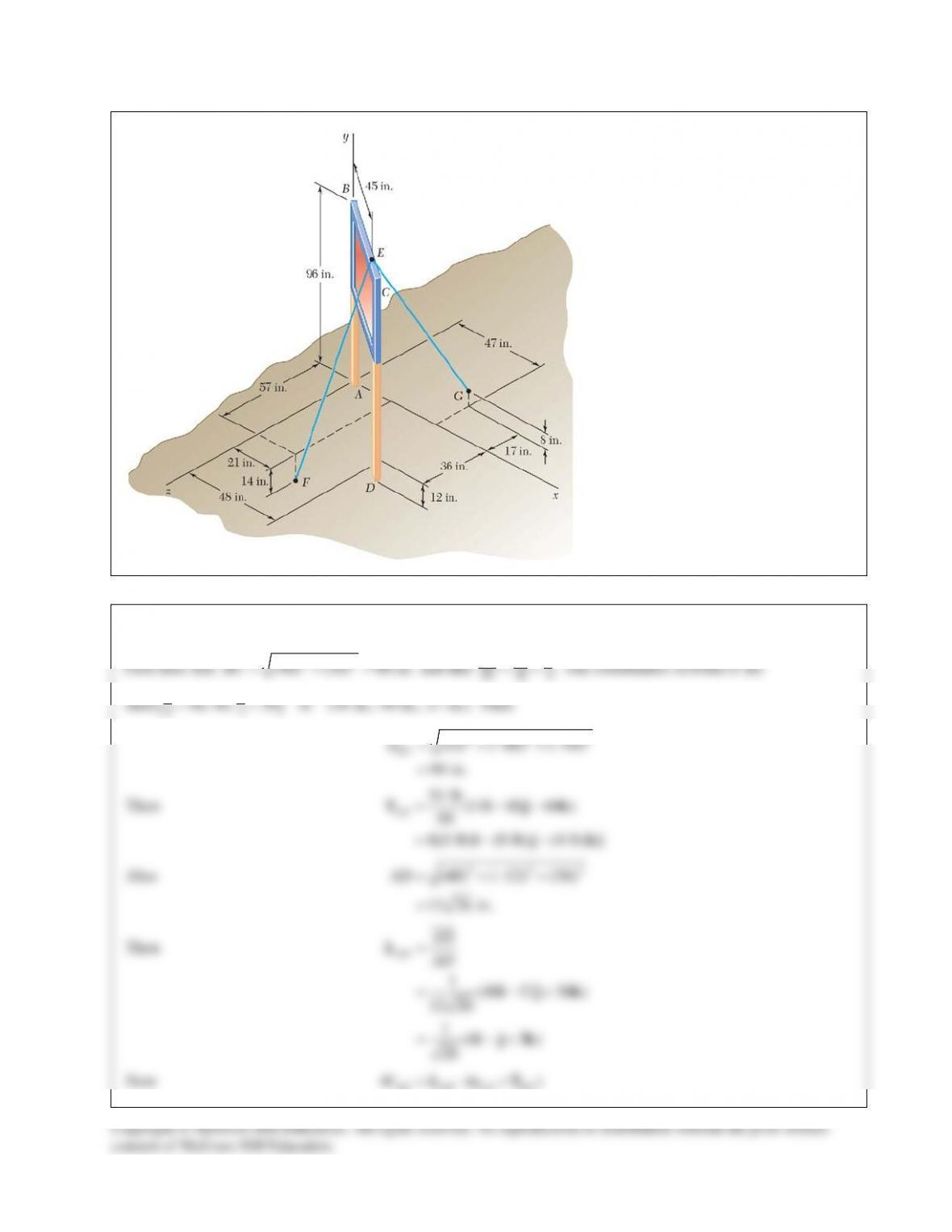
PROBLEM 3.43
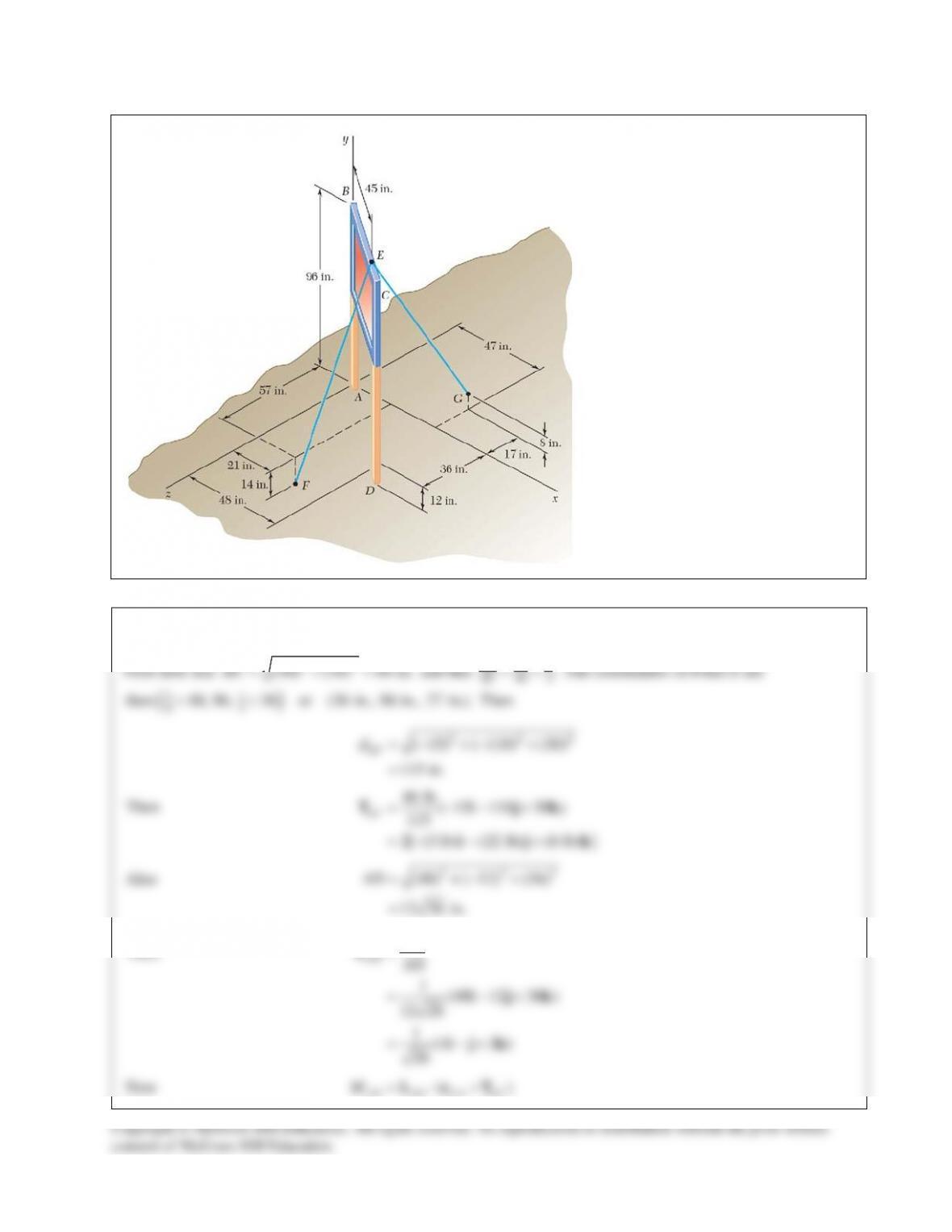
A sign erected on uneven ground is
guyed by cables EF and EG. If the
force exerted by cable EF at E is 46 lb,
determine the moment of that force
about the line joining Points A and D.
SOLUTION
First note that
22
(48) (36) 60 in.BC = +=
and that
45 3
60 4 .
BE
BC = =
The coordinates of Point E are
then
( )
33
44
48, 96, 36 or (36 in., 96 in., 27 in.).××
Then
2 22
( 15) ( 110) (30)
115 in.
EF
d= − +− +
=
Then
46 lb ( 15 110 30 )
115
2[ (3 lb) (22 lb) (6 lb) ]
EF
= −− +
=−− +
T i jk
i jk
Also
2 22
(48) ( 12) (36)
12 26 in.
AD = +− +
=
Then
1(48 12 36 )
12 26
1(4 3 )
26
AD
AD
AD
=
= −+
= −+
ijk
ij k
λ
Now
/
()
AD AD E A EF
M=⋅×rTλ
SOLUTION Continued
where
/
(36 in.) (96 in.) (27 in.)
EA
=++r ijk
Then
4 13
1(2) 36 96 27
26 3 22 6
2(2304 81 2376 864 216 2376)
26
AD
M
−
=
−−
= +− + + +
or
1359 lb in.
AD
M= ⋅
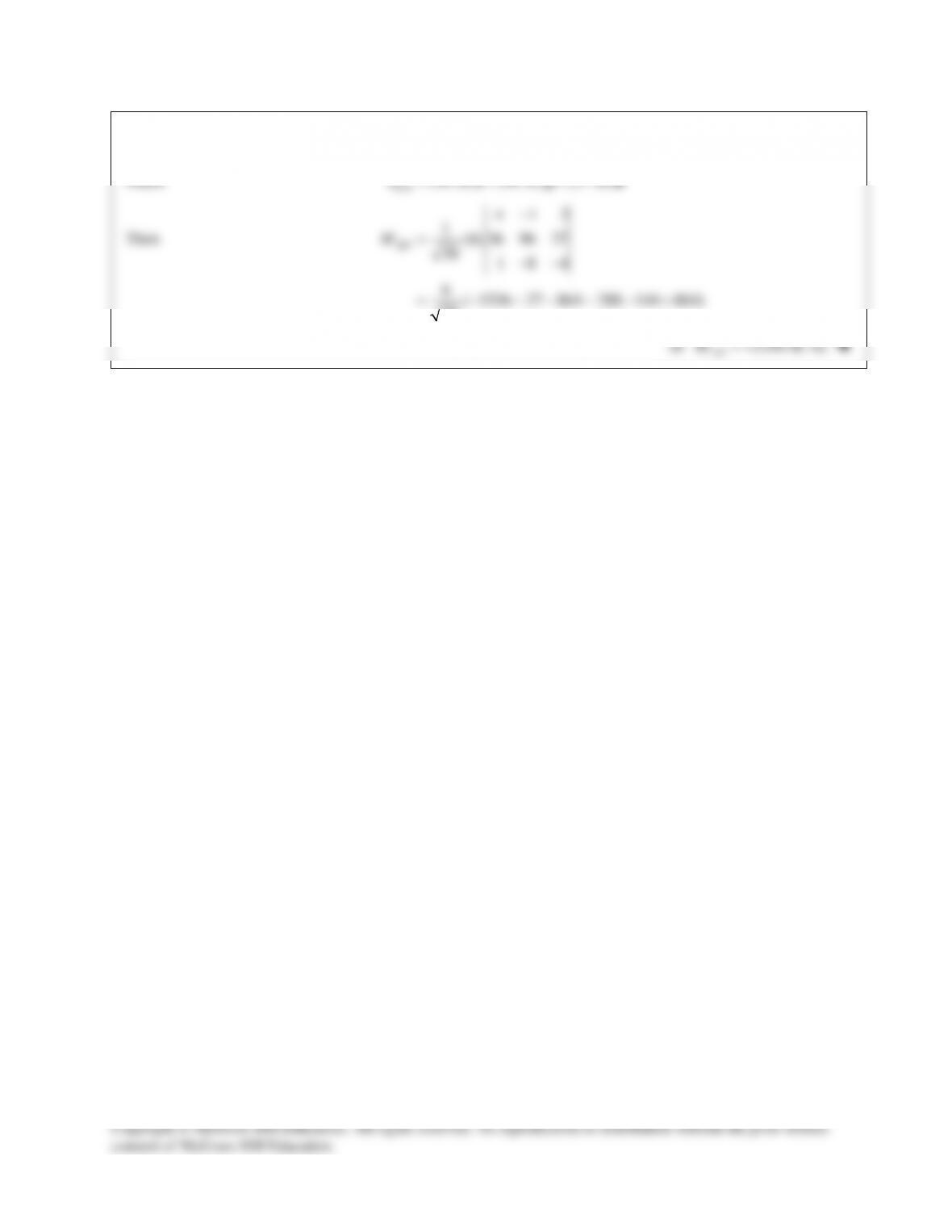
PROBLEM 3.44
A sign erected on uneven ground is
guyed by cables EF and EG. If the
force exerted by cable EG at E is 54 lb,
determine the moment of that force
about the line joining Points A and D.
SOLUTION
First note that
22
(48) (36) 60 in.BC = +=
and that
45 3
60 4 .
BE
BC = =
The coordinates of Point E are
then
( )
33
44
48, 96, 36 or (36 in., 96 in., 27 in.).××
Then
222
(11) ( 88) ( 44)
99 in.
EG
d= +− +−
=
Then
54 lb (11 88 44 )
99
6[(1 lb) (8 lb) (4 lb) ]
EG
= −−
= −−
T ijk
ijk
Also
2 22
(48) ( 12) (36)
12 26 in.
AD = +− +
=
Then
1(48 12 36 )
12 26
1(4 3 )
26
AD
AD
AD
=
= −+
= −+
ijk
ij k
λ
Now
/
()
AD AD E A EG
M=⋅×rTλ
SOLUTION Continued
where
/
(36 in.) (96 in.) (27 in.)
EA
=++r ijk
Then
413
1(6) 36 96 27
26 184
6( 1536 27 864 288 144 864)
26
AD
M
−
=
−−
= − −− − − +
or
2350 lb in.
AD
M=−⋅
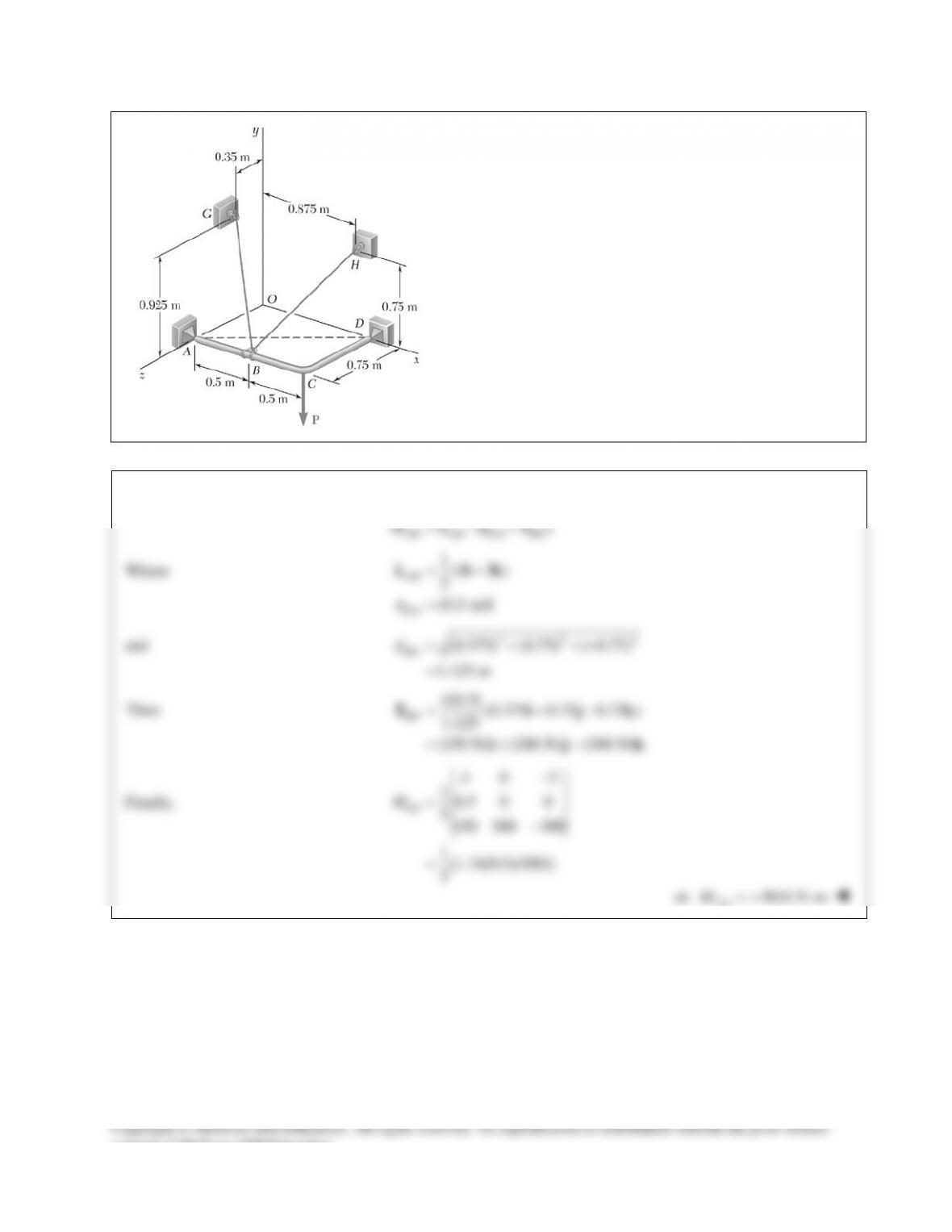
PROBLEM 3.45
The frame ACD is hinged at A and D and is supported by a
cable that passes through a ring at B and is attached to hooks
at G and H. Knowing that the tension in the cable is 450 N,
determine the moment about the diagonal AD of the force
exerted on the frame by portion BH of the cable.
SOLUTION
/
()
AD AD B A BH
M=⋅×rTλ
Where
/
1(4 3 )
5
(0.5 m)
AD
BA
= −
=
ik
ri
λ
and
22 2
(0.375) (0.75) ( 0.75)
1.125 m
BH
d= + +−
=
Then
450 N (0.375 0.75 0.75 )
1.125
(150 N) (300 N) (300 N)
BH
= +−
=+−
T ijk
ijk
Finally,
40 3
10.5 0 0
5150 300 300
1[( 3)(0.5)(300)]
5
AD
M
−
=
−
= −
or
90.0 N m
AD
M=−⋅
consent of McGraw–Hill Education.
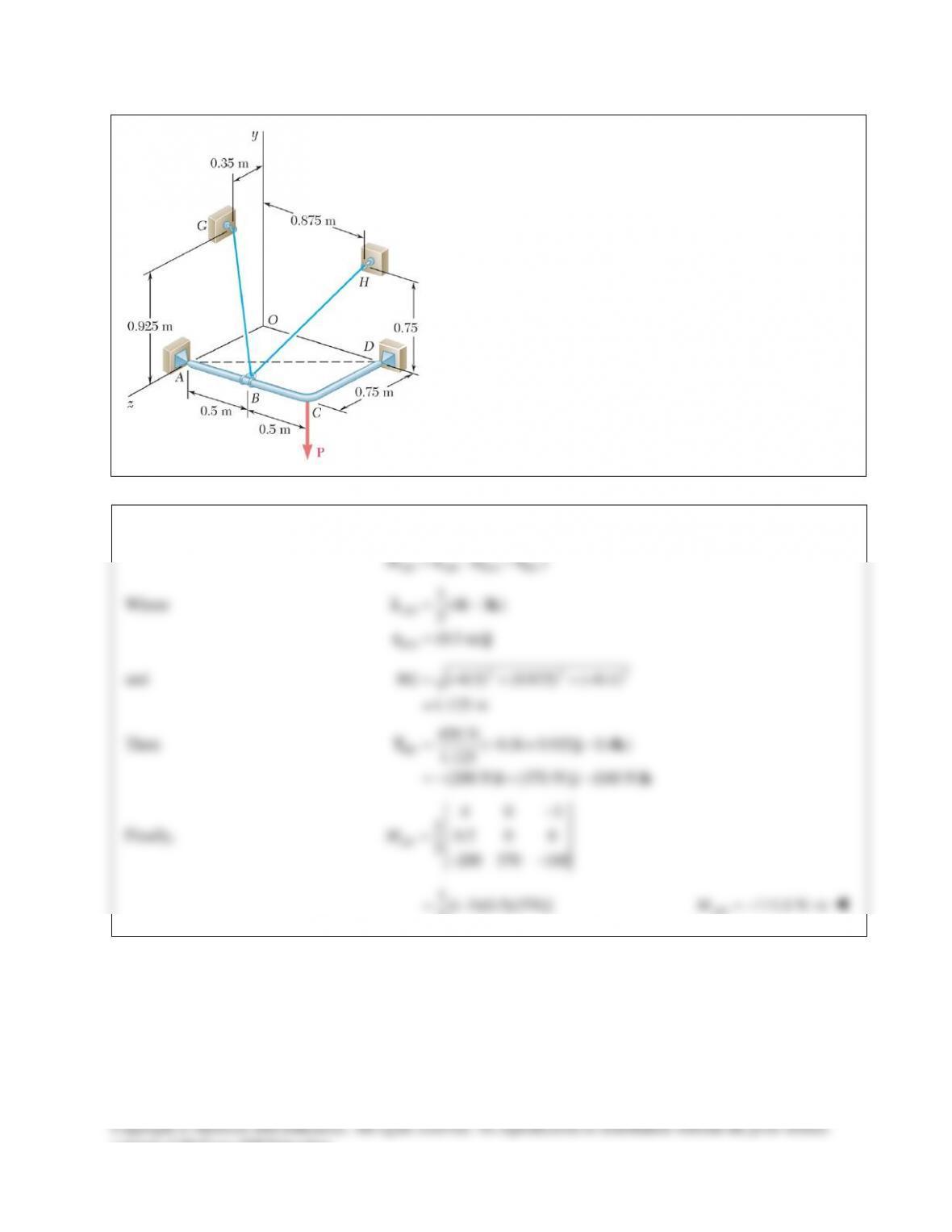
PROBLEM 3.46
In Problem 3.45, determine the moment about the diagonal AD
of the force exerted on the frame by portion BG of the cable.
PROBLEM 3.45 The frame ACD is hinged at A and D and is
supported by a cable that passes through a ring at B and is
attached to hooks at G and H. Knowing that the tension in the
cable is 450 N, determine the moment about the diagonal AD
of the force exerted on the frame by portion BH of the cable.
SOLUTION
/
()
AD AD B A BG
M=⋅×rTλ
Where
/
1(4 3 )
5
(0.5 m)
AD
BA
= −
=
ik
rj
λ
and
2 22
( 0.5) (0.925) ( 0.4)
1.125 m
BG = − + +−
=
Then
450 N ( 0.5 0.925 0.4 )
1.125
(200 N) (370 N) (160 N)
BG
= −+ −
=−+ −
T i jk
i jk
Finally,
40 3
10.5 0 0
5200 370 160
AD
M
−
=
−−
1[( 3)(0.5)(370)]
5
= −
111.0 N m
AD
M=−⋅
consent of McGraw–Hill Education.
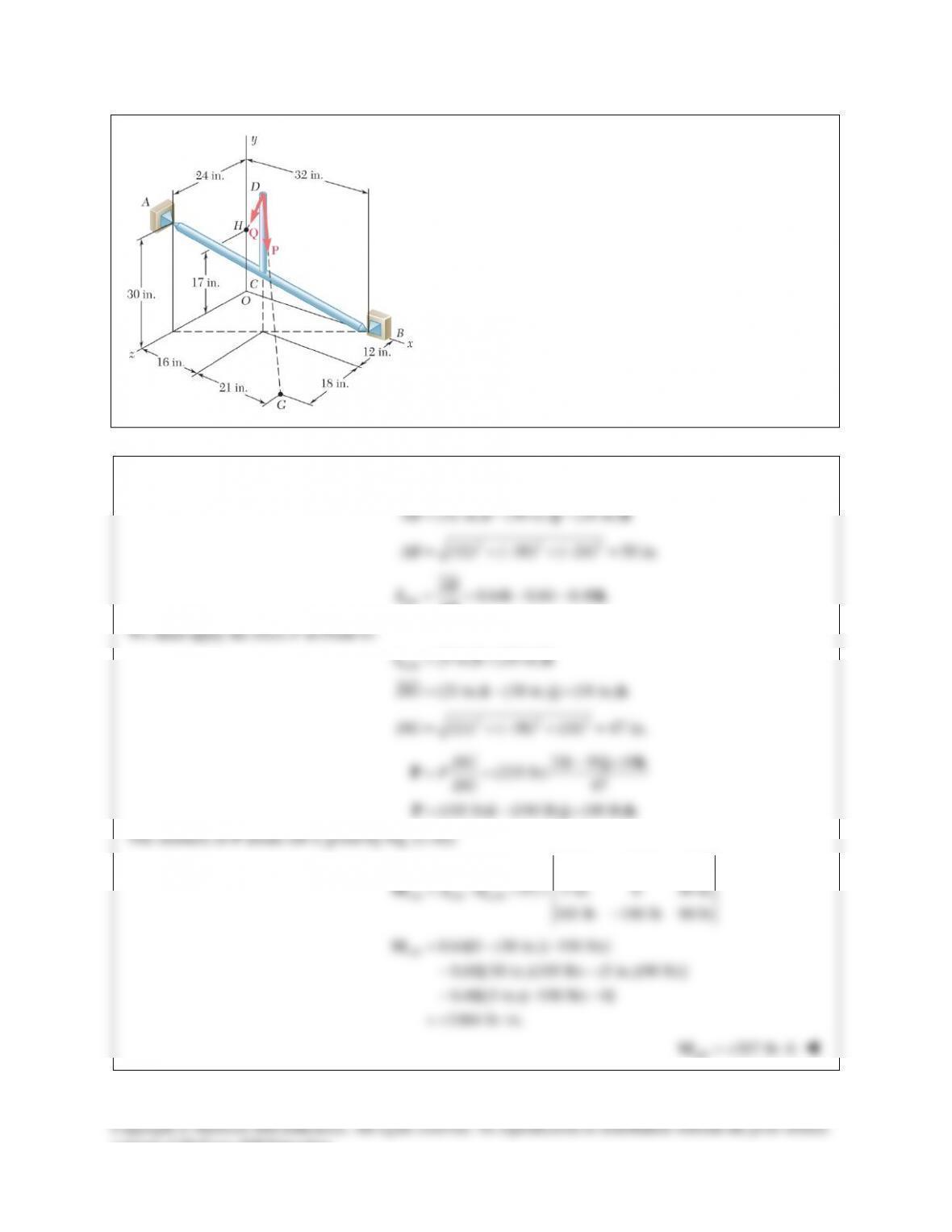
PROBLEM 3.47
The 23–in. vertical rod CD is welded to the midpoint C of
the 50–in. rod AB. Determine the moment about AB of the
235-lb force P.
SOLUTION
(32 in.) (30 in.) (24 in.)AB =−−ijk
222
(32) ( 30) ( 24) 50 in.AB = +− +− =
0.64 0.60 0.48
AB AB
AB
== −−ik
λ
/(5 in.) (30 in.)
GB= +
r ik
(21 in.) (38 in.) (18 in.)DG =−+i jk
2 22
(21) ( 38) (18) 47 in.DG = +− + =
21 38 18
(235 lb) 47
DG
PDG
−+
= = i jk
P
(105 lb) (190 lb) (90 lb)=−+P i jk
/
0.64 0.60 0.48
( ) 5 in. 0 30 in.
105 lb 190 lb 90 lb
AB AB G B
P
−−
= ⋅ ×=
−
Mr
λ
0.64[0 (30 in.)( 190 lb)]
0.60[(30 in.)(105 lb) (5 in.)(90 lb)]
0.48[(5 in.)( 190 lb) 0]
2484 lb in.
AB
=−−
−−
− −−
=+⋅
M
207 lb ft
AB
=+⋅M
consent of McGraw–Hill Education.
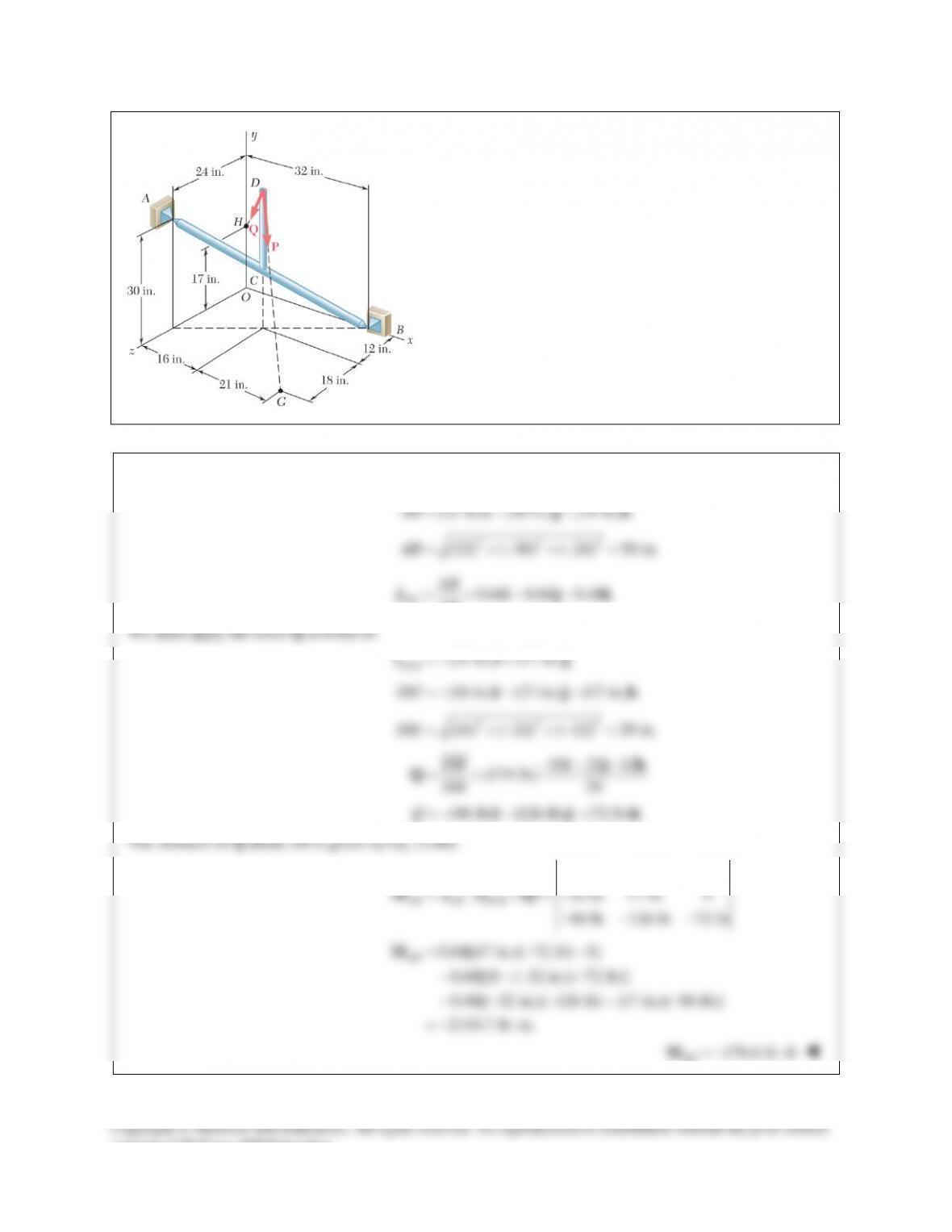
PROBLEM 3.48
The 23–in. vertical rod CD is welded to the midpoint C of
the 50–in. rod AB. Determine the moment about AB of the
174-lb force Q.
SOLUTION
(32 in.) (30 in.) (24 in.)AB =−−ijk
222
(32) ( 30) ( 24) 50 in.AB = +− +− =
0.64 0.60 0.48
AB
AB
AB
==−−ijk
λ
/
(32 in.) (17 in.)
HB
=−+r ij
(16 in.) (21 in.) (12 in.)
DH =−− −i jk
222
(16) ( 21) ( 12) 29 in.DH = +− +− =
16 21 12
(174 lb) 29
DH
DH
−− −
= = i jk
Q
(96 lb) (126 lb) (72 lb)Q=−− −i jk
/
0.64 0.60 0.48
( ) 32 in. 17 in. 0
96 lb 126 lb 72 lb
AB AB H B
−−
= ⋅ ×=−
−− −
M rQ
λ
0.64[(17 in.)( 72 lb) 0]
0.60[(0 ( 32 in.)( 72 lb)]
0.48[( 32 in.)( 126 lb) (17 in.)( 96 lb)]
2119.7 lb in.
AB
= −−
− −− −
−− − − −
=−⋅
M
176.6 lb ft
AB
=−⋅M
consent of McGraw–Hill Education.
PROBLEM 3.42
For the davit of Problem 3.41, determine the largest allowable
distance x when the tension in line ABAD is 60 lb.
SOLUTION
From the solution of Problem 3.41,
AD
T
is now
2 22
60 lb ( 7.75 3 )
( 7.75) ( 3)
AD
AD
TAD
x
x
=
= −−
+− +−
T
i jk
Then
/
()
z A C AD
M=⋅×
kr T
becomes
2 22
2
2
2
00 1
60
279 0 7.75 3
( 7.75) ( 3) 7.75 3
60
279 | (1)(7.75)( ) |
69.0625
279 69.0625 465
0.6 69.0625
xx
x
x
xx
xx
=+− +− −−
= −
+
+=
+=
Squaring both sides:
22
0.36 24.8625xx+=
2
38.848
x=
6.23 ftx=
PROBLEM 3.43
A sign erected on uneven ground is
guyed by cables EF and EG. If the
force exerted by cable EF at E is 46 lb,
determine the moment of that force
about the line joining Points A and D.
SOLUTION
First note that
22
(48) (36) 60 in.BC = +=
and that
45 3
60 4 .
BE
BC = =
The coordinates of Point E are
then
( )
33
44
48, 96, 36 or (36 in., 96 in., 27 in.).××
Then
2 22
( 15) ( 110) (30)
115 in.
EF
d= − +− +
=
Then
46 lb ( 15 110 30 )
115
2[ (3 lb) (22 lb) (6 lb) ]
EF
= −− +
=−− +
T i jk
i jk
Also
2 22
(48) ( 12) (36)
12 26 in.
AD = +− +
=
Then
1(48 12 36 )
12 26
1(4 3 )
26
AD
AD
AD
=
= −+
= −+
ijk
ij k
λ
Now
/
()
AD AD E A EF
M=⋅×rTλ
SOLUTION Continued
where
/
(36 in.) (96 in.) (27 in.)
EA
=++r ijk
Then
4 13
1(2) 36 96 27
26 3 22 6
2(2304 81 2376 864 216 2376)
26
AD
M
−
=
−−
= +− + + +
or
1359 lb in.
AD
M= ⋅
PROBLEM 3.44
A sign erected on uneven ground is
guyed by cables EF and EG. If the
force exerted by cable EG at E is 54 lb,
determine the moment of that force
about the line joining Points A and D.
SOLUTION
First note that
22
(48) (36) 60 in.BC = +=
and that
45 3
60 4 .
BE
BC = =
The coordinates of Point E are
then
( )
33
44
48, 96, 36 or (36 in., 96 in., 27 in.).××
Then
222
(11) ( 88) ( 44)
99 in.
EG
d= +− +−
=
Then
54 lb (11 88 44 )
99
6[(1 lb) (8 lb) (4 lb) ]
EG
= −−
= −−
T ijk
ijk
Also
2 22
(48) ( 12) (36)
12 26 in.
AD = +− +
=
Then
1(48 12 36 )
12 26
1(4 3 )
26
AD
AD
AD
=
= −+
= −+
ijk
ij k
λ
Now
/
()
AD AD E A EG
M=⋅×rTλ
SOLUTION Continued
where
/
(36 in.) (96 in.) (27 in.)
EA
=++r ijk
Then
413
1(6) 36 96 27
26 184
6( 1536 27 864 288 144 864)
26
AD
M
−
=
−−
= − −− − − +
or
2350 lb in.
AD
M=−⋅
PROBLEM 3.45
The frame ACD is hinged at A and D and is supported by a
cable that passes through a ring at B and is attached to hooks
at G and H. Knowing that the tension in the cable is 450 N,
determine the moment about the diagonal AD of the force
exerted on the frame by portion BH of the cable.
SOLUTION
/
()
AD AD B A BH
M=⋅×rTλ
Where
/
1(4 3 )
5
(0.5 m)
AD
BA
= −
=
ik
ri
λ
and
22 2
(0.375) (0.75) ( 0.75)
1.125 m
BH
d= + +−
=
Then
450 N (0.375 0.75 0.75 )
1.125
(150 N) (300 N) (300 N)
BH
= +−
=+−
T ijk
ijk
Finally,
40 3
10.5 0 0
5150 300 300
1[( 3)(0.5)(300)]
5
AD
M
−
=
−
= −
or
90.0 N m
AD
M=−⋅
consent of McGraw–Hill Education.
PROBLEM 3.46
In Problem 3.45, determine the moment about the diagonal AD
of the force exerted on the frame by portion BG of the cable.
PROBLEM 3.45 The frame ACD is hinged at A and D and is
supported by a cable that passes through a ring at B and is
attached to hooks at G and H. Knowing that the tension in the
cable is 450 N, determine the moment about the diagonal AD
of the force exerted on the frame by portion BH of the cable.
SOLUTION
/
()
AD AD B A BG
M=⋅×rTλ
Where
/
1(4 3 )
5
(0.5 m)
AD
BA
= −
=
ik
rj
λ
and
2 22
( 0.5) (0.925) ( 0.4)
1.125 m
BG = − + +−
=
Then
450 N ( 0.5 0.925 0.4 )
1.125
(200 N) (370 N) (160 N)
BG
= −+ −
=−+ −
T i jk
i jk
Finally,
40 3
10.5 0 0
5200 370 160
AD
M
−
=
−−
1[( 3)(0.5)(370)]
5
= −
111.0 N m
AD
M=−⋅
consent of McGraw–Hill Education.
PROBLEM 3.47
The 23–in. vertical rod CD is welded to the midpoint C of
the 50–in. rod AB. Determine the moment about AB of the
235-lb force P.
SOLUTION
(32 in.) (30 in.) (24 in.)AB =−−ijk
222
(32) ( 30) ( 24) 50 in.AB = +− +− =
0.64 0.60 0.48
AB AB
AB
== −−ik
λ
/(5 in.) (30 in.)
GB= +
r ik
(21 in.) (38 in.) (18 in.)DG =−+i jk
2 22
(21) ( 38) (18) 47 in.DG = +− + =
21 38 18
(235 lb) 47
DG
PDG
−+
= = i jk
P
(105 lb) (190 lb) (90 lb)=−+P i jk
/
0.64 0.60 0.48
( ) 5 in. 0 30 in.
105 lb 190 lb 90 lb
AB AB G B
P
−−
= ⋅ ×=
−
Mr
λ
0.64[0 (30 in.)( 190 lb)]
0.60[(30 in.)(105 lb) (5 in.)(90 lb)]
0.48[(5 in.)( 190 lb) 0]
2484 lb in.
AB
=−−
−−
− −−
=+⋅
M
207 lb ft
AB
=+⋅M
consent of McGraw–Hill Education.
PROBLEM 3.48
The 23–in. vertical rod CD is welded to the midpoint C of
the 50–in. rod AB. Determine the moment about AB of the
174-lb force Q.
SOLUTION
(32 in.) (30 in.) (24 in.)AB =−−ijk
222
(32) ( 30) ( 24) 50 in.AB = +− +− =
0.64 0.60 0.48
AB
AB
AB
==−−ijk
λ
/
(32 in.) (17 in.)
HB
=−+r ij
(16 in.) (21 in.) (12 in.)
DH =−− −i jk
222
(16) ( 21) ( 12) 29 in.DH = +− +− =
16 21 12
(174 lb) 29
DH
DH
−− −
= = i jk
Q
(96 lb) (126 lb) (72 lb)Q=−− −i jk
/
0.64 0.60 0.48
( ) 32 in. 17 in. 0
96 lb 126 lb 72 lb
AB AB H B
−−
= ⋅ ×=−
−− −
M rQ
λ
0.64[(17 in.)( 72 lb) 0]
0.60[(0 ( 32 in.)( 72 lb)]
0.48[( 32 in.)( 126 lb) (17 in.)( 96 lb)]
2119.7 lb in.
AB
= −−
− −− −
−− − − −
=−⋅
M
176.6 lb ft
AB
=−⋅M
consent of McGraw–Hill Education.