PROBLEM 15.10
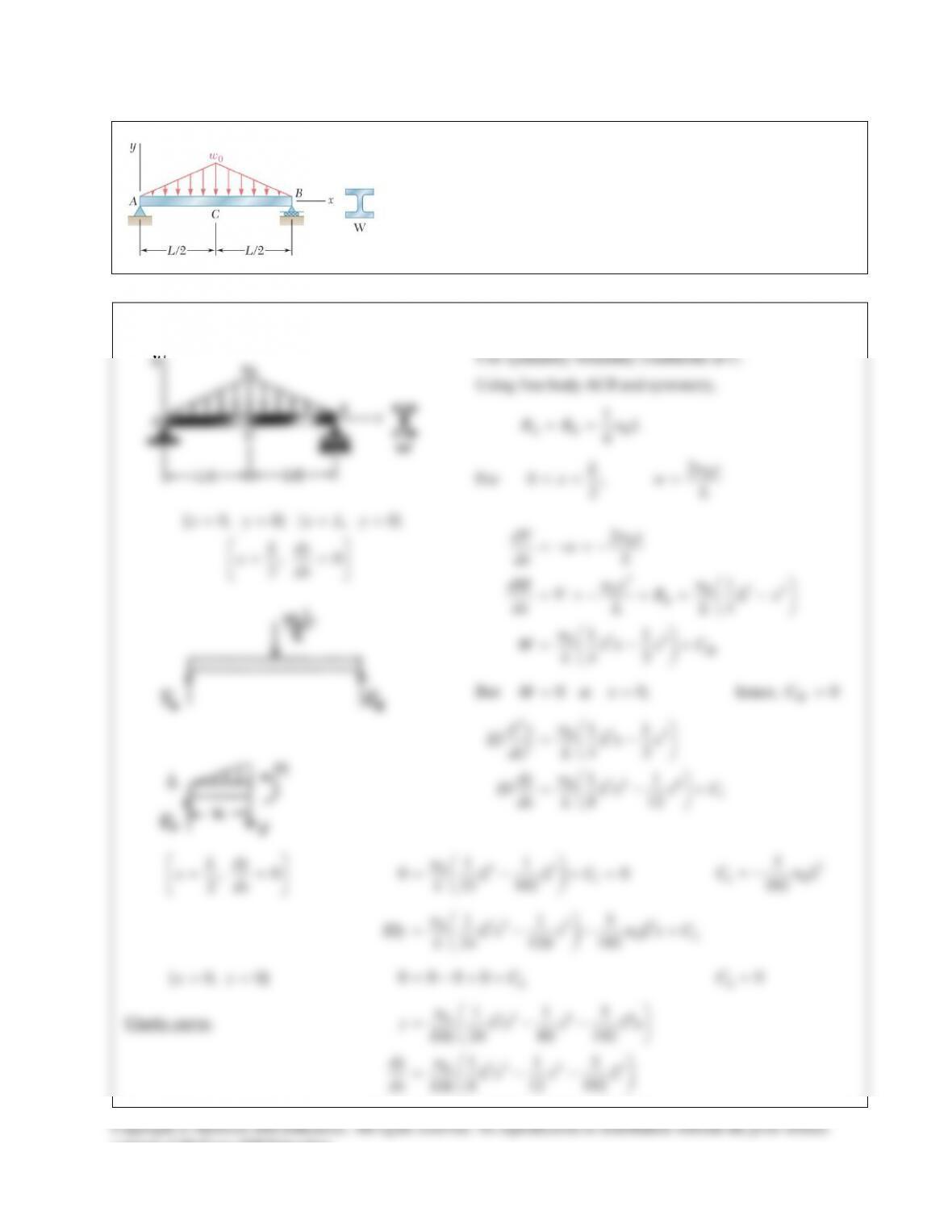
Knowing that beam AB is a
W10 33×
rolled shape and that
0
3 kips/ft,
w=
12 ft,L=
and
6
29 10 psi,E= ×
determine (a) the
slope at A, (b) the deflection at C.
SOLUTION
PROBLEM 15.10 (Continued)
Data:
64
0
3 kips/ft, 29 10 psi, 171inwE I= =×=
6 92 3
(29 10 )(171) 4.959 10 lb in 34.438 10 kip ft,
12 ft
EI
L
=× = × ⋅= × ⋅
=
(a) Slope at x = 0.
43
3
35
(12) 3.92 10
192
(34.438 10 )(12)
dy
dx
= − =−×
×
3
3.92 10 rad
A
θ
−
= ×
(b)
Deflection at 6 ft.
x=
23 5 4 3
3
3 1 15
(12) (6) (6) (12) (6) 15.0531 10 ft
24 60 192
(34.438 10 )(12)
C
y
−
= −− =−×
×
0.1806 in
C
y= ↓.
consent of McGraw–Hill Education.
PROBLEM 15.11
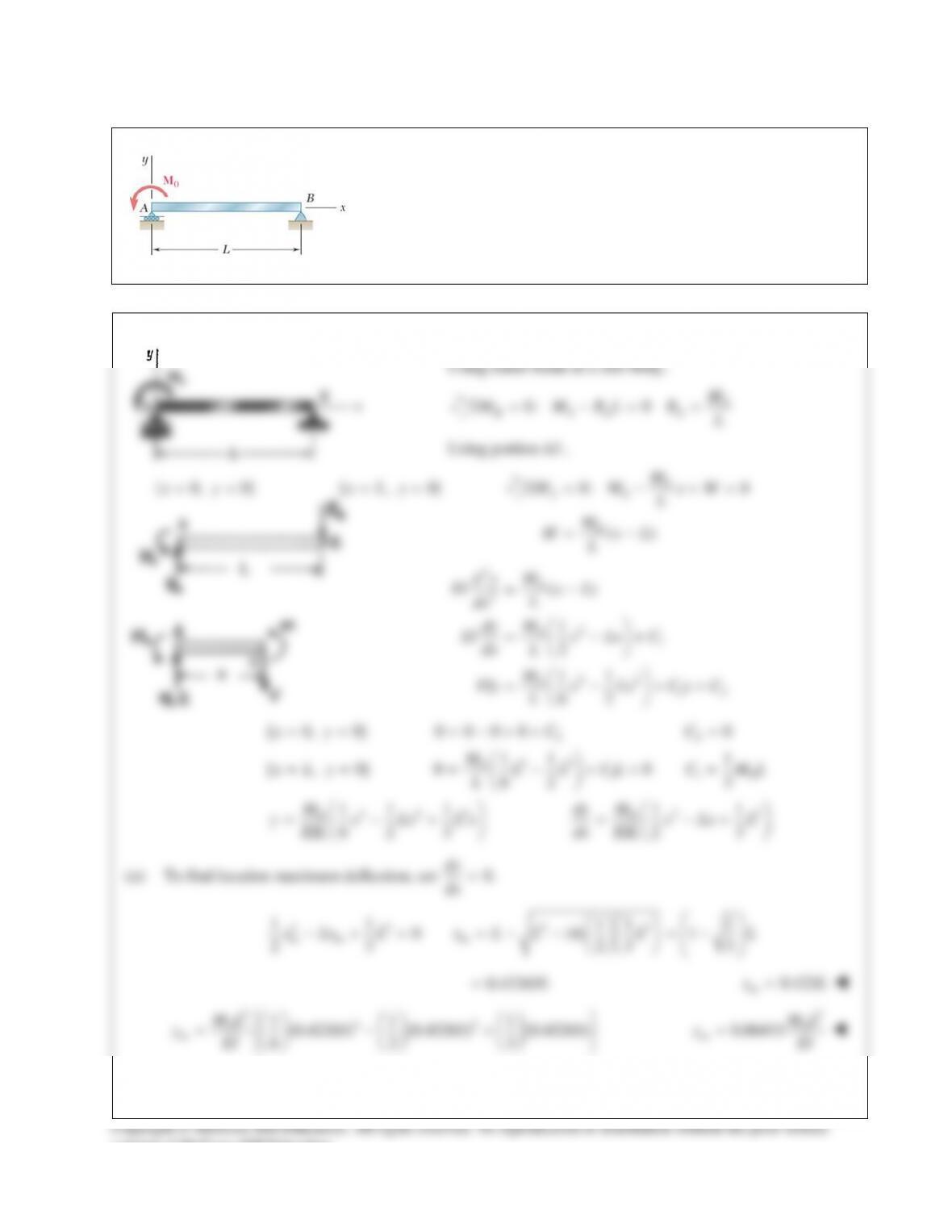
(a) Determine the location and magnitude of the maximum deflection of
beam AB. (b) Assuming that beam AB is a
W360 64, 3.5 m,L×=
and
200 GPa,E=
calculate the maximum allowable value of the applied
moment M0 if the maximum deflection is not to exceed 1 mm.
SOLUTION
PROBLEM 15.11 (Continued)
Solving for
0,M
02
0.06415
m
EIy
ML
=
(b) Data:
9 6 4 64
3
9 63 3
02
200 10 Pa, 178 10 mm 178 10 m
3.5m 1mm 10 m
(200 10 )(178 10 )(10 ) 45.3 10 N m
(0.06415)(3.5)
m
EI
Ly
M
−
−
−−
=× =×=×
= = =
××
= =×⋅
045.3 kN mM= ⋅
consent of McGraw–Hill Education.
PROBLEM 15.12
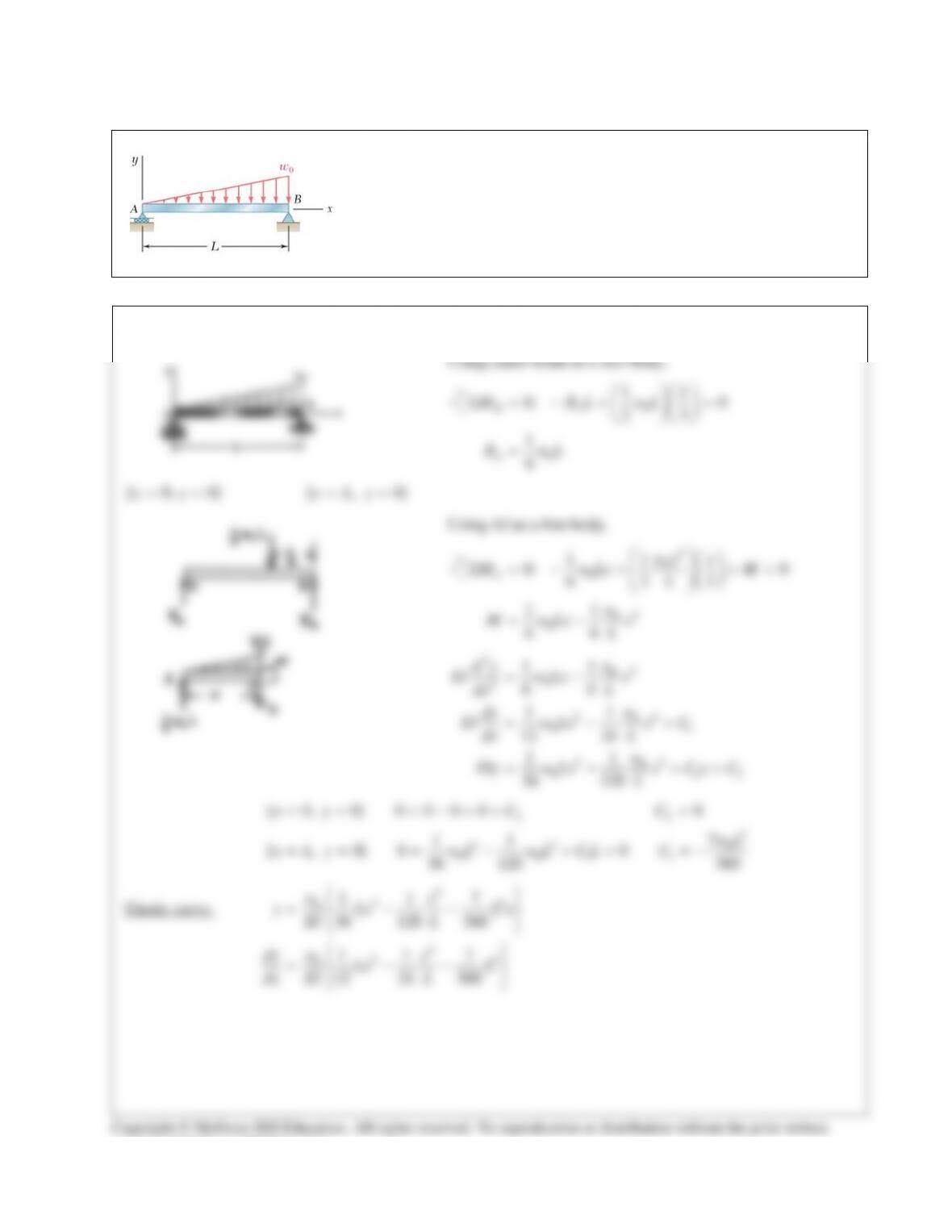
For the beam and loading shown, (a) express the magnitude and location of
the maximum deflection in terms of w0, L, E, and I. (b) Calculate the value
of the maximum deflection, assuming that beam AB is a
W18 50×
rolled
shape and that
0
4.5 kips/ft,w=
18 ft,L=
and
6
29 10 psi.E= ×
SOLUTION
consent of McGraw–Hill Education.
PROBLEM 15.12 (Continued)
dy
PROBLEM 15.13
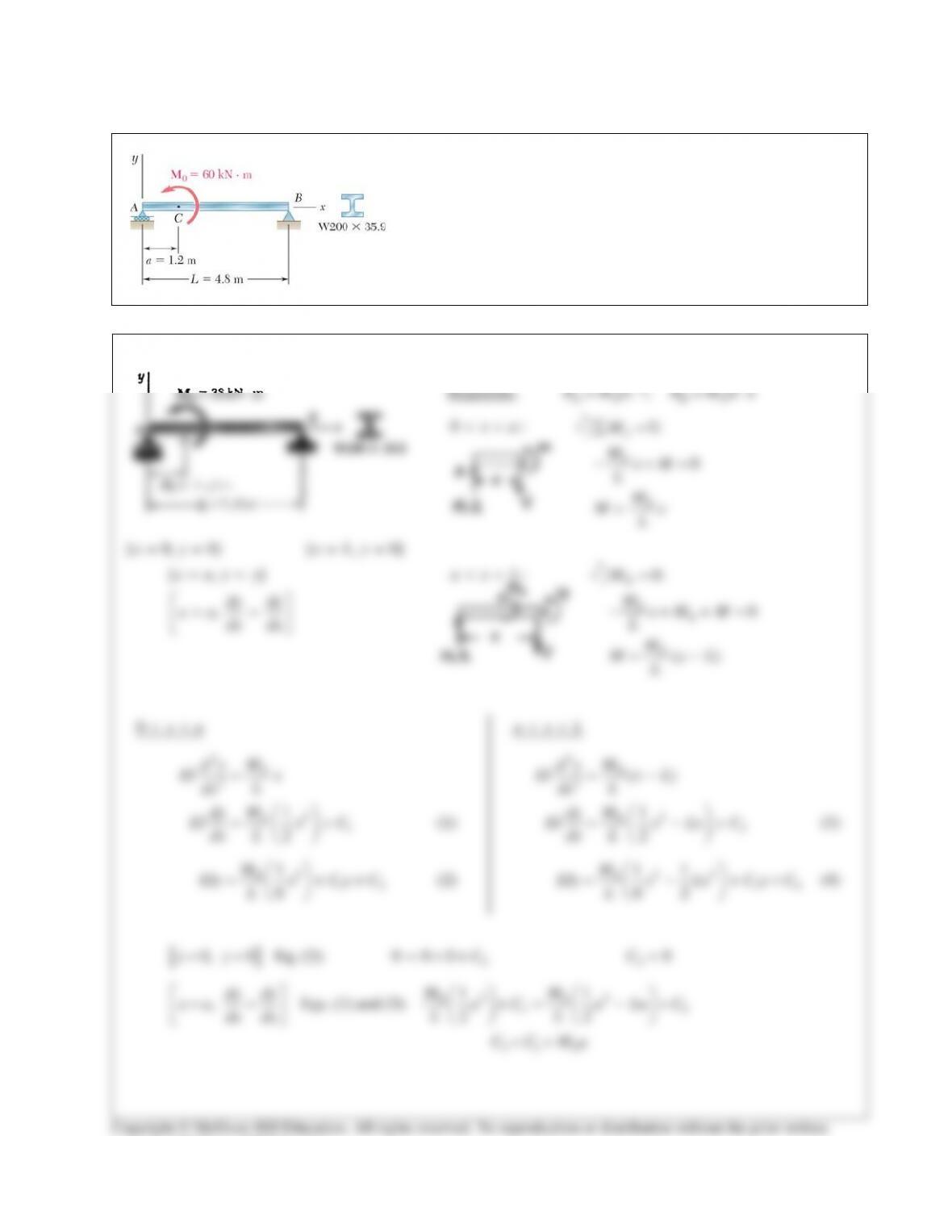
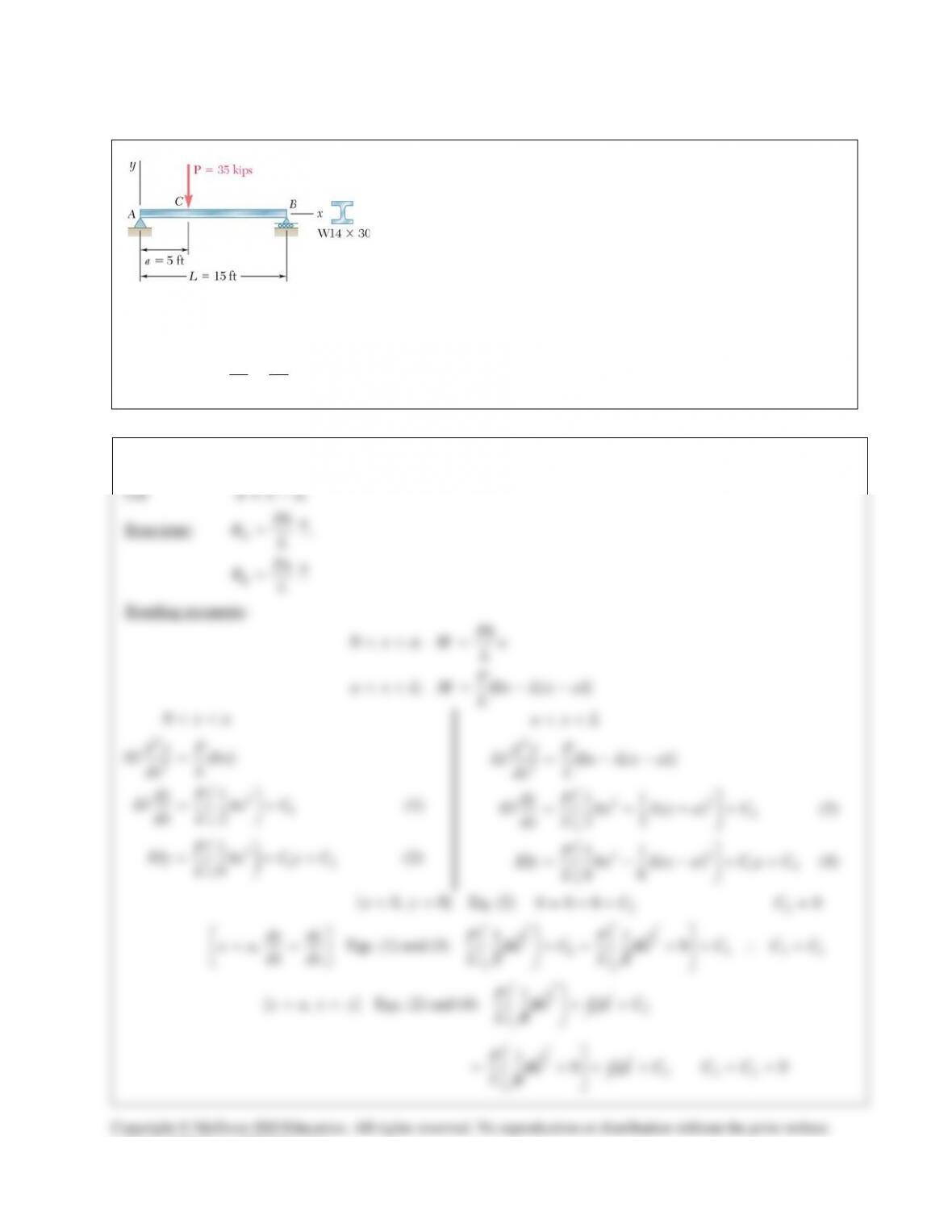
For the beam and loading shown, determine the deflection at
point C. Use
200 GPa.E=
SOLUTION
consent of McGraw–Hill Education.
PROBLEM 15.13 (Continued)
[ ]
3
0
1
, Eqs. (2) and (4): 6
M
x ay y a
L
= =
1
Ca
+
3
0
1
6
Ma
L
=
21
1(
2La C
−+
04
2
40
)
1
2
Maa C
C Ma
++
= −
[ ]
33 2
010 0
22
0
1
11 1
, 0 Eq. (4): ( ) 0
62 2
11
32
M
x L y L L C MaL Ma
L
M
C L a aL
L
= = − ++ − =
= +−
Elastic curve for 0 .xa
<<
3 22
0
1 11
6 32
M
y x L a aL x
EIL
= + +−
Make
.xa=
3 2 32 3 2 2
00
11 1 21
63 2 33
C
MM
y a La a a L a La La
EIL EIL
= + +− = + −
Data:
9
200 10 Pa,E= ×
6 4 64
34.4 10 mm 34.4 10 m ,I
−
=×=×
3
060 10 N mM=×⋅
1.2 m, 4.8 maL= =
33 2 2
3
96
(60 10 ) (2)(1.2) /3 (4.8) (1.2)/3 (4.8)(1.2) 6.28 10 m
(200 10 )(34.4 10 )(4.8)
C
y
−
−
× +−
= = ×
××
6.28 mm
C
y= ↑
[ 0, 0] [ , 0]
[, ]
,
x y x Ly
x ay y
dy dy
xa
dx dx
= = = =
= =
= =
PROBLEM 15.14
For the beam and loading shown, determine the deflection at
point C. Use
6
29 10 psi.E= ×
SOLUTION
Let
.b La= −
Reactions:
,
A
B
Pb
RL
Pa
RL
= ↑
= ↑
Bending moments:
0:
: [ ( )]
Pb
x aM x
L
P
a x L M bx L x a
L
<< =
<< = − −
2
2
21
0
()
1
2
xa
dy P
EI bx
L
dx
dy P
EI bx C
dx L
<<
=
= +
(1)
312
1
6
P
EIy bx C x C
L
= ++
(2)
2
2
[ ( )]
axL
dy P
EI bx L x a
L
dx
<<
= −−
22
3
11
()
22
dy P
EI bx L x a C
dx L
= − −+
(3)
33
34
11
()
66
P
EIy bx L x a C x C
L
= − − ++
(4)
[ 0, 0]xy= =
Eq. (2)
2
000C=++
2
0C=
2
1
, Eqs. (1) and (3) 2
dy dy P
x a ba
dx dx L
= =
2
1
1
2
P
C ba
L
+=
3 31
0C CC
++ ∴ =
3
1
[ , ] Eqs. (2) and (4) 6
P
x a y y ba
L
= =
1
Ca
+
2
C+
3
1
6
Pba
L
=
1
0Ca
++
4 42
0
C CC+==
Copyright © McGraw–Hill Education. All rights reserved. No reproduction or distribution without the prior written
consent of McGraw–Hill Education.
PROBLEM 15.10
Knowing that beam AB is a
W10 33×
rolled shape and that
0
3 kips/ft,
w=
12 ft,L=
and
6
29 10 psi,E= ×
determine (a) the
slope at A, (b) the deflection at C.
SOLUTION
PROBLEM 15.10 (Continued)
Data:
64
0
3 kips/ft, 29 10 psi, 171inwE I= =×=
6 92 3
(29 10 )(171) 4.959 10 lb in 34.438 10 kip ft,
12 ft
EI
L
=× = × ⋅= × ⋅
=
(a) Slope at x = 0.
43
3
35
(12) 3.92 10
192
(34.438 10 )(12)
dy
dx
= − =−×
×
3
3.92 10 rad
A
θ
−
= ×
(b)
Deflection at 6 ft.
x=
23 5 4 3
3
3 1 15
(12) (6) (6) (12) (6) 15.0531 10 ft
24 60 192
(34.438 10 )(12)
C
y
−
= −− =−×
×
0.1806 in
C
y= ↓.
consent of McGraw–Hill Education.
PROBLEM 15.11
(a) Determine the location and magnitude of the maximum deflection of
beam AB. (b) Assuming that beam AB is a
W360 64, 3.5 m,L×=
and
200 GPa,E=
calculate the maximum allowable value of the applied
moment M0 if the maximum deflection is not to exceed 1 mm.
SOLUTION
PROBLEM 15.11 (Continued)
Solving for
0,M
02
0.06415
m
EIy
ML
=
(b) Data:
9 6 4 64
3
9 63 3
02
200 10 Pa, 178 10 mm 178 10 m
3.5m 1mm 10 m
(200 10 )(178 10 )(10 ) 45.3 10 N m
(0.06415)(3.5)
m
EI
Ly
M
−
−
−−
=× =×=×
= = =
××
= =×⋅
045.3 kN mM= ⋅
consent of McGraw–Hill Education.
PROBLEM 15.12
For the beam and loading shown, (a) express the magnitude and location of
the maximum deflection in terms of w0, L, E, and I. (b) Calculate the value
of the maximum deflection, assuming that beam AB is a
W18 50×
rolled
shape and that
0
4.5 kips/ft,w=
18 ft,L=
and
6
29 10 psi.E= ×
SOLUTION
consent of McGraw–Hill Education.
PROBLEM 15.12 (Continued)
dy
PROBLEM 15.13
For the beam and loading shown, determine the deflection at
point C. Use
200 GPa.E=
SOLUTION
consent of McGraw–Hill Education.
PROBLEM 15.13 (Continued)
[ ]
3
0
1
, Eqs. (2) and (4): 6
M
x ay y a
L
= =
1
Ca
+
3
0
1
6
Ma
L
=
21
1(
2La C
−+
04
2
40
)
1
2
Maa C
C Ma
++
= −
[ ]
33 2
010 0
22
0
1
11 1
, 0 Eq. (4): ( ) 0
62 2
11
32
M
x L y L L C MaL Ma
L
M
C L a aL
L
= = − ++ − =
= +−
Elastic curve for 0 .xa
<<
3 22
0
1 11
6 32
M
y x L a aL x
EIL
= + +−
Make
.xa=
3 2 32 3 2 2
00
11 1 21
63 2 33
C
MM
y a La a a L a La La
EIL EIL
= + +− = + −
Data:
9
200 10 Pa,E= ×
6 4 64
34.4 10 mm 34.4 10 m ,I
−
=×=×
3
060 10 N mM=×⋅
1.2 m, 4.8 maL= =
33 2 2
3
96
(60 10 ) (2)(1.2) /3 (4.8) (1.2)/3 (4.8)(1.2) 6.28 10 m
(200 10 )(34.4 10 )(4.8)
C
y
−
−
× +−
= = ×
××
6.28 mm
C
y= ↑
[ 0, 0] [ , 0]
[, ]
,
x y x Ly
x ay y
dy dy
xa
dx dx
= = = =
= =
= =
PROBLEM 15.14
For the beam and loading shown, determine the deflection at
point C. Use
6
29 10 psi.E= ×
SOLUTION
Let
.b La= −
Reactions:
,
A
B
Pb
RL
Pa
RL
= ↑
= ↑
Bending moments:
0:
: [ ( )]
Pb
x aM x
L
P
a x L M bx L x a
L
<< =
<< = − −
2
2
21
0
()
1
2
xa
dy P
EI bx
L
dx
dy P
EI bx C
dx L
<<
=
= +
(1)
312
1
6
P
EIy bx C x C
L
= ++
(2)
2
2
[ ( )]
axL
dy P
EI bx L x a
L
dx
<<
= −−
22
3
11
()
22
dy P
EI bx L x a C
dx L
= − −+
(3)
33
34
11
()
66
P
EIy bx L x a C x C
L
= − − ++
(4)
[ 0, 0]xy= =
Eq. (2)
2
000C=++
2
0C=
2
1
, Eqs. (1) and (3) 2
dy dy P
x a ba
dx dx L
= =
2
1
1
2
P
C ba
L
+=
3 31
0C CC
++ ∴ =
3
1
[ , ] Eqs. (2) and (4) 6
P
x a y y ba
L
= =
1
Ca
+
2
C+
3
1
6
Pba
L
=
1
0Ca
++
4 42
0
C CC+==
Copyright © McGraw–Hill Education. All rights reserved. No reproduction or distribution without the prior written
consent of McGraw–Hill Education.