
When determining whether independence is impaired because of an ownership interest
in a client company, materiality will affect ownership
A) in all circumstances.
B) only for direct ownership.
C) only for indirect ownership.
D) under no circumstances.
An example of a breach of contract would likely include
A) an auditor’s refusal to return the client’s general ledger book until the client paid last
year’s audit fees.
B) a bank’s claim that an auditor had a duty to uncover material errors in financial
statements that had been relied on in making a loan.
C) a CPA firm’s failure to complete an audit on the agreed-upon date because the firm
had a backlog of other work which was more lucrative.
D) an auditor’s claim that the client staff is unqualified.
The first phase in planning an audit and designing an audit approach is to
A) accept the client and perform initial audit planning.
B) set the preliminary judgment of materiality.
C) understand the client’s business and industry.
D) perform preliminary audit procedures.
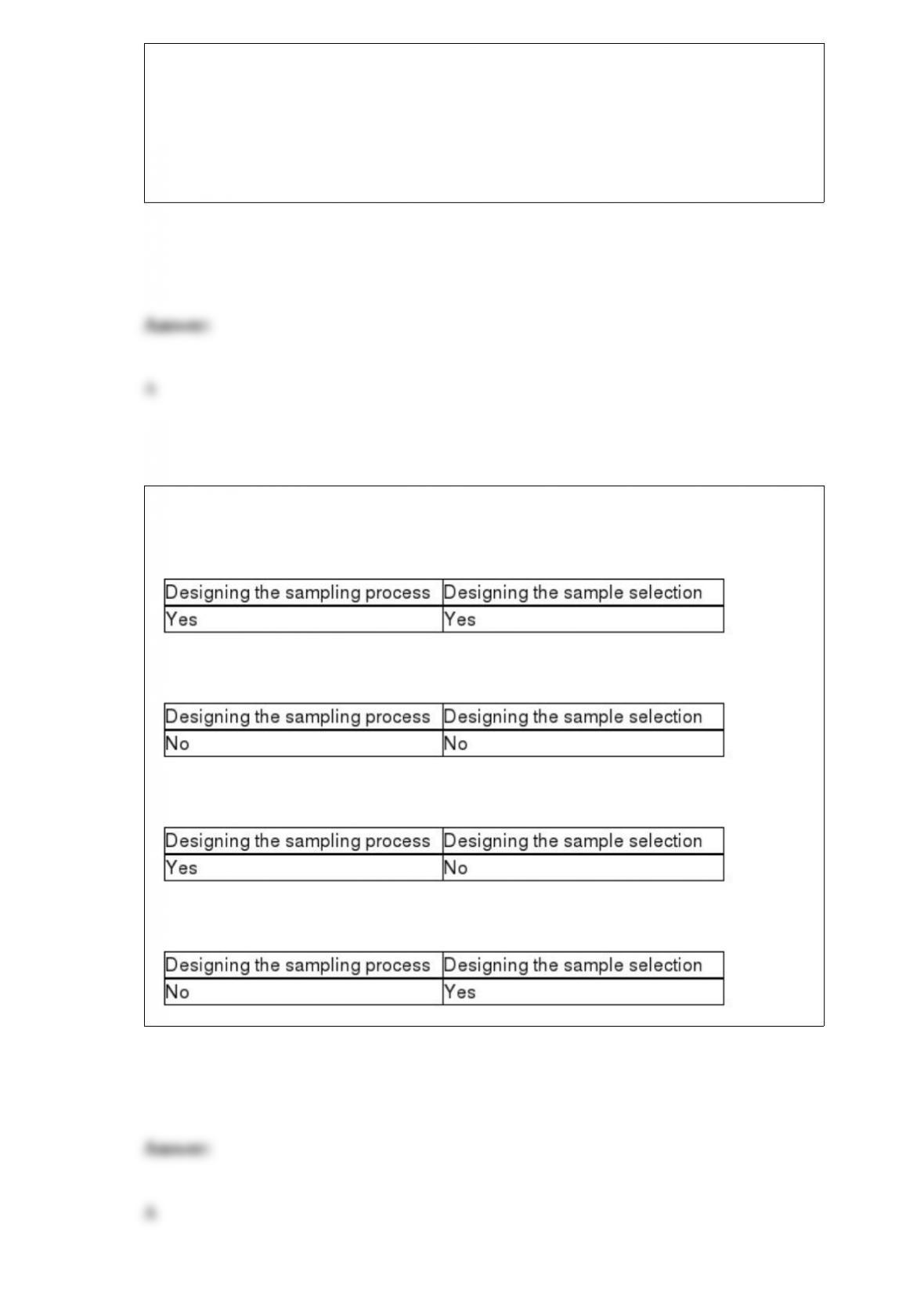
An auditor can increase the likelihood that a sample is representative by using care in
A)
B)
C)
D)

Most cases of fraudulent reporting involve
A) inadequate disclosures.
B) an overstatement of income.
C) an overstatement of liabilities.
D) an overstatement of expenses.
The most effective and efficient audit approach in the examination of the income
statement would be which of the following?
A) Examine income statement accounts concurrently with the related balance sheet
accounts.
B) Compare company’s components of net income to other businesses in the same
industry.
C) Compare company’s components of net income to the previous two years.
D) Examine changes in all balance sheet accounts.
Reports on agreed-upon procedures are intended to be distributed

A) to only the involved parties, who would have the requisite knowledge about those
procedures and the level of assurance resulting from them.
B) to only the involved parties, who would have the requisite knowledge about those
procedures but not the level of assurance resulting from them.
C) to any party to whom the client wishes.
D) only to the stockholders of the client.
The CPA firm will lose its independence if
A) a staff auditor providing audit services to the client acquires stock in that client.
B) a staff tax preparer who provides 15 hours of non-audit services to the client
acquires stock in that client.
C) an audit manager in an office different than the office providing audit services has a
direct, immaterial financial interest in the audit client.
D) a covered member has an indirect, immaterial financial interest in an audit client.
“Independence” in auditing means
A) maintaining an indirect financial interest.
B) not being financially dependent on a client.

C) taking an unbiased viewpoint.
D) being an advocate for a client.
Typical controls developed for manual systems which are still important in IT systems
include
A) management’s authorization of transactions.
B) competent personnel.
C) adequate preparation of input source documents.
D) all of the above.
The test of details of balances procedure that requires the auditor to trace the book
balance on the reconciliation to the general ledger is an attempt to satisfy the audit
objective of
A) detail tie-in.
B) existence.
C) completeness.
D) accuracy.

Misappropriation of assets is normally perpetrated by
A) members of the board of directors.
B) employees at lower levels of the organization.
C) management of the company.
D) the internal auditors.
When dealing with audit risk,
A) audit risk should not be a factor when determining if a new client should be
accepted.
B) audits with a low acceptable audit risk generally result in lower audit fees.
C) if management of a company has a reputation of integrity, but is also known to take
aggressive financial risks, the auditor should not accept the company as a new client.
D) if the auditor concludes that acceptable audit risk is low, but the client is still
acceptable, the auditor may still accept the engagement but increase the fee proposed to
the client.
Which of the following is true statement regarding professional skepticism?
A) Auditors reject most potential clients perceived as lacking honesty and integrity.
B) If the auditor has past experience with a client, they can assume the client is honest.
C) Material frauds occur in most of the audits of financial statements.
D) Professional skepticism is required only during the planning phase.
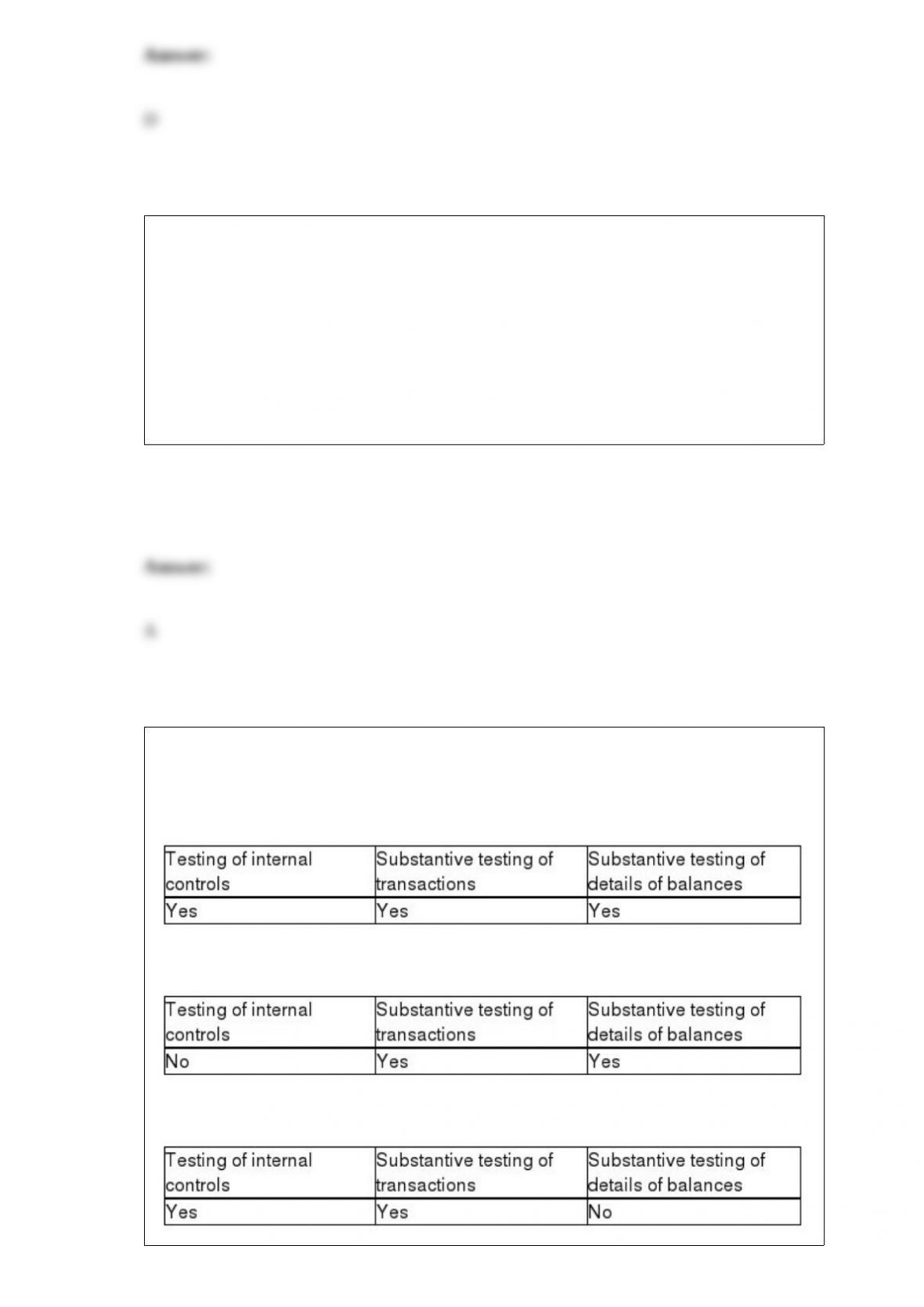
Tests for rates of occurrence are appropriately used in all but which of the following
situations?
A)
B)
C)

D)
The Single Audit Act requires that an audit be conducted for recipients who receive
total federal funds in any fiscal year of more than
A) $1,000,000.
B) $750,000.
C) $500,000.
D) $100,000.
Which of the auditor’s defenses against client suits contends no implied or expressed
contract?
A) lack of duty
B) non-negligent performance
C) contributory negligence

D) absence of causal connections
Which of the following is an account that is not affected by the sales and collection
cycle?
A) cash
B) accounts receivable
C) allowance for doubtful accounts
D) accounts payable
When auditors wish to evaluate a sample statistically, an acceptable selection method is:
A) systematic sample selection.
B) judgmental selection.
C) haphazard selection.
D) block sample selection.

________ misstatements are those where the auditor can determine the amount of the
misstatement in the account.
A) Potential
B) Likely
C) Known
D) Projected
Evidence is generally considered appropriate when
A) it has been obtained by random selection.
B) there is enough of it to afford a reasonable basis for an opinion on financial
statements.
C) it is relevant to the audit objective being tested.
D) it consists of written statements made by managers of the company under audit.

Audit evidence has two primary qualities for the auditor; relevance and reliability.
Given the choices below, which provides the auditor with the most reliable audit
evidence?
A) general ledger account balances
B) confirmation of accounts receivable balance received from a customer
C) internal memo explaining the issuance of a credit memo
D) copy of month-end adjusting entries
Auditors will generally send a standard inquiry to the client’s attorney letter to
A) only those attorneys who have devoted substantial time to client matters during the
year.
B) every attorney that the client has been involved with in the current or preceding year,
plus any attorney the client engages on occasion.
C) every attorney whose legal fees for the year exceed a materiality threshold.
D) only the attorney who represents the client in proceeding where the client is
defendant.
If there is a deviation in the statements’ preparation in accordance with GAAP and
another accounting principle was applied on a basis that was not consistent with that of

the preceding year,
A) the auditor must choose which modification to include in the audit report.
B) only the most material modification can be disclosed.
C) more than one modification should be included in the report.
D) none of the above.
Critical lessons learned after analyzing major criminal cases against auditors include the
fact that
A) the partner, but not the audit staff, must be independent.
B) transactions with related parties are an indication of fraud.
C) an investigation of the integrity of management is an important part of deciding
whether to accept a new client.
D) accounting principles can be relied on exclusively in deciding if the financial
statements are fairly presented.
Which of the following is a correct statement regarding the standard unmodified
opinion audit report?
A) The format of the audit report for public and nonpublic entities are identical.

B) The auditor’s responsibility paragraph includes a statement that the auditors are
responsible for selecting the appropriate accounting principles.
C) The audit report includes the name of the lead partner on the audit.
D) The scope paragraph includes a statement that the auditor considers internal controls
when designing the audit procedures performed.
Which of the following would not be considered further audit procedures?
A) tests of controls
B) analytical procedures
C) tests of details of balances
D) risk assessment procedures
Four of the six Ethical Principles in the AICPA’sCode of Professional Conduct are
equally applicable to all members of the AICPA. Which of the following principles
applies only to members in public practice?
A) Scope and Nature of Services
B) Integrity

C) Due Care
D) The Public Interest
Which of the following statements is most correct with concerning the quantification of
sampling risk?
A) Sampling risk cannot be quantified.
B) Sampling risk can be quantified only when nonprobabilistic selection techniques are
used to select the sample.
C) Sampling risk can be quantified only when probabilistic selection techniques are
used to select the sample.
D) None of the above is correct.
Under the Securities Exchange Act of 1934, which type of organization is required to
submit audited financial statements to the SEC?
A) every company with securities traded on national and over-the-counter exchanges
B) every corporation
C) every company issuing new securities
D) every corporation which is chartered by a state government