Archives: Quiz
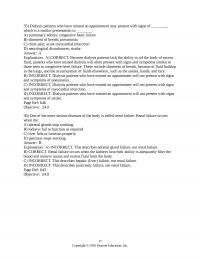
978-0134024554 Chapter 24 Part 3
35) Dialysis patients who have missed an appointment may present with signs of ________, which is a similar presentation to ________. A) pulmonary edema; congestive heart failure B) shortness of breath; pneumonia C) chest pain; acute myocardial infarction D) neurological […]
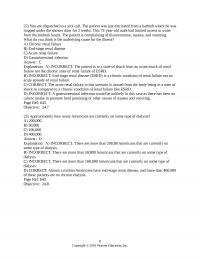
978-0134024554 Chapter 24 Part 2
22) You are dispatched to a sick call. The patient was just extricated from a bathtub where he was trapped under the shower door for 2 weeks. This 72-year-old male had limited access to water from the bathtub faucet. The […]
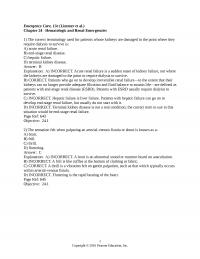
978-0134024554 Chapter 24 Part 1
Emergency Care, 13e (Limmer et al.) Chapter 24 Hematologic and Renal Emergencies 1) The correct terminology used for patients whose kidneys are damaged to the point where they require dialysis to survive is: A) acute renal failure. B) end-stage renal […]
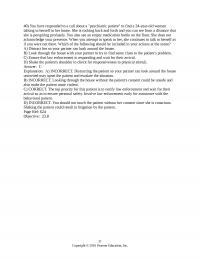
978-0134024554 Chapter 23 Part 3
40) You have responded to a call about a “psychiatric patient” to find a 24-year-old woman talking to herself in her home. She is rocking back and forth and you can see from a distance that she is perspiring profusely. […]
978-0134024554 Chapter 23 Part 2
20) There are general rules when dealing with psychiatric emergencies. Which of the following is NOT one of those rules and would be considered inappropriate? A) Identify yourself and your role. B) Speak slowly and clearly, using a calm and […]
978-0134024554 Chapter 23 Part 1
Emergency Care, 13e (Limmer et al.) Chapter 23 Behavioral and Psychiatric Emergencies and Suicide 1) When a person acts in a manner that is unacceptable to himself or those around him, this would be considered which of the following? A) […]
978-0134024554 Chapter 22 Part 3
38) Your patient is a 17-year-old with a history of asthma. She is complaining of pain in her lower abdomen. Assessment reveals that her breath sounds are clear and equal, she has a respiratory rate of 28 breaths per minute, […]
978-0134024554 Chapter 22 Part 2
22) You arrive on the scene to find an approximately 60-year-old male patient writhing on the floor. He is complaining of a tearing pain radiating to his lower back. He has absent femoral pulses and has a pulsatile mass just […]
978-0134024554 Chapter 22 Part 1
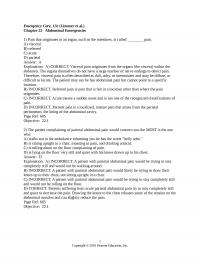
Emergency Care, 13e (Limmer et al.) Chapter 22 Abdominal Emergencies 1) Pain that originates in an organ, such as the intestines, is called ________ pain. A) visceral B) referred C) acute D) parietal Objective: 22.1 2) The patient complaining of […]
978-0134024554 Chapter 21 Part 4
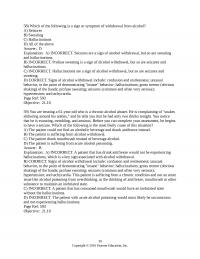
58) Which of the following is a sign or symptom of withdrawal from alcohol? A) Seizures B) Sweating C) Hallucinations D) All of the above Objective: 21.10 59) You are treating a 61-year-old who is a chronic alcohol abuser. He […]
978-0134024554 Chapter 21 Part 3
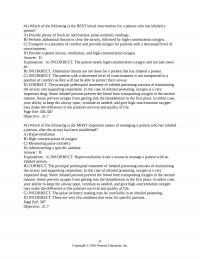
41) Which of the following is the BEST initial intervention for a patient who has inhaled a poison? A) Provide plenty of fresh air and monitor pulse oximetry readings. B) Perform abdominal thrusts to clear the airway, followed by high-concentration […]
978-0134024554 Chapter 21 Part 2
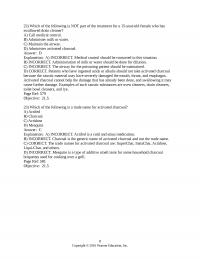
22) Which of the following is NOT part of the treatment for a 15-year-old female who has swallowed drain cleaner? A) Call medical control. B) Administer milk or water. C) Maintain the airway. D) Administer activated charcoal. Objective: 21.5 23) […]
978-0134024554 Chapter 21 Part 1
Emergency Care, 13e (Limmer et al.) Chapter 21 Poisoning and Overdose Emergencies 1) The term poison is BEST described as any substance that can do which of the following? A) Increase cellular activity B) Deactivate nerve transmission C) Depress the […]
978-0134024554 Chapter 20 Part 3
33) Which of the following is NOT a side effect of epinephrine? A) Pallor B) Vomiting C) Bradycardia D) Chest pain Objective: 20.8 34) You respond to a local swim park for a 29-year-old male who was stung by a […]
978-0134024554 Chapter 20 Part 2
21) Your patient has eaten a casserole that may have contained seafood. The patient is worried because he has a seafood allergy. Upon assessment, you find no signs or symptoms of anaphylaxis. The patient’s vital signs are stable and he […]
978-0134024554 Chapter 20 Part 1
Emergency Care, 13e (Limmer et al.) Chapter 20 Allergic Reaction 1) What is another name for a severe allergic reaction? A) Dermatitis B) Asthma C) Anaphylaxis D) Psychosomatic reaction Objective: 20.1 2) Which of the following statements concerning severe allergic […]
978-0134024554 Chapter 19 Part 3
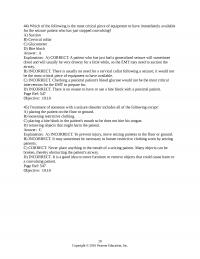
44) Which of the following is the most critical piece of equipment to have immediately available for the seizure patient who has just stopped convulsing? A) Suction B) Cervical collar C) Glucometer D) Bite block Objective: 19.10 45) Treatment of […]
978-0134024554 Chapter 19 Part 2
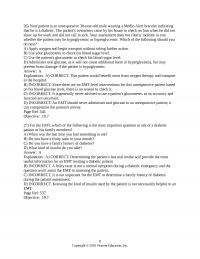
26) Your patient is an unresponsive 30-year-old male wearing a Medic-Alert bracelet indicating that he is a diabetic. The patient’s coworkers came by his house to check on him when he did not show up for work and did not […]
978-0134024554 Chapter 19 Part 1
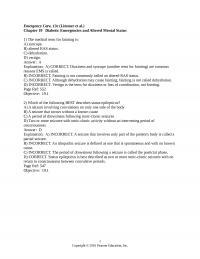
Emergency Care, 13e (Limmer et al.) Chapter 19 Diabetic Emergencies and Altered Mental Status 1) The medical term for fainting is: A) syncope. B) altered RAS status. C) dehydration. D) vertigo. Objective: 19.1 2) Which of the following BEST describes […]
978-0134024554 Chapter 18 Part 3
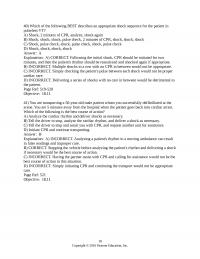
40) Which of the following BEST describes an appropriate shock sequence for the patient in pulseless VT? A) Shock, 2 minutes of CPR, analyze, shock again B) Shock, shock, shock, pulse check, 2 minutes of CPR, shock, shock, shock C) […]
978-0134024554 Chapter 18 Part 2
24) Which of the following is the name given to the condition in which fluid accumulates in the lungs? A) Chronic obstructive pulmonary disease (COPD) B) Pulmonary edema C) Pedal edema D) Dyspnea Objective: 18.7 25) Which of the following […]
978-0134024554 Chapter 18 Part 1
Emergency Care, 13e (Limmer et al.) Chapter 18 Cardiac Emergencies 1) Which of the following is the general term used to refer to a problem with the heart? A) Myocardial infarction B) Cardiac dysrhythmia C) Cardiac compromise D) Congestive heart […]
978-0134024554 Chapter 17 Part 3
35) You are responding to a 54-year-old female patient in respiratory distress. The patient is on home oxygen by nasal cannula at 1 lpm. The patient has diminished lung sounds bilaterally with wheezes. She appears malnourished and has a barrel […]
978-0134024554 Chapter 17 Part 2
21) Your patient is a 30-year-old female who may have overdosed on antidepressant medications. On your arrival, she is lying supine on her bed with her head on a pillow. She is unresponsive to painful stimuli and is snoring. She […]
978-0134024554 Chapter 17 Part 1
Emergency Care, 13e (Limmer et al.) Chapter 17 Respiratory Emergencies 1) Which of the following does NOT occur during inspiration? A) Intercostal muscles contract B) Chest cavity increases in size C) Diaphragm lowers D) Diaphragm relaxes Objective: 17.1 2) Which […]
978-0134024554 Chapter 16 Part 3
35) Which of the following BEST describes the five rights? A) In date, right medication, right order, right dose, right time B) Right patient, right medication, in date, right dose, right route C) Right decision, right medication, right order, right […]
978-0134024554 Chapter 16 Part 2
22) How does aspirin actually reduce the chances that a patient suffering a heart attack will die? A) It reduces the amount of pain in the heart. B) It prevents a deadly fever from developing. C) It reduces the inflammation […]
978-0134024554 Chapter 16 Part 1
Emergency Care, 13e (Limmer et al.) Chapter 16 General Pharmacology 1) The symptoms or circumstances for which a medication is given are called: A) contraindications. B) indications. C) side effects. D) untoward effects. Objective: 16.1 2) When you give patients […]
978-0134024554 Chapter 15 Part 4
53) Which of the following is NOT an appropriate use of patient care report (PCR) information? A) To conduct research B) To provide EMS personnel with education and quality assurance C) For billing and insurance purposes D) For referral to […]
978-0134024554 Chapter 15 Part 3
42) Which of the following is NOT appropriate to document on your patient care report? A) Patient’s attitude B) Patient’s mental status C) Patient’s race D) All should be documented Objective: 15.11 43) Which of the following should be documented […]
978-0134024554 Chapter 15 Part 2
21) You have received an order from medical direction that you feel would be detrimental to your patient. Which of the following should you do? A) Politely question the physician. B) Carry out the order but document that you disagreed […]
978-0134024554 Chapter 15 Part 1
Emergency Care, 13e (Limmer et al.) Chapter 15 Communication and Documentation 1) Which of the following BEST describes a base station? A) A two-way radio at a fixed site B) A device used to receive and then amplify transmissions that […]
978-0134024554 Chapter 14 Part 5
85) You and another EMT are discussing a call he previously ran. The EMT said the patient had classic chest pain symptoms and he treated it as a possible heart attack, but he later found out the patient just had […]
978-0134024554 Chapter 14 Part 4
65) You are called for a 58-year-old male who is concerned that his blood pressure is too high. He tells you that he has had a headache and is feeling a little dizzy. You notice that his skin is flushed […]
978-0134024554 Chapter 14 Part 3
43) Immediately following a rapid physical exam on an unresponsive medical patient, which of the following should you do next? A) Obtain baseline vital signs. B) Check the scene for medications. C) Find out who the patient’s doctor is. D) […]
978-0134024554 Chapter 14 Part 2
22) For which of the following patients is a focused physical examination appropriate? A) A 30-year-old male with a history of diabetes and who is found unresponsive by his son B) A 25-year-old female with a history of asthma and […]
978-0134024554 Chapter 14 Part 1
Emergency Care, 13e (Limmer et al.) Chapter 14 The Secondary Assessment 1) The patient was a driver in a lateral impact motor vehicle collision. During the assessment of his chest, the EMT notes a segment of the chest wall moving […]
978-0134024554 Chapter 13 Part 3
41) You are assessing an 82-year-old female that has been lost in the woods behind her nursing home for several hours on a crisp fall evening. Your pulse oximeter shows her oxygen saturation to be 82% even though she appears […]
978-0134024554 Chapter 13 Part 2
24) You are called to care for a child who has fallen out of a third-story window. You arrive to find the child in his mother’s arms. As you approach, you notice the child’s skin is pale with dark spots […]
978-0134024554 Chapter 13 Part 1
Emergency Care, 13e (Limmer et al.) Chapter 13 Vital Signs and Monitoring Devices 1) When the heart contracts and forces blood into the arteries, the pressure created is known as the: A) pulse pressure. B) systolic blood pressure. C) diastolic […]
978-0134024554 Chapter 12 Part 3
35) Your patient is a 33-year-old man who has been ejected from his vehicle during a high-speed collision. During your primary assessment it is discovered that he is not moving, does not appear to have adequate respirations, and has suffered […]
978-0134024554 Chapter 12 Part 2
22) Which of the following is NOT assessed during the “Breathing” phase of the primary assessment? A) Determining the depth of respiration B) Counting the respiratory rate C) Determining the presence of respirations D) Obtaining a pulse oximetry reading Objective: […]
978-0134024554 Chapter 12 Part 1
Emergency Care, 13e (Limmer et al.) Chapter 12 The Primary Assessment 1) What BEST defines the immediate sense of the patient’s degree of distress, formulated from the patient’s immediate environment, appearance, and chief complaint? A) General impression B) Primary assessment […]
978-0134024554 Chapter 11 Part 2
19) Which of the following will deliver a medium velocity impact? A) Bullet from a handgun B) Ice pick C) Butcher knife D) Bullet from an assault rifle Objective: 11.7 20) When determining possible injuries suffered from a gunshot wound, […]
978-0134024554 Chapter 11 Part 1
Emergency Care, 13e (Limmer et al.) Chapter 11 Scene Size-Up 1) Which of the following is NOT determined in a scene size-up? A) Chief complaint B) Mechanism of injury C) Potential hazards to the EMS crew D) Need for additional […]
978-0134024554 Chapter 10 Part 3
36) Venturi masks are designed to mix oxygen with: A) nitrogen. B) inhaled air. C) humidified air. D) carbon monoxide. Objective: 10.18 37) The oxygen flow rate for a nasal cannula should not exceed ________ liters per minute. A) 8 […]
978-0134024554 Chapter 10 Part 2
22) What device is used to perform mouth-to-mask ventilation? A) Pocket face mask B) Bag-valve mask C) Stoma D) Automatic transport ventilator Objective: 10.13 23) What is NOT one of the basic parts of a bag-valve-mask system? A) Self-refilling shell […]
978-0134024554 Chapter 10 Part 1
Emergency Care, 13e (Limmer et al.) Chapter 10 Respiration and Artificial Ventilation 1) For life to be maintained, a balance of oxygen and carbon dioxide is needed. The condition when oxygen levels are low is called: A) hypotension. B) hypercarbia. […]
978-0134024554 Chapter 9 Part 2
14) On which of the following types of calls should you bring your portable suction unit to the patient’s side upon arrival on the scene? A) Motor vehicle collision B) Cardiac arrest C) Seizure D) All of the above Objective: […]
978-0134024554 Chapter 9 Part 1
Emergency Care, 13e (Limmer et al.) Chapter 9 Airway Management 1) The high-pitched sound caused by an upper airway obstruction is known as: A) gurgling. B) stridor. C) rhonchi. D) rales. Objective: 9.1 2) The trachea branches off at the […]