
In general, in times of rising prices, using FIFO has a favorable effect on cash flows.
The accrual basis of accounting results in a more accurate measurement of net income
for the period than does the cash basis of accounting.
Knowledge of the exchange rate is necessary to apply the money measure concept in
case of international transactions.
Closing entries deal primarily with the balances of real accounts.
Horizontal analysis will result in common-size statements.

Dividends in arrears pertain only to cumulative preferred stock.
When a withdrawal is made, the Cash account is debited and the Withdrawals account
is credited.
It is possible for a partner’s Capital account to increase even if a net loss occurs.
The account ‘Wages Payable’ would appear on the income statement.

Small expenditures for what ordinarily are considered capital expenditures frequently
are treated as revenue expenditures.
Partial-year depreciation may be rounded to the nearest whole month or the half-year
convention may be used.
When an asset lasts longer than its estimated useful life, depreciation no longer should
be recorded.
The intentional preparation of misleading financial statements is referred to as
fraudulent financial reporting.
In a journal entry, debits are always recorded before credits.

The amount of the Withdrawals account can be found on the work sheet.
Under the perpetual inventory system, cost of goods sold is not recorded until the end
of the accounting period.
Both diversified companies and conglomerates operate in a single, well-defined
industry.
An increase or decrease in the fair value of a company’s total trading portfolio is
included in net income in the period in which the increase or decrease occurs.

The balances of all the real (permanent) accounts are the same on the adjusted trial
balance as they are on a post-closing trial balance.
The objective of financial reporting established by the FASB is to provide information
that is useful to potential customers.
When customers pay with bank credit cards, cash sales are considered to have taken
place.
Owner’s equity equals cumulative net income or loss plus owner investments minus
cumulative withdrawals.
The Allowance to Adjust Long-Term Investments to Market account appears in the
assets section of the balance sheet.

Using the full-costing method, the cost of dry wells is capitalized with the cost of
producing wells.
The conventions of consistency and conservatism require that financial statements
present all the information relevant to users’ understanding of the statements.
The sale of treasury stock at an amount less than cost results in a loss to be reported on
the income statement.
Limited liability can be viewed as both an advantage and a disadvantage.

Diversified companies are required to report information that includes certain revenue
and expense items and assets for each of its segments.
If the carrying value of goodwill is more than its fair value, an impairment loss must be
recorded.
When the columns of the trial balance equal each other, it is still possible that errors
may have occurred in recording and posting the transactions.
When a bond issue is converted into common stock, total contributed capital is
increased by the fair market value of the bonds converted.
Interest on debt is tax-deductible to the issuing corporation, whereas dividends on stock
are not.
The liability of corporate stockholders is limited to their percentage share of ownership.
Closing entries are important to managing a business because
A. the owners expect periodic reports of the progress of the business.
B. management needs to prepare budgets for future time periods.
C. to assess progress toward goals, managers need to divide the life of the business into
relatively short time periods.
D. All of these choices.
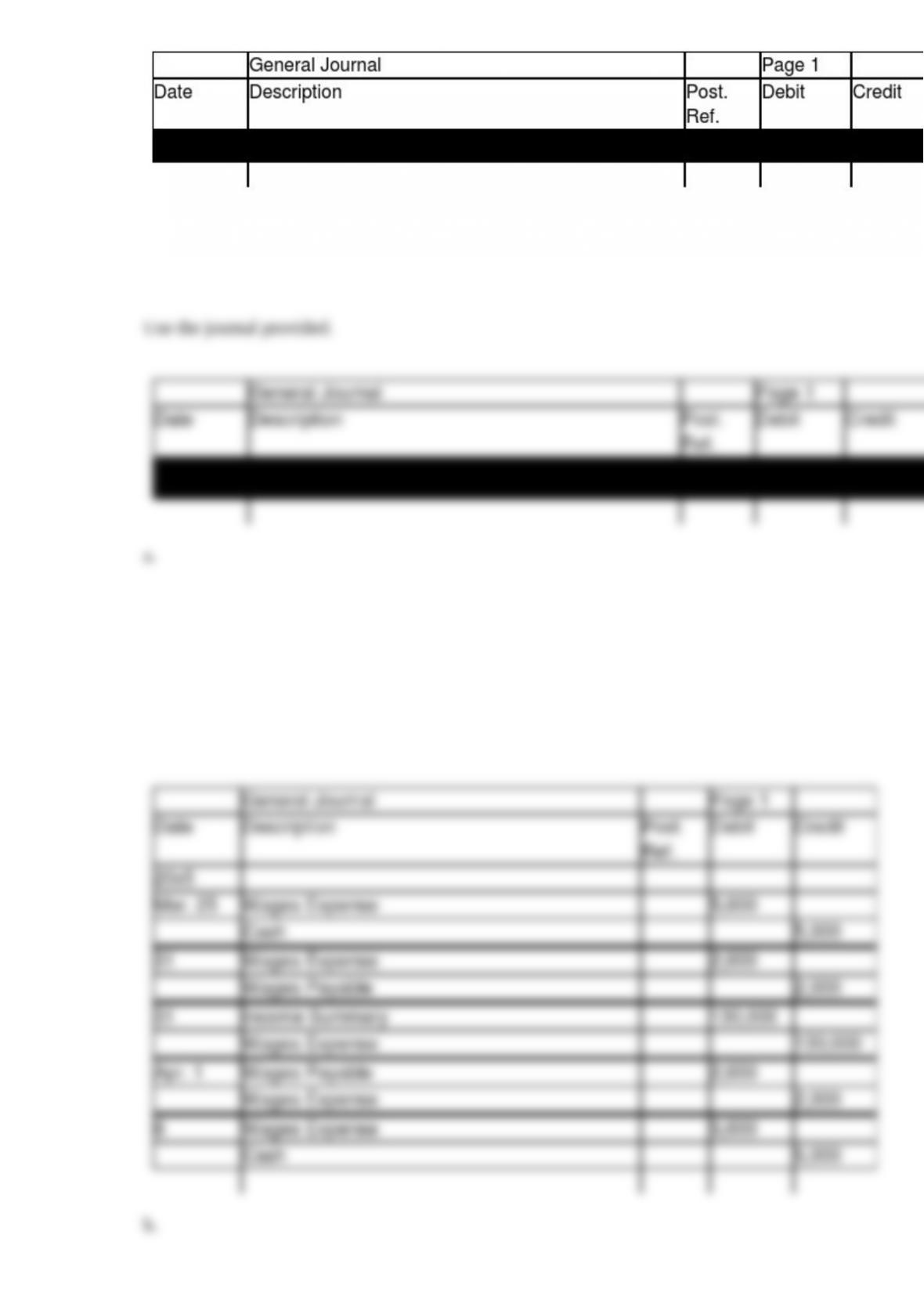
Powell Repair pays wages of $5,000 every other Friday ($500 per weekday).
a. In the journal provided, prepare the following entries (omit explanations) for the
fiscal year ended March 31, 20×5:
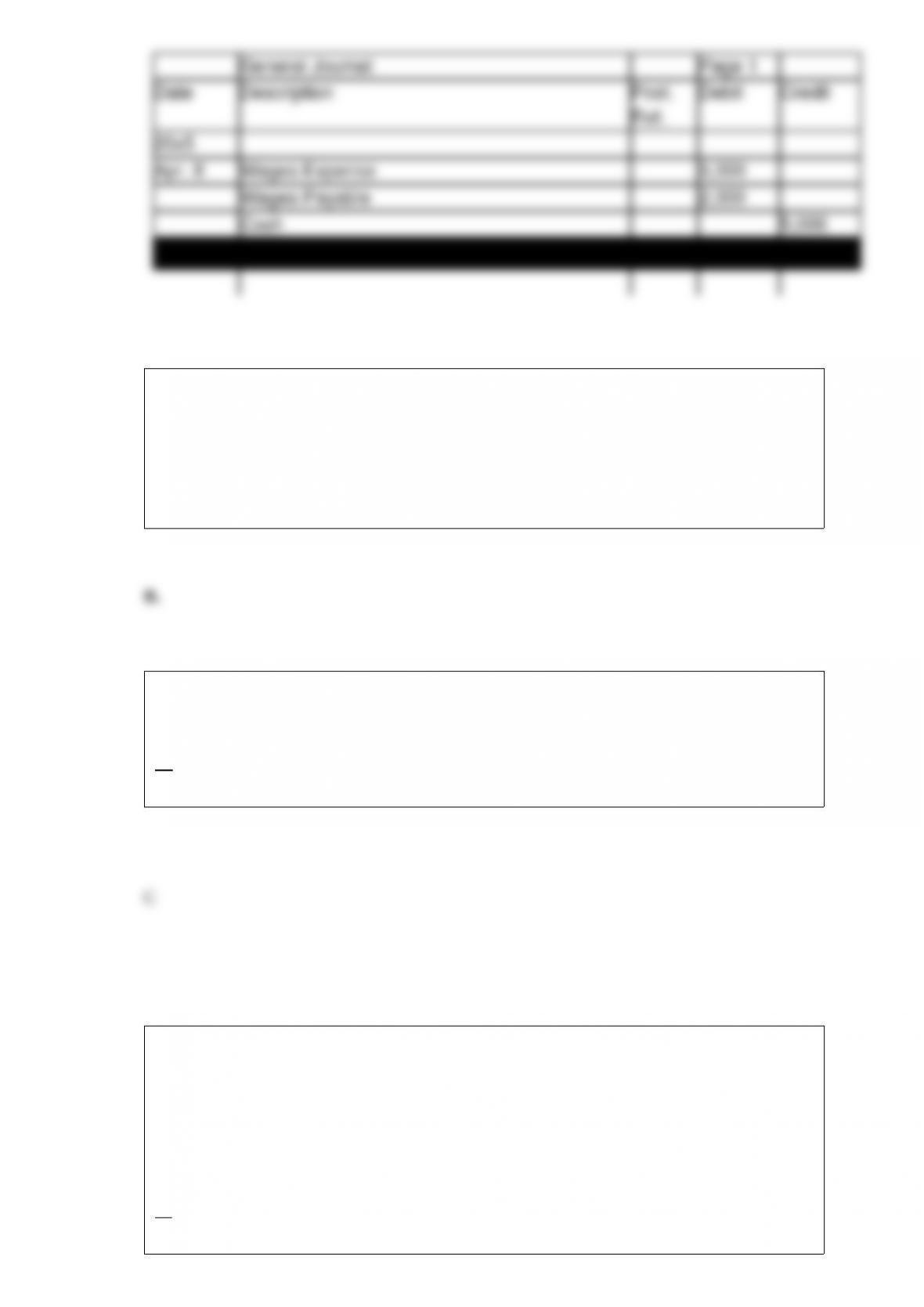
b. What would the April 8 entry be if no reversing entry was made?
On December 9, A issues a 60-day promissory note to B. The December 31 adjusting
entry for B is
A. Interest Payable – Debit; Cash – Credit
B. Interest Receivable – Debit; Interest Income – Credit
C. Interest Expense – Debit; Cash – Credit
D. Interest Expense – Debit; Interest Payable – Credit
Which of the following is not a category of investments?
A. Held-to-maturity securities
B. Trading securities
C. Collateral securities
D. Available-for-sale securities
Riley Company has a credit balance of $44,000 in its Allowance to Adjust Long-Term
Investments to Market account at the end of the year, before adjustment. Its investment
portfolio has a total cost of $300,000 and a market value of $264,000 at December 31, a
balance sheet date. The year-end adjustment entry that would be recorded in the books
of Riley Company is:
A. Long-Term Investments 8,000
Realized Gain on Long-Term Investments 8,000
B. Allowance to Adjust Long-Term Investments to Market 8,000
Unrealized Loss on Long-Term Investments 8,000

C. Unrealized Loss on Long-Term Investments 8,000
Allowance to Adjust Long-Term Investments to Market 8,000
D. Long-Term Investments 8,000
Allowance to Adjust Long-Term Investments to Market 8,000
The term used to describe the allocation of the cost of an intangible asset to the periods
it benefits is
A. depletion.
B. apportionment.
C. amortization.
D. depreciation.
Which of the following represents the proper order of financial statement preparation?
A. Statement of cash flows, balance sheet, income statement, statement of owner’s
equity
B. Statement of owner’s equity, income statement, statement of cash flows, balance
sheet
C. Balance sheet, statement of cash flows, statement of owner’s equity, income
statement
D. Income statement, statement of owner’s equity, balance sheet, statement of cash
flows
Slim Co. is ordering a new computer for its corporate office. Which of the following
events would trigger the recognition of the computer and related liability on Slim’s
books?
A. The company generates a purchase order.
B. The purchasing department sends a purchase order to the supplier.
C. The company receives the computer.
D. The company receives the bill from the supplier.
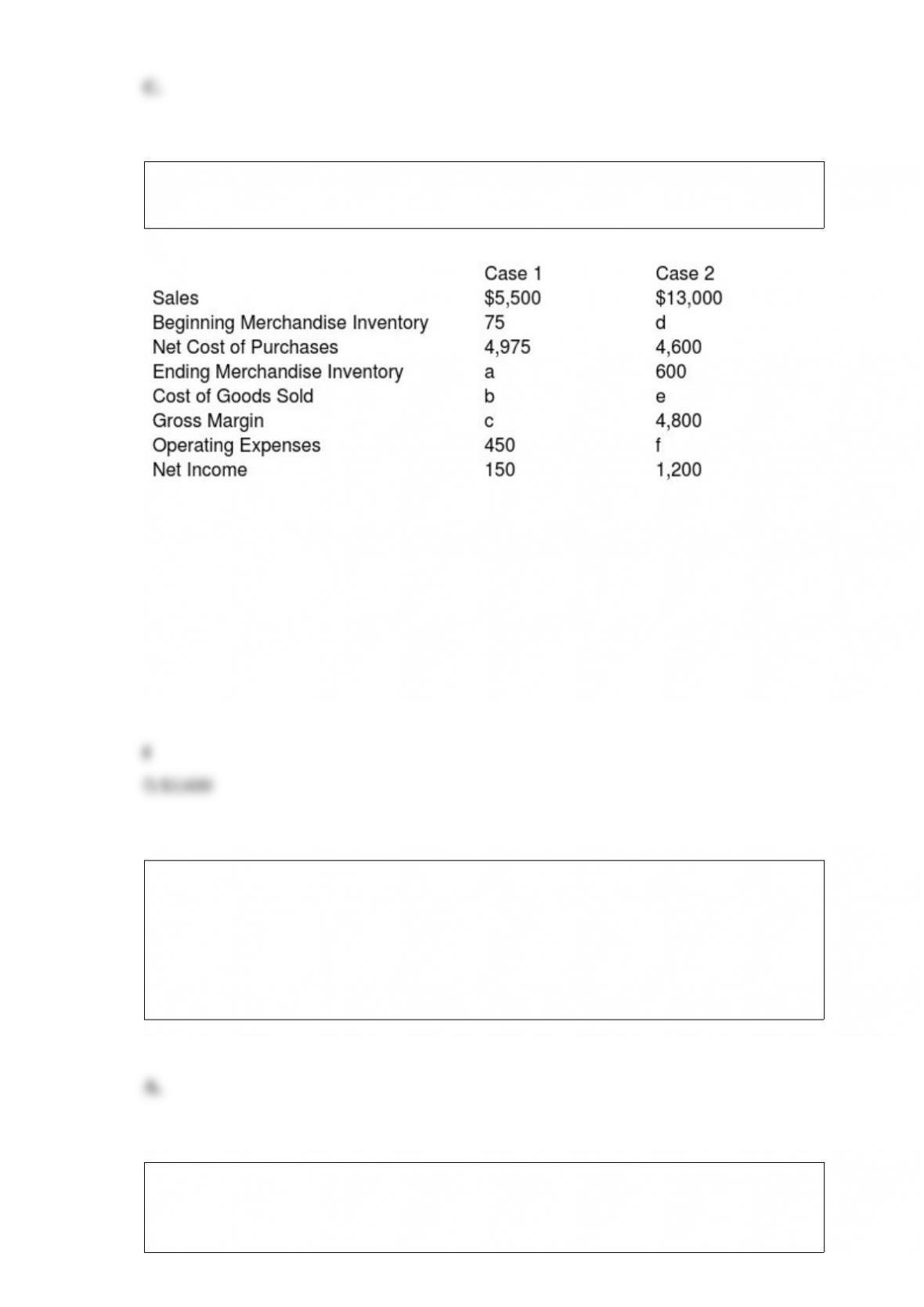
Compute the dollar amount of the items indicated by letters a through f in the table
below.
a)$150
b) $4,900
c) $600
d) $4,200
e)$8,200
A company wishes to make annual contributions into a fund intended to retire $700,000
in debt five years from now. The amount to contribute each year equals $700,000
A. divided by the appropriate future value of an ordinary annuity factor.
B. times the appropriate present value of an ordinary annuity factor.
C. times the appropriate future value of an ordinary annuity factor.
D. divided by the appropriate present value of an ordinary annuity factor.
When a credit sale takes place,
A. a revenue account will increase.
B. liabilities will increase.
C. one asset account will increase and another will decrease.
D. assets will be unaffected.
Sleepy Monk Coffee Company operates a chain of retail coffee shops and also sells its
signature roasted coffee to local resorts. Which of the following accounting estimates
would be most important for Sleepy Monk Coffee Company?
A. Uncollectible accounts receivable.
B. Warranty claims.
C. Depreciable lives for its operating assets.
D. Sales returns.
Which of the following phrases is not descriptive of an ordinary annuity?
A. Payments made at the beginning of equal periods of time
B. Both present and future value can be calculated
C. Compound interest assumed
D. Series of equal payments
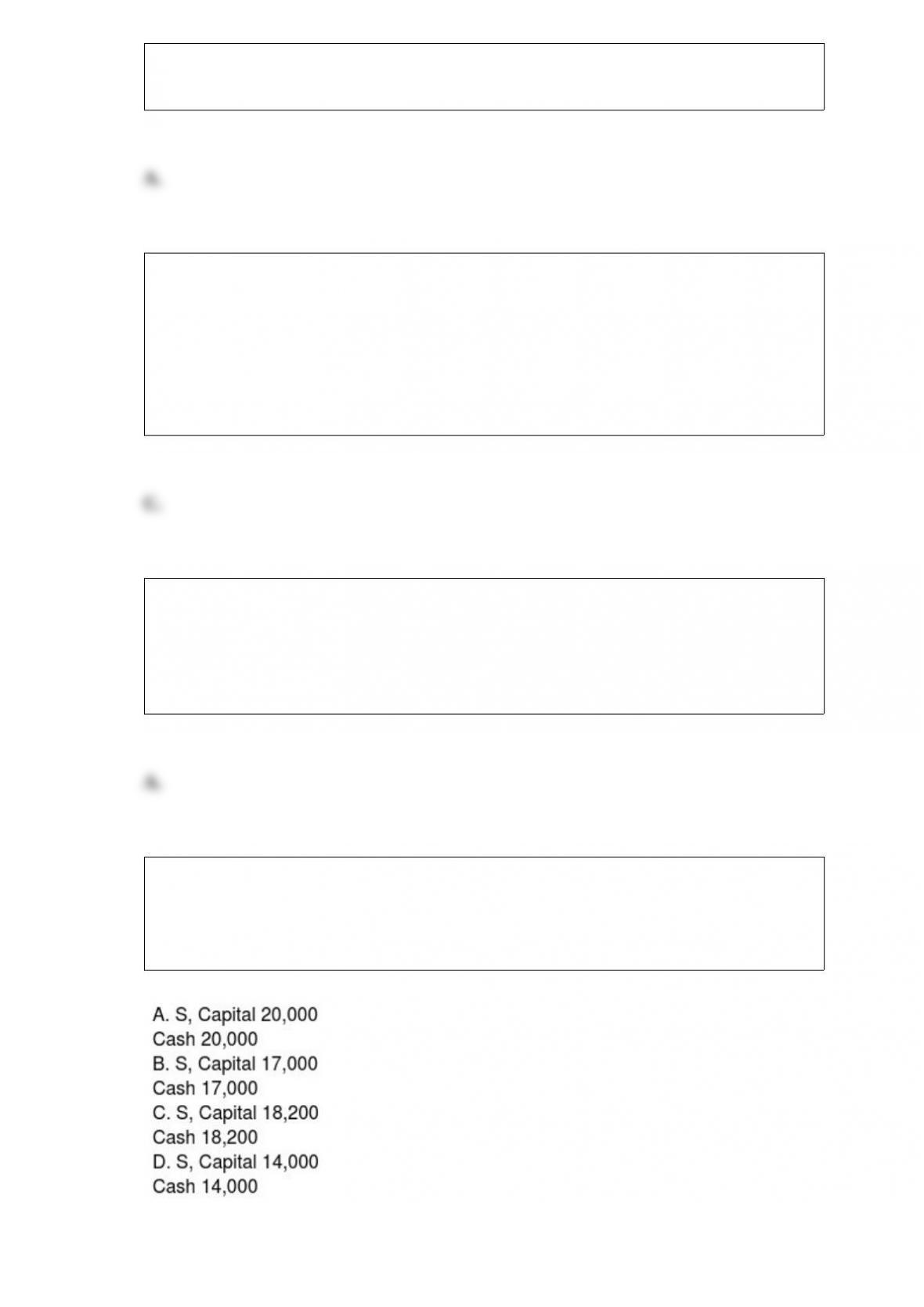
Partners S, T, and U share income and losses in a 5:3:2 ratio, respectively. S wishes to
leave the partnership, so the assets are revalued and are found to be overvalued by
$6,000. If each partner had a capital balance of $20,000 prior to S’s notification of
withdrawal, the entry to record the withdrawal of S’s interest from the partnership is:

The general ledger account for Accounts Receivable shows a debit balance of $50,000.
Allowance for Uncollectible Accounts has a credit balance of $3,000. Net sales for the
year were $500,000. In the past, 3 percent of sales have proved uncollectible, and an
aging of accounts receivable resulted in an estimate of $20,000 of uncollectible
accounts receivable.
Using the percentage of net sales method, the Allowance for Uncollectible Accounts
balance (after adjustment) would be
A. $12,000.
B. $15,000.
C. $18,000.
D. $20,000.
On January 1, 20×5, Dove Valley Corporation had 100,000 shares of $10 par value
common stock issued and outstanding. All 100,000 shares had been issued in a prior
period at $30 per share. On February 1, 20×5, Dove Valley purchased 4,000 shares of
treasury stock for $36 per share and later sold the treasury shares for $40 per share on
March 2, 20×5. The entry to record the purchase of the treasury shares on February 1,
20×5, is:
A. Cash 144,000
Treasury Stock-Common 144,000
B. Cash 144,000
Treasury Stock-Common 128,000
Gain on Treasury Stock-Common 16,000
C. Treasury Stock, Common 40,000
Loss on Treasury Stock-Common 104,000
Cash 144,000
D. Treasury Stock, Common 144,000
Which of the following is the final step in the accounting cycle?
A. Prepare financial statements.
B. Close the accounts.
C. Prepare and adjusted trial balance.
D. Post the journal entries to the ledger.

Fred, Kristina, and Nick each receive a $14,000 salary, as well as 15 percent interest on
their respective average investments of $40,000, $20,000, and $80,000. If they share
remaining income and losses in a 4:3:2 ratio, respectively, by how much would Nick’s
account increase or decrease (indicate a decrease by placing parentheses around the
amount), assuming (a) net income of $81,000, (b) net income of $54,000, and (c) net
loss of $63,000.
a. $30,000
b. $24,000
c. ($2,000)
The asset turnover ratio measures
A. how quickly the company uses assets to pay debt.
B. how efficiently assets are used to produce sales.
C. the income produced by selling inventory.
D. how efficiently equity is used to produce revenue.
Under the perpetual inventory system, which of the following accounts would not be
used?
A. Cost of Goods Sold
B. Merchandise Inventory
C. Sales
D. Purchases
Plum Corporation issues $400,000 of 7 percent, five-year bonds on January 1, 20×5,
and sells them on the same date for their face value. The bond indenture states that
interest is to be paid on January 1 and July 1 of each year. The entry to record the first
interest payment includes
A. a credit to Cash for $28,000.
B. a debit to Interest Expense for $14,000.
C. a debit to Unamortized Discount on Bonds Payable for $14,000.
D. All of these choices.
Which of the following typically would not be done to satisfy a current liability?
A. Use long-term assets to satisfy the liability
B. Render a service to satisfy the liability
C. Use current assets to satisfy the liability
D. Take on another current liability to satisfy the liability
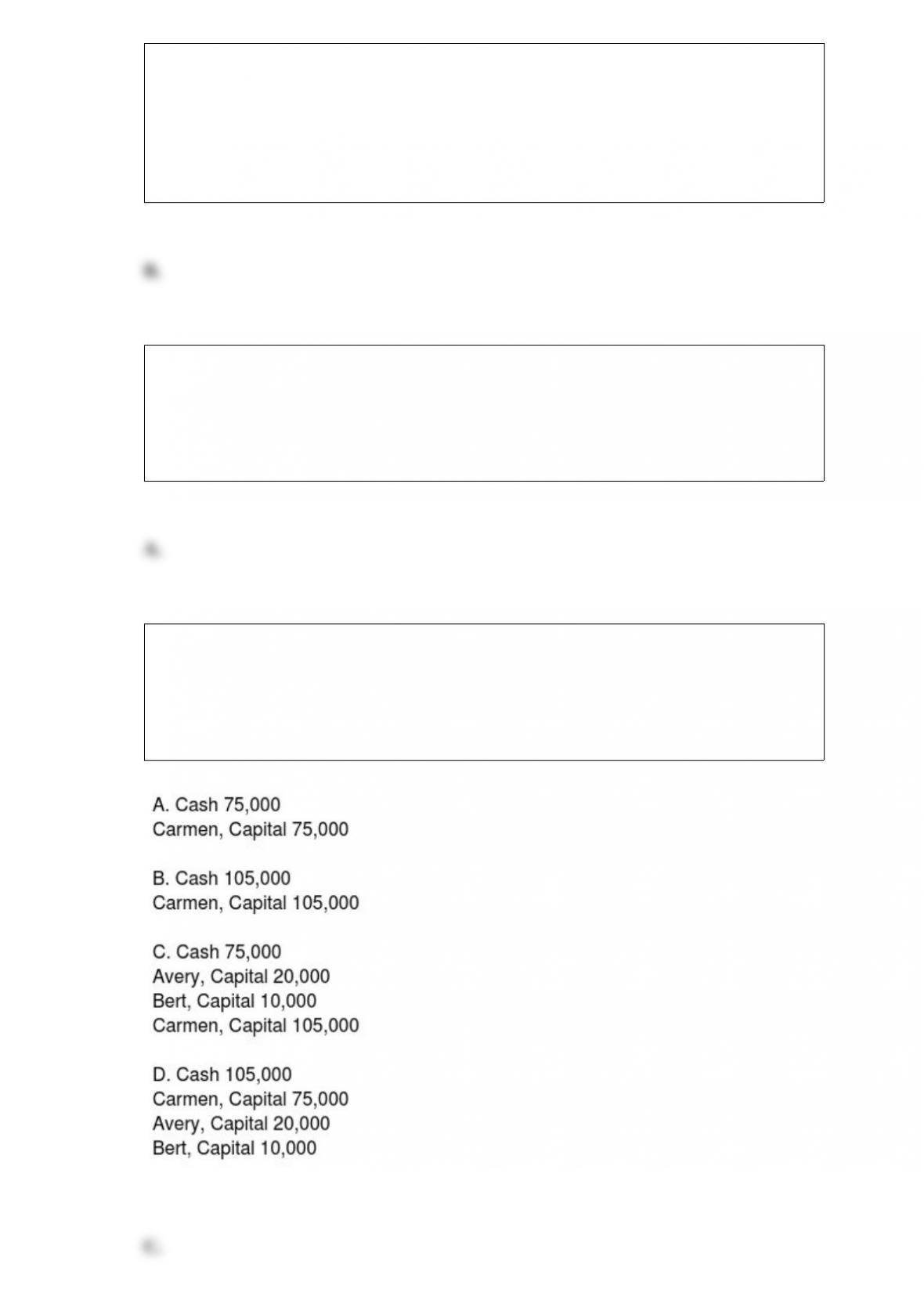
Avery and Bert are partners who share profits and losses in a ratio of 2:1 and have
capital balances of $75,000 and $150,000, respectively. The partners agree to admit
Carmen to the partnership. Carmen invests $75,000 for a 35 percent interest in the
partnership. The new total capital balance after admitting Carmen is $300,000. The
entry to record the admission of Carmen to the partnership is:
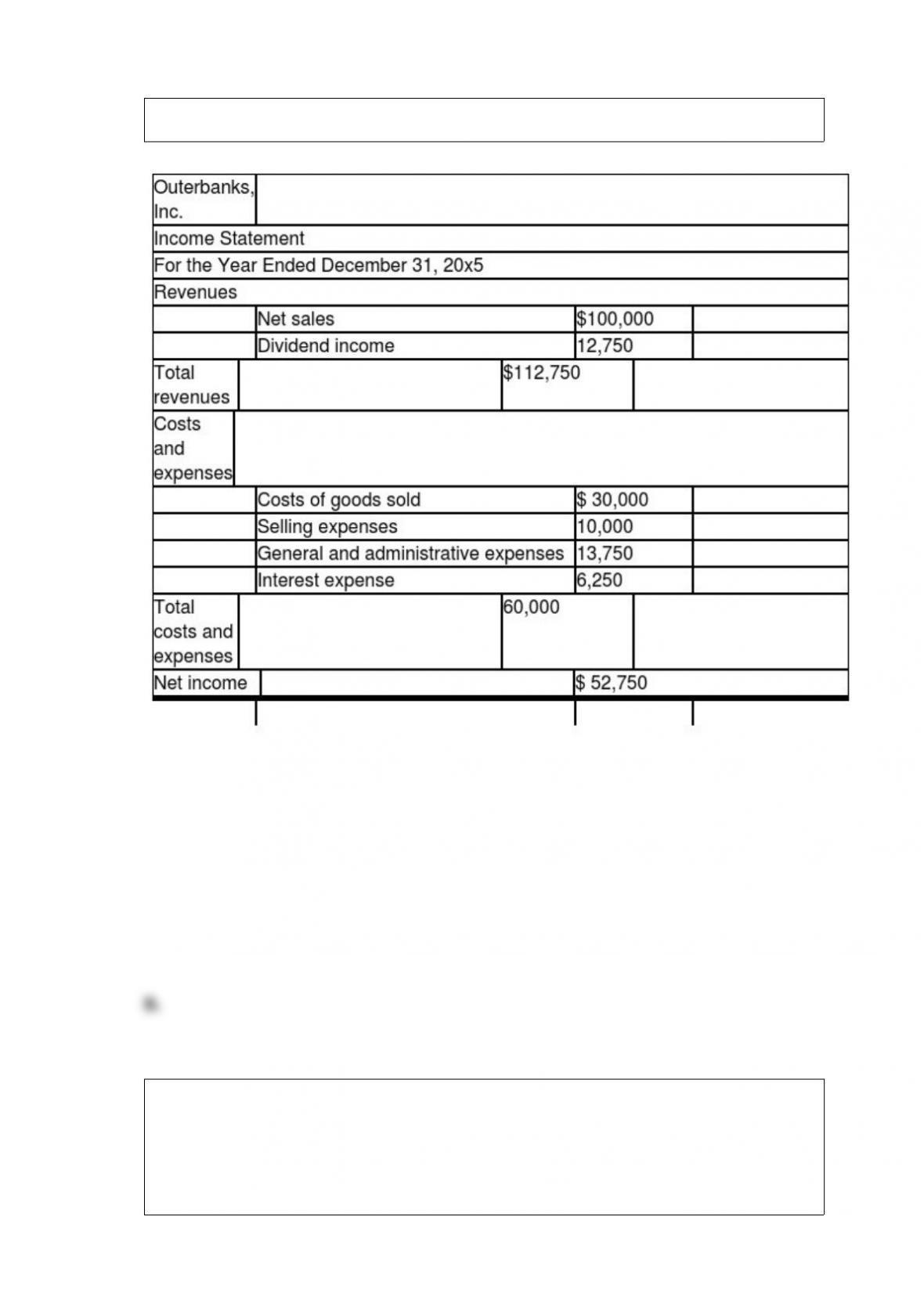
Use this information to answer the following question.
If the income statement were prepared in a multistep form, excess of other expenses over
other revenues would be
A. $12,750.
B. $6,500.
C. $19,000.
D. $6,250.
Which of the following transactions results in an increase in revenues?
A. Receipt of accounts receivable.
B. Purchase of inventory.
C. Receipt of principal from a bank loan.
D. Delivery of a service in exchange for future payment.
All of the following are advantages of issuing bonds rather than stock except
A. financial leverage.
B. payment of bond interest is not required
C. bond interest is tax-deductible.
D. bondholders do not have voting rights.
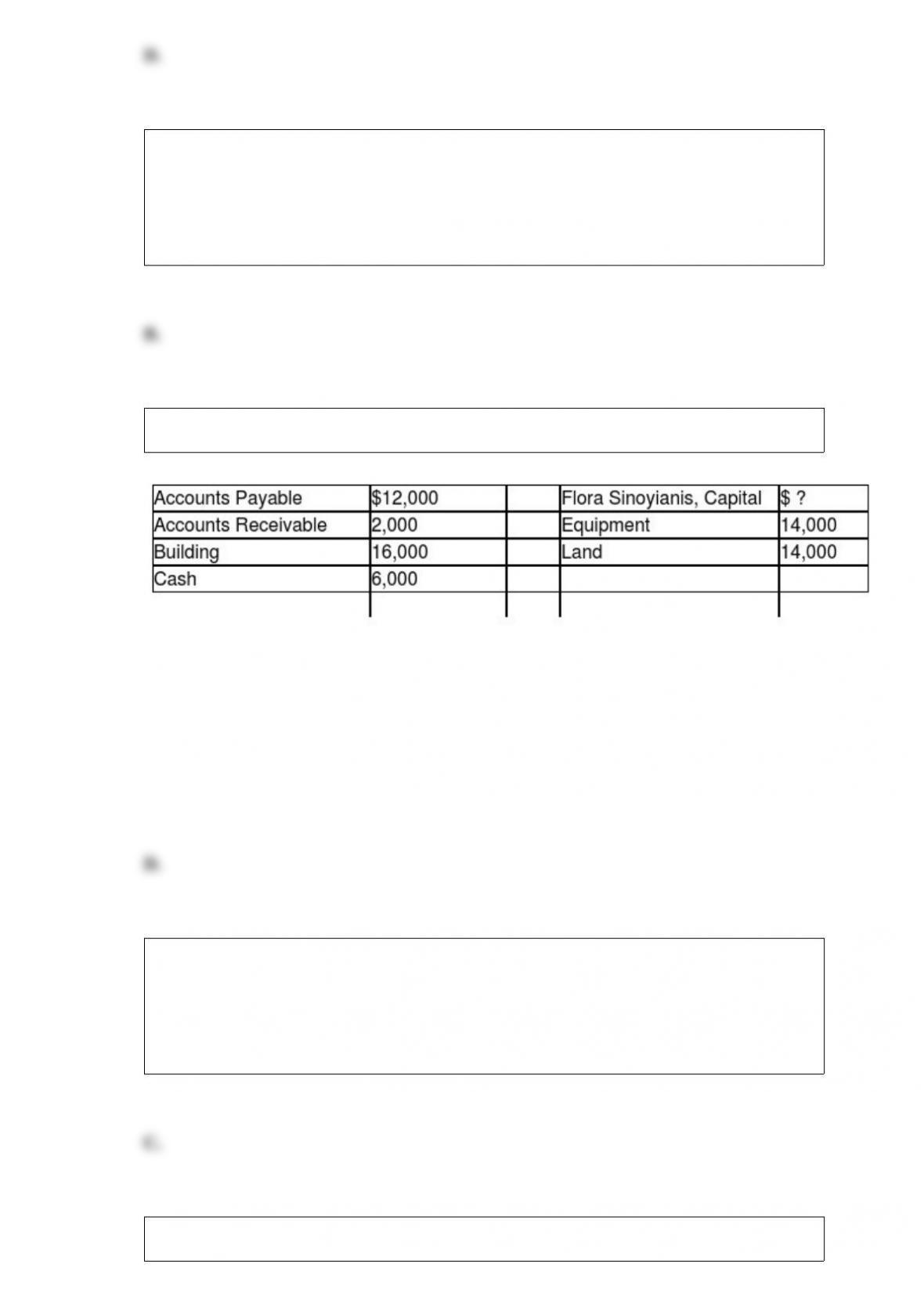
Sinoyianis Realty Company had the following balance sheet accounts and balances:
If the equipment were sold for $14,000, what would be the total of owner’s equity?
A. $8,000
B. $22,000
C. $36,000
D. $40,000
The last step in the operating cycle is the
A. sale of merchandise inventory for cash or on credit.
B. payment for purchases made on credit.
C. collection of cash from credit sales.
D. purchase of merchandise inventory for cash or on credit.
Use this information to answer the following question.

Panadora Company has the following information for the pay period of January 1-15,
2014. Payment occurs on January 20.
The entry on January 20 would be a debit to
A. Salaries Payable and a credit to Cash.
B. Salaries Payable and a credit to Salaries Expense.
C. Salaries Expense and a credit to Cash.
D. Salaries Expense and a credit to Salaries Payable.
Internal control is weakened by all of the following except
A. collusion.
B. separation of duties.
C. human error.
D. effects of changing conditions.
The general ledger account for Accounts Receivable shows a debit balance of $50,000.
Allowance for Uncollectible Accounts has a credit balance of $3,000. Net sales for the
year were $500,000. In the past, 3 percent of sales have proved uncollectible, and an
aging of accounts receivable resulted in an estimate of $20,000 of uncollectible
accounts receivable.
Using the accounts receivable aging method, the Allowance for Uncollectible Accounts
balance (after adjustment) would be
A. $17,000.
B. $20,000.
C. $21,500.
D. $23,000.