
Which one of the following is the primary difference between a swap contract and a
forward contract?
A. underlying asset
B. number of exchanges
C. daily marking to the market
D. option versus obligation
E. time of payment
Answer:
Real rates are defined as nominal rates that have been adjusted for which of the
following?
A. inflation
B. default risk
C. accrued interest
D. interest rate risk
E. both inflation and interest rate risk
Answer:

Which of the following are current assets?
I. patent
II. inventory
III. accounts payable
IV. cash
A. I and III only
B. II and IV only
C. I, II, and IV only
D. I, II and IV only
E. II, III, and IV only
Answer:
Titan Mining Corporation has 14 million shares of common stock outstanding, 900,000
shares of 9 percent preferred stock outstanding and 220,000 ten percent semiannual
bonds outstanding, par value $1,000 each. The common stock currently sells for $42 per
share and has a beta of 1.15, the preferred stock currently sells for $80 per share, and
the bonds have 17 years to maturity and sell for 91 percent of par. The market risk
premium is 11.5 percent, T-bills are yielding 7.5 percent, and the firm’s tax rate is 32
percent. What discount rate should the firm apply to a new project’s cash flows if the
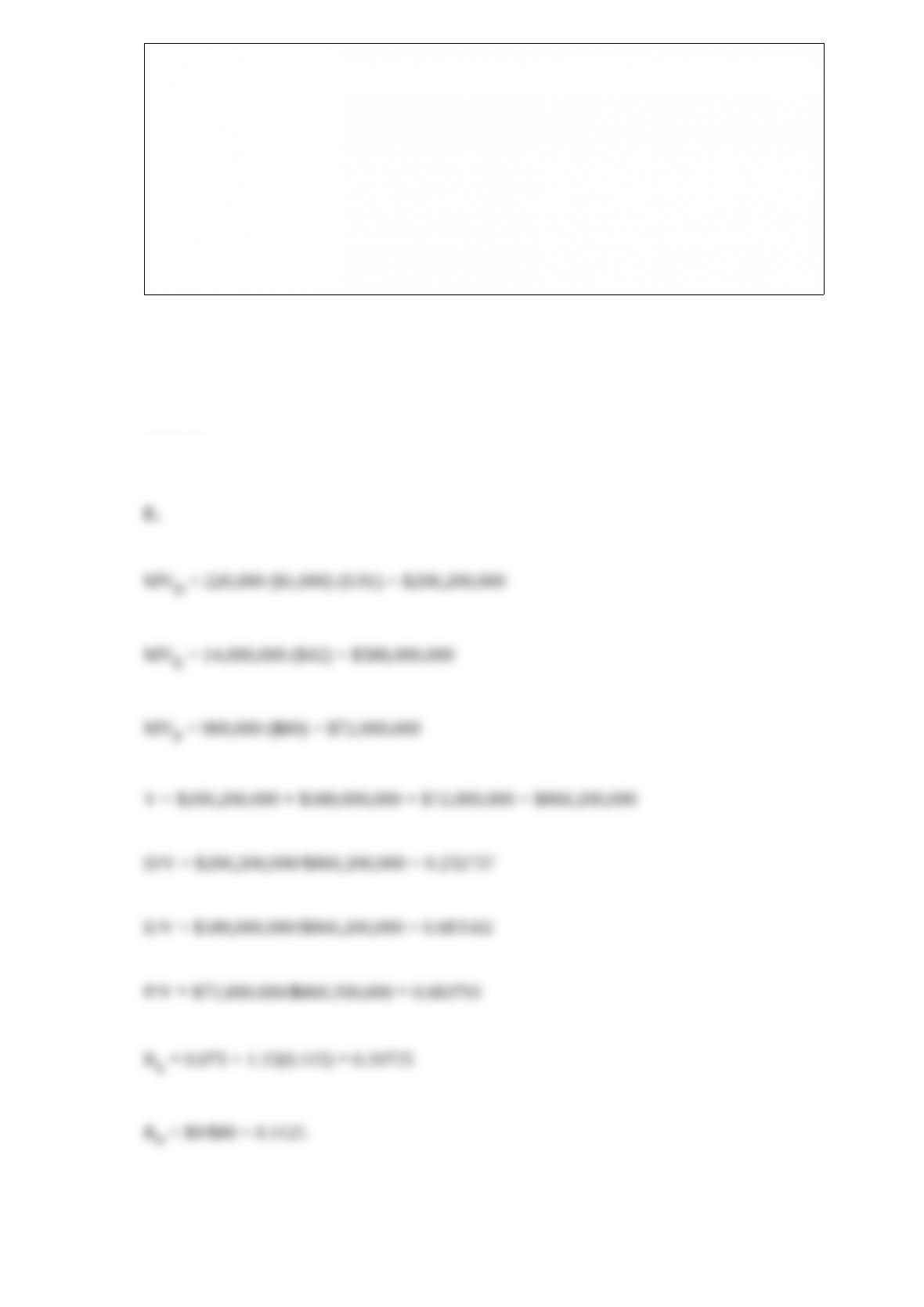
project has the same risk as the firm’s typical project?
A. 14.59 percent
B. 14.72 percent
C. 15.17 percent
D. 15.54 percent
E. 16.88 percent
Answer:

You are aware that your neighbor trades stocks based on confidential information he
overhears at his workplace. This information is not available to the general public. This
neighbor continually brags to you about the profits he earns on these trades. Given this,
you would tend to argue that the financial markets are at best _____ form efficient.
A. weak
B. semiweak
C. semistrong
D. strong
E. perfect
Answer:
Which one of the following statements is correct given the following exchange rates?

A. On Thursday, one U.S. dollar was equal to 0.1023 South African rand.
B. On Friday, one Thai baht was equal to $21.
C. Both the South African rand and the Thai baht appreciated against the U.S. dollar
from Thursday to Friday.
D. The South African rand appreciated from Thursday to Friday against the U.S. dollar.
E. The U.S. dollar depreciated from Thursday to Friday against the Thai baht.
Answer:
Absolute purchasing power parity is most apt to exist for which one of the following
items?
A. lumber
B. computer
C. silver
D. automobile
E. cell phone
Answer:

Texas Foods has a 6 percent bond issue outstanding that pays $30 in interest every
March and September. The bonds are investment grade and sell at par. The bonds are
callable at a price equal to the present value of all future interest and principal payments
discounted at a rate equal to the comparable Treasury rate plus 0.50 percent. Which of
the following correctly describe the features of this bond?
I. bond rating of B
II. “make whole” call price
III. $1,000 face value
IV. offer price of $1,000
A. I and III only
B. III and IV only
C. I, III, and IV only
D. II, III, and IV only
E. I, II, III, and IV
Answer:
What was the average rate of inflation over the period of 1926-2010?
A. less than 2.0 percent
B. between 2.0 and 2.5 percent

C. between 2.5 and 3.0 percent
D. between 3.0 and 3.5 percent
E. greater than 3.5 percent
Answer:
You are investing $100 today in a savings account at your local bank. Which one of the
following terms refers to the value of this investment one year from now?
A. future value
B. present value
C. principal amounts
D. discounted value
E. invested principal
Answer:

To compute the value of a put using the Black-Scholes option pricing model, you:
A. first have to apply the put-call parity relationship.
B. first have to compute the value of the put as if it is a call.
C. compute the value of an equivalent call and then subtract that value from one.
D. compute the value of an equivalent call and then subtract that value from the market
price of the stock.
E. compute the value of an equivalent call and then multiply that value by e-RT.
Answer:
You are comparing two mutually exclusive projects. The crossover point is 12.3
percent. You have determined that you should accept project A if the required return is
13.1 percent. This implies you should:
A. always accept project A.
B. be indifferent to the projects at any discount rate above 13.1 percent.
C. always accept project A if the required return exceeds the crossover rate.
D. accept project B only when the required return is equal to the crossover rate.
E. accept project B if the required return is less than 13.1 percent.
Answer:

Northern Warehouses wants to raise $11.4 million to expand its business. To
accomplish this, it plans to sell 40-year, $1,000 face value, zero-coupon bonds. The
bonds will be priced to yield 8.75 percent. What is the minimum number of bonds it
must sell to raise the $11.4 million it needs?
A. 210,411
B. 239,800
C. 254,907
D. 326,029
E. 350,448
Answer:
Which of the following will reduce collection time?
I. billing customers electronically rather than by mail
II. accepting debit cards but not checks as payment for a sale

III. offering cash discounts for early payment
IV. reducing the processing delay by one day
A. I and II only
B. I and III only
C. I, II, and III only
D. II, III, and IV only
E. I, II, III, and IV
Answer:
J&N, Inc. stock has a current market price of $46 a share. The one-year call on this
stock with a strike price of $55 is priced at $0.05 while the one-year put with a strike
price of $55 is priced at $8.24. What is the risk-free rate of return?
A. 1.49 percent
B. 1.82 percent
C. 3.10 percent
D. 3.64 percent
E. 4.21 percent
Answer:

The information content of a dividend increase generally signals that:
A. the firm has a one-time surplus of cash.
B. the firm has few, if any, net present value projects to pursue.
C. management believes earnings growth will be strong going forward.
D. the firm has more cash than it needs due to a decline in future orders.
E. dividends thereafter will be lower.
Answer:
Josh opted to exercise his January option at the end of December and paid $3,250 at
that time to acquire 100 shares of stock. Which one of the following did Josh own?
A. American call
B. American put
C. European call
D. European put
E. European convertible bond
Answer:

Which one of these statements related to preferred stock is correct?
A. Preferred shareholders normally receive one vote per share of stock owned.
B. Preferred shareholders determine the outcome of any election that involves a proxy
fight.
C. Preferred shareholders are considered to be the residual owners of a corporation.
D. Preferred stock normally has a stated liquidating value of $1,000 per share.
E. Cumulative preferred shares are more valuable than comparable non-cumulative
shares.
Answer:
Yesteryear Productions is considering a project with an initial start up cost of $960,000.
The firm maintains a debt-equity ratio of 0.50 and has a flotation cost of debt of 6.8
percent and a flotation cost of equity of 11.4 percent. The firm has sufficient internally
generated equity to cover the equity cost of this project. What is the initial cost of the
project including the flotation costs?
A. $979,417
B. $982,265
C. $992,386
D. $1,038,513

E. $1,065,089
Answer:
You just received a $3,000 gift from your grandmother. You have decided to save this
money so that you can gift it to your grandchildren 50 years from now. How much
additional money will you have to gift to your grandchildren if you can earn an average
of 8.5 percent instead of just 8 percent on your savings?
A. $17,318.09
B. $22,464.79
C. $25,211.16
D. $28,811.99
E. $36,554.11
Answer:

Over the past five years, a stock produced returns of 11 percent, 14 percent, 4 percent,
-9 percent, and 5 percent. What is the probability that an investor in this stock will not
lose more than 10 percent in any one given year?
A. greater than 0.5 but less than 1.0 percent
B. greater than 1.0 percent but less than 2.5 percent
C. greater than 2.5 percent but less than 16 percent
D. greater than 84 percent but less than 97.5 percent
E. greater than 95 percent
Answer:

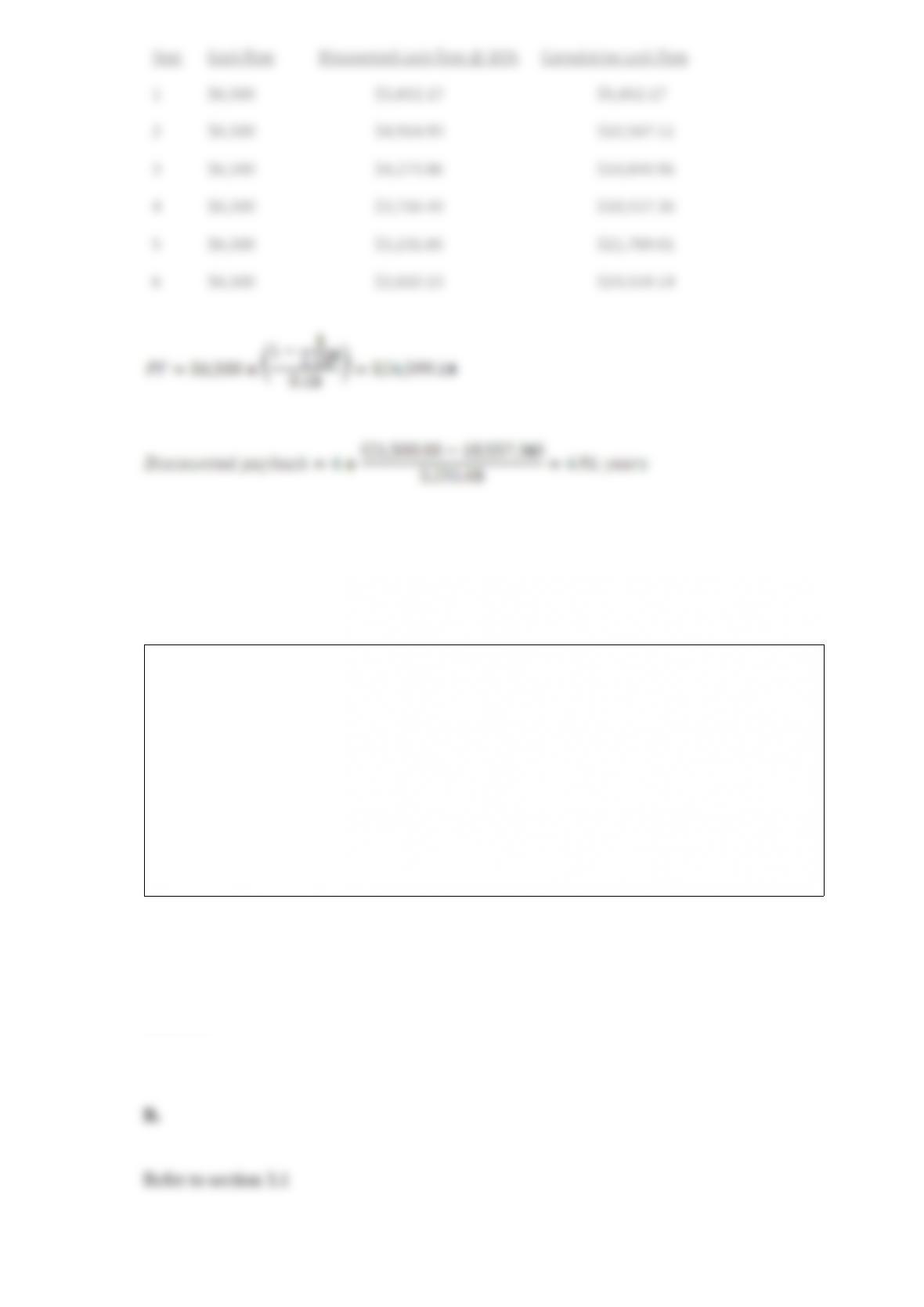
An investment project costs $21,500 and has annual cash flows of $6,500 for 6 years. If
the discount rate is 15 percent, what is the discounted payback period?
A. 4.41 years
B. 4.91 years
C. 5.12 years
D. 5.40 years
E. never
Answer:
Which one of the following is a source of cash?
A. repurchase of common stock
B. acquisition of debt
C. purchase of inventory
D. payment to a supplier
E. granting credit to a customer
Answer:

You just received $225,000 from an insurance settlement. You have decided to set this
money aside and invest it for your retirement. Currently, your goal is to retire 25 years
from today. How much more will you have in your account on the day you retire if you
can earn an average return of 10.5 percent rather than just 8 percent?
A. $417,137
B. $689,509
C. $1,050,423
D. $1,189,576
E. $1,818,342
Answer:
Unsystematic risk:

A. can be effectively eliminated by portfolio diversification.
B. is compensated for by the risk premium.
C. is measured by beta.
D. is measured by standard deviation.
E. is related to the overall economy.
Answer:
Which of the following shareholders tend to favor a high dividend policy?
I. retired individuals
II. endowment funds
III. corporate investors
IV. investors with high dividend tax rates but low capital gains tax rates
A. I and III only
B. II and IV only
C. I, II, and III only
D. II, III, and IV only
E. I, II, III, and IV

Answer:
Which of the following are uses of cash?
I. collecting a receivable
II. increasing inventory
III. obtaining a bank loan
IV. paying a supplier for previous purchases
A. I and III only
B. II and IV only
C. I and II only
D. I, II, and IV only
E. II, III, and IV only
Answer:

Which one of the following was the least volatile over the period of 1926-2010?
A. large-company stocks
B. inflation
C. long-term corporate bonds
D. U.S. Treasury bills
E. intermediate-term government bonds
Answer:
Jamestown Supply is trying to decide whether to lease or buy some new equipment.
The equipment costs $72,000, has a 4-year life, and will be worthless after the 4 years.
The equipment will be replaced. The cost of borrowed funds is 9 percent and the tax
rate is 34 percent. The equipment can be leased for $23,800 a year. What is the amount
of the aftertax lease payment?
A. $13,897
B. $14,250
C. $14,667
D. $15,708
E. $15,820
Answer:

Hanover Tech is currently an all equity firm that has 320,000 shares of stock
outstanding with a market price of $19 a share. The current cost of equity is 15.4
percent and the tax rate is 34 percent. The firm is considering adding $1.2 million of
debt with a coupon rate of 8 percent to its capital structure. The debt will be sold at par
value. What is the levered value of the equity?
A. $5.209 million
B. $5.288 million
C. $5.312 million
D. $6.512 million
E. $6.708 million
Answer: