
The change in revenue that occurs when one more unit of output is sold is referred to
as:
A. marginal revenue.
B. average revenue.
C. total revenue.
D. erosion.
E. scenario revenue.
Answer:
The Eliot Co. needs $185,000 a week to pay bills. The standard deviation of the weekly
disbursements is $17,600. The firm has established a lower cash balance limit of
$75,000. The applicable interest rate is 5.5 percent and the fixed cost of transferring
funds is $47. Based on the BAT model, what is the optimal initial cash balance?
A. $90,668
B. $97,515
C. $104,141
D. $128,224
E. $136,509
Answer:

Uncovered interest parity is defined as:
A. E(St) = S0 × [1 + (hFC – hUS)]t.
B. E(St) = S0 × [1 + (RFC – RUS)]t.
C. E(St) = S0 × [1 – (RFC – RUS)]t.
D. E(St) = S0 × [1 + (RUS – RFC)]t.
E. E(St) = S0 × [1 + (RFC + RUS)]t.
Answer:
Hollister & Hollister is considering a new project. The project will require $543,000 for
new fixed assets, $218,000 for additional inventory, and $42,000 for additional
accounts receivable. Short-term debt is expected to increase by $165,000. The project
has a 6-year life. The fixed assets will be depreciated straight-line to a zero book value
over the life of the project. At the end of the project, the fixed assets can be sold for 20
percent of their original cost. The net working capital returns to its original level at the
end of the project. The project is expected to generate annual sales of $875,000 with
costs of $640,000. The tax rate is 34 percent and the required rate of return is 13
percent. What is the project’s cash flow at time zero?
A. -$536,000
B. -$638,000
C. -$720,000
D. -$779,000
E. -$944,000
Answer:
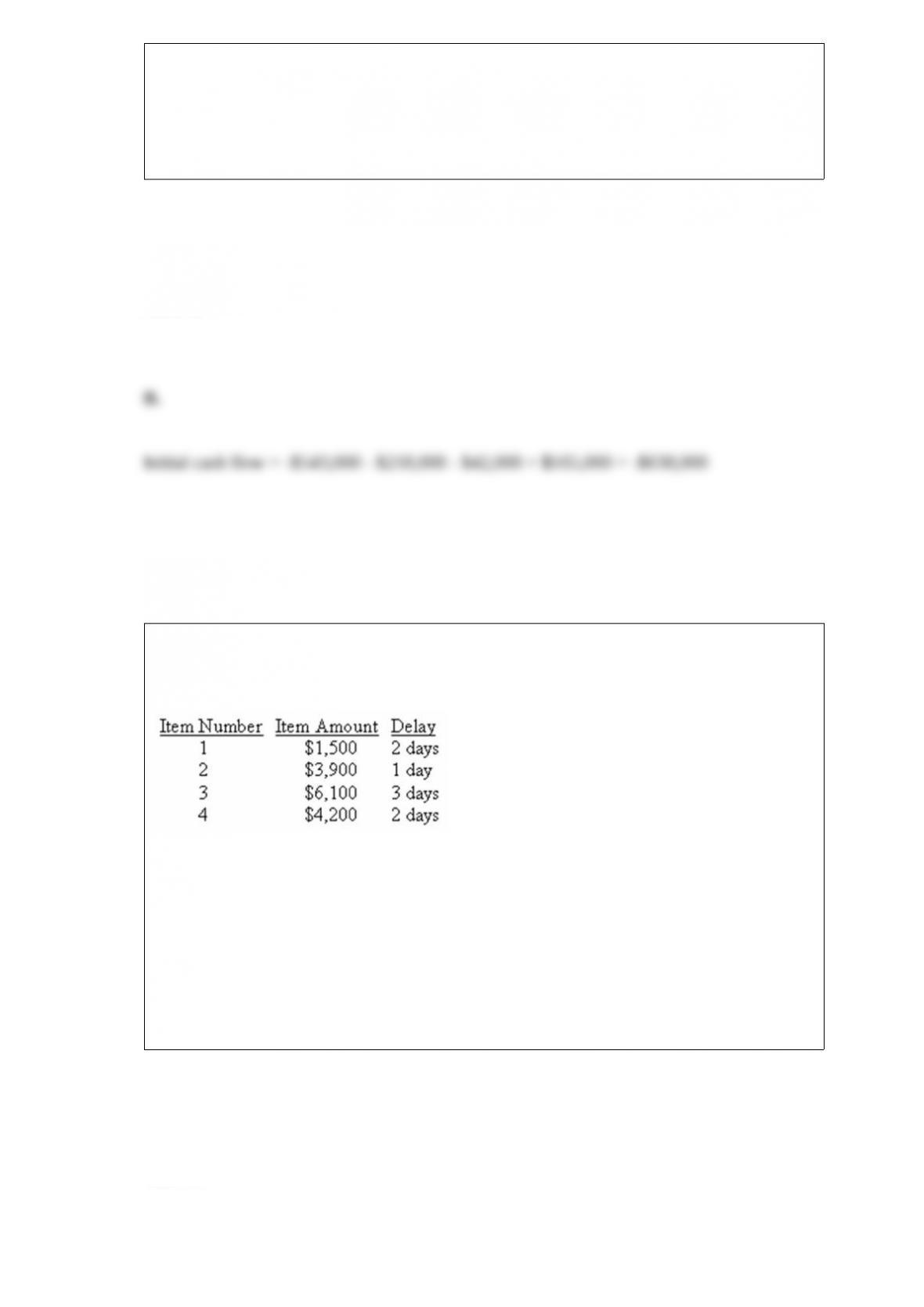
Your firm generally receives 4 checks a month. The check amounts and the collection
delay for each check is shown below. Given this information what is the amount of the
average daily float? Assume a 30 day month.
A. $1,120
B. $2,333
C. $2,640
D. $2,900
E. $3,416
Answer:

Jenningston Mills has a market value equal to its book value. Currently, the firm has
excess cash of $1,200, other assets of $5,800, and equity valued at $3,750. The firm has
250 shares of stock outstanding and net income of $420. What will the new earnings per
share be if the firm uses 25 percent of its excess cash to complete a stock repurchase?
A. $1.83
B. $1.89
C. $1.96
D. $2.00
E. $2.08
Answer:
Last year, you purchased a “TIPS” at par. Since that time, both market interest rates and
the inflation rate have increased by 0.25 percent. Your bond has most likely done which
one of the following since last year?
A. decreased in value due to the change in inflation rates

B. experienced an increase in its bond rating
C. maintained a fixed real rate of return
D. increased in value in response to the change in market rates
E. increased in value due to a decrease in time to maturity
Answer:
The Lumber Yard is considering adding a new product line that is expected to increase
annual sales by $238,000 and cash expenses by $184,000. The initial investment will
require $96,000 in fixed assets that will be depreciated using the straight-line method to
a zero book value over the 6-year life of the project. The company has a marginal tax
rate of 32 percent. What is the annual value of the depreciation tax shield?
A. $5,120
B. $13,160
C. $25,840
D. $32,560
E. $41,840
Answer:

Which one of the following statements is correct?
A. The majority of firms in the U.S. are structured as corporations.
B. Corporate profits are taxable income to the shareholders when earned.
C. Corporations can raise large amounts of capital generally easier than partnerships
can.
D. Stockholders face no potential losses related to their corporate investment.
E. Corporate shareholders elect the corporate president.
Answer:
Uptown Promotions has three divisions. As part of the planning process, the CFO
requested that each division submit its capital budgeting proposals for next year. These
proposals represent positive net present value projects that fall within the long-range
plans of the firm. The requests from the divisions are $4.2 million, $3.1 million, and
$6.8 million, respectively. For the firm as a whole, the management of Uptown
Promotions has limited spending to $10 million for new projects next year. This is an
example of:
A. scenario analysis.
B. sensitivity analysis.
C. determining operating leverage.
D. soft rationing.
E. hard rationing.
Answer:
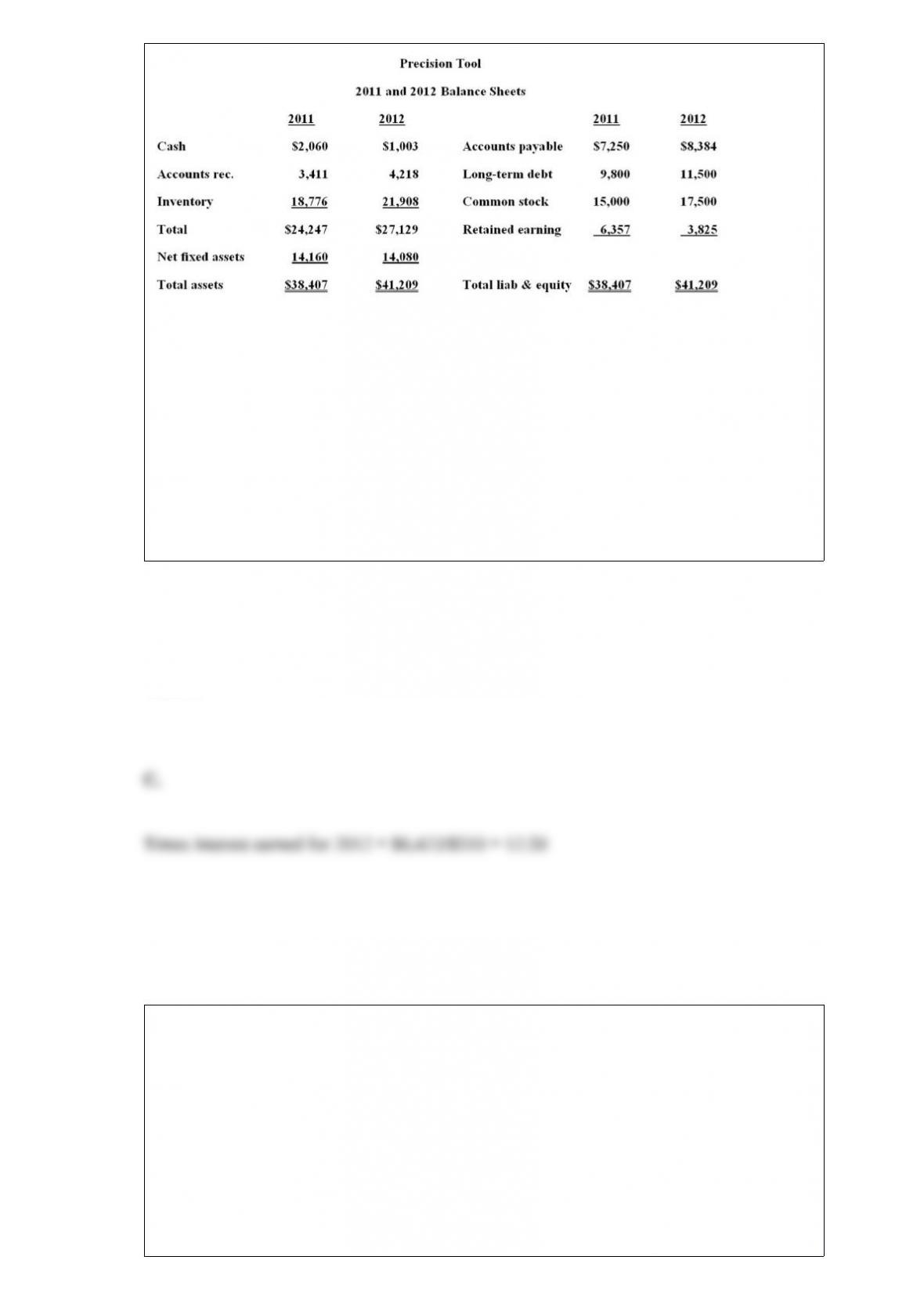
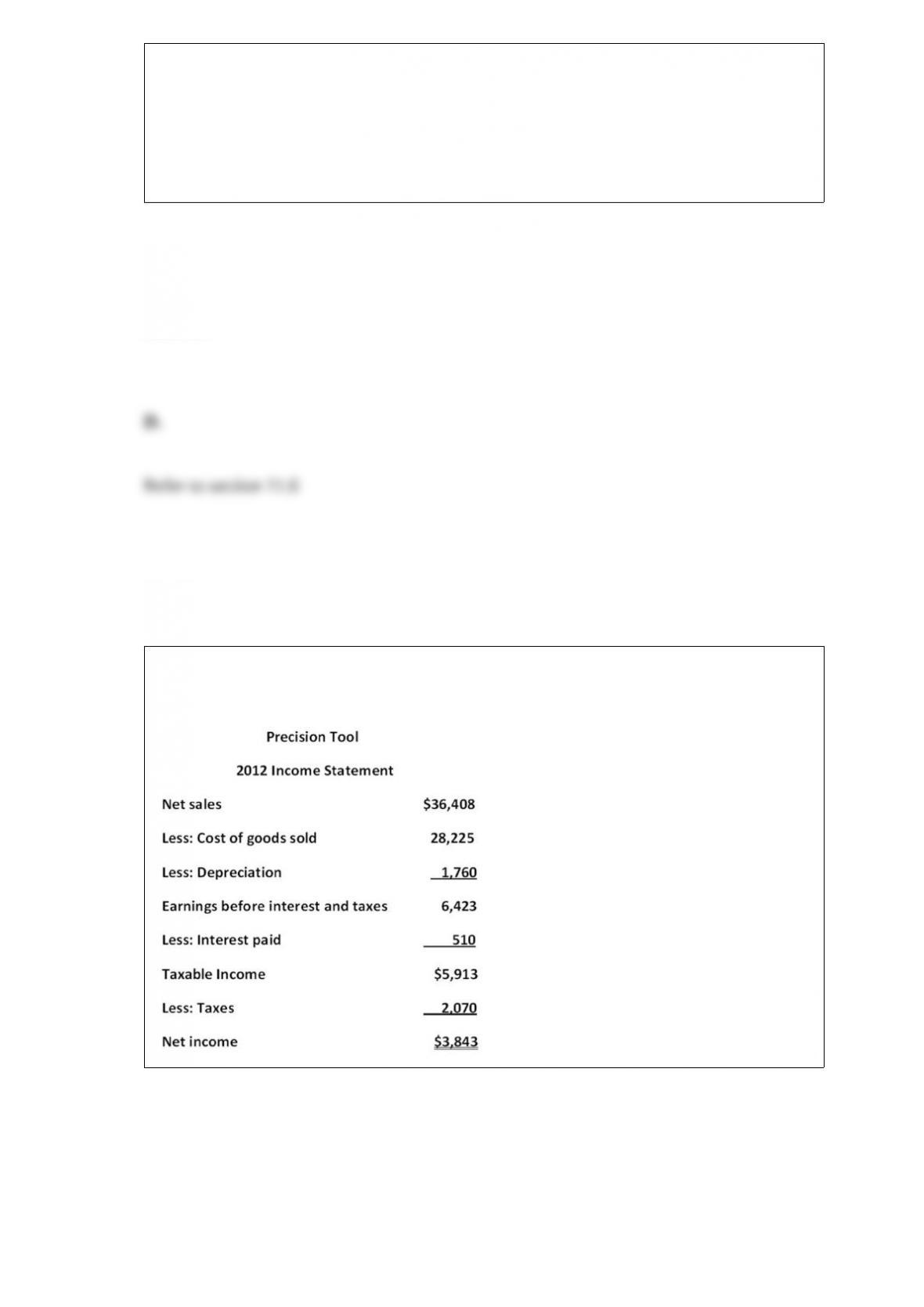
What is the times interest earned ratio for 2012?
A. 9.63
B. 10.12
C. 12.59
D. 14.97
E. 16.05
Answer:
Forty years ago, your mother invested $5,000. Today, that investment is worth
$430,065.11. What is the average annual rate of return she earned on this investment?
A. 11.68 percent
B. 11.71 percent
C. 11.78 percent
D. 11.91 percent

E. 12.02 percent
Answer:
Party A has agreed to exchange $1 million U.S. dollars for $1.21 million Canadian
dollars. What is this agreement called?
A. gilt
B. LIBOR
C. SWIFT
D. Yankee agreements
E. swap
Answer:

You recently purchased a stock that is expected to earn 30 percent in a booming
economy, 9 percent in a normal economy, and lose 33 percent in a recessionary
economy. There is a 5 percent probability of a boom and a 75 percent chance of a
normal economy. What is your expected rate of return on this stock?
A. -3.40 percent
B. -2.25 percent
C. 1.65 percent
D. 2.60 percent
E. 3.50 percent
Answer:
Della’s Pool Halls has 12,000 shares of stock outstanding with a par value of $1 per
share and a market price of $39 a share. The firm just announced a 4-for-3 stock split.
How many shares of stock will be outstanding after the split?
A. 9,000 shares
B. 10,000 shares
C. 12,000 shares
D. 14,600 shares
E. 16,000 shares
Answer:

Which one of the following is computed by dividing next year’s annual dividend by the
current stock price?
A. yield to maturity
B. total yield
C. dividend yield
D. capital gains yield
E. growth rate
Answer:
A Treasury bond is quoted as 99:18 asked and 99:09 bid. What is the bid-ask spread in
dollars on a $5,000 face value bond?
A. $0.03
B. $0.63
C. $11.00

D. $14.06
E. $16.25
Answer:
A firm offers terms of 2/9, net 41. What effective annual interest rate does the firm earn
when a customer does not take the discount?
A. 18.67 percent
B. 20.45 percent
C. 23.37 percent
D. 25.34 percent
E. 25.92 percent
Answer:

Which one of the following will increase net working capital? Assume the current ratio
is greater than 1.0.
A. paying a supplier for a previous purchase
B. paying off a long-term debt
C. selling inventory at cost
D. purchasing inventory on credit
E. selling inventory at a profit on credit
Answer:
Kwik n Hot Dogs is considering the installation of a new computerized pressure cooker
that will cut annual operating costs by $23,000. The system will cost $39,900 to
purchase and install. This system is expected to have a 4-year life and will be
depreciated to zero using straight-line depreciation. What is the amount of the earnings
before interest and taxes for this project?
A. $10,525
B. $13,025
C. $15,525
D. $16,900
E. $19,400
Answer:

The accounting break-even production quantity for a project is 12,320 units. The fixed
costs are $216,000 and the contribution margin per unit is $28. The fixed assets
required for the project will be depreciated on straight-line basis to zero over the
project’s 5-year life. What is the amount of fixed assets required for this project?
A. $325,920
B. $644,800
C. $748,500
D. $1,080,000
E. $1,629,600
Answer:
Travis & Sons has a capital structure which is based on 40 percent debt, 5 percent
preferred stock, and 55 percent common stock. The pre-tax cost of debt is 7.5 percent,

the cost of preferred is 9 percent, and the cost of common stock is 13 percent. The
company’s tax rate is 39 percent. The company is considering a project that is equally as
risky as the overall firm. This project has initial costs of $325,000 and annual cash
inflows of $87,000, $279,000, and $116,000 over the next three years, respectively.
What is the projected net present value of this project?
A. $68,211.04
B. $68,879.97
C. $69,361.08
D. $74,208.18
E. $76,011.23
Answer:
Your portfolio is comprised of 40 percent of stock X, 15 percent of stock Y, and 45
percent of stock Z. Stock X has a beta of 1.16, stock Y has a beta of 1.47, and stock Z
has a beta of 0.42. What is the beta of your portfolio?
A. 0.87
B. 1.09
C. 1.13
D. 1.18
E. 1.21

Answer:
The Black-Scholes option pricing model can be used for:
A. American options but not European options.
B. European options but not American options.
C. call options but not put options.
D. put options but not call options.
E. both zero coupon bonds and coupon bonds.
Answer:
How much are you willing to pay for one share of Jumbo Trout stock if the company
just paid a $0.70 annual dividend, the dividends increase by 2.5 percent annually, and
you require a 10 percent rate of return?
A. $9.29
B. $9.33

C. $9.57
D. $9.53
E. $9.59
Answer:
Which of the following are negative covenants that might be found in a bond indenture?
I. The company shall maintain a current ratio of 1.10 or better.
II. No debt senior to this issue can be issued.
III. The company cannot lease any major assets without approval by the lender.
IV. The company must maintain the loan collateral in good working order.
A. I and II only
B. II and III only
C. III and IV only
D. II, III, and IV only
E. I, II, and III only
Answer:

A bond is quoted at a price of $989. This price is referred to as which one of the
following?
A. call price
B. face value
C. clean price
D. dirty price
E. wholesale price
Answer:
You would like to know the minimum level of sales that is needed for a project to be
accepted based on its net present value. To determine that sales level you should
compute the:
A. contribution margin per unit and set that margin equal to the fixed costs per unit.
B. contribution margin per unit.
C. accounting break-even point.

D. cash break-even point.
E. financial break-even point.
Answer:
A firm with a variable-rate loan wants to protect itself from increases in interest rates.
Which of the following would interest this firm?
I. interest rate floor
II. interest rate cap
III. put option on an interest rate
IV. call option on an interest rate
A. I only
B. I and III only
C. I and IV only
D. II and III only
E. II and IV only
Answer:

The average compound return earned per year over a multi-year period is called the
_____ average return.
A. arithmetic
B. standard
C. variant
D. geometric
E. real
Answer:
You want to buy a bond from a dealer. Which one of the following prices will you pay?
A. call price
B. auction price
C. bid price
D. asked price
E. bid-ask spread

Answer:
You are the beneficiary of a life insurance policy. The insurance company informs you
that you have two options for receiving the insurance proceeds. You can receive a lump
sum of $200,000 today or receive payments of $1,400 a month for 20 years. You can
earn 6 percent on your money. Which option should you take and why?
A. You should accept the payments because they are worth $209,414 to you today.
B. You should accept the payments because they are worth $247,800 to you today.
C. You should accept the payments because they are worth $336,000 to you today.
D. You should accept the $200,000 because the payments are only worth $189,311 to
you today.
E. You should accept the $200,000 because the payments are only worth $195,413 to
you today.
Answer:

The flotation cost for a firm is computed as:
A. the arithmetic average of the flotation costs of both debt and equity.
B. the weighted average of the flotation costs associated with each form of financing.
C. the geometric average of the flotation costs associated with each form of financing.
D. one-half of the flotation cost of debt plus one-half of the flotation cost of equity.
E. a weighted average based on the book values of the firm’s debt and equity.
Answer: