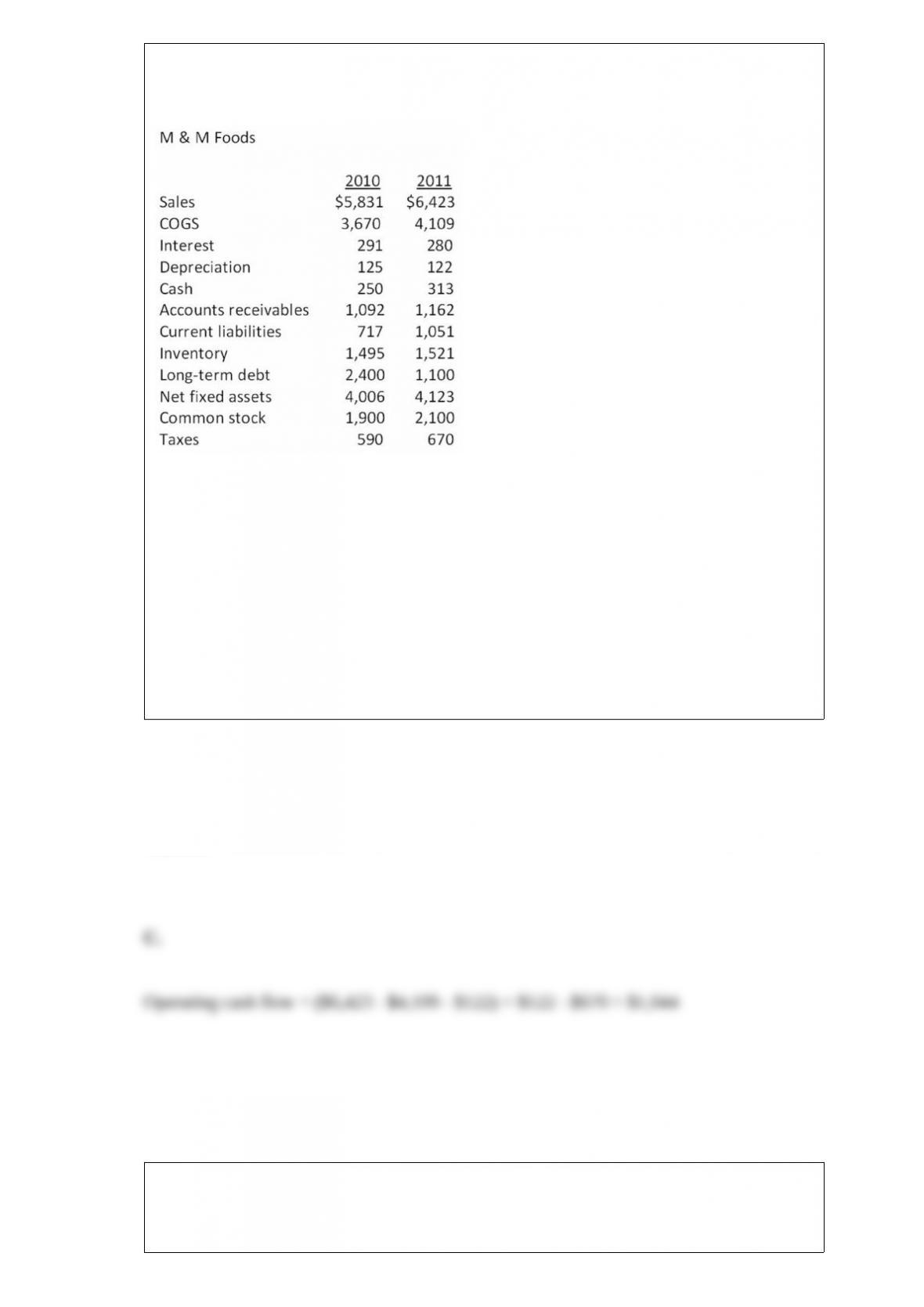
What is the operating cash flow for 2011?
A. $1,226
B. $1,367
C. $1,644
D. $1,766
E. $1,823
Answer:
Which of the following help convince managers to work in the best interest of the
stockholders? Assume there are no golden parachutes.

I. compensation based on the value of the stock
II. stock option plans
III. threat of a company takeover
IV. threat of a proxy fight
A. I and II only
B. III and IV only
C. I, II, and III only
D. I, III, and IV only
E. I, II, III, and IV
Answer:
Big Falls Tours just paid a dividend of $1.55 per share. The dividends are expected to
grow at 30 percent for the next 8 years and then level off to a 6 percent growth rate
indefinitely. What is the price of this stock today given a required return of 15 percent?
A. $67.54
B. $69.90
C. $70.47
D. $71.07
E. $78.19

Answer:
Your father invested a lump sum 26 years ago at 4.25 percent interest. Today, he gave
you the proceeds of that investment which totaled $51,480.79. How much did your
father originally invest?
A. $15,929.47
B. $16,500.00
C. $17,444.86
D. $17,500.00
E. $17,999.45
Answer:

What is the relationship between present value and future value interest factors?
A. The present value and future value factors are equal to each other.
B. The present value factor is the exponent of the future value factor.
C. The future value factor is the exponent of the present value factor.
D. The factors are reciprocals of each other.
E. There is no relationship between these two factors.
Answer:
Cooper Brands, Inc., has 68,000 shares of stock outstanding at a market price of $63 a
share. The par value is $1 per share. The company has just announced a 5-for-4 stock
split. What will the market price per share be after the split?
A. $50.40
B. $58.20
C. $62.50
D. $78.75
E. $82.50
Answer:

Which of the following correspond to a wide frequency distribution?
I. relatively low risk
II. relatively low rate of return
III. relatively high standard deviation
IV. relatively large risk premium
A. II only
B. III only
C. I and II only
D. II and III only
E. III and IV only
Answer:
What was the highest price per troy ounce for the December silver futures contract
today?

Silver – 5,000 troy oz.: dollars and cents per troy oz.
A. $10.185
B. $10.225
C. $10.250
D. $10.814
E. $10.830
Answer:
A newly issued bond has a 7 percent coupon with semiannual interest payments. The
bonds are currently priced at par value. The effective annual rate provided by these
bonds must be:
A. 3.5 percent.
B. greater than 3.5 percent but less than 7 percent.
C. 7 percent.
D. greater than 7 percent.
E. Answer cannot be determined from the information provided.
Answer:

You are expecting a payment of C$100,000 four years from now. The risk-free rate of
return is 3.8 percent in the U.S. and 4.1 percent in Canada. The inflation rate is 2
percent in the U.S. and 3 percent in Canada. Suppose the current exchange rate is C$1 =
$0.8273. How much will the payment four years from now be worth in U.S. dollars?
A. $61,129
B. $62,414
C. $66,667
D. $78,202
E. $81,745
Answer:
Which one of the following statements is correct concerning the costs of issuing
securities?
A. Domestic bonds are generally more expensive to issue than equity IPOs.
B. Abnormal returns are rarely associated with seasoned issues.
C. A seasoned offering is typically more expensive on a percentage basis than an IPO.
D. There tends to be substantial economies of scale when issuing securities.

E. The costs of issuing convertible bonds tend to be less on a percentage basis than the
costs of issuing straight debt.
Answer:
Which one of the following is an agency cost?
A. accepting an investment opportunity that will add value to the firm
B. increasing the quarterly dividend
C. investing in a new project that creates firm value
D. hiring outside accountants to audit the company’s financial statements
E. closing a division of the firm that is operating at a loss
Answer:

An individual investor with a small portfolio who wishes to purchase 100 shares of
each IPO is more likely to receive an allocation of shares when:
A. an IPO is substantially oversubscribed than when it is not.
B. the knowledgeable investors feel the issue is underpriced.
C. an IPO is severely underpriced.
D. an IPO is undersubscribed.
E. he or she has a standing order with the underwriter to purchase shares in every IPO
handled by that underwriter.
Answer:
Which of the following will increase the operating cycle?
I. increasing the inventory turnover rate
II. increasing the payables period
III. decreasing the receivable turnover rate
IV. decreasing the inventory level
A. I only
B. III only
C. II and IV only
D. I and IV only
E. II and III only

Answer:
George and Pat just made an agreement to exchange currencies based on today’s
exchange rate. Settlement will occur tomorrow. Which one of the following is the
exchange rate that applies to this agreement?
A. spot exchange rate
B. forward exchange rate
C. triangle rate
D. cross rate
E. current rate
Answer:
Nielsen Auto Parts had beginning net fixed assets of $218,470 and ending net fixed
assets of $209,411. During the year, assets with a combined book value of $6,943 were
sold. Depreciation for the year was $42,822. What is the amount of net capital
spending?
A. $33,763

B. $40,706
C. $58,218
D. $65,161
E. $67,408
Answer:
The primary purpose of Blume’s formula is to:
A. compute an accurate historical rate of return.
B. determine a stock’s true current value.
C. consider compounding when estimating a rate of return.
D. determine the actual real rate of return.
E. project future rates of return.
Answer:

Which one of the following statements is correct concerning a portfolio of 20 securities
with multiple states of the economy when both the securities and the economic states
have unequal weights?
A. Given the unequal weights of both the securities and the economic states, the
standard deviation of the portfolio must equal that of the overall market.
B. The weights of the individual securities have no effect on the expected return of a
portfolio when multiple states of the economy are involved.
C. Changing the probabilities of occurrence for the various economic states will not
affect the expected standard deviation of the portfolio.
D. The standard deviation of the portfolio will be greater than the highest standard
deviation of any single security in the portfolio given that the individual securities are
well diversified.
E. Given both the unequal weights of the securities and the economic states, an investor
might be able to create a portfolio that has an expected standard deviation of zero.
Answer:
Peterson’s Antiquities currently has a 31 day cash cycle. Assume the firm changes its
operations such that it decreases its receivables period by 2 days, decreases its
inventory period by 3 days, and decreases its payables period by 4 days. What will the
length of the cash cycle be after these changes?
A. 22 days
B. 23 days

C. 29 days
D. 30 days
E. 31 days
Answer:
Big Guy Subs has net income of $150,980, a price-earnings ratio of 12.8, and earnings
per share of $0.87. How many shares of stock are outstanding?
A. 13,558
B. 14,407
C. 165,523
D. 171,000
E. 173,540
Answer:
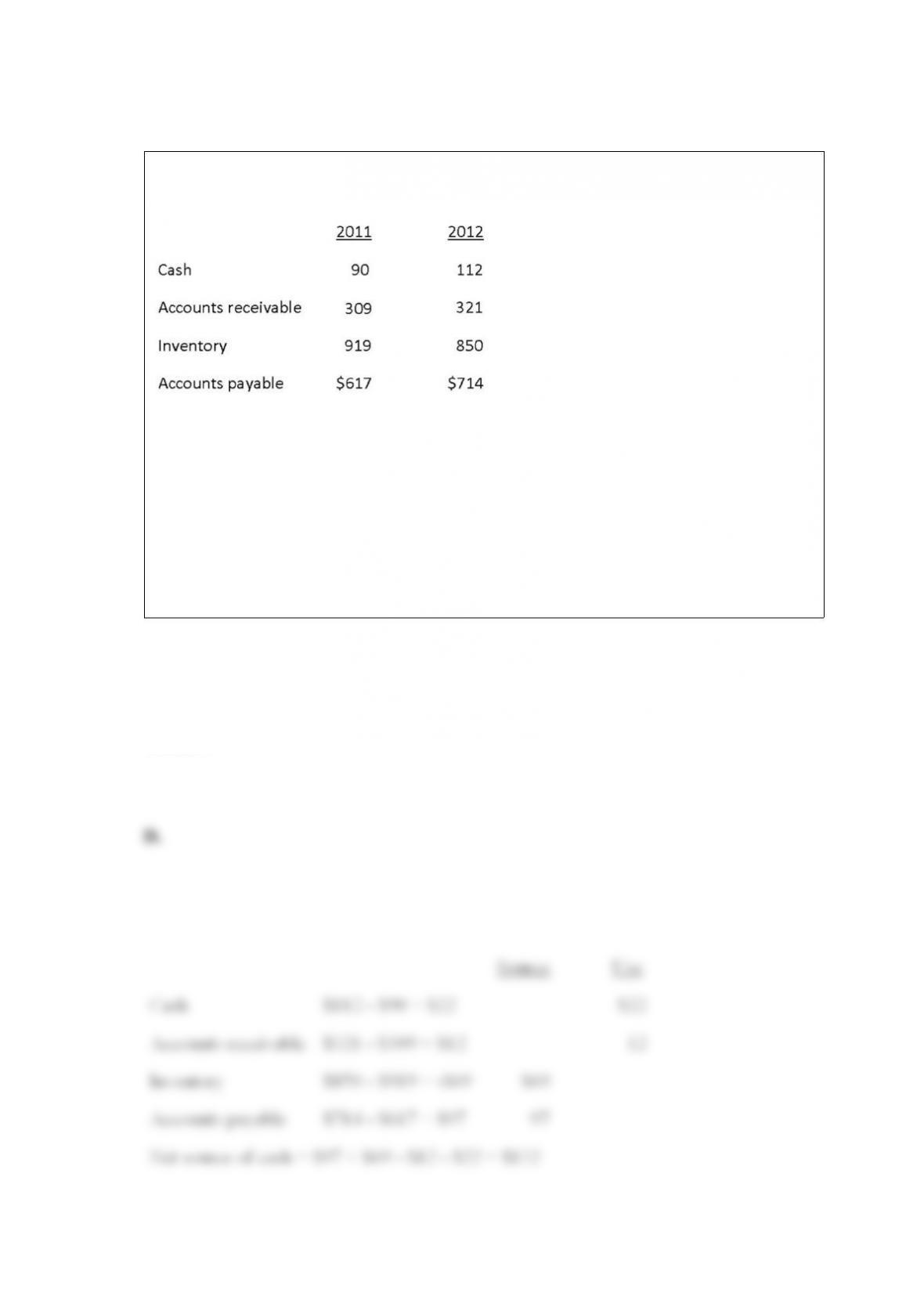
Wise’s Corner Grocer had the following current account values. What effect did the
change in net working capital have on the firm’s cash flows for 2012?
A. net use of cash of $37
B. net use of cash of $83
C. net source of cash of $83
D. net source of cash of $132
E. net source of cash of $135
Answer:

Sue and Neal are twins. Sue invests $5,000 at 7 percent when she is 25 years old. Neal
invests $5,000 at 7 percent when he is 30 years old. Both investments compound
interest annually. Both Sue and Neal retire at age 60. Which one of the following
statements is correct assuming that neither Sue nor Neal has withdrawn any money
from their accounts?
A. Sue will have less money when she retires than Neal.
B. Neal will earn more interest on interest than Sue.
C. Neal will earn more compound interest than Sue.
D. If both Sue and Neal wait to age 70 to retire, then they will have equal amounts of
savings.
E. Sue will have more money than Neal as long as they retire at the same time.
Answer:
You own 400 shares of Western Feed Mills stock valued at $51.20 per share. What is
the dividend yield if your annual dividend income is $352?
A. 1.68 percent
B. 1.72 percent
C. 1.83 percent
D. 1.13 percent
E. 1.21 percent

Answer:
At the beginning of the year, a firm had current assets of $121,306 and current liabilities
of $124,509. At the end of the year, the current assets were $122,418 and the current
liabilities were $103,718. What is the change in net working capital?
A. -$19,679
B. -$11,503
C. -$9,387
D. $1,809
E. $21,903
Answer:
The City Street Corporation’s common stock has a beta of 1.2. The risk-free rate is 3.5
percent and the expected return on the market is 13 percent. What is the firm’s cost of
equity?

A. 11.4 percent
B. 12.8 percent
C. 14.9 percent
D. 17.6 percent
E. 19.1 percent
Answer:
The Bakery is considering a new project it considers to be a little riskier than its current
operations. Thus, management has decided to add an additional 1.5 percent to the
company’s overall cost of capital when evaluating this project. The project has an initial
cash outlay of $58,000 and projected cash inflows of $17,000 in year one, $28,000 in
year two, and $30,000 in year three. The firm uses 25 percent debt and 75 percent
common stock as its capital structure. The company’s cost of equity is 15.5 percent
while the aftertax cost of debt for the firm is 6.1 percent. What is the projected net
present value of the new project?
A. -$6,208
B. -$1,964
C. -$308
D. $1,427
E. $1,573

Answer:
A proposed expansion project is expected to increase sales of JL Ticker’s Store by
$41,000 and increase cash expenses by $21,000. The project will cost $28,000 and be
depreciated using straight-line depreciation to a zero book value over the 4-year life of
the project. The store has a marginal tax rate of 30 percent. What is the operating cash
flow of the project using the tax shield approach?
A. $5,600
B. $7,800
C. $16,100
D. $13,300
E. $14,600
Answer:

Long-run financial risk:
A. can frequently be hedged on a permanent basis.
B. is best hedged on a division by division basis within a conglomerate.
C. is related more to near-term transactions than to advancements in technology.
D. generally results from changes in the underlying economics of a business.
E. can generally be hedged such that the financial viability of a firm is protected.
Answer:
The expected inflation rate in Finland is 2.8 percent while it is 3.2 percent in the U.S. A
risk-free asset in the U.S. is yielding 4.9 percent. What approximate real rate of return
should you expect on a risk-free Finnish security?
A. 1.2 percent
B. 1.7 percent
C. 2.1 percent
D. 2.5 percent
E. 2.8 percent
Answer:

The expected return on a stock given various states of the economy is equal to the:
A. highest expected return given any economic state.
B. arithmetic average of the returns for each economic state.
C. summation of the individual expected rates of return.
D. weighted average of the returns for each economic state.
E. return for the economic state with the highest probability of occurrence.
Answer:
You have saved a total of $200,000 over the past several years. Jane, a trusted business
associate, recently approached you with an offer. She has offered you a partnership in a
new firm that she expects to be exceedingly profitable. Your initial investment in the
partnership would be $125,000. However, Jane cannot give you any odds on that
success occurring. You have decided to keep your $125,000 and forego this opportunity
simply because you don’t know the probability of success. Which one of the following
behavior characteristics do you have?
A. aversion to ambiguity
B. recency bias
C. sentiment-based risk aversion
D. clustering illusion
E. money illusion

Answer:
Incorporating flotation costs into the analysis of a project will:
A. cause the project to be improperly evaluated.
B. increase the net present value of the project.
C. increase the project’s rate of return.
D. increase the initial cash outflow of the project.
E. have no effect on the present value of the project.
Answer:
Northern Lights is trying to decide whether to lease or buy some new equipment. The
equipment costs $54,000, has a 5-year life, and will be worthless after the 5 years. The
company has a tax rate of 34 percent, a cost of borrowed funds of 8.75 percent, and
uses straight-line depreciation. The equipment can be leased for $14,100 a year. What is
the amount of the annual depreciation tax shield?
A. $3,672
B. $5,878
C. $6,936
D. $8,407
E. $10,200
Answer:
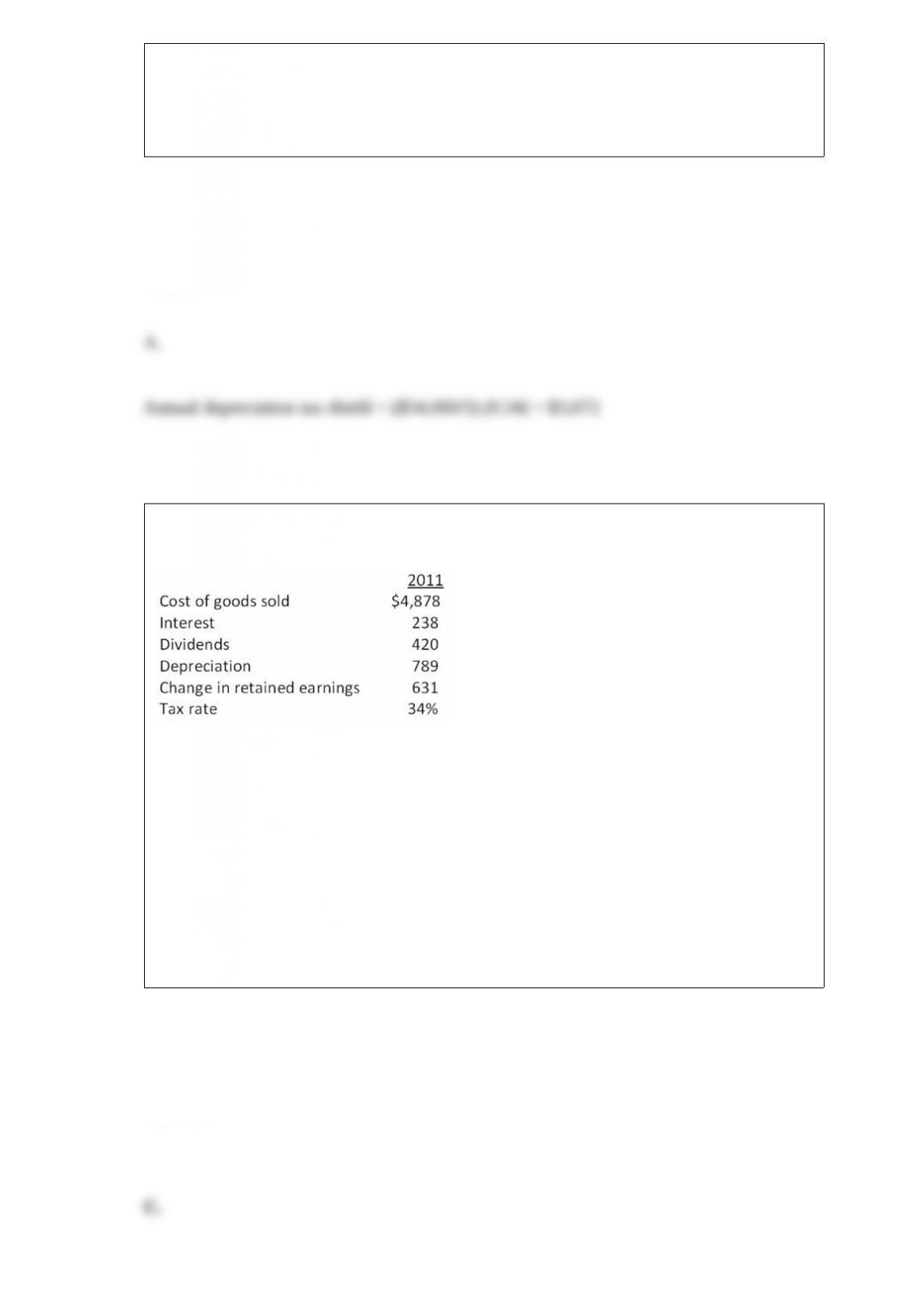
What is the taxable income for 2011?
A. $1,051.00
B. $1,367.78
C. $1,592.42
D. $2,776.41
E. $3,091.18
Answer: