5) In Chapter 10 of your textbook, panel data estimation was introduced. Panel data consist of
observations on the same n entities at two or more time periods T. For two variables, you have
(Xit, Yit), i = 1,…, n and t = 1,…, T
where n could be the U.S. states. The example in Chapter 10 used annual data from 1982 to 1988 for the
fatality rate and beer taxes. Estimation by OLS, in essence, involved “stacking” the data.
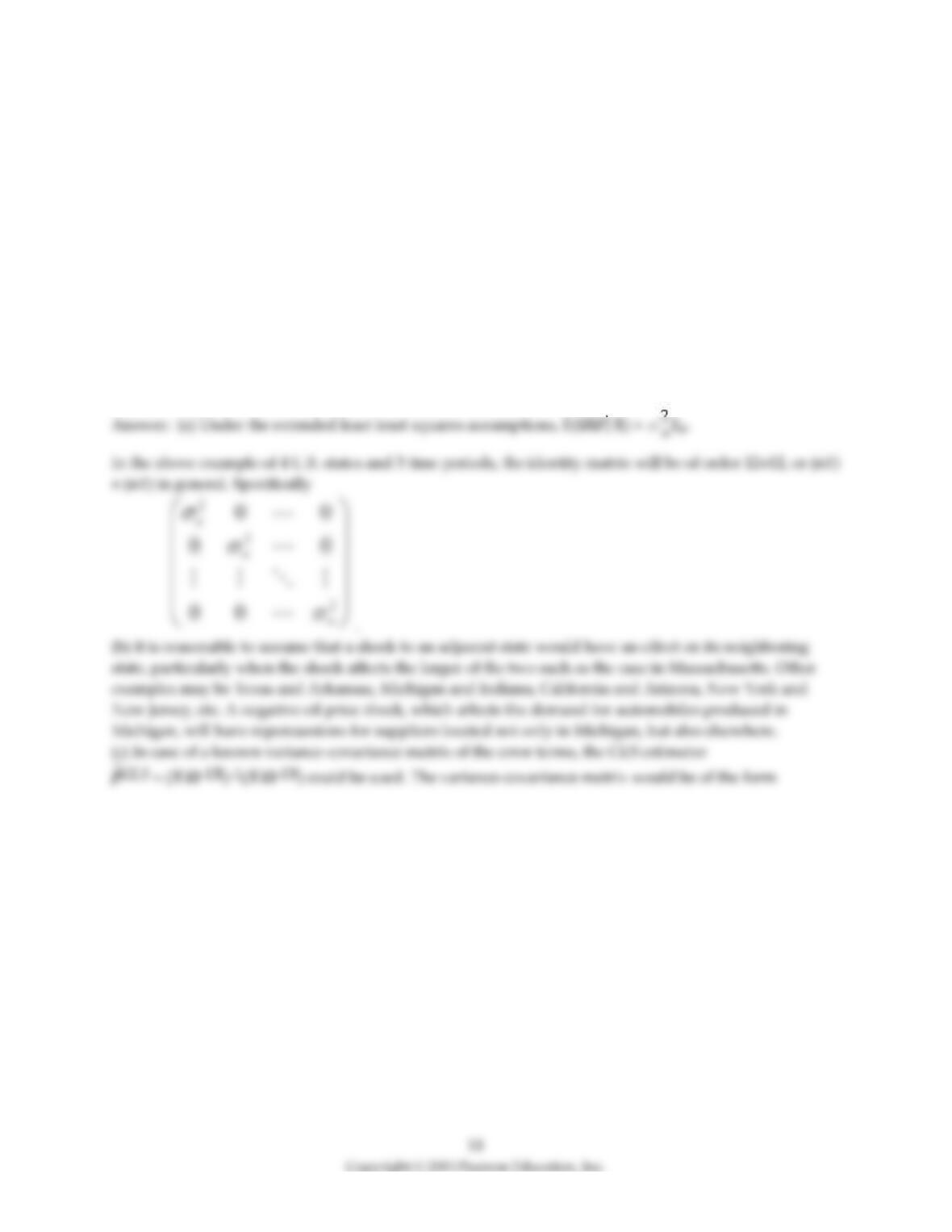
(a) What would the variance–covariance matrix of the errors look like in this case if you allowed for
homoskedasticity–only standard errors? What is its order? Use an example of a linear regression with one
regressor of 4 U.S. states and 3 time periods.
(b) Does it make sense that errors in New Hampshire, say, are uncorrelated with errors in Massachusetts
during the same time period (“contemporaneously”)? Give examples why this correlation might not be
zero.
(c) If this correlation was known, could you find an estimator which was more efficient than OLS?
18.3 Mathematical and Graphical Problems
1) Your textbook derives the OLS estimator as
= X)–1Y.
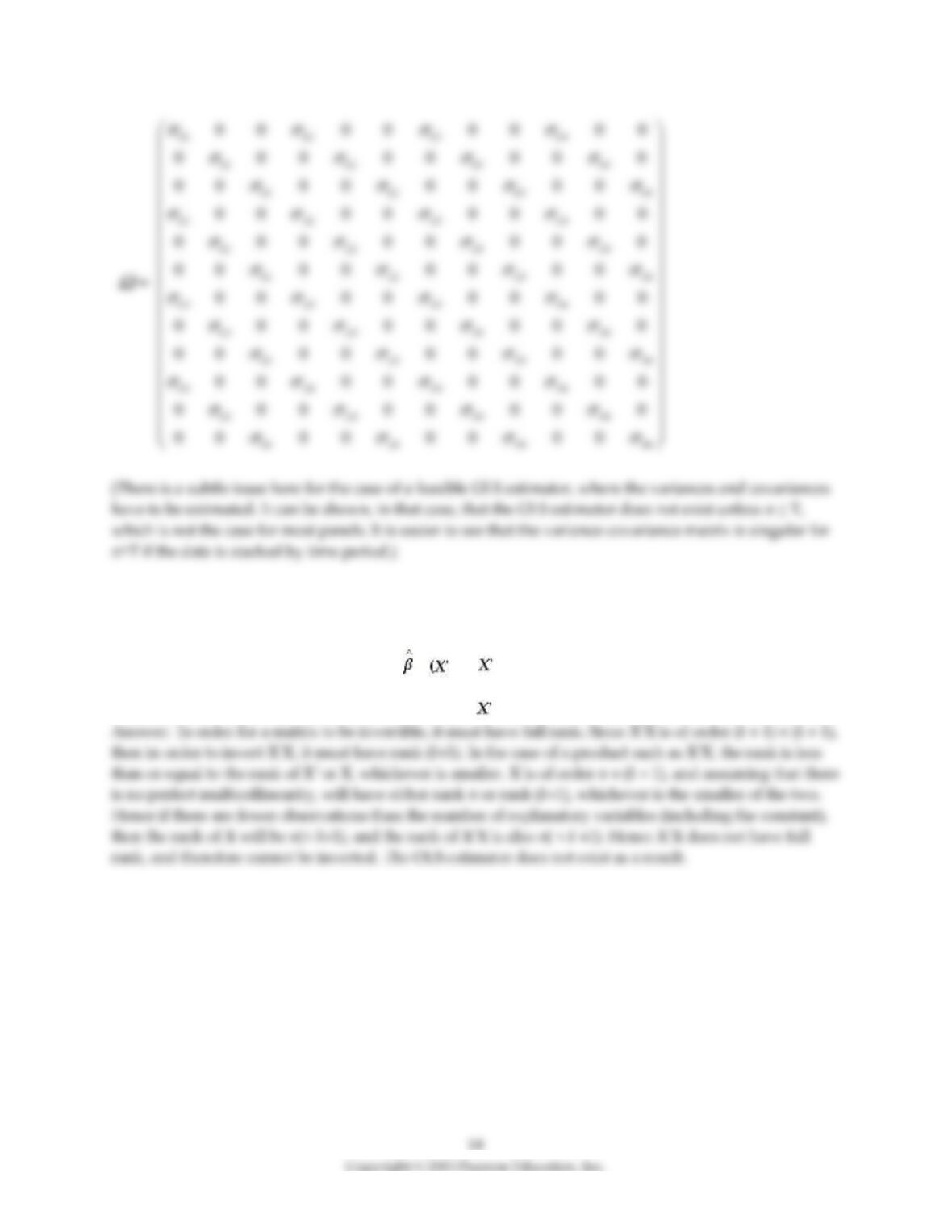
Show that the estimator does not exist if there are fewer observations than the number of explanatory
variables, including the constant. What is the rank of X in this case?
15
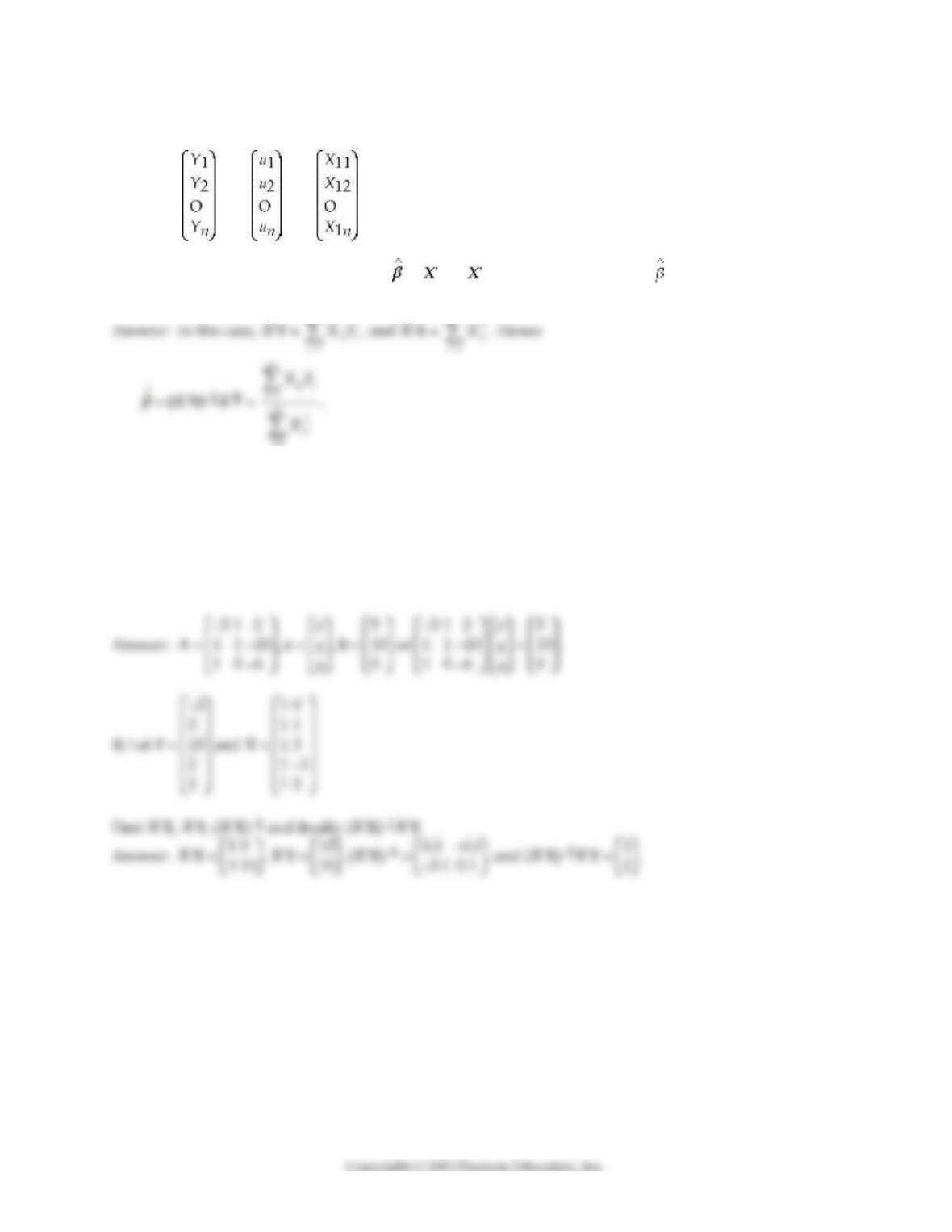
2) Assume that the data looks as follows:
Y = , U = , X = , and β = (β1)
Using the formula for the OLS estimator = (X)–1Y, derive the formula for 1, the only slope in this
“regression through the origin.”
n
n
3) Write the following three linear equations in matrix format Ax = b, where x is a 3×1 vector containing q,
p, and y, A is a 3×3 matrix of coefficients, and b is a 3×1 vector of constants.
q = 5 +3 p – 2 y
q = 10 – p + 10 y
p = 6 y
16
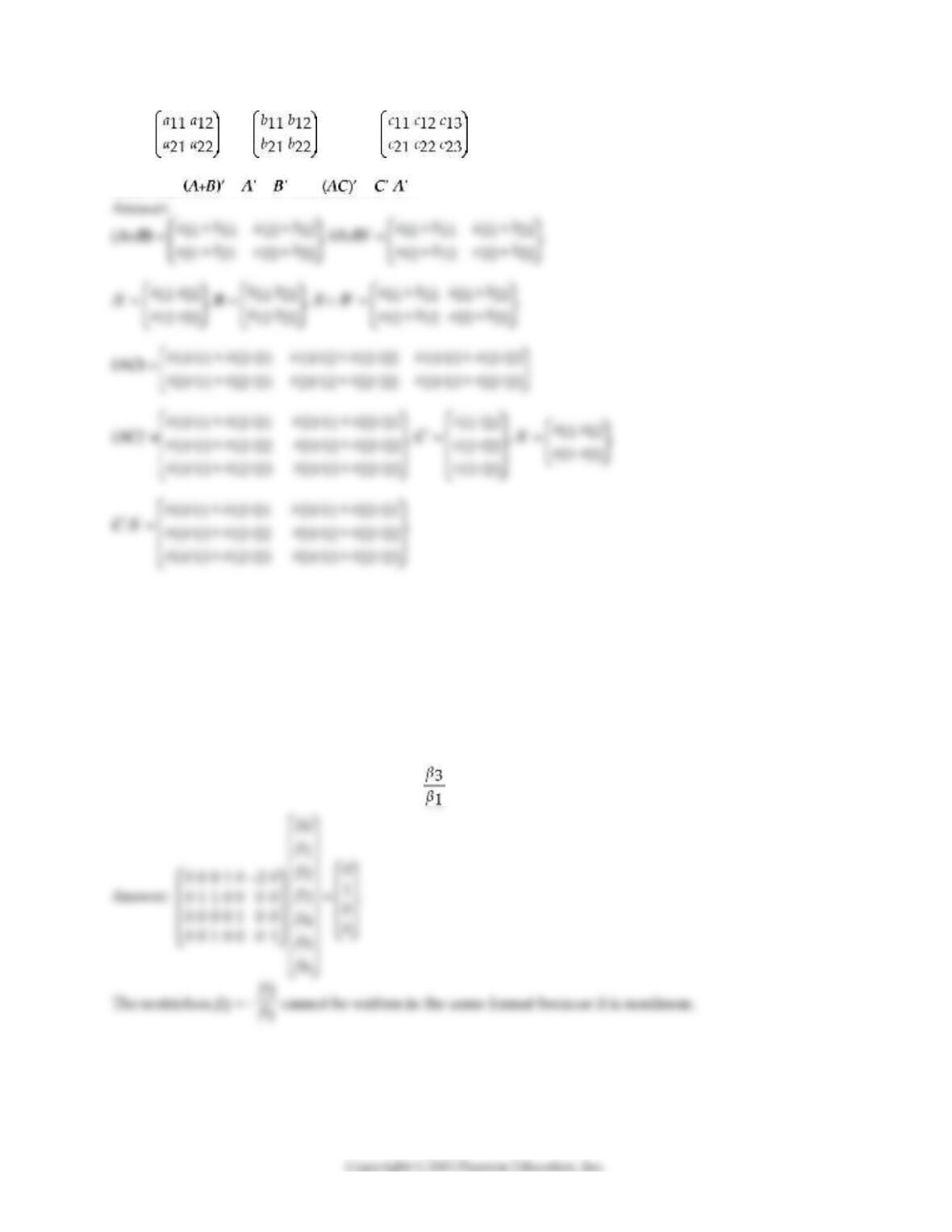
5) A = , B = , and C =
show that = + and = .
6) Write the following four restrictions in the form Rβ = r, where the hypotheses are to be tested
simultaneously.
β3 = 2β5,
β1 + β2 = 1,
β4 = 0,
β2 = –β6.
Can you write the following restriction β2 = – in the same format? Why not?
17
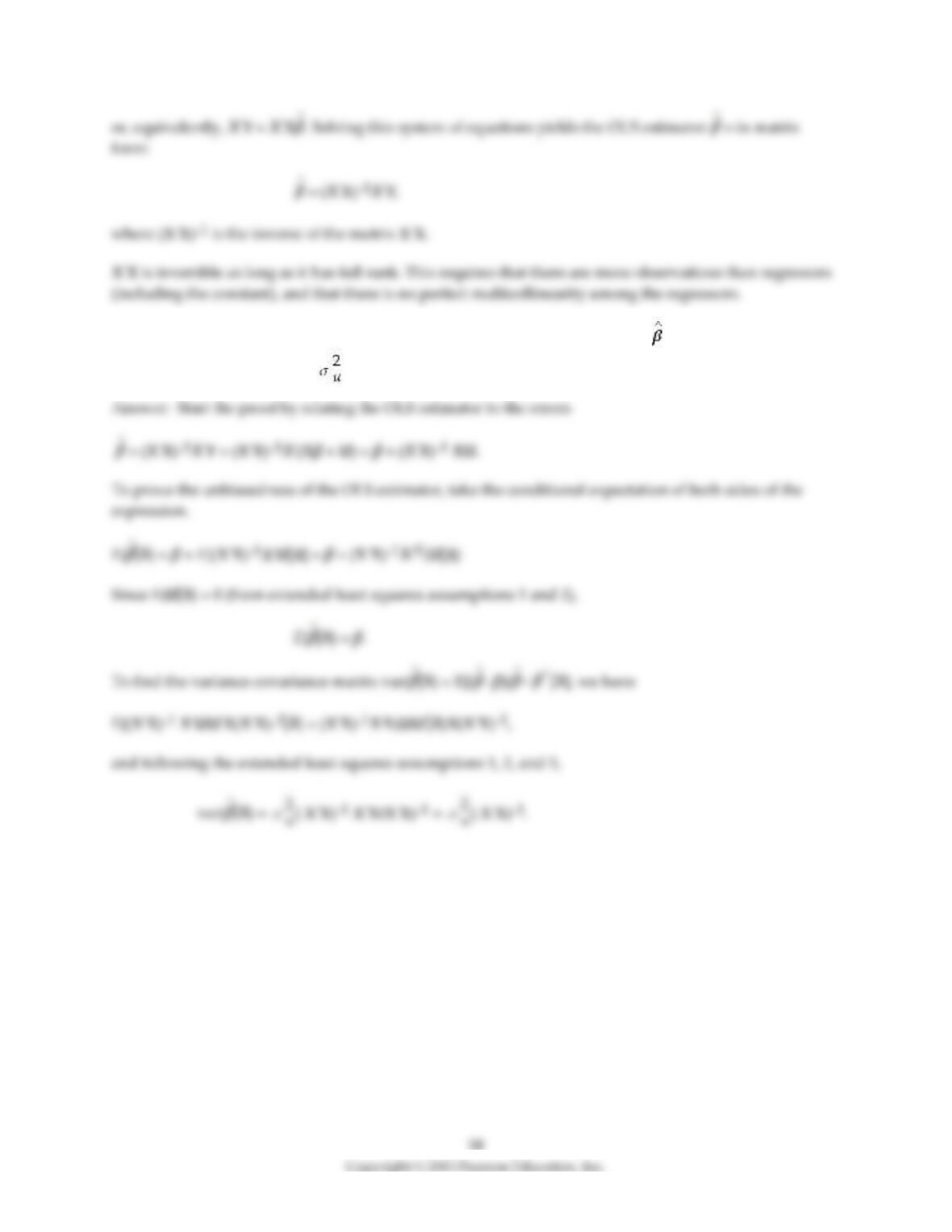
7) Using the model Y = Xβ + U, and the extended least squares assumptions, derive the OLS estimator .
Discuss the conditions under which X is invertible.
Answer:
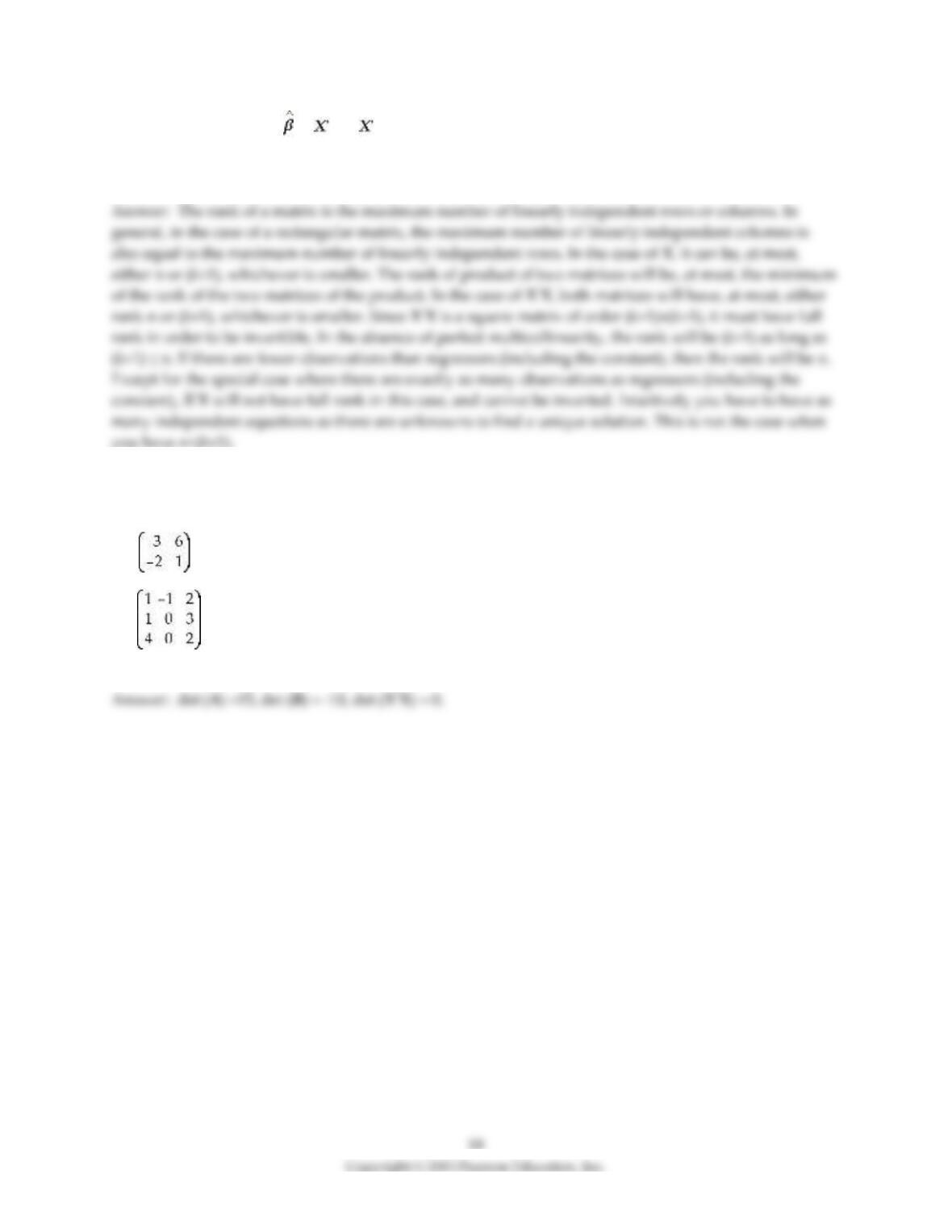
8) Prove that under the extended least squares assumptions the OLS estimator is unbiased and that its
variance–covariance matrix is (X’X)–1.
9) For the OLS estimator = ( X)–1Y to exist, X’X must be invertible. This is the case when X has full
rank. What is the rank of a matrix? What is the rank of the product of two matrices? Is it possible that X
could have rank n? What would be the rank of X‘X in the case n<(k+1)? Explain intuitively why the OLS
estimator does not exist in that situation.
10) In order for a matrix A to have an inverse, its determinant cannot be zero. Derive the determinant of
the following matrices:
A =
B =
X’X where X = (1 10)
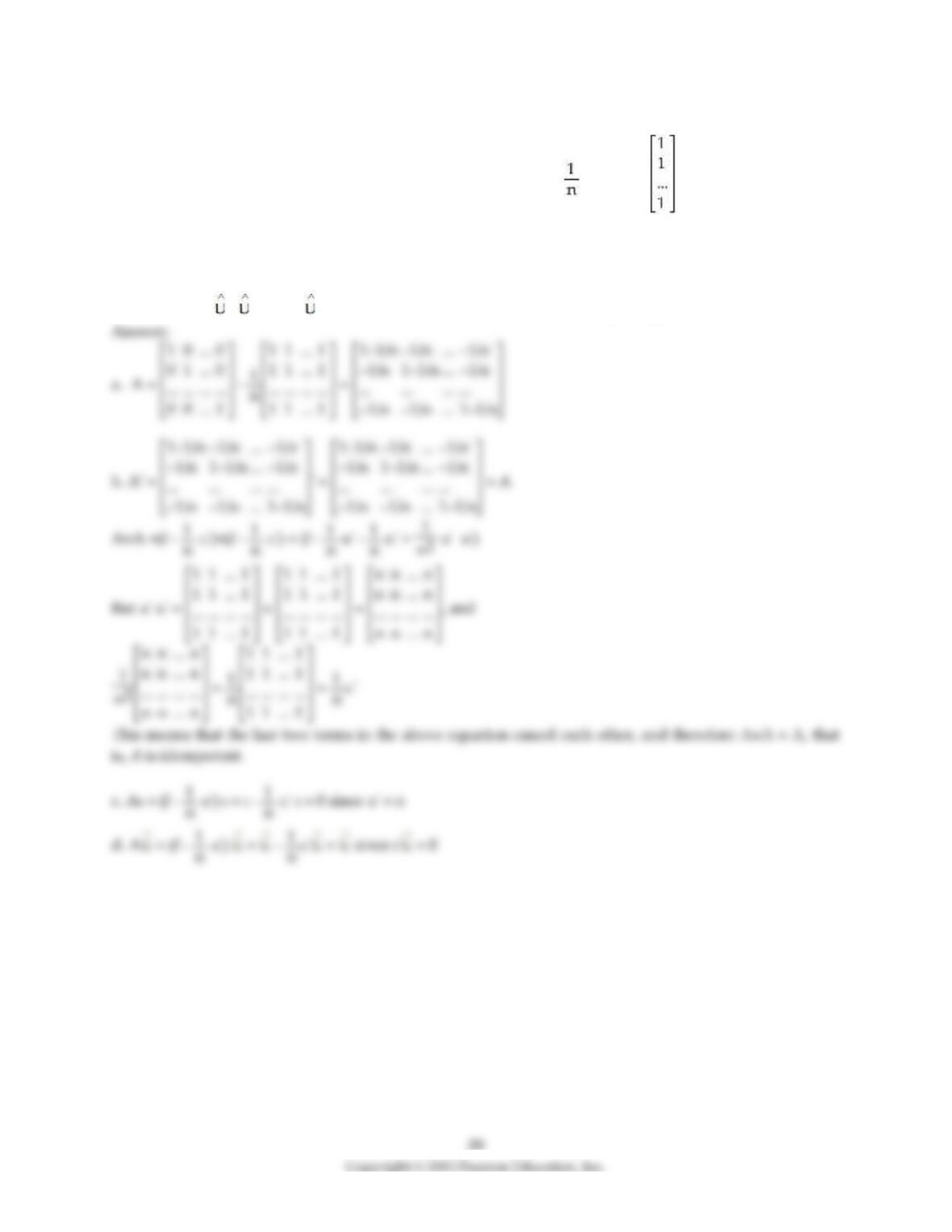
11) Your textbook shows that the following matrix (Mx = In – Px) is a symmetric idempotent matrix.
Consider a different Matrix A, which is defined as follows: A = I – ιι’ and ι =
a. Show what the elements of A look like.
b. Show that A is a symmetric idempotent matrix
c. Show that Aι = 0.
d. Show that A = , where is the vector of OLS residuals from a multiple regression.
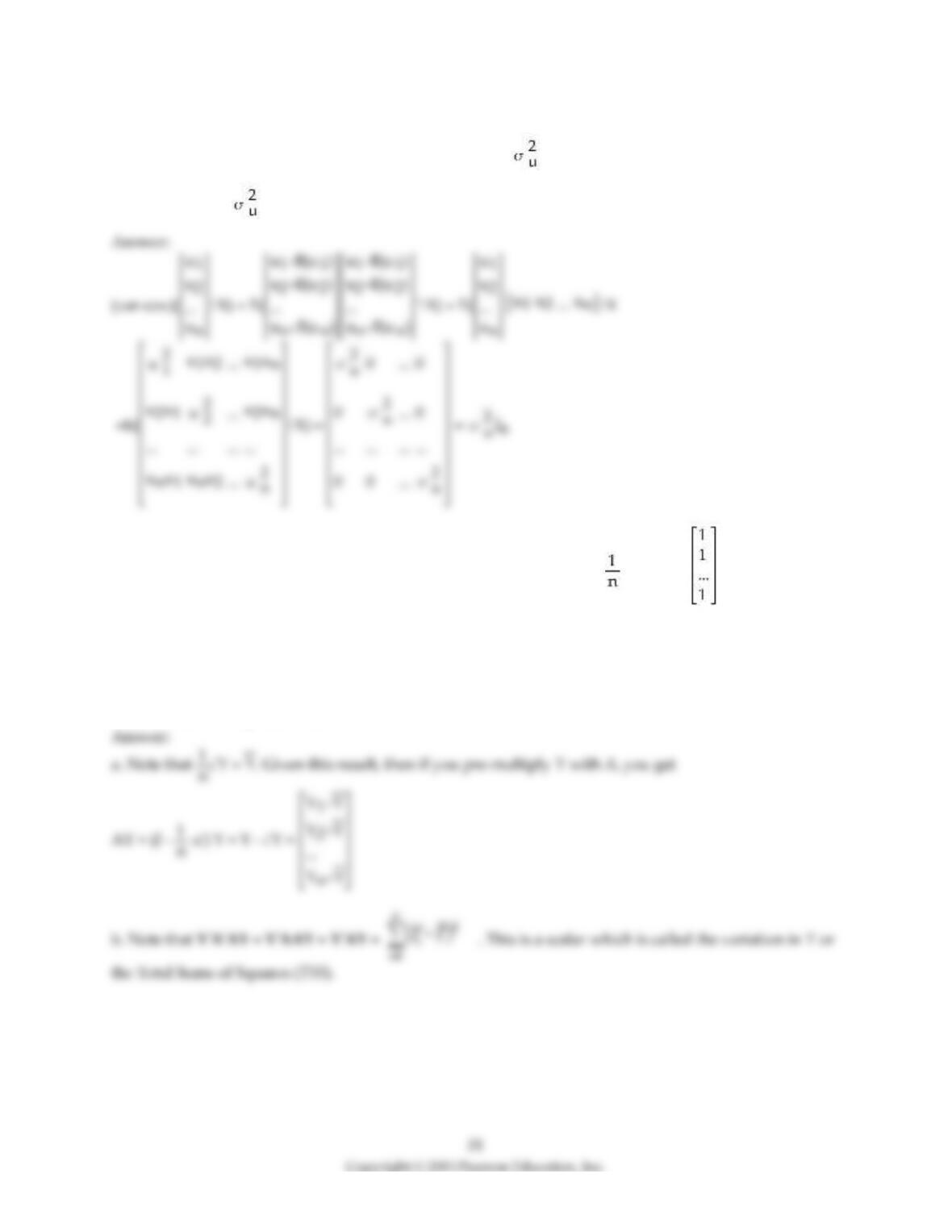
12) Write down, in general, the variance–covariance matrix for the multiple regression error term U.
Using the assumptions cov(ui,uj|XiXj) = 0 and var(ui|Xi) = . Show that the variance–covariance matrix
can be written as In.
13) Consider the following symmetric and idempotent Matrix A: A = I – ιι’ and ι =
a. Show that by postmultiplying this matrix by the vector Y (the LHS variable of the OLS regression), you
convert all observations of Y in deviations from the mean.
b. Derive the expression Y’AY. What is the order of this expression? Under what other name have you
encountered this expression before?
22
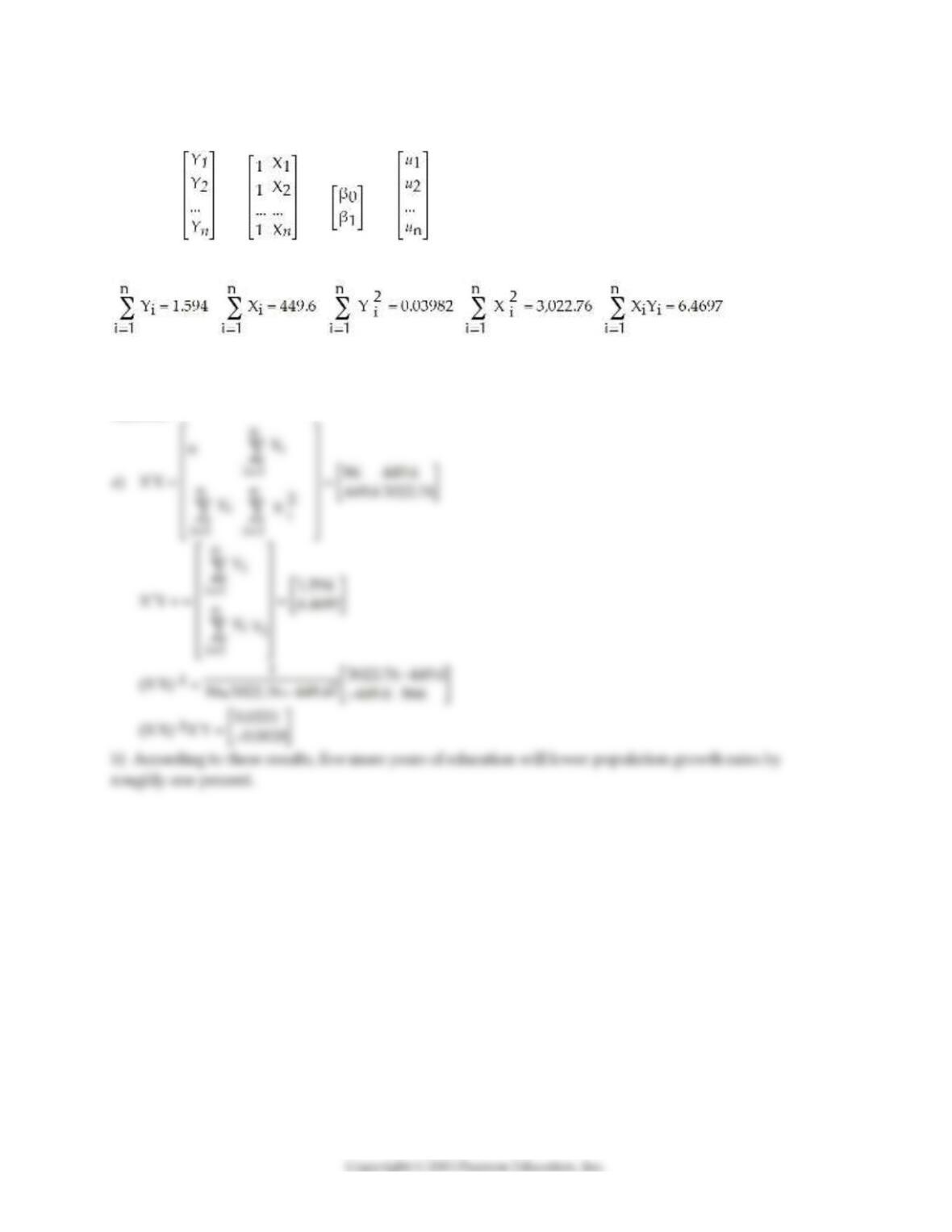
14) Consider the following population regression function: Y = Xβ + U
where Y= , X= , β = , U=
Given the following information on population growth rates (Y) and education (X) for 86 countries
, , , ,
a) find X’X, X’Y, (X’X)–1 and finally (X’X)–1 X’Y.
b) Interpret the slope, and if necessary, the intercept.
Answer:

15) You have obtained data on test scores and student–teacher ratios in region A and region B of your
state. Region B, on average, has lower student–teacher ratios than region A. You decide to run the
following regression.
Yi = β0+ β1X1i + β2X2i + β3X3i+ui
where X1 is the class size in region A, X2 is the difference between the class size between region A and B,
and X3 is the class size in region B. Your regression package shows a message indicating that it cannot
estimate the above equation. What is the problem here and how can it be fixed? Explain the problem in
terms of the rank of the X matrix.