
CHAPTER 6: TIME MANAGEMENT: MINUTE BY MINUTE
TRUE/FALSE
1. Managers need to read 300 to 500 words per minute.
a. True
b. False
2. An effective way to avoid procrastination is to set deadlines and let others know about them.
a. True
b. False
3. A time log helps determine if your day is full.
a. True
b. False
4. The telephone is one of the most common time abusers.
a. True
b. False
5. To better manage the time used by drop-in visitors, stand up when someone enters your office, and
conduct the conversation with both of you standing.
a. True
b. False
6. As much as 50 percent of managers’ time may be spent in meetings.
a. True
b. False
7. Effective time managers concentrate on doing things right, rather than on doing the right things.
a. True
b. False
8. Subvocalization enhances and accelerates the reading process.
a. True
b. False

9. Managers should delegate whenever possible.
a. True
b. False
10. To highlight most effectively, read all of the material first and then go back and highlight afterward.
a. True
b. False
11. A time map in not an effective tool for time management.
a. True
b. False
12. Effective managers/leaders focus more on people than on tasks.
a. True
b. False
13. Delegation moves organizational communication upward.
a. True
b. False
14. Your daily log should help you determine when you are at your peak.
a. True
b. False
15. Improving reading efficiency can help control the paper flood.
a. True
b. False
16. Law enforcement managers do not have the same problems as other managers with employee
productivity because calls for service keep officers busy.
a. True
b. False
17. The three times rule states that it is necessary to write an idea down three time before it becomes
permanent.
a. True
b. False

18. One effective method for retaining what you need to remember is highlighting.
a. True
b. False
19. The key to effective scheduling is to schedule your priorities.
a. True
b. False
20. When planning a schedule, Time Management suggests as a rule of thumb to include half the number
of things you think you can do in a day.
a. True
b. False
MULTIPLE CHOICE
21. According to Voltaire, time is __________.
a.
divisible
b.
neglected
c.
swift
d.
all of these
22. A way to assess if you are effectively controlling your time is to __________.
a.
ask yourself if you have to stay late or take work home to get it done
b.
ask yourself if you find yourself doing work at the last minute
c.
ask yourself if you are stressed about deadlines
d.
all are ways of controlling your time
23. Many service organizations such as law enforcement agencies have responsibilities that __________.
a.
are time-consuming but not explicitly action-oriented
b.
yield few tangible results yet are necessary to citizen satisfaction
c.
cannot easily be measured
d.
all of these
24. Which of the following is generally true?
a.
Time is a resource.
b.
It is better to count time than to make time count.
c.
Time is recyclable.
d.
none of these.

25. An entire 20-year career in law enforcement would equal approximately__________.
a.
5,000 hours
b.
25,000 hours
c.
40,000 hours
d.
80,000 hours
26. One common time waster is __________.
a.
setting goals
b.
delegation
c.
crisis management
d.
saying “no”
27. This is an effective tool for managing time.
a.
daily journal
b.
day planner
c.
daily time log
d.
none of the other choices
28. Which of the following is not recommended as a technique to combat procrastination?
a.
Schedule time to work on projects.
b.
Do things perfectly the first time so that you do not have to spend additional time fixing
errors.
c.
Start with your most unpleasant task to get it out of the way.
d.
Set deadlines and let others know about them.
29. According to the ____________________ principle, each time you repeat the same task, you become
more efficient.
a.
Pareto
b.
learning curve
c.
Franklin
d.
Parkinson
30. Police paper load is a problem because __________.
a.
volume makes absorption difficult
b.
some managers like to create busy paperwork
c.
police tasks generate paperwork because of legal requirements
d.
all of these
31. With every promotion comes a corresponding increase in __________.
a.
the number of hours worked in a day
b.
the number of days worked in a week
c.
the amount of duties and responsibilities

d.
all of these
32. ___________ are at the heart of time management.
a.
Goals
b.
Work plans
c.
Pareto principles
d.
Time abusers
33. A tickler file system consists of ________ files.
a.
3
b.
12
c.
45
d.
365
34. One issue of the New York Times conveys as much information as a person living in the 16th century
would obtain __________.
a.
in one week
b.
in one month
c.
in one year
d.
in a lifetime
35. Adult eye span is ____________ words.
a.
2–3
b.
5–8
c.
10–15
d.
20–30
36. By helping one manage minute by minute, the single most important time management tool is most
likely to be the __________.
a.
learning curve
b.
daily to-do list
c.
tickler file system
d.
Parkinson’s Law
37. What is considered management’s greatest resource?
a.
goals
b.
work plans
c.
time
d.
employees
38. Which of the following is the most important part of the concept of “single handling”?
a.
Throw away any unnecessary paper.

b.
File paper for later action.
c.
Avoid picking up any document until you are ready to deal with it.
d.
Route paperwork when necessary.
39. The most common objective for using a time log is __________.
a.
to log work hours for pay
b.
to keep track of what employees are doing
c.
to manage time
d.
to add more daily tasks
40. Which of the following is not a behavior that decreases reading efficiency?
a.
regression
b.
skimming
c.
narrow eye span
d.
subvocalization
41. If a police manager could gain two hours more of productive time daily, his or her annual gain would
approximate ___________ hours.
a.
150
b.
350
c.
500
d.
650
42. “The only reason for time is so that everything doesn’t happen at once” was stated by__________.
a.
Aristotle
b.
Einstein
c.
Plato
d.
Franklin
43. One way to determine productive time is to __________.
a.
make a comprehensive time use list
b.
make an unproductive time list
c.
make a priority and goal list
d.
all of these
44. In devising a priority list, how much time should be spent on priority two?
a.
10%
b.
40%
c.
50%
d.
70%
45. Generally, time abusers can be divided into the categories of __________.

a.
immediate and delayed
b.
internal and external
c.
general and specific
d.
proactive and reactive
46. Parkinson’s Law states __________.
a.
“Proper planning prevents poor performance.”
b.
“Work harder, not smarter.”
c.
“Work expands so as to fill the time available for its completion.”
d.
“The urgent drives out the important.”
47. To be an effective manager, it is necessary to understand that the most important priority is
__________.
a.
schedules
b.
plans
c.
people
d.
checking things off a to-do list
48. The time a person spends coming into work early or staying late to impress the boss is called
__________.
a.
lag time
b.
face time
c.
time abuse
d.
creative procrastination
49. Normal reading speed is about __________ words per minute.
a.
75
b.
125
c.
250
d.
575
50. Managing time involves __________.
a.
working longer and faster
b.
managing yourself and your daily life
c.
trying to get everything accomplished yourself
d.
all of these
51. According to the Pareto principle, 20 percent of your activities may produce ________ percent of your
accomplishments.
a.
10
b.
20
c.
40
d.
80

52. Time management needs to be __________.
a.
short range
b.
long range
c.
both short and long range
d.
neither—range has nothing to do with it
53. According to this principle, if an individual performs a group of similar tasks together, this can reduce
the total amount of time it takes to do them.
a.
learning curve principle
b.
Parkinson principle
c.
5P principle
d.
80% principle
COMPLETION
54. ___________________ can be stopped by keeping the lips together and placing the tongue against the
back of the teeth when reading.
55. Handling paperwork only once, when you are ready to do something with it, is called
_________________________________.
56. Alfredo _________ was an economist who observed that 20 percent of the Italian population owned 80
percent of the wealth.
57. _________________ is the memory method of choice for most college students, and it is an effective
way to transfer information from short-term to long-term memory if done correctly.
58. Among the most common outside or external time wasters are _________________.
59. The words “________________________” will prompt you and others to keep on task.
60. Time management and productivity are integrally related. “Work smarter, not _____.”
61. The 5P principle states “ _____________________________________________________.”
62. _____________ occurs when a person focuses on one word at a time rather than taking in groups of
words in one look.
63. Effective time managers, besides setting priorities, also set _____________: tasks that are not
necessary, have a minimal payoff and have very limited consequences.
MATCHING
Match each statement to the item listed below
a.
creative procrastination
f.
priorities
b.
learning curve principle
g.
procrastination
c.
narrow eye span
h.
scanning
d.
Parkinson’s Law
i.
skimming
e.
posteriorities
j.
subvocalization
64. work expands to fill the time available for its completion
65. focusing on one word at a time rather than taking in groups of words in one look
66. putting off those things that do not really matter
67. reading material rapidly for specific information
68. tasks that do not have to be done, have a minimal payoff and very limited negative consequences
69. putting things off
70. grouping similar tasks can reduce the amount of time each task takes
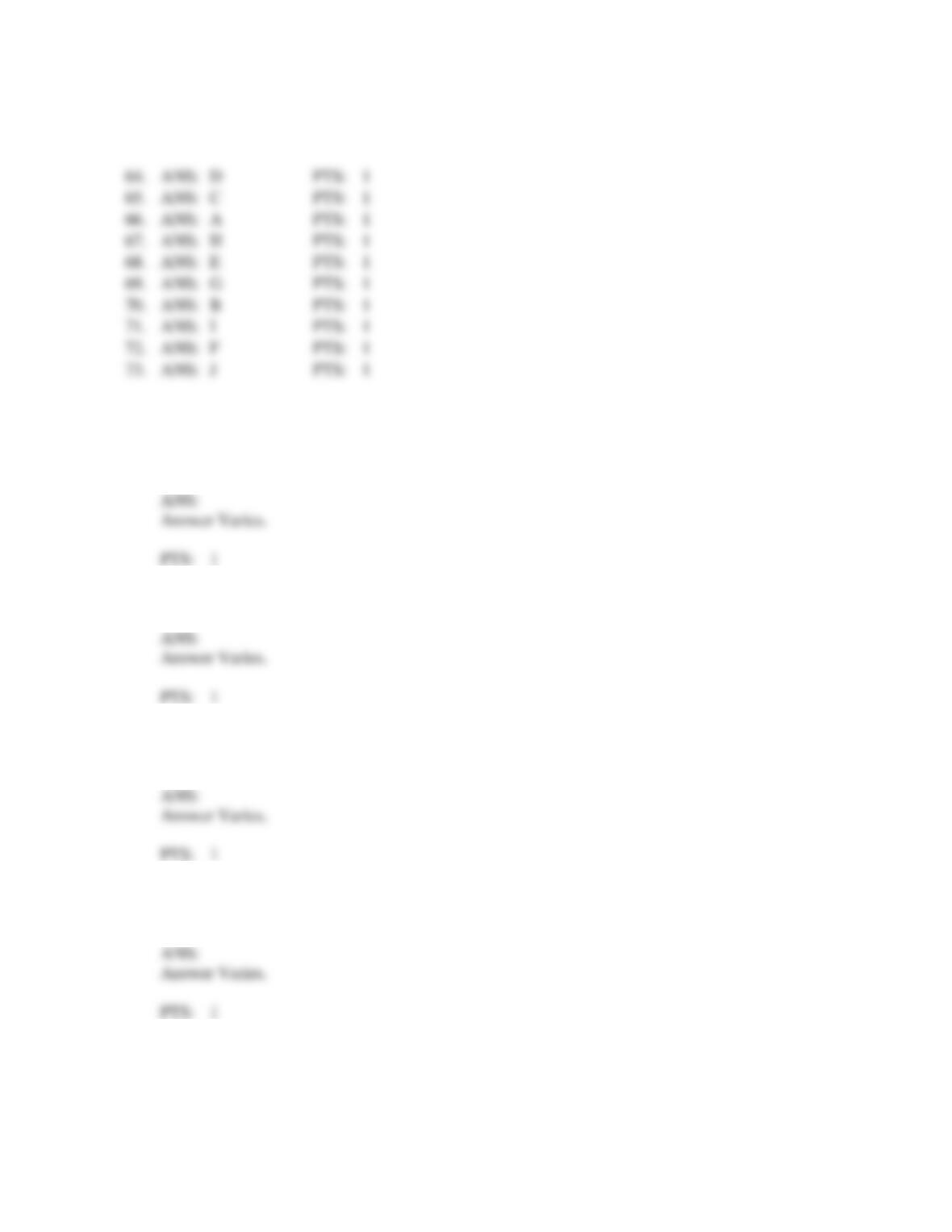
71. reading information rapidly for the main ideas
72. tasks that must be done, have a big payoff and prevent negative consequences
73. moving the lips or the tongue to form the words being read
ESSAY
74. Explain the tickler file system and how it is used to segment tasks.
75. Explain the Pareto principle and give three practical examples of it from everyday life.
76. Discuss the difference between urgent and important as they relate to time management. Ideally,
which one should be the priority? In reality, which one receives the most time and attention?
77. Knowledge is doubling every year, which means more information to process and more paperwork.
What techniques can an administrator use to keep this paper flood and overload under control?
78. Discuss the difference between priorities and posteriorities and what managers can do to focus more
on the former.