
73. The post-closing trial balance for Blakely Hospital as of January 1, 20X5, is as follows:
Debit
Credit
Cash
79,800
Patient Accounts Receivable
37,000
Allowance for Receivables and Third-Party Contractual Adjustments
7,000
Inventory of Supplies
14,000
Long-Term Investments
146,200
Property, Plant, and Equipment
2,830,000
Accumulated Depreciation
564,000
Endowment Investments
260,000
Vouchers Payable
16,000
Accrued Expenses
6,000
Mortgage Bonds Payable
150,000
Unrestricted Net Assets
1,158,000
Temporarily Restricted Net Assets
1,250,000
Permanently Restricted Net Assets
216,000
3,367,000
3,367,000
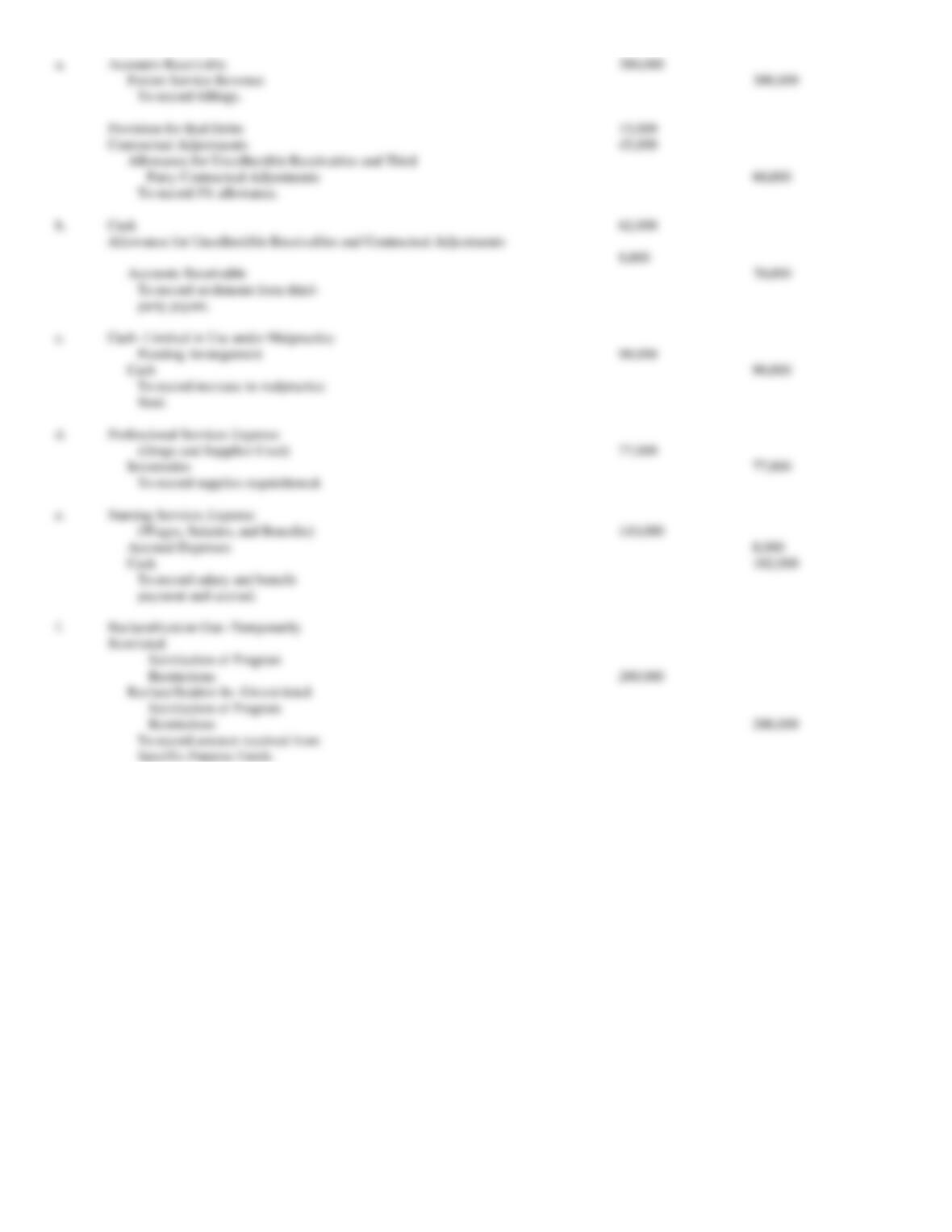
The following events occurred during 20X5:

a.
Gross charges for hospital service, all charged to accounts receivable, were as follows:
Room and board charges
$780,000
Charges for other professional services
321,000
b.
Estimates were made for:
Uncollectible receivables
$30,000
Charity service
15,000
c.
The hospital paid $18,000 to retire mortgage bonds payable with an equivalent book value.
d.
During the year, Blakely Hospital received general contributions of $50,000 and income of $6,500 from
endowment investments. Income received on endowment investments is unrestricted.
e.
Patients were billed $3,000 for television rental.
f.
$26,000 of donor specified contributions were used to acquire new equipment. The hospital policy is to release
donor restrictions when asset is placed in service.
g.
A sterilizer that originally cost $24,000 and had a book value of $2,400 was sold for $3,500.
h.
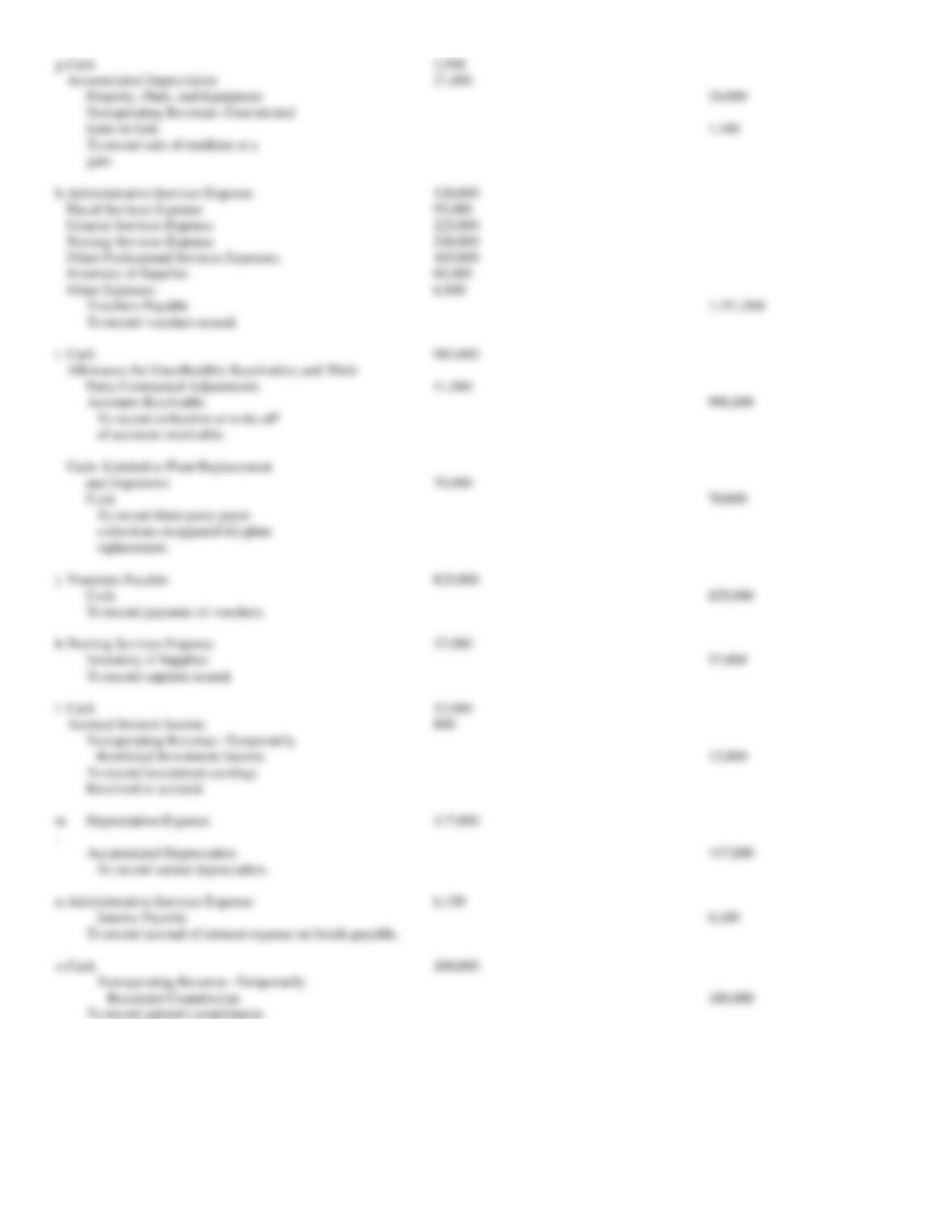
Vouchers totaling $1,191,000 were issued for the following items:
Administrative services expense
$120,000
Fiscal services expense
95,000
General services expense
225,000
Nursing services expense
520,000
Other professional services expense
165,000
Supplies (use a perpetual inventory system)
60,000
Expenses accrued on December 31, 20X4
6,000
i.
Collections on accounts receivable totaled $985,000. Accounts written off as uncollectible amounted to $11,000.
Collections from third-party payers included $70,000 that the Board designated for plant replacement.
j.
Cash payments on vouchers payable during the year were $825,000.
k.
Supplies of $37,000 were issued to nursing services.
l.
During the year, $12,000 of cash income on temporarily restricted investments was received. On December 31,
20X5, there was $800 of accrued interest income on these investments. Earnings are restricted to plant and
expansion.
m.
Depreciation of buildings and equipment for the year was $117,000.
n.
On December 31, 20X5, an accrual of $6,100 was made for interest on mortgage bonds payable. Interest is
considered an Administrative Services Expense.
o.
A grateful patient contributed $100,000 in cash. Earnings must accumulate during the patient’s lifetime. Upon
death, the principal and accumulated earnings are to be used for plant expansion.
Required:
Using the following format, prepare journal entries for the events. Expense data are recorded based on types of services provided.
Event
Journal Entry
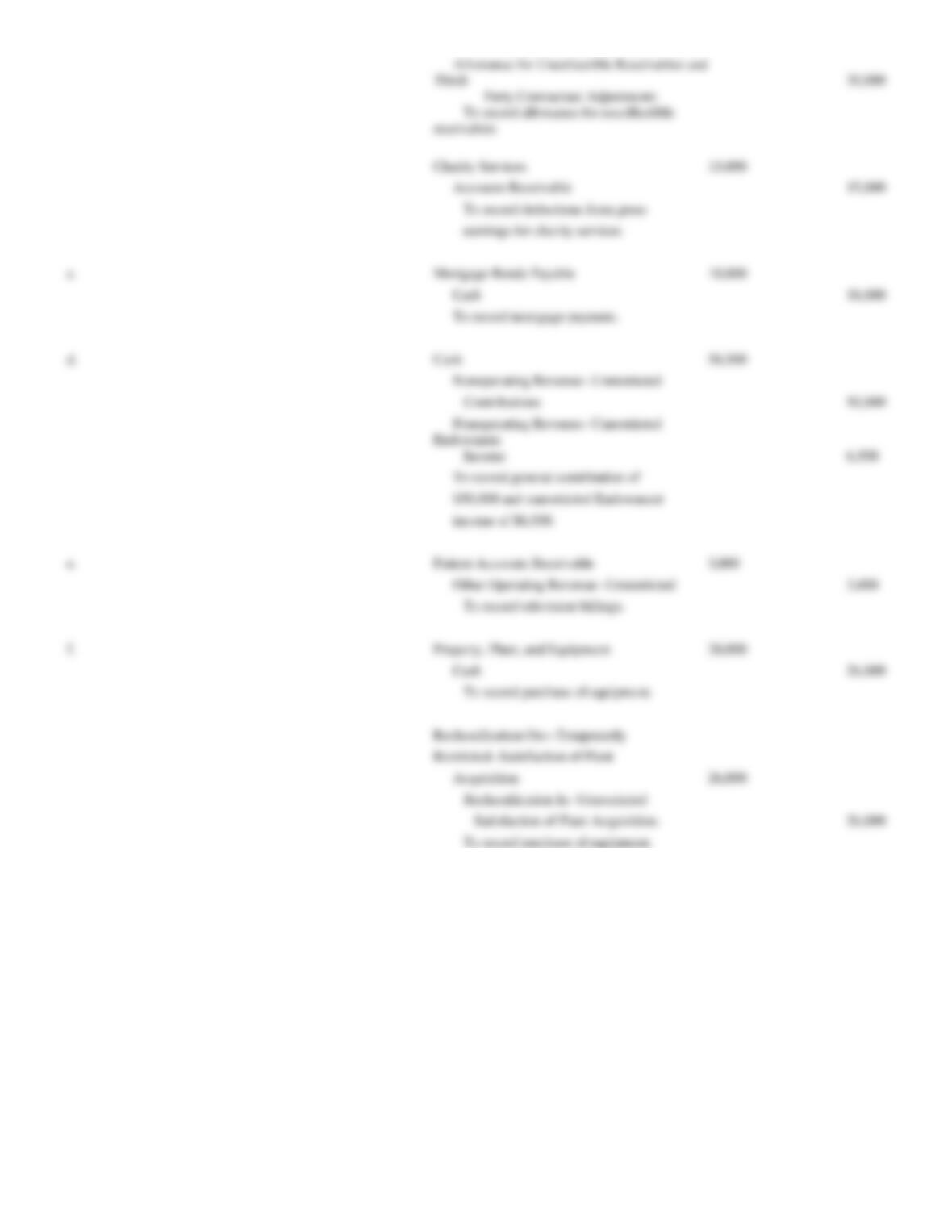
Charity Services
15,000
Accounts Receivable
15,000
earnings for charity services
Mortgage Bonds Payable
18,000
Cash
18,000
To record mortgage payment.
d.
Cash
56,500
Nonoperating Revenue—Unrestricted
Contributions
50,000
Income
6,500
To record general contribution of
$50,000 and unrestricted Endowment
income of $6,500.
Patient Accounts Receivable
3,000
Other Operating Revenue—Unrestricted
3,000
To record television billings.
Property, Plant, and Equipment
26,000
Cash
26,000
To record purchase of equipment.
Reclassification Out—Temporarily
Acquisition
26,000
Reclassification In—Unrestricted
Satisfaction of Plant Acquisition.
26,000
To record purchase of equipment.

74. The following is an adjusted trial balance of the General Funds of Barnes Nursing Home (non-profit).
Barnes Nursing Home
Adjusted Current Funds Trial Balance
December 31, 20X5
Unrestricted
Restricted
Cash
300,000
107,000
Pledges Receivable
12,000
206,000
Accrued Interest Receivable.
1,000
Inventory of Supplies
120,000
Vouchers Payable
50,000
10,000
Accrued Expenses
25,000
Refundable Deposits
2,000
Allowance for Uncollectible
Pledges
3,000
Net Assets, January 1, 20X5
Designated—Unrestricted
12,000
Undesignated—Unrestricted
26,000
Temporarily Restricted
3,000
Permanently Restricted
250,000
Contributions
200,000
50,000
Resident Service Revenue
415,000
Other Operating Revenue
20,000
5,000
Outreach Expenses
20,000
Nursing Services Expenses
100,000
Dietary Service Expense
100,000
General Service Expense
45,000
Financial Service Expense
60,000
Reclassification In—
Satisfaction of Program
Restriction
5,000
Reclassification Out—
Satisfaction of Program
Restrictions
5,000
758,000
758,000
318,000
318,000
Required:
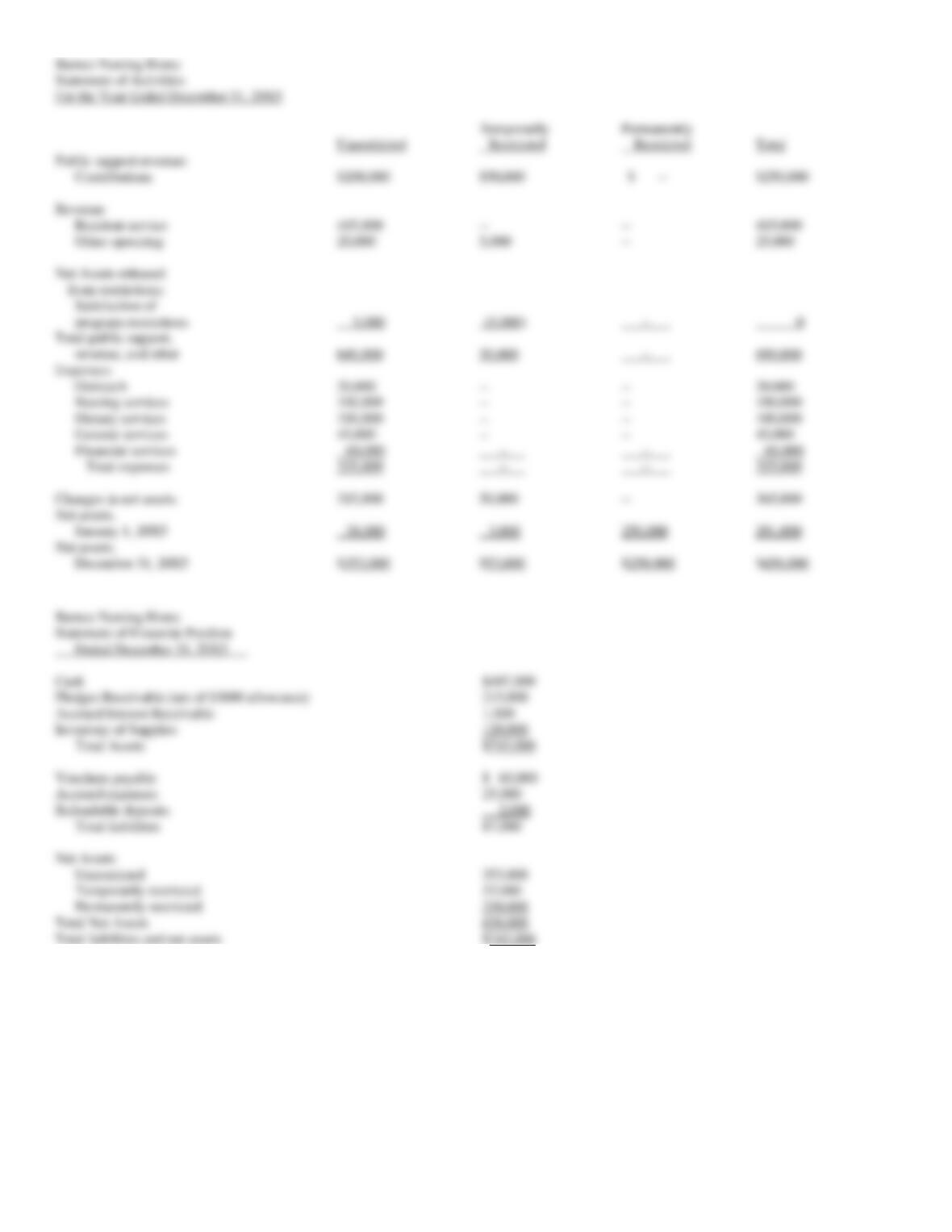
Prepare a statement of activities and a statement of financial position as of December 31, 20X5.

75. Elder Care Services is a not-for-profit provider of health care services.
a.
The condensed income statement for the year ended August 31, 20X5 shows the
following:
Net patient service revenue
$9,164,600
Other operating revenue
568,000
Total operating revenues
$9,732,600
Operating expenses (includes $478,200 in
depreciation; $6,600 of amortization of
deferred financing costs; and an increase in
liability for estimated malpractice costs of
$112,500)
9,671,500
Income from operations
$ 61,100
Nonoperating revenue (net) (includes
loss on sale of equipment of $5,300; gain
on sale of investments of $39,800)
388,900
Excess of revenues over expenses
$ 450,000
b.
Comparative balance sheets for August 31 show the following:
20X5
20X4
Client accounts receivable
$432,200
$341,600
Supplies inventory
153,500
172,800
Accounts payable
318,760
288,460
Accrued expenses
60,100
75,200
Required:
Elder Care Services
Reconciliation of Excess of Revenues over Expenses
To Net Cash Provided by Operating Activities and
Nonoperating Revenue
For the Year Ended August 31, 20X5
Excess of revenues over expenses
$450,000
Adjustments to reconcile excess of revenues
over expenses to net cash provided by
operating activities:
Depreciation
478,200
Amortization of deferred financing costs
6,600
Increase in liability for estimated
malpractice costs
112,500
Loss on sale of equipment
5,300
Gain on sale of investments
(39,800)
Increase in client accounts receivable (1)
(90,600)
Decrease in supplies inventory (2)
19,300
Increase in accounts payable (3)
30,300
Decrease in accrued expenses (4)
(15,100)
Net cash provided by operating activities
$956,700
76. The following data apply to Riverside Hospital, a not-for-profit organization.
a.
Summarized cash receipts showed cash received from the following:
Patients and third-party payers
$903,420
Other operational activities
57,120
Donor restricted gifts for programs
11,220
Unrestricted interest from investments
25,100
b.
Summarized cash payments showed cash paid to the following:
Suppliers and employees
$892,140
The bank to cover interest charges
14,500
For the purchase of equipment
45,450
c.
Donation of $100,000 cash received with donor restriction that it be permanently restricted. Income may
be used for replacement of equipment.
d.
Bonds payable that would have matured in two years were retired on an interest date at a face value of
$18,000.
e.
The cash balance on January 1, 20X1, was $168,020. On December 31, 20X1, the cash balance was
$294,790.
Required:
Using the direct method, prepare a statement of cash flows for the year ended December 31, 20X1.
Riverside Hospital
Statement of Cash Flows of General Funds
For the Year Ended December 31, 20X1
Cash flows from operating activities and nonoperating revenue:
Cash received from patients and third-party payers
$903,420
Cash received from other operational activities
57,120
Cash received from restricted gifts
11,220
Cash received from unrestricted interest
25,100
Cash paid to suppliers and employees
(892,140)
Cash paid to bank for interest charges
(14,500)
Net cash provided by operating activities and nonoperating revenue
$ 90,220
Cash flows from investing activities:
Purchase of equipment
$ (45,450)
Net cash used by investing activities
$ (45,450)
Cash flows from financing activities:
Retirement of long-term bonds payable
$ (18,000)
Contributions received restricted for long-term investment
100,000
Net cash provided by financing activities
$ 82,000
Net increase in cash
$126,770
Cash balance at beginning of year
168,020
Cash balance at end of year
$294,790
77. How has the adoption of GASB Statement No. 35 changed the reporting standards for colleges and
universities.
78. Are not-for-profit universities required to use fund accounting?
79. Explain how certain transactions that traditionally were reported as restricted by private universities will
now be categorized as unrestricted exchange transaction. Describe how they will be accounted for per FASB
116.
80. In accounting for not-for-profit public universities, Endowment and Similar Funds are commonly used.
Required:
a.
List and briefly define the three types of endowments often found in the university environment.
b.
Describe the accounting procedures for income earned on endowment funds.
c.
Explain the use of investment pools.
81. In accounting for health care services, several methods are utilized.
Required:
a.
List and briefly define the three types of classifications of health care facilities
b.
Describe the effects of third party payer arrangements on revenue recognition procedures for health care organizations.
c.
Describe the classification of expenses in a health care environment.
a.
Investor Owned – privately owned and operated for a profit
Governmental Health Care Entities – operated by a governmental unit and accounted
for as an enterprise fund
Voluntary Not for Profit Health Care Entities – entities organized and sustained by
member of a group or community, such as a religious affiliation
achieve profitability.
or controlling body, usually from Unrestricted Current Funds.
unrestricted general fund, where it is credited to Endowment Income.