56) Suppose you have one point on a demand curve. To plot another point for this demand curve
using a group of indifference curves,
A) transfer all points from the indifference curve to the corresponding demand curve.
B) horizontally sum the indifference curves.
C) change the price of a good, rotate the budget line, and find the new best affordable point. This
new price and quantity is another point on the demand curve.
D) calculate the marginal rates of substitution from the indifference curve and transfer these
values to the demand curve.
E) transfer the budget line so that it becomes the demand curve.
57) To derive a demand curve using the indifference curve model, you must change the
A) consumer’s preferences.
B) consumer’s income.
C) price of one good, holding the price of the other good and income constant.
D) price of both goods simultaneously but by different amounts.
E) price of both goods simultaneously but by the same percentage.
58) Points on a demand curve
A) reflect best affordable points along indifference curves.
B) show diminishing marginal rate of substitution.
C) show increasing marginal rate of substitution.
D) show combinations of goods among which a consumer is indifferent.
E) show all the combinations of affordable goods the consumer can buy.
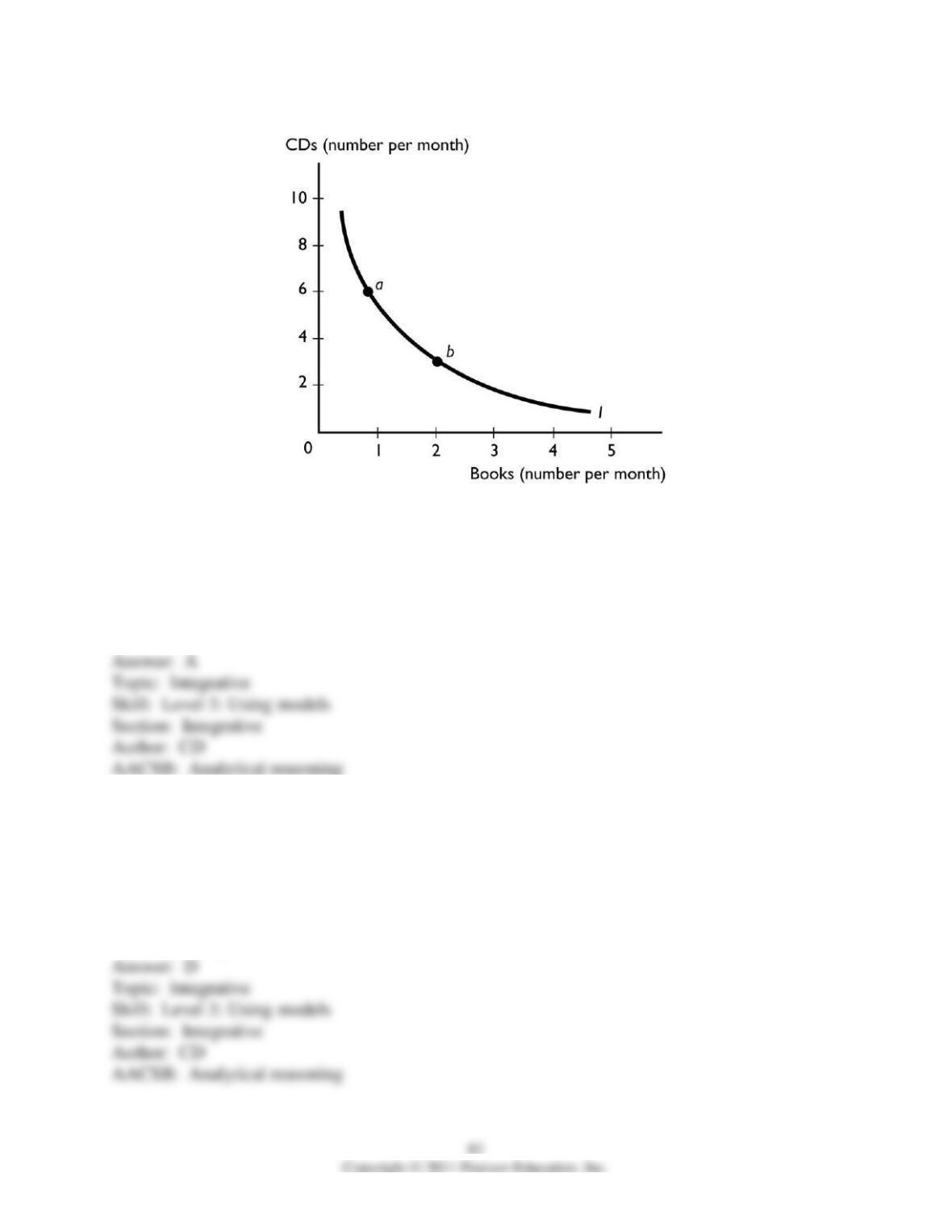
59) In the above figure, I is an indifference curve. Moving from point a to point b,
A) the marginal rate of substitution for books decreases.
B) the budget line rotates inward.
C) the budget line rotates outward.
D) there is diminishing total utility.
E) the marginal rate of substitution for books increases.
60) The above figure shows one of Cheri’s indifference curves. Suppose point a represents the
best affordable point for Cheri. Cheri’s best affordable point could move to point b if
A) marginal utility increases.
B) total utility increases.
C) the price of a CD falls and the price of a book rises.
D) the price of a CD rises and the price of a book falls.
E) Cheri’s budget increases.
61) Consider an indifference curve for sodas and pizza, drawn in a figure with sodas measured
along the horizontal axis. Moving downward along the indifference curve, the
A) marginal utility per dollar for sodas must increase.
B) marginal utility per dollar for pizza must increase.
C) consumer remains indifferent among the different combinations of soda and pizza.
D) the level of total utility must change.
E) marginal rate of substitution is constant.
62) ________ leads to a decrease in marginal utility per dollar for soda.
A) Increasing marginal utility
B) The diminishing marginal rate of substitution as fewer sodas are consumed
C) An outward shift in the indifference curves for soda
D) An increase in the price of soda
E) A fall in the price of soda
63) Suppose Lizzie consumes soda and pizza. If the last bottle of soda she drinks provides 100
units of utility per dollar while the last slice of pizza she eats provides 300 units of utility per
dollar,
A) the demand curve for soda must have shifted outward.
B) the demand curve for pizza must have shifted inward.
C) Lizzie should buy more pizza and less soda to maximize her utility.
D) the indifference curve for soda and pizza must have rotated inward.
E) the marginal rate of substitution between soda and pizza equals 3.
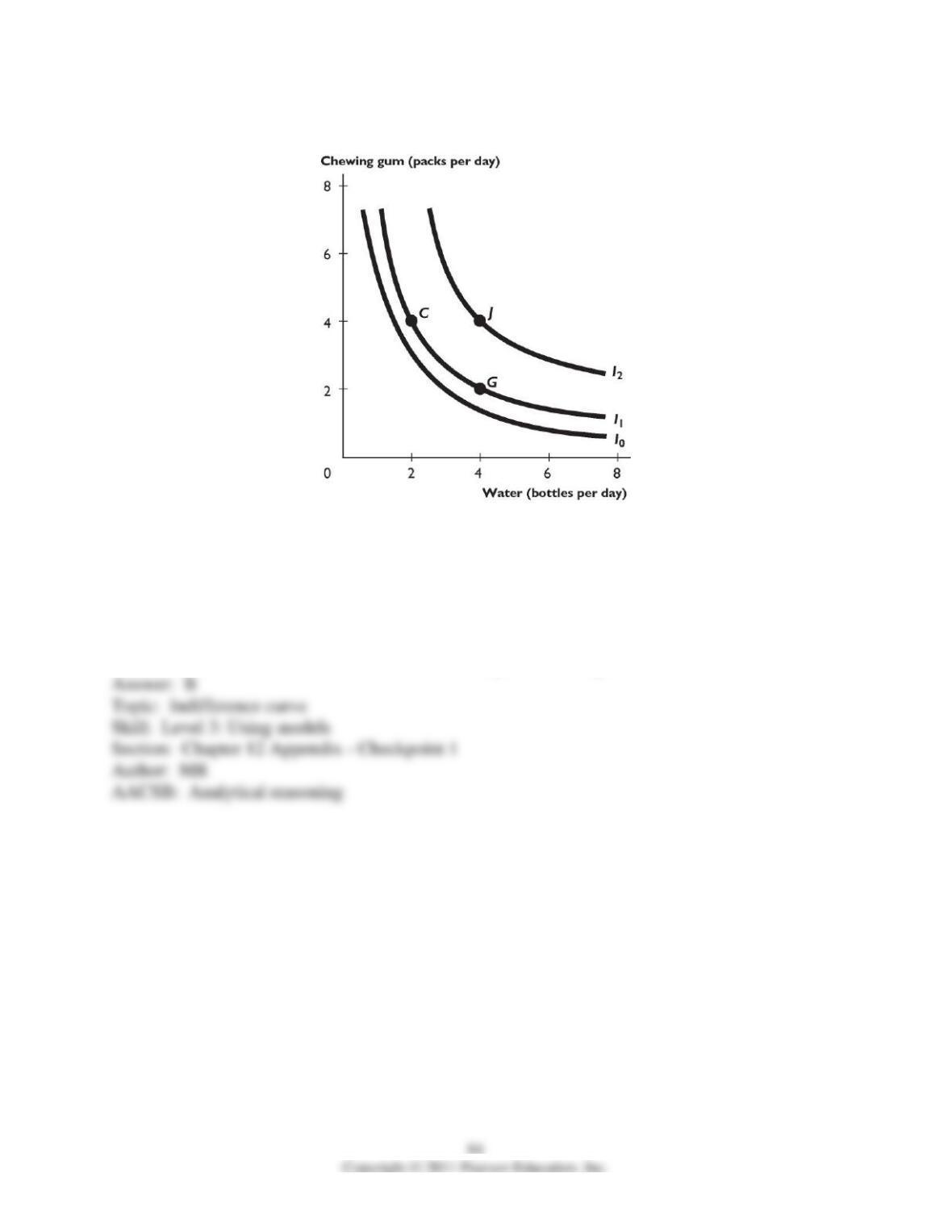
12.6 Appendix figures
The figure above shows three of a consumer’s indifference curves.
1) Which point is most preferred?
A) Point C only.
B) Point J only.
C) Point G only.
D) Point C and G are tied for the most preferred.
E) More information is needed to determine which point is most preferred.
2) Which of the following are true?
i. Points C and G are equally preferred because they lie on the same indifference curve.
ii. Points C and J are equally preferred because on them the consumption of chewing gum is
equal.
iii. Points G and J are equally preferred because on them the consumption of water is equal.
A) i only
B) ii only
C) iii only
D) ii and iii
E) i, ii, and iii
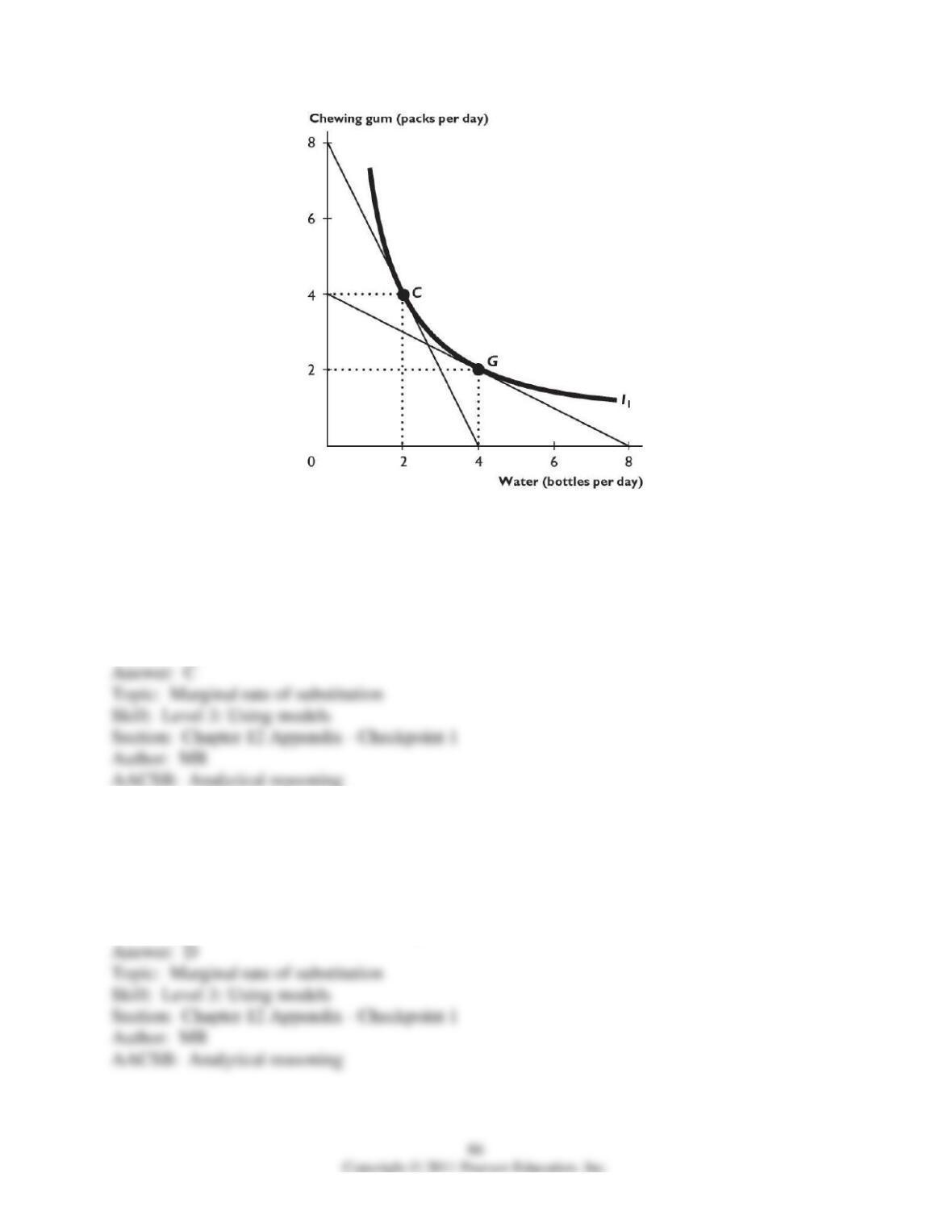
The figure above shows one of a consumer’s indifference curves.
3) The marginal rate of substitution (MRS) at point C equals
A) 4.
B) 8.
C) 2.
D) 1/2.
E) More information is needed to calculate the MRS.
4) The marginal rate of substitution (MRS) at point G equals
A) 4.
B) 8.
C) 2.
D) 1/2.
E) More information is needed to calculate the MRS.
12.7 Integrative Questions
1) Billy has a $20 budget to spend on yogurt and cereal. Yogurt cost $2 each and cereal costs $4
each. Suppose that the quantity of yogurt is on the vertical axis and the quantity of cereal is on
the horizontal axis. If the price of yogurt increases, which of the following is true?
i) The budget line rotates outward.
ii) Yogurt’s marginal utility per dollar decreases.
iii) The relative price of yogurt increases.
A) i and ii
B) i and iii
C) ii and iii
D) i, ii, and iii
E) Only i
2) Billy has a $20 budget to spend on yogurt and cereal. Yogurt cost $2 each and cereal costs $4
each. Suppose that the quantity of yogurt is on the vertical axis and the quantity of cereal is on
the horizontal axis. The budget line’s vertical intercept equals ________.
A) $10
B) 5 yogurts
C) 10 yogurts
D) 5 cereals
E) None of the above answers is correct.
1) You are studying with a friend and your friend says “A budget line shows the various
combinations of two goods that can be purchased with the buyer’s income at current prices.” Is
your friend’s assessment correct or not?
2) How is a budget line similar to a production possibilities frontier? How do they differ?
3) Why is the budget line negatively sloped?
4) If the price of a good rises and the consumer’s budget remains the same, what happens to the
consumer’s consumption possibilities?
5) What does the slope of the budget line equal?
6) If your budget increases, what is the effect on your budget line?
7) If Bill’s income increases from $30,000 per year to $41,000 per year. He consumes pickup
trucks and lamb chops, so with his increase in budget Bill’s budget line shifts outward. This
increase in Bill’s budget means he can consume more trucks and more lamb.” Are these
statements true or false? Briefly explain your answer.
8) Explain how changes in the price of goods and the consumer’s budget affect the budget line.
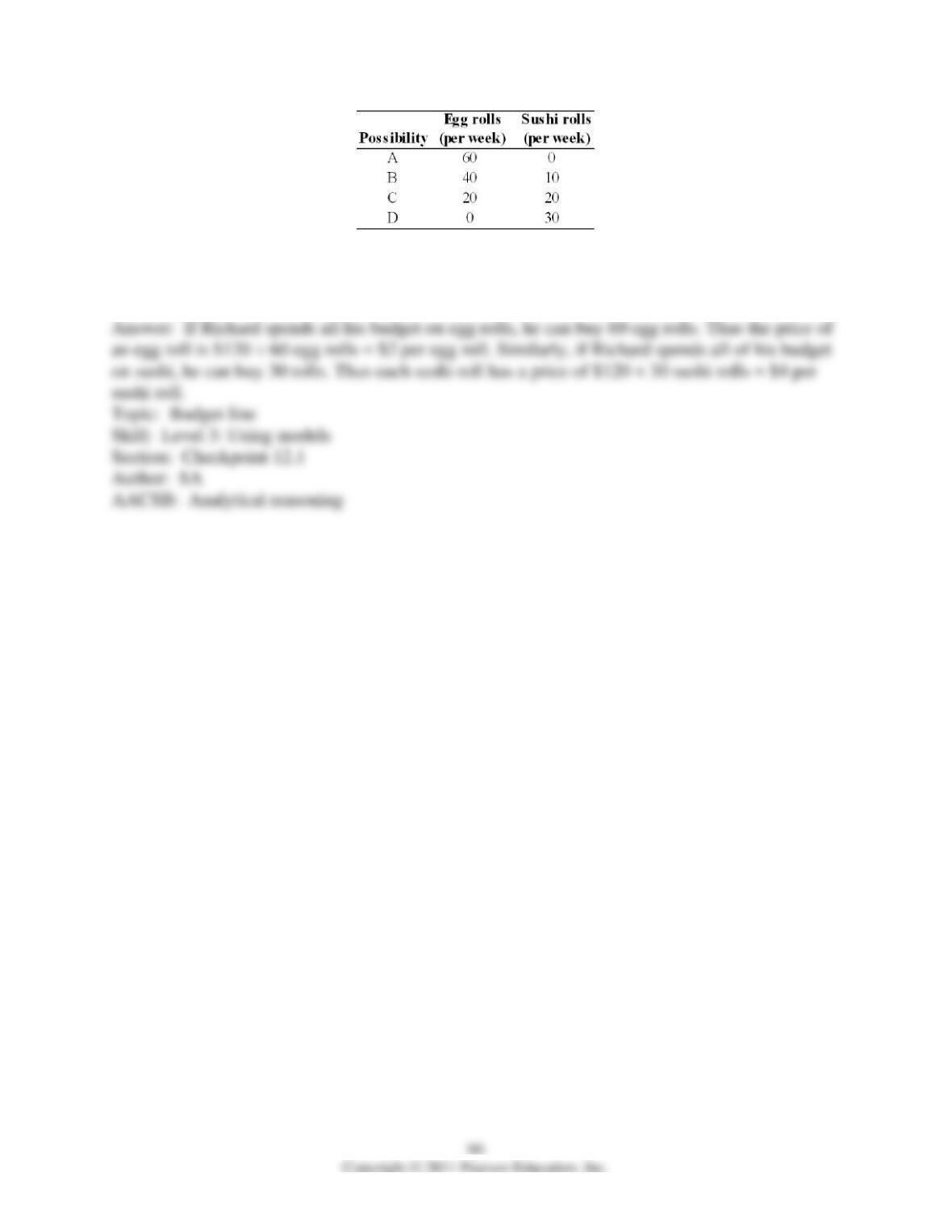
9) The table above has different combinations of egg rolls and sushi rolls that Richard can buy.
Richard’s budget for egg rolls and sushi rolls is $120 per week. What are the prices of an egg roll
and a sushi roll?
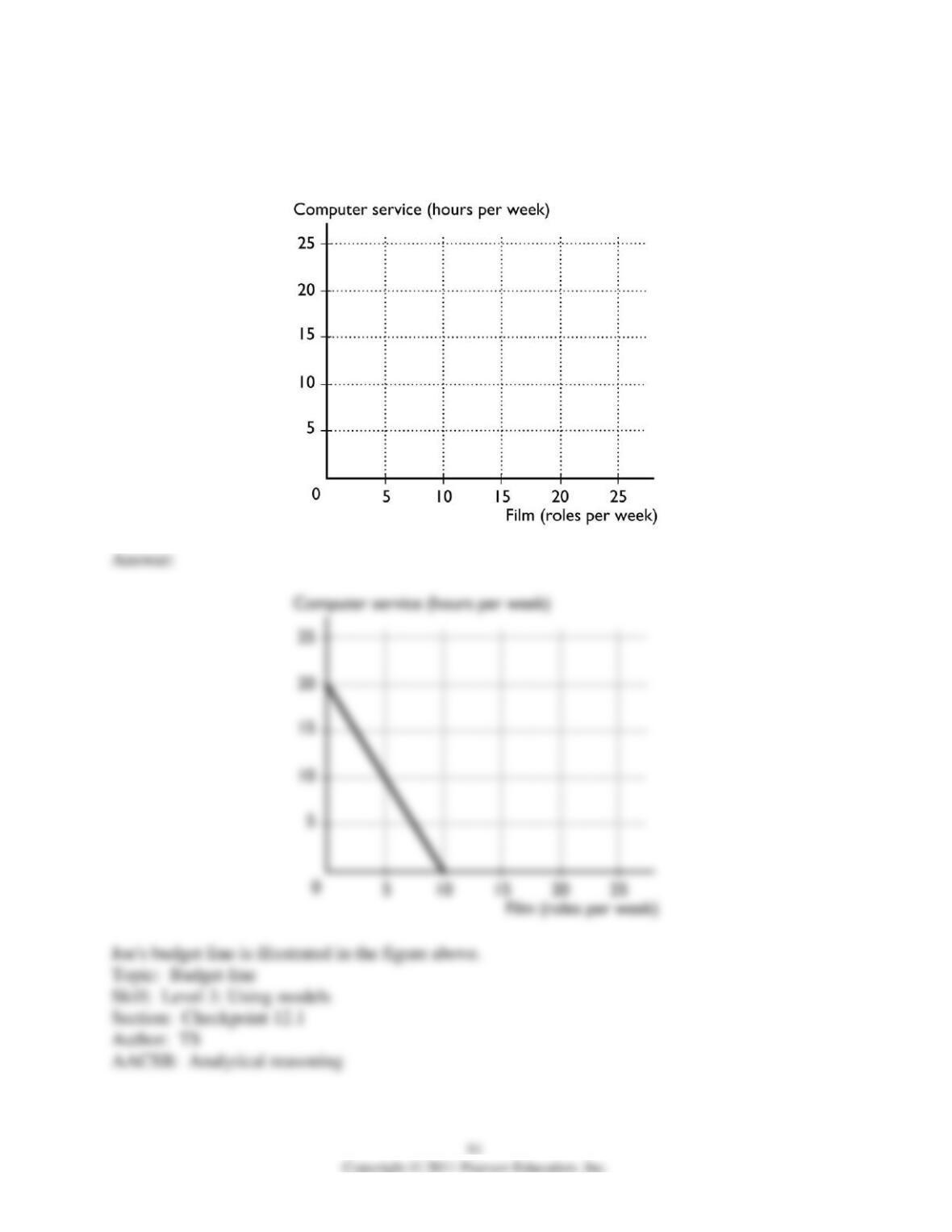
10) Joe has $100 a week to purchase either computer online service or film for his other hobby,
photography. The price of on-line service is $5 an hour while the price of film is $10 a roll. Draw
Joe’s budget line in the figure below.
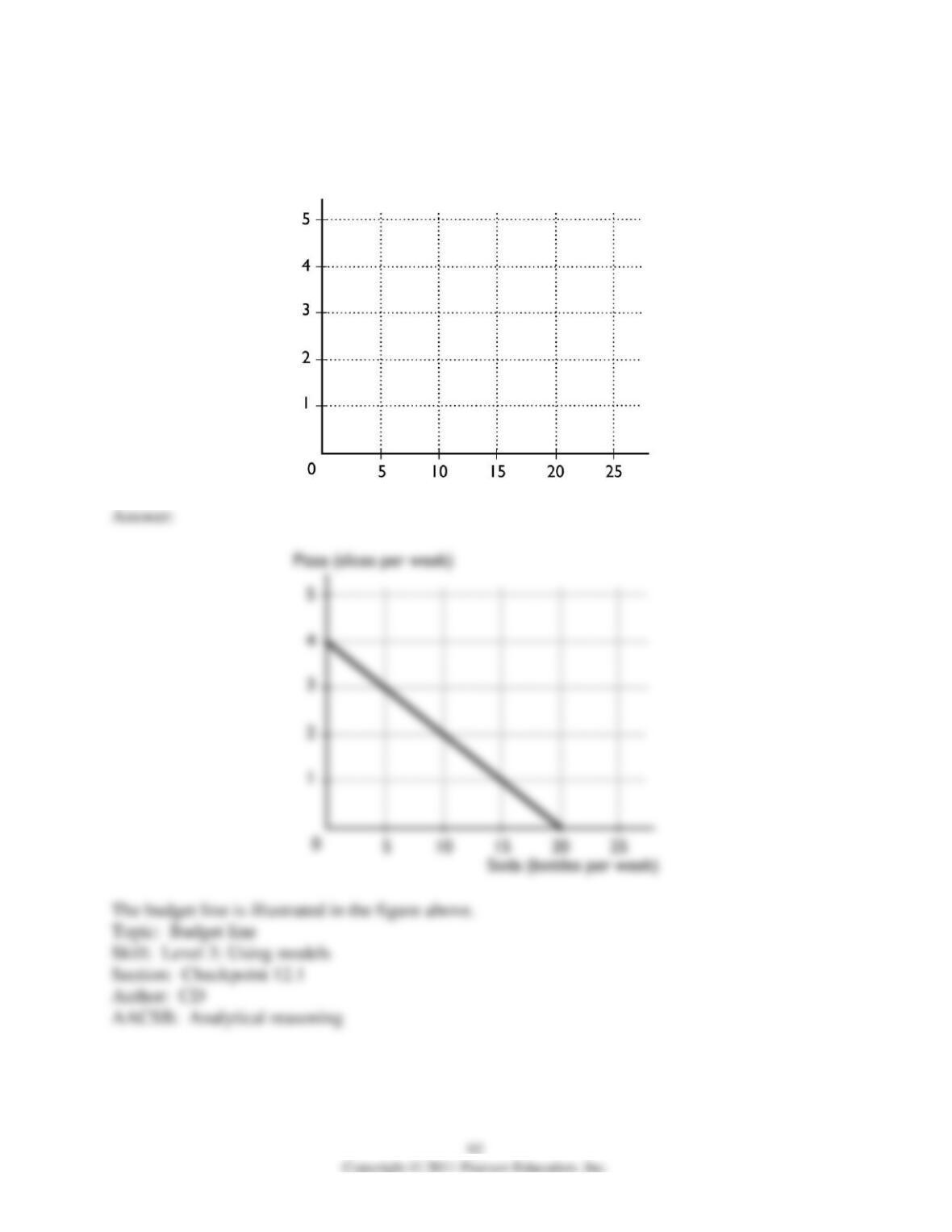
11) Suppose you have a $20 budget per week, the price of soda is $1 per bottle, and the price of
pizza is $4 per slice. In the above below, draw a budget line for soda and pizza, placing soda on
the horizontal axis. Correctly label the axes.
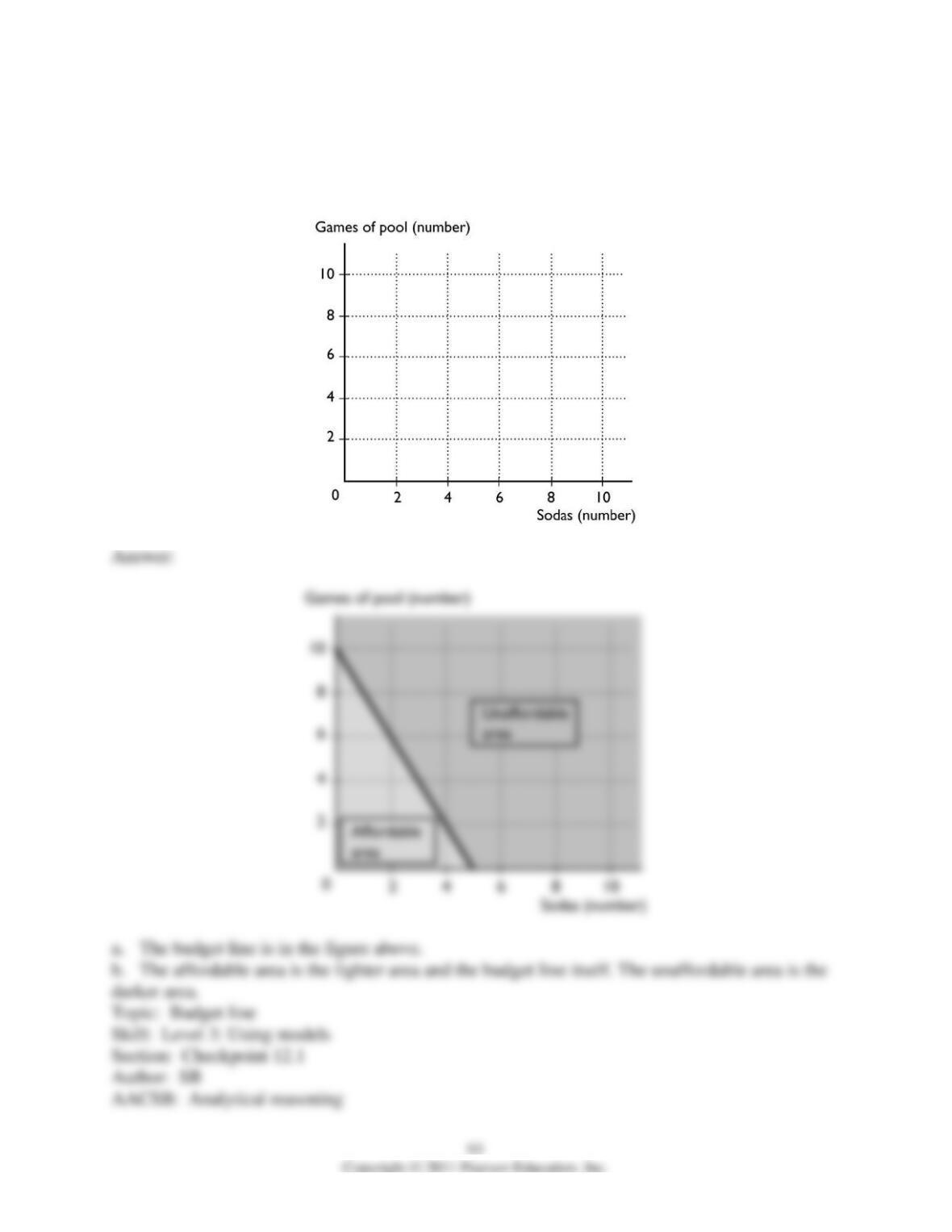
12) John likes to spend Thursday nights playing pool and drinking soda. John’s budget for
Thursday nights is $10, a soda costs $2, and one game of pool costs $1.
a. Draw a graph of John’s budget line in the figure below.
b. In your graph, label the affordable and unaffordable areas.
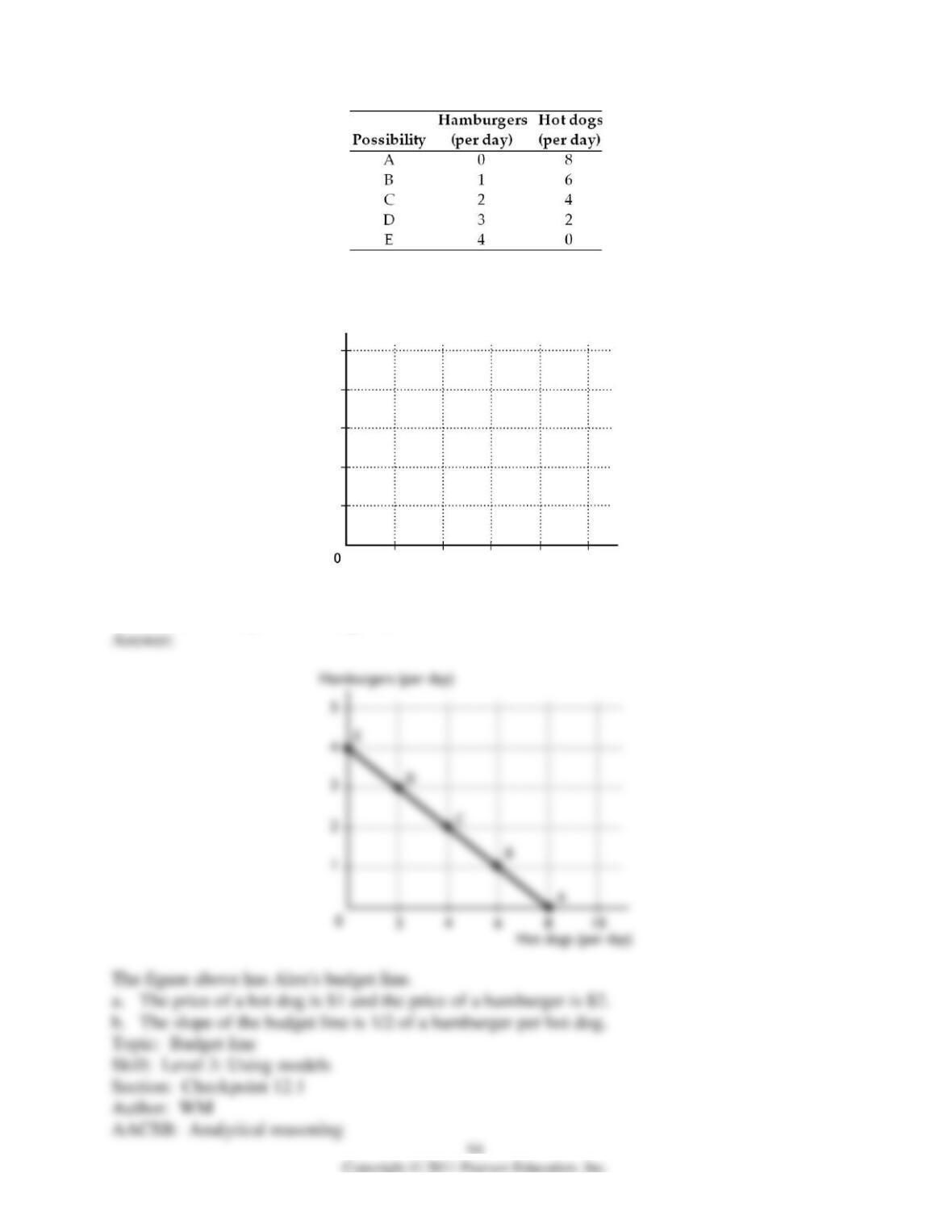
13) The table above has different combinations of hamburgers and hot dogs that Alex can buy.
After labeling the axes, graph Alex’s budget line in the figure, putting hot dogs on the x-axis.
a. Alex’s income is $8 per day. What is the price of a hot dog? Of a hamburger?
b. What is the slope of the budget line?
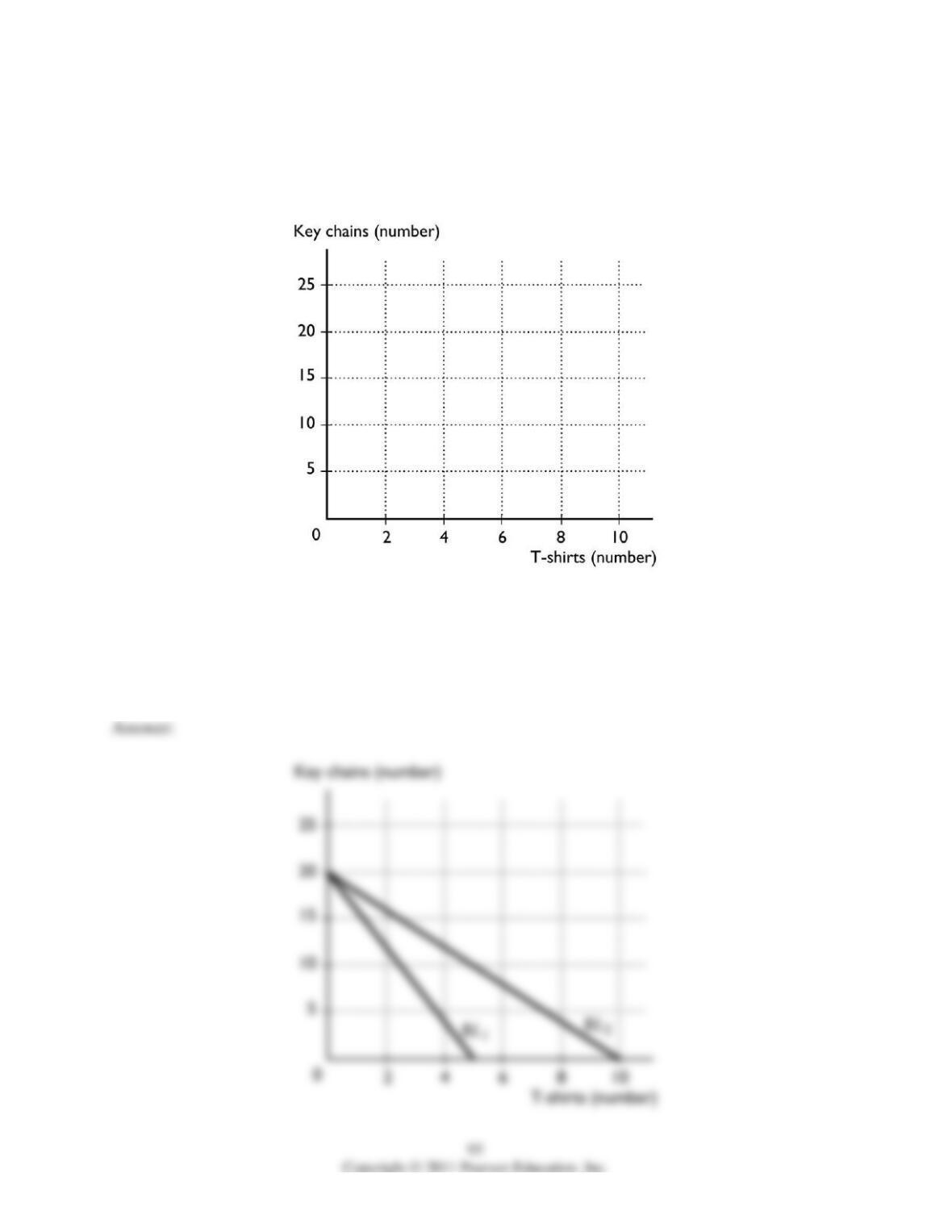
14) Sherry is on vacation and wants to bring souvenirs home to family and friends. Her souvenir
budget is $100, and she can choose between T-shirts, which cost $20 each, and key chains,
which cost $5 each.
a. Draw a graph of Sherry’s budget line in the figure below.
b. What is the slope of Sherry’s budget line? How does that slope represent an opportunity cost?
Suppose that Sherry now finds a store where T-shirts are on sale for $10 each. (Key chains still
cost $5 each).
c. Draw the new budget line in the figure.
d. What is the slope of the new budget line? How has the opportunity cost changed?
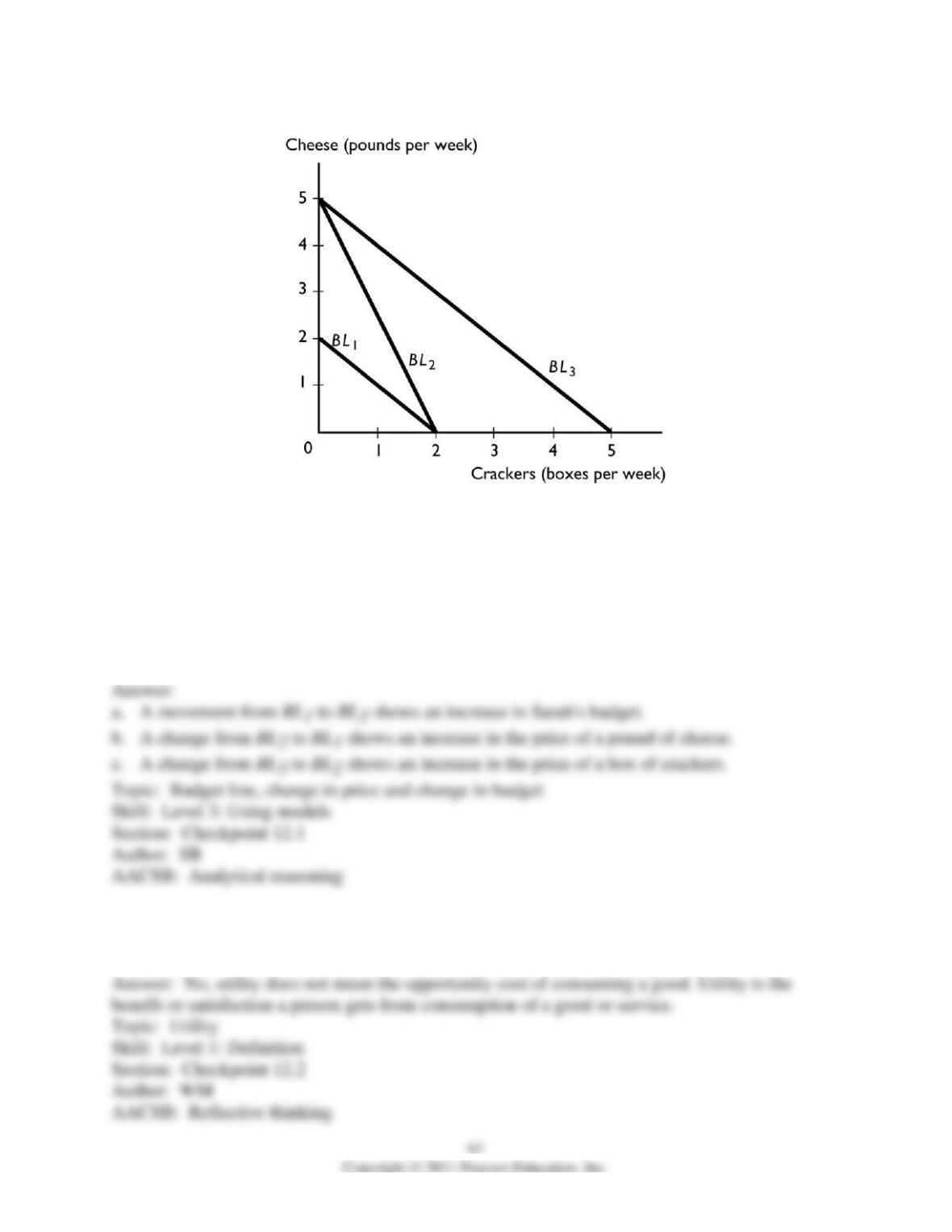
15) The figure above contains several budget lines for Sarah, who uses her income to purchase
two goods, cheese and crackers.
a. A movement between which two budget lines represents an increase in Sarah’s budget for
cheese and crackers?
b. A movement between which two budget lines represents an increase in the price of a pound
of cheese?
c. A movement between which two budget lines represents an increase in the price of a box of
crackers?
12.9 Essay: Marginal Utility Theory
1) Is “utility” another word for the cost we give up when we consume a good?
2) What is “marginal utility?”
3) How are total and marginal utility related?
4) What is the “principle of diminishing marginal utility”?
5) “As Rob consumes more dates over the course of a day, it is likely that his marginal utility
from date consumption will rise.” Is the previous statement likely correct or incorrect?
6) How can restaurants offer all-you-can-eat specials without fear of going bankrupt?
7) If Tommy is consuming a combination of goods and services on his budget line, has he
allocated his entire budget?
8) You are studying with a friend, and your friend says “To maximize utility, a consumer must
consume the combination of goods so that the marginal utility of good X equals the marginal
utility of good Y.” Explain whether your friend’s statement is correct or incorrect.
9) What is the utility-maximizing rule?
10) Explain why total utility is maximized when the marginal utility per dollar from a good is
equal across goods.
11) To maximize utility, why does a consumer consume the combination of goods that equates
marginal utility per dollar from the different goods rather than just equating the marginal utility
of the different goods?