
When chemical, transport, or mechanical work is done by an organism, what happens to
the heat generated?
A) It is used to power yet more cellular work.
B) It is used to store energy as more ATP.
C) It is used to generate ADP from nucleotide precursors.
D) It is lost to the environment.
Use the following description to answer the question(s) below.
The cycads, a mostly tropical phylum of gymnosperms, evolved about 300 million
years ago and were dominant forms during the Age of the Dinosaurs. Though their
sperm are flagellated, their ovules are pollinated by beetles. These beetles get nutrition
(they eat pollen) and shelter from the microsporophylls. Upon visiting
megasporophylls, the beetles transfer pollen to the exposed ovules. In cycads, pollen
cones and seed cones are borne on different plants. Cycads synthesize neurotoxins,
especially in the seeds, that are effective against most animals, including humans.
If the beetles survive by consuming cycad pollen, then whether the beetles should be
considered mutualists with, or parasites of, the cycads depends upon the ____.
A) extent to which their overall activities affect cycad reproduction
B) extent to which the beetles are affected by the neurotoxins
C) extent to which the beetles damage the cycad flowers
D) distance the beetles must travel between cycad microsporophylls and cycad
megasporophylls

Which of the following ions is most likely to cross the plasma membrane of a resting
neuron?
A) K+
B) Na+
C) Ca2+
D) Cl–
Use the following information to answer the question(s) below.
In the United States and Canada, bats use one of two strategies to survive winter: They
either migrate south, or they hibernate. Recently, those that hibernate seem to have
come under attack by a fungus, Geomyces destructans (Gd), an attack that is occurring
from Missouri to southern Canada. Many infected bats have a delicate, white
filamentous mat on their muzzles, which is referred to as white-nose syndrome (WNS).
The fungus invades the bat tissues, causes discomfort, and awakens the bat from its
hibernation. The bat fidgets and wastes calories, using up its stored fat. The bat then
behaves abnormally, leaving its cave during daytime in winter to search for food. Their
food, primarily insects, is scarce during the winter, and the bats ultimately starve to
death. Since 2007, it is estimated that up to one million bats have perished from WNS.
The Gd mat on the fur of the bats should be expected to consist of _____.
A) hyphae
B) haustoria
C) yeasts
D) basidia

A gardener in Canada wants to surprise his mother on her birthday and make her
favorite hibiscus bush flower in May instead of at the end of June. The bush is growing
in the greenhouse. Which of the following might make the hibiscus bush flower early?
A) grafting leaves of a hibiscus that was exposed to long night
B) grafting leaves of a hibiscus that was exposed to short night
C) exposing flower buds of the hibiscus bush to long nights
D) exposing flower buds of the hibiscus bush to short nights
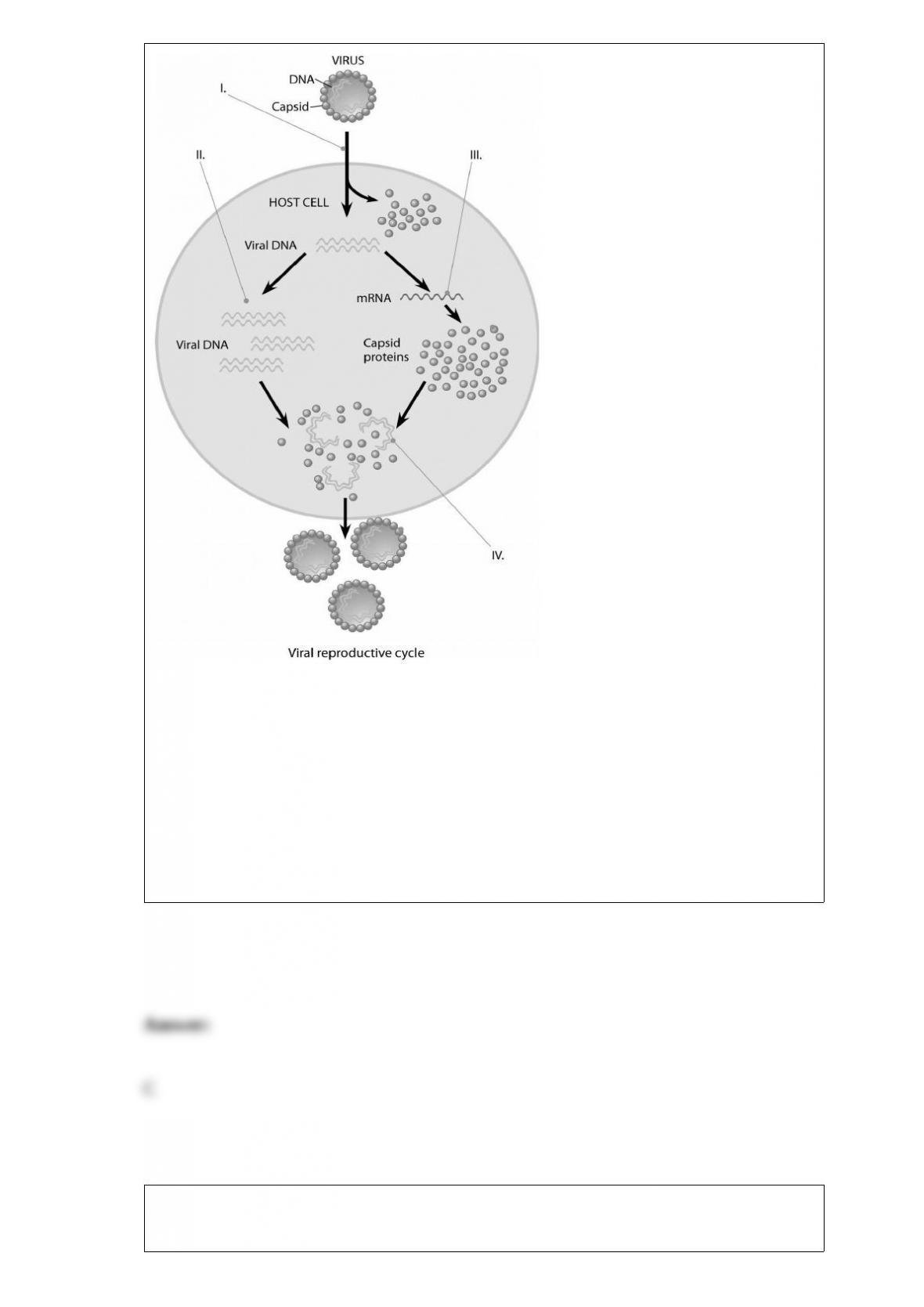
In the figure, at the arrow marked II, what enzyme(s) are being utilized?
A) reverse transcriptase
B) viral DNA polymerase
C) host cell DNA polymerase
D) host cell RNA polymerase
During the alternation of generations in plants, _____.

A) meiosis produces gametes
B) mitosis produces gametes
C) fertilization produces spores
D) fertilization produces gametes
An example of ligand-gated ion channels is _____.
A) the spreading of action potentials in the heart
B) acetylcholine receptors at the neuromuscular junction
C) cAMP-dependent protein kinases
D) action potentials on the axon
Monocot vascular bundles do not have a vascular cambium between the xylem and
phloem. This means that monocots _____.
A) are much less efficient at conducting water and sugars
B) have very thin stems
C) do not produce wood in annual rings

D) cannot produce lateral shoots
Which of the following is the best modern definition of evolution?
A) descent with modification
B) change in the number of genes in a population over time
C) survival of the fittest
D) inheritance of acquired characters
Environmental cues that influence the timing of reproduction generally do so by _____.
A) increasing the body temperature
B) providing access to water for external fertilization
C) increasing ambient temperature most favorable for sex
D) direct effects on hormonal control mechanisms

When gene duplication occurs to its ultimate extent by doubling all genes in a genome,
what has occurred?
A) pseudogene creation
B) creation of a gene cluster
C) creation of a polyploid
D) creation of a diploid
Learning has the most influence on behavior when _____.
A) making mistakes does not result in death
B) animals reproduce asexually
C) animals have enormous cognitive ability
D) making mistakes result in death
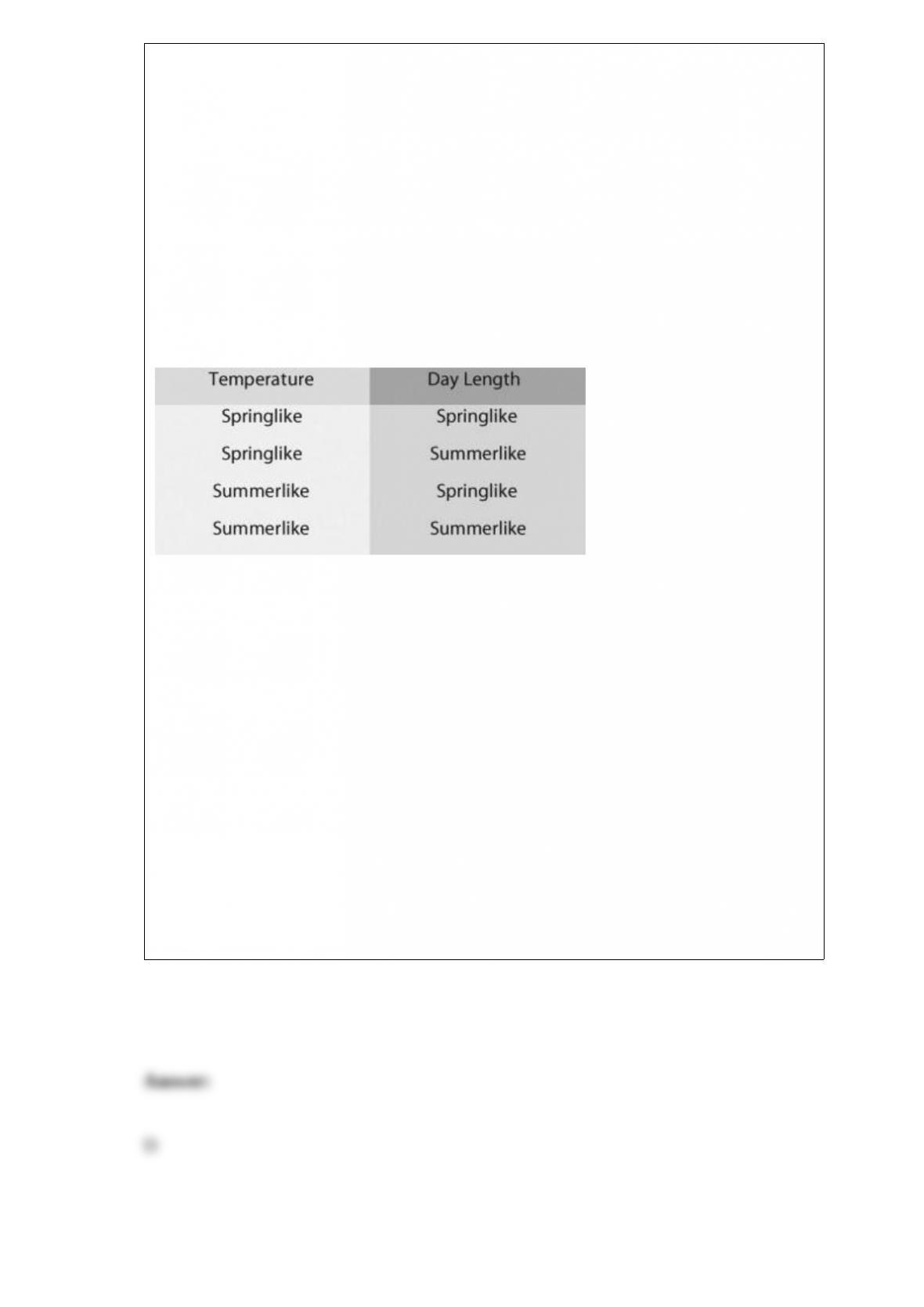
The following experiment is used for the corresponding question(s).
A researcher discovered a species of moth that lays its eggs on oak trees. Eggs are laid
at two distinct times of the year: early in spring when the oak trees are flowering and in
midsummer when flowering is past. Caterpillars from eggs that hatch in spring feed on
oak flowers and look like oak flowers. But caterpillars that hatch in summer feed on
oak leaves and look like oak twigs.
How does the same population of moths produce such different-looking caterpillars on
the same trees? To answer this question, the biologist caught many female moths from
the same population and collected their eggs. He put at least one egg from each female
into eight identical cups. The eggs hatched, and at least two larvae from each female
were maintained in one of the four temperature and light conditions listed below.
In each of the four environments, one of the caterpillars was fed oak flowers, the other
oak leaves. Thus, there were a total of eight treatment groups (4 environments 2 diets).
Refer to the accompanying figure. Recall that eggs from the same female were exposed
to each of the eight treatments used. This aspect of the experimental design tested
which of the following hypotheses?
A) The longer day lengths of summer trigger the development of twig-like caterpillars.
B) Differences in air pressure, due to elevation, trigger the development of different
types of caterpillars.
C) Differences in diet trigger the development of different types of caterpillars.
D) The differences are genetic. A female will either produce all flowerlike caterpillars
or all twig-like caterpillars.

If a bacterium regenerates from an endospore that did not possess any of the plasmids
that were contained in its original parent cell, the regenerated bacterium will probably
also _____.
A) lack antibiotic-resistant genes
B) lack a cell wall
C) lack a chromosome
D) lack water in its cytoplasm
Which of the following is the most predictable outcome of increased gene flow between
two populations?
A) lower average fitness in both populations
B) higher average fitness in both populations
C) increased genetic difference between the two populations
D) decreased genetic difference between the two populations
A mutation that inactivates a regulatory gene of a repressible operon in an E. coli cell
would result in _____.
A) continuous transcription of the structural gene controlled by that regulator

B) complete inhibition of transcription of the structural gene controlled by that
regulator
C) irreversible binding of the repressor to the operator
D) continuous translation of the mRNA because of alteration of its structure
When ATP releases some energy, it also releases inorganic phosphate. What happens to
the inorganic phosphate in the cell?
A) It is secreted as waste.
B) It is used only to regenerate more ATP.
C) It may be used to form a phosphorylated intermediate.
D) It enters the nucleus and affects gene expression.
What was the main reason the honeybees switched from the “round dance” to the
“waggle dance”?
A) The waggle dance communicates the presence of nectar.
B) The preferred food source was farther away.
C) The round dance uses too much energy.

D) The round dance did not communicate the quality of the food.
The umami receptor in the sense of taste detects _____.
A) glucose
B) potassium ions
C) hydrogen ions
D) monosodium glutamate
Over time, the movement of people on Earth has steadily increased. This has altered the
course of human evolution by increasing _____.
A) nonrandom mating
B) geographic isolation
C) genetic drift
D) gene flow

Compared to a cell with few aquaporins in its membrane, a cell containing many
aquaporins will _____.
A) have a faster rate of osmosis
B) have a lower water potential
C) have a higher water potential
D) have a faster rate of active transport
What provides the energy for the polymerization reactions in DNA synthesis?
A) ATP
B) DNA polymerase
C) breaking the hydrogen bonds between complementary DNA strands
D) the deoxyribonucleotide triphosphate substrates

The Bohr shift on the oxygen-hemoglobin dissociation curve is produced by changes in
_____.
A) the partial pressure of oxygen
B) hemoglobin concentration
C) temperature
D) pH
Opening all of the sodium channels on an otherwise typical neuron, with all other ion
channels closed (which is an admittedly artificial setting), should move its membrane
potential to _____.
A) -90 mV
B) 0 mV
C) +30 mV
D) +62 mV
Use the following information when answering the corresponding question(s).
In 1668, Francesco Redi performed a series of experiments on spontaneous generation.
He began by putting similar pieces of meat into eight identical jars. Four jars were left

open to the air, and four were sealed. He then did the same experiment with one
variation: Instead of sealing four of the jars completely, he covered them with gauze
(the gauze excluded the flies while allowing the meat to be exposed to air). In both
experiments, he monitored the jars and recorded whether or not maggots (young flies)
appeared in the meat.
Refer to the paragraph on Redi’s experiments. In both experiments, flies appeared in all
of the open jars and only in the open jars. Which one of the following statements is
correct?
A) The experiment was inconclusive because Redi used only one kind of meat.
B) The experiment was inconclusive because it did not run long enough.
C) The experiment supports the hypothesis that spontaneous generation occurs in
rotting meat.
D) The experiment supports the hypothesis that maggots arise only from eggs laid by
adult flies.
In the human knee-jerk reflex of a seated individual, as the calf is raised from a vertical
position to a horizontal position, the muscles of the quadriceps (on the front of the
thighs) and the muscles of the hamstring (on the back side of the thighs) are _____.
A) both excited and contracting
B) both inhibited and relaxed
C) excited and inhibited, respectively
D) inhibited and excited, respectively

Which molecule shown above contains a functional group that cells use to transfer
energy between organic molecules?
A) A
B) B
C) C
D) D
In a hypothetical situation, the genes for sex pilus construction and for tetracycline
resistance are located on the same plasmid within a particular bacterium. If this
bacterium readily performs conjugation involving a copy of this plasmid, then the result
should be the _____.
A) temporary possession by this bacterium of a completely diploid genome
B) rapid spread of tetracycline resistance to other bacteria in that habitat
C) subsequent loss of tetracycline resistance from this bacterium
D) production of endospores among the bacterium’s progeny

Carbon dioxide is split to form oxygen gas and carbon compounds _____.
A) during photosynthesis
B) during respiration
C) during photosynthesis and respiration
D) in neither photosynthesis nor respiration
The only vertebrates in which blood flows directly from respiratory organs to body
tissues without first returning to the heart are the _____.
A) amphibians
B) fishes
C) mammals
D) reptiles

Locating new nature preserves in biodiversity hot spots may not necessarily the best
choice because _____.
A) hot spots are situated in remote areas not accessible to the public
B) their ecological importance makes land purchase very expensive
C) a hot spot helps conserve only a few species
D) changing environmental conditions may shift the location of the communities