
The fact that plants can be cloned from somatic cells demonstrates that _____.
A) differentiated cells retain all the genes of the zygote
B) genes are lost during differentiation
C) the differentiated state is normally very unstable
D) differentiation does not occur in plants
One of two major forms of a human condition called neurofibromatosis (NF 1) is
inherited as a dominant gene, although it may range from mildly to very severely
expressed. Which of the following is the best explanation for why a young, affected
child is the first in her family to be diagnosed?
A) The mother carries the gene but does not express it.
B) One of the parents has a mild expression of the gene.
C) The condition skipped a generation in the family.
D) The child has one more chromosome than either of the parents.
The “threshold” potential of a membrane is the _____.
A) lowest frequency of action potentials a neuron can produce

B) minimum hyperpolarization needed to prevent the occurrence of action potentials
C) minimum depolarization needed to operate the voltage-gated sodium and potassium
channels
D) peak amount of depolarization seen in an action potential
Tadpoles must undergo a major metamorphosis to become frogs. This change includes
reabsorption of the tail, growth of limbs, calcification of the skeleton, increase in
rhodopsin in the eye, development of lungs, change in hemoglobin structure, and
reformation of the gut from the long gut of an herbivore to the short gut of a carnivore.
Amazingly, all of these changes are induced by thyroxine. What is the most likely
explanation for such a wide array of effects of thyroxine?
A) There are many different forms of thyroxine, each specific to a different tissue.
B) Different tissues have thyroxine receptors that activate different signal transduction
pathways.
C) Some tissues have membrane receptors for thyroxine, while other tissues have
thyroxine receptors within the nucleus.
D) Different releasing hormones release thyroxine to different tissues.
Testosterone and estradiol are male and female sex hormones, respectively, in many
vertebrates. In what way(s) do these molecules differ from each other? Testosterone and
estradiol _____.

A) are structural isomers but have the same molecular formula
B) are cis-trans isomers but have the same molecular formula
C) have different functional groups attached to the same carbon skeleton
D) are enantiomers of the same organic molecule
Pax-6 is a gene that is involved in eye formation in many invertebrates, such as
Drosophila. Pax-6 is also found in vertebrates. A Pax-6 gene from a mouse can be
expressed in a fly and the protein (PAX-6) leads to a compound fly eye. This
information suggests which of the following?
A) Pax-6 genes are identical in nucleotide sequence.
B) PAX-6 proteins have identical amino acid sequences.
C) Pax-6 is highly conserved and shows shared evolutionary ancestry.
D) PAX-6 proteins are different for formation of different kinds of eyes.
In an experimental situation, a student researcher inserts an mRNA molecule into a
eukaryotic cell after she has removed its cap and poly-A tail. Which of the following
would you expect her to find?

A) The mRNA is quickly converted into a ribosomal subunit.
B) The cell adds a new poly-A tail to the mRNA.
C) The mRNA attaches to a ribosome and is translated, but more slowly.
D) The molecule is digested by enzymes because it is not protected at the end.
Which of the following can be attributed to water’s high specific heat?
A) Oil and water do not mix well.
B) A lake heats up more slowly than the air around it.
C) Ice floats on water.
D) Sugar dissolves in hot tea faster than in iced tea.
What is the function of proton pumps localized in the plant plasma membrane?
A) to transfer phosphorus groups from ATP to proteins
B) to transfer metal ions across the plasma membrane
C) to transfer anions across the plasma membrane
D) to create a membrane potential

The movement of water across biological membranes can best be predicted by _____.
A) prevailing weather conditions
B) aquaporins
C) level of active transport
D) water potentials
Use the following information to answer the question(s) below.
The Brazil nut tree, Bertholletia excels (n = 17), is native to tropical rain forests of
South America. It is a hardwood tree that can grow to over 50 meters tall, is a source of
high-quality lumber, and is a favorite nesting site for harpy eagles. As the rainy season
ends, tough-walled fruits, each containing 8-25 seeds (Brazil nuts), fall to the forest
floor. Brazil nuts are composed primarily of endosperm. About $50 million worth of
nuts are harvested each year. Scientists have discovered that the pale yellow flowers of
Brazil nut trees cannot fertilize themselves and admit only female orchid bees as
pollinators. The agouti (Dasyprocta spp.), a cat-sized rodent, is the only animal with
teeth strong enough to crack the hard wall of Brazil nut fruits. It typically eats some of
the seeds, buries others, and leaves still others inside the fruit, which moisture can now
enter. The uneaten seeds may subsequently germinate.
The harpy eagle, Harpia harpyja, is the largest, most powerful raptor in the Americas. It
nests only in trees taller than 25 meters. It is a ‘sloth specialist,” but will also take
agouti. Thus, if these eagles capture too many agoutis from a particular locale, they
might contribute to their own demise by _____.
A) having too many offspring
B) decreasing their habitat
C) decreasing atmospheric carbon dioxide
D) increasing the number of sloths
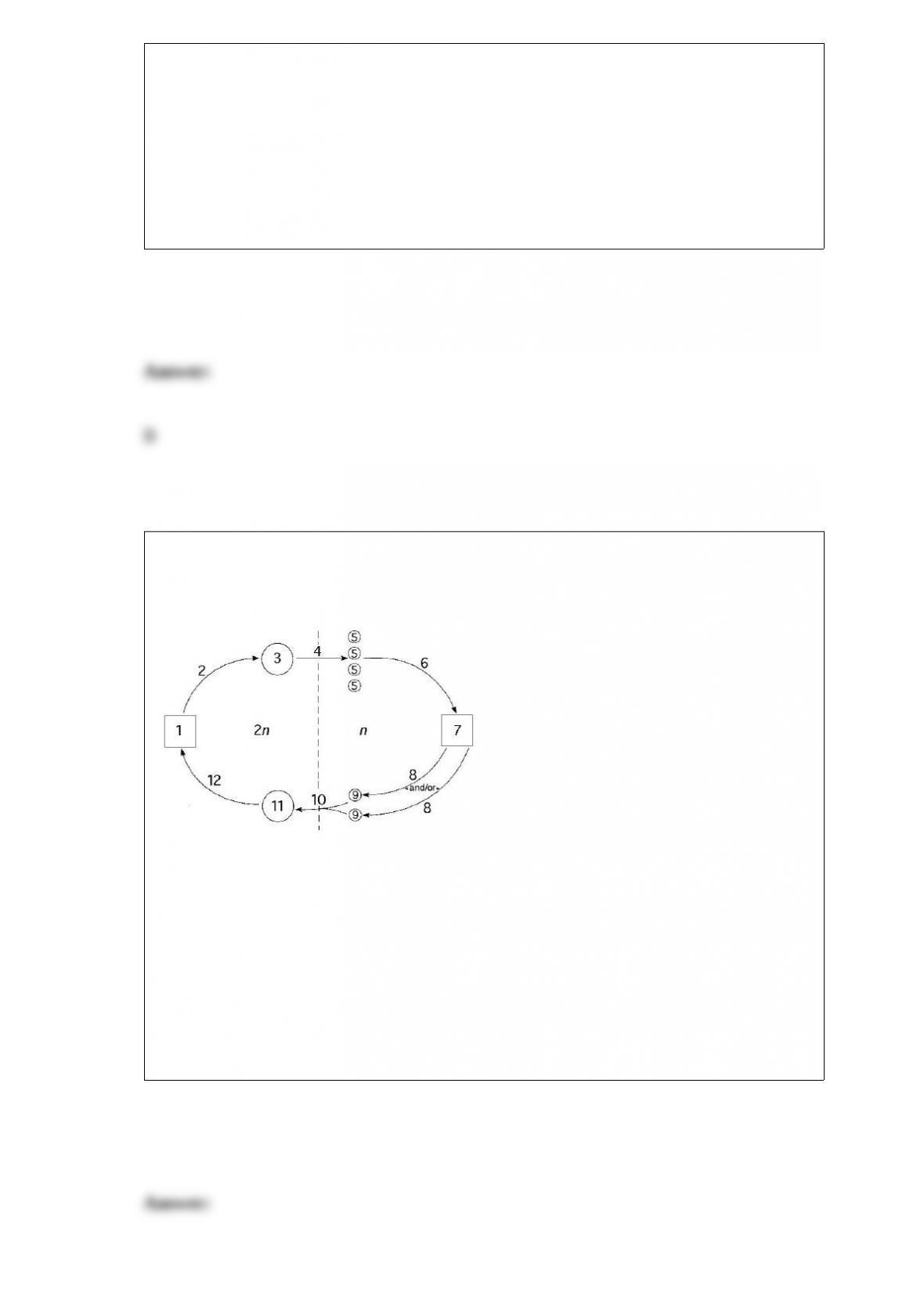
The following questions refer to the generalized life cycle for land plants shown in the
figure below. Each number within a circle or square represents a specific plant or plant
part, and each number over an arrow represents either meiosis, mitosis, or fertilization.
Which number represents a megaspore mother cell in the figure above?
A) 1
B) 3
C) 5
D) 7

Cells move to new positions as an embryo establishes its three germ-tissue layers
during _____.
A) determination
B) cleavage
C) induction
D) gastrulation
In July 2008, the United States had a population of approximately 302,000,000 people.
How many Americans were there in July 2009, if the estimated 2008 growth rate was
0.88%?
A) 5,500,000
B) 303,000,000
C) 304,000,000
D) 2,710,800,000

A multigene family is composed of _____.
A) multiple genes whose products must be coordinately expressed
B) genes whose sequences are very similar and that probably arose by duplication
C) a gene whose exons can be spliced in a number of different ways
D) a highly conserved gene found in a number of different species
If a molecule of carbon dioxide released into the blood in your left toe is exhaled from
your nose, it must pass through all of the following EXCEPT _____.
A) the pulmonary vein
B) an alveolus
C) the trachea
D) the right atrium
If there are 20 duplicated chromosomes in a cell, how many centromeres are there?
A) 10
B) 20

C) 30
D) 40
Refer to the following figure to answer the questions below.
How many electrons will a single atom of sulfur with no charge and no bonds have in
its valence shell (see the figure above)?
A) 6
B) 8
C) 16
D) 32

Which of the following is true for all exergonic reactions?
A) The products have more total energy than the reactants.
B) The reaction proceeds with a net release of free energy.
C) The reaction goes only in a forward direction: all reactants will be converted to
products, but no products will be converted to reactants.
D) A net input of energy from the surroundings is required for the reactions to proceed.
Increasing the substrate concentration in an enzymatic reaction could overcome which
of the following?
A) the need for a coenzyme
B) allosteric inhibition
C) competitive inhibition
D) insufficient cofactors

In a very large population, a quantitative trait has the following distribution pattern.
If there is no gene flow, the curve shifts to the left or to the right, and the population
size consequently increases over successive generations, which of the following is most
likely occurring?
A) immigration or emigration
B) directional selection
C) disruptive selection
D) genetic drift
Fragments of DNA have been extracted from the remnants of extinct woolly
mammoths, amplified, and sequenced. These can now be used to _____.
A) introduce certain mammoth traits into relatives, such as elephants
B) clone live woolly mammoths
C) appreciate the reasons why mammoths went extinct
D) better understand the evolutionary relationships among members of related taxa

In an egg cell treated with a chemical that binds calcium and magnesium ions, the
_____.
A) acrosomal reaction would be blocked
B) fusion of sperm and egg nuclei would be blocked
C) fast block to polyspermy would not occur
D) fertilization envelope would not be formed
A bacterium engulfed by a white blood cell through phagocytosis will be digested by
enzymes contained in _____.
A) lysosomes
B) Golgi vesicles
C) vacuoles
D) secretory vesicles

Corneal surgery is now routinely performed to change the shape of the cornea and
improve vision. This surgery is beneficial because it _____.
A) improves the circulation of nutrients to the eye
B) improves the focusing of light onto the retina
C) decreases the amount of light entering the eye
D) increases the sensitivity of the photoreceptors
Anabolic pathways _____.
A) are usually highly spontaneous chemical reactions
B) consume energy to build up polymers from monomers
C) release energy as they degrade polymers to monomers
D) consume energy to decrease the entropy of the organism and its environment
Which of the following best describes siRNA?
A) a double-stranded RNA, one of whose strands can complement and inactivate a
sequence of mRNA
B) a single-stranded RNA that can, where it has internal complementary base pairs, fold

into cloverleaf patterns
C) a double-stranded RNA that is formed by cleavage of hairpin loops in a larger
precursor
D) a portion of rRNA that allows it to bind to several ribosomal proteins in forming
large or small subunits
Which of the following statements best describes the relationship between
photosynthesis and respiration?
A) Respiration runs the biochemical pathways of photosynthesis in reverse.
B) Photosynthesis stores energy in complex organic molecules; respiration releases
energy from complex organic molecules
C) Photosynthesis occurs only in plants; respiration occurs only in animals.
D) Photosynthesis is catabolic; respiration is anabolic.
Which of the following is the correct sequence of the zones in the primary growth of a
root, moving from the root cap inward?
A) zone of cell division, zone of elongation, zone of differentiation
B) zone of differentiation, zone of elongation, zone of cell division

C) zone of elongation, zone of cell division, zone of differentiation
D) zone of cell division, zone of differentiation, zone of elongation
When the digestion and absorption of organic carbohydrates results in more energy-rich
molecules than are immediately required by an animal, the excess is _____.
A) eliminated in the feces
B) stored as starch in the liver
C) stored as glycogen in the liver and muscles
D) oxidized and converted to ATP
You find what you believe is a new species of animal. Which of the following
characteristics would enable you to argue that it is more closely related to a flatworm
than it is to a roundworm?
A) It is a suspension feeder.
B) It has no coelom.
C) It is shaped like a worm.
D) It has a mouth and an anus.

Glucocorticoids do which of the following?
A) promote the immune response
B) promote the release of fatty acids
C) increase blood glucose levels
D) increase insulin production
Nematodes and arthropods both _____.
A) develop an anus from the blastopore (pore) formed in the gastrula stage
B) are suspension feeders
C) grow by shedding their exoskeleton
D) have ciliated larvae

In mammalian eggs, the receptors for sperm are found in the _____.
A) fertilization membrane
B) egg plasma membrane
C) cytosol of the egg
D) mitochondria of the egg
Why are hydrocarbons insoluble in water?
A) The majority of their bonds are polar covalent carbon-to-hydrogen linkages.
B) The majority of their bonds are nonpolar covalent carbon-to-hydrogen linkages.
C) They exhibit considerable molecular complexity and diversity.
D) They are less dense than water.