
What is the probable sequence in which the following clades of animals originated,
from earliest to most recent?
1. tetrapods
2. vertebrates
3. deuterostomes
4. amniotes
5. bilaterians
A) 5 → 3 → 2 → 1 → 4
B) 5 → 3 → 4 → 2 → 1
C) 3 → 5 → 4 → 2 → 1
D) 3 → 5 → 2 → 1 → 4
In 1997, Dolly the sheep was cloned. Which of the following processes was used?
A) replication and dedifferentiation of adult stem cells from sheep bone marrow
B) separation of an early stage sheep blastula into separate cells, one of which was
incubated in a surrogate ewe
C) fusion of an adult cell’s nucleus with an enucleated sheep egg, followed by
incubation in a surrogate
D) isolation of stem cells from a lamb embryo and production of a zygote equivalent

Which of the following statements about protected areas that have been established to
preserve biodiversity are correct?
I) About 25 percent of Earth’s land area is now protected.
II) National parks are one of many types of protected areas.
III) Management of a protected area should be coordinated with management of the
land surrounding the area.
IV) It is especially important to protect biodiversity hot spots.
A) only I and III
B) only II and IV
C) only I, II, and IV
D) only II, III, and IV
A woman is found to have forty-seven chromosomes, including three X chromosomes.
Which of the following describes her expected phenotype?
A) a female with masculine characteristics such as facial hair
B) an apparent male who is sterile
C) healthy female of slightly above-average height
D) a sterile female

The most important feature that permits a gene to act as a molecular clock is _____.
A) a large number of base pairs
B) being acted upon by natural selection
C) a reliable average rate of mutation
D) a recent origin by a gene-duplication event
Sequencing eukaryotic genomes is more difficult than sequencing genomes of bacteria
or archaea because of the _____.
A) large size of eukaryotic proteins
B) hard-to-find proteins
C) high proportion of G-C base pairs in eukaryotic DNA
D) large size of eukaryotic genomes and the large amount of eukaryotic repetitive DNA

An ecologist recorded twelve white-tailed deer, Odocoileus virginianus, per square
kilometer in one woodlot and twenty per square kilometer in another woodlot. What
was the ecologist comparing?
A) density
B) dispersion
C) carrying capacity
D) range
You find a multi-legged animal in your garden and want to determine if it is a centipede
or a millipede. You take the animal to a university where a myriapodologist quickly
tells you that you have found a centipede. Which of the following may have allowed her
to make this distinction?
A) segmentation
B) poisonous fangs
C) egg-laying
D) molting
Compare the graphs in the figure above of carbon dioxide (CO2) emission for
Cormocephalus morsitans and Scutigerina weberi. What hypothesis can you make
about each centipede’s habitat?
A) C. morsitans lives in a habitat that provides more carbon dioxide than does S.
weberi.
B) C. morsitans lives in a habitat with more predators than does S. weberi.
C) C. morsitans lives in a colder habitat than does S. weberi.
D) C. morsitans lives in a drier habitat than does S. weberi.
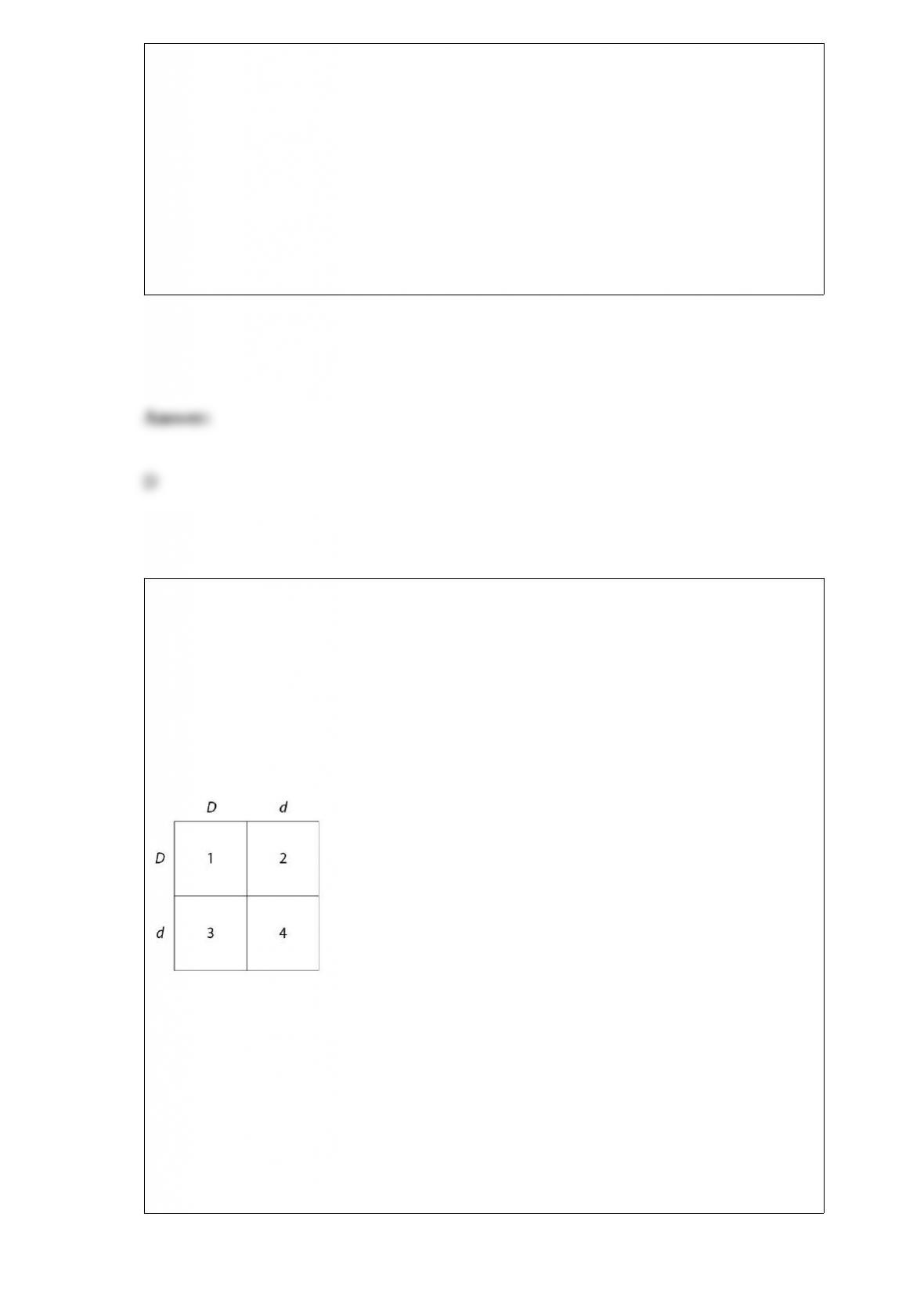
Use the figure and the following description to answer the question(s) below.
In a particular plant, leaf color is controlled by gene locus D. Plants with at least one
allele D have dark green leaves, and plants with the homozygous recessive dd genotype
have light green leaves. A true-breeding, dark-leaved plant is crossed with a
light-leaved one, and the F1 offspring is allowed to self-pollinate. The predicted
outcome of the F2 is diagrammed in the Punnett square shown in the figure, where 1, 2,
3, and 4 represent the genotypes corresponding to each box within the square.
Which of the boxes marked 1-4 correspond to plants with dark leaves?
A) 1 only
B) 2 and 3
C) 4 only
D) 1, 2, and 3

Which of the following animals is correctly paired with its feeding mechanism?
A) baleen whale fluid feeder
B) aphid suspension feeder
C) clam substrate feeder
D) snake bulk feeder
Which of the following might be an investigation of microclimate?
A) the effect of ambient temperature on the onset of caribou migration
B) the seasonal population fluctuation of nurse sharks in coral reef communities
C) competitive interactions between various species of songbirds during spring
migration
D) the effect of sunlight intensity on species composition in a decaying rat carcass
The complement system is _____.
A) a set of proteins involved in innate but not acquired immunity
B) a group of proteins that includes interferons and interleukins
C) a group of antimicrobial proteins that act together in a cascade fashion
D) a set of proteins that act individually to attack and lyse microbes
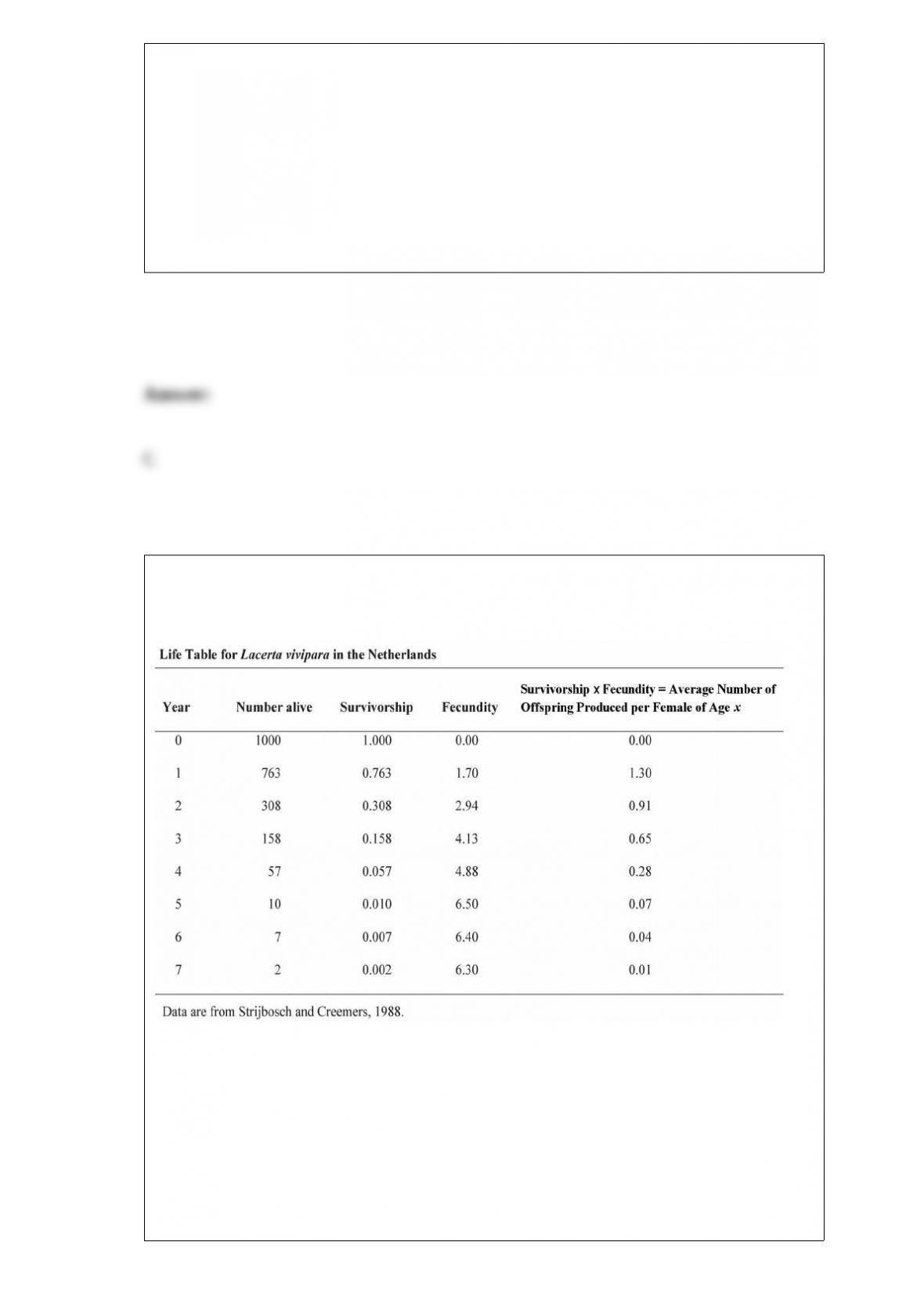
Using the table above, how would you describe the population dynamics of L. vivipara?
A) The population is increasing.
B) The population is decreasing.
C) The population is stable.

D) The figure does not provide this information.
Current analysis indicates that less than 2% of the human genome codes for proteins.
Based on the systems approach employed by the ENCODE project, what percentage of
the genome is estimated to contain functional elements (includes functional RNAs and
regulatory sequences)?
A) Less than 2%
B) About 50%
C) At least 80%
D) 100%
What is the pH of a solution with a hydroxyl ion (OH-) concentration of 10-12 M?
A) pH 2
B) pH 4
C) pH 10
D) pH 12

The following steps refer to various stages in transmission at a chemical synapse.
1. Neurotransmitter binds with receptors associated with the postsynaptic membrane.
2. Calcium ions rush into neuron’s cytoplasm.
3. An action potential depolarizes the membrane of the presynaptic axon terminal.
4. The ligand-gated ion channels open.
5. The synaptic vesicles release neurotransmitter into the synaptic cleft.
Which sequence of events is correct?
A) 1 → 2 → 3 → 4 → 5
B) 2 → 3 → 5 → 4 → 1
C) 3 → 2 → 5 → 1 → 4
D) 4 → 3 → 1 → 2 → 5
Yeast cells that have defective mitochondria incapable of respiration will be able to
grow by catabolizing which of the following carbon sources for energy?
A) glucose
B) proteins
C) fatty acids

D) Such yeast cells will not be capable of catabolizing any food molecules, and
therefore, will die.
Before plowing a field, a farmer thought the bare field looked weed-free. Three days
after plowing and turning over the soil, he was amazed to see thousands of tiny
seedlings. What is the most likely reason for the mass germination of seeds?
A) large seeds that needed soil disturbance to germinate
B) small seeds that need light to germinate
C) small seeds that were scarified by exposure to plow
D) large seeds that needed exposure to higher levels of oxygen to germinate
The necropsy (postmortem analysis) of a freshwater fish that died after being placed
accidentally in saltwater would likely show that _____.
A) loss of water by osmosis from cells in vital organs resulted in cell death and organ
failure
B) high amounts of salt had diffused into the fish’s cells, causing them to swell and lyse
C) the kidneys were not able to keep up with the water removal necessary in this
hyperosmotic environment, creating an irrevocable loss of homeostasis

D) the gills became encrusted with salt, resulting in inadequate gas exchange and a
resulting asphyxiation
In a simple synapse, neurotransmitter chemicals are received by _____.
A) the postsynaptic membrane
B) the presynaptic membrane
C) axon hillocks
D) cell bodies
Cerebrospinal fluid can be described as which of the following?
I) functioning in transport of nutrients and hormones through the brain
II) a product of the filtration of blood in the brain
III) functioning to cushion the brain
IV) filling spaces between glial cells and neurons in the gray matter
A) only I and III
B) only II and IV

C) only I, II, and III
D) only II, III, and IV
The questions below refer to the following paragraph.
HIV’s genome of RNA includes the code for reverse transcriptase (RT), an enzyme that
acts early in infection to synthesize a DNA genome off of an RNA template. The HIV
genome also codes for protease (PR), an enzyme that acts later in infection by cutting
long viral polyproteins into smaller, functional proteins. Both RT and PR represent
potential targets for antiretroviral drugs. Drugs called nucleoside analogs (NA) act
against RT, whereas drugs called protease inhibitors (PI) act against PR.
Which of the following represents the treatment option most likely to avoid the
evolution of drug-resistant HIV (assuming no drug interactions or side effects)?
A) using a series of NAs, one at a time, and changed about once a week
B) using a single PI, but slowly increasing the dosage over the course of a week
C) using high doses of NA and a PI at the same time for a period not to exceed one day
D) using moderate doses of NA and two different PIs at the same time for several
months
Female birds lay their eggs, thereby facilitating flight by reducing weight. Which
‘strategy” seems most likely for female bats to use to achieve the same goal?

A) limit litters to a single embryo
B) refrain from flying throughout pregnancy (about six weeks long)
C) give birth to underdeveloped young, and subsequently carry them in a pouch that has
teats
D) feed multiple embryos internally using placentas
The eleven pairs of appendages projecting from the rostral area of star-nosed moles are
_____.
A) chemosensory structures
B) tactile structures
C) olfactory structures
D) gustatory structures
A covalent bond is likely to be polar when _____.
A) one of the atoms sharing electrons is more electronegative than the other atom
B) the two atoms sharing electrons are equally electronegative

C) carbon is one of the two atoms sharing electrons
D) the two atoms sharing electrons are the same elements
A parasitic fungus, Geomyces destructans, has decimated millions of bats in the United
States since it was first observed in upstate New York in 2006. The disease has been
named White-nose syndrome because of the white fungal hyphae that cover the bat
upon infection. It is believed that this fungus was introduced from Europe by into caves
with hibernating bat populations. Which prediction most likely reflects changes that
will occur in natural communities as a result of massive bat mortality?
A) Increased animal populations as a result of niche availability.
B) Increased rodent populations as a result of an increase in flying insect populations.
C) Increased flying insect populations and decreased populations of bat-pollinated
plants
D) Decreased bird populations as the spread of the fungus infects other closely
What type of immunity is associated with breast feeding?
A) innate immunity
B) active immunity
C) passive immunity

D) cell-mediated immunity
Which of the following statements is true about protein synthesis in prokaryotes?
A) Extensive RNA processing is required before prokaryotic transcripts can be
translated.
B) Translation can begin while transcription is still in progress.
C) Prokaryotic cells have complicated mechanisms for targeting proteins to the
appropriate cellular organelles.
D) Unlike eukaryotes, prokaryotes require no initiation or elongation factors.
Which extant chordates are postulated to be most like the earliest chordates in
appearance?
A) lancelets
B) adult tunicates
C) amphibians
D) chondrichthyans

Which of these is NOT an example of a parenchyma cell?
A) cells that can form clones in tissue culture of plants
B) support cells near the outside of nonwoody stems
C) edible cells in fruits and vegetables
D) tissue in leaves that photosynthesizes
The metabolic breakdown of specialized brown fat depots in certain animals is
substantially increased during _____.
A) acclimatization
B) torpor
C) nonshivering thermogenesis
D) shivering thermogenesis