
Campbell Biology, 10e (Reece)
Chapter 43 The Immune System
1) Innate immunity _____.
A) is activated immediately upon infection
B) depends on an infected animal’s previous exposure to the same pathogen
C) is based on recognition of antigens that are specific to different pathogens
D) is found only in vertebrate animals
2) A fruit fly, internally infected by a potentially pathogenic fungus, is protected by its _____.
A) immunoglobulins
B) antibodies
C) antimicrobial peptides
D) B cells
3) Engulfing-phagocytic cells of innate immunity of vertebrates include _____.
I) neutrophils
II) macrophages
III) dendritic cells
IV) natural killer cells
A) I and III
B) II and IV
C) I and IV
D) I, II, and III
4) The cells and signaling molecules involved in the initial stages of the inflammatory response
are _____.
A) phagocytes and chemokines
B) dendritic cells and interferons
C) mast cells and histamines
D) lymphocytes and interferons

5) Inflammatory responses typically include _____.
A) increased activity of phagocytes in an inflamed area
B) reduced permeability of blood vessels to conserve plasma
C) release of substances to decrease the blood supply to an inflamed area
D) inhibiting the release of white blood cells from bone marrow
6) Mammals have Toll-like receptors (TLRs) that can recognize a kind of macromolecule that is
absent from vertebrates but present in or on certain groups of pathogens, such as viral _____.
A) double-stranded DNA
B) double-stranded RNA
C) glycoproteins
D) phospholipids
7) Septic shock, a systemic response including high fever and low blood pressure, is a response
to _____.
A) certain bacterial infections
B) specific forms of viruses
C) the presence of natural killer cells
D) increased production of neutrophils
8) The cells involved in innate immunity, whose absence increases the chances of developing
malignant tumors, are _____.
A) cytotoxic T cells
B) natural killer cells
C) macrophages
D) B cells
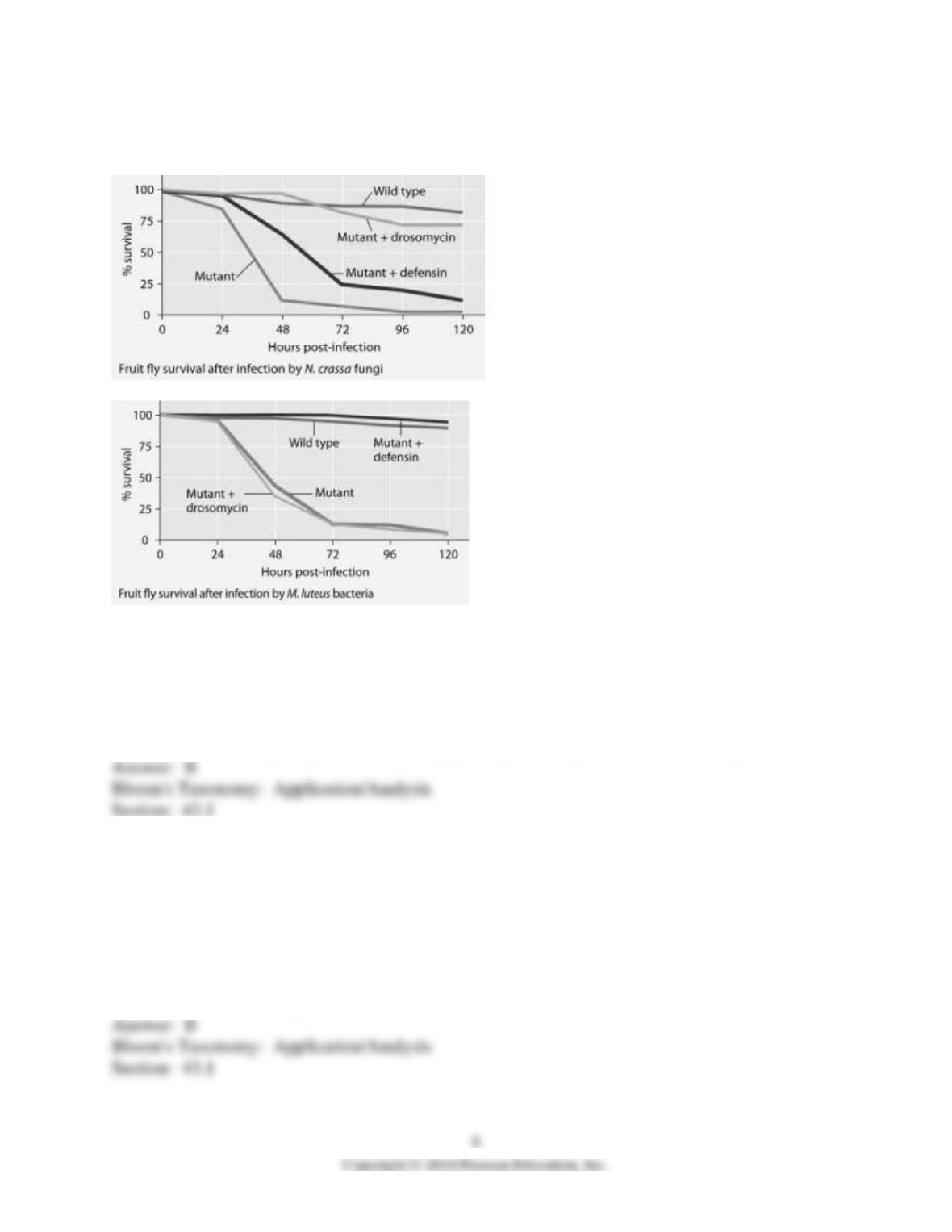
Mutant fruit flies that make only one antimicrobial peptide were tested for survival after
infection with Neurospora crassa fungi or with Micrococcus luteus bacteria.
9) The results shown in the graphs support the hypothesis that _____.
A) adding the defensin gene to such mutants protects them from death by fungal infection
B) adding the drosomycin gene to such mutants protects them from death by fungal infection
C) wild-type flies with the full set of genes for antimicrobial peptides are highly susceptible to
these infective agents
D) the presence of any single antimicrobial peptide protects against both infective agents
10) You and a friend were in line for a movie when you noticed the woman in front of you
sneezing and coughing. Both of you were equally exposed to the woman’s virus, but over the
next few days, only your friend acquired flu-like symptoms and was ill for almost a week before
recovering. Which one of the following is a logical explanation for this?
A) Your friend had antibodies to that virus.
B) You had an adaptive immunity to that virus.
C) Your friend had an autoimmune disorder.
D) Your friend had allergies.

11) A boy falls while riding his bike. A scrape on his hand almost immediately begins to bleed
and becomes red, warm, and swollen. What response is occurring?
A) inflammatory response
B) lytic response
C) adaptive immune response
D) autoimmune response
12) Acidity in human sweat is an example of _____.
A) cell-mediated immune responses
B) acquired immunity
C) adaptive immunity
D) innate immunity
13) The eyes and the respiratory tract are both protected against infections by _____.
A) interferons produced by immune cells
B) the secretion of complement proteins
C) the release of slightly alkaline secretions
D) the secretion of lysozyme onto their surfaces
14) The complement system is _____.
A) a set of proteins involved in innate but not acquired immunity
B) a group of proteins that includes interferons and interleukins
C) a group of antimicrobial proteins that act together in a cascade fashion
D) a set of proteins that act individually to attack and lyse microbes
15) Bacteria entering the body through a small cut in the skin _____.
A) inactivate the erythrocytes
B) stimulate apoptosis of nearby body cells
C) stimulate release of interferons
D) activate a group of proteins called complement

16) Mucus occurs in both the respiratory and digestive tracts. What is its main immunological
function?
A) sweeping away debris
B) physically trapping pathogens
C) destruction of pathogens because it is acidic
D) increasing oxygen absorption
17) Within a differentiated B cell, the rearrangement of DNA sequences between variable
regions and joining regions is accomplished by a(n)_____.
A) RNA polymerase
B) reverse transcriptase
C) epitopase
D) recombinase
18) Clonal selection and differentiation of B cells activated by antigen exposure leads to the
production of _____.
A) large quantities of the antigen initially recognized
B) vast numbers of B cells with random antigen-recognition receptors
C) long-lived erythrocytes that can later secrete antibodies for the antigen
D) short-lived plasma cells that secrete antibodies for the antigen
19) A newborn who is accidentally given a drug that destroys the thymus would most likely
_____.
A) lack innate immunity
B) be unable to genetically rearrange antigen receptors
C) be unable to differentiate and mature T cells
D) have a reduced number of B cells and be unable to form antibodies

20) Clonal selection is an explanation for how _____.
A) V, J, and C gene segments are rearranged
B) an antigen can provoke production of high levels of specific antibodies
C) HIV (human immunodeficiency virus) can disrupt the immune system
D) macrophages can recognize specific T cells and B cells
21) An immunoglobulin (Ig) molecule, of whatever class, with regions symbolized as C or V, H
or L, has a light chain made up of _____.
A) one C region and one V region
B) one H region and one L region
C) three H regions and one L region
D) two C regions and two V regions
22) Immunological memory accounts for _____.
A) the human body’s ability to distinguish self from non-self
B) the observation that some strains of the pathogen that causes dengue fever cause more severe
disease than others
C) the ability of a helper T cell to signal B cells via cytokines
D) the ancient observation that someone who had recovered from the plague could safely care
Use the following information to answer the question(s) below.
An otherwise healthy student in your class is infected with EBV, the virus that causes infectious
mononucleosis. The same student had already been infected when she was a child, at which time
she had merely experienced a mild sore throat and swollen lymph nodes in her neck. This time,
though infected, she does not get sick.
23) The EBV antigen fragments will be presented by the virus-infected cells along with _____.
A) a complement
B) antibodies
C) class I MHC molecules
D) class II MHC molecules

24) Vaccination increases the number of _____.
A) lymphocytes with receptors that can bind to the pathogen
B) epitopes that the immune system can recognize
C) macrophages specific for a pathogen
D) major histocompatability (MHC) molecules that can present an antigen
25) If a patient is missing B and T cells, what would be absent from the immune response?
A) memory
B) lysozymes
C) cytokines
D) defense against bacteria
26) Lymphocytes mature in the _____.
I) spleen
II) thymus
III) bone marrow
A) only I and III
B) only I and II
C) only II and III
D) I, II, and III
27) Which of the following statements are fundamental to the clonal-selection theory of how the
adaptive immune system functions?
I) Each lymphocyte has a unique membrane receptor that recognizes one antigen.
II) When the lymphocyte binds an antigen, it is activated and begins dividing to form many
identical copies of itself.
III) Cloned lymphocytes have slight differences and are selected by the spleen for removal if they
do not bind an antigen.
IV) Cloned cells descend from an activated lymphocyte and persist even after the pathogen is
eliminated.
A) only I and III
B) only II and IV
C) only I, II, and IV
D) only II, III, and IV

28) What major advantage is conveyed by having a system of adaptive immunity?
A) It enables a rapid defense against an antigen that has been previously encountered.
B) It enables an animal to counter most pathogens almost instantly the first time they are
encountered.
C) It results in effector cells with specificity for a large number of antigens.
D) It allows for the destruction of antibodies.
29) Which of the following is a difference between B cells and T cells?
A) One has a major role in antibody production, while the other has a major role in cytotoxicity.
B) One binds a receptor called BCR (B-cell receptor), while the other recognizes a receptor
called TCR (T-cell receptor).
C) B cells are activated by free-floating antigens in the blood or lymph. T cells are activated by
membrane-bound antigens.
D) T cells are produced in the thymus and B cells are produced in the bone marrow.
30) A certain cell type has existed in the blood and tissue of its vertebrate host’s immune system
for over twenty years. One day, it recognizes a newly arrived antigen and binds to it,
subsequently triggering a secondary immune response in the body. Which of the following cell
types most accurately describes this cell?
A) plasma cell
B) thyroid cell
C) memory cell
D) macrophage
31) Which of the following statements about epitopes are correct?
I) B-cell receptors bind to epitopes.
II) T-cell receptors bind to epitopes.
III) There can be 10 or more different epitopes on each antigen.
IV) There is a one-to-one correspondence between antigen and epitope.
A) only I and III
B) only II and IV
C) only I, II, and III
D) only II, III, and IV

32) Which of the following pairs of proteins shares the most overall similarity in structure?
A) B-cell receptors and T-cell receptors
B) B-cell receptors and antibodies
C) T-cell receptors and antibodies
D) antibodies and antigens
33) What type of immunity is associated with breast feeding?
A) innate immunity
B) active immunity
C) passive immunity
D) cell-mediated immunity
34) Select the pathway that would lead to the activation of cytotoxic T cells.
A) B cell contact antigen → helper T cell is activated → clonal selection occurs
B) body cell becomes infected with a virus → new viral proteins appear → class I MHC
molecule-antigen complex displayed on cell surface
C) complement is secreted → B cell contacts antigen → helper T cell activated → cytokines
released
D) cytotoxic T cells → class II MHC molecule–antigen complex displayed → cytokines released
→ cell lysis
35) Arrange in the correct sequence these components of the mammalian immune system as it
first responds to a pathogen.
I) Pathogen is destroyed.
II) Lymphocytes secrete antibodies.
III) Antigenic determinants from pathogen bind to antigen receptors on lymphocytes.
IV) Lymphocytes specific to antigenic determinants from pathogen become numerous.
V) Only memory cells remain.
A) I → III → II → IV → V
B) II → I → IV → III → V
C) IV → II → III → I → V
D) III → IV → II → I → V

36) A nonfunctional CD4 protein on a helper T cell would result in the helper T cell being unable
to _____.
A) respond to T-independent antigens
B) lyse tumor cells
C) stimulate a cytotoxic T cell
D) interact with a class II MHC-antigen complex
37) CD4 and CD8 are _____.
A) proteins secreted by antigen-presenting cells
B) receptors present on the surface of natural killer cells
C) molecules present on the surface of T cells where they interact with major histocompatability
(MHC) molecules
D) molecules on the surface of antigen-presenting cells where they enhance B cell activity
38) T cells of the immune system include _____.
A) CD4, CD8, and plasma cells
B) cytotoxic and helper cells
C) plasma, antigen-presenting, and memory cells
D) lymphocytes, macrophages, and dendritic cells
39) B cells interacting with helper T cells are stimulated to differentiate when _____.
A) B cells produce IgE antibodies
B) B cells release cytokines
C) cytotoxic T cells present the class II MHC molecule-antigen complex on their surface
D) helper T cells release cytokines
40) When antibodies bind antigens, the clumping of antigens results from _____.
A) the antibody having at least two binding regions
B) disulfide bridges between the antigens
C) bonds between class I and class II MHC molecules
D) denaturation of the antibodies

41) Phagocytosis of microbes by macrophages is enhanced by _____.
I) the binding of antibodies to the surface of microbes
II) antibody-mediated agglutination of microbes
III) the release of cytokines by activated B cells
A) only I and II
B) only II and III
C) only I and III
D) I, II, and, III
42) Naturally acquired passive immunity can result from the _____.
A) injection of vaccine
B) ingestion of interferon
C) placental transfer of antibodies
D) absorption of pathogens through mucous membranes
43) Jenner’s successful use of cowpox virus as a vaccine against the smallpox virus was due to
the fact that _____.
A) the immune system responds nonspecifically to antigens
B) the cowpox virus made antibodies in response to the presence of smallpox
C) there are some epitopes (antigenic determinants) common to both pox viruses
D) cowpox and smallpox are caused by the same virus
44) An individual who has been bitten by a poisonous snake that has a fast-acting toxin would
likely benefit from _____.
A) vaccination with a weakened form of the toxin
B) injection of antibodies to the toxin
C) injection of interleukin-1
D) injection of interferon

45) For the successful development of a vaccine to be used against a pathogen, it is necessary
that _____.
A) the surface antigens of the pathogen stay the same
B) all of the surface antigens on the pathogen be identified
C) the pathogen has only one epitope
D) the major histocompatability (MHC) molecules are heterozygous
46) The switch of one B cell from producing one class of antibody to another class of antibody
that is responsive to the same antigen is due to _____.
A) the rearrangement of V region genes in that clone of responsive B cells
B) a switch in the kind of antigen-presenting cell that is involved in the immune response
C) a patient’s reaction to the first kind of antibody made by the plasma cells
D) the rearrangement of immunoglobulin heavy-chain C region DNA
47) The number of major histocompatability (MHC) protein combinations possible in a given
population is enormous. However, an individual in that diverse population has a far more limited
array of MHC molecules because _____.
A) the MHC proteins are made from several different gene regions that are capable of
rearranging in a number of ways
B) MHC proteins from one individual can only be of class I or class II
C) each of the MHC genes has a large number of alleles, but each individual only inherits two
for each gene
D) once a B cell has matured in the bone marrow, it is limited to two MHC response categories
48) A bone marrow transplant may not be appropriate from a given donor (Jane) to a given
recipient (Jane’s cousin Bob), even though Jane has previously given blood for one of Bob’s
needed transfusions, because _____.
A) even though Jane’s blood type is a match to Bob’s, her major histocompatability (MHC)
proteins may not be a match
B) a blood type match is less stringent than a match required for transplant because blood is
more tolerant of change
C) for each gene, there is only one blood allele but many tissue alleles
D) Jane’s MHC class II genes are not expressed in bone marrow

49) An immune response to a tissue graft will differ from an immune response to a bacterium
because _____.
A) MHC molecules of the donor may stimulate rejection of the graft tissue, but bacteria lack
MHC molecules
B) the tissue graft, unlike the bacterium, is isolated from the circulation and will not enter into an
immune response
C) a bacterium cannot escape the immune system by replicating inside normal body cells
Use the following information to answer the question(s) below.
An otherwise healthy student in your class is infected with EBV, the virus that causes infectious
mononucleosis. The same student had already been infected when she was a child, at which time
she had merely experienced a mild sore throat and swollen lymph nodes in her neck. This time,
though infected, she does not get sick.
50) Her immune system’s recognition of the second infection involves memory _____.
A) helper T cells
B) natural killer cells
C) plasma cells
D) cytotoxic T cells
51) Which of the following should be the same in identical twins?
A) the set of antibodies produced
B) the set of major histocompatability (MHC) molecules produced
C) the set of T cell antigen receptors produced
D) the susceptibility to a particular virus
52) Which of the following is crucial to activation of the adaptive immune response?
A) memory cells
B) presentation of MHC (major histocompatibility complex)-antigen complex on a cell surface
C) somatic hypermutation
D) phagocytosis of antibody-antigen complex by macrophages in the blood (the humoral
response)

53) Which of the following components of the immune system destroys bacteria in a way similar
to an antitank weapon destroying armored military tanks by punching holes in the wall of the
bacteria?
A) complement protein
B) macrophages
C) plasma cells
D) major histocompatibility complex proteins
54) Yearly vaccination of humans for influenza viruses is necessary because _____.
A) of an increase in immunodeficiency diseases
B) the flu can generate anaphylactic shock
C) surviving the flu one year exhausts the immune system to nonresponsiveness the second year
D) rapid mutation in flu viruses alters the surface proteins in infected host cells
55) A patient who has a high level of mast cell activity, dilation of blood vessels, and acute drop
in blood pressure is likely suffering from _____.
A) an autoimmune disease
B) a typical skin allergy (contact dermatitis) that can be treated by antihistamines
C) an organ transplant, such as a skin graft
D) anaphylactic shock immediately following exposure to an allergen
56) The ability of some viruses to remain inactive (latent) for a period of time is exemplified by
_____.
A) influenza, a particular strain of which returns every 10-20 years
B) herpes simplex viruses (oral or genital) whose reproduction is triggered by physiological or
emotional stress in the host
C) Kaposi’s sarcoma, which causes a skin cancer in people with AIDS but rarely in those not
infected by HIV
D) the virus that causes a form of the common cold, which recurs in patients many times in their
lives

57) A patient complaining of watery, itchy eyes and sneezing after being given a flower bouquet
as a birthday gift should first be treated with _____.
A) a vaccine
B) sterile pollen
C) antihistamines
D) monoclonal antibodies
58) Which of the following would help a virus avoid triggering an effective adaptive immune
response?
I) having frequent mutations in genes for surface proteins
II) building the viral shell from host proteins
III) producing proteins very similar to those of other viruses
IV) infecting and killing helper T cells
A) only I and III
B) only I, II, and IV
C) only I, II, and III
D) only II, III, and IV
59) Which of the following is the best definition of autoimmune disease?
A) a condition in which B cells and T cells respond independently to antigens and do not interact
correctly
B) a condition in which the adaptive immune system fails to recognize the second infection by
the same antigen
C) a condition in which self molecules are treated as non-self
D) a condition in which the immune system creates random antibodies without being triggered
by an antigen
60) Which of the following would prevent allergic attacks?
A) blocking the attachment of the IgE antibodies to the mast cells
B) blocking the antigenic determinants of the IgM antibodies
C) reducing the number of helper T cells in the body
D) reducing the number of cytotoxic cells

61) In a humoral or antibody-mediated immune response, specific B cells are stimulated by
Helper T cells to transform into plasma cells that secrete antibodies. What would be an important
feature added to B cells In this transition process?
A) Duplication of specific gene sequences for the appropriate antibody.
B) Increased rough endoplasmic reticulum in order to have the surface area needed for antibody
production.
C) Duplication of lysosomes in order to store the antibodies before transport.