Campbell Biology, 10e (Reece)
Chapter 40 Basic Principles of Animal Form and Function
1) Penguins, seals, and tuna have body forms that permit rapid swimming, because _____.
A) all share a recent common ancestor
B) all of their bodies have been compressed since birth by intensive underwater pressures
C) the shape is a convergent evolutionary solution, which reduces drag while swimming
D) this is the only shape that will allow them to maintain a constant body temperature in water
2) As the size of some animals has evolved to greater sizes, the effectiveness of their adaptations
that promote exchanges with the environment have also increased. For example, in many larger
organisms, evolution has favored lungs and a digestive tract with _____.
A) more branching or folds
B) increased thickness
C) larger cells
D) decreased blood supply
3) Much of the coordination of vertebrate body functions via chemical signals is accomplished
by the _____.
A) respiratory system
B) endocrine system
C) integumentary system
D) excretory system
4) Compared with a smaller cell, a larger cell of the same shape has _____.
A) less surface area
B) less surface area per unit of volume
C) a smaller average distance between its mitochondria and the external source of oxygen
D) a smaller cytoplasm-to-nucleus ratio
5) If you were to view a sample of animal tissue under a light microscope and notice an
extensive extracellular matrix surrounding a tissue, which tissue type would you most suspect?
A) connective
B) epithelial
C) nervous
D) striated muscle
6) Some animals have no gills when young, but then develop gills that grow larger as the animal
grows larger. What is the reason for this increase in gill size?
A) The young of these animals are much more active than the adult, which leads to a higher
BMR (basal metabolic rate) and, therefore, a higher need for oxygen.
B) Relative to their volume, the young have more surface area across which they can transport
all the oxygen they need.
C) The young have a higher basal metabolic rate.
D) Relative to their surface area, the young have more body volume in which they can store
oxygen for long periods of time.
7) Evolutionary adaptations that help diverse animals directly exchange matter between cells and
the environment include _____.
A) a gastrovascular activity, a two-layered body, and a torpedo-like body shape
B) an external respiratory surface, a small body size, and a two-cell-layered body
C) a large body volume, a long, tubular body, and a set of wings
D) an unbranched internal surface, a small body size, and thick covering
8) All animals, whether large or small, have _____.
A) an external body surface that is dry
B) a basic body plan that resembles a two-layered sac
C) a body surface covered with hair to keep them warm
D) most of their cells in contact with an aqueous medium
9) Interstitial fluid is _____.
A) the internal environment inside animal cells
B) identical to the composition of blood
C) a common site of exchange between blood and body cells
D) found only in the lumen of the small intestine
10) Of the following choices, the epithelium with the shortest diffusion distance is _____.
A) simple squamous epithelium
B) simple columnar epithelium
C) pseudostratified ciliated columnar epithelium
D) stratified squamous epithelium
11) Most of the exchange surfaces of multicellular animals are lined with _____.
A) connective tissue
B) smooth muscle cells
C) neural tissue
D) epithelial tissue
12) Connective tissues typically have _____.
A) little space between the membranes of adjacent cells
B) the ability to transmit electrochemical impulses
C) the ability to shorten upon stimulation
D) relatively few cells and a large amount of extracellular matrix
13) If you gently bend your ear, and then let go, the shape of your ear will return because the
cartilage of your ear contains_____.
A) collagenous fibers
B) elastic fibers
C) reticular fibers
D) adipose tissue
14) Blood is best classified as connective tissue because _____.
A) its cells are separated from each other by an extracellular matrix
B) it contains more than one type of cell
C) its cells can move from place to place
D) it is found within all the organs of the body
15) Most types of communication between cells utilize _____.
A) the exchange of cytosol between the cells
B) the movement of the cells
C) chemical or electrical signals
D) the exchange of DNA between the cells
16) All types of muscle tissue have _____.
A) striated banding patterns seen under the microscope
B) cells that lengthen when appropriately stimulated
C) a response that can be consciously controlled
D) interactions between actin and myosin
17) Cardiac muscle cells are both _____.
A) striated and interconnected by intercalated disks
B) smooth and under voluntary control
C) striated and under voluntary control
D) smooth and under involuntary control
18) The type of muscle tissue surrounding the intestines and blood vessels is _____.
A) skeletal muscle
B) cardiac muscle
C) intercalated cells
D) smooth muscle
19) Food moves along the digestive tract as the result of contractions by _____.
A) cardiac muscle
B) smooth muscle
C) striated muscle
D) skeletal muscle
20) The cells lining the air sacs in the lungs make up a _____.
A) simple squamous epithelium
B) stratified squamous epithelium
C) pseudostratified ciliated columnar epithelium
D) simple columnar epithelium
21) The body tissue that consists largely of material located outside of cells is _____.
A) epithelial tissue
B) connective tissue
C) skeletal muscle
D) nervous tissue
22) You are looking through a microscope at a slide of animal tissue and see a single layer of
flat, closely packed cells that cover a surface. This specific tissue is most likely _____.
A) adipose
B) a tendon
C) epithelial
D) a neuron
23) Environmental influences appear to contribute to cellular mutations that lead to tumor
growth. For example, certain diets lead to higher incidence of colon cancers, and overexposure to
sunlight leads to higher incidence of skin cancers. The tissues in closest contact with a
carcinogen or mutagen (anything that causes genetic mutations) are obviously the ones most
likely to develop tumors. Carcinomas and melanomas account for well over half of all cancers.
What type of tissue would you guess the term carcinoma and melanoma is most closely
associated with?
A) connective
B) muscle
C) epithelial
D) nervous
24) Which of the following is a true statement about body size and physiology?
A) The amount of food and oxygen an animal requires and the amount of heat and waste it
produces are inversely proportional to its mass.
B) The rate at which an animal uses nutrients and produces waste products is independent of its
volume.
C) Small and large animals face different physiological challenges because an animal’s body
mass increases cubically while its surface area increases as a squared function.
D) The wastes produced by an animal double as its volume doubles and triple as its surface area
triples.
25) An elephant and a mouse are running in full sunlight, and both overheat by the same amount
above their normal body temperatures. When they move into the shade and rest, which animal
will cool down faster?
A) The elephant will because it has the higher surface-area-to-volume ratio.
B) The elephant will because it has the lower surface-area-to-volume ratio.
C) The mouse will because it has the higher surface-area-to-volume ratio.
D) They will cool at the same rate because they overheated by the same amount.
26) You have a cube of modeling clay in your hands. Which of the following changes to the
shape of this cube of clay will decrease its surface area relative to its volume?
A) Pinch the edges of the cube into small folds.
B) Flatten the cube into a pancake shape.
C) Round the clay up into a sphere.
D) Stretch the cube into a long, shoebox shape.
27) If an organism was discovered that had no epithelial tissues, it would require adaptations to
maintain homeostasis in which of the following areas? The organism would require adaptations
_____.
A) in its skeleton for structure
B) in its nervous system for sensing external stimuli
C) that would prevent water loss from the body in a terrestrial environment
D) in its muscular system for movement
The crucian carp (Carassius carassius) is a Northern European freshwater fish often inhabiting
ponds that become hypoxic (have reduced oxygen levels) and even anoxic (have no oxygen)
when the surface freezes during the winter. Surprisingly, when oxygen levels are normal, these
fish lack the lamellae that provide a large surface area for gas exchange between water and
blood: their gills are smooth. Yet when the level of oxygen in the water falls, the gill morphology
undergoes a change: packing cells stop dividing and programmed cell death is induced, exposing
gill lamellae that were buried in other tissue. With lamellae exposed, the gills have increased
surface area for gas exchange. These changes in gill lamellar profile are reversible: investigators
observed that the gills return to their normal structure within seven days after returning the fish
to well-oxygenated water. (Jørund Sollid, Paula De Angelis, Kristian Gundersen, and Göran E.
Nilsson. 2003. Hypoxia induces adaptive and reversible gross morphological changes in crucian
carp gills. Journal of Experimental Biology 206:3667-73.)
28) Refer to the paragraph on crucian carp. Gills serve multiple functions in fish in addition to
gas exchange. Given the large surface area of gills with lamellae, what is the most likely
explanation for why crucian carp cover protruding lamellae in their gills when levels of oxygen
are normal?
A) to prevent loss of heat to the surrounding water
B) to prevent loss of ions to the surrounding water
C) to prevent protein loss to the surrounding water
D) to prevent loss of oxygen to the surrounding water
29) Once labor begins in childbirth, contractions increase in intensity and frequency, causing
more contractions to occur until delivery. The increasing labor contractions of childbirth are an
example of which type of regulation?
A) positive feedback
B) negative feedback
C) feedback inhibition
D) enzymatic catalysis
30) When the body’s blood glucose level rises, the pancreas secretes insulin and, as a result, the
blood glucose level declines. When the blood glucose level is low, the pancreas secretes
glucagon and, as a result, the blood glucose level rises. Such regulation of the blood glucose
level is the result of _____.
A) catalytic feedback
B) positive feedback
C) negative feedback
D) protein-protein interactions
31) The body’s automatic tendency to maintain a constant and optimal internal environment is
termed _____.
A) balanced equilibrium
B) physiological chance
C) homeostasis
D) static equilibrium
32) An example of a properly functioning homeostatic control system is seen when _____.
A) the core body temperature of a runner rises gradually from 37°C to 45°C
B) the kidneys excrete salt into the urine when dietary salt levels rise
C) a blood cell shrinks when placed in a solution of salt and water
D) the blood pressure increases in response to an increase in blood volume
33) Positive feedback differs from negative feedback in that _____.
A) positive feedback benefits the organism, whereas negative feedback is detrimental
B) the positive feedback’s effector responses are in the same direction as the initiating stimulus
rather than opposite of it
C) the effector’s response increases some parameter (such as body temperature), whereas in
negative feedback it can only decrease the parameter
D) positive feedback systems have only effectors, whereas negative feedback systems have only
receptors
34) Which of the following is an example of negative feedback?
A) During birthing contractions, oxytocin (a hormone) is released and acts to stimulate further
contractions.
B) When a baby is nursing, suckling leads to the production of more milk and a subsequent
increase in the secretion of prolactin (a hormone that stimulates lactation).
C) After a blood vessel is damaged, signals are released by the damaged tissues that activate
platelets in the blood. These activated platelets release chemicals that activate more platelets.
D) When the level of glucose in the blood increases, the pancreas produces and releases the
hormone insulin. Insulin acts to decrease blood glucose. As blood glucose decreases, the rate of
production and release of insulin decreases as blood glucose decreases.
35) You discover a new species of bacteria that grows in aquatic environments with high salt
levels. While studying these bacteria, you note that their internal environment is similar to the
salt concentrations in their surroundings. You also discover that the internal salt concentrations
of the bacteria change as the salt concentration in their environment changes. The new species
can tolerate small changes in this way, but dies from large changes because it has no mechanism
for altering its own internal salt levels. What type of homeostatic mechanism is this species using
to regulate its internal salt levels?
A) conformation
B) regulation
C) integration
D) assimilation
36) Chum salmon (Oncorhynchus keta) are born in freshwater environments and then migrate to
the sea. Near the end of their lives, they return to the freshwater stream where they were born to
spawn. In freshwater, water constantly diffuses into the body and ions are lost from the body. In
salt water, body water diffuses out of the body and excess ions are gained from the water. A
salmon’s gills have special cells to pump salt in or out of the body to maintain homeostasis. In
response to the salmon’s moves between freshwater and salt water, some cells in the gills are
produced and others are destroyed. These changes made in the cells of the gills during the
lifetime of an individual salmon are an example of which of the following?
A) evolution
B) trade-off
C) acclimatization
D) adaptation
37) To prepare flight muscles for use on a cool morning, hawkmoths _____.
A) relax the muscles completely until after they launch themselves into the air
B) decrease their standard metabolic rate
C) rapidly contract and relax these muscles to generate metabolic warmth
D) reduce the metabolic rate of the muscles to rest them before flight
38) In a cool environment, an ectotherm is more likely to survive an extended period of food
deprivation than would an equally sized endotherm because the ectotherm _____.
A) maintains a higher basal metabolic rate
B) expends more energy per kilogram of body mass than does the endotherm
C) invests little energy in temperature regulation
D) has greater insulation on its body surface
39) Sweating allows a person to lose heat through the process of _____.
A) conduction
B) convection
C) radiation
D) evaporation
40) An example of an ectothermic organism that has few or no behavioral options when it comes
to its ability to adjust its body temperature is a _____.
A) sea star living deep in the ocean
B) bass living in a farm pond
C) hummingbird flying through a prairie
D) honeybee in a hive on a rural farm
41) The panting responses that are observed in overheated birds and mammals dissipate excess
heat by _____.
A) countercurrent exchange
B) acclimation
C) vasoconstriction
D) evaporation
42) Most land-dwelling invertebrates and all of the amphibians _____.
A) are ectothermic organisms with variable body temperatures
B) alter their metabolic rates to maintain a constant body temperature of 37°C
C) are endotherms but become thermoconformers when they are in water
D) become more active when environmental temperatures drop below 15°C
43) The temperature-regulating center of vertebrate animals is located in the _____.
A) thyroid gland
B) hypothalamus
C) subcutaneous layer of the skin
D) liver
44) The metabolic breakdown of specialized brown fat depots in certain animals is substantially
increased during _____.
A) acclimatization
B) torpor
C) nonshivering thermogenesis
D) shivering thermogenesis
45) A moth preparing for flight on a cold morning may warm its flight muscles via _____.
A) acclimatization
B) torpor
C) evaporative cooling
D) shivering thermogenesis
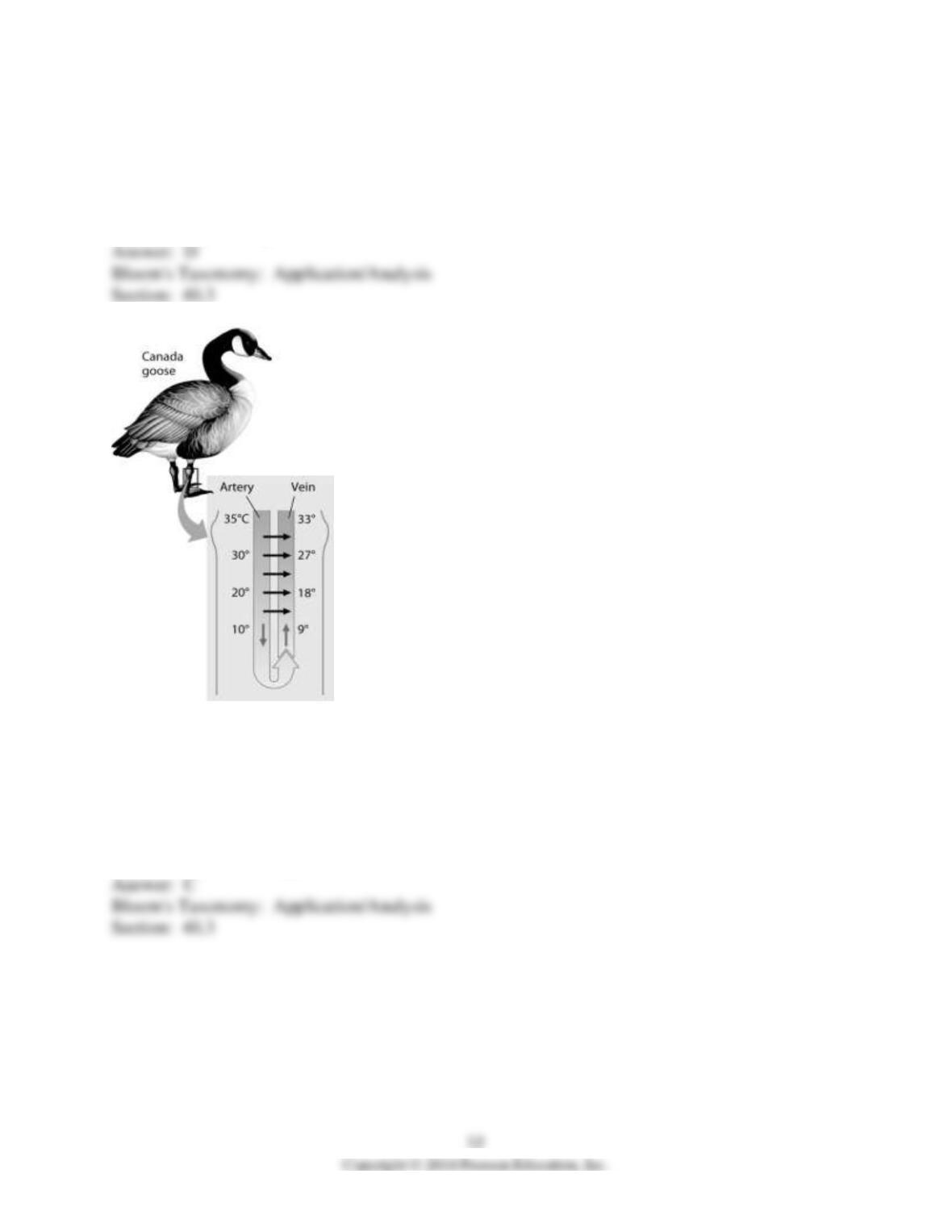
46) The thin horizontal arrows in the figure above show that the _____.
A) warmer arterial blood can bypass the legs as needed, when the legs are too cold to function
well
B) warmer venous blood transfers heat to the cooler arterial blood
C) warmer arterial blood transfers heat to the cooler venous blood
D) arterial blood is always cooler in the abdomen, compared to the temperature of the venous
blood in the feet of the goose
47) Examine the figure above. Near a goose’s abdomen, the countercurrent arrangement of the
arterial and venous blood vessels causes the _____.
A) temperature difference between the contents of the two sets of vessels to be minimized
B) venous blood to be as cold near the abdomen as it is near the feet
C) blood in the feet to be as warm as the blood in the abdomen
D) loss of the maximum possible amount of heat to the environment
48) Which of the following would increase the rate of heat exchange between an animal and its
environment?
A) feathers or fur
B) vasoconstriction
C) wind blowing across the body surface
D) blubber or fat layer
49) You are studying a large tropical reptile that has a high and relatively stable body
temperature. How would you determine whether this animal is an endotherm or an ectotherm?
A) You know from its high and stable body temperature that it must be an endotherm.
B) You know that it is an ectotherm because it is not a bird or mammal.
C) You subject this reptile to various temperatures in the lab and find that its body temperature
and metabolic rate change with the ambient temperature. You conclude that it is an ectotherm.
D) You note that its environment has a high and stable temperature. Because its body
temperature matches the environmental temperature, you conclude that it is an ectotherm.
50) A woman standing and watching the stars on a cool, calm night will lose most of her body
heat by _____.
A) radiation
B) convection
C) conduction
D) evaporation
51) There are advantages and disadvantages to adaptations. Animals that are endothermic are
likely to be at the greatest disadvantage in _____.
A) very cold environments
B) very hot environments
C) environments with a constant food source
D) environments with variable and limited food sources
52) Which principle of heat exchange is the most important explanation for why birds look larger
in colder weather because they fluff their feathers?
A) Fluffing feathers results in less cooling by radiation because feathers emit less infrared
radiation than other tissues do.
B) Fluffing decreases the amount of heat lost by conduction when the bird makes contact with
cold objects in its environment.
C) Fluffing creates a pocket of air near the bird that acts as insulation.
D) Fluffing decreases the surface-area-to-volume ratio, thus decreasing the amount of heat lost to
the environment.
53) Snake behavior in Wisconsin changes throughout the year. For example, a snake is _____.
A) less active in winter because the food supply is decreased
B) less active in winter because it does not need to avoid predators
C) more active in summer because that is the period for mating
D) more active in summer because it can gain body heat by conduction
54) Standard metabolic rate (SMR) and basal metabolic rate (BMR) are _____.
A) used differently: SMR is measured during exercise, whereas BMR is measured at rest
B) used to compare metabolic rates during feeding and other active conditions
C) both measured across a wide range of temperatures for a given species
D) both measured in animals in a resting and fasting state
55) Independent of whether an organism is an endotherm or ectoderm, the LEAST reliable
indicator of an animal’s metabolic rate is the amount of _____.
A) food eaten in one day
B) heat generated in one day
C) oxygen used in mitochondria in one day
D) water consumed in one day
56) Consider the energy budgets for a human, an elephant, a penguin, a mouse, and a snake. The
_____ would have the highest total annual energy expenditure, and the _____ would have the
highest energy expenditure per unit mass.
A) elephant; mouse
B) elephant; human
C) human; penguin
D) mouse; snake
57) An animal’s inputs of energy and materials would exceed its outputs if _____.
A) the animal is an endotherm, which must always take in more energy because of its high
metabolic rate
B) it is actively foraging for food
C) it is hibernating
D) it is growing and increasing its mass
58) Which of the following animals most likely uses the largest percentage of its energy budget
for homeostatic regulation?
A) a marine jelly (an invertebrate) living deep in the ocean
B) a snake in a tropical forest
C) a shark swimming in the open ocean
D) a bird living year round in a desert
59) A researcher is setting up an experiment to measure basal metabolic rate in prairie voles
(Microtus ochrogaster–a small rodent). Which of the following would be the best set of
conditions for the voles immediately before and during the measurement?
A) House the animals in a cage with plenty of food and water to avoid stress; conduct
measurements in a warmer room than the room where housed.
B) House the animals in a cage with plenty of food and water to avoid stress; conduct
measurements in a room the same temperature as the room where housed.
C) House the animals in a cage with no food for a few hours before measurement; conduct
measurements in a colder room than the room where housed, and exercise the voles.
D) House the animals in a cage with no food for a few hours before measurement; conduct
measurements in a room the same temperature as the room where housed.
60) Hummingbirds are small birds that require a regular food supply. When hummingbirds are
faced with a situation that decreases their food supply, such as a storm, which of the following
adaptations would be most useful for the bird to survive such an unpredictable and short-term
absence of food resources?
A) shivering
B) torpor
C) hibernation
D) burrowing into soil
61) Organisms maintain dynamic homeostasis (internal balance) through behavioral and
physiological mechanisms. Which of the following statements is an accurate explanation of a
negative feedback mechanism used by animals to regulate body temperature?
A) Squirrels are able to cool themselves during warmer months by producing more brown fat,
which contains abundant mitochondria and a rich blood supply.
B) Desert jackrabbits have unusually large ears that serve as solar heat collectors to enable them
to maintain their body temperatures.
C) A ground squirrel’s hypothalamus detects changes in environmental temperatures and
responds by activating or suppressing metabolic heat production.
D) A goldfish slows its movements when the water temperature is lower.