1) which of the following pathogens would our innate immunity help protect us
against?
a. viruses
b. bacteria
c. fungi
d. innate immunity would defend us against all of these pathogens.
2) which of the following is not a function of the lymphatic system?
a. produce and distribute lymphocytes.
b. absorb excess tissue fluid and return it to the blood stream.
c. absorb fats and transport them to the bloodstream.
d. all of these are functions of the lymphatic system.
3) what is the function of naturally occurring restriction enzymes in bacterial cells?
a. they are used during dna replication in the bacterial cell.
b. they are used to degrade the bacterial cell’s dna.
c. restriction enzymes recognize and cleave dna molecules that are foreign to the
bacterial cell.
d. these enzymes are used to attach pieces of dna into an opening created by ligase
enzymes.
4) ________ are hormones that act locally, affecting neighboring cells.
a. insulin
b. oxytocin
c. pheromones
d. prostaglandins
e. oxytocin and pheromones are both correct.
5) which of the following is not a role played by biodiversity within an ecosystem?
a. biogeochemical cycling
b. waste recycling
c. water purification
d. prevention of soil erosion
e. all of the choices are roles played by biodiversity.
6) all of the following are true concerning down syndrome except
a. it is caused by autosomal trisomy 21
b. in 23% of cases, the sperm contributes the extra chromosome
c. it is the most common trisomy in humans
d. chances of a woman having a child with down syndrome decreases with her age
incorrect
7) which of the following statements about taxonomy is not true?
a. in cladistics, a common ancestor and all its descendents that share one or more
derived traits are placed in a single clade.
b. analogous structures are derived from a common ancestral structure to perform the
same function.
c. biochemical data and the fossil record can be used independently to indicate the
length of time since two species diverged from a common ancestor.
d. homologous structures are derived from a single structure in the ancestor, although
they may be adapted to different uses in the descendent species (e.g., a dog’s foreleg
and a human’s arm).
8) what is the term used to describe the changes in allele frequencies of a population
over generations?
a. genetic drift
b. founder effect
c. microevolution
d. directional selection
9) an oxygen debt occurs when
a. there is too much oxygen in the muscle tissues.
b. atp is depleted, and the body starts to use creatine phosphate to supply new atp.
c. atp is depleted, and the body starts breaking down actin and myosin to allow muscle
contraction to occur.
d. there is no oxygen for aerobic respiration, and the body must use lactic acid
fermentation to produce atp.
e. none of the choices are correct.
10) in a classic mendelian monohybrid cross between a homozygous dominant parent
and a homozygous recessive parent, which generation is always completely
heterozygous?
a. f1 generation
b. f2 generation
c. f3 generation
d. p generation
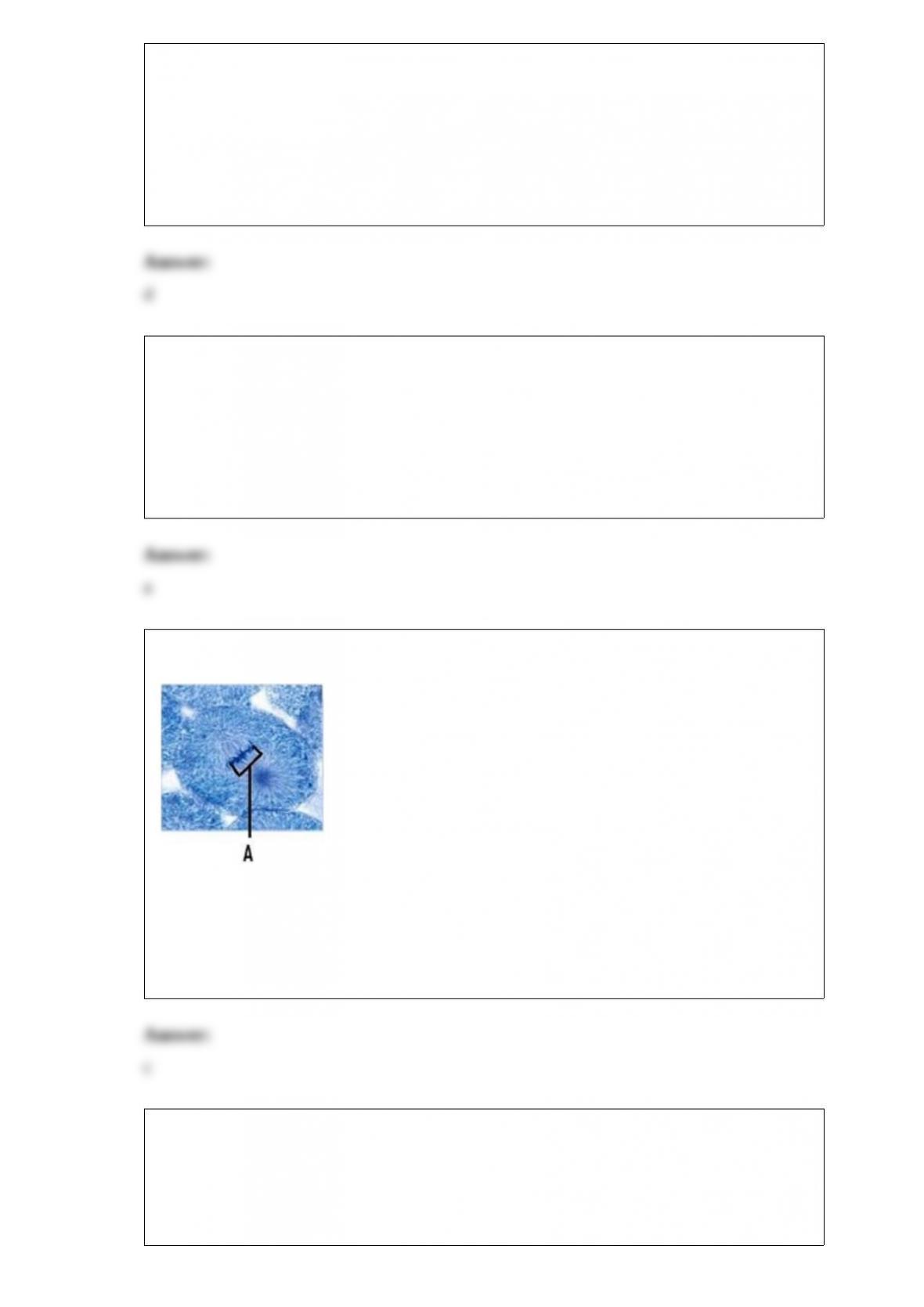
11) what phase of mitosis is pictured?
a. prophase
b. prometaphase
c. metaphase
d. anaphase
e. telophase
12) the event that signals the start of anaphase is
a. division of the centromeres to separate sister chromatids.
b. migration of the centrioles to opposite poles of the nuclear space.
c. a cleavage furrow starts to form.
d. asters disappear.

13) as they flow over rotten logs as a fluid sheet, slime molds appear to lack any
partitioning into individual cells; however, slime molds do become cellular when they
change form to produce spores. the surface of some parasitic flatworms and some insect
tissues are a ‘syncytium” or layer of living material that contains many nuclei and cell
organelles but lacks partitioning by cell membranes. these tissues consume food and
produce wastes. in light of the cell theory that “all living things are composed of cells,”
then
a. these tissues are not living because they are not cellular.
b. these tissues are obviously a bridge between nonliving and primitive living cells.
c. the general concept of life-is-cellular still holds because these organisms are cellular
at specific stages in their life cycle, but this shows that cell membrane partitions can be
abandoned.
d. this proves that a “vital force” beyond cell chemistry can give life to substances.
e. all of the choices are true.
14) seeds require _____________ for germination to occur.
a. oxygen for increased metabolism
b. adequate warmth
c. adequate water
d. all of the choices are required.
15) which of the following ideas was most commonly held in the eighteenth century?
a. evolution by natural selection over time
b. genetic change through mutation
c. the fixity of species
d. changes in a species through adaptation to the environment
16) which mineral is especially important for women to incorporate into their diet if
they are menstruating?
a. aluminum
b. iron
c. magnesium
d. sodium
17) what is the main reason that the field of conservation biology has developed?
a. the current rates of extinction on earth due to human related factors.
b. humans looking for new methods of obtaining resources from the natural
environment.
c. the consolidation of multiple fields of science into one in an attempt to be more
efficient.
d. as a means of monitoring the stability of ecosystems.