
1) an adolescent female who is hyperactive, nervous, irritable and has eyes that are
protruding from their sockets is most likely suffering from ________ which is caused
by ___________.
a. grave’s disease, oversecretion of t3 or t4 due to antibodies that mimic the effect of
tsh.
b. grave’s disease, undersecretion of t3 or t4 due to antibodies that mimic the effect of
tsh.
c. cushings disease, oversecretion of t3 or t4 due to antibodies that mimic the effect of
tsh.
d. grave’s disease, oversecretion of t3 or t4 due to antibodies that mimic the effect of
calcitonin.
e. cushings disease, oversecretion of t3 or t4 due to antibodies that mimic the effect of
parathyroid hormone.
2) _________ is the level of genetic control that involves the processing of early rna
transcripts to mrna and the rate at which mrna leaves the nucleus.
a. feedback control
b. translational control
c. transcriptional control
d. posttranscriptional control
e. posttranslational control
3) the first phase of aerobic cellular respiration is:
a. the citric acid cycle.
b. glycolysis.
c. the electron transport system.
d. fermentation.
e. the preparatory reaction.
4) the greek root words meaning “together” and “fatherland” are the basis for the term
a. prezygotic.
b. adaptive radiation.
c. speciation.
d. allopatric.
e. sympatric.
5) which of the following statements applies to the semiconservative nature of dna
replication?
a. the old strands serve as a template for the new strand.
b. the old strand is pulled apart and reformed into the new strand.
c. the new strand serves asa template for the old strand.
d. none of these statements apply to the semiconservative nature of dna replication.
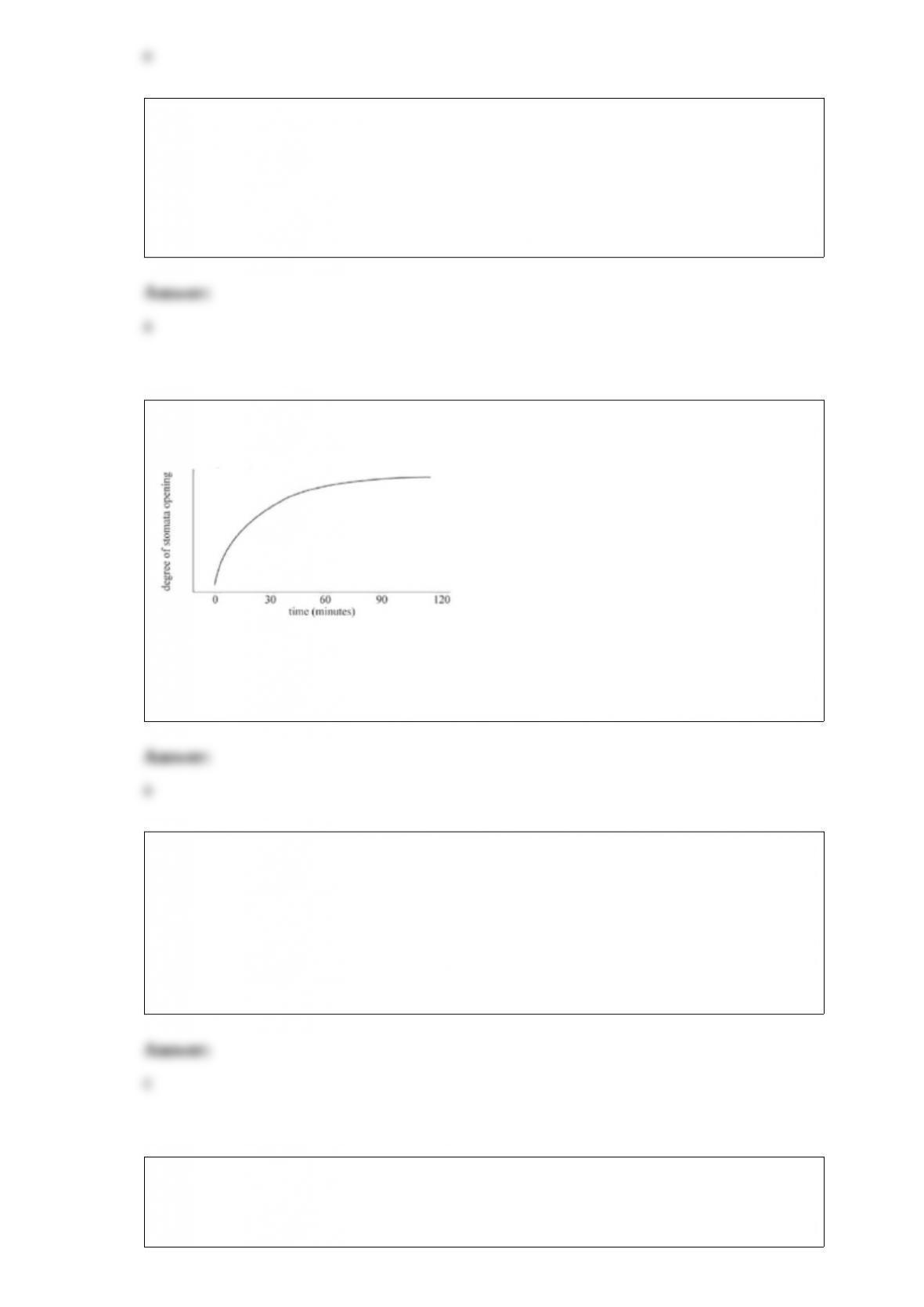
6) stomate opening after illumination following eight hours in darkness: plant is
xanthium pennsylvanicum.
a. supports both hypothesis i and ii.
b. supports only hypothesis i.
c. supports only hypothesis ii.
d. supports neither hypothesis.
7) madagascar is considered a biodiversity “hotspot” because
a. it originated as a volcanic island.
b. it has lost nearly all of its native species to extinction.
c. it contains an unusually high concentration of species.
d. it has resisted habitat destruction that has caused extinctions elsewhere.
e. all of the choices are correct.
8) which statement is not true about the proteins in the plasma membrane?
a. proteins may be attached to the inner surface of the plasma membrane.
b. the hydrophobic portion of a protein is embedded within the membrane.

c. some peripheral proteins are connected to cytoskeletal filaments.
d. integral proteins are responsible for membrane functions.
e. glycoproteins contain carbohydrate chains that are oriented toward the inner surface
of the membrane.
incorrect
9) which of the following characteristics about saprotrophs is not true?
a. they are viruses that infect plant and fungal cells.
b. they are bacteria that decompose large organic molecules.
c. saprotrophs are also called decomposers.
d. they are ecologically important in recycling matter.
10) all the populations of all the different species interacting with one another in the
same environment is called
a. diversity.
b. a community.
c. an ecosystem.
d. predation.
e. symbiosis.
11) starting with the simplest and moving towards more complex, what is the correct
evolutionary sequence of animals in regards to the complexity of their nervous
systems?
a. sponges – hydras – planarians – annelids – molluscs – fish
b. sponges – planarians – hydras – annelids – molluscs – fish
c. hydras – sponges – planarians – annelids – molluscs – fish
d. sponges – hydras – planarians – molluscs – annelids – fish
e. annelids – sponges – hydras – planarians – molluscs – fish
12) what is the correct sequence of events in the lytic cycle of a bacteriophage
infection?

a. attachment, viral dna penetration into host cell, integration of viral dna into host cell
dna, biosythesis, maturation, release
b. endocytosis of virion, uncoating, maturation, and release
c. attachment, fusion of envelope and host cell membrane, biosynthesis, maturation, and
release
d. attachment, viral dna penetration, biosynthesis, maturation and release
13) which statement about plant hormones is not true?
a. plant hormones include at least one form that is a gas.
b. each naturally occurring hormone has a specific chemical structure.
c. hormones are among the principal internal regulators of plant growth.
d. responses to plant hormones may be observed in nearly any part of a plant.
e. all known growth regulators of plants are chemicals produced naturally in plants.
14) the following are differences between amphibians and reptiles except
a. amphibians have smooth non-scaly skin, whereas reptiles are covered with scales and
their skin is dry.
b. all reptiles respire by the use of lungs, while amphibians use small lungs
supplemented by cutaneous respiration.
c. amphibian eggs are laid in water, but reptiles do not require water for reproduction.
d. reptiles are ectothermic, while amphibians are endothermic.
15) ________ prevent hybrid offspring from developing or if the hybrid is born, it is
infertile.
a. prezygotic reproductive isolating mechanisms
b. temporal isolation mechanisms
c. postzygotic isolating mechanisms
d. two of theseare correct.
e. none of the above.

16) human red blood cells can live from two to four months without a nucleus and yet
they continue to synthesize hemoglobin. this
a. means that the necessary mrnas are able to persist all this time.
b. suggests that there is a low level of ribonucleases to degrade the mrna.
c. is a chemical process that does not require continued living pathways. the red blood
cells are essentially dead after they lose their nuclei.
d. all of the choices are true.
e. only two of the choices are correct.
17) the time that it takes for half of a radioactive isotope to change into another stable
element is its
a. activation time.
b. life span.
c. half-life.
d. chemical life cycle.
18) which of the following statements about high energy electrons and nadh is correct?
a. nad+ will capture two electrons and one h+ in order to make nadh.
b. nad+ will capture one electron and two h+ in order to make nadh.
c. nad+ will capture 2 electrons and one h+ in order to make nadph.
d. nad+ does not require electrons or h+ in order to make nadh.
19) in a water molecule,
a. the oxygen atom is more electronegative than the hydrogen atoms.
b. the oxygen atom has an overall negative charge with the hydrogen atoms having an
overall positive charge.
c. unequal sharing of electrons results in a polar molecule.
d. all of the choices are correct.
20) the removal of the anterior pituitary gland would result in all of the following
except

a. a decrease in the body’s ability to lower blood calcium levels.
b. a decrease in the ability to stimulate the adrenal cortex.
c. milk production.
d. production of the sex hormones.