Auditing standards indicate that reasonable assurance is a moderate, but not absolute,
level of assurance that the financial statements are free of material misstatement.
LANs link equipment within a single or small cluster of buildings and are used within a
company.
It is generally impractical for the auditor to obtain complete assurance about the
correctness of each class of transactions.
Most public companies’ audited financial statements are available on the SEC’s
EDGAR database.
The appropriate tests of controls for separation of duties are ordinarily restricted to the
auditor’s observations of activities and discussions with personnel.
CPA firms can establish policy guidelines to help their auditors determine materiality.
While most cycles include at least two classes of transactions, the payroll and personnel
cycle includes only one class of transactions.
As acceptable audit risk is decreased, the likely cost of conducting an audit increases.
Examples of cash equivalents include time deposits, certificates of deposit, and
marketable securities.
If an auditor assigns a tolerable misstatement of $1,000 to accounts payable, he or she
would need to obtain more audit evidence for that account than if $100,000 had been
assigned.
An audit program is the list of audit procedures for an audit area or an entire audit.

An unmodified opinion audit report with an emphasis-of-matter paragraph is issued
when the auditor believes the financials are fairly stated but also believes additional
information should be provided.
When auditors apply MUS to a sample, the sample is selected using random sampling
techniques.
A proof of cash involves a combination of substantive tests of transactions and tests of
details of balances.
When performing price tests for purchased inventory, the auditor would not be
concerned with the most recent vendors’ invoices if the client uses the FIFO valuation
method.
Form 10-K must be filed with the SEC whenever a public company experiences a
significant event.
Financial statement users are normally much more concerned about a disclaimer than
an unmodified opinion audit report that contains an additional-emphasis-of-matter
paragraph.
Imprest accounts usually carry a significant balance.

The unmodified opinion audit report with emphasis-of-matter paragraph does not meet
the criteria of a complete audit with satisfactory results.
Overconfidence is the tendency to put more weight on information that is consistent
with the initial beliefs or preferences.
In a computerized environment, the auditor can often perform substantive tests of
transactions quickly for a large sample of transactions.
For proper internal control, the person(s) responsible for signing the payroll checks
should not have access to timekeeping or be otherwise involved in the preparation of
payroll.
The general balance-related audit objective that deals with determining that details in
the account balance agree with related master file amounts, foot to the total in the
account balance, and agree with the total in the general ledger is the detail tie-in
objective.
When an auditor is verifying quoted market prices, they are concerned about the
balance-related audit objective of accuracy.
Inspection consists of looking at a process or procedure being performed by others.
The effect of a violation of the completeness transaction-related audit objective for cash
disbursements transactions would be an overstatement of cash disbursements.
The primary role of the United States General Accounting Office is the enforcement of
the federal tax laws as defined by Congress and interpreted by the courts.
The profession has developed professional judgment frameworks that illustrate an
effective decision-making process.
Inquiries of clients and recalculations normally have a low cost associated with them.
The approach to auditing patents and copyrights is similar to that used for property,
plant, and equipment accounts.
Only tests of details of balances involve physical examination and confirmation.
Performance materiality is important for verifying current year additions because these
transactions have consistent dollar amounts from year to year.
When preparing a standard inquiry to the client’s attorney letter, the client’s letterhead
should be used, and the letter should be signed by the client company’s officials.
An auditor can use engagement management software to facilitate tracking audit
progress.
When performing a review (SSARS review) of financial statements, the accountant is
required to obtain a letter of representation from management.
The acquisition and payment cycle ends with the receiving of the goods or services.
The choice of which types of tests to use and how extensively they need to be
performed must be the same for all audits.
The most important audit objective for depreciation expense is detail tie-in.
The most important objectives for financial instruments are existence and consistency.

The form that must be completed and filed with the Securities and Exchange
Commission whenever a company experiences a significant event that is of interest to
public investors is the
A) Form S-1.
B) Form 8-K.
C) Form 10-K.
D) Form 10-Q.
Which of the following is not a category of inquiry used by auditors?
A) assessment inquiry
B) declarative inquiry
C) interrogative inquiry
D) informational inquiry

In which situation would the auditor be choosing between “except for” qualified
opinion and an adverse opinion?
A) The auditor lacks independence.
B) A client-imposed scope limitation
C) A circumstance-imposed scope limitation
D) Lack of full disclosure within the footnotes
________ is not a transaction-related audit objective for the classes of transactions
underlying the payroll cycle.
A) Classification
B) Existence
C) Timing
D) Completeness
Which of the following tests of controls is useful to test the transaction-related audit
objective of posting and summarization?

A) Observe whether monthly statements are sent.
B) Observe unrecorded cash at a point in time.
C) Observe whether the accountant reconciles the bank account.
D) Observe endorsement of incoming checks.
Which staff level in a CPA firm performs most of the detailed audit work?
A) partner
B) staff assistant
C) senior auditor
D) senior manager
Which of the following is the primary basis used to decide materiality for a
profit-oriented entity?
A) net sales
B) net assets
C) net income before tax

D) all of the above
The auditor is performing substantive tests of balances for accounts payable. What
documentation would provide the best evidence for the ending balance?
A) vendors’ invoices
B) vendors’ statements
C) receiving reports
D) purchase orders
A tour of the client’s facilities provides the auditor an opportunity to
A) meet key personnel.
B) observe operations.
C) assess physical safeguards over assets.
D) all of the above

The most difficult type of cash embezzlement for auditors to detect is when it occurs
A) after the merchandise has been shipped.
B) before the merchandise has been shipped.
C) before the cash is recorded in the cash receipts journal or other cash listing.
D) after the cash is recorded in the cash receipts journal or other cash listing.
When CPAs are able to maintain their actual independence, it is referred to as
independence in
A) conduct.
B) appearance.
C) fact.
D) total.

As a consequence of his failure to adhere to generally accepted auditing standards in the
course of his examination of the Lamp Corp., Harrison, CPA, did not detect the
embezzlement of a material amount of funds by the company’s controller. As a matter of
common law, to what extent would Harrison be liable to the Lamp Corp. for losses
attributable to the theft?
A) He would have no liability, since the ordinary examination cannot be relied upon to
detect thefts of assets by employees.
B) He would have no liability because privity of contract is lacking.
C) He would be liable for losses attributable to his negligence.
D) He would be liable only if it could be proven that he was grossly negligent.
Which of the following is an accurate statement regarding Rule 10b-5 of the Securities
Exchange Act of 1934?
A) The Supreme Court has ruled that liability under Rule 10b-5 does not extend to
aiders or abettors who participated in financial statement misstatements that were not
the primary defendants.
B) Federal court decisions have clarified that Rule 10b-5 applies only to direct sellers.
C) Hochfelder and subsequent court decisions have increased the liability of auditors
under Rule 10b-5.
D) According to most recent court decisions, poor judgment is proof of fraud.

Collectively, procedures performed to obtain an understanding of the entity and its
environment, including internal controls, represent the auditor’s
A) audit strategy.
B) tests of controls.
C) risk assessment procedures.
D) tests of transactions.
When using the probability threshold for contingencies, the likelihood of the occurrence
of the event is classified as
A) not likely, likely, or highly likely.
B) remote, reasonably possible, or probable.
C) slight, moderate, great.
D) remote, likely, possible.
Match seven of the terms (a-k) with the definitions provided below (1-7):
a. tests of details of balances
b. tests of controls

c. substantive tests of transactions
d. analytical procedures
e. transaction-related audit objectives
f. management assertions
g. balance-related audit objectives
h. fraud
i. illegal act
j. error
k. management fraud
________ 1. an intentional misstatement of the financial statements
________ 2. a set of six audit objectives the auditor must meet, including timing,
posting and summarization, and accuracy
________ 3. implied or expressed representations made by the client about classes of
transactions, account balances and disclosures in the financial statements
________ 4. audit procedures testing for monetary misstatements to determine whether
the balance-related audit objectives have been satisfied for each significant account
balance
________ 5. a set of nine audit objectives the auditor must meet, including
completeness, detail tie-in, and rights and obligations
________ 6. audit procedures designed to test the effectiveness of control policies and
procedures
________ 7. use of comparisons and relationships to assess whether account balances
or other data appears reasonable

The process of transferring money from one bank account to another and improperly
recording the transaction is referred to as
A) kiting.
B) lapping.
C) scamming.
D) embezzling.
The authorization of an issuance of capital stock normally includes all but which of the
following?
A) type of stock to be issued
B) number of shares to be issued
C) date shares are to be issued
D) amount of dividend to be paid on shares issued
The responsibility for adopting sound accounting policies and maintaining adequate
internal control rests with the
A) board of directors.
B) company management.
C) financial statement auditor.
D) company’s internal audit department.
As compared to a financial audit, an operational audit:
A)
B)
C)
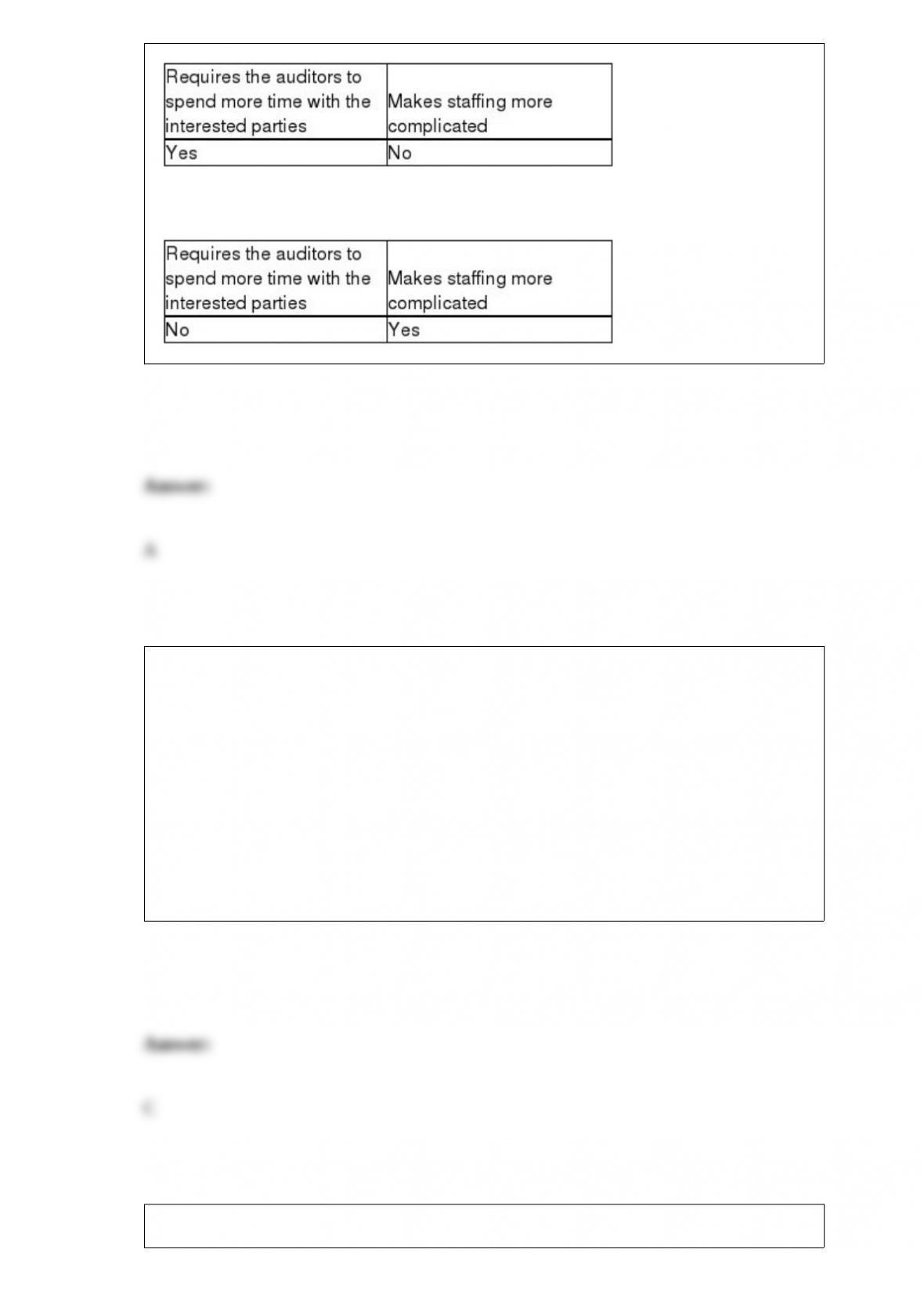
D)
Which of the following questions is the auditor not required to ask company
management when assessing fraud risk?
A) Does management have knowledge of any fraud or suspected fraud within the
company?
B) What is the nature of the fraud risks identified by management?
C) Is management using all assets effectively?
D) What internal controls have been implemented to address the fraud risks?
Which of the following does not have to be considered in determining the initial sample
size of a test of details?
A) tolerable misstatement
B) acceptable risk of incorrect rejection
C) estimate of misstatements in the population
D) inherent risk
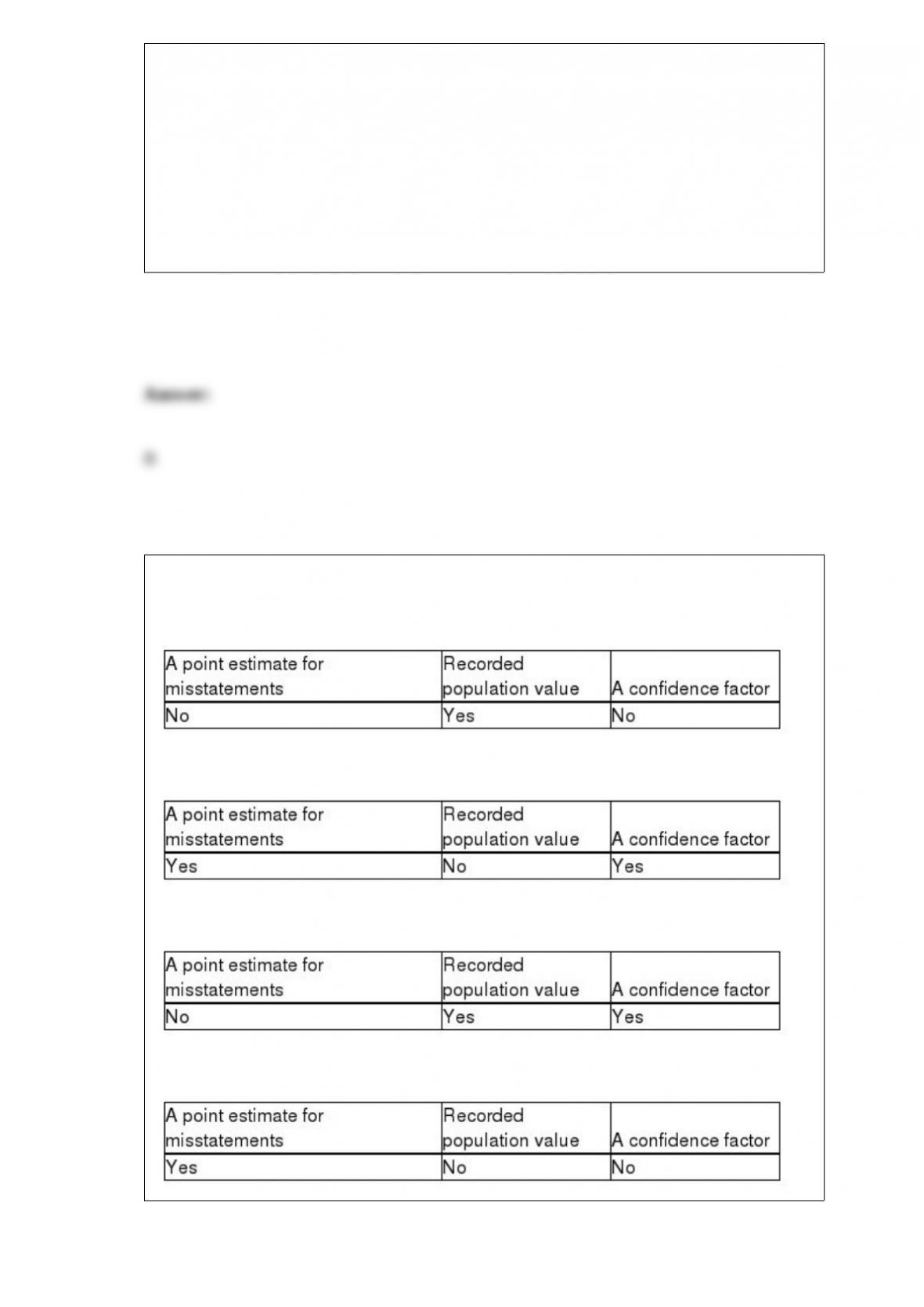
Which of the following item(s) are needed to determine the sample size using MUS?
A)
B)
C)
D)

No individual with access to time cards, payroll records, or checks should also be
permitted access to
A) the computer.
B) job time tickets.
C) personnel records.
D) the canceled check file.
When auditing the payroll and personnel cycle, the auditor should keep in mind that
A) since payroll transactions are typically uniform, all companies have the same
internal controls over payroll.
B) the substantive tests of transactions for the payroll cycle are the same for all audit
clients.
C) controls the auditor intends to rely on to reduce assessed control risk must be tested
with tests of controls.
D) the tests of controls and the substantive tests of transactions for payroll cannot be
combined.

Historically, auditing standards have been organized into three categories, including
A) standards of field work.
B) purpose of an audit.
C) responsibilities of the auditor.
D) proper planning and supervision.
When a physical count of inventory is performed at an interim date, the auditor
observes it at that time and tests the perpetual records for transactions
A) throughout the year.
B) which are a representative sample of the period under audit.
C) from the date of the count to year-end.
D) from the date of the count to the end of the audit field work.

What type of test is used to obtain the most types of evidence?
A) substantive tests of transactions
B) tests of controls
C) risk assessment tests
D) tests of details of balances
By tracing receiving reports issued at and before year-end to vendors’ invoices and
making sure they are included in accounts payable, the auditor is testing for
A) theft of merchandise by employees.
B) unrecorded obligations.
C) lapping.
D) kiting.
When an auditor recomputes the unexpired portion of prepaid insurance, they are
satisfying which audit objective?
A) completeness
B) existence

C) accuracy and detail tie-in
D) rights
________ generally provide the most reliable evidence.
A) Confirmations
B) Recalculations
C) Reperformances
D) Observations
Upon discovering information that indicates a material misstatement due to fraud may
have occurred, auditors should
A) acquire additional evidence as needed.
B) thoroughly probe the issues.
C) consult with other team members.
D) all of the above