If a company is planning to reduce the selling price, they must believe that ________.
A) variable costs will decline as well
B) the fixed costs will cover the lower sales price
C) more units will be sold
D) increased collections will increase income
Carriage Incorporated manufactures horse carriages. The company has two divisions,
Wheels and Assembly. Because of different accounting methods and inflation rates, the
company is considering multiple evaluation measures. The following information is
provided for 2018:
ASSETS INCOME
The company is currently using a 14% required rate of return.
What are Wheels’s and Assembly’s return on investment based on current values,
respectively?
A) 14%; 27%
B) 24%; 22%
C) 22%; 24%
D) 27%; 14%
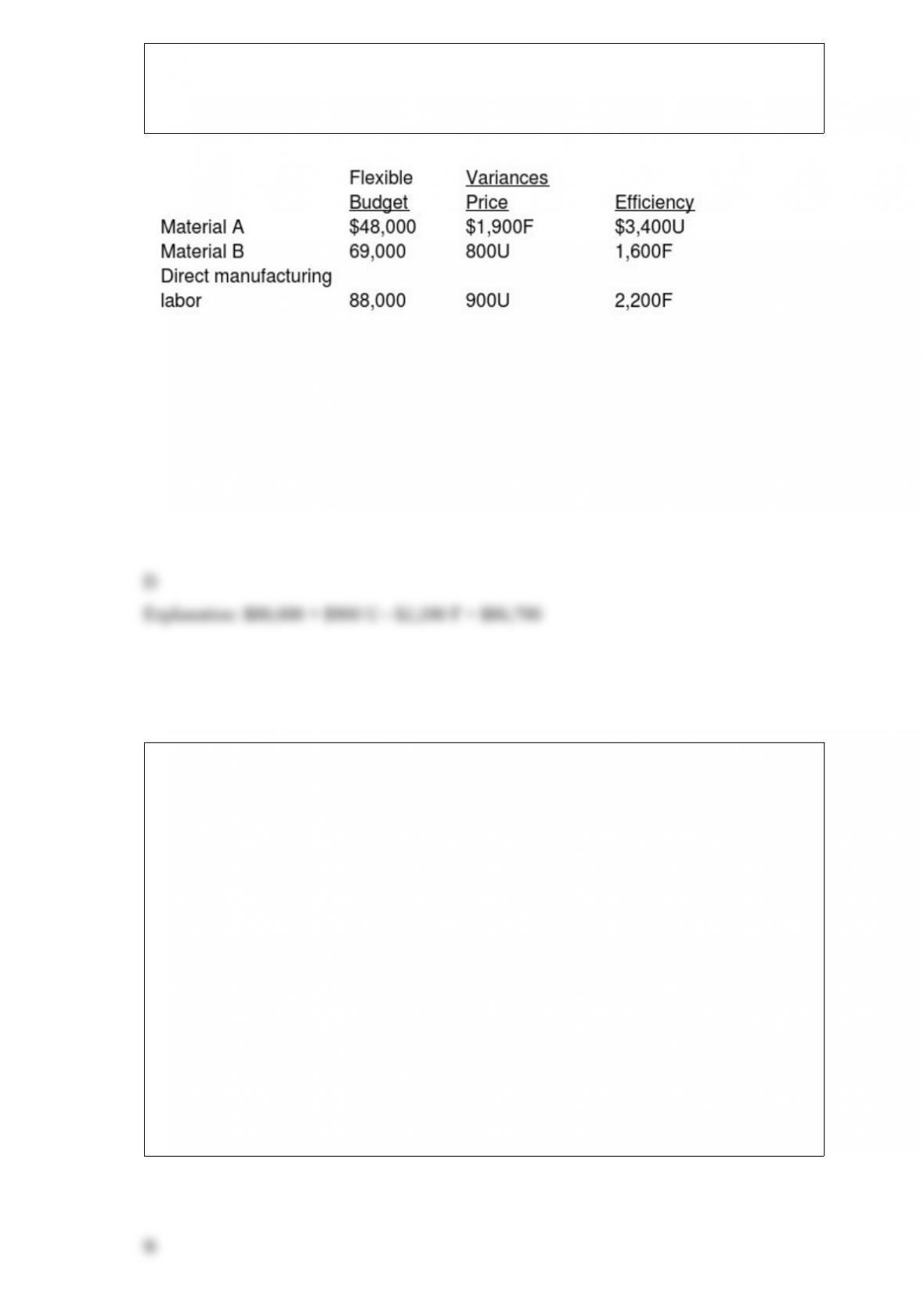
Handley Manufacturing Company has prepared the following flexible budget for
August and is in the process of interpreting the variances. F denotes a favorable
variance and U denotes an unfavorable variance.
The actual amount spent for direct manufacturing labor was ________.
A) $88,000
B) $91,100
C) $89,300
D) $86,700
Timekeeper Corporation has two divisions, Distribution and Manufacturing. The
company’s primary product is high-end watches. Each division’s costs are provided
below:
Manufacturing: Variable costs per unit $1.87
Fixed costs per unit $7.29
Distribution: Variable costs per unit $1.40
Fixed costs per unit $0.60
The Distribution Division has been operating at a capacity of 4,009,000 units a week
and usually purchases 2,004,500 units from the Manufacturing Division and 2,004,500
units from other suppliers at $10.00 per unit.
What is the transfer price per watch from the Manufacturing Division to the
Distribution Division, assuming the method used to place a value on each watch is
170% of variable costs?
A) $1.87
B) $3.18
C) $3.19
D) $8.13
Top management faces a persistent challenge to make sure that the performance
evaluation model of lower level managers is ________.
A) focused on short-term performance
B) based solely on quantitative factors
C) consistent with the decision model
D) based solely on qualitative factors
Home Decor Inc., manufactures home cleaning products. The company has two
divisions, Bleach and Cleanser. Because of different accounting methods and inflation
rates, the company is considering multiple evaluation measures. The following
information is provided for 2018:
ASSETS INCOME
The company is currently using a 15% required rate of return.
What are Bleach’s and Cleanser’s return on investment based on book values, respectively?
A) 29%; 40 %
B) 58%; 36 %
C) 36%; 58%
D) 40%; 29%

Which of the following term is defined as: “the flow of goods, services, and information
from the initial sources of materials and services to the delivery of products to
consumers”?
A) customer list
B) enterprise requirements plan (ERP)
C) material requirements plan (MRP)
D) supply chain
Costing systems measure ________.
A) locked in costs
B) sunk costs
C) cost incurrence
D) out of pocked costs
Annette has been recently promoted to head of her department. She is responsible for
activities that influence revenues and is responsible for controlling the expenses of her
department. She is held responsible for maximizing the profits of the department and to
ensure that the earnings are ploughed back into the business. Annette is most likely to
head a (n) ________.
A) revenue center
B) investment center
C) cost center
D) profit center
Home Decor Inc., manufactures home cleaning products. The company has two
divisions, Bleach and Cleanser. Because of different accounting methods and inflation
rates, the company is considering multiple evaluation measures. The following
information is provided for 2018:
ASSETS INCOME
The company is currently using a 15% required rate of return.
What are Bleach’s and Cleanser’s residual incomes based on book values, respectively?
A) $83,750; $63,500
B) $125,000; $71,750
C) $63,500; $83,750
D) $71,750; $125,000
Which of the following statements is true of strategic analysis of operating income?
A) Management accountants compare budgeted operating performance over two
different periods.
B) Management accountants compare actual and budgeted operating performance over
the same time
periods.
C) Management accountants compare actual operating performance of one year and
budgeted operating performance of another year.
D) Management accountants compare actual operating performance over two different
periods.
Kennywood Inc., a manufacturing firm, is able to produce 1,000 pairs of pants per hour,
at maximum efficiency. There are three eight-hour shifts each day. Due to unavoidable
operating interruptions, production averages 825 units per hour. The plant actually
operates only 27 days per month. Based on the current budget, Kennywood estimates
that it will be able to sell only 503,000 units due to the entry of a competitor with
aggressive marketing capabilities. But the demand is unlikely to be affected in future
and will be around 518,000. Assume the month has 30 days. What is the theoretical
capacity for the month?
A) 222,750 units
B) 720,000 units
C) 534,600 units
D) 648,000 units
For inventory carrying costs, which of the following statements is true of the relevant
opportunity cost of capital of inventory?
A) It is the return received by investing capital in inventory rather than elsewhere.
B) It is calculated as the per-unit costs of carrying inventory divided by the required
rate of return .
C) It is the return foregone by investing capital elsewhere rather than in inventory.
D) It is calculated as the required rate of return multiplied by the per-unit costs of
acquiring inventory including the purchase price, incoming freight, and incoming
inspection.
Genent Industries, Inc. (GII), developed standard costs for direct material and direct
labor. In 2017, GII estimated the following standard costs for one of their major
products, the 30-gallon heavy-duty plastic container.
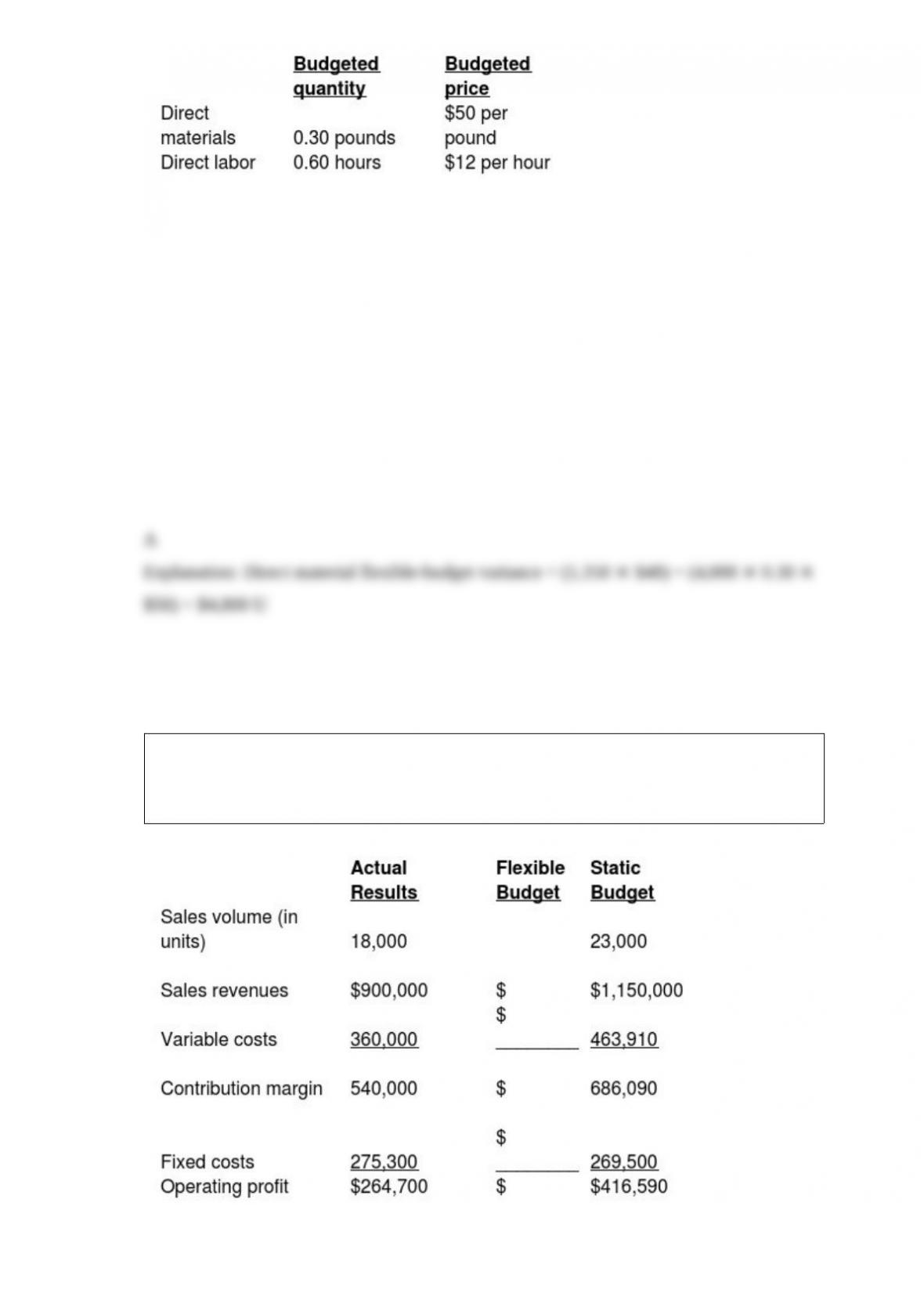
During July, GII produced and sold 4,000 containers using 1,350 pounds of direct
materials at an average cost per pound of $48 and 2,450 direct manufacturing labor hours
at an average wage of $12.25 per hour.
July’s direct material flexible-budget variance is ________.
A) $4,800 unfavorable
B) $7,500 favorable
C) $9,900 unfavorable
D) $0
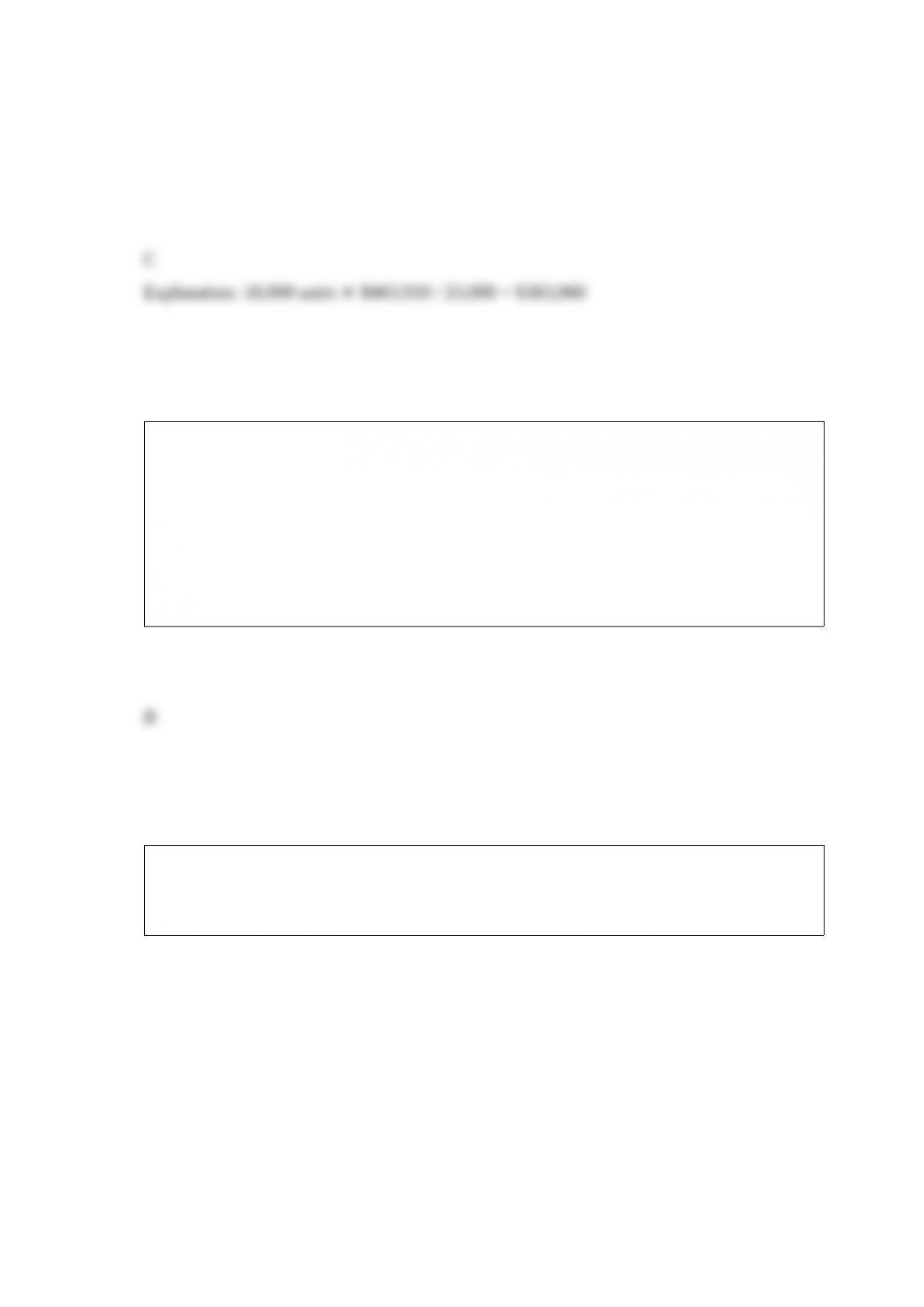
The actual information pertains to the month of June. As a part of the budgeting
process, Great Cabinets Company developed the following static budget for June. Great
Cabinets is in the process of preparing the flexible budget and understanding the results.
The flexible budget will report ________ for variable costs.
A) $592,774
B) $460,000
C) $363,060
D) $463,910
How does the physical-measure method allocate joint costs?
A) allocates joint costs to joint products in a way that each product has an identical
gross-margin percentage
B) allocates joint costs to joint products on the basis of a comparable physical measure
at the split-off point
C) allocates joint costs to joint products on the basis of the relative sales value at the
split-off point
D) allocates joint costs to joint products on the basis of relative NRV
Following a strategy of product differentiation, Izzy’s Limited Company makes a
high-end Appliance, XT15. Izzy’s Limited presents the following data for the years
2017 and 2018:
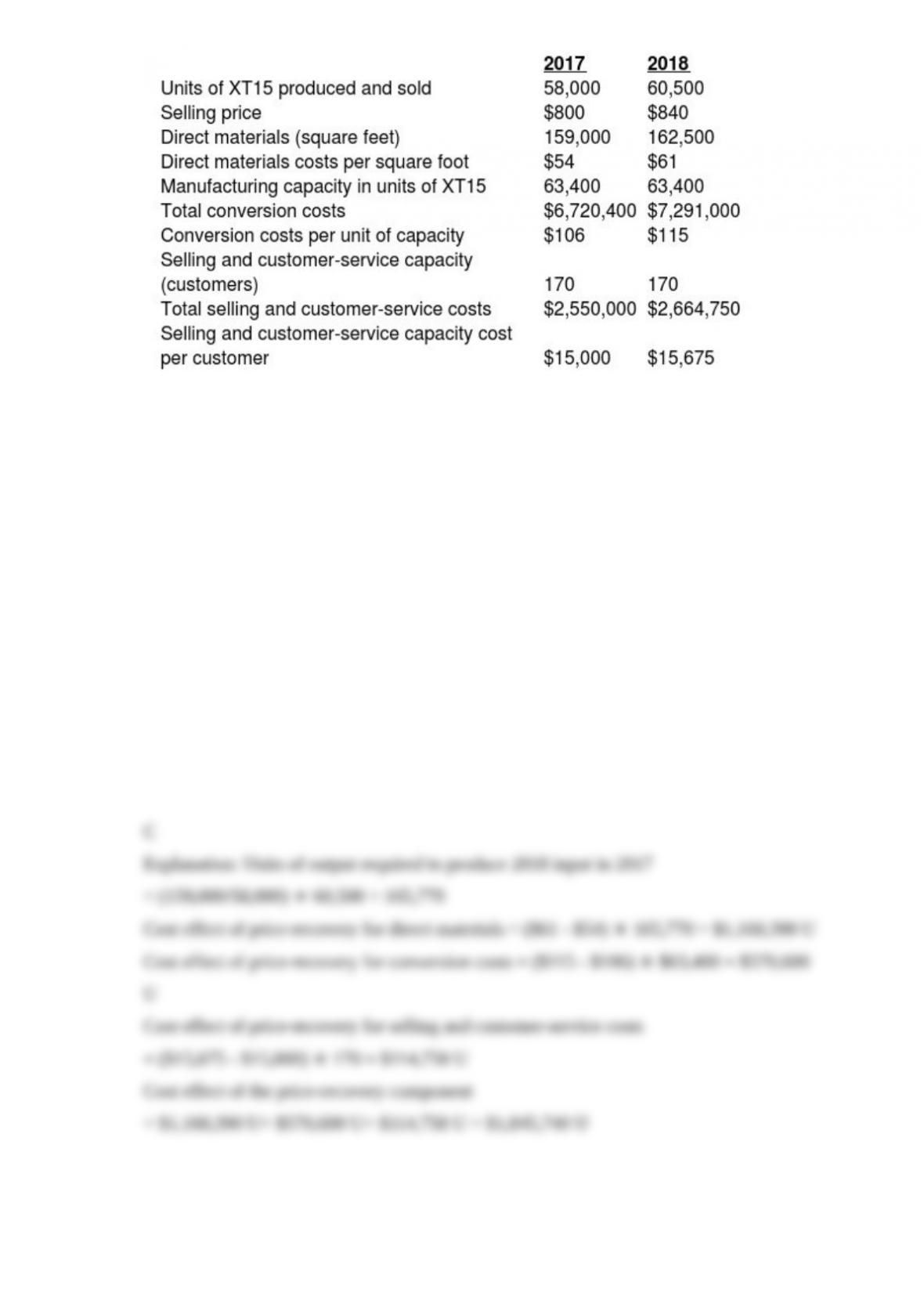
Izzy’s Limited produces no defective units but it wants to reduce direct materials usage per
unit of XT15. Manufacturing conversion costs in each year depend on production capacity
defined in terms of XT15 units that can be produced. Selling and customer-service costs
depend on the number of customers that the customer and service functions are designed to
support. Izzy’s Limited had 155 customers in 2017 and 160 customers in 2018.
What is the cost effect of the price-recovery component? (Round any intermediary
calculations to two decimals and your final answer to the nearest dollar.)
A) $365,580 F
B) $365,580 U
C) $1,845,740 U
D) $1,845,740 F
Examining past performance and exploring alternative ways to make better informed
decisions in the future is ________.
A) control
B) planning
C) learning
D) implementation
Which of the following costs always differ among future alternatives?
A) fixed costs
B) historical costs
C) relevant costs
D) variable costs
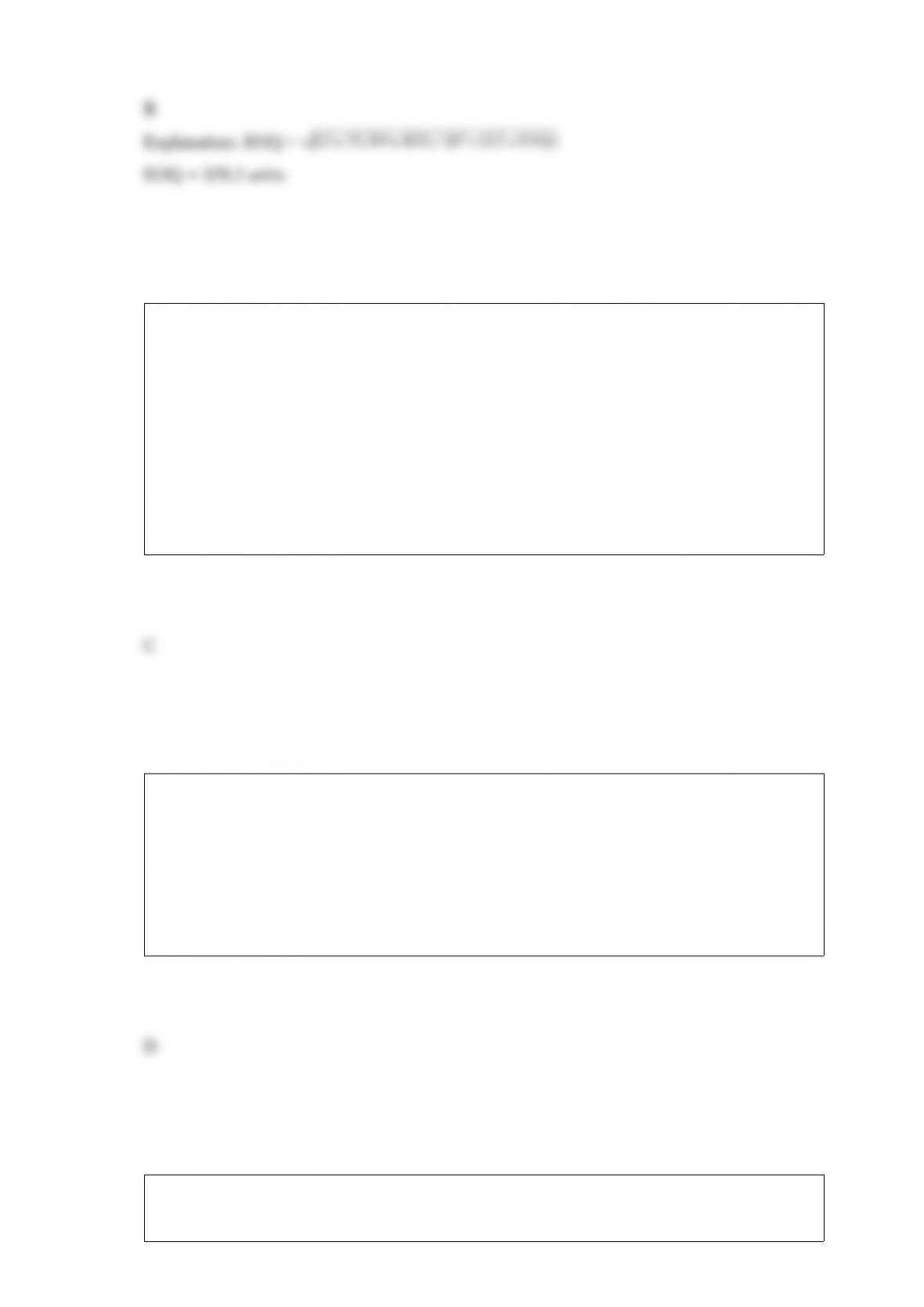
Miniature Company sells stuffed tigers. Birtal Inc. manufactures many different stuffed
animals. Miniature orders 21,200 tigers per year, 22 per week, at $10 per tiger. The
manufacturer covers all shipping costs. Miniature earns 20% on its cash investments.
The purchase-order lead time is 2 weeks. Miniature sells 320 tigers per week. The
following data are available (based on management’s estimates):
What is the economic order quantity using the estimated amounts?
A) 698.3 stuffed tigers
B) 329.2 stuffed tigers
C) 232.8 stuffed tigers
D) 493.8 stuffed tigers
Which of the following most accurately describes the contrast between process and job
costing?
A) In process costing, they include all the factors of production but job costing includes
only materials and labor
B) job costing includes materials, labor and overhead while process costing only
considers conversion costs
C) the main difference is the extent of averaging used to compute the unit costs
D) job costing measures the variable cost of identical jobs while process costing
measures the cost of identical products using average units costs of materials and
conversion costs, some of which are fixed costs
Budgets incorporate managements goals and
A) are a strategic long range plan
B) are both a short range and long range profit plan
C) includes only financial aspects of an operation as those are the only items that can be
quantified in a profit plan
D) express management’s operating and financial plan for a specified period – usually a
fiscal year
In the cash budget, the cash excess (surplus) or deficiency (deficit) is calculated using
which of the following formulas?

A) beginning cash + receipts – disbursements
B) beginning cash + receipts – disbursements – minimum cash balance + loan proceeds
C) beginning cash + receipts – disbursements – minimum cash balance
D) total cash needed – cash disbursements
The sales-quantity variance can be decomposed into ________.
A) sales-mix variance and sales-volume variance
B) static-budget variance and flexible-budget variance
C) flexible-budget variance and sales-volume variance
D) market-share variance and market-size variance
Which of the following best describes customer life-cycle costs?
A) costs incurred by the selling company to satisfy the customer.
B) costs to the customers for buying and using a product.
C) same as the selling life-cycle prices.
D) replacement costs of using a product or service.
The following information applies to Krynton Corp. which supplies microscopes to
laboratories throughout the country. Krynton purchases the microscopes from a
manufacturer which has a reputation for very high quality in its manufacturing
operation.
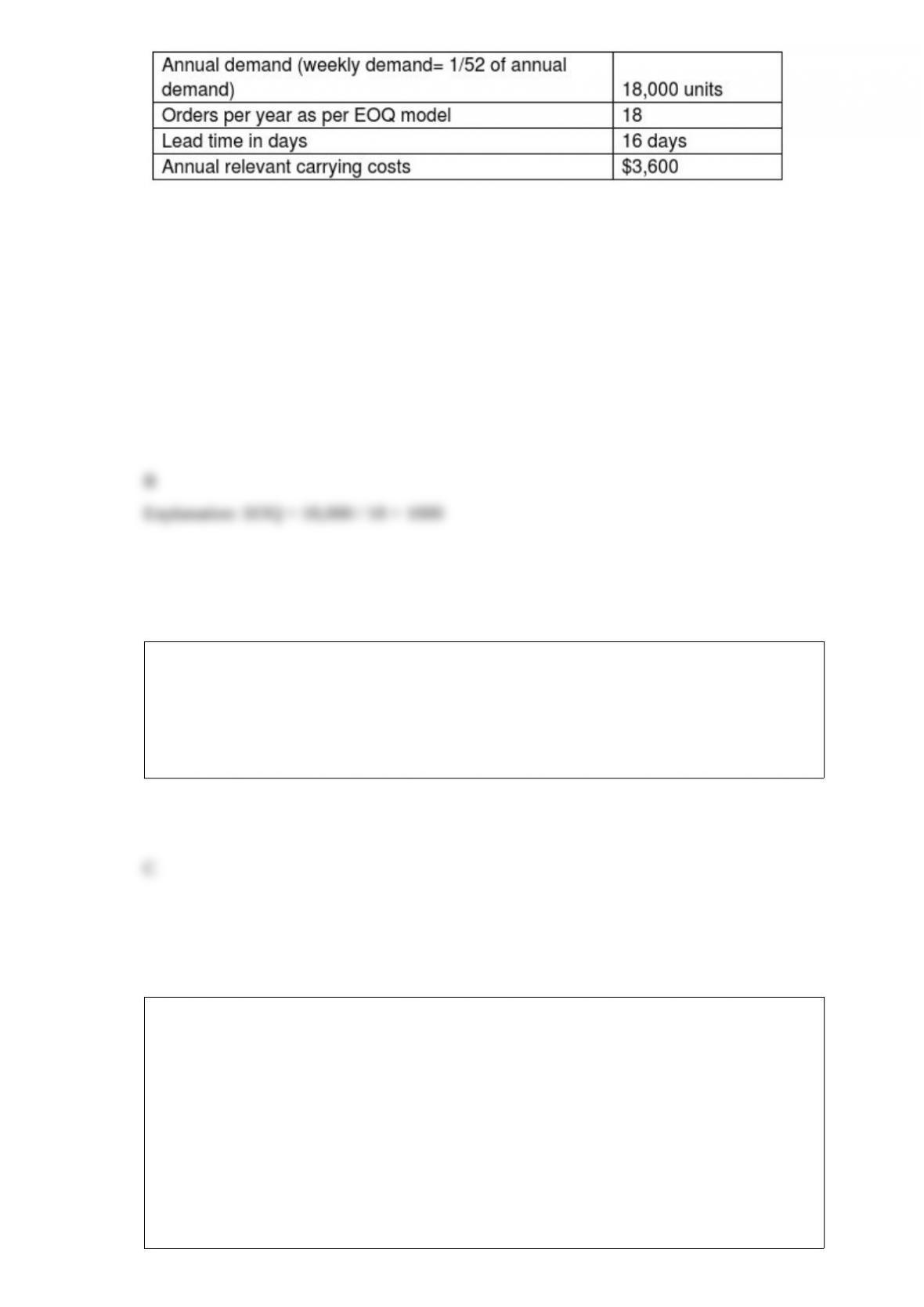
What is the economic order quantity assuming each order was made at the
economic-order-quantity amount?
A) 2057 units
B) 1000 units
C) 1108 units
D) 3200 units
In a flexible budget ________.
A) variable costs are calculated proportionately for the budgeted level of sales
B) fixed costs are calculated proportionately for the actual level of sales
C) fixed costs are kept at the same level of static budget
D) variable costs are kept at the same level of static budget
For each of the following, identify whether it BEST relates to market-based, cost-based,
negotiated, or all types of transfer pricing.
________ a. Bargaining between selling and buying units
________ b. Budgeted costs
________ c. 145% of full costs
________ d. Internal product transfers are required if goods are available internally
________ e. Manufacturing costs plus marketing costs plus distribution costs
plus customer service costs
________ f. Prices listed in a trade journal
________ g. Selling price less normal sales commissions
________ h. Variable manufacturing cost plus a markup
Expo Manufacturing Inc., is in the process of evaluating a new product using the
following information:
∙ A new transformer has three production runs each year, each with $14,000 in setup
costs.
∙ The new transformer incurred $50,000 in development costs and is expected to be
produced over the next three years.
∙ Direct costs of producing the transformers are $55,000 per run of 5100 transformers
each.
∙ Indirect manufacturing costs charged to each run are $55,000.
∙ Destination charges for each transformer average $4.00.
∙ Customer service expenses average $0.20 per transformer.
∙ The transformers are selling for $40 the first year and will increase by $2 each year
thereafter.
∙ Sales units equal production units each year.
What are estimated life-cycle revenues?
A) $612,000
B) $1,254,600
C) $1,897,200
D) $1,927,800
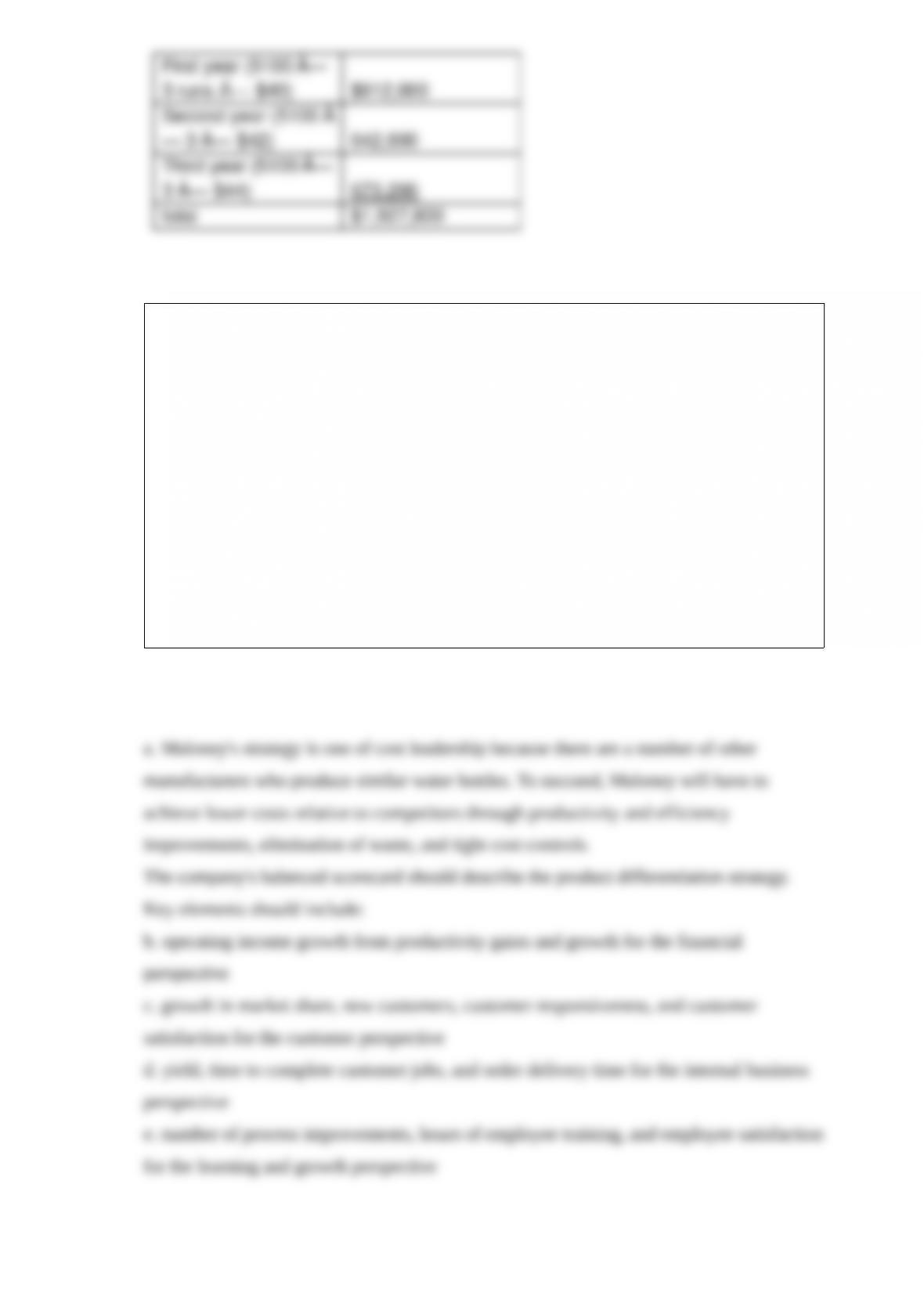
Maloney Corporation manufactures plastic water bottles. It plans to grow by producing
high-quality water bottles at a low cost that are delivered in a timely manner. There are
a number of other manufacturers who produce similar water bottles. Maloney believes
that continuously improving its manufacturing processes and having satisfied
employees are critical to implementing its strategy.
Required:
a. Is Maloney’s strategy one of product differentiation or cost leadership? Explain
briefly.
Identify at least one key element that you would expect to see included in the balanced
scorecard:
b. for the financial perspective.
c. for the customer perspective.
d. for the internal business process perspective.
e. for the learning and growth perspective.
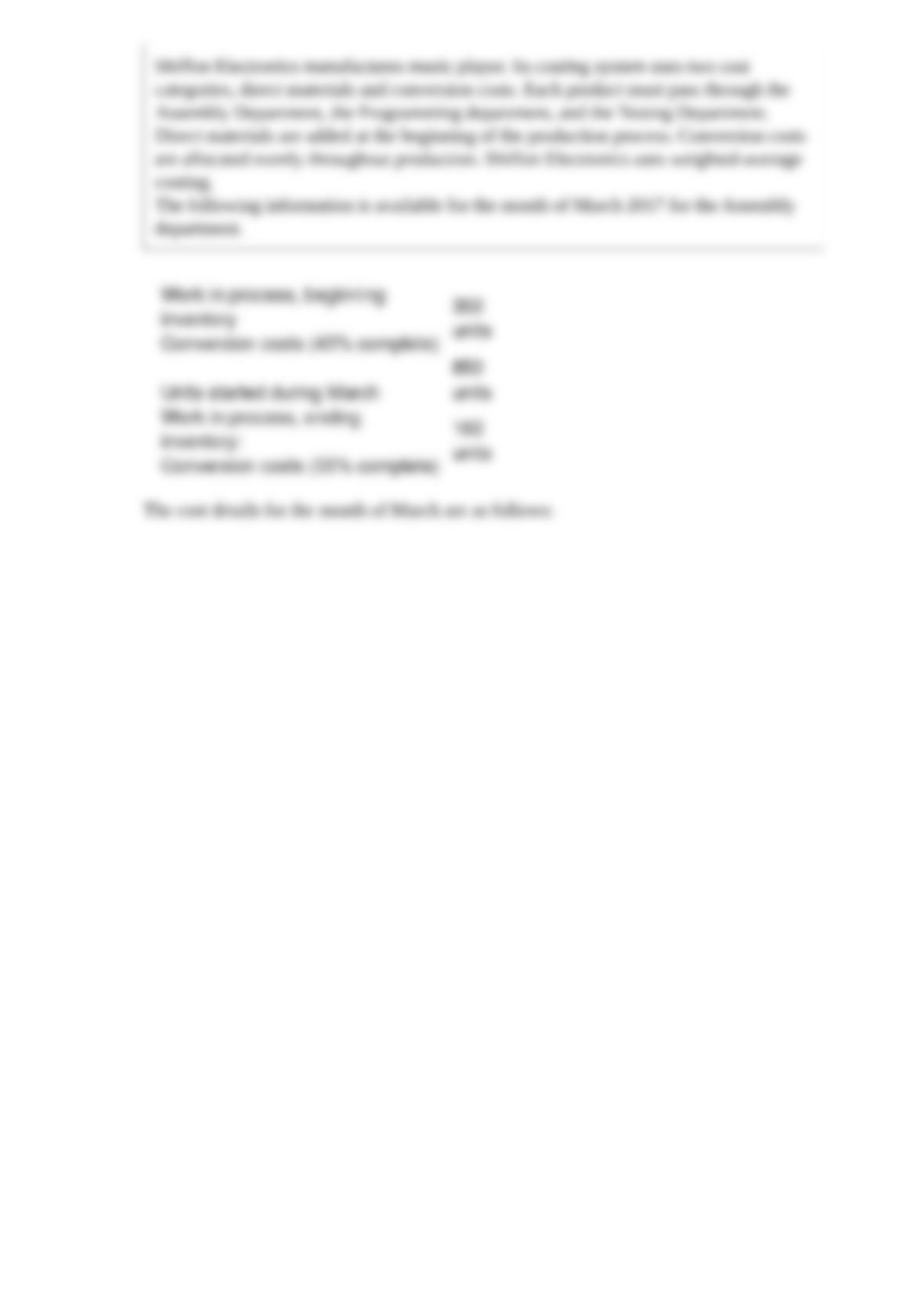
Shiffon Electronics manufactures music player. Its costing system uses two cost
categories, direct materials and conversion costs. Each product must pass through the
Assembly Department, the Programming department, and the Testing Department.
Direct materials are added at the beginning of the production process. Conversion costs
are allocated evenly throughout production. Shiffon Electronics uses weighted-average
costing.
The following information is available for the month of March 2017 for the Assembly
department.
The cost details for the month of March are as follows:
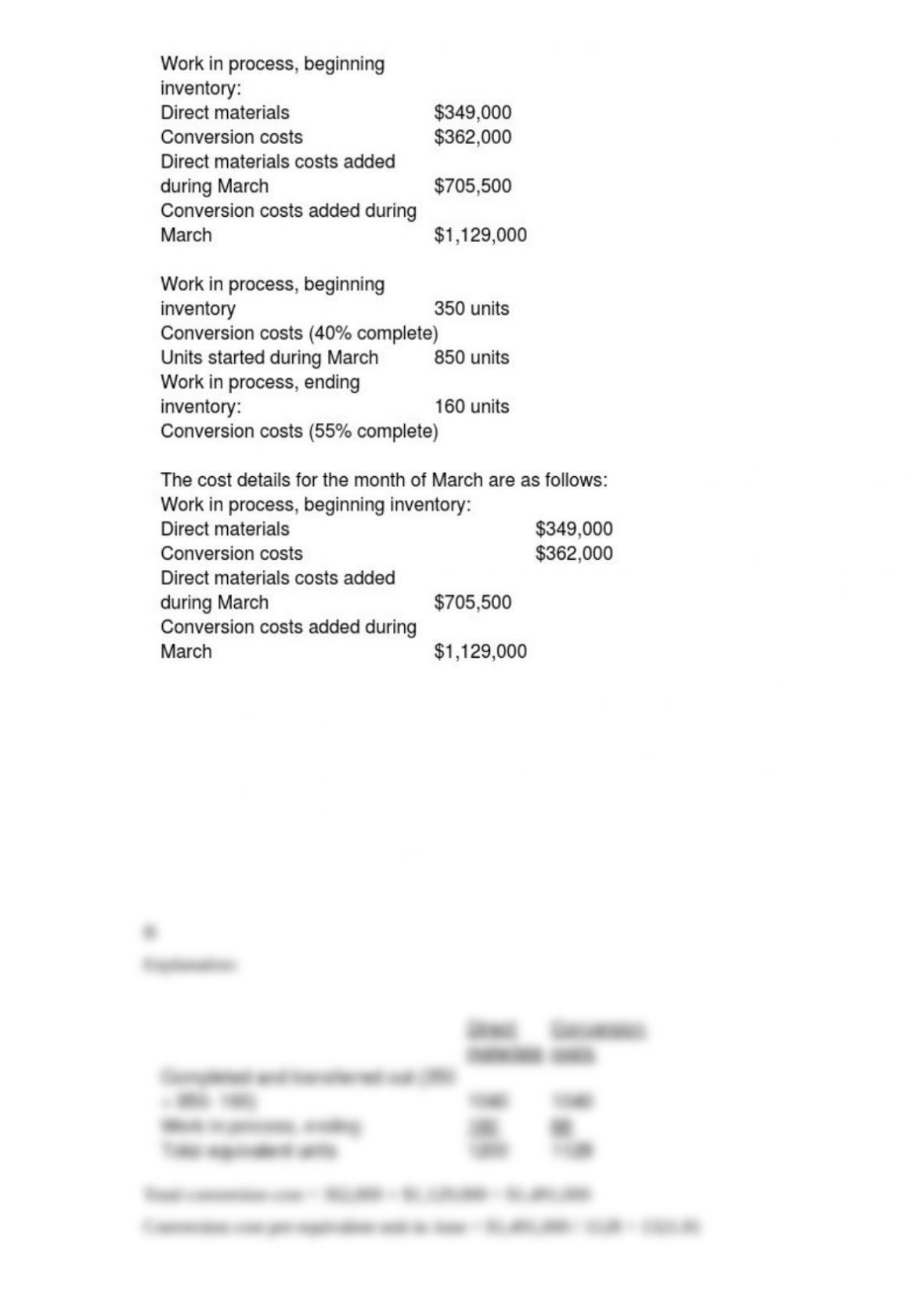
What is the conversion cost per equivalent unit in March? (Round to the nearest cent)
A) $940.83
B) $1321.81
C) $1310.28
D) $1000.89

Opportunity costs is defined as ________.
A) the cost of manufacturing a one-time-only special order when a firm has excess
capacity to make more products
B) the contribution to operating income that is forgone by not using a limited resource
in its next-best alternative use
C) the sum of variable and fixed costs in a particular business function of the value
chain, such as manufacturing costs or marketing costs
D) the sum of variable and fixed costs in all business functions of the value chain, such
as manufacturing costs or marketing costs
Which of the following is not one of the reasons why absorption costing might also be
used for internal reporting?
A) It is more useful for managerial decision making than variable costing
B) It is cost effective and less confusing for managers to use one common method for
both internal and external reporting
C) It can help prevent managers from making decisions that make their performance
look good to the detriment of income reported to shareholders
D) For long-term decision making both variable and fixed costs must be considered for
inventory related decisions